

|
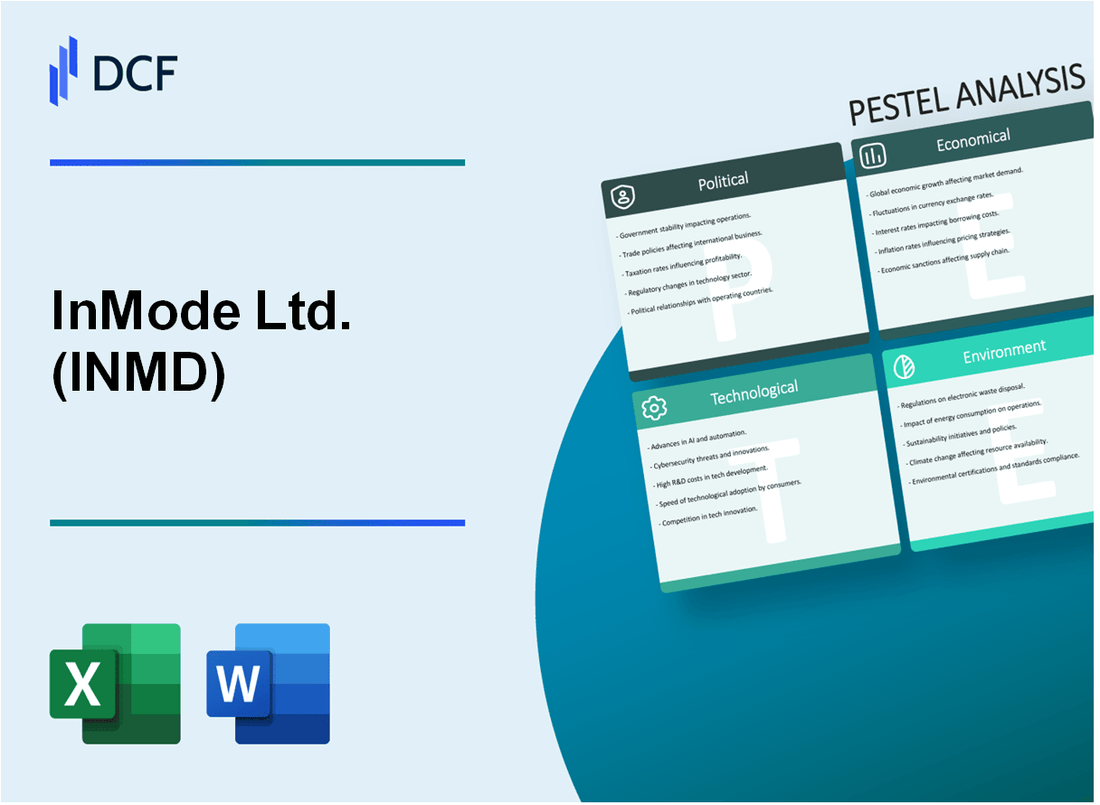
InMode Ltd. (INMD): PESTLE Analysis [Nov-2025 Updated] |
Fully Editable: Tailor To Your Needs In Excel Or Sheets
Professional Design: Trusted, Industry-Standard Templates
Investor-Approved Valuation Models
MAC/PC Compatible, Fully Unlocked
No Expertise Is Needed; Easy To Follow
InMode Ltd. (INMD) Bundle
You're looking for a clear-eyed view of InMode Ltd. (INMD), and the PESTLE framework is defintely the right tool. The direct takeaway is this: InMode's core strength is its proprietary, minimally-invasive technology, but its near-term performance is tied to the macroeconomic cycle and capital spending by aesthetic practices.
Here's the breakdown of the six building blocks, mapping the risks and opportunities as we see them in late 2025.
Honesty, the biggest challenge for InMode right now isn't technology-it's the economy. While the demand for non-surgical treatments is soaring, especially with the aging population, high interest rates above 5.0% are slowing down the clinics that buy their devices. The company is still poised for a solid 2025 with projected revenue around $530 million, but that growth hinges on defending their proprietary Radiofrequency (RF) patents while navigating stricter FDA and environmental regulations. It's a race between innovation and interest rates.
InMode Ltd. (INMD) - PESTLE Analysis: Political factors
FDA and international regulatory approval processes remain complex and costly.
The political landscape for a medical technology company like InMode Ltd. is dominated by regulatory bodies, particularly the U.S. Food and Drug Administration (FDA) and its international counterparts. Honestly, this is a non-negotiable cost of doing business, and it's getting more complex, not simpler. Delays in obtaining clearance for new devices directly impact the revenue timeline.
For example, InMode's strategic expansion into new areas like eye care is dependent on these political gates. The Envision device, aimed at dry-eye and facial treatments, currently lacks full FDA clearance for all its applications, though the existing IPL (Intense Pulsed Light) component can be used under current approvals. The RF (Radiofrequency) component requires specific local approvals, which means a fragmented and slower market entry. You can't sell what you can't clear.
The cost of compliance and the risk of regulatory shifts are constant. If the FDA or foreign bodies change their clearance policies-which they can do at any time-it can increase compliance costs and delay product modifications, directly impairing the company's ability to capitalize on its product pipeline.
Geopolitical tensions can affect global supply chain and manufacturing costs.
InMode's primary manufacturing base is in Israel, which exposes the company to acute geopolitical risk, a factor cited by 58% of businesses as a top supply chain concern in 2025. The ongoing Israel-Hamas war and broader regional instability in the Middle East, including disruptions in vital shipping lanes like the Red Sea and Strait of Hormuz, create immediate operational and financial risks.
These tensions translate directly into higher operating expenses. For instance, the persistent disruption in major shipping routes has forced Asia-Europe routes to detour via the Cape of Good Hope, which has pushed freight rates up by an estimated 150% to 300% in 2025. While InMode maintains a strong balance sheet-ending Q2 2025 with $510.7 million in cash and equivalents-these external shocks erode profitability and make long-range planning defintely harder.
- Geopolitical risk is the top supply chain threat in 2025.
- Freight rates on key routes are up 150%-300% due to regional instability.
- Manufacturing base in Israel creates unique regional exposure.
Shifting import/export tariffs impact the cost of capital equipment sales worldwide.
Changes in international trade policy, particularly U.S. tariffs, hit InMode's gross margins directly because the company exports its capital equipment from Israel to the U.S. The company is currently subjected to a 15% import tariff on its products entering the U.S. from Israel.
The impact of these trade policies is measurable and significant. Management has quantified that the current U.S. tariffs, at a 10% level, are expected to impact the company's gross margins by approximately 2% to 3%. This is a crucial factor when assessing the company's full-year 2025 guidance, which projects revenues between $365 million and $375 million and a Non-GAAP gross margin that remains high, between 78% and 80%. The margin would be even higher without the tariff headwind.
Here's the quick math on the tariff impact on their projected Non-GAAP gross margin:
| Metric | 2025 Full-Year Guidance (Management Estimate) | Impact of U.S. Tariffs (Approximate) |
|---|---|---|
| Projected Revenue | $365M - $375M | N/A |
| Non-GAAP Gross Margin (With Tariffs) | 78% - 80% | N/A |
| Tariff Impact on Gross Margin | N/A | 2% - 3% reduction |
| Estimated Gross Margin (Without Tariffs) | N/A | ~80% - 83% |
Government healthcare spending policies don't directly cover most aesthetic procedures.
The political reality of healthcare spending is a unique opportunity for InMode. Since the company primarily sells capital equipment for elective, cosmetic, and minimally invasive aesthetic procedures, its revenue stream is largely insulated from the political volatility of government healthcare budgets. Most of its procedures are paid for by patients via out-of-pocket spending, not by federal programs like Medicare or Medicaid.
While total U.S. health spending is projected to reach $5.6 trillion in 2025, with Medicare spending alone projected at $942 billion and Medicaid at $656 billion, very little of this massive public expenditure covers aesthetic treatments. This means InMode's business model is not subject to the political risk of Medicare payment cuts or changes to the Medicare Physician Fee Schedule, which are major concerns for traditional medical device companies. The risk shifts from government policy to consumer discretionary income.
Still, the rising cost of traditional healthcare, with total out-of-pocket spending projected to increase through 2033, may reduce the capital available for elective procedures if consumers feel financially stretched. This is a soft political risk, but it's not a direct regulatory threat.
Next Step: Review the Q3 2025 earnings call transcript for management's specific plans to mitigate the 2% to 3% tariff impact.
InMode Ltd. (INMD) - PESTLE Analysis: Economic factors
High Interest Rates Increase Financing Costs
The current high-interest-rate environment in the United States is a significant headwind for InMode Ltd., directly impacting the purchasing power of its primary customers-dermatology and plastic surgery clinics. These clinics often finance the purchase of high-capital aesthetic devices, like the Morpheus8 or EvolveX platforms, through commercial loans or equipment financing.
As of November 2025, the Wall Street Journal Prime Rate-a key benchmark for commercial lending-sits at 7.00%. This baseline translates to actual small business loan rates (SBA 7(a) fixed rates) ranging from 10.00% to 15.00%, depending on the loan size and term. Here's the quick math: a higher rate means a higher monthly payment, which forces clinics to delay or downsize capital expenditure plans.
- Financing costs are up considerably.
- Clinics defer purchasing new equipment.
- Sales cycles for InMode's capital equipment lengthen.
Consumer Discretionary Spending Sensitivity
The aesthetic medical device market is highly sensitive to shifts in consumer discretionary spending (money left over after paying for necessities). Honesty, when people feel uncertain about the economy, non-essential cosmetic procedures are the first things they cut. This is a direct risk to the utilization of InMode's installed base and the recurring revenue from consumables and service contracts.
Management cited 'continued market weakness and persistent uncertainty surrounding the U.S. economic outlook' as a primary reason for lowering its 2025 revenue guidance. This economic caution directly translates to fewer patient bookings for procedures, slowing the return-on-investment (ROI) for clinics that have already purchased InMode's devices.
InMode's 2025 Revenue Projection and Growth Headwinds
The economic slowdown is clearly reflected in the company's financial outlook. InMode's full-year 2025 revenue guidance has been revised downward and now stands between $365 million and $375 million. This is a substantial decline from the $394.8 million reported for the full year 2024, indicating a year of contraction, not growth, in the face of economic pressures.
What this estimate hides is the significant divergence between the U.S. and international markets. The U.S. business is expected to face a decline, while sales outside the U.S. (OUS) are expected to rebound with growth around +23% for the full year 2025. This OUS growth is the defintely bright spot, but it's not enough to offset the domestic slump.
| Metric | Full Year 2024 Actual | Full Year 2025 Guidance (Range) | Year-over-Year Change (Midpoint) |
|---|---|---|---|
| Total Revenue | $394.8 million | $365 million - $375 million | -6.3% |
| Non-GAAP Operating Income | $129.1 million | $93 million - $98 million | -26.4% |
| Non-GAAP EPS | $1.95 (Approx.) | $1.55 - $1.59 | -20.0% |
Strong U.S. Dollar (USD) Currency Risk
InMode is a global company, but the majority of its revenue is generated in the United States. Still, as the company pushes for international expansion, especially in Europe where growth is accelerating, a strong U.S. Dollar (USD) presents a translation risk. When InMode converts revenue earned in foreign currencies (like the Euro or Yen) back into U.S. Dollars for financial reporting, a stronger USD makes that foreign revenue worth less. This negatively impacts reported top-line revenue and operating margins.
The anticipated growth of +23% in OUS sales for 2025 could have been even higher on a constant currency basis. So, while international growth is a key strategy, USD strength acts as a constant, subtle drag on the consolidated financial statements.
InMode Ltd. (INMD) - PESTLE Analysis: Social factors
You're watching a fundamental shift in how people view and approach aesthetics, and it's a powerful tailwind for InMode Ltd. (INMD). The core takeaway is that social acceptance, amplified by digital platforms, has cemented non-surgical treatments as a mainstream wellness choice, not just a luxury option. This is driving massive market expansion, especially in procedures where InMode's technology excels.
Increasing acceptance of non-surgical, minimally-invasive aesthetic treatments drives demand
The stigma around cosmetic enhancement is defintely fading, replaced by a proactive, self-care mindset. People want results without the scalpel or the long recovery time. This preference for non-surgical, minimally-invasive aesthetic treatments (MIAT) is the engine of the market. The global non-invasive aesthetic treatment market is valued at an estimated $22.67 billion in 2025, with some forecasts projecting an even higher valuation, and is expected to grow at a Compound Annual Growth Rate (CAGR) of up to 9.9% through 2034.
This market segment now holds the highest share of the total aesthetic medicine market, accounting for approximately 52%, with a projected CAGR of 12.39% through 2032.
Here's the quick math on the market's shift toward MIAT:
- Non-invasive procedures: Account for 52% of the total aesthetic market.
- Device market share: Non-invasive and minimally invasive devices contributed over 78% of the body contouring devices market share in 2024.
- Patient preference: Less risk, less downtime, and quicker results are fueling adoption across all age groups.
Aging populations in key markets seek anti-aging solutions, expanding the customer base
The demographic reality of an aging population in key markets like the US is a structural driver of demand. Globally, the number of people aged 60 and older is expected to grow by 56% to 1.4 billion by 2030, and they are actively seeking solutions that align with their extended working and social lives.
Also, the patient pool is getting younger. Facelift patients aged 35 to 55 have risen to as high as 32% of all facelift patients, seeking 'early-intervention' procedures.
A new, near-term social trend is the rise of GLP-1 weight-loss medications (like Ozempic). Nearly half of facial plastic surgeons reported a surge in patients in 2025 seeking procedures to counteract the resulting facial volume loss and skin laxity-often called 'Ozempic face.' InMode's radiofrequency (RF) skin-tightening technology, which addresses laxity, is perfectly positioned to capture this new, high-growth segment.
Social media and digital platforms accelerate awareness and demand for specific procedures (e.g., Morpheus8)
Social media is the new word-of-mouth for aesthetics. Digital platforms accelerate awareness and drive specific product demand, turning procedures into recognizable brand names. InMode's Morpheus8 is a prime example; celebrity endorsements and high social media visibility have amplified its popularity.
This digital buzz translates directly to the bottom line. Morpheus8 is a key contributor to InMode's financial performance, helping drive the company's Q2 2025 quarterly revenue of $95.6 million and contributing to gross margins as high as 80%.
The 2025 digital environment favors short-form video (TikTok, Instagram Reels) and hyper-personalized, authentic content. This means brands must focus on real, genuine results and targeted messaging, moving away from overly polished, generic ads.
| Social Media Impact on Aesthetic Demand (2025) | Metric/Trend | Value/Observation |
|---|---|---|
| InMode Revenue Driver | Q2 2025 Quarterly Revenue (INMD) | $95.6 million |
| Key Product Margin Contribution | Morpheus8 Gross Margin Contribution | Up to 80% |
| Content Preference | Dominant Content Format | Short-form video (Reels, TikTok) |
| Marketing Shift | Consumer Preference | Authenticity and hyper-personalization |
Growing focus on wellness and body contouring, moving beyond just facial aesthetics
The consumer focus has broadened from just the face to a comprehensive wellness and body contouring framework. This shift is critical for InMode, whose technology is highly versatile. The global body contouring devices market is a significant opportunity, projected to grow from $1.89 billion in 2025 to $3.15 billion by 2032, at a CAGR of 11.60%.
Non-invasive devices are leading this growth, expected to hold a 42.1% share of the body sculpting market in 2025. InMode's Morpheus8 Deep attachment is specifically designed to capitalize on this, delivering radiofrequency energy up to 8mm deep to target adipose tissue for body remodeling. Body contouring is no longer just for post-pregnancy or post-massive weight loss; it's part of a general fitness and aesthetic routine.
The demand is also expanding to male patients, who are increasingly seeking aesthetic treatments, with 92% of facial plastic surgeons reporting seeing male patients in their practices.
InMode Ltd. (INMD) - PESTLE Analysis: Technological factors
Proprietary Radiofrequency (RF) technology allows for superior skin tightening and fat coagulation.
InMode Ltd. maintains a strong market position anchored by its proprietary Radiofrequency (RF) technologies, notably the AccuTite, FaceTite, and BodyTite platforms. These platforms use minimally invasive applicators to deliver RF energy subdermally, allowing for targeted fat coagulation and skin contraction. This approach offers a significant advantage over traditional surgical procedures, driving adoption among practitioners and patients seeking less downtime.
The core technological differentiator is the ability to monitor and control temperature in real-time. For instance, the company's Morpheus8 technology, which combines microneedling with RF, has seen massive uptake. The precision of these systems allows for consistent, repeatable results, which is a key factor in the aesthetic market.
Here is a quick look at the technological focus areas:
- RF Energy Delivery: Precise, subdermal energy for targeted tissue remodeling.
- Temperature Monitoring: Real-time feedback for enhanced safety and efficacy.
- Minimally Invasive: Reduced patient downtime compared to surgery.
Rapid R&D cycles require continuous investment to maintain a competitive edge.
Maintaining technological leadership in the energy-based aesthetic device sector is expensive and demanding. InMode Ltd. must commit substantial capital to Research and Development (R&D) to refresh its product line and secure new intellectual property (IP). For the 2025 fiscal year, the company's R&D expenditure is estimated to be around $40 million to $50 million, reflecting an ongoing commitment to innovation. This is a crucial investment, as product life cycles in this industry are often short.
Here's the quick math: If R&D is approximately 8% to 10% of the projected 2025 annual revenue, every 1% increase in R&D spend translates to a multi-million dollar commitment. To be fair, this aggressive spending is necessary to keep their technology ahead of the curve, but it places pressure on operating margins.
The focus is not just on new platforms but also on improving existing handpieces and treatment protocols to expand the addressable market for current customers.
Competitors are quickly developing similar energy-based platforms, increasing market saturation.
The success of InMode Ltd.'s minimally invasive RF technology has attracted aggressive competition. Companies like Cynosure, Candela, and Solta Medical (a division of Bausch Health) are rapidly introducing their own energy-based platforms that directly compete with InMode's core offerings. This competitive pressure is a near-term risk.
For example, while InMode has Morpheus8, competitors have launched similar fractional RF microneedling systems. This market saturation is putting downward pressure on average selling prices (ASPs) for new systems. In 2025, the competitive landscape is segmented by technology type:
| Competitor | Competing Technology/Platform | InMode Ltd. Equivalent |
|---|---|---|
| Cynosure | Potenza (RF Microneedling) | Morpheus8 |
| Candela | Profound (RF Microneedling) | Morpheus8 |
| Solta Medical (Bausch Health) | Thermage (Non-invasive RF) | EmbraceRF (Non-invasive) |
The continuous introduction of new, similar devices means that InMode Ltd. must defintely accelerate its product refresh cycle just to maintain its current market share of approximately 15% to 20% in the minimally invasive aesthetic device segment.
Integration of AI and machine learning for personalized treatment protocols is the next frontier.
The future of aesthetic technology lies in the integration of Artificial Intelligence (AI) and machine learning (ML) to create personalized treatment protocols. This is the next frontier for InMode Ltd. and its rivals. AI can analyze patient-specific data-skin type, fat density, age, and desired outcomes-to optimize energy delivery settings, minimizing side effects while maximizing efficacy.
InMode Ltd. is investing in data collection from its installed base of over 15,000 systems globally to feed ML algorithms. The goal is to move from standardized protocols to dynamic, patient-specific treatments. This shift will help practitioners achieve better, more predictable results, which in turn drives patient satisfaction and repeat business.
The concrete next step: Technology team: pilot AI-driven protocol optimization on the Morpheus8 platform by the end of Q1 2026.
InMode Ltd. (INMD) - PESTLE Analysis: Legal factors
Intellectual property (IP) protection, especially patents on RF technology, is critical for market defense.
Protecting the core Radiofrequency (RF) technology is defintely a high-stakes legal priority for InMode Ltd. Their business model hinges on proprietary, minimally invasive devices, so their intellectual property (IP) portfolio acts as a primary market defense against competitors. The company relies on a combination of patent, trademark, and copyright laws to shield its technology.
As of 2025, InMode holds a modest portfolio of around 22 patents, which is foundational for future innovation but not extensive when compared to larger medical device firms. This means they must be vigilant about defending these specific patents, particularly those covering their RF-assisted lipolysis and deep subdermal fractional RF technologies. A single successful IP challenge could erode their competitive moat and force product redesigns, which is a massive risk.
Increasing risk of class action lawsuits related to device efficacy or patient safety.
The company faces a significant near-term legal risk from ongoing litigation, specifically a shareholder class action lawsuit. This isn't just a nuisance; it speaks to the core of their operational compliance. The amended complaint in this case was filed as recently as January 31, 2025. The core allegations are serious and focus on misrepresentations and regulatory non-compliance, not just stock price movement. The court did dismiss most of the claims, but allowed for a replead as of November 5, 2025, keeping the issue alive.
The specific claims in the lawsuit highlight two critical legal vulnerabilities you need to track:
- Off-Label Marketing: Allegations that InMode violated U.S. Food and Drug Administration (FDA) regulations by promoting products for treatments that lack FDA approval.
- Injury Reporting: Claims the company failed to timely report injuries caused by its devices to the FDA, which is a mandatory regulatory requirement.
Here's the quick math on the potential financial impact: while the final cost is unknown, the legal expenses alone weigh on earnings. For context, InMode reported Q3 2025 revenues of $93.2 million, down from the prior year, so any significant legal settlement would hit the bottom line hard, especially with a revised full-year 2025 revenue guidance of $365 million to $375 million.
Strict adherence to data privacy regulations (e.g., HIPAA in the US) for patient data handling.
Operating in the medical device space means handling sensitive patient data, which puts InMode squarely under the purview of strict data privacy laws globally. In the U.S., the Health Insurance Portability and Accountability Act (HIPAA) governs patient health information, and the California Consumer Privacy Act (CCPA) regulates consumer data. Plus, as an Israeli company, they must also comply with the Israeli Protection of Privacy Law of 1981.
Compliance here is non-negotiable. A breach or a failure to comply with established protocols could result in significant fines and reputational damage. The risk is compounded by the fact that InMode's devices are used in a variety of clinical settings, increasing the touchpoints for data collection. Honesty, the cost of a robust data security framework is minimal compared to the liability from a single major HIPAA violation.
| Regulation | Jurisdiction | Key Compliance Requirement for InMode |
|---|---|---|
| HIPAA | United States | Protecting electronic Protected Health Information (ePHI) and ensuring security safeguards. |
| CCPA/CPRA | California, US | Providing consumers with rights over their personal information (e.g., right to know, delete, opt-out). |
| Israeli Protection of Privacy Law of 1981 | Israel (Headquarters) | Regulating the collection, use, and security of personal data, including medical records. |
Regulatory bodies (FDA, EU MDR) are increasing post-market surveillance requirements.
Regulatory oversight is tightening globally, requiring a more proactive approach to device monitoring after a product hits the market. The U.S. FDA and the European Union Medical Device Regulation (EU MDR) are the two big players driving this change. The EU MDR, in particular, has introduced a far more rigorous, lifecycle-oriented framework.
For InMode, this means moving beyond passive incident reporting to active, systematic data gathering. The full compliance deadline for many aspects of the EU MDR was effectively May 2024, making 2025 a year of full enforcement and scrutiny. This requires increased investment in quality management systems (QMS) and clinical follow-up studies.
The increased requirements translate to clear operational actions:
- Post-Market Surveillance (PMS) Plan: Must be actively and systematically executed to gather real-world data on quality and safety.
- Periodic Safety Update Report (PSUR): Requires regular, in-depth reporting of the risk-benefit profile for each device.
- Post-Market Clinical Follow-up (PMCF): Budgeting for more clinical studies to confirm the long-term safety and performance of their RF devices.
This shift adds to the company's operating costs, but it's a necessary investment to maintain market access, especially in the profitable European market. If they fail to meet these new standards, they risk losing the CE Mark, which is the stamp of approval for the EU. That would be a catastrophic loss of revenue.
InMode Ltd. (INMD) - PESTLE Analysis: Environmental factors
Focus on reducing waste from single-use disposable treatment tips and accessories.
The core of InMode Ltd.'s business model, particularly for popular platforms like Morpheus8, creates a significant environmental challenge: the reliance on single-use disposable treatment tips and accessories. These tips, which carry the regulatory symbol for 'Do not reuse/single use only', are a direct and continuous waste stream for every procedure performed globally.
This is not a minor revenue stream; it is a major driver of the company's financial performance. In the third quarter of 2025 alone, InMode reported revenues from consumables and service of $19.9 million, representing a 26% increase compared to the same period in 2024. This growth in consumables revenue directly correlates to an escalating volume of non-reusable plastic and electronic waste that is generated at the point of care, creating a sustainability liability that is growing alongside sales.
The industry needs to defintely shift toward multi-use or fully biodegradable components. Until then, InMode must invest in clear, quantifiable programs for tip take-back and specialized recycling, or face increasing scrutiny on its 'circular economy' credentials.
Energy consumption of high-powered aesthetic devices is a growing sustainability concern.
The energy demand of high-powered Radio-Frequency (RF) aesthetic devices is an overlooked environmental factor. While individual treatment times might be short (often 30-60 minutes), the aggregate power consumption across a global installed base of thousands of systems like Morpheus8 is substantial.
A single Morpheus8 system, for instance, operates on a power cord inlet rated for 100-240V~, 15A, 50-60Hz. Here's the quick math: at maximum draw, the system can pull up to 3.6 kW (240V 15A). This high power requirement, necessary to deliver the deep fractional RF energy, translates into a higher operational carbon footprint for the medical practices that use the equipment.
The industry needs to see a move toward more energy-efficient RF delivery systems or better power management features. Lowering the power draw without sacrificing clinical efficacy is a clear opportunity for innovation and a strong ESG selling point.
Investor and public pressure for transparent ESG (Environmental, Social, Governance) reporting.
Institutional investors, including major asset managers, are increasingly integrating ESG factors into their valuation models. This is no longer a peripheral issue; it's a financial one. Companies that lack transparent, quantitative ESG disclosures face a higher cost of capital and potential divestment risk.
In the medical technology sector, pressure focuses on two main areas:
- Scope 3 Emissions: Tracking and reducing the environmental impact of downstream product use, specifically the disposal of those single-use tips.
- Governance Integration: Ensuring the Board of Directors has direct oversight of environmental targets, moving beyond simple compliance to strategic sustainability.
The absence of a publicly available, dedicated InMode ESG report with verifiable metrics on waste weight or energy use by the end of 2025 is a material risk. It suggests a gap in transparency that the market will eventually price in, especially given the high-volume disposable nature of the business.
Compliance with global regulations on hazardous materials in electronic device manufacturing.
Compliance with global regulations like the European Union's Restriction of Hazardous Substances (RoHS) and Waste Electrical and Electronic Equipment (WEEE) Directives is non-negotiable for market access. For medical device manufacturers like InMode, the regulatory landscape is tightening in 2025.
What this estimate hides is the complexity of medical device exemptions. Multiple exemptions under the EU RoHS Annex III and Annex IV, including those for Category 8 (medical devices), are set to expire in 2025 and are under review. A failure to secure renewal for a key exemption could force a costly redesign of a core platform.
Also, the new China RoHS standard, GB 26572-2025, was published on August 1, 2025, with a mandatory compliance date of August 1, 2027. This dictates a significant overhaul of material declarations and labelling for all electronic products entering the massive Chinese market.
Here is a quick view of the key environmental metrics and regulatory risks:
| Environmental Factor | 2025 Financial/Technical Metric | Near-Term Risk/Opportunity |
|---|---|---|
| Single-Use Waste Volume | Q3 2025 Consumables Revenue: $19.9 million | Risk: Increasing public scrutiny over landfill impact of single-use tips. |
| Device Energy Consumption | Morpheus8 Max Power Draw: 3.6 kW (240V, 15A) | Opportunity: Develop and market a next-gen platform with a 25% lower average power draw. |
| Hazardous Material Compliance | EU RoHS Category 8 Exemptions: Expiring/Under Review in 2025 | Risk: Loss of a critical EU RoHS exemption could force an expensive and time-consuming product redesign. |
Finance: draft a 13-week cash view by Friday to model the cost and inventory impact of a potential redesign if a key EU RoHS exemption is not renewed.
Disclaimer
All information, articles, and product details provided on this website are for general informational and educational purposes only. We do not claim any ownership over, nor do we intend to infringe upon, any trademarks, copyrights, logos, brand names, or other intellectual property mentioned or depicted on this site. Such intellectual property remains the property of its respective owners, and any references here are made solely for identification or informational purposes, without implying any affiliation, endorsement, or partnership.
We make no representations or warranties, express or implied, regarding the accuracy, completeness, or suitability of any content or products presented. Nothing on this website should be construed as legal, tax, investment, financial, medical, or other professional advice. In addition, no part of this site—including articles or product references—constitutes a solicitation, recommendation, endorsement, advertisement, or offer to buy or sell any securities, franchises, or other financial instruments, particularly in jurisdictions where such activity would be unlawful.
All content is of a general nature and may not address the specific circumstances of any individual or entity. It is not a substitute for professional advice or services. Any actions you take based on the information provided here are strictly at your own risk. You accept full responsibility for any decisions or outcomes arising from your use of this website and agree to release us from any liability in connection with your use of, or reliance upon, the content or products found herein.