
|
Intel Corporation (INTC): BCG Matrix [Dec-2025 Updated] |
Fully Editable: Tailor To Your Needs In Excel Or Sheets
Professional Design: Trusted, Industry-Standard Templates
Investor-Approved Valuation Models
MAC/PC Compatible, Fully Unlocked
No Expertise Is Needed; Easy To Follow
Intel Corporation (INTC) Bundle
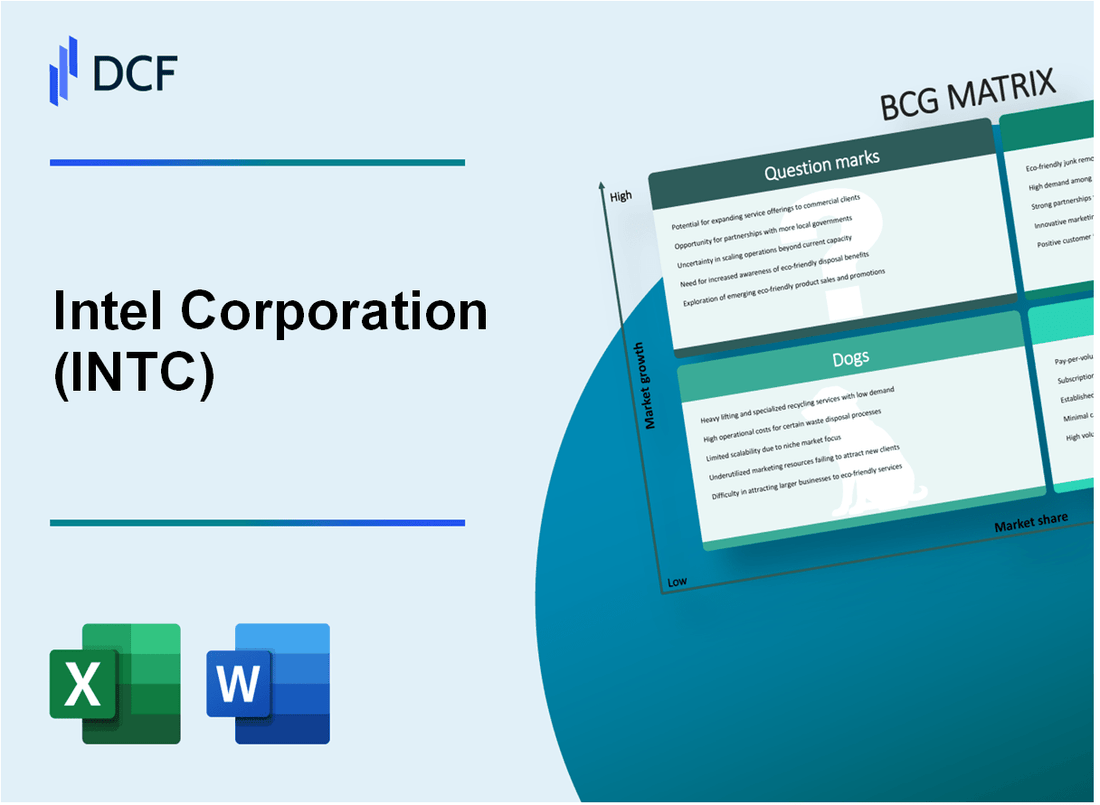
You're trying to make sense of Intel Corporation's complex portfolio as of late 2025, so here's the distilled view: the company is running a high-stakes game of resource allocation, clearly spotlighting Mobileye as the Star with projected growth between 12% to 14%, while the Client Computing Group acts as the steady Cash Cow, posting $8.5 billion in Q3 revenue. Still, the real tension lies with the Question Marks, where Intel Foundry Services is absorbing a massive $3.2 billion operating loss to chase process leadership, even as they divest low-growth Dogs like the spun-off Network and Edge Group. Keep reading to see the precise breakdown of where Intel is investing its future and what's just paying the bills.
Background of Intel Corporation (INTC)
You're looking at Intel Corporation (INTC) right as it's trying to execute a massive turnaround, and the numbers from late 2025 really tell the story of that pivot. Intel Corporation, founded way back in 1968, is the semiconductor giant that built its name designing and manufacturing CPUs and related components for both business and consumer markets. Honestly, the last few years have been tough, marked by a steep decline in market share, but the recent results show some real operational shifts under the new leadership of CEO Lieu Chen, who joined in March 2025.
Let's look at the most concrete data we have, which is the third-quarter 2025 performance. Intel posted total revenue of $13.7 billion, which was a 3% increase year-over-year. That top-line growth was paired with a significant return to profitability; the company reported a GAAP net income of $4.06 billion, a massive swing from the $16.6 billion loss it posted in the third quarter of 2024. The non-GAAP diluted Earnings Per Share (EPS) hit $0.23, a huge improvement from the -$0.46 reported in the prior-year period. This operational success was defintely helped by strategic government support.
The margin story is perhaps the most striking operational positive from Q3 2025. The non-GAAP gross margin shot up to 40.0%, which is more than double the 18.0% seen in Q3 2024. Furthermore, operating income turned positive at $683 million, compared to a staggering $9.1 billion loss in the same quarter last year. This improved efficiency is part of a broader cost-cutting initiative, with Intel targeting 2025 operating expenses at $17 billion.
When we break down the business units for Q3 2025, the Client Computing Group (CCG), which handles PC chips, brought in $8.5 billion, marking a 5% year-over-year rise, likely helped by AI PC demand. However, the Data Center and AI (DCAI) segment reported revenue of $4.1 billion, which was actually down 1% year-over-year, suggesting they still have significant ground to gain against rivals in the core server and AI accelerator space. The company also secured $5.7 billion of the $8.9 billion in funding from the U.S. Government to support manufacturing expansion.
Intel's foundry ambition, Intel Foundry Services (IFS), remains the biggest strategic challenge. While the company is betting heavily on process nodes like 18A, which started risk production in April 2025, external revenue projections for the full calendar year 2025 are estimated to be a mere $120 million, a figure 1,000 times lower than its main competitor. To put Intel's competitive standing in perspective, a Q1 2025 research note showed its processor market share had slumped to 65.3%, its weakest position since 2002, with rivals like AMD holding 21.1%.
Intel Corporation (INTC) - BCG Matrix: Stars
Mobileye (MBLY) is positioned as the clear Star within Intel Corporation's portfolio, characterized by high market growth in the Advanced Driver-Assistance Systems (ADAS) sector and strong relative market share. This unit is a primary focus for investment to secure future market leadership.
Mobileye (MBLY) is the clear Star with projected 2025 revenue growth of 12% to 14%. This upward revision in guidance reflects strong execution in the core ADAS business. For instance, Q3 2025 revenue reached $504 million, marking a 4% year-over-year increase, driven by an 8% rise in EyeQ chip shipments over the same period. The full-year 2025 revenue outlook is projected to be between $1,845 million to $1,885 million.
The unit maintains a dominant market share in the high-growth Advanced Driver-Assistance Systems (ADAS) sector, which is a key driver for its Star classification. The company's ADAS business is highly cash generative, with net cash from operations reaching $489 million for the first nine months of 2025, representing an approximate 150% year-over-year increase.
Strong EyeQ chip volumes and new SuperVision program wins drive momentum. The full-year 2025 outlook for EyeQ volumes was raised to a range of 35 million to 35.5 million units. Furthermore, SuperVision volume surpassed 20,000 units in Q3 2025, with the full-year expectation now set at approximately 50,000 units at the midpoint.
High-growth autonomous vehicle technology requires continued investment to maintain share. The company is actively developing next-generation technology, citing the receipt of first silicon samples for the EyeQ7 high chip. This necessitates significant capital deployment to sustain leadership against emerging competitors.
Here's a quick look at some key 2025 financial and volume metrics for Mobileye:
| Metric | Value | Period/Context |
| Projected 2025 Revenue Growth | 12% to 14% | Full Year 2025 Outlook |
| Q3 2025 Revenue | $504 million | Quarterly Result |
| Projected 2025 EyeQ Volume (Midpoint) | 35.25 million units | Full Year Outlook (using midpoint of 35.0M and 35.5M) |
| Q3 2025 EyeQ Volume | 9.2 million units | Quarterly Result |
| Projected 2025 SuperVision Volume (Midpoint) | 50,000 units | Full Year Outlook |
| Year-to-Date Operating Cash Flow | $489 million | First Nine Months of 2025 |
Key operational highlights supporting the Star status include:
- EyeQ volume growth of 8% in Q3 2025 outpacing vehicle production growth of 1% among top 10 customers.
- Securing a Surround ADAS design win with Volkswagen.
- Receiving confirmation for a high-volume EyeQ6 high-based surround ADAS program with a leading Western OEM.
- Q1 2025 systems shipped rose to 8.5 million from 3.6 million a year ago.
Intel Corporation (INTC) - BCG Matrix: Cash Cows
You're looking at the core engine of Intel Corporation's current financial stability, the Client Computing Group (CCG). This segment is the quintessential Cash Cow because it commands a high market share in a mature PC CPU market, meaning it doesn't require massive, speculative investment to maintain its position. In fact, CCG was the bedrock of the company's financial results in the third quarter of 2025, representing 62.5% of Intel Corporation's consolidated revenue mix for the period.
The numbers from the third quarter of 2025 clearly show this segment's strength in generating profit margins, which is what turns market share into actual cash flow. We see this in the segment's reported revenue and profitability metrics, which you can review here:
| Metric | Value (Q3 2025) | Year-over-Year Change |
| CCG Revenue | $8.5 billion | 5% |
| CCG Operating Income | Approximately $2.7 billion | Not specified |
| CCG Operating Margin | 31.6% | Not specified |
This performance is what the scenario describes: high market share in a mature space leading to high profit margins. The segment benefits from the ongoing Windows 11 refresh cycle and the initial ramp of AI PC adoption, which drove higher average selling prices (ASPs) due to a deliberate shift in capacity toward higher-margin models like Arrow Lake and Lunar Lake. Still, Intel Corporation's Trailing Twelve Months (TTM) Free Cash Flow as of September 2025 was negative at $-8,418 Million, which underscores exactly why the reliable cash generation from CCG is so vital.
That cash flow is the lifeblood for the rest of the enterprise. It's the pool used to fund the high-risk, high-growth Question Marks-like the Intel Foundry Services expansion-and to cover corporate overhead. The strategy here is to 'milk' the gains passively while making targeted infrastructure investments to improve efficiency, not to pour money into aggressive market share battles in this specific segment. Here's a quick look at the financial context:
- CCG revenue concentration in Q3 2025: 62.5%.
- Total Intel Corporation revenue (Q3 2025): $13.7 billion.
- Non-GAAP operating expenses target for full-year 2025: approximately $17 billion.
- Gross capital expenditures target for full-year 2025: $18 billion.
Finance: draft a sensitivity analysis on CCG margin impact if ASPs drop by 3% next quarter.
Intel Corporation (INTC) - BCG Matrix: Dogs
You're looking at the parts of Intel Corporation that, despite their scale, aren't driving the growth or market leadership the company needs right now. These are the Dogs in the BCG framework: low market share in markets that aren't expanding quickly, tying up capital that should be fueling the core x86 and AI roadmap. Honestly, expensive turn-around plans for these units rarely pay off, which is why Intel is choosing divestiture.
The primary candidates for this quadrant, based on recent strategic moves under CEO Lip-Bu Tan, are the Network and Edge Group (NEX) and the recently divested Altera unit. These segments represent a necessary shedding of non-core assets to reduce operational complexity and cost, a clear signal that Intel is exiting anything not essential to its primary ambitions.
The Network and Edge Group (NEX) was officially announced to be spun off in 2025, seeking external strategic investors while Intel retains an anchor stake, much like the previous Altera transaction. This move is emblematic of the broader philosophy shift: Intel is streamlining to innovate faster in its core chip business. The segment had low growth, reporting only 1% year-over-year (YoY) revenue increase for the full year 2024, even though the fourth quarter saw a stronger 10% YoY jump.
Here's a quick look at the financial profile of these units that are being divested or separated to free up capital. The math shows why these units are candidates for divestiture: they consume focus without delivering star-level returns.
| Metric | Network and Edge Group (NEX) (2024) | Altera (2024) |
|---|---|---|
| Annual Revenue | $5.8 billion | $1.54 billion |
| Revenue as % of Intel Total (2024) | 11% (of $53.1 billion total revenue) | Included in 'all other' category; deconsolidated post-spin-off |
| YoY Revenue Growth (Full Year) | 1% | Performance struggle noted by revenue decline from 2014 levels |
| Operating Income/Loss (Reported) | $931 million operating income (implied 16% margin) | $35 million non-GAAP operating income |
| GAAP Operating Income/Loss | Not explicitly stated for 2024 separation | ($615 million) operating loss |
| Divestiture/Spin-off Action | Announced spin-off in 2025 | 51% stake sold to Silver Lake in April 2025 |
| Divestiture Valuation | Seeking strategic investors; no final valuation yet | Enterprise value set at $8.75 billion |
The divestiture of non-core assets like NEX and Altera directly supports the goal of reducing operational complexity and cost, which is critical as Intel targets $17 billion in cost reductions for 2025. The move allows Intel to concentrate resources, including R&D spending, on its most critical paths. The company is shedding these units to focus capital on the x86 and AI roadmap, where it aims to regain process leadership with nodes like 18A.
The strategic rationale involves a significant workforce realignment as well. Intel is reducing its global headcount, aiming to end 2025 with approximately 75,000 employees, down from 99,500 in 2024. This focus on efficiency is paramount.
The units categorized as Dogs share common characteristics that align with the BCG model:
- Network and Edge Group (NEX) was spun off in 2025 to streamline core operations.
- The segment had low growth, reporting only 1% YoY revenue increase in 2024.
- Divestiture of non-core assets like NEX and Altera reduces operational complexity and cost.
- Intel is shedding these units to focus capital on the x86 and AI roadmap.
For Altera, the situation was stark; its 2024 revenue of $1.54 billion and non-GAAP operating income of only $35 million stood in sharp contrast to its 2015 acquisition price of $16.7 billion. The sale of a majority stake for an $8.75 billion valuation clearly marks it as a unit Intel needed to move on from to preserve capital for core technology development.
Finance: draft 13-week cash view by Friday.
Intel Corporation (INTC) - BCG Matrix: Question Marks
You're looking at the riskiest, yet potentially most rewarding, part of Intel Corporation's portfolio right now. These are the Question Marks: business units operating in markets that are expanding rapidly, but where Intel Corporation still holds a very small slice of the pie. They are cash-hungry because they require massive investment to scale up, but the payoff-turning into a Star-is the key to Intel Corporation's future dominance.
The most significant Question Mark is definitely Intel Foundry Services (IFS). This division is fighting in the high-growth foundry market, yet it commands less than 1% global market share. That low share in such a critical, expanding sector defines its position here. To even compete with established players, IFS reported a Q2 2025 operating loss of $3.2 billion, a figure that underscores the enormous capital infusion needed just to keep pace with process technology development. Honestly, this unit is burning cash to buy future relevance.
The bet to leapfrog the competition rests heavily on the 18A process node. This is the high-risk, high-reward play designed to catch TSMC and secure external customers. The goal is to prove process leadership by 2025 and lock in major design wins. If 18A succeeds, IFS moves toward Star status; if it falters, the massive capital expenditure could quickly turn this unit into a Dog.
The Data Center and AI Group (DCAI) also exhibits Question Mark characteristics, though its revenue base is larger. While the overall AI and data center market booms, DCAI faced intense competition, with Q3 2025 revenue down 1% year-over-year. That slight contraction in a booming market signals a low relative market share struggle against rivals. The pressure is on to rapidly gain share in specific high-growth product lines.
Here's a quick look at the market dynamics for these two key cash consumers:
| Business Unit | Market Growth Trajectory | Intel Corporation Market Share | Recent Financial Drain (Approximate) |
| Intel Foundry Services (IFS) | High Growth (Foundry Services) | Less than 1% | Q2 2025 Operating Loss of $3.2 billion |
| Data Center and AI Group (DCAI) | High Growth (AI/Server Infrastructure) | Low/Stagnant (Q3 YoY Revenue Change of -1%) | Requires massive investment to gain share against competitors |
To manage these Question Marks, Intel Corporation must make clear, decisive choices about where to allocate its limited capital. The strategy is simple: double down on potential or cut losses. The key areas demanding immediate focus are:
- AI accelerators (Gaudi) must rapidly increase design wins.
- Xeon 6 processors need to capture significant server refresh share.
- The 18A node must achieve high-volume manufacturing yields in 2025.
- Securing multi-year supply agreements with hyperscalers is paramount.
- Reduce operating expenses to mitigate the cash drain from IFS.
If you're managing this portfolio, you know that these units are currently losing the company money. The path forward requires heavy investment in 18A and AI accelerators to gain share quickly, or a strategic decision to divest or significantly scale back efforts that aren't showing rapid traction. Finance: draft the 2026 capital allocation plan prioritizing 18A milestones by Friday.
Disclaimer
All information, articles, and product details provided on this website are for general informational and educational purposes only. We do not claim any ownership over, nor do we intend to infringe upon, any trademarks, copyrights, logos, brand names, or other intellectual property mentioned or depicted on this site. Such intellectual property remains the property of its respective owners, and any references here are made solely for identification or informational purposes, without implying any affiliation, endorsement, or partnership.
We make no representations or warranties, express or implied, regarding the accuracy, completeness, or suitability of any content or products presented. Nothing on this website should be construed as legal, tax, investment, financial, medical, or other professional advice. In addition, no part of this site—including articles or product references—constitutes a solicitation, recommendation, endorsement, advertisement, or offer to buy or sell any securities, franchises, or other financial instruments, particularly in jurisdictions where such activity would be unlawful.
All content is of a general nature and may not address the specific circumstances of any individual or entity. It is not a substitute for professional advice or services. Any actions you take based on the information provided here are strictly at your own risk. You accept full responsibility for any decisions or outcomes arising from your use of this website and agree to release us from any liability in connection with your use of, or reliance upon, the content or products found herein.