

|
Kaiser Aluminum Corporation (KALU): ANSOFF MATRIX [Dec-2025 Updated] |
Fully Editable: Tailor To Your Needs In Excel Or Sheets
Professional Design: Trusted, Industry-Standard Templates
Investor-Approved Valuation Models
MAC/PC Compatible, Fully Unlocked
No Expertise Is Needed; Easy To Follow
Kaiser Aluminum Corporation (KALU) Bundle
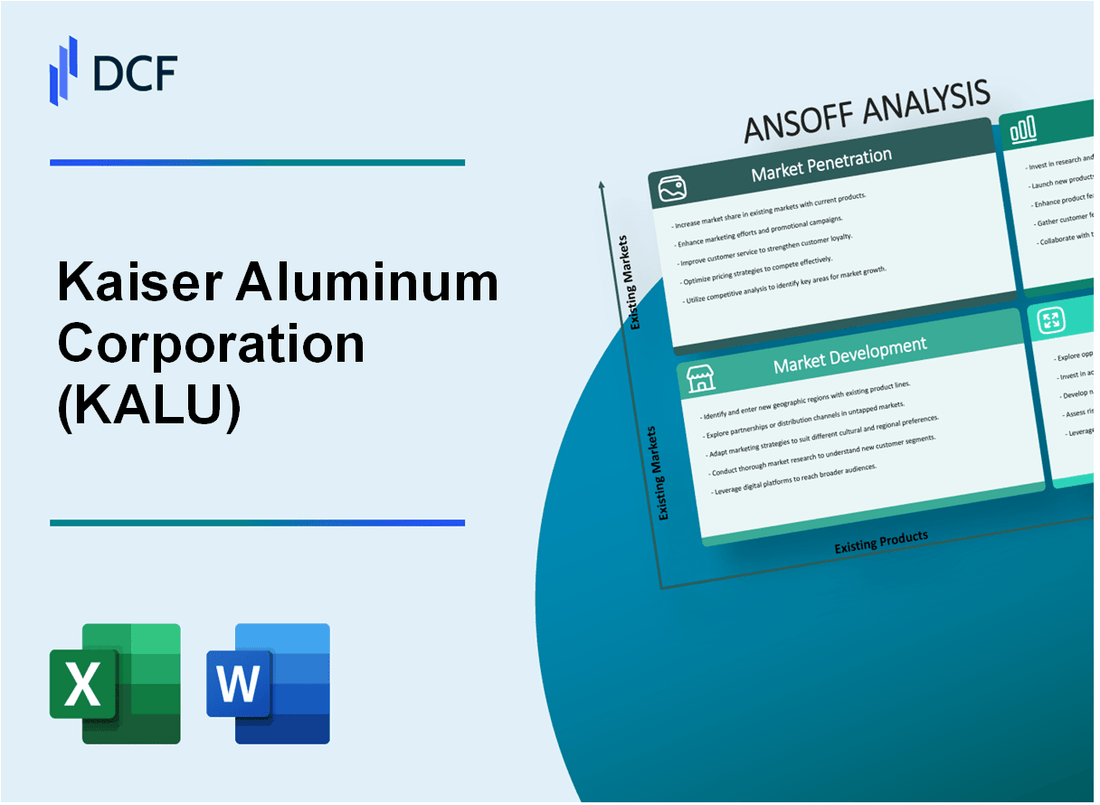
You're looking for the next clear growth moves for Kaiser Aluminum Corporation (KALU), and after two decades analyzing industrial balance sheets, I've distilled their strategy into an actionable Ansoff Matrix. Honestly, it's not just theory; we're talking about concrete steps like pushing for a 5% boost in plate output, defending that 23.2% Adjusted EBITDA margin, or funding international moves with their 3.6x leverage ratio. For you, this means seeing exactly where Kaiser Aluminum Corporation (KALU) plans to put its expected $120-130 million in capital spending-whether it's developing new alloys or acquiring solar component makers-so you can gauge the risk versus reward right now. Dive in below to see the specific actions tied to each quadrant.
Kaiser Aluminum Corporation (KALU) - Ansoff Matrix: Market Penetration
You're looking at how Kaiser Aluminum Corporation (KALU) plans to squeeze more revenue from its existing markets-that's the core of market penetration. The strategy here is about volume, margin, and making sure every pound shipped contributes more to the bottom line.
The first action point centers on maximizing the new capacity coming online. Kaiser Aluminum Corporation completed the $25 million Trentwood Phase VII expansion, the seventh stage of modernization, by late 2025, which expands a heat-treating furnace and is designed to increase output by around 5 per cent. This added capacity is specifically targeted to support the existing Aero/HS and GE plate output, aiming for that 5% boost in utilization to meet anticipated demand in 2026.
To capture more of the domestic market, Kaiser Aluminum Corporation is aggressively targeting share in US General Engineering. While Q3 segment data isn't fully detailed in the latest reports, Q2 2025 saw General Engineering Products ship 63.4 million pounds. The push here is to capitalize on trade policy that favors domestic suppliers, ensuring Kaiser Aluminum Corporation is the default choice for existing customers needing reliable material.
For the Automotive Extrusions business, the focus shifts to margin mix. You saw conversion revenue for this segment decline by 4 per cent year-over-year in Q2 2025 due to customer uncertainties, but the underlying strength remains in high-margin platforms. The penetration strategy involves deepening relationships with platforms like SUVs and light trucks, which remain healthy, to drive higher-margin sales within the existing customer base.
Sustaining profitability is key to funding these efforts. The cost-discipline program is designed to lock in the strong performance seen in the third quarter of 2025. Kaiser Aluminum Corporation achieved an Adjusted EBITDA of $81 million on a Conversion Revenue of $351 million for Q3 2025, resulting in an Adjusted EBITDA margin of 23.2%. Maintaining this level of margin, which is a significant expansion from the 12.7 per cent seen in Q3 2024, is a primary operational goal.
Finally, financial signaling plays a role in securing long-term supply agreements. Kaiser Aluminum Corporation declared a quarterly cash dividend of $0.77 per share, payable on November 14, 2025. This consistent return of capital is intended to signal financial stability to key partners, helping to secure those multi-year contracts necessary for volume commitment.
Here's a quick look at the Q3 2025 profitability metrics that underpin this market penetration push:
| Metric | Amount (Q3 2025) |
| Net Sales | $844 million |
| Conversion Revenue | $351 million |
| Adjusted EBITDA | $81 million |
| Adjusted EBITDA Margin | 23.2% |
| Net Income per Diluted Share | $2.38 |
The operational levers Kaiser Aluminum Corporation is pulling to drive this penetration include:
- Completing Trentwood Phase VII expansion by early Q4 2025.
- Targeting a 5 per cent output increase from the upgraded Trentwood furnace.
- Raising the full-year 2025 Adjusted EBITDA outlook to a 20% to 25% improvement year-over-year.
- Focusing on Packaging mix/pricing, which saw conversion revenue rise to $137.8 million (+7% YoY) in Q3 2025.
- Improving the Net Debt Leverage Ratio to 3.6x as of September 30, 2025.
Kaiser Aluminum Corporation (KALU) - Ansoff Matrix: Market Development
You're looking at how Kaiser Aluminum Corporation can push its current products into new geographic areas or customer segments, which is the Market Development quadrant of the Ansoff Matrix. This strategy leans heavily on the operational improvements and financial strengthening you've seen recently.
The financial footing is definitely better for taking on new international ventures. As of September 30, 2025, Kaiser Aluminum Corporation improved its Net Debt Leverage Ratio to 3.6x, a solid step down from 4.3x at the end of 2024. This deleveraging, coupled with total liquidity of $577 million at the end of Q3 2025, provides the necessary cushion to finance modest international distribution partnerships. The company also secured a longer runway by amending and extending its $575 million Revolving Credit Facility to mature in October 2030.
Here are the key financial snapshots from the third quarter of 2025 to frame this expansion:
| Metric | Q3 2025 Value | Year-over-Year Comparison Context |
| Net Sales | $844 million | Up from $748 million in the prior year period |
| Net Income | $40 million | Up from $9 million in Q3 2024 |
| Adjusted EBITDA | $81 million | With an Adjusted EBITDA Margin of 23.2% |
| Full Year 2025 Adjusted EBITDA Outlook | 20% to 25% improvement | Year-over-year growth expectation |
For existing Packaging coil products, the focus is on crossing borders within North America. Kaiser Aluminum Corporation is one of only four dedicated can sheet mills in North America, positioning it well to meet growing demand for recyclable packaging across the continent. Expanding sales of this existing Bottle Stock and Body Stock into markets like Mexico or Canada represents a clear Market Development path, leveraging established North American production capabilities.
The Aero/HS plate segment can target European commercial aerospace manufacturers by leveraging the quality assurance already in place. Kaiser Aluminum Corporation has been actively investing to support this market recovery; for instance, the recent $25 million expansion at the Trentwood rolling mill boosts output by 5%, specifically enhancing heat-treat capability on plate products. This increased, proven capacity supports the push into new international aerospace supply chains.
Introducing General Engineering products to new industrial segments requires identifying adjacent needs where Kaiser's existing material science applies. This could mean targeting high-speed rail component suppliers or specialized marine applications. Kaiser Aluminum Corporation already serves the General Engineering end market, so this is about finding new customer bases within that product line, rather than developing a new product itself.
To capture a broader portion of the global aluminum market, establishing a strategic sales office in a key international hub is a necessary step to formalize international engagement beyond existing customer relationships. This move would complement the financial flexibility provided by the 3.6x Net Debt Leverage Ratio.
The financing for these market development efforts should be modest, given the current focus on completing internal investment cycles, which recently included approximately $20 million in non-recurring startup costs at the Trentwood and Warrick facilities in Q3 2025. The ability to use the improved balance sheet to finance modest international distribution partnerships is a direct action supported by the current financial health.
- Packaging coil expansion targets include Mexico and Canada.
- Aero/HS plate leverages capacity from Trentwood Phase VII completion.
- General Engineering targets new industrial segments like high-speed rail.
- The company operates 12 US manufacturing facilities.
- Financing is supported by total liquidity of $577 million as of Q3 2025.
Finance: draft a preliminary budget for establishing a single international sales liaison office by next month.
Kaiser Aluminum Corporation (KALU) - Ansoff Matrix: Product Development
You're looking at how Kaiser Aluminum Corporation (KALU) can drive growth by focusing on new products, which is the Product Development quadrant of the Ansoff Matrix. This strategy relies on leveraging existing markets with offerings that bring more value or address future needs.
For the Packaging segment, the focus is on maximizing the utility of the Warrick roll coat line. This facility, which saw a significant investment of roughly $200 million to house the new line, is designed to shift volume into higher margin products, making the plant's future much more stable. The goal isn't just volume, but value; the new line allows the shift toward coated products used for food and beverage cans, lids, tabs, and ends. Keep in mind, Q3 2025 results included approximately $20 million in non-recurring startup costs tied to major investments at the Warrick facility, which is part of completing this investment cycle.
In the Aero/HS market, the push is for next-generation, high-strength aluminum alloys. Kaiser Aluminum is advancing a USD 25 million investment at the Trentwood facility, on track for completion by the end of 2025, to expand production capabilities for heat-treated plate and sheet. This capacity is expected to come online early in the fourth quarter of 2025. You're looking to support future aircraft weight reduction demands with materials like the 7050-T7651 and 7475-T7351 alloys, among others KaiserSelect® Aerospace Plate™ offerings. This focus aligns with the overall 2025 guidance, where the company is raising its full year Adjusted EBITDA outlook by 10%, projecting 20% to 25% year-over-year growth over the recasted 2024 Adjusted EBITDA of $241 million.
Developing specialized, complex extruded shapes for the Automotive market beyond current SUV/light truck platforms is a natural extension of Kaiser Aluminum's existing extrusion expertise. This product innovation supports the broader financial health, as seen by the Net Debt Leverage Ratio improving to 3.6x as of September 30, 2025, down from 4.3x at the end of 2024. The company is making these strategic moves while maintaining a quarterly dividend of $0.77 per share.
To fuel these advancements, a portion of the 2025 capital expenditure, expected to be between $120 million and $130 million, must be directed toward R&D for advanced surface treatments. This investment in process and product refinement is key to maintaining a competitive edge. The company is focused on operational excellence as it completes this investment cycle.
Capitalizing on aluminum's sustainability advantage means offering a new line of infinitely recyclable products to existing customers. Aluminum is an infinitely recyclable material, and Kaiser Aluminum is working with partners to increase the use of recycled aluminum content to the maximum extent possible. For example, a partnership with an aerospace customer reverts pre-consumer recycled aluminum content back into the manufacturing process with no effect on final strength or quality. This commitment to circularity is a product feature in itself.
Here's a look at some key 2025 performance indicators as of the third quarter:
| Metric | Value (Q3 2025) | Value (9 Months 2025) |
| Net Sales | $844 Million | N/A |
| Conversion Revenue | $351 Million | N/A |
| Adjusted EBITDA | $81 Million | USD 222 million |
| Adjusted EBITDA Margin | 23.2% | N/A |
| Net Debt Leverage Ratio | N/A | 3.6x |
The Product Development strategy is supported by these operational improvements, which are expected to drive the full-year 2025 Conversion Revenue guidance to be flat to up 5% year-over-year. The focus on higher-margin, specialized products is designed to deliver long-term shareholder value through disciplined capital allocation.
The specific product development focus areas for Kaiser Aluminum Corporation include:
- New, value-added coated products for Packaging using the Warrick roll coat line.
- Next-generation, high-strength aluminum alloys for Aero/HS market.
- Specialized, complex extruded shapes for the Automotive market.
- Advanced surface treatments funded by 2025 R&D investment.
- Infinitely recyclable aluminum product offerings for existing customers.
Finance: draft 13-week cash view by Friday.
Kaiser Aluminum Corporation (KALU) - Ansoff Matrix: Diversification
The Diversification quadrant of the Ansoff Matrix requires Kaiser Aluminum Corporation to pursue new products in new markets, representing the highest risk but potentially the highest reward path for growth outside its core semi-fabricated specialty aluminum products.
For 2025, Kaiser Aluminum Corporation is projecting capital expenditures of approximately $130 million, with a full-year Free Cash Flow outlook revised to $30-50 million, though earlier in the year, the projection was stated to exceed $100 million. This capital allocation must support exploration into entirely new revenue streams, such as those detailed below, leveraging existing extrusion and material science expertise.
The following outlines potential diversification vectors, grounded in current market statistics:
- Acquire a small manufacturer of aluminum-based structural components for the rapidly growing US solar energy market.
- Develop and market aluminum composite materials (ACMs) for the residential and commercial building facade industry.
- Leverage extrusion expertise to produce specialized components for the non-aluminum-based battery casing market for electric vehicles.
- Form a joint venture to produce high-purity aluminum powder for the emerging additive manufacturing (3D printing) industry.
The financial rationale for these moves is supported by the scale and growth of the target markets:
| Diversification Target Area | Relevant Market Metric | Real-Life Number/Amount |
| US Solar Structural Components | Global Aluminum Solar Panel Frame Market Size (2024) | $15.17 Billion |
| US Solar Structural Components | Projected Global CAGR (2025-2033) | 8.59% |
| ACMs for Building Facades | U.S. ACM Market Size (Projected 2025) | $0.71 Billion |
| ACMs for Building Facades | Global ACM Panel Market Size (2025) | $6.96 Billion |
| EV Battery Casing Components | Global EV Battery Case Box Market Size (2023) | $3.9 Billion |
| EV Battery Casing Components | Aluminum Segment Share (2023) | Over 47% |
| High-Purity Aluminum Powder (AM) | Global Aluminum Powder in AM Market Size (2025 Projection) | $6.29 Billion |
| High-Purity Aluminum Powder (AM) | High-Purity Segment Estimate (2025) | $500 million |
Focusing on the solar sector, the global aluminum solar panel frame market was valued at $15.17 Billion in 2024, with the utility segment dominating demand, and the U.S. holding a 2.9% global market share as of late 2025 data. This represents an opportunity to apply existing structural aluminum knowledge to components requiring corrosion resistance and structural integrity for utility-scale projects.
For building facades, the U.S. Aluminum Composite Material (ACM) market was estimated at $0.67 billion in 2024, with projections showing it reaching $0.71 billion in 2025. The construction segment accounted for 70.6% of the revenue share in 2024, aligning with Kaiser Aluminum Corporation's existing industrial customer base.
Leveraging extrusion expertise for electric vehicle (EV) battery casings targets a market where aluminum already held a share of over 47% of the $3.9 billion global EV battery case box market in 2023. Global projections suggest the required extruded aluminum tonnage for EVs could exceed 3 million tonnes by 2040.
The joint venture path into high-purity aluminum powder for additive manufacturing taps into a specialized, high-growth niche. The broader Aluminum Powder in Additive Manufacturing Market was valued at $4.76 billion in 2024, with a projection to reach $6.29 billion in 2025. The high-purity segment alone is conservatively estimated at $500 million in 2025, with North America accounting for 35.3% of the total aluminum powder market in 2025.
The execution of these diversification strategies would draw from Kaiser Aluminum Corporation's recent financial performance, such as the Q3 2025 reported Net Sales of $844 million and Adjusted EBITDA of $81 million, with an EBITDA margin of 23.2%.
Disclaimer
All information, articles, and product details provided on this website are for general informational and educational purposes only. We do not claim any ownership over, nor do we intend to infringe upon, any trademarks, copyrights, logos, brand names, or other intellectual property mentioned or depicted on this site. Such intellectual property remains the property of its respective owners, and any references here are made solely for identification or informational purposes, without implying any affiliation, endorsement, or partnership.
We make no representations or warranties, express or implied, regarding the accuracy, completeness, or suitability of any content or products presented. Nothing on this website should be construed as legal, tax, investment, financial, medical, or other professional advice. In addition, no part of this site—including articles or product references—constitutes a solicitation, recommendation, endorsement, advertisement, or offer to buy or sell any securities, franchises, or other financial instruments, particularly in jurisdictions where such activity would be unlawful.
All content is of a general nature and may not address the specific circumstances of any individual or entity. It is not a substitute for professional advice or services. Any actions you take based on the information provided here are strictly at your own risk. You accept full responsibility for any decisions or outcomes arising from your use of this website and agree to release us from any liability in connection with your use of, or reliance upon, the content or products found herein.