

|
Lamar Advertising Company (LAMR): ANSOFF MATRIX [Dec-2025 Updated] |
Fully Editable: Tailor To Your Needs In Excel Or Sheets
Professional Design: Trusted, Industry-Standard Templates
Investor-Approved Valuation Models
MAC/PC Compatible, Fully Unlocked
No Expertise Is Needed; Easy To Follow
Lamar Advertising Company (LAMR) Bundle
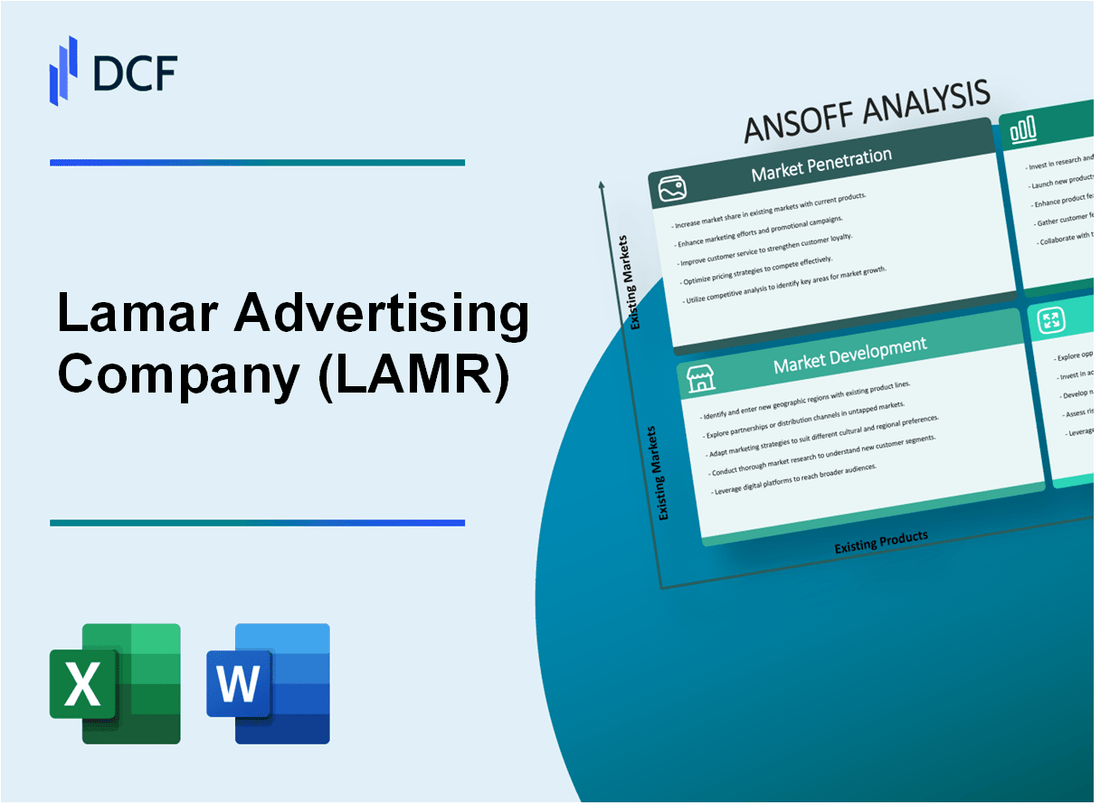
You're looking for the clearest path forward for Lamar Advertising Company, and after two decades analyzing these kinds of assets, I can tell you the Ansoff Matrix cuts right through the noise. We've mapped out four distinct growth lanes, moving from the safest bet-like boosting digital billboard conversion rates by 10% in top US markets-to more aggressive plays, such as converting 500 static signs to HD digital or even exploring diversification into drone advertising tech. Honestly, whether you're focused on squeezing more out of existing assets or making bold moves into Mexico or new product lines like geofencing bundles, the strategy is laid out right here. Dive in below to see the exact, actionable steps we've defined for each quadrant.
Lamar Advertising Company (LAMR) - Ansoff Matrix: Market Penetration
You're looking at how Lamar Advertising Company can squeeze more revenue from its existing markets and assets. This is about deepening the relationship with current customers and maximizing the yield from every sign face you already own, so the focus is on execution efficiency.
To increase digital billboard inventory conversion rate by a target of 10% in top 50 US Designated Market Areas (DMAs), you first need to know your base. As of December 31, 2024, Lamar Advertising operated approximately 5,000 digital billboards out of about 159,000 total billboard displays. The company is targeting over 350 new digital billboard deployments in 2025. Remember, converting a static unit to digital can yield a revenue lift of approximately 5 to 6 times, potentially bringing in around $15,000 per month per digital billboard. In Q1 2025, digital billboard revenue already increased by 4% and represented about 30% of total billboard revenue.
Offering performance-based advertising contracts directly targets the core customer base. Local and regional sales were a significant driver, accounting for 82% of billboard revenue in Q1 2025. Capturing a larger share of that existing local spend means proving superior return on investment (ROI) compared to other media. This strategy is about shifting budget allocation within the client's existing marketing plan.
Implementing dynamic pricing models helps smooth out revenue volatility. While specific occupancy rate data isn't immediately available, the growth in programmatic advertising shows a clear path to filling unsold inventory. Programmatic revenue grew by nearly 30% in Q1 2025, adding $2 million in that quarter alone. This automated buying channel is effectively a dynamic pricing mechanism for off-peak inventory.
Targeting competitors' long-term contracts nearing expiration requires deep market intelligence on local contract terms. This action relies on superior sales execution and offering immediate, tangible value that outweighs incumbent loyalty. The company's strong financial position, with total leverage at three times net debt to EBITDA as of Q3 2025, provides the capacity for aggressive, value-added offers.
Expanding transit shelter and bench advertising presence means maximizing street-level real estate in existing metro areas. As of year-end 2024, Lamar operated around 47,500 transit advertising displays. This segment, grouped with logo advertising, contributed $188.3 million in revenue over the first nine months of 2025.
Here's a quick look at the revenue landscape from the third quarter of 2025 to ground these penetration efforts:
| Metric | Amount (Q3 2025) | Comparison/Context |
| Net Revenues (3 Months) | $585.541 million | Up 3.8% year-over-year, including acquisitions |
| Billboard Advertising Revenue (9 Months) | $1.48 billion | Core segment driving top-line growth |
| Other Revenue (Logo/Transit - 9 Months) | $188.3 million | Represents street furniture and logo sign performance |
| Digital Billboard Revenue Share (Q1 2025) | Approx. 30% | Of total billboard revenue, a key area for conversion focus |
| Local/Regional Billboard Revenue Share (Q1 2025) | 82% | The target market for performance-based contracts |
The push for market penetration is fundamentally about optimizing the existing asset base. You're looking to increase the revenue per available display (yield management) and deepen penetration with current customer types, like local businesses. Finance: draft the projected revenue lift from a 10% increase in digital utilization across the top 50 DMAs by end of Q1 2026.
Lamar Advertising Company (LAMR) - Ansoff Matrix: Market Development
The pursuit of new geographic markets and customer segments for Lamar Advertising Company (LAMR) is grounded in aggressive acquisition activity and the expansion of its digital and programmatic offerings.
Regarding expansion into new international territories, revenues from external customers attributable to foreign countries totaled $22.5 million for the nine months ended September 30, 2025. The net carrying value of long-lived assets located in foreign countries stood at $9.9 million as of September 30, 2025.
Lamar Advertising completed over 30 acquisitions of outdoor advertising assets during the nine months ended September 30, 2025, which included more than 1,500 billboard faces across ten states as part of the Verde Outdoor acquisition. The company is targeting over $150 million in Mergers and Acquisitions (M&A) activity for the full year 2025.
For cross-border campaigns, Lamar Advertising already operates across the United States and Canada, managing more than 360,000 displays across both countries as of late 2024. The company's programmatic channel is a key area for attracting new buyers, with programmatic revenue growing by nearly 30% in Q1 2025, adding $2 million in that quarter alone. Industry-wide, Programmatic Digital Out-of-Home (DOOH) ad spend is projected to surpass $1 billion by 2025.
Focusing on new US markets involves building out digital inventory; Lamar plans to deploy an additional 350-375 new digital displays in 2025. As of the end of 2024, Lamar operated approximately 5,000 digital billboards, which accounted for 32% of the company's annual billboard revenue in 2024. The company anticipates total capital expenditures of approximately $195 million in 2025 to support this growth.
The development of the programmatic buying platform is supported by the company's existing investment in the technology provider, where Lamar invested $30 million in July 2021.
Here are key financial and operational metrics relevant to market development activities:
| Metric | Value (2025 YTD/Projected) | Period/Date |
| Total Revenue (TTM) | $2.24 Billion USD | November 2025 |
| Q3 2025 Net Revenues | $585.5 million | Q3 2025 |
| Foreign Country Revenue | $22.5 million | Nine Months Ended September 30, 2025 |
| Projected 2025 M&A Activity | Over $150 million | Full Year 2025 Guidance |
| Acquisitions Completed YTD | Over 30 | Nine Months Ended September 30, 2025 |
| Projected 2025 Capital Expenditures | $195 million | 2025 Projection |
| Programmatic Revenue Growth | Nearly 30% | Q1 2025 |
| Digital Billboard Deployments Planned | 350-375 new units | 2025 Target |
The strategy for attracting smaller, geographically dispersed agencies relies on the platform's ease of use, which is reflected in the following operational statistics:
- Programmatic advertising currently represents 2% of Lamar Advertising's outdoor business.
- Programmatic DOOH ad spend is projected to surpass $1 billion globally by 2025.
- Research found that 76% of American consumers have taken an action after being exposed to a DOOH placement.
- Nearly 48% of marketers expect to rely primarily on cookie-free targeting by the end of 2025.
The company's existing presence in Canada supports bundled cross-border offerings, with Lamar operating approximately 47,500 transit advertising displays as of December 31, 2024, in addition to its billboard and logo sign operations across the country.
For secondary US markets, the focus on new static billboard builds is being superseded by digital conversion, but the overall billboard count remains significant:
- Total billboard displays operated by Lamar as of December 31, 2024, was approximately 159,000.
- Static formats held 58% of the United States out-of-home advertising market share in 2024.
- Digital billboards accounted for 32% of Lamar's annual revenue in 2024.
Finance: draft Q4 2025 pro-forma international revenue impact analysis by January 15, 2026.
Lamar Advertising Company (LAMR) - Ansoff Matrix: Product Development
You're looking at how Lamar Advertising Company (LAMR) can grow by creating new offerings for its existing customer base. This is about developing new products or significantly enhancing current ones, like taking a static billboard and making it a dynamic, interactive experience.
For direct consumer engagement, the push is toward interactive digital displays. Think about integrating QR codes and near-field communication (NFC) capabilities directly onto the inventory. While specific adoption rates for these features aren't public, the overall digital shift is clear: Lamar ended Q3 2025 with 5,442 digital units in operation, an increase of approximately 450 year-to-date. This digital inventory now accounts for roughly 31% of total billboard billing.
To enhance campaign effectiveness, the development of proprietary data tools is key. Lamar CIO Sukhvinder Singh noted the strategy is to bring data into one consolidated source to unleash AI and make salespeople more efficient. This effort supports services like Device ID Passback and Foot Traffic Studies, which allow brands to anonymously measure consumer activity post-exposure, such as app downloads or site visits. The programmatic channel, which relies heavily on this data capability, grew over 13% in Q3 2025.
A core part of this product enhancement is the conversion of static assets. The specific goal here is to convert an additional 500 static billboards to high-definition digital displays. This move targets a significant revenue premium, as digital units generate about 5x the revenue compared to the prior static board. This focus on digital is already paying off; digital and programmatic revenue was up 5% in Q3 2025, contributing to total revenues of $585 million for the quarter.
Extending reach through bundled offerings is another product development angle. This involves packaging the physical Out-of-Home (OOH) space with mobile geofencing services for existing clients. This strategy complements the existing digital footprint, which management projected would see over 350 new digital billboard deployments in 2025.
Developing specialized, smaller-format digital screens for niche placements, like inside retail environments or university campuses, represents a move into new product form factors. This diversification is supported by a strong balance sheet, with Lamar reporting total leverage of three times net debt to EBITDA and an investment capacity well over $1 billion as of Q3 2025.
Here's a look at the financial context supporting these digital product investments:
| Metric | Value (Q3 2025 or Latest Available) | Context |
| Q3 2025 Consolidated Revenue | $585 million | Total revenue for the third quarter. |
| Digital & Programmatic Revenue Growth (Q3 2025) | 5% | Growth rate for the digital segment. |
| Digital Billboard Faces in Operation (End Q3 2025) | 5,442 units | Total digital inventory count. |
| Digital Share of Billboard Billing (Q3 2025) | Approx. 31% | Proportion of billboard revenue from digital. |
| Revenue Multiple (Digital vs. Static) | Approx. 5x | Revenue lift from converting a static board to digital. |
| Total Consolidated Debt (Q3 2025) | Approx. $3.4 billion | Total debt level reported. |
The focus on digital conversion is a clear product strategy. For instance, same-store digital revenue grew 3.4% quarter-over-quarter in Q3 2025.
- Target for static-to-digital conversion: 500 units.
- Programmatic revenue growth in Q3 2025: Over 13%.
- Year-to-date digital unit increase (End Q3 2025): Approximately 450.
- Capital spending devoted to digital billboards (Q3 2025): $25 million.
- Total liquidity available (Q3 2025): Well over $1 billion.
Finance: draft 13-week cash view by Friday.
Lamar Advertising Company (LAMR) - Ansoff Matrix: Diversification
You're looking at how Lamar Advertising Company can move beyond its core roadside and transit assets, which generated TTM revenue of $2.24 Billion USD as of November 2025. The company is financially positioned for this, ending Q3 2025 with total leverage at 3 times net debt to EBITDA, and an investment capacity well over $1 billion. Still, the core business is heavily weighted, with billboard advertising bringing in $524.8 million in Q3 2025 revenue alone, representing 76% of total billboard revenue from bulletins. Diversification here means chasing adjacent, higher-growth digital spaces.
Consider the move into aerial OOH media by acquiring a minority stake in a drone-based advertising technology firm. This taps into a future where digital OOH (DOOH) is already expected to grow at a CAGR of around 6.2% to 9.79% through 2033 in the US. While specific drone ad market numbers aren't public for Lamar Advertising Company, the general digital shift is clear: Lamar's digital and programmatic revenue was up 5% in Q3 2025, outpacing static billboard revenue growth of 2%. This is about securing a foothold in the next format.
For hyper-local digital signage in indoor venues like arenas, you are looking at a segment within the larger DOOH space. The US DOOH market itself is estimated at $9.38 billion in 2025. Indoor signage, especially in high-traffic areas like airports, is already a growth driver for Lamar, with airport sales up 6% in Q3 2025. This strategy leverages existing client relationships but requires a different CapEx profile; Lamar planned for total CapEx of $195 million for 2025, so indoor network build-out needs to be weighed against digital billboard deployment, which saw $25 million of the Q3 CapEx.
Creating a subsidiary to manage municipal smart-city infrastructure offers a recurring revenue model outside traditional ad sales. The US Smart Cities market is projected to grow at a CAGR of 27.7% from 2025 to 2030. While the US market revenue was only $147.3 million in 2024, that rapid growth suggests a significant future opportunity for managing digital kiosks or public Wi-Fi access points for service fees. This is a utility play, not just an ad play.
Developing a proprietary Content Management System (CMS) creates a Software-as-a-Service (SaaS) stream. Lamar Advertising Company is already focused on digital conversion, with 4,994 digital units at the end of 2024 and a goal of adding around 375 new units in 2025. If Lamar can productize the software that manages these, it creates a high-margin revenue source. The current programmatic channel represents 2% of its outdoor business, showing the early stage of this digital revenue evolution.
Finally, acquiring an experiential marketing agency integrates physical advertising with live consumer engagement. This is about capturing the ad dollar before it even hits the media buy. Lamar's nine-month revenue for logo and transit advertising combined was $188.3 million. An agency acquisition, like the Verde Outdoor deal which was valued at about $143 million and closed in Q3 2025, shows the appetite for M&A. This type of acquisition diversifies revenue source type, moving from pure media space sales to service integration.
Here's a quick look at how the core business compares to the growth potential in the new digital/infrastructure spaces:
| Metric/Area | Lamar Advertising Company Core (2025 Est./Actual) | Digital OOH Market (US, 2025 Est.) | Smart City Infrastructure Market (US, 2025 Est.) |
| Annual Revenue (TTM/Est.) | $2.24 Billion USD | $9.38 Billion USD (Total Market Size) | Market CAGR 2025-2030: 27.7% |
| Digital Revenue Growth (Q3 2025) | 5% (Digital/Programmatic) | CAGR 2025-2030: 6.2% | Market Revenue (2024): $147.3 Million USD |
| Capital Allocation (Q3 2025) | $25 Million USD to Digital Billboards | Digital Billboard Share (2024): 76% of Billboard Revenue | Leverage Target: Below 3x Net Debt/EBITDA |
The path forward involves using the strong cash flow, which is expected to exceed capital expenditures and dividends for 2025, to fund these adjacent market entries. The focus on digital conversion within the core business-with digital units generating 5x the revenue of static boards-is the bridge to these diversification plays.
- Acquire drone tech for aerial OOH exploration.
- Invest in hyper-local digital signage networks.
- Form subsidiary for municipal digital kiosk management.
- Generate SaaS revenue from proprietary OOH CMS.
- Buy regional event sponsorship and experiential agency.
Finance: draft 13-week cash view by Friday.
Disclaimer
All information, articles, and product details provided on this website are for general informational and educational purposes only. We do not claim any ownership over, nor do we intend to infringe upon, any trademarks, copyrights, logos, brand names, or other intellectual property mentioned or depicted on this site. Such intellectual property remains the property of its respective owners, and any references here are made solely for identification or informational purposes, without implying any affiliation, endorsement, or partnership.
We make no representations or warranties, express or implied, regarding the accuracy, completeness, or suitability of any content or products presented. Nothing on this website should be construed as legal, tax, investment, financial, medical, or other professional advice. In addition, no part of this site—including articles or product references—constitutes a solicitation, recommendation, endorsement, advertisement, or offer to buy or sell any securities, franchises, or other financial instruments, particularly in jurisdictions where such activity would be unlawful.
All content is of a general nature and may not address the specific circumstances of any individual or entity. It is not a substitute for professional advice or services. Any actions you take based on the information provided here are strictly at your own risk. You accept full responsibility for any decisions or outcomes arising from your use of this website and agree to release us from any liability in connection with your use of, or reliance upon, the content or products found herein.