

|
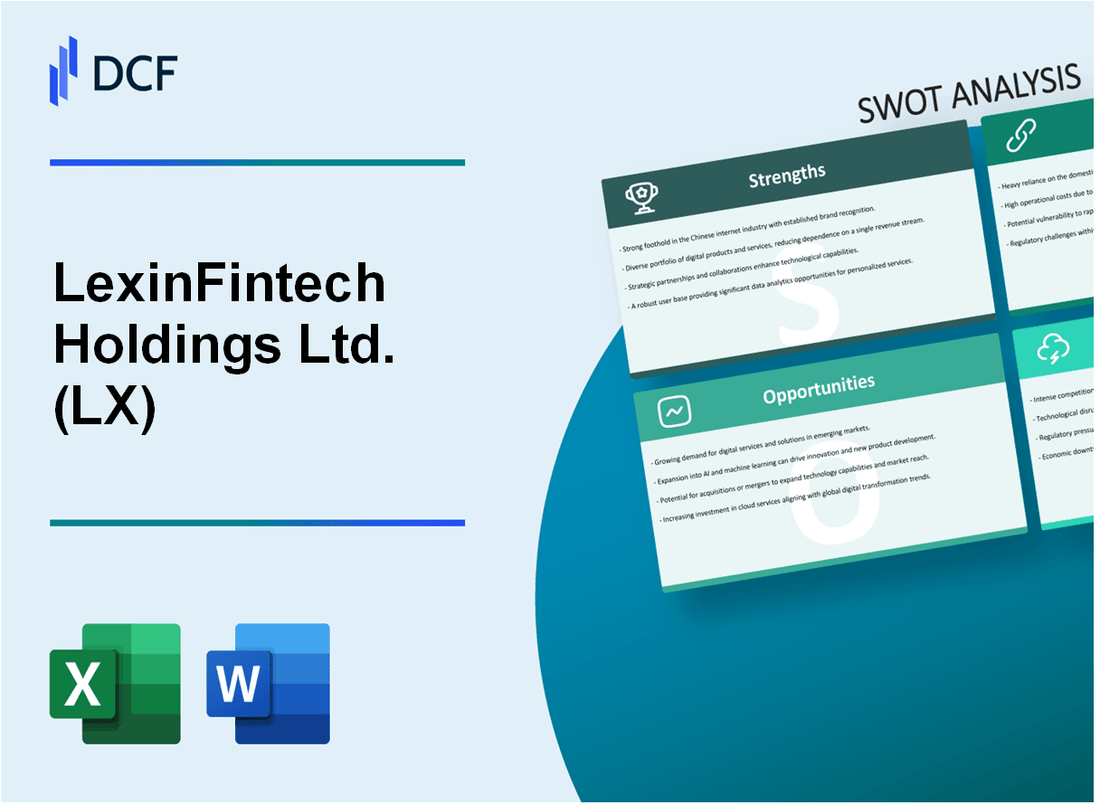
LexinFintech Holdings Ltd. (LX): SWOT Analysis [Nov-2025 Updated] |
Fully Editable: Tailor To Your Needs In Excel Or Sheets
Professional Design: Trusted, Industry-Standard Templates
Investor-Approved Valuation Models
MAC/PC Compatible, Fully Unlocked
No Expertise Is Needed; Easy To Follow
LexinFintech Holdings Ltd. (LX) Bundle
You're watching LexinFintech Holdings Ltd. (LX) navigate a tough Chinese consumer finance landscape, and the story is one of a strategic pivot paying off, but not without real risks. Despite a 6.7% year-over-year drop in total operating revenue to RMB 3.4 billion in Q3 2025, their net income surged an impressive 68%, showing the power of their shift to a capital-light model. They hold a massive 240 million registered user base and their AI-driven risk management is holding up, but the looming 24% annual interest rate cap and intense competition mean the path ahead is anything but smooth. Let's map out the near-term position.
LexinFintech Holdings Ltd. (LX) - SWOT Analysis: Strengths
You're looking for evidence of resilience and growth in a challenging market, and LexinFintech Holdings Ltd. (LX) is delivering exactly that by focusing on profitability and a capital-light model. The company's strategic pivot and strong execution in risk management are showing up clearly in the 2025 fiscal data, driving significant net income growth and improving asset quality.
Net income surged 68% year-over-year to RMB 521 million in Q3 2025
The most compelling strength is the company's ability to generate profit, even while navigating a complex regulatory environment. LexinFintech reported a net income of RMB 521 million in the third quarter of 2025, which is a remarkable 68% increase year-over-year. This result marks the highest quarterly net income the company has achieved in the last 15 quarters. Here's the quick math: achieving this record profit against a backdrop of industry-wide volatility demonstrates strong operational efficiency and cost control. The net income margin also improved to 15% from 14% in the previous quarter.
Successful pivot to capital-light model; tech-empowerment revenue grew 72.8% in Q1 2025
LexinFintech has been successfully transitioning its business model to focus more on technology services and less on holding credit risk on its own balance sheet-what we call the capital-light model. This shift is defintely a strength. In the first quarter of 2025, the income from its tech-empowerment services surged by 72.8% year-over-year, reaching RMB 625 million. This substantial growth shows the market's demand for the company's proprietary technology solutions, which empower financial institutions with data-driven credit risk management. It's a smart move to diversify revenue streams away from pure credit facilitation.
AI-driven risk management reduced the 90-day+ delinquency rate to 3.0% in 2025
A finance company is only as strong as its loan quality, and LexinFintech's AI-driven risk management is paying off. The 90-day+ delinquency ratio, a key measure of asset quality, was reduced to just 3.0% as of September 30, 2025, an improvement from 3.1% just three months prior. This metric, which tracks loans seriously past due, reflects the effectiveness of their dual-driven risk control and data management strategy. For new loan originations, the first payment default rate (30 day+) remained impressively low, below 1% as of September 30, 2025. That's a clear sign of superior underwriting.
| Key Risk Metric | Value as of Sep 30, 2025 | Context |
|---|---|---|
| 90-Day+ Delinquency Ratio | 3.0% | Improved from 3.1% in the prior quarter. |
| First Payment Default Rate (New Loans) | Below 1% | Indicates strong initial asset quality. |
| Total Outstanding Principal Balance | RMB 102 billion | Managed loan book size. |
Strong user base of 240 million registered users as of September 30, 2025
The sheer scale of the user base provides a massive competitive moat. The total number of registered users reached 240 million as of September 30, 2025. This large, established user base gives LexinFintech a significant advantage in customer acquisition and cross-selling opportunities compared to smaller competitors. Plus, the number of cumulative borrowers with a successful drawdown reached 35.9 million by the same date, showing a solid conversion of registered users into active, revenue-generating customers. This extensive network is a foundational strength for future growth.
Enhanced shareholder returns with a dividend payout ratio increased to 30% of net profit
Management is clearly committed to returning value to shareholders, which builds investor confidence. The Board approved an increase in the cash dividend payout ratio from 25% to 30% of total net income, effective from the second half of 2025. This move is a tangible demonstration of confidence in the company's sustained profitability and cash flow generation, even during a period of industry transition. They are also actively executing a share repurchase plan, further boosting shareholder value.
- Dividend payout ratio boosted to 30% of net profit.
- Share repurchases valued at approximately US$25 million were conducted.
- CEO is personally purchasing shares, aligning management interests.
LexinFintech Holdings Ltd. (LX) - SWOT Analysis: Weaknesses
You're looking at LexinFintech Holdings Ltd. (LX) and, while the net income growth looks strong, the core revenue and loan origination trends in Q3 2025 point to a clear challenge in sustaining volume growth under tightening regulatory caps. The biggest weakness is the decelerating top-line growth and the structural risk of being tied to a highly regulated and volatile Chinese consumer finance market.
Total operating revenue declined to RMB 3.4 billion in Q3 2025, a 6.7% year-over-year drop.
The headline number for the third quarter of 2025 shows a concerning trend: total operating revenue was RMB 3,417 million. This is a significant decrease of 6.7% compared to the same period in 2024. This revenue contraction is largely due to a drop in the company's core credit facilitation service income, which fell by 11.9% year-over-year to RMB 2,617 million. The shift in business model and regulatory pressure on loan pricing-like the cap of 24% annual interest rate on new loans effective October 1, 2025-is directly impacting the revenue-generating capacity of the loan portfolio.
Here's the quick math on the revenue segments:
| Revenue Segment (Q3 2025) | Amount (RMB in millions) | Year-over-Year Change |
|---|---|---|
| Total Operating Revenue | 3,417 | Decrease of 6.7% |
| Credit Facilitation Service Income | 2,617 | Decrease of 11.9% |
| Tech-Empowerment Service Income | 456 | Increase of 18.9% |
| Installment E-commerce Platform Service Income | 345 | Increase of 11.8% |
Increased credit costs and a modest uptick in early delinquency were noted in Q3 2025.
Despite a reported improvement in the 90-day delinquency ratio to 3.0% as of September 30, 2025, the near-term credit environment remains a significant weakness. Management noted that risk and provisioning pressure increased during the quarter, with credit costs rising by approximately RMB 40 million. This increase reflects a continuously strengthened provisioning effort, which eats directly into the net revenue from the credit business, causing it to decrease by 3% quarter-over-quarter. You also saw a modest uptick in early delinquency, which is a leading indicator of potential future asset quality issues, and the company warns that Q4 2025 will face continued liquidity and risk volatility.
Loan originations were nearly flat at RMB 50.9 billion in Q3 2025, showing limited growth.
The company's ability to drive new business volume is stalling. Total loan originations for Q3 2025 were RMB 50.9 billion. This figure was essentially flat, reflecting a minor decline of just 0.2% compared to the RMB 51.0 billion originated in the third quarter of 2024. While stability can be a positive, in a high-growth sector, flat loan volume suggests a struggle to expand market share or a prudent, but limiting, slowdown in growth due to risk control and regulatory compliance. This lack of volume growth makes the revenue decline even more defintely a concern.
Continued reliance on the volatile Chinese consumer finance market for the majority of revenue.
LexinFintech Holdings Ltd. is an online consumer finance platform focused almost entirely on the People's Republic of China (PRC) market. This geographic concentration exposes the company to a unique set of macroeconomic and regulatory risks that are currently heightened. The industry is grappling with 'short-term compliance challenges and heightened credit risk volatility'.
The specific risks tied to this reliance include:
- Regulatory Headwinds: New rules, such as the 24% annual interest rate cap on new loans, directly compress lending margins and force business model adjustments.
- Macroeconomic Uncertainty: The overall consumer credit growth in China has been lackluster, which challenges the company's revenue growth outlook for the near term.
- Geopolitical Tensions: As a China-based company listed on the NASDAQ, it faces sentiment headwinds and potential U.S. investment restrictions due to strained U.S.-China relations.
The company is trying to expand overseas, with other Chinese fintechs targeting markets like Indonesia and Mexico, but the vast majority of its revenue still comes from the volatile domestic landscape.
LexinFintech Holdings Ltd. (LX) - SWOT Analysis: Opportunities
You've navigated the regulatory storms in China's fintech sector, and the good news is that the very compliance requirements that squeezed out weaker players are now creating a massive opportunity for LexinFintech Holdings Ltd. The path forward is clear: consolidate market share, deepen user monetization, and strategically diversify outside of China. This isn't just about survival; it's about capturing a newly compliant, high-margin market.
New regulatory environment raises industry entry barriers, concentrating market share to compliant leaders.
The tightening regulatory environment, which includes stricter capital requirements and interest rate caps, acts as a moat for established, compliant platforms like LexinFintech. Honestly, the barrier to entry has never been higher for new fintech players. This is a classic case where regulation kills the competition, leaving you with a clearer field.
Management has explicitly stated that the new rules will 'further raise industry entry barriers' and push market resources to 'leading compliance platform[s]'. You can see this advantage in the financial metrics: the net income take rate hit 2.01% in the third quarter of 2025 (Q3 2025), a 92 basis point year-over-year increase, reaching the year-end goal ahead of schedule. This rise in profitability per unit of loan volume confirms that the shift to a compliant, quality-focused model is paying off handsomely.
Further monetization of the large user base through cross-selling installment e-commerce and finance.
LexinFintech is sitting on a goldmine with its massive user base, and the cross-selling opportunity between its finance and e-commerce segments is accelerating. As of September 30, 2025, the platform had 240 million total registered users. The key is converting these users into multi-product customers, and the installment e-commerce platform is the engine for this.
The growth here is staggering. Gross Merchandise Volume (GMV) for the installment e-commerce platform reached RMB2,313 million in Q3 2025, marking a huge 180% increase from Q3 2024. This isn't just selling high-ticket items anymore; it's about essential daily consumer goods, where GMV surged 58.5% quarter-over-quarter in Q3 2025. That's sticky, recurring revenue.
Here's the quick math on the e-commerce segment's growth:
| Metric (Q3 2025) | Amount (RMB) | Year-over-Year Change |
| Installment E-commerce Platform Service Income | 345 million | +11.8% |
| Installment E-commerce Platform GMV | 2,313 million | +180% |
| Users Served by E-commerce Platform | Over 520,000 | N/A |
International expansion, such as the initial move into Mexico, diversifies geographic risk.
Relying solely on the Chinese market, however large, carries concentrated regulatory and macroeconomic risk. The initial moves into international markets like Mexico and Indonesia are a crucial long-term opportunity to diversify the revenue base. The overseas business achieved 'steady growth in volume' in Q3 2025.
The strategic value is twofold: diversification and higher asset yield. Management has indicated that the asset yield in the overseas market is expected to be 'better than the domestic business'. In the Mexican market, early results showed a 61% increase in loan scale and a 113% increase in revenue compared to the prior quarter, suggesting a high-growth, high-return environment. This is how you hedge against domestic volatility.
Leveraging AI and large-scale models to enhance the smart risk control system and efficiency.
The company's heavy investment in Artificial Intelligence (AI) and large-scale models is not just a buzzword; it's a tangible competitive advantage that directly impacts the bottom line through superior risk control and operational efficiency. The next-generation smart risk control system, powered by AI agents, is shifting risk management from quantitative-driven to fully AI-driven.
The results are already showing up in asset quality metrics:
- The 90-day+ delinquency rate fell to 3.1% in Q2 2025, down from 3.3% in Q1 2025.
- First payment default rates remained below 1%.
Plus, the internal efficiency gains are defintely worth noting. The proprietary 'Singularity' AI model is used by 100% of developers, assisting in generating 860,000 lines of code per month and proposing 210,000 code-quality improvement suggestions over the past year. That's a huge boost to R&D productivity, which translates into faster product deployment and lower long-term operating costs.
LexinFintech Holdings Ltd. (LX) - SWOT Analysis: Threats
You're looking at LexinFintech Holdings Ltd. (LX) and seeing a resilient business, but the threats right now are less about execution and more about the structural shifts happening in China. The core risks are regulatory pressure on pricing, a fragile consumer economy, and a competitive landscape where the biggest players are getting a quiet regulatory nod to re-enter the market.
Heightened regulatory risk around lending activity, including the 24% annual interest rate cap
The biggest near-term threat is the hard ceiling on loan pricing. LexinFintech Holdings Ltd. confirmed that, effective October 1, 2025, all new loans originated are priced at or below an annual interest rate of 24% to comply with new regulatory requirements.
This cap squeezes margins, especially on riskier borrowers, and forces a trade-off: either accept lower profitability or tighten credit standards and shrink the addressable market. The industry is already facing short-term compliance challenges and heightened credit risk volatility as a result.
Here's the quick math: A lower interest rate means LexinFintech Holdings Ltd. must either cut its operating costs or find a way to significantly improve its risk-adjusted return on capital (RAROC) by only lending to the best-qualified customers. It's a fundamental change to the business model.
Macroeconomic volatility in China, which pressures consumer spending and credit demand
While the Chinese government is pushing to boost domestic consumption, the consumer is still hesitant, and that directly impacts credit demand. The country's GDP growth is expected to slow to around 4.0% in 2025, according to some forecasts, though others project around 5%. Still, a soft housing market and a fragile job market have locked consumer confidence in the doldrums, as evidenced by a persistently high household savings rate.
This weak demand is compounded by rising credit risk across the sector. In the first quarter of 2025, Chinese banks and consumer finance firms put RMB 74.3 billion of non-performing loans (NPLs) up for sale, representing a massive 190% year-on-year increase, with consumer loans making up about 70% of this non-performing debt. This NPL surge signals a significant deterioration in borrower quality, increasing LexinFintech Holdings Ltd.'s provisioning pressure and credit costs for Q4 2025 and beyond.
Intense competition from larger, well-capitalized tech giants and traditional financial institutions
The regulatory environment, while painful, is concentrating market resources, which means the competition that survives is stronger and better-capitalized. The biggest threat is the cautious re-entry of tech giants like Ant Group and Tencent-backed WeBank into consumer lending, which has been quietly encouraged by Beijing through measures like consumer-loan interest subsidies.
The overall online lending market is huge, expected to rise 7.6% in 2025 to RMB 5.4 trillion (approximately $758 billion), but the largest players are now competing on price and scale with regulatory backing. Traditional banks are also being urged to boost personal consumer loan disbursements, which means they are regaining market share with lower-cost funding and a conservative lending approach that appeals to prime borrowers.
The competitive pressure is summarized here:
- Tech Giants: Ant Group, WeBank are expanding cautiously with new regulatory support.
- Traditional Banks: Increasing personal loan and credit card activity, backed by lower funding costs.
- Market Size: Online lending is projected to reach RMB 5.4 trillion in 2025, making the fight for market share intense.
Investor sensitivity, demonstrated by a recent sharp share price decline amid peer divergence
The market remains highly sensitive to any sign of regulatory or economic trouble in the Chinese fintech sector. LexinFintech Holdings Ltd.'s stock (LX) was trading at $3.50 as of November 21, 2025, reflecting a year-to-date decline of -34.91%. This sharp drop, despite the company reporting a strong Q3 2025 net income of RMB 521 million, shows a deep investor skepticism about the sustainability of its earnings under the new regulatory regime.
Technical indicators suggested bearish momentum as of the Q3 2025 earnings report, and management itself warned that Q4 2025 will face continued liquidity and risk volatility before any gradual stabilization.
What this estimate hides is the market's fear that the regulatory compliance achieved in Q3-pricing all new loans at 24% or below-will lead to a significant revenue contraction in the following quarters, even if net income was temporarily boosted by cost-cutting and improved risk management. The stock price is defintely pricing in future pain.
Disclaimer
All information, articles, and product details provided on this website are for general informational and educational purposes only. We do not claim any ownership over, nor do we intend to infringe upon, any trademarks, copyrights, logos, brand names, or other intellectual property mentioned or depicted on this site. Such intellectual property remains the property of its respective owners, and any references here are made solely for identification or informational purposes, without implying any affiliation, endorsement, or partnership.
We make no representations or warranties, express or implied, regarding the accuracy, completeness, or suitability of any content or products presented. Nothing on this website should be construed as legal, tax, investment, financial, medical, or other professional advice. In addition, no part of this site—including articles or product references—constitutes a solicitation, recommendation, endorsement, advertisement, or offer to buy or sell any securities, franchises, or other financial instruments, particularly in jurisdictions where such activity would be unlawful.
All content is of a general nature and may not address the specific circumstances of any individual or entity. It is not a substitute for professional advice or services. Any actions you take based on the information provided here are strictly at your own risk. You accept full responsibility for any decisions or outcomes arising from your use of this website and agree to release us from any liability in connection with your use of, or reliance upon, the content or products found herein.