
|
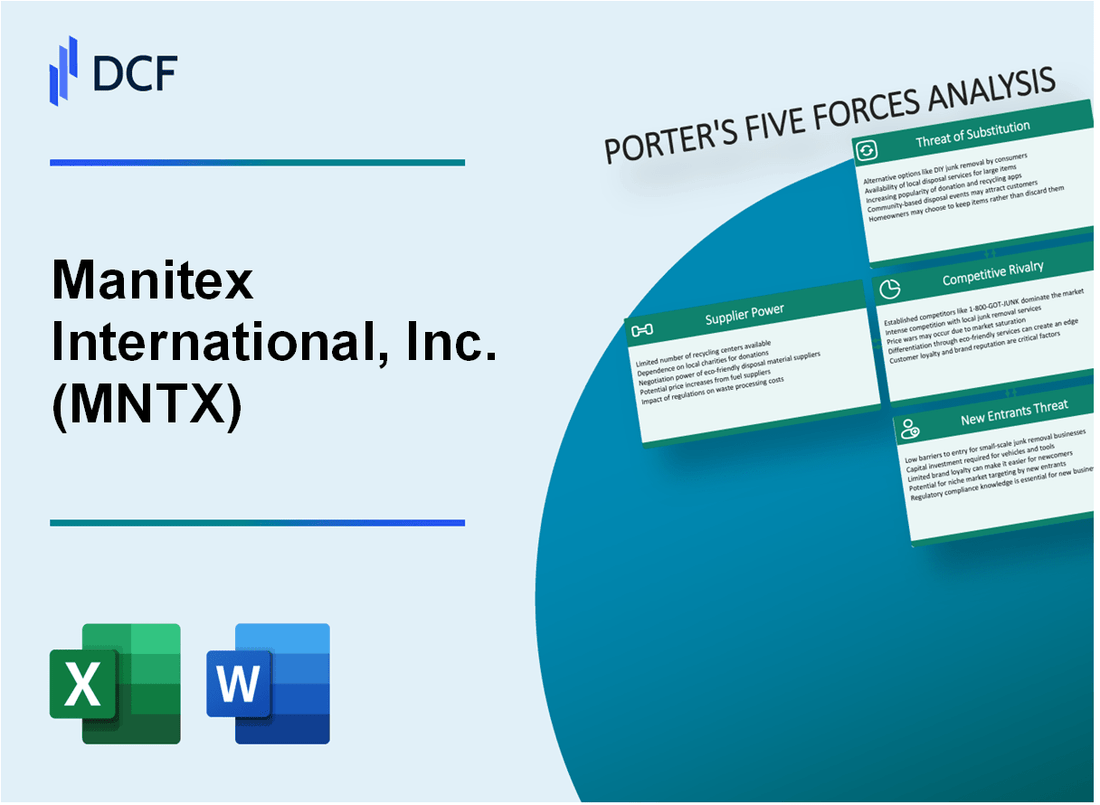
Manitex International, Inc. (MNTX): 5 FORCES Analysis [Nov-2025 Updated] |
Fully Editable: Tailor To Your Needs In Excel Or Sheets
Professional Design: Trusted, Industry-Standard Templates
Investor-Approved Valuation Models
MAC/PC Compatible, Fully Unlocked
No Expertise Is Needed; Easy To Follow
Manitex International, Inc. (MNTX) Bundle
You're digging into Manitex International, Inc. right after its January 2025 acquisition by Tadano, and that changes the whole game for this specialized lifting equipment maker. Honestly, the core tension is clear: suppliers still hold sway over critical components, but the company's established 35% North American market share in straight-mast cranes gives it serious defense against demanding customers. The competitive environment is now a mix of high rivalry from global players and new entry barriers set by its parent. We need to see how these five forces shape near-term strategy, so let's break down the real risks and advantages below.
Manitex International, Inc. (MNTX) - Porter's Five Forces: Bargaining power of suppliers
You're analyzing Manitex International, Inc.'s supplier landscape as of late 2025, right after it became a wholly owned subsidiary of Tadano Ltd. The power held by suppliers in this specialized industrial equipment sector is a constant pressure point, defintely something to watch.
The bargaining power of suppliers for Manitex International, Inc. leans toward high because the company relies on a limited pool of vendors for highly specialized, mission-critical components. Think about the core of a boom truck; you can't just source a custom hydraulic system or a heavy-duty engine from any general supplier. This reliance on specialized components like chassis, engines, and hydraulic systems naturally gives those specific suppliers more leverage in pricing and delivery terms.
We saw evidence of this leverage earlier. Supply chain constraints, which were a noted issue around 2022, definitely increased supplier leverage for critical parts, forcing Manitex to focus on operational efficiency to offset the input cost pressure. Still, management was clearly working on this, as evidenced by their strategy to drive margin expansion through 'Centralization of procurement and supply chain' between year-end 2022 and 2025.
Here's a quick look at the cost structure from the last reported figures before the acquisition closed:
| Metric | Value (Q3 2024) | Unit |
|---|---|---|
| Net Revenue | $66.5 | Million |
| Gross Profit | $16.0 | Million |
| Gross Margin | 24.1 | % |
| Lifting Equipment Revenue | $57.3 | Million |
Component costs for materials like steel and machined parts directly translate to the bottom line. For instance, in Q3 2024, Manitex International, Inc. reported a gross margin of 24.1%. That margin was achieved despite revenue headwinds, partly because of lower material costs resulting from supply chain initiatives implemented during 2024.
However, the power dynamic shifts now that Manitex International, Inc. is part of the Tadano Group, which completed its acquisition in early Q1 2025. This integration is expected to mitigate supplier power significantly. The power is now mitigated by Tadano's global scale and the resulting procurement synergies. The centralization of procurement, a stated margin driver, should allow the combined entity to negotiate better terms for high-volume inputs like steel and hydraulic components, leveraging Tadano's massive purchasing footprint across its global operations.
You should watch for these specific supplier-related actions going forward:
- Negotiation leverage from combined purchasing volumes.
- Reduced lead times for specialized hydraulic systems.
- Impact of steel price fluctuations on the consolidated cost of goods sold.
- Success in integrating Manitex International, Inc.'s European and North American supply chains.
Manitex International, Inc. (MNTX) - Porter's Five Forces: Bargaining power of customers
You're analyzing Manitex International, Inc.'s customer power right as the company transitioned to private ownership under Tadano Ltd. in early 2025. That shift definitely changes the long-term view, but for the immediate power dynamic Manitex faced, we look at the nature of their sales. Since boom trucks and specialized cranes are significant capital expenditures for construction and utility companies, your customers aren't making these purchases lightly. When a utility company budgets for a new straight-mast crane, that purchase might be planned over several fiscal years, meaning they have time to shop around and negotiate terms. This inherent high-cost nature of the purchase pushes the bargaining power toward the buyer, suggesting a medium to high level of influence.
To be fair, customers certainly have strong alternatives. The global crane market, valued around $43 billion as of 2025, is populated by massive global players. Manitex International, Inc. was competing directly against established giants like Terex Corporation and Palfinger AG, both of whom offer broad product portfolios that can satisfy many of the same end-user needs across construction and infrastructure. When you can easily compare specifications, service contracts, and pricing across major manufacturers, your leverage increases.
However, Manitex International, Inc. had a specific shield against this pressure, particularly in its core area. The company maintained a dominant estimated market share of 35% within the domestic Straight Mast market. This leadership position in a key niche meant that for customers specifically requiring that type of equipment, Manitex wasn't just another option; they were often the primary source. Here's a quick look at the scale and competitive context:
| Metric | Value/Context |
|---|---|
| North American Straight-Mast Market Share | 35% |
| TTM Revenue (as of Sep '24) | $294.78 million USD |
| Global Crane Market Size (Est. 2025) | ~$43 billion USD |
| Key Competitors | Terex Corporation, Palfinger AG, Tadano Ltd. |
Still, the power of the customer is tempered by the infrastructure Manitex built around its products. A global dealer network, which Manitex International, Inc. actively worked to enhance through 2024 and into 2025 with new agreements, creates tangible switching costs. Once a customer invests in a Manitex product, the associated training, parts inventory, and service relationships with their local dealer become sticky. This network supports brand loyalty across various product lines, making a switch to a competitor more than just a price decision; it becomes an operational headache.
The dealer network's role in reducing customer power centers on support and accessibility:
- Certified dealers sell and support PM Group knuckle boom cranes.
- The network provides local support for Manitex aerial work platforms.
- Partnerships are key to expanding share in North American markets.
- Shared core values with dealers aim to maintain customer focus.
- This structure builds a world-class support network.
If onboarding a new dealer takes 14+ days, churn risk rises, but a strong, established network keeps that risk low. Finance: draft 13-week cash view by Friday.
Manitex International, Inc. (MNTX) - Porter's Five Forces: Competitive rivalry
The competitive rivalry intensity remains high, now viewed under the umbrella of its parent company, Tadano Ltd., which completed the acquisition of Manitex International, Inc. in early Q1 2025 for an equity value of $123 million (total transaction value of $223 million).
Manitex International, Inc.'s last reported standalone net revenue for the third quarter of 2024 was $66.5 million, with the Lifting Equipment Segment contributing $57.3 million.
Competition is measured against major global entities, including Terex Corporation and Palfinger AG, alongside the new parent, Tadano. North America, a key market, is estimated to hold 32.4% of the Global Crane And Hoist Market in 2025, a market valued at USD 31.78 Bn in the same year.
| Competitive Factor | Manitex International, Inc. (Pre-Acquisition Context) | Major Global Competitors (Contextual Data) |
| Direct Rivalry Focus | Boom trucks, knuckle boom cranes, industrial cranes. | Global Crane And Hoist Market estimated at USD 31.78 Bn in 2025. |
| Market Share (Niche) | 35% market share within the domestic Straight Mast market. | Terex is listed among major players in the North American market. |
| Product Innovation Example | Valla electric cranes, with a past order valued at approximately $2.5 Million. | Palfinger AG is profiled in the Mini Cranes Market analysis. |
| Financial Strength Context | Reported net leverage of 2.5x at the end of Q3 2024. | Heavy Lifting Equipment Market projected to reach $35,722.1 Million by the end of 2025. |
Manitex International, Inc. actively manages rivalry intensity by concentrating on specific segments where it maintains a strong foothold or offers unique value propositions.
- Retain leadership position within Straight Mast market.
- Invest in higher-growth, underpenetrated adjacent markets.
- Share expansion of PM | Oil & Steel and Valla in the USA.
- Valla electric cranes offer zero-emissions capability.
The industry structure dictates that demand is inherently tied to external economic factors, creating a cyclical environment.
- The crane market follows a cyclical growth trend of about 3% per year.
- Anticipated global upturn by the second half of 2025.
- Demand is tied to infrastructure spending, data centers, and equipment replacement cycles.
Manitex International, Inc. (MNTX) - Porter's Five Forces: Threat of substitutes
You're analyzing Manitex International, Inc.'s position, and the threat of substitutes is definitely a key area to watch. Honestly, the market for lifting equipment isn't monolithic; there are several ways a customer can achieve their lifting goal without buying a Manitex boom truck or specialized crane.
We see a moderate threat from alternative lifting solutions. Think about larger mobile cranes, telehandlers, or aerial work platforms (AWPs). These competitors can often handle similar, though perhaps less specialized, tasks. To put this in perspective, the global addressable market (TAM) for Manitex International, Inc.'s core Lifting Equipment segment was estimated at approximately $18 billion as of late 2023, representing a massive pool where substitutes could potentially draw demand away.
However, this threat isn't overwhelming because Manitex International, Inc. occupies specific, non-substitutable niches. Their strength in engineered lifting solutions, particularly with their specialized boom trucks and industrial cranes like Valla, means that for certain jobs-especially those requiring precise articulation or specific load handling in tight industrial settings-the alternatives simply don't measure up. This specialization acts as a moat.
Here's a quick look at how the competitive landscape stacks up against these substitutes:
| Lifting Solution Category | Primary Competitor Type | Manitex International, Inc. (MNTX) Counter-Strategy | Market Context (Late 2025 View) |
|---|---|---|---|
| General Heavy Lifting | Larger Mobile Cranes | Focus on truck-mounted, maneuverable units | High demand driven by infrastructure spending |
| Material Handling / Access | Telehandlers / Aerial Work Platforms (AWPs) | Leveraging AWP share expansion in N.A. | AWP sales saw revenue decline in Q3 2024 |
| Specialized Industrial Lifts | Other Niche Manufacturers | Strength in straight mast cranes; growing Valla brand in NA | Targeting above-market organic growth in these niches |
Now, let's talk about the rental market, which is a direct substitute for a new equipment purchase, especially when capital expenditure budgets tighten. Manitex International, Inc. strategically countered this by acquiring Rabern Rentals. This segment provides a crucial hedge against economic uncertainty; customers can rent instead of buy. The U.S. Equipment Rental Market itself is a huge opportunity, estimated at $65 billion by 2025.
The Rabern Rentals segment is performing well, which validates this strategy. For the third quarter of 2024, the Rental Equipment Segment revenue hit $9.3 million, marking a strong year-over-year increase of 22.0%. This recurring revenue stream, which management noted generally carries a higher gross margin than legacy equipment sales, helps stabilize the overall financial picture when new equipment sales cycles slow down.
Key dynamics regarding substitutes include:
- Rental equipment carries relative stability versus equipment sales cycles.
- Rabern Rentals is expected to represent between 10-20% of annual revenue.
- Manitex International, Inc. maintains a 35% market share in the domestic Straight Mast market.
- The acquisition by Tadano in early Q1 2025 may consolidate substitute offerings under one roof, depending on integration strategy.
Finance: draft the pro-forma 2025 revenue split between Equipment Sales and Rental based on the 10-20% target range by next Tuesday.
Manitex International, Inc. (MNTX) - Porter's Five Forces: Threat of new entrants
The threat of new entrants for Manitex International, Inc. (MNTX) business, especially following its integration into Tadano, remains low to moderate. New players face substantial upfront investment hurdles, particularly in manufacturing facilities and the continuous Research and Development (R&D) required to keep pace with product evolution, such as the trend toward hybrid and electric boom trucks.
Here's a quick look at the financial scale you are competing against in the market space:
| Metric | Value/Range | Context/Year |
|---|---|---|
| Global Booms Truck Market Size | $10.5 Billion | Projected for 2025 |
| Manitex 2025 Revenue Target | $325-360MM | Pre-acquisition target |
| Manitex 2025 Target EBITDA Margin | 11-13% | Pre-acquisition target |
| Order Backlog (Indicative Demand) | Over $200 million | As of late 2024 |
The established infrastructure for sales, service, and parts distribution acts as a significant moat. A new entrant would need years to replicate the reach Manitex already possessed through its independent dealer network, which spans North America, South America, Europe, the Middle East, and Asia. This distribution and aftermarket support system is not easily built.
The brand equity associated with the acquired product lines also presents a high barrier. You are not just competing against a generic manufacturer; you are competing against recognized names:
- Manitex (Core brand)
- PM (Knuckle boom cranes)
- Valla (Small electric cranes)
- Oil & Steel (Aerial work platforms)
Furthermore, the complexity of the equipment itself demands specialized engineering expertise. Designing and manufacturing lifting equipment that meets stringent safety standards requires deep, proven technical knowledge. New entrants must navigate complex regulatory hurdles across multiple jurisdictions before a single unit can be sold commercially.
The competitive bar was definitely raised when Tadano completed its acquisition of Manitex International on January 2, 2025. Tadano acquired the remaining shares for $5.80 per share. This move instantly consolidated a major competitor's established North American and European footprint and product portfolio under a global giant, making it substantially harder for any new, standalone entity to gain traction against the combined engineering, sales, and service capabilities now under the Tadano umbrella.
Disclaimer
All information, articles, and product details provided on this website are for general informational and educational purposes only. We do not claim any ownership over, nor do we intend to infringe upon, any trademarks, copyrights, logos, brand names, or other intellectual property mentioned or depicted on this site. Such intellectual property remains the property of its respective owners, and any references here are made solely for identification or informational purposes, without implying any affiliation, endorsement, or partnership.
We make no representations or warranties, express or implied, regarding the accuracy, completeness, or suitability of any content or products presented. Nothing on this website should be construed as legal, tax, investment, financial, medical, or other professional advice. In addition, no part of this site—including articles or product references—constitutes a solicitation, recommendation, endorsement, advertisement, or offer to buy or sell any securities, franchises, or other financial instruments, particularly in jurisdictions where such activity would be unlawful.
All content is of a general nature and may not address the specific circumstances of any individual or entity. It is not a substitute for professional advice or services. Any actions you take based on the information provided here are strictly at your own risk. You accept full responsibility for any decisions or outcomes arising from your use of this website and agree to release us from any liability in connection with your use of, or reliance upon, the content or products found herein.