

|
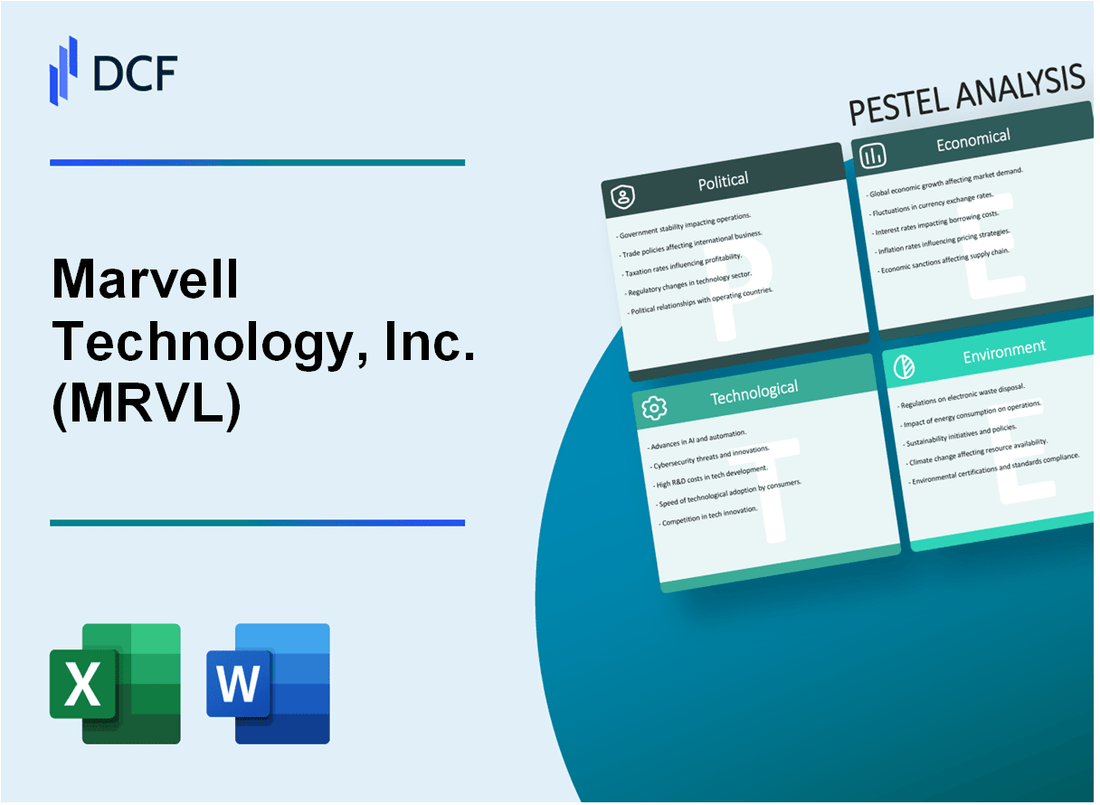
Marvell Technology, Inc. (MRVL): PESTLE Analysis [Nov-2025 Updated] |
Fully Editable: Tailor To Your Needs In Excel Or Sheets
Professional Design: Trusted, Industry-Standard Templates
Investor-Approved Valuation Models
MAC/PC Compatible, Fully Unlocked
No Expertise Is Needed; Easy To Follow
Marvell Technology, Inc. (MRVL) Bundle
You're looking at Marvell Technology, Inc. (MRVL) right now, and the picture is sharp: they banked $5.767 billion in fiscal year 2025 revenue by nailing custom AI silicon, but that success is tied to geopolitical tightropes and industry cycles. Honestly, understanding how US-China tensions, high capex demands, and their 86% Scope 1 & 2 GHG reduction goal impact their next move is crucial. Dive in below to see the full PESTLE breakdown that shapes their path forward.
Marvell Technology, Inc. (MRVL) - PESTLE Analysis: Political factors
US-China trade tensions directly restrict advanced chip exports.
The escalating geopolitical rivalry between the U.S. and China is the single most significant political risk for Marvell Technology. The U.S. government's policy of restricting the export of advanced semiconductors and related technology to China, primarily for national security reasons, directly impacts Marvell's market access.
The political climate is highly volatile; for instance, in 2025, there were renewed discussions about the U.S. administration's intent to not allow the export of certain advanced chips, which includes the high-performance custom silicon that Marvell designs for data centers. This uncertainty forces a continuous re-evaluation of product roadmaps and sales strategies. Honestly, the political risk here isn't just about lost sales; it's about the long-term viability of a major market.
43% of FY2025 revenue was exposed to China, creating material risk.
Marvell Technology has a substantial portion of its business tied to the Chinese market, making it acutely vulnerable to any further tightening of export controls or tariffs. For the fiscal year 2025 (FY2025), the company reported total revenue of approximately $5.77 billion. Of this, an estimated 43% of revenue was derived from the Chinese market.
Here's the quick math: a 10% revenue hit in this region due to new sanctions would equate to a loss of over $248 million from the China-exposed revenue base alone. This heavy reliance is a material risk, especially as the company focuses on its high-growth Data Center segment, which includes custom AI silicon-the very products most targeted by U.S. export restrictions.
| Metric | Value (FY2025) | Implication |
|---|---|---|
| Total Revenue | $5.77 Billion | Base for China exposure calculation. |
| Revenue Exposure to China | ~43% | High dependency on a politically volatile market. |
| US Market Revenue Share | ~16% | Indicates a need for significant domestic diversification. |
US CHIPS and Science Act provides domestic manufacturing subsidies.
On the flip side, U.S. domestic policy offers a significant opportunity through the CHIPS and Science Act of 2022. This legislation is a direct political effort to bolster the domestic semiconductor supply chain and reduce reliance on Asian manufacturing. The Act authorized roughly $280 billion in new spending through FY2027, including over $52 billion in direct funding and tax credits for semiconductor manufacturing.
As a U.S.-based fabless chip designer with significant research and development (R&D) operations in California, Marvell Technology is positioned to benefit from these incentives. The most immediate benefit is the semiconductor investment tax credit, which was boosted to between 25% and 30% through 2026 for domestic production investments. This effectively lowers the cost of domestic R&D and manufacturing partnerships, helping Marvell compete against rivals who may not qualify for the same level of subsidy.
Government contracts require compliance with strict supply chain sourcing rules.
While the CHIPS Act provides subsidies, it also comes with strings attached, particularly for companies seeking or holding U.S. government contracts. The political push for supply chain resilience and security has led to a major overhaul of the Federal Acquisition Regulation (FAR) in 2025, focusing on domestic sourcing and transparency.
Marvell's involvement in critical data infrastructure, including custom silicon for hyperscalers who are major government contractors, means it must navigate these complex rules. The key compliance requirements include:
- Stricter Buy American Requirements: Agencies are prioritizing goods made in the USA, which can complicate Marvell's global, fabless manufacturing model.
- TAA Compliance: Meeting the Trade Agreements Act (TAA) standards is non-negotiable for federal contracts, requiring detailed tracking of component country of origin.
- Cybersecurity Maturity Model Certification (CMMC): This is becoming a must for more contracts, forcing Marvell and its partners to implement robust, documented cybersecurity controls.
The political environment is demanding that Marvell not only innovate but also prove the security and domestic origin of its supply chain. If onboarding takes 14+ days to verify a new supplier's compliance, churn risk rises. This focus on domestic sourcing and security is a clear political trend for 2025 and beyond.
Marvell Technology, Inc. (MRVL) - PESTLE Analysis: Economic factors
You're looking at Marvell Technology, Inc.'s economic landscape as of late 2025, and the story is one of massive, targeted growth masking underlying industry volatility and accounting realities. The main takeaway is this: the Data Center segment is an absolute powerhouse, driving record revenue, but the GAAP bottom line still shows a significant loss due to strategic charges and the inherent nature of the semiconductor cycle.
Cyclical nature of the semiconductor industry causes revenue volatility
Honestly, you can never forget that Marvell Technology, Inc. operates in the semiconductor industry, which is notoriously cyclical. The sector has flipped from growth to contraction nine times in the last 34 years, and while 2025 looks solid for now, the outlook for 2026 remains uncertain. This cyclicality means that while Marvell is currently in an acceleration phase, driven by AI, the balance of supply and demand across all chip types can remain bumpy. For a company like Marvell, this means that segments not tied to the current AI buildout can experience sharp inventory corrections or slower demand, which directly impacts overall revenue stability.
To be fair, the industry is structurally growing faster than the global economy because chips are in everything, but that doesn't stop the short-term swings. A key action here is recognizing that any downward movement in AI spending-though not the base case for 2025-could ripple through the entire electronics supply chain.
High interest rates may slow capital expenditure on large cloud infrastructure
The spending spree in cloud infrastructure is staggering, but it's not without financial pressure points. Major hyperscalers-think Amazon, Microsoft, and Google-are projected to spend $\mathbf{\$318 \text{ billion}}$ on capital expenditures in 2025 alone. This massive outlay is primarily for AI-ready servers and data centers. While this fuels Marvell Technology, Inc.'s Data Center segment, the sheer scale of this investment is stretching corporate balance sheets.
Here's the quick math: AI capex is expected to consume up to $\mathbf{94\%}$ of operating cash flow (minus dividends and buybacks) for 2025 and 2026, forcing these giants to rely more heavily on debt markets. While high interest rates and construction costs are factors to monitor, especially for data center real estate, the urgency of the AI race seems to be overriding immediate financing concerns for now. What this estimate hides is the risk associated with refinancing that massive debt load if economic conditions tighten further.
Strong Data Center segment growth offsets weakness in carrier and enterprise markets
This is where you see the strategic pivot in action. Marvell Technology, Inc.'s fiscal year 2025 results clearly show a tale of two businesses. The Data Center segment is on fire, driven by custom AI silicon and interconnect products. For the full fiscal year 2025, Data Center revenue surged $\mathbf{88\%}$ year-over-year to $\mathbf{\$4.16 \text{ billion}}$. In the fourth quarter, this segment grew $\mathbf{78\%}$ year-over-year and represented about $\mathbf{75\%}$ of total revenue.
Conversely, the Carrier Infrastructure and Enterprise Networking segments were lackluster, enduring inventory corrections that dragged down total revenue performance earlier in the year. The company was banking on a recovery in these areas in the second half of FY2025, which contributed to the overall revenue growth. Furthermore, Marvell made a strategic economic move by divesting its Automotive Ethernet business, which was expected to generate $\mathbf{\$225 \text{ million}}$ to $\mathbf{\$250 \text{ million}}$ in 2025 revenue, to focus capital on infrastructure. Infineon Technologies completed the acquisition of this unit for $\mathbf{\$2.5 \text{ billion}}$.
FY2025 GAAP net loss was $\mathbf{(\$885.0) million}$, despite revenue growth
This is the crucial accounting distinction you need to watch. Despite delivering record fourth-quarter revenue of $\mathbf{\$1.817 \text{ billion}}$ and full-year revenue of $\mathbf{\$5.767 \text{ billion}}$, Marvell Technology, Inc. posted a GAAP net loss of $\mathbf{(\$885.0) million}$ for fiscal 2025. This loss compares to a $\mathbf{(\$933.4) million}$ loss in fiscal 2024, so it is an improvement, but still a loss on paper.
The story changes completely when you look at non-GAAP figures, which strip out things like amortization of acquired intangibles and restructuring charges. Non-GAAP net income for FY2025 was a healthy $\mathbf{\$1.377 \text{ billion}}$. The GAAP loss is largely explained by significant operating expenses, including a major restructuring charge taken in Q3 FY2025, and high R&D spending of $\mathbf{\$1.95 \text{ billion}}$ to fuel the AI focus. Still, the company generated a record $\mathbf{\$1.68 \text{ billion}}$ in operating cash flow for the year, which is the real measure of operational health.
Here are the key financial figures for the fiscal year ended February 1, 2025:
| Metric | Value (FY2025) | Context |
| Net Revenue | $\mathbf{\$5.767 \text{ billion}}$ | Up $\mathbf{4.7\%}$ year-over-year |
| GAAP Net Income/(Loss) | $\mathbf{(\$885.0) \text{ million}}$ | Improved from $\mathbf{(\$933.4) \text{ million}}$ in FY2024 |
| Non-GAAP Net Income | $\mathbf{\$1.377 \text{ billion}}$ | Shows strong underlying profitability |
| Data Center Revenue | $\mathbf{\$4.16 \text{ billion}}$ | Represents an $\mathbf{88\%}$ surge year-over-year |
| Operating Cash Flow | $\mathbf{\$1.68 \text{ billion}}$ | A record figure for the full fiscal year |
| Shareholder Returns | $\mathbf{\$933 \text{ million}}$ | Returned via repurchases and dividends |
The company's commitment to future growth is clear, as they expect Q1 FY2026 revenue growth to be over $\mathbf{60\%}$ year-over-year at the midpoint of guidance.
The economic risks you need to track include:
- Cyclical downturn risk in non-AI segments.
- Sustained high cost of capital for hyperscaler expansion.
- Inventory rebalancing in Carrier/Enterprise markets.
- The success of the custom AI silicon ramp continuing into FY2026.
Finance: draft 13-week cash view by Friday
Marvell Technology, Inc. (MRVL) - PESTLE Analysis: Social factors
You're navigating a market where what you do is only half the story; how you report on it is the other half. Investors and customers are demanding proof that your growth isn't coming at the expense of the planet or people, so transparency is now a core business requirement, not just a compliance chore.
Increasing investor and customer demand for transparent ESG reporting
Marvell Technology, Inc. is responding to this by making its sustainability data accessible. They published their FY25 Sustainability Report, which details progress across their three pillars: Thriving Organization, Sustainable Products, and Responsible Supply Chain. For instance, in their operations, they crushed their initial goal, reducing Scope 1 and 2 GHG emissions by 86% in FY25 from the FY22 baseline, far exceeding the original target of 50% by FY30. This kind of concrete data helps build credibility with stakeholders who are increasingly using ESG scores to filter investments; Marvell's S&P Global ESG Score as of February 05, 2025, stood at 43.
Internally, the focus on people is also measurable. They reported an increase in their employee engagement score (eSAT) by two points over the last year, showing continued improvement in the workplace experience. Still, the pressure remains to meet other targets, like achieving a 20% employee participation rate in the philanthropy program by FY27.
Focus on talent attraction and retention in the highly competitive AI labor market
Honestly, finding and keeping the right engineers in the AI and high-performance computing space is a war, and Marvell Technology, Inc. is actively fighting it. To capitalize on the AI spending boom, Marvell plans to grow its workforce in India by 15% annually over the next three years. This aggressive hiring push is necessary because top AI talent is scarce and commands premium compensation; roles adjacent to Big Data or AI architecture in 2025 can easily exceed $300,000 annually, plus equity.
The reality is that AI skills are now essential across the board, not just for specialized roles. In India, for example, a recent survey found that 44% of the tech workforce uses AI daily to hit performance goals. Marvell's ability to scale its R&D and engineering teams hinges on its value proposition beyond just salary. It defintely helps that they are recognized as a trustworthy employer.
Societal pressure for lower data center energy consumption drives product design
The societal conversation around climate change is directly impacting how Marvell Technology, Inc. designs its chips. Data centers, fueled by AI, are massive power consumers; projections suggest AI systems could consume up to 49% of total data center power by the end of 2025. Globally, data center electricity consumption is forecast to hit 536 TWh in 2025.
This external pressure translates into a competitive advantage for Marvell. Their engineers are prioritizing product power efficiency to reduce the Scope 3 emissions associated with product use. They have a clear goal to reduce these emissions by 55% per petabyte per second by FY30, using the FY22 figures as a base. This means every new chip needs to deliver more performance using less energy, which is a direct response to infrastructure planners and customers worrying about grid strain.
Company inclusion in Newsweek's Most Trustworthy Companies for 2025
Earning trust is a tangible asset in this environment. Marvell Technology, Inc. was named to Newsweek and Statista's World's Most Trustworthy Companies list for 2025. This isn't just a popularity contest; the ranking was built on a holistic methodology involving an independent survey of 65,000 residents who submitted over 200,000 evaluations across customer, investor, and employee trust dimensions. Marvell sits among 45 corporations recognized in the Technology Hardware industry category. This external validation helps with customer confidence and signals stability to potential employees and investors alike.
Here's a quick look at some of the key social and ESG metrics driving perception:
| Metric/Factor | Value/Target | Context/Date |
|---|---|---|
| Scope 1 & 2 GHG Reduction (vs FY22) | 86% Reduction | Achieved in FY25 |
| Top Tier 1 Suppliers Audited (RBA VAP) | Pursuing 100% | Goal for 2025 |
| Employee Engagement Score (eSAT) | Increased by 2 points | FY25 Milestone |
| India Workforce Growth | 15% Annually | Planned over next three years |
| Data Center Energy Share (Global) | Up to 49% | Projected AI share by end of 2025 |
| Newsweek Trust Survey Evaluations | Over 200,000 | Used for 2025 Ranking |
Finance: draft a memo by next Tuesday outlining how the FY25 ESG achievements will be integrated into the Q1 2026 capital allocation pitch.
Marvell Technology, Inc. (MRVL) - PESTLE Analysis: Technological factors
You're looking at a company whose entire near-term valuation hinges on its ability to execute in the most demanding technological arms race in history: AI infrastructure.
Honestly, Marvell Technology, Inc. is no longer just a supplier; it's a key enabler for the hyperscalers building the next generation of AI compute. The technological landscape is defined by specialization, speed, and process node mastery, and Marvell is making aggressive, targeted bets to secure its position in this high-stakes game.
AI-Related Revenue Milestone in Fiscal Year 2025
The big news here is that Marvell Technology hit a crucial internal benchmark, proving its custom silicon strategy is working. For the fiscal year ending February 1, 2025, Marvell Technology's AI-related revenue successfully exceeded $1.5 billion.
To put that in perspective, the company's total net revenue for the full fiscal year 2025 was reported at $5.767 billion. Management has signaled that the contribution from AI is set to become the majority, expecting AI-related revenue to surpass 50% of total revenues very soon. This shift is driven by the ramp of custom XPU (accelerated computing) solutions and high-speed interconnects for cloud providers.
Core Strength: Custom AI Silicon and Electro-Optical Interconnects
Marvell Technology's competitive edge isn't in general-purpose GPUs; it's in the specialized 'plumbing' that connects them. Their core strength lies in two areas: custom AI ASICs (Application-Specific Integrated Circuits) and the electro-optical interconnects that move data between those chips.
These custom chips are designed for workload-specific optimization, offering better power draw and cost-per-performance than off-the-shelf solutions for inference tasks. On the connectivity side, they are shipping critical components like 800G PAM4 DSPs (Digital Signal Processors) and qualifying next-generation 1.6T PAM4 DSPs. This focus on the infrastructure layer is what makes them a vital partner for cloud giants looking to differentiate their AI platforms. It's a defintely sticky business once you're integrated.
Here's a quick look at where their key product strengths lie:
- Leading SerDes and optical interconnect Intellectual Property (IP).
- Custom ASIC capabilities for workload optimization.
- Ramping 51.2 Tbps switches for data center fabrics.
- New offerings like COLORZ 800G ZR/ZR+ for multi-site training.
R&D Investment in Next-Generation Process Nodes and Packaging
To keep pace with the hyperscalers' aggressive refresh cycles-which are now demanding innovation in under 12 months-Marvell Technology is heavily investing in the bleeding edge of semiconductor manufacturing. Their R&D is focused on securing foundational IP for future products across the most advanced process nodes available.
The company is actively developing products on 5nm, 3nm, and 2nm technology platforms. They have already demonstrated their first 2nm silicon IP built on TSMC's 2nm process, which includes high-speed 3D I/O and SerDes capable of speeds beyond 200 Gbps. Furthermore, they are driving advancements in chiplet integration, which is crucial for building complex, high-performance systems in a modular way.
Here's how their process node focus stacks up against their latest product announcements:
| Technology Focus Area | Process Node/Speed Target | Key Product/Application |
| Custom Silicon IP | 2nm | Next-generation AI and cloud infrastructure silicon. |
| Optical Interconnects | 3nm | Marvell Ara 1.6T PAM4 DSP (8 channels at 200G/lambda). |
| Data Movement | Foundational IP | High-speed long-reach SerDes beyond 200 Gbps. |
Intense Competition in Custom Silicon
This is where you need to keep your eye on the ball. Marvell Technology is fighting for share in a market where Broadcom is the established giant, reportedly holding around 70% of the custom AI processor market. Broadcom's success is tied to its deep, multi-year partnerships with hyperscalers like Google.
However, Marvell is aggressively challenging this dominance. They are targeting a 20% market share of custom AI processors by 2028, up from less than 5% in 2023. The competitive dynamic is fueled by hyperscalers seeking alternatives due to pricing concerns or a desire to diversify supply away from a single vendor, which has benefited Marvell Technology, especially with customers like Amazon. Still, you can't ignore NVIDIA, which is also reportedly moving into the custom chip design space itself, aiming to maintain its overall ecosystem lock-in.
The competition is fierce:
- Broadcom: Current market leader in custom silicon.
- NVIDIA: The incumbent, pushing new GPU generations and entering custom ASIC design.
- Hyperscalers: All major cloud providers are investing heavily in their own chip teams.
Finance: draft a sensitivity analysis on MRVL's gross margin if Broadcom were to win a major design win currently attributed to Marvell by Q3 2026.
Marvell Technology, Inc. (MRVL) - PESTLE Analysis: Legal factors
You're navigating a legal landscape that demands constant vigilance, especially given Marvell Technology, Inc.'s deep involvement in sensitive technology and government supply chains. The key takeaway here is that while the company actively manages environmental compliance, the persistent high-stakes nature of semiconductor IP litigation and the shadow of past governance issues require robust, forward-looking legal oversight.
Compliance required for US government contracts, including supply chain restrictions
If Marvell Technology, Inc. is bidding on or supporting defense or critical infrastructure contracts, compliance is non-negotiable and getting stricter. Their high-performance semiconductor products are classified as Dual-Use Items, meaning they fall under U.S. export controls like the Export Administration Regulations (EAR) and International Traffic in Arms Regulations (ITAR). This means you defintely need to screen every transaction to avoid doing business with restricted parties or in certain countries without specific U.S. government authorization.
For 2025, the focus is heavily on supply chain integrity and cybersecurity. New rules are pushing for more domestic sourcing, with a goal of 75% domestic components in items purchased by federal agencies by 2029, up from 55%. Furthermore, the Cybersecurity Maturity Model Certification (CMMC) framework is being rolled out, requiring contractors to meet specific security standards to remain eligible for Department of Defense (DoD) contracts. Marvell's secure hardware IP, which can cryptographically bind supplier information to the device, is a direct response to these sovereignty requirements.
Here are the primary regulatory frameworks impacting government-facing sales:
- Export controls subject to EAR, ITAR, and OFAC regulations.
- Potential license requirement for exports to military end users in China, Russia, and Venezuela.
- Adherence to CMMC levels for DoD contract eligibility.
- Increasing domestic sourcing mandates under Buy American Act scrutiny.
Adherence to global chemical and waste laws (RoHS, REACH, WEEE)
As a fabless semiconductor company, Marvell Technology, Inc. relies heavily on its suppliers to ensure product compliance with global environmental mandates, but the ultimate liability rests with them. They declare that their integrated circuit products comply with the EU RoHS Directive (2011/65/EU and amendment (EU) 2015/863) and are Halogen Free. This is a continuous process, as evidenced by their compliance certificate referencing the SVHC (Substances of Very High Concern) list released on January 21, 2025, under REACH regulations.
Failure to comply with these laws, including the EU Waste Electrical and Electronic Equipment Directive (WEEE Directive), can result in fines, sales limitations, or other sanctions. The company explicitly states it will not be liable for damages arising from non-conformance, placing the onus on supplier declarations and testing, which is a risk factor in itself.
Intellectual property (IP) litigation risk is high in the semiconductor sector
The semiconductor space is a legal minefield, and patent disputes are a major concern heading into 2025. A recent survey indicated that 46% of companies expecting increased IP exposure cited greater vulnerability to patent disputes over the last year. This isn't just theoretical for Marvell Technology, Inc.; while a massive verdict occurred earlier, it highlights the potential scale of risk. A jury previously awarded $1.17 billion in damages in a patent infringement case brought by Carnegie Mellon University (CMU) concerning read channel detector technology, though Marvell Technology, Inc. intended to vigorously appeal.
The risk is compounded by the general environment, where AI tools are creating new questions about ownership and training data, pushing more companies toward enforcement litigation.
| Litigation Risk Factor | Sector Trend (2025 Expectation) | Marvell Specific Context |
| Patent Disputes | 46% of firms expecting increased exposure cited this | History of massive damage awards (e.g., $1.17 billion verdict) |
| Trade Secret Disputes | 44% of firms expecting increased exposure cited this | High reliance on in-house patented technology requires strong defense |
| AI-Related IP Issues | 55% of firms expecting increased exposure cited AI as a factor | Developing custom ASIC solutions leveraging proprietary IP creates exposure points |
SEC charges for past accounting issues show a history of governance risk
You must recognize that Marvell Technology, Inc. has a history of governance risk related to financial disclosures. In September 2019, the company paid $5.5 million to settle SEC charges that it misled investors by failing to disclose a practice of accelerating sales, known as pull-ins. This practice masked declining demand and loss of market share.
Here's the quick math on the scale of the undisclosed activity:
- Total pulled-in revenue across three quarters: $165 million.
- Q4 FY2015 pull-in: $24 million (5% of storage segment revenue).
- Q1 FY2016 pull-in: $64 million (16% of storage segment revenue).
What this estimate hides is the potential for ongoing, less publicized legal costs; for instance, Marvell Technology, Inc.'s Selling, General, and Administrative expense in fiscal 2025 saw a decrease partly due to lower charges related to an intellectual property matter in fiscal 2024. This history suggests that governance and internal controls around revenue recognition and disclosure must remain under intense scrutiny.
Finance: Draft a memo by next Tuesday detailing the internal audit schedule for Q1 FY2026 revenue recognition controls, specifically referencing the 2019 SEC settlement.
Marvell Technology, Inc. (MRVL) - PESTLE Analysis: Environmental factors
You're looking at how Marvell Technology, Inc. is handling the environmental pressures that come with designing chips for the massive AI and cloud buildout. Honestly, the biggest takeaway right now is that they are hitting their operational targets way ahead of schedule, but the real long-term battle is in the supply chain and the power consumption of the chips once they are in customer data centers.
Surpassed Science Based Target, reducing Scope 1 and 2 GHG emissions by 86% in FY2025
Marvell Technology, Inc. has made incredible strides in cleaning up its own house. They set a Science Based Target (SBT) to cut Scope 1 and 2 Greenhouse Gas (GHG) emissions-that's emissions from their direct operations-by 50% by Fiscal Year 2030, using FY2022 as the baseline year. Well, they blew past that goal in FY2025. They reported an 86% reduction in Scope 1 and 2 emissions compared to that FY2022 baseline. This massive drop is largely thanks to their commitment to renewable energy; they reached approximately 97% renewable electricity usage globally in FY2025. That's six years early, which is defintely something to note when assessing operational risk.
Here's a quick look at where they stand on their key climate goals:
| Metric | Target Goal | Baseline Year | Status/FY2025 Achievement |
| Scope 1 & 2 GHG Reduction (Operational) | 50% reduction | FY2022 | Achieved 86% reduction in FY2025 |
| Scope 3 GHG Reduction (Use of Sold Products) | 55% reduction per petabyte per second | FY2022 | Target set for FY2030 |
| Renewable Electricity Usage (Global) | Not explicitly stated as a final goal | N/A | Reached approximately 97% in FY2025 |
Designing products for power efficiency to reduce data center energy footprint
Since Marvell Technology, Inc. is a fabless semiconductor designer, the bulk of their impact-over 90% of their total footprint-is in Scope 3, specifically from customers using their sold products. This means power efficiency isn't just a nice-to-have; it's a core business strategy and a competitive advantage, especially as AI energy demands skyrocket. Their engineers are focused on delivering higher performance with less power draw.
They have a specific target to drive this: reduce their product use GHG emissions by 55% per petabyte per second by FY2030, relative to the FY2022 baseline. They are achieving this through innovation in areas like custom ASICs, which offer lower power consumption, and new product families like the Structera CXL controllers that improve memory efficiency, thus lowering the energy needed for compute and cooling in the data center. Plus, their partnership with Empower Semiconductor to integrate voltage regulators closer to the processor aims to cut down on power transmission losses right at the source. That's smart engineering tackling a real-world energy problem.
Reliance on Taiwan Semiconductor Manufacturing Company (TSMC) carries climate-related supply chain risk
As a fabless company, Marvell Technology, Inc. relies heavily on external foundries, most notably Taiwan Semiconductor Manufacturing Company (TSMC), for manufacturing. This dependence means that TSMC's climate-related risks-like securing renewable energy for their massive fabrication plants-become Marvell's climate-related supply chain risks. To manage this, Marvell is actively engaging its supply chain. They are working with industry partners, including being a member of the Semiconductor Climate Consortium (SCC), to promote abatement strategies and energy efficiency best practices across the sector.
What this looks like in practice:
- Hold regular discussions on supplier climate action plans.
- Integrate climate-related criteria into supplier Quarterly Business Reviews.
- Collaborate on enhancing environmental resilience in the semiconductor supply chain.
Mandatory supplier disclosure on climate targets via the CDP Supply Chain program
You can't manage what you don't measure, and Marvell Technology, Inc. is pushing hard for transparency upstream. They require their direct manufacturing suppliers to report their Scope 1, 2, and key Scope 3 emissions data through the CDP Supply Chain program. This isn't just a suggestion; it's becoming standard operating procedure for their partners. For FY2025, they expanded this request beyond just Tier 1 suppliers to all direct manufacturing suppliers for their products. That's a significant step up in accountability. They saw a 65% response rate from this expanded group, which is a solid start given the varying levels of climate disclosure maturity among suppliers. They are using this data to evaluate sustainability maturity across their value chain.
Finance: draft 13-week cash view by Friday
Disclaimer
All information, articles, and product details provided on this website are for general informational and educational purposes only. We do not claim any ownership over, nor do we intend to infringe upon, any trademarks, copyrights, logos, brand names, or other intellectual property mentioned or depicted on this site. Such intellectual property remains the property of its respective owners, and any references here are made solely for identification or informational purposes, without implying any affiliation, endorsement, or partnership.
We make no representations or warranties, express or implied, regarding the accuracy, completeness, or suitability of any content or products presented. Nothing on this website should be construed as legal, tax, investment, financial, medical, or other professional advice. In addition, no part of this site—including articles or product references—constitutes a solicitation, recommendation, endorsement, advertisement, or offer to buy or sell any securities, franchises, or other financial instruments, particularly in jurisdictions where such activity would be unlawful.
All content is of a general nature and may not address the specific circumstances of any individual or entity. It is not a substitute for professional advice or services. Any actions you take based on the information provided here are strictly at your own risk. You accept full responsibility for any decisions or outcomes arising from your use of this website and agree to release us from any liability in connection with your use of, or reliance upon, the content or products found herein.