

|
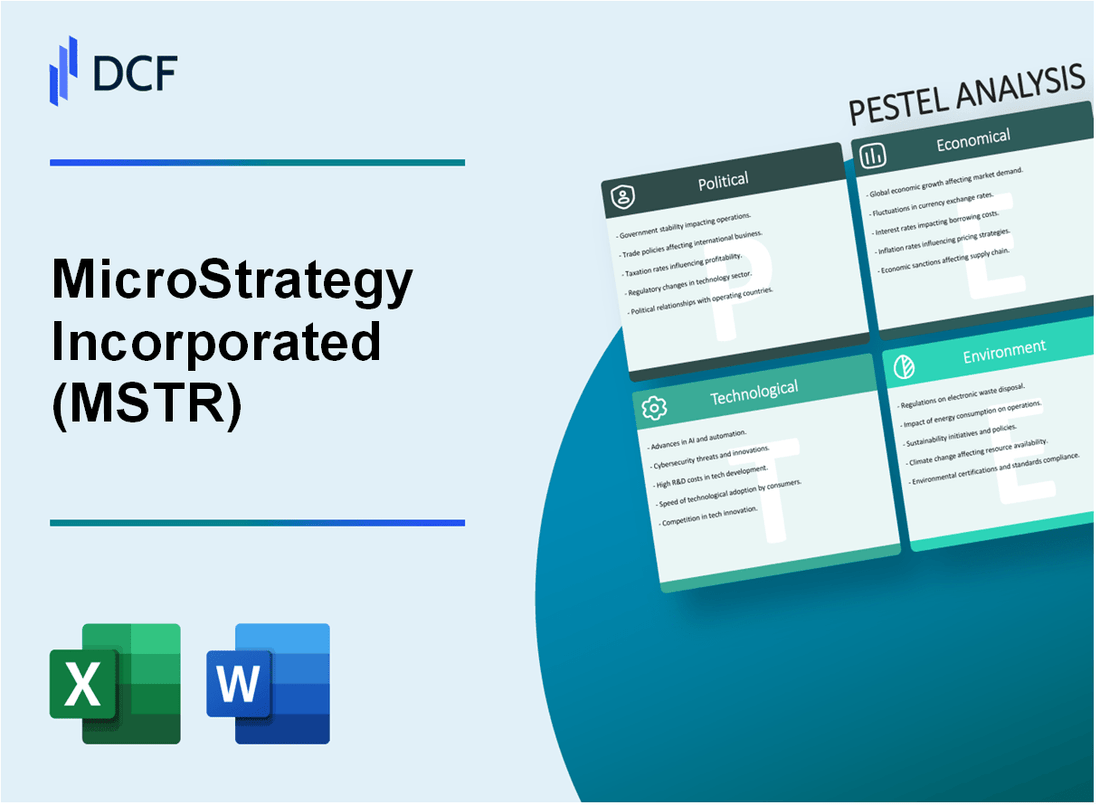
MicroStrategy Incorporated (MSTR): PESTLE Analysis [Nov-2025 Updated] |
Fully Editable: Tailor To Your Needs In Excel Or Sheets
Professional Design: Trusted, Industry-Standard Templates
Investor-Approved Valuation Models
MAC/PC Compatible, Fully Unlocked
No Expertise Is Needed; Easy To Follow
MicroStrategy Incorporated (MSTR) Bundle
You're looking for a clear-eyed view of MicroStrategy Incorporated (MSTR), and that means mapping the external forces shaping its dual identity: a business intelligence software firm and a massive corporate Bitcoin treasury. Honestly, the company's fate is now tied less to software sales and more to the regulatory and market environment for digital assets, so we need to analyze that reality. For instance, the sheer size of their Bitcoin holdings-recently over 200,000 coins, with an estimated market value in late 2025 potentially exceeding $15 billion-makes them an economic proxy for the asset class itself. This PESTLE analysis cuts straight to the near-term political, economic, and technological risks and opportunities you need to act on.
MicroStrategy Incorporated (MSTR) - PESTLE Analysis: Political factors
Global regulatory clarity on Bitcoin custody and corporate treasury rules
The political environment for MicroStrategy Incorporated's (MSTR) Bitcoin strategy is defined by a global, yet fragmented, push toward regulatory clarity. This is a double-edged sword: institutional adoption requires rules, but those rules can constrain the very mechanism that made the company's strategy work.
The corporate treasury movement, which MicroStrategy pioneered, is now a global trend, with over 100 companies worldwide holding Bitcoin on their balance sheets. This institutional flow is quantifiable, with institutional-scale transactions (over $1 million) now representing a substantial share of on-chain volume in 2025. The maturation of this asset class is forcing policymakers to act. For example, Japan has provided a regulatory environment that makes holding digital assets via corporate entities more tax-efficient, which is a clear political lever for adoption.
The US Congress has also made progress in 2025 with the passage of the GENIUS Act (for stablecoins) and the proposed CLARITY Act (which aims to define oversight between the Securities and Exchange Commission and the Commodity Futures Trading Commission). This legislative movement reduces legal uncertainty for the broader crypto market, which, in turn, legitimizes MicroStrategy's role as a primary Bitcoin proxy for institutional capital.
US government stance on digital asset taxation and accounting standards
The US government's actions on accounting and tax standards in 2025 have fundamentally changed how MicroStrategy reports its core asset, which is a massive political and financial shift. You no longer have to deal with the old, punitive intangible asset accounting treatment.
The Financial Accounting Standards Board (FASB) adopted ASU 2023-08, effective for fiscal years beginning after December 15, 2024. This mandates that companies use fair value accounting for crypto assets and recognize changes in net income each reporting period. MicroStrategy adopted this in Q1 2025, which resulted in a significant cumulative net increase of $12.7 billion to the opening balance of retained earnings.
On the tax side, the Internal Revenue Service (IRS) is tightening reporting. Brokers are now required to report gross proceeds for digital asset transactions on Form 1099-DA starting January 1, 2025. This phased-in reporting will increase transparency and compliance for all digital asset transactions, including those related to MicroStrategy's capital raising and treasury operations.
Geopolitical tensions affecting global capital flows into decentralized assets
Geopolitical instability and macroeconomic policy uncertainty are key drivers for the institutional capital flowing into decentralized assets like Bitcoin, which directly benefits MicroStrategy's stock premium. The company acts as a high-beta proxy for this flow.
However, this political-economic link is a risk, too. In early 2025, Bitcoin's correlation with the Nasdaq 100 reached 0.80, its highest since 2022. This strong correlation means Bitcoin is increasingly behaving like a conventional risk asset, not just a safe-haven hedge, making it more sensitive to US interest rate decisions and global liquidity conditions. The primary political driver remains a lack of investor confidence in fiat money systems, which continues to push institutional investors, including sovereign wealth funds, toward hard-capped assets.
Increased scrutiny from the Securities and Exchange Commission (SEC) on Bitcoin-focused public companies
MicroStrategy's status as the pioneer of the Bitcoin treasury model has placed it directly in the crosshairs of US financial regulators, creating a major near-term political risk. The SEC and the Financial Industry Regulatory Authority (FINRA) are jointly investigating over 200 listed companies that announced crypto treasury plans in 2025. The focus is on abnormal stock price fluctuations prior to disclosures, examining potential insider trading or breaches of Regulation Fair Disclosure (Reg FD).
MicroStrategy is also facing a securities fraud class action lawsuit, filed by investors, alleging the company made false or misleading statements about its Bitcoin holdings and related financial risks. This legal scrutiny is compounded by the existential threat of index exclusion.
Here's the quick math on the index exclusion risk:
| Index Provider | Decision Date | Potential Forced Outflow (Estimate) | Reason for Scrutiny |
|---|---|---|---|
| MSCI (Morgan Stanley Capital International) | January 15, 2026 | $2.8 billion (MSCI funds alone) | Balance sheet dominated by Bitcoin (Digital Asset Treasury Company classification) |
| Other Index Providers (Nasdaq, Russell) | Follow-up to MSCI | Up to $8.8 billion to $11.6 billion (Total) | Following MSCI's precedent for companies whose main business is holding crypto assets |
If the MSCI removes MicroStrategy, it would trigger forced sales of approximately $2.8 billion in passive funds, which would severely impact the stock's liquidity and valuation premium. The company's ability to raise equity and debt, which fuels its Bitcoin purchases, is defintely tied to its inclusion in these major indices.
MicroStrategy Incorporated (MSTR) - PESTLE Analysis: Economic factors
Bitcoin price volatility directly impacting MSTR's balance sheet and stock valuation.
The economic reality for MicroStrategy Incorporated is that its valuation is now inextricably linked to the price volatility of Bitcoin (BTC). As of late November 2025, the company holds approximately 649,870 BTC, acquired at an average cost of around $74,433 per coin.
This massive treasury position, which dwarfs the firm's software revenue of roughly $500 million annually, means every swing in the crypto market is an immediate, magnified risk or opportunity for the stock. For instance, when Bitcoin recently recovered toward the $90,000 level, it restored investor confidence; however, the stock has also been punished far more than the underlying asset during downturns. The correlation coefficient between the stock and Bitcoin has been extremely high, recently increasing to 0.94 since the October peak. The stock is a leveraged proxy for Bitcoin, plain and simple.
Here's the quick math: with the average cost at $74,433, a drop below that level would push the company into an unrealized loss position, triggering market panic and potentially margin pressure on some of its leveraged debt. This is a single, clear risk. The market-implied Net Asset Value (mNAV) premium, which allowed the company to raise capital accretively, has collapsed to nearly 1x the value of its Bitcoin holdings, fundamentally altering its capital-raising economics.
| Metric (as of Nov 2025) | Value/Range | Economic Implication |
|---|---|---|
| Total Bitcoin Holdings | 649,870 BTC | Over 90% of total assets, making it a 'digital asset treasury' firm. |
| Average Bitcoin Cost | ~$74,433 per BTC | The psychological and financial break-even point for the treasury. |
| BTC-to-MSTR Stock Correlation | 0.94 | Stock acts as a highly leveraged, high-beta bet on Bitcoin price. |
| Market-Implied NAV Premium | Near 1x | The primary capital-raising mechanism (selling stock at a premium to buy Bitcoin) is disabled. |
Inflation rates and central bank policies driving institutional interest in Bitcoin as a hedge.
The macroeconomic environment of persistent inflation and a shifting Federal Reserve (Fed) policy is a key driver for the institutional narrative that supports MicroStrategy's strategy. The annual US inflation rate stood at 3% in September 2025, remaining above the Fed's 2% target. This sustained inflation has kept the 'digital gold' hedge thesis alive for Bitcoin, attracting institutional money.
Moreover, the Fed's monetary policy has shifted toward easing, with the Federal Funds Rate target range lowered to 3.75%-4.00% in October 2025. This easing, driven by a cooling labor market, typically reduces the real return on traditional fixed-income assets, making non-yielding, fixed-supply assets like Bitcoin more attractive to large-scale investors like pension funds.
- US Inflation (Sept 2025): 3%, above the 2% target.
- Fed Funds Rate (Oct 2025): Target range of 3.75%-4.00% after a 25 bps cut.
- Lower real rates increase the opportunity cost of holding cash or low-yield bonds.
- This environment justifies MSTR's pitch of Bitcoin as a superior treasury reserve asset.
US dollar strength affecting the global purchasing power of their software services.
While the Bitcoin treasury dominates the financial conversation, MicroStrategy still generates revenue from its enterprise software business, and that revenue is subject to foreign exchange (FX) translation effects. The US Dollar Index (DXY), which measures the dollar against a basket of major currencies, was around 100.10 to 100.1455 in late November 2025.
The dollar has technically strengthened by 1.38% over the past month, which creates a slight foreign exchange headwind for US-based multinational companies like MicroStrategy. However, the DXY is down 6.42% over the last 12 months, suggesting that, on a year-over-year basis, foreign revenue translated back into US dollars would have received a tailwind for most of 2025. Any sustained dollar strength from the 100 mark going forward will reduce the dollar-equivalent value of their software sales made in foreign currencies, impacting their reported revenue. This is a minor headwind compared to the Bitcoin volatility, but it's defintely a factor for the core software business.
Cost of capital for future debt issuance used to finance further Bitcoin purchases.
MicroStrategy's ability to finance its Bitcoin purchases hinges on its remarkably low cost of capital, largely achieved through its use of convertible senior notes. The company has raised over $20 billion in capital since 2020 through these instruments.
The cost of this funding is exceptionally low. For example, recent issuances include $2 billion in 0% notes due 2030 and $1.75 billion in 0.625% notes due 2028. The total notional value of its six convertible debt sales is $8.2 billion, carrying an average low coupon rate of just 0.421%. This low rate is possible because bondholders are compensated with the option to convert their debt into stock at a premium (typically 35% to 55%), giving them leveraged upside exposure to Bitcoin's price. This is a structural advantage. What this estimate hides, however, is that as the stock's premium to its Net Asset Value collapses, raising new capital becomes harder and more dilutive, as the conversion premium is less valuable to investors.
MicroStrategy Incorporated (MSTR) - PESTLE Analysis: Social factors
You need to understand how major social shifts-from institutional acceptance of Bitcoin to the new reality of remote work-are reshaping the value proposition and risks for MicroStrategy Incorporated. The core takeaway is that while the social validation of Bitcoin is a massive tailwind, the company's dual identity as a software vendor and a Bitcoin proxy creates unique, high-stakes social and talent challenges.
Growing institutional acceptance of Bitcoin as a legitimate store of value
The social perception of Bitcoin (BTC) has fundamentally shifted from a niche, volatile asset to a legitimate, institutional-grade store of value. This is a massive social validation for MicroStrategy's entire strategy. A Q1 2025 survey found that 93% of institutional investors involved in digital assets maintain a positive long-term outlook on blockchain technology, regardless of short-term volatility.
This acceptance is translating into real capital flows. By Q2 2025, surveys indicate that roughly 59% of institutional investors now dedicate at least 10% of their portfolios to Bitcoin and other digital assets, a significant jump from prior years. We are also seeing the first phase of 401(k) plans adding Bitcoin ETF options, a process expected to accelerate between 2025 and 2027. This mainstreaming of the asset class directly supports MicroStrategy's balance sheet strategy, which held 553,555 BTC as of April 28, 2025.
| 2025 Institutional Bitcoin Adoption Metrics | Key Data Point | Implication for MicroStrategy |
|---|---|---|
| Institutional Sentiment (Q1 2025) | 93% positive long-term outlook on digital assets. | Validates the long-term treasury strategy and attracts more institutional equity investors. |
| Portfolio Allocation (Q2 2025) | 59% of institutions dedicate $\ge$10% of portfolios to digital assets. | Creates a larger, more stable investor base for a Bitcoin proxy like MicroStrategy. |
| Projected Institutional Inflows (FY 2025) | Expected $\sim$$120 billion in institutional funds to flow into Bitcoin. | Provides a powerful demand-side catalyst for the asset that underpins MicroStrategy's valuation. |
Talent acquisition challenges in a competitive market for both AI/BI engineers and crypto experts
MicroStrategy operates at the intersection of two of the most competitive talent markets: enterprise analytics (AI/BI engineers) and digital assets (crypto experts). The general market is facing persistent skills shortages, especially in technology and engineering.
For the software side, the demand for skilled data analysts and AI engineers is soaring. Remote data analyst job listings on platforms like LinkedIn reached over 10,000 in 2025, showing the intensity of the competition. The integration of AI has actually increased the strategic value of these roles, meaning the talent bar is higher, not lower. The crypto side adds another layer of complexity; attracting top-tier crypto experts requires a culture and compensation structure that competes with highly-liquid, crypto-native firms, not just traditional tech companies.
Here's the quick math: MicroStrategy needs to hire for a software business that generated Q3 2025 revenue of $128.7 million, but its valuation is driven by a Bitcoin treasury that requires a different, highly specialized skillset. It's a tough pitch to make defintely.
Public perception of the company, heavily influenced by the CEO's high-profile Bitcoin advocacy
The company's public identity is inseparable from its Executive Chairman's, Michael Saylor, and his staunch Bitcoin advocacy. This high-profile stance is a double-edged sword that creates both intense loyalty from Bitcoin maximalists and significant scrutiny from traditional finance (TradFi).
The most immediate social risk is the ongoing review by MSCI, an index provider, regarding MicroStrategy's classification. The firm is debating whether to exclude companies whose digital assets make up at least half of their total assets from flagship equity indices. Exclusion could trigger a sell-off of up to $8.8 billion in index-linked outflows, a major perception and liquidity event.
The CEO's public defense is that MicroStrategy is an operating business with a $500 million software division, not a passive fund. Still, the stock's volatility acts as a social barometer for the Bitcoin market. For example, in November 2025, the stock collapsed more than 40% in one week, sitting 70% below its recent peak, which amplifies negative sentiment across the broader crypto space.
- CEO's advocacy: Creates a clear, polarizing brand identity that attracts Bitcoin-focused capital.
- MSCI risk: Potential reclassification could trigger up to $8.8 billion in passive outflows, challenging the public narrative.
- Stock volatility: MicroStrategy often acts as a leveraged proxy for Bitcoin, with its stock price movements heavily influencing market sentiment.
Shifting work models (remote/hybrid) impacting demand for enterprise analytics platforms
The global shift toward remote and hybrid work models is a profound social change that directly impacts the demand for enterprise analytics platforms like MicroStrategy's software. The good news is that this shift is driving demand for data-driven decision-making tools.
With 22 million Americans projected to work remotely in 2025, and 63% of companies offering hybrid options, organizations need sophisticated Business Intelligence (BI) tools to manage a decentralized workforce and complex operations. This environment increases the need for centralized, cloud-based analytics platforms that can be accessed anywhere, which is a key selling point for a modern BI vendor.
The demand for remote work is not slowing down; 98% of employees prefer to work remotely, making flexibility a non-negotiable social norm for talent acquisition and retention. This trend forces companies to invest in the digital infrastructure-including analytics-that supports a distributed workforce, creating a sustained opportunity for MicroStrategy's software sales, which saw Subscription Services Revenues increase by 61.6% year-over-year in Q1 2025. The move to hybrid work is a tailwind for the software side of the business.
Action: Finance needs to model the revenue impact of a 10% increase in subscription services, driven by hybrid work demand, against the potential $8.8 billion index-exclusion risk by Friday.
MicroStrategy Incorporated (MSTR) - PESTLE Analysis: Technological factors
Rapid advancements in generative AI and machine learning integration into Business Intelligence (BI) platforms.
You're seeing the BI market pivot hard into generative AI (GenAI), and MicroStrategy is defintely pushing to keep pace. They've integrated their 'Auto AI bot' into the MicroStrategy ONE platform, which lets users query data using plain, natural language instead of complex code or dashboard filters. This is a critical move to democratize data access across an enterprise.
The latest release in January 2025 focused on personalizing the AI experience, making the conversational bot smarter by using context and past interactions. Plus, they're using features like 'Auto Narratives' to automatically summarize data visualizations, cutting straight through the noise to the insight. This focus on user-friendliness is key because the best BI tool is the one people actually use.
The need for continuous innovation to compete with cloud-native BI rivals like Snowflake and Microsoft.
MicroStrategy's core BI business is in a tough, high-stakes fight against cloud-native giants. Competitors like Microsoft (with Power BI) and Snowflake are driving the market's shift to cloud-first, consumption-based models. To counter this, MicroStrategy has fully embraced a cloud-native architecture, making MicroStrategy ONE available on all major cloud marketplaces, including AWS, Microsoft Azure, and Google Cloud.
The company is still spending to innovate, with estimated Research & Development (R&D) expenses for the 2025 fiscal year projected to be around $102.50 million, representing a significant year-over-year growth of about 30.13%. That kind of spending is necessary just to stay relevant. Interestingly, they're also partnering with some rivals; for instance, Snowflake recognized MicroStrategy as a leader in Business Intelligence in its Modern Marketing Data Stack Report 2025, which shows a strategy of co-existence and deep integration with the modern data stack. You can't beat everyone, so you partner with some.
Security risks associated with managing a vast, decentralized Bitcoin treasury.
The biggest technological risk for MicroStrategy isn't in their software business; it's in their treasury. Managing a massive, decentralized Bitcoin (BTC) treasury-which stood at over 650,000 bitcoins as of November 2025-introduces a unique, existential security risk. The technical challenge is the secure custody of the private keys for a digital asset portfolio that was valued at over $73 billion in Q3 2025 when the BTC price was over $114,000.
A single, catastrophic security breach or loss of private keys could instantly wipe out a huge portion of the company's assets. The volatility itself is a risk; the company's SEC filings in 2025 noted that Bitcoin's price swung between $60,000 and $120,000 over the preceding year, directly impacting their share price and financial stability. It's a huge asset, but the security model has to be flawless.
Key technological security risks for the Bitcoin treasury:
- Custody Risk: Loss or destruction of private keys for the cold storage.
- Cyberattacks: Sophisticated, highly targeted exploits aiming at the private key management systems.
- Internal Threats: Compromise of employees with access to the multi-signature scheme.
- Software Vulnerabilities: Exploits in the digital asset management software or hardware used for custody.
Development of layer-2 solutions and scaling technologies for Bitcoin, enhancing its utility.
The technology around Bitcoin is evolving rapidly beyond just a store of value. The surge in adoption of Layer 2 (L2) solutions in 2025 is a massive opportunity that could fundamentally change the utility of MicroStrategy's holdings. These L2 solutions, like the Lightning Network (with a Total Value Locked (TVL) of over $234 million) and new networks like Stacks and Merlin Chain, are designed to enhance Bitcoin's scalability and programmability.
They enable faster, cheaper transactions and allow for the development of decentralized finance (DeFi) applications-often called BTCFi-directly secured by the Bitcoin blockchain. If MicroStrategy can find a way to securely and profitably integrate its vast BTC treasury into this emerging BTCFi ecosystem, it could create a new revenue stream and further validate its 'Bitcoin Treasury Company' model.
Here's a quick look at how L2 technologies are changing the game for Bitcoin:
| Layer 2 Solution | Primary Technological Benefit | Impact on MSTR's Treasury Strategy |
|---|---|---|
| Lightning Network | Enables instant, low-cost micro-transactions off-chain. | Potential for using BTC for corporate payments or services, not just a store of value. |
| Stacks (sBTC) | Adds smart contract capabilities and decentralized apps (dApps) to Bitcoin. | Allows the treasury to be used as collateral or to participate in yield-generating BTCFi protocols. |
| Rollups (e.g., Merlin Chain) | Batches transactions for efficient settlement on the main chain, increasing throughput. | Improves the efficiency of any future large-scale treasury transactions or capital deployment. |
| Legal Action Event (2025) | Key Financial Trigger | Outcome/Status (as of Nov 2025) |
|---|---|---|
| Class Action Lawsuit Filed (May 2025) | $5.91 billion unrealized loss on digital assets in Q1 2025 | One case (Hamza) dismissed 'with prejudice' (Aug 2025), others pending. |
| Motion to Dismiss Denied (June 2025) | Stock dropped 3.2% on the news | Litigation allowed to advance to the discovery phase. |
Compliance with international data privacy laws (e.g., GDPR) for the BI software segment
For its enterprise BI software segment, MicroStrategy Incorporated must strictly comply with international data privacy laws like the European Union's General Data Protection Regulation (GDPR). The company states its Data Processing Agreements (DPAs) are GDPR-compliant and uses Standard Contractual Clauses for cross-border data transfers, plus it is certified under the EU-US Data Privacy Framework (DPF).
Still, the risk is escalating. GDPR enforcement is more aggressive than ever in 2025, with major US tech companies facing fines totaling over €3 billion in the first half of the year alone. The core risk for MicroStrategy's BI platform lies in:
- Cross-border data transfers, especially to the US.
- New rules for AI and Machine Learning algorithms, which are central to modern BI platforms.
- The potential for a fine of up to €20 million or 4% of global annual turnover for serious violations.
The BI business is the steady revenue stream, and a major GDPR fine could significantly erode its operating margins.
Intellectual property protection for their proprietary BI algorithms and software features
While the headlines are dominated by Bitcoin, the company's long-term value rests on its proprietary BI algorithms and software features, particularly those integrating Artificial Intelligence (AI) for advanced analytics. In the competitive enterprise software space, IP protection is critical. Though no major 2025 patent infringement lawsuits against MicroStrategy were publicly reported, the industry trend shows rising IP litigation, especially around AI-driven features.
The legal focus here is proactive: securing patents for new AI/ML-driven BI features and defending against inevitable claims from competitors like SAP, IBM, and Oracle. The European Union's AI Act, which entered its final implementation phase in early 2025, introduces binding regulations for AI development and deployment, requiring greater transparency in algorithms. This means the company's proprietary BI algorithms must not only be legally protected but also compliant with new, stringent explainability and fairness standards, which is a major compliance cost.
Evolving legal frameworks for digital asset custody and collateralization
The regulatory environment for digital assets is rapidly professionalizing in 2025, which is both an opportunity and a risk for a company holding 632,457 Bitcoins.
- US Regulation: The new administration's Executive Order 14178 and the formation of the SEC Crypto Task Force signal a move toward a formal legislative framework, potentially clarifying jurisdiction via proposed laws like the Clarity Act.
- Global Clarity: The EU's Markets in Crypto-Assets Regulation (MiCAR) is fully operational since January 2025, providing legal certainty for crypto-asset service providers.
This evolving framework directly impacts MicroStrategy's ability to issue its digital credit securities (STRK, STRF, STRD, STRC, STR), which total $7.7 billion notionally in 2025. Clearer rules on custody and collateralization will either legitimize and de-risk these instruments or impose stricter capital and operational requirements that increase the cost of maintaining their leveraged Bitcoin position.
Finance: draft 13-week cash view by Friday, factoring in a $50 million contingency for legal defense costs.
MicroStrategy Incorporated (MSTR) - PESTLE Analysis: Environmental factors
Scrutiny over the energy consumption of the Bitcoin network (Proof-of-Work)
The core environmental risk for MicroStrategy Incorporated (MSTR) is its massive, indirect exposure to Bitcoin's Proof-of-Work (PoW) consensus mechanism. You're not a mining company, but your balance sheet, which holds over 649,870 Bitcoin as of late 2025, makes you the most visible corporate proxy for Bitcoin's environmental impact. The Bitcoin network's annual energy consumption is staggering, estimated at around 173 TWh in 2025, which is comparable to the energy use of entire mid-sized nations like Poland.
While the Bitcoin mining industry has made progress, with approximately 52.4% of its energy mix coming from sustainable sources like renewables and nuclear power, the sheer volume of energy used still results in a significant carbon footprint, estimated at roughly 39.8 million metric tons of CO₂ annually. This environmental cost is a persistent narrative that MSTR cannot escape. It's a fundamental headwind for the stock, regardless of Bitcoin's price. The market is defintely watching.
| Bitcoin Network Environmental Metric (2025) | Value | Context |
|---|---|---|
| Estimated Annual Energy Consumption | 173 - 175.9 TWh | Equivalent to the power usage of a country like Poland. |
| Estimated Annual Carbon Emissions | ~39.8 Million Metric Tons CO₂ | A conservative estimate based on the current energy mix. |
| Sustainable Energy Share in Mining | ~52.4% | Includes renewable and nuclear energy sources. |
| MSTR Bitcoin Holdings (Late 2025) | 649,870 BTC | The largest corporate holder, magnifying the indirect environmental link. |
Pressure from ESG (Environmental, Social, and Governance) investors regarding the company's indirect carbon footprint
The indirect carbon footprint is translating directly into financial and structural risk. Major institutional investors, including firms like BlackRock and Vanguard, have been observed paring their exposure to MSTR through the third quarter of 2025. This is a clear signal that ESG mandates are influencing capital allocation decisions, especially as the stock's premium to its net asset value (mNAV) has collapsed.
The most critical near-term risk is the potential exclusion from major equity indices like MSCI. The proposed rule would remove companies whose digital-asset holdings exceed 50% of total assets. With MSTR's Bitcoin holdings representing over 77% of its assets, the company is squarely in the crosshairs. Analysts estimate that an exclusion from MSCI alone could trigger $2.8 billion in forced selling from passive funds, with total outflows potentially reaching $8.8 billion if other index providers follow suit. This is a massive, mechanical risk tied directly to the ESG-driven re-classification of the company.
Opportunities to promote their BI software as a tool for corporate sustainability tracking
The software business, now branded as Strategy, offers a critical opportunity to counterbalance the Bitcoin narrative. The broader Business Intelligence (BI) market is rapidly adopting ESG reporting as a key use case. Your Strategy One and Strategy Mosaic™ AI+BI platforms, with their strong data governance and federated analytics capabilities, are perfectly positioned to capitalize on this trend.
Companies are struggling to consolidate the vast and disparate data required for ESG reporting-from energy meters to supply chain emissions. Strategy's core value proposition, providing a unified semantic layer for trusted data, directly solves this problem. You can market the platform as the essential tool for real-time tracking of Scope 1, 2, and 3 emissions, helping clients meet emerging global sustainability frameworks. This is a chance to pivot the narrative: MSTR is a company that enables other companies to be sustainable.
- Automate collection of energy/waste data for Scope 1 & 2 reporting.
- Use Strategy Mosaic™ for a single source of truth on all sustainability KPIs.
- Leverage AI+BI to forecast future carbon emissions and identify mitigation opportunities.
Need for transparent reporting on the environmental impact of their operational data centers
While the Bitcoin holdings dominate the conversation, MSTR's software business still relies on data centers, which are under intense environmental scrutiny. Global data center energy usage now accounts for over 1.1% of worldwide electricity consumption, and the industry is under pressure to disclose metrics like Power Usage Effectiveness (PUE) and water consumption.
MSTR has not provided granular, public disclosures on the environmental impact of its own software operations' data centers in 2025. This lack of transparency is a self-inflicted wound that compounds the Bitcoin-related ESG risk. To be a credible provider of ESG-tracking software, MSTR must first demonstrate its own commitment. Hyperscale cloud providers, which MSTR utilizes, are reporting renewable energy usage as high as 91%, and MSTR needs to clearly articulate its cloud-based carbon footprint and mitigation strategy to meet investor expectations.
Actionable transparency is the only way forward here.
Disclaimer
All information, articles, and product details provided on this website are for general informational and educational purposes only. We do not claim any ownership over, nor do we intend to infringe upon, any trademarks, copyrights, logos, brand names, or other intellectual property mentioned or depicted on this site. Such intellectual property remains the property of its respective owners, and any references here are made solely for identification or informational purposes, without implying any affiliation, endorsement, or partnership.
We make no representations or warranties, express or implied, regarding the accuracy, completeness, or suitability of any content or products presented. Nothing on this website should be construed as legal, tax, investment, financial, medical, or other professional advice. In addition, no part of this site—including articles or product references—constitutes a solicitation, recommendation, endorsement, advertisement, or offer to buy or sell any securities, franchises, or other financial instruments, particularly in jurisdictions where such activity would be unlawful.
All content is of a general nature and may not address the specific circumstances of any individual or entity. It is not a substitute for professional advice or services. Any actions you take based on the information provided here are strictly at your own risk. You accept full responsibility for any decisions or outcomes arising from your use of this website and agree to release us from any liability in connection with your use of, or reliance upon, the content or products found herein.