
|
ArcelorMittal S.A. (MT): Business Model Canvas [Dec-2025 Updated] |
Fully Editable: Tailor To Your Needs In Excel Or Sheets
Professional Design: Trusted, Industry-Standard Templates
Investor-Approved Valuation Models
MAC/PC Compatible, Fully Unlocked
No Expertise Is Needed; Easy To Follow
ArcelorMittal S.A. (MT) Bundle
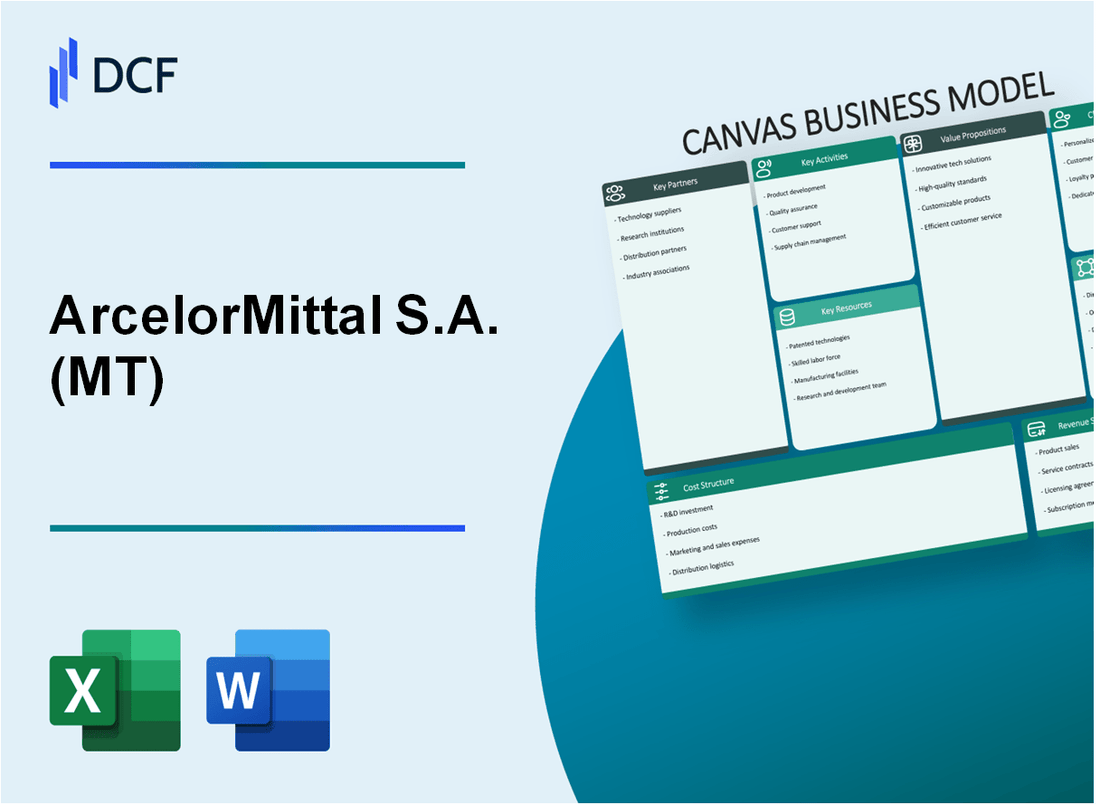
You're looking past the commodity price swings to truly understand how a global giant like ArcelorMittal S.A. makes its money right now, especially as it navigates the massive shift to green steel. Honestly, the picture is complex: they are funding a huge capital expenditure push-like that $1.2 billion over the last year-while simultaneously returning capital via buybacks that have slashed shares by 38% since 2020, all while posting an EBITDA of about $6.9 billion for the last twelve months. This is steelmaking reinvented. So, let's break down their entire operating logic, from their XCarb® value proposition to their key partnerships with tech innovators, using their late-2025 structure to see exactly where the risk and reward lie below.
ArcelorMittal S.A. (MT) - Canvas Business Model: Key Partnerships
You're looking at the critical external relationships ArcelorMittal S.A. (MT) relies on to execute its strategy as of late 2025. These aren't just vendor agreements; they are strategic alignments driving growth and the green transition.
Joint Venture with Nippon Steel (AMNS India)
The relationship with Nippon Steel in ArcelorMittal Nippon Steel India (AMNS India) is central to your growth story in Asia. This entity operates as a 60:40 joint venture between ArcelorMittal and Nippon Steel.
The Hazira facility is undergoing significant expansion, aiming to scale capacity from 9 million tonnes (MT) to 15 MT under an investment plan totaling Rs 60,000 crore. The broader ambition for AMNS India is to reach 24 MTPA (million tonnes per annum) across upstream and downstream processes.
| JV Entity | Partner Stake | Hazira Capacity Goal (MT) | Total Investment Plan (INR) |
| AMNS India | 60:40 (ArcelorMittal:Nippon Steel) | 15 (from 9 MT) | Rs 60,000 crore |
Government Entities and Local Stability
Local government relationships provide stability and support for major capital projects, especially in the context of decarbonization and industrial policy. In South Africa, for instance, the Industrial Development Corporation (IDC) has been involved in capital structure-related interventions within the steel market. Also, ArcelorMittal in Luxembourg maintains a long-standing partnership with the Luxembourg government through Agora, a company established in 2000 with an equal, 50:50 ownership split, focused on redeveloping the 120-hectare Belval industrial wasteland.
For European decarbonization projects, host countries offered funding support, contingent on European Commission approval, to offset the higher costs of the transition.
Technology Partners via XCarb® Innovation Fund
The XCarb® Innovation Fund is your mechanism for external technology scouting to accelerate carbon-neutral steelmaking. As of late 2022, the fund had committed nearly $200 million to startups, operating with an annual budget target of $100 million.
Key technology partnerships include:
- Form Energy: Received a $25 million equity injection in its Series D round (2021).
- Heliogen: Received an initial investment of $10 million (2021).
- LanzaTech: A carbon recycling technology provider with whom ArcelorMittal was building a carbon capture project in Belgium (targeted commissioning by end of 2022).
Global Raw Material Suppliers
Securing consistent, high-quality raw materials is non-negotiable for integrated steelmaking. For the first nine months of 2025, ArcelorMittal's own iron ore production reached 35.7 million tons, marking a 19.8% year-on-year increase. The Mining segment alone produced 16.7 million tonnes in the first half of 2025.
Capital projects are also tied to these supply chains. The revamping at the Las Truchas mine in Mexico is set to increase its pellet feed capacity to 2.3 million tonnes per year.
Renewable Energy Developers
The push for clean energy security and decarbonization involves significant partnerships with renewable energy developers. ArcelorMittal is building a competitive renewable energy portfolio totaling 2.3 GW in India, Brazil, and Argentina. These initiatives are projected to add $1.9 billion in annual EBITDA by the end of 2027.
A prime example is the 1 GW hybrid renewable energy project in Andhra Pradesh, India, developed by the wholly-owned subsidiary AM Green Energy, which cost $700 million. This project is designed to supply at least 250MW of round-the-clock power to AMNS India's Hazira plant, aiming to cut its carbon emissions by 1.5 million tonnes per year.
| Region | Portfolio Status | Specific Project Capacity (GW) | Projected EBITDA Contribution (by end 2027) |
| India, Brazil, Argentina | In operation or under development | 2.3 GW (Total Portfolio) | $1.9 billion (Annual) |
| India (AMNS India Specific) | Commissioned (Hybrid Solar/Wind/Hydro) | 1 GW | Part of total |
ArcelorMittal S.A. (MT) - Canvas Business Model: Key Activities
You're looking at the core actions ArcelorMittal S.A. (MT) takes to run its business as of late 2025. It's a massive, integrated operation, so the key activities are centered on high-volume production, strategic expansion, and a necessary, though sometimes slow, pivot toward greener steelmaking.
Integrated Steel Production and Iron Ore Mining Globally
ArcelorMittal S.A. (MT) remains one of the world's largest integrated steel and mining companies, operating primary steelmaking facilities in 15 countries across four continents and running mining operations in 9 operating units globally. The scale of this activity is best seen in the first half of 2025 (H1 2025) performance.
| Metric | H1 2025 Result | 2024 Full Year Result |
| Revenue | $30.7 billion | $62.4 billion |
| Crude Steel Production | 29.2 million tonnes | 57.9 million metric tonnes |
| Iron Ore Production | 23.6 million tonnes | 42.4 million tonnes |
| Total Steel Shipments | 27.4 million tonnes | N/A |
The company's steelmaking footprint includes 37 integrated and mini-mill steel-making facilities. The mining segment saw its production increase by 19.8 percent year-on-year in H1 2025, reaching 23.6 million tonnes of iron ore. Quarterly performance in Q2 2025 showed an EBITDA of $627 million and a net income of $1,793 million.
Executing Strategic Growth Projects like the Liberia Iron Ore Expansion
A major focus has been scaling up the mining franchise, particularly in Liberia. The Phase Two Expansion project, costing approximately US$1.8 billion, centered on a new concentrator plant inaugurated in June 2025. This activity is critical for supplying higher-grade ore.
- Target annual iron ore capacity by end 2025: 20 million tonnes.
- Production increase from: 5 million tons to 20 million tons per year.
- H1 2025 Mining segment iron ore production: 16.7 million tonnes.
- Expected incremental EBITDA contribution from strategic growth projects in 2025: $0.7 billion.
This expansion is designed to capture $0.5 billion of that incremental EBITDA in the second half of 2025 alone. Also, in Asia, the ArcelorMittal Nippon Steel India joint venture is launching a 2-million-ton advanced automotive steel capacity at its Hazira facility by March 2025.
Decarbonization via Electric Arc Furnace (EAF) Conversion and XCarb® Product Development
ArcelorMittal S.A. (MT) actively manages its transition to lower-carbon steel, using both product offerings and capital investment in new technology. The company has 29 EAFs currently, representing 21.5Mt per year of capacity, which is slated to grow to 23.4Mt by 2026 following projects in Gijon and Sestao.
The XCarb® initiative is a key commercial activity for low-carbon sales. Sales of XCarb® steel doubled from 0.2 million tonnes in 2023 to 0.4 million tonnes in 2024. The company is on track to sell approximately 400,000 tonnes of XCarb® steel in 2025. The company has allocated between 300 to 400 million euros specifically for decarbonisation projects in 2025, following $800 million spent between 2021 and 2024.
Research and Development of Advanced High-Strength Steels (AHSS) for Automotive
While specific R&D spend is often bundled, the operational deployment of advanced products for the automotive sector is a clear activity. The commissioning of the 1.5 million-tonne electric arc furnace (EAF) at its U.S. Calvert facility is designed to produce automotive-grade steel with lower emissions. Furthermore, the launch of the 2-million-ton advanced automotive steel capacity at AM/NS India by March 2025 directly supports this segment.
Disciplined Capital Allocation and Share Buybacks
Capital allocation activity is heavily weighted toward returning cash to shareholders, signaling management confidence. ArcelorMittal S.A. (MT) completed its 85 million shares buyback program on April 1, 2025. This followed a period where the company aimed to reduce shares by 38% since 2020.
The company has established a clear policy for ongoing capital return, committing to return a minimum of 50 % of post-dividend annual free cash flow to shareholders through repurchases. A new share buyback program was announced to run through May 2030, commencing with an immediate first tranche of up to 10 million shares.
The company maintains a robust liquidity position, reporting $11 billion in liquidity as of H1 2025, supporting capital expenditure guidance of $4.5-$5.0 billion for the full year 2025.
ArcelorMittal S.A. (MT) - Canvas Business Model: Key Resources
You're looking at the core assets ArcelorMittal S.A. (MT) relies on to operate globally, and honestly, the numbers tell a clear story about scale and financial positioning as of late 2025.
Global network of 37 integrated and mini-mill steel-making facilities.
ArcelorMittal S.A. (MT) maintains a massive physical footprint, which is fundamental to its position as the world's second-largest steel producer behind Baowu. This network spans operations in 15 countries across four continents. The company's production base is geographically diversified, with approximately 38% of its crude steel produced in the Americas, 53% in Europe, and 9% in other regions as of 2024.
Extensive iron ore mining operations across 9 operating units.
Vertical integration is a major strength here. ArcelorMittal S.A. (MT) has a global portfolio of 9 operating units with mines in operation and development. This allows the company to self-supply a significant portion of its raw material needs. For instance, in 2024, the company sourced 58% of its iron ore consumption from its own mines. The company also has iron ore mining activities in locations including Liberia, Canada, and Brazil.
The scale of these mining operations is substantial. For the six months ended June 30, 2025, total group iron ore production reached 23.6 million tonnes, with 16.7 million tonnes coming from the Mining segment itself.
Here's a quick look at how these core operational assets stack up:
| Resource Metric | Value as of Late 2025 Data Point | Reference Period/Date |
| Integrated and Mini-Mill Facilities | 37 | Current Operations |
| Iron Ore Mining Operating Units | 9 | Current Operations |
| Crude Steel Production (Annualized Estimate) | 58 million metric tonnes | 2024 |
| Iron Ore Self-Sufficiency | 58% | 2024 |
Strong liquidity position of $11.2 billion as of September 30, 2025.
Financial flexibility is a key resource, especially in a capital-intensive sector. As of the end of the third quarter of 2025, ArcelorMittal S.A. (MT) maintained a robust liquidity level of $11.2 billion. This total is composed of $5.7 billion in cash and cash equivalents, supplemented by $5.5 billion in available credit lines. This strong position supported a net debt level of $9.1 billion at that same date.
Proprietary low-carbon steel technology and brand, XCarb®.
The XCarb® brand is the vehicle for the company's low-carbon offerings. While sales of XCarb® products doubled from 0.2 million tonnes in 2023 to 0.4 million tonnes in 2024, this volume remains a small fraction of the total 54.3 million tonnes of steel shipped in 2024. The company is investing in this area, though critics note the pace. For the first half of 2025, spending on decarbonization initiatives totaled just $100 million, against an annual budget target of $300-$400 million.
Human capital and technical expertise in complex steel metallurgy.
The knowledge base is critical for operating the complex assets mentioned above. As of the close of 2024, ArcelorMittal S.A. (MT) employed approximately 125,416 people globally. This workforce underpins the technical execution across its operations, from mining to the production of specialized products like the new electric steel lines being launched in France, which require a dedicated team of 175 employees for the initial phase.
- LTIF rate (Lost Time Injury Frequency rate) was 0.76x in 3Q 2025.
- The company is advancing projects like the new electric steel production unit in Mardyck, France, a €500 million investment.
- In 2024, the average carbon intensity was 1.75 tonnes of CO2 per tonne of crude steel.
Finance: draft 13-week cash view by Friday.
ArcelorMittal S.A. (MT) - Canvas Business Model: Value Propositions
You're looking at the core value ArcelorMittal S.A. (MT) delivers to its customers, which is built on low-carbon innovation, product breadth, and reliable global reach.
XCarb® low-carbon steel with a footprint as low as 300 kg of CO2 per tonne.
ArcelorMittal S.A. (MT) offers the XCarb® range, which includes steel made via the Electric Arc Furnace (EAF) route using renewable electricity and 100% scrap metallics, resulting in a carbon footprint as low as approximately 300 kg of CO2 per tonne of finished steel. For example, the footprint for their long steel products can be up to 333 kgCO2eq per ton. This focus is scaling up; the modernization project in Sestao is expected to give ArcelorMittal S.A. (MT) an annual production capacity of 1.6 million tonnes of low CO2 flat products by 2026. In Europe, sales of CO2-reduced steel reached around 400,000 tonnes in 2024. To drive breakthrough technologies, the XCarb® innovation fund commits $100 million a year.
Diversified, high-quality product portfolio (flat, long, specialized products).
ArcelorMittal S.A. (MT) provides a broad range of steel products, including flat products, long products, and pipes and tubes. The scale of this operation is substantial, as seen in the first half of 2025 (H1 2025) results. Here's a quick look at the production and shipment scale:
| Metric | H1 2025 Value |
| Sales | $30.7 billion |
| Crude Steel Production | 29.2 million tonnes |
| Steel Shipments | 27.4 million tonnes |
| Iron Ore Production (Total Group) | 23.6 million tonnes |
The company has 37 integrated and mini-mill steel-making facilities. Furthermore, strategic growth investments are adding capacity, such as the new 1.5Mt EAF at Calvert in the U.S..
Global supply chain reliability across 129 countries.
ArcelorMittal S.A. (MT) serves a diverse customer base across approximately 129 countries. This global footprint includes steel-making operations in 15 countries across four continents. The company employs 125,416 people as of June 2025 and operates in 60 countries overall. This extensive network allows for market access and supply chain management, though it also makes the company sensitive to trade policy changes.
Specialized high-strength steel (e.g., AHSS) for automotive safety and lightweighting.
ArcelorMittal S.A. (MT) produces a broad range of high-quality finished and semi-finished steel products. While specific 2025 volumes for Advanced High-Strength Steel (AHSS) aren't explicitly detailed in the latest reports, the value proposition is supported by investments in advanced facilities like the new 1.5Mt EAF at Calvert, which is part of the North America segment. The company also has specialized units like ArcelorMittal Tailored Blanks Americas (AMTBA), which was fully consolidated following an acquisition in Q2 2025.
CO2 attribute certificates to help customers reduce their Scope 3 emissions.
Customers can purchase XCarb® steel certificates attached to their physical orders. These certificates represent real savings in ArcelorMittal S.A. (MT)'s CO2 emissions through targeted investment. This mechanism directly enables customers to report a reduction in their Scope 3 carbon emissions, following the GHG Protocol Corporate Accounting and Reporting Standard.
Finance: draft 13-week cash view by Friday.
ArcelorMittal S.A. (MT) - Canvas Business Model: Customer Relationships
You're looking at how ArcelorMittal S.A. (MT) manages its connections with its industrial buyers, which is the core of its business. Honestly, for a company this size, relationships aren't just about sales; they're about deep integration into the customer's value chain, especially since the company's revenue for the first half of 2025 was $30.724 billion.
Dedicated, long-term B2B relationships with large industrial enterprises
ArcelorMittal S.A. (MT) operates almost exclusively on a business-to-business (B2B) model, focusing its direct sales efforts on major industrial clients. This means building enduring partnerships rather than chasing one-off transactions. The company's strategy is fundamentally about deep engagement with key players in sectors that require massive, consistent steel supply. The scale of this commitment is evident in its operational footprint, which includes 37 integrated and mini-mill steel-making facilities globally.
These relationships are critical because they secure demand across the cycle. The company serves diverse, high-volume segments, which necessitates a tailored approach to supply and product specification. For instance, the company is a major supplier to the mobility, construction, infrastructure, industrial, and energy sectors.
| Customer Segment Focus | Operational Scale Context (H1 2025) | Relationship Implication |
| Automotive Industry | Crude Steel Production: 29.2 million tonnes | Long-term supply agreements for specialized grades. |
| Construction & Infrastructure | Iron Ore Production: 23.6 million tonnes | Volume consistency and project-specific material sourcing. |
| Industrial & Energy | Total Steel Shipments: 27.4 million tonnes | Technical collaboration on new material requirements. |
Provision of specialized engineering support and technical consultation
To maintain these B2B ties, ArcelorMittal S.A. (MT) goes beyond just shipping steel; it embeds technical expertise into the customer experience. This involves providing specialized engineering support and technical consultation, which helps clients optimize their use of advanced materials. The company's strategy emphasizes its technical proficiency as a key differentiator in the market. This consultative approach is vital when dealing with complex, high-value products, such as the electrical steels where the company is investing in 3.4 million tonnes of additional EAF capacity by the end of 2026.
The focus here is on inventing smarter steels to meet evolving customer needs, driven by the research and development team. This support helps customers integrate these materials seamlessly, which is a major value-add that locks in the relationship.
Project-based, tailor-made steel packages and logistics services
A significant part of the customer relationship involves delivering solutions that are not off-the-shelf. ArcelorMittal S.A. (MT) develops project-based, tailor-made steel packages that often include complex logistics services to ensure just-in-time delivery to large-scale industrial sites. This is directly tied to the company's strategic growth investments, which are expected to support structurally higher EBITDA in future periods. The company is actively investing in strategic capex projects, with $1.2 billion invested over the past 12 months ending September 30, 2025.
These tailor-made offerings are crucial for securing business in high-growth areas. For example, in India, where steel consumption growth is expected to be six percent to seven percent in 2025, customized packages support rapid infrastructure development.
- Tailored solutions for the automotive sector's lightweighting needs.
- Integrated logistics to manage complex, multi-site construction projects.
- Customized low-carbon steel solutions supporting customer decarbonization goals.
- Value creation through downstream transformation and distribution activities.
Proactive stakeholder engagement to ensure consistency across the Group
Managing relationships extends beyond direct buyers to regulators, communities, and investors. ArcelorMittal S.A. (MT) views proactive, inclusive, and meaningful stakeholder engagement as crucial for long-term, trusting relationships. To ensure this is managed consistently across its global operations, the company took specific action in late 2025. In the third quarter of 2025, the company updated its external stakeholder engagement procedure and launched a new training program for its social performance directors and managers across all segments.
This effort aims to leverage best practice and ensure consistency across the Group. Key stakeholder groups that are actively engaged include:
- Employees and Trade Unions.
- Investors (with a focus on shareholder returns, including a proposed base annual dividend of $0.55/share for FY 2025).
- Regulators and Multilateral Organisations.
- Suppliers and NGOs.
- Local Communities (with site-level grievance mechanisms in place).
The company's commitment to integrity and reputation is central to preserving its social license to operate.
ArcelorMittal S.A. (MT) - Canvas Business Model: Channels
You're looking at how ArcelorMittal S.A. (MT) gets its products-from slabs to specialized coated steel-into the hands of industrial clients as of late 2025. The core is direct engagement.
Primary channel is direct sales teams for B2B industrial clients.
The direct sales force targets major industrial segments, including automotive, appliance, engineering, construction, and machinery industries, selling to customers in approximately 129 countries. For the first half of 2025, ArcelorMittal S.A. (MT) recorded steel shipments of 27.4 million tonnes, contributing to sales of $30.7 billion for the same period. The company's global scale, which positions it as the world's largest steel producer outside China, is supported by its 37 integrated and mini-mill steel-making facilities. The sales performance reflects its market reach, with the US being the top market in 2024, generating $8.44 billion in sales.
| Market (2024 Sales) | Sales Amount (USD) | Segment Production Facilities |
|---|---|---|
| United States | $8.44 billion | North America (Segment) |
| Brazil | $7.56 billion | Brazil (Segment) |
| Germany | $5.76 billion | Europe (Segment) |
| Poland | $4.44 billion | Europe (Segment) |
Global network of stockyards and distribution centers for minimal lead times.
ArcelorMittal S.A. (MT) uses a dedicated in-house trading and distribution arm that functions as a growth vector. This network includes more than 300 commercial and production sites spread across over 60 countries. This infrastructure supports value-added and customized steel solutions through further processing. For example, in Spain, ArcelorMittal Distribución Iberia operates 14 distribution centers, with a new, larger center being constructed at the Villaverde plant, set to merge the services of the Getafe and Coslada centers.
Strategic presence at major industry trade shows and exhibitions.
Market engagement and product innovation communication are supported through targeted investor and industry events. ArcelorMittal S.A. (MT) presented its strategy and operational updates at key forums, including a Roadshow presentation in March 2025 and a Sustainability presentation in November 2025. The company also highlighted its technological advancements, such as winning an award for its AI-Driven 'Approach to Investment Assessment' in June 2025.
- Sustainability presentation - November 2025
- Roadshow presentation - March 2025
- AM/NS India: Hazira site visit presentation - Sept 2024
Digital platforms for technical information and product innovation marketing.
Digitalization is transforming supply chain, logistics, and sales forecasting. The company leverages its big data platform and artificial intelligence (AI) algorithms for defect recognition and quality assurance. This digital focus supports the marketing of high-value products, such as those for the automotive sector, where ArcelorMittal S.A. (MT) has a 40-year partnership. The digital transformation efforts have yielded measurable impacts across internal processes, which indirectly supports the efficiency of external channels.
| Digital Initiative Metric | Reported Value/Status |
|---|---|
| Employees Connected to Digital System (Almexoft) | More than 5,000 |
| Reduction in Paper Consumption (Internal Processes) | > 60% |
| Document Approval Time Reduction | From days to hours |
| Q1 2025 EBITDA/tonne (Margin Indicator) | $116/t |
ArcelorMittal S.A. (MT) - Canvas Business Model: Customer Segments
You're looking at the core buyers for ArcelorMittal S.A. (MT) as of late 2025, which is really about where their massive steel and iron ore output lands. Honestly, it's a global spread, with sales reaching customers in approximately 129 countries in 2024. The company's total revenue for the twelve months ending December 31, 2024, was $62.4 billion.
The customer base is segmented across several heavy industries, reflecting the diverse product mix of flat, long, and tubular products. ArcelorMittal S.A. (MT) sells to a diverse range of customers including the automotive, appliance, engineering, construction and machinery industries. Steel consumption patterns differ significantly; developed markets lean toward flat products and higher value-added mixes, while developing markets use more long products and commodity grades.
Here is a breakdown of the key customer groups ArcelorMittal S.A. (MT) serves:
- Automotive manufacturers, demanding high-strength, lightweight steel.
- Construction and infrastructure developers.
- Machinery, engineering, and home appliance industries.
- Energy sector (upstream, midstream, and downstream applications).
- Customers seeking low-carbon solutions (XCarb® buyers).
The automotive sector is a major focus, often secured through longer-term purchase contracts, which sometimes include steel price surcharges to cover input cost increases. For low-carbon demand, the company is actively positioning its portfolio to capture needs from end markets like electrical vehicles.
The construction and infrastructure segment remains a significant user of ArcelorMittal S.A. (MT)'s products. While the prompt suggests this segment accounted for 20% of 2024 sales, the company's 2024 revenue breakdown by product shows Flat products at 56.7% ($35.38B) and Long products at 21.4% ($13.39B) of the total $62.44B revenue. Furthermore, steel demand growth in India during the first half of 2025 was supported by continued strength in construction activity, particularly in infrastructure.
The energy sector is served through the sale of flat products, which include materials for various applications. The machinery, engineering, and home appliance industries are also core recipients of ArcelorMittal S.A. (MT)'s output.
The push toward decarbonization is creating a distinct customer segment focused on low-carbon steel, primarily through the XCarb® offering. This is a clear area of near-term growth, though still a small part of the total volume. Here's the quick math on that segment's growth through 2024:
| Metric | 2023 Value | 2024 Value |
| XCarb® Sales Volume (Mt) | 0.2 | 0.4 |
| Total Steel Shipments (Mt) | Not specified | 54.3 |
| XCarb® Carbon Footprint (kg/tonne) | As low as 300 | As low as 300 |
Sales of XCarb® steel doubled from 0.2 million tonnes (Mt) in 2023 to 0.4Mt in 2024. This 2024 volume represents a small fraction of the total 54.3 million tonnes shipped that year. The offering includes XCarb® Steel Certificates, which verify carbon savings from cleaner steelmaking investments. The company is on track to double sales to approximately 400,000 tonnes for 2024. What this estimate hides is that only a limited number of customers are willing to pay a green premium for these products currently. Finance: draft 13-week cash view by Friday.
ArcelorMittal S.A. (MT) - Canvas Business Model: Cost Structure
Variable costs for ArcelorMittal S.A. (MT) are heavily influenced by commodity prices, primarily for raw materials used in steel production.
- Reliance on coal for approximately 87% of ironmaking capacity.
- Seaborne iron ore prices averaged $103.45/t in the first quarter of 2025, declining to $97.18/t in the second quarter of 2025.
- As of December 1, 2025, raw material costs were iron ore at $90.6/t and premium hard coking coal at $172.6/t.
Significant capital expenditure (CapEx) is directed towards strategic growth projects and the transition to lower-emission production methods.
| Cost Component | Amount/Period | Reference Date/Period |
| Strategic Growth CapEx (Last 12 Months) | $1.2 billion | Ending September 30, 2025 |
| Decarbonization CapEx (Last 12 Months) | $0.3 billion | Ending September 30, 2025 |
| Annual Decarbonization Budget (Targeted) | $300-400 million | 2025 |
| Decarbonization Spending (H1 2025) | $100 million | First Half of 2025 |
Decarbonization and environmental compliance costs represent a growing area of expenditure, though large-scale project deployment is subject to policy stability. For instance, ArcelorMittal S.A. (MT) declined subsidies of approximately €1.3 billion (or $1.49 billion) for a planned carbon-neutral conversion project in Germany due to high energy costs.
Fixed costs are substantial, tied to maintaining a large, integrated operational footprint. ArcelorMittal S.A. (MT) operates 37 integrated and mini-mill steel-making facilities as of the first half of 2025. The company's operating profitability, reflected in EBITDA per tonne, was $121 for the year to date through September 2025, with a margin of $135/tonne in the second quarter of 2025.
Working capital investment reflects the cyclical nature of the business, often increasing during periods of anticipated growth or inventory build-up. The investment in working capital for the first nine months of 2025 was $1.9 billion, which was expected to unwind in the fourth quarter of 2025.
- Working Capital Investment (9M 2025)
- Net Debt (September 30, 2025): $9.1 billion.
- Cash and Cash Equivalents (September 30, 2025): $5.7 billion.
ArcelorMittal S.A. (MT) - Canvas Business Model: Revenue Streams
You're looking at how ArcelorMittal S.A. (MT) converts its operations into cash, which is the core of its Revenue Streams block. Honestly, for a massive integrated steel and mining company, this is all about volume, pricing power, and commodity cycles.
The total revenue for the twelve months ending September 30, 2025, was reported at $61.095 billion. This shows the sheer scale we're dealing with, even with market headwinds.
The primary revenue drivers follow the core business segments. While the precise breakdown for the 12 months to September 2025 isn't fully detailed across all required categories in the latest reports, the general structure, based on recent financial data, looks like this:
| Revenue Source Category | Approximate Revenue Amount (Based on recent reporting structure) | Percentage of Total Revenue (Based on recent reporting structure) |
| Flat steel products (sheet and plate) | $35.38 billion | 56.7% |
| Long steel products (bars, rods, structural shapes) | $13.39 billion | 21.4% |
| Iron ore sales from the Mining segment | $1.19 billion | 1.9% |
Note that the sum of these specific segments plus Tubular products and Other products equals the total revenue figure reported in the source for the revenue breakdown.
The Mining segment's contribution, driven by operations like those in Liberia reaching its full expanded 20Mt capacity by end 2025, is a key component of the commodity revenue stream. For instance, iron ore production in the first six months of 2025 was 23.6 million tonnes, with 16.7 million tonnes from the Mining segment specifically.
Revenue from value-added services like pre-fabrication and project management is embedded within the segment sales but is increasingly important as ArcelorMittal S.A. (MT) focuses on higher-value products. You see this strategic shift in action with projects like the new high added-value finishing line under development at the Tubarão facility. Furthermore, the company expects an incremental $2.1 billion of EBITDA from strategic growth projects and M&A, with some of that benefit flowing through in 2025.
To give you a sense of recent operational profitability that underpins these revenue streams, here are some key performance indicators:
- EBITDA for the three months ended September 30, 2025, was reported as $1.5 billion.
- EBITDA for the quarter ending September 30, 2025, was $1.474 billion, showing a 9.59% increase year-over-year.
- EBITDA for the first half of 2025 (6 months ended June 30, 2025) was $3.440 billion.
And, as you noted, the required benchmark for the full twelve months ending September 2025 is approximately $6.9 billion for Total EBITDA. That's the number management is likely using to gauge the cycle's performance.
The company is also actively managing its portfolio to enhance returns, which impacts the revenue mix; for example, they completed the full consolidation of AM/NS Calvert during the second quarter of 2025. This move is expected to support higher normalized EBITDA of circa $0.3 billion.
Finance: draft 13-week cash view by Friday.
Disclaimer
All information, articles, and product details provided on this website are for general informational and educational purposes only. We do not claim any ownership over, nor do we intend to infringe upon, any trademarks, copyrights, logos, brand names, or other intellectual property mentioned or depicted on this site. Such intellectual property remains the property of its respective owners, and any references here are made solely for identification or informational purposes, without implying any affiliation, endorsement, or partnership.
We make no representations or warranties, express or implied, regarding the accuracy, completeness, or suitability of any content or products presented. Nothing on this website should be construed as legal, tax, investment, financial, medical, or other professional advice. In addition, no part of this site—including articles or product references—constitutes a solicitation, recommendation, endorsement, advertisement, or offer to buy or sell any securities, franchises, or other financial instruments, particularly in jurisdictions where such activity would be unlawful.
All content is of a general nature and may not address the specific circumstances of any individual or entity. It is not a substitute for professional advice or services. Any actions you take based on the information provided here are strictly at your own risk. You accept full responsibility for any decisions or outcomes arising from your use of this website and agree to release us from any liability in connection with your use of, or reliance upon, the content or products found herein.