

|
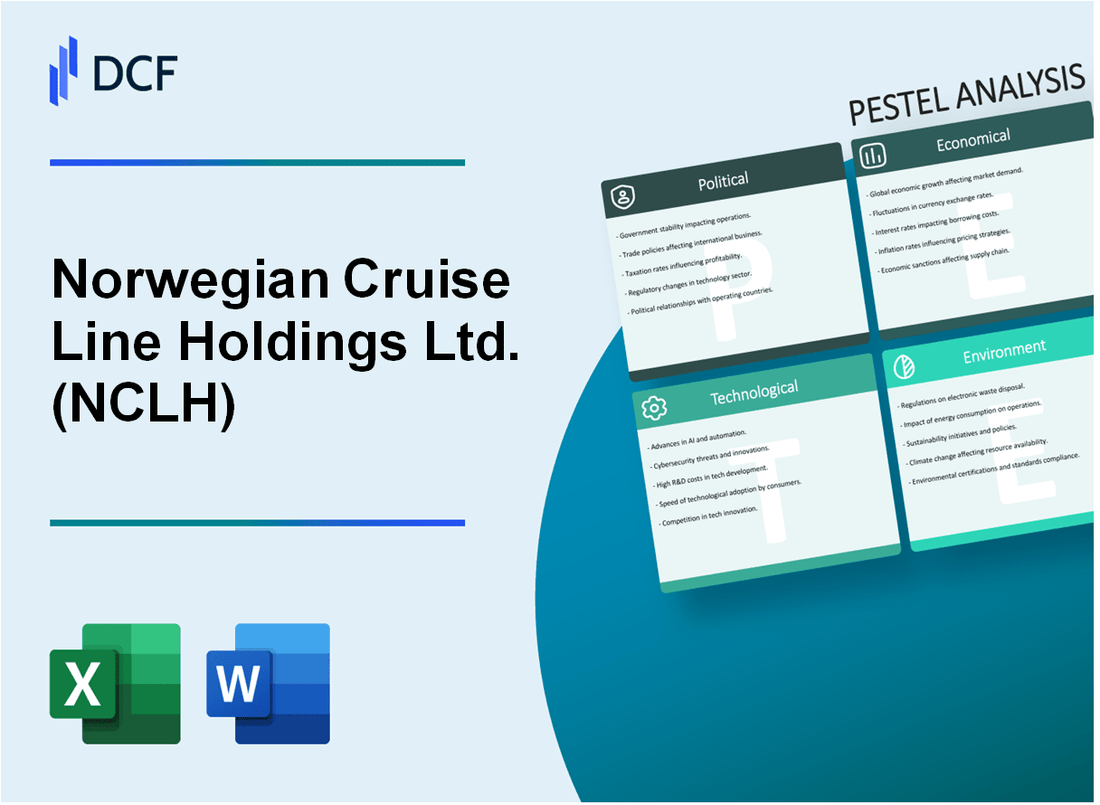
Norwegian Cruise Line Holdings Ltd. (NCLH): PESTLE Analysis [Nov-2025 Updated] |
Fully Editable: Tailor To Your Needs In Excel Or Sheets
Professional Design: Trusted, Industry-Standard Templates
Investor-Approved Valuation Models
MAC/PC Compatible, Fully Unlocked
No Expertise Is Needed; Easy To Follow
Norwegian Cruise Line Holdings Ltd. (NCLH) Bundle
You're looking for a clear-eyed view of Norwegian Cruise Line Holdings Ltd. (NCLH) as we close out 2025, and honestly, the landscape is a mix of high seas and strong tailwinds. The key takeaway is this: NCLH is capitalizing on sustained consumer demand, but geopolitical friction and the rising cost of decarbonization-specifically the EU's new carbon taxes-are the two biggest anchors on their projected $10.5 billion in revenue for the year. The question isn't whether they'll hit that number, but how much the estimated $150 million cost from the EU Emissions Trading System and forced itinerary changes will eat into the bottom line, especially with Net Yields up an estimated +8%; let's defintely break down the full PESTLE picture so you can map your next move.
Norwegian Cruise Line Holdings Ltd. (NCLH) - PESTLE Analysis: Political factors
Geopolitical Instability Forces Itinerary Changes and Capacity Redeployment
You need to be a trend-aware realist, and the near-term risk for Norwegian Cruise Line Holdings Ltd. (NCLH) is clear: geopolitical instability is directly hitting the bottom line by forcing expensive itinerary changes and capacity redeployment. The ongoing conflict in the Middle East, particularly the security situation in the Red Sea, has compelled NCLH to cancel more than a dozen cruises across seven ships scheduled for 2025. This isn't just a headache; it's a significant operational disruption that reduces available capacity days and impacts near-term revenue.
For example, the rerouting of ships like the Norwegian Sky around Africa, instead of through the Suez Canal, is a massive logistical and cost challenge. Here's the quick math: fewer available Capacity Days-the industry metric for measuring available berths multiplied by sailing days-directly cuts into revenue. The company's Q1 2025 revenue was already down by 3% year-over-year to $2.1 billion, a decline attributed in part to reduced Capacity Days from dry-dock and repositioning. To mitigate this risk long-term, NCLH is strategically reducing its European footprint by 6% for 2026, shifting that capacity to more stable and high-demand Caribbean routes. That's a clear action to map near-term risk to a future opportunity.
US-Cuba Relations Remain Frozen, Blocking a Key Caribbean Market
The political freeze between the US and Cuba continues to block a high-yield Caribbean market for NCLH. Since the US government announced new regulations in June 2019 that ended cruise line travel to Cuba, the market has been effectively closed. This ban immediately impacted hundreds of pre-scheduled itineraries across all three NCLH brands-Norwegian Cruise Line, Oceania Cruises, and Regent Seven Seas Cruises.
This isn't just about one island; it's about a high-demand, high-yield destination that offered a unique, culturally immersive selling point to Caribbean itineraries. The political reality means NCLH cannot use Cuba as a differentiator, forcing them to rely more heavily on private islands like Great Stirrup Cay, where the company is investing heavily. The political decision to maintain the ban remains a significant structural headwind, limiting the company's ability to fully capitalize on Caribbean demand, which is a defintely a missed opportunity for premium pricing.
Increased Scrutiny on Cruise Line Safety and Health Protocols
Government scrutiny on cruise line safety and health protocols remains high, especially following the pandemic, but NCLH has turned this political pressure into a competitive advantage. The US Centers for Disease Control and Prevention (CDC) continues its rigorous, unannounced Vessel Sanitation Program (VSP) inspections. NCLH's commitment to exceeding these standards is evident in recent performance.
In the 2024 inspection results, which set the operational benchmark for 2025, NCLH ships demonstrated superior performance. This is a powerful, data-driven talking point for investors and consumers alike.
- Total ships inspected by CDC in 2024: 151
- Total ships with a perfect score of 100: 27
- NCLH ships with a perfect score of 100: 7 (more than any other cruise company)
The company's ability to consistently score high on these unannounced inspections-ships like the Norwegian Jade, Norwegian Jewel, and Norwegian Bliss all achieved perfect scores-shows their internal 'SailSAFE' program works. This high level of compliance reduces the risk of operational shutdowns or fines from the CDC, providing a layer of regulatory certainty that competitors may lack.
Trade Policies and Tariffs Affect Shipbuilding and Maintenance Costs
Trade policies, particularly the escalating US-China trade tensions, are creating cost uncertainty in the capital-intensive shipbuilding sector. NCLH's new ships are built primarily in European shipyards, but the materials and components often originate globally, where new US tariffs come into play. The potential for retaliatory tariffs or increased costs on key maritime equipment is a clear risk to NCLH's massive capital expenditure (CapEx) program.
The US government, via the U.S. Trade Representative (USTR), has proposed new fees under Section 301 of the 1974 Trade Act, specifically targeting Chinese-built vessels and related equipment. These measures, set to come into effect in October 2025, include a fee structure that will directly increase the cost of doing business for any vessel built in China that calls on US ports. While NCLH's fleet is largely European-built, the tariffs on cargo handling equipment like ship-to-shore cranes will increase port operating costs, which are then passed on to the cruise lines.
This political environment is contributing to NCLH's soaring CapEx. The company's projected Capital expenditures for the full fiscal year 2025 are a staggering $2.6 billion, a sharp increase from $1.0 billion in 2024. This massive spend is driven by new vessel delivery (Norwegian Aqua) and fleet modernization, and any increase in material or component costs due to tariffs will immediately inflate this already substantial budget.
| 2025 US Tariff Impact on Shipping (Effective October 2025) | Amount | Impact on NCLH Operations |
|---|---|---|
| Fee on Chinese-built vessels (per Net Tonnage) | $18/NT | Increases port fees and operating costs, even if ships are European-built, due to tariffs on cargo-handling equipment. |
| Fee on Chinese-built vessels (per container) | $120/container | Increases costs for all imported goods and supplies needed for ship maintenance and onboard retail. |
| NCLH Projected 2025 Capital Expenditures | $2.6 billion | Tariffs on materials and components increase the cost of new builds and dry-dock maintenance, inflating this CapEx number. |
Norwegian Cruise Line Holdings Ltd. (NCLH) - PESTLE Analysis: Economic factors
The economic landscape for Norwegian Cruise Line Holdings Ltd. (NCLH) in 2025 is a classic study in balancing strong consumer demand against stubborn cost inflation and a heavy debt load. You're seeing robust top-line performance, but the bottom line is still under pressure from the cost of capital and operating expenses. The key takeaway is that strong US consumer spending is driving revenue, but currency and interest rate volatility are the major financial risks right now.
Strong US Consumer Spending Drives Net Yield Growth
Honesty, the US consumer is still spending on experiences, and that's NCLH's biggest tailwind. This strong demand is what allows the company to push pricing and ancillary revenue (onboard spending). For the full 2025 fiscal year, NCLH projects its Net Yield (a key measure of revenue per passenger capacity) on a Constant Currency basis to increase by approximately 2.4% to 2.5% year-over-year. This is a solid performance, especially when you consider it's building on the significant growth seen in 2024. The company's full-year Adjusted EBITDA is expected to reach approximately $2.72 billion, an 11.0% increase over 2024, showing operational strength. That's a clear sign of pricing power.
Here's the quick math on the expected financial performance for 2025:
| Metric | 2025 Full-Year Guidance | Change vs. 2024 |
|---|---|---|
| Adjusted EBITDA | Approximately $2.72 billion | +11.0% |
| Adjusted Net Income | Approximately $1.045 billion | Reiterated |
| Net Yield (Constant Currency) | Increase of 2.4% to 2.5% | Increase |
| Adjusted Net Cruise Cost Excl. Fuel (Constant Currency) | Growth of Approximately 0.75% | Growth |
Inflationary Pressures and Operating Costs
While revenue is up, costs are defintely a battle. Inflationary pressures are hitting the cruise line's supply chain, particularly for food and labor. NCLH manages this well, but they can't eliminate it. The company's guidance for the full year 2025 indicates that Adjusted Net Cruise Cost excluding Fuel per Capacity Day is expected to grow by a modest approximately 0.75% on a Constant Currency basis versus 2024. This figure is the best proxy for the combined impact of inflation on non-fuel expenses like provisions (food), crew wages, and ship maintenance.
The cost control is impressive, but specific areas still face upward pressure:
- Provisions (Food): Global food commodity price increases continue to impact costs, requiring careful procurement.
- Crew Wages: Increased competition for skilled maritime labor globally drives up crew compensation.
- Dry-dock Expenses: Higher costs for materials and labor for scheduled ship maintenance increase capacity day costs.
Currency Fluctuation Impacts European Operations and Debt
NCLH is a US-based company with significant Euro-denominated debt and substantial European operations, so foreign exchange (FX) rates matter a lot. Contrary to a simple strong-dollar narrative, the US Dollar has shown volatility in 2025. For the full year, NCLH's outlook uses a Euro (EUR) to US Dollar exchange rate of $1.18 and a British Pound (GBP) to US Dollar rate of $1.37 as of June 30, 2025.
A strengthening Euro against the US Dollar creates a headwind in two ways: it makes European operating expenses (like port fees and supplies) more expensive in US Dollar terms, and more critically, it results in non-cash foreign exchange losses on the company's Euro-denominated debt. In the second quarter of 2025 alone, NCLH reported $121.9 million in non-cash losses related to the mark-to-market valuation of its Euro-denominated debt. This FX loss is a real accounting drag on net income.
Interest Rate Stability and Significant Debt Load
The company is still carrying a substantial debt load from the post-pandemic recovery and its ongoing fleet expansion. As of March 31, 2025, NCLH's total debt stood at $14.0 billion. This high leverage makes interest rate stability a paramount economic factor. The company is actively managing this, having completed strategic capital market transactions in September 2025 to reduce interest expense and extend the maturity profile of its debt.
Still, the cost of servicing that debt is significant. Full-year 2025 interest expense is projected to be approximately $700 million. What this estimate hides is the risk from variable rate debt: a mere one percentage point increase in annual SOFR (Secured Overnight Financing Rate) would increase NCLH's annual interest expense by an estimated $9 million. The company is focused on reducing its Net Leverage, which is projected to end the year around 5.2x. That's a high number, making any shift in the Federal Reserve's rate policy a major financial risk.
Norwegian Cruise Line Holdings Ltd. (NCLH) - PESTLE Analysis: Social factors
Sustained 'Revenge Travel' Demand and Occupancy Rates
You may be wondering if the post-pandemic surge, often called 'revenge travel,' is finally slowing down. Honestly, for Norwegian Cruise Line Holdings Ltd. (NCLH), the demand remains exceptionally strong, which is a massive tailwind for their core business model. The consumer desire to spend on experiences, not just things, is still driving record bookings into 2026.
The proof is in the numbers. NCLH's occupancy rate (or load factor), which is double-occupancy adjusted, has consistently been above the 100% mark. For the third quarter of 2025, the company reported an occupancy of 106.4%, actually exceeding their guidance of approximately 105.5%. This sustained high capacity utilization is a clear indicator of robust social demand. For the full fiscal year 2025, NCLH expects its Load Factors to improve over 100 basis points year-over-year to nearly 102%.
Here's the quick math on the near-term occupancy performance:
| Metric | Q2 2025 Actual | Q3 2025 Actual | Q4 2025 Projection | Full Year 2025 Expectation |
|---|---|---|---|---|
| Occupancy Rate (Load Factor) | 103.9% | 106.4% | Approx. 101.9% | Nearly 102% |
Growing Preference for Premium and Luxury Experiences
The affluent consumer segment is showing no signs of pulling back, and NCLH is strategically positioned to capture this spending. They have successfully repositioned their brands to capitalize on the growing preference for premium and ultra-luxury travel.
The company has officially moved Oceania Cruises from the upper-premium segment into the full-fledged luxury market. This shift is supported by new hardware, like the Oceania Allura, delivered in the second quarter of 2025. Regent Seven Seas Cruises remains the pinnacle of the ultra-luxury all-inclusive segment. This dual-brand luxury strategy ensures NCLH has a product for different tiers of the high-end traveler, and management confirms demand trends for both luxury brands remain intact.
The luxury focus is a smart move because it drives higher Net Yield-the revenue per capacity day. Full year 2025 Net Yield is expected to increase approximately 2.4% to 2.5% on a Constant Currency basis versus 2024, showing that pricing power is holding up, especially in these higher-end segments.
Focus on Health, Wellness, and Sustainable Travel
Today's traveler is defintely more conscious about their health, their wellness, and the environmental footprint of their vacation. This is no longer a niche concern; it influences booking decisions for a growing number of consumers.
NCLH addresses this social trend directly through its global sustainability program, Sail & Sustain. The program is a core part of their strategy, which is what the modern investor and consumer expect to see. They are not just talking about it; they have concrete targets.
- Sailing Safely: Maintains a comprehensive public health and safety program that surpasses regulatory requirements.
- Environmental Commitment: Targets a 10% reduction in Greenhouse Gas (GHG) intensity by 2026, measured against a 2019 baseline.
- Wellness Integration: The focus on luxury and premium cruising naturally aligns with increased onboard health and wellness offerings.
Labor Shortages and Crew Wage Costs
The global hospitality and maritime sectors continue to face labor market tightness, and the cruise industry is not immune. This social factor translates directly into cost pressure for NCLH, primarily in crew wages and related expenses.
While the company is disciplined with its costs, the underlying labor market forces are pushing up operational expenses. The most precise financial indicator of this is the Adjusted Net Cruise Cost excluding Fuel per Capacity Day, which is a key metric showing non-fuel operating costs. For the full year 2025, this cost is expected to grow approximately 0.75% on a Constant Currency basis compared to 2024. This modest but persistent growth in non-fuel costs reflects the necessary investment in crew compensation and retention to maintain service levels in a tight labor market.
The company is working hard on cost-saving initiatives that are non-consumer-facing to offset some of these rising costs. Still, you should anticipate this labor cost inflation to remain a structural headwind for the near term.
Norwegian Cruise Line Holdings Ltd. (NCLH) - PESTLE Analysis: Technological factors
AI-driven dynamic pricing models optimize revenue management for an estimated 2% lift in ticket revenue.
You need to see how technology translates directly into revenue, and for Norwegian Cruise Line Holdings Ltd. (NCLH), it's in pricing. The company's investment in new revenue management systems, which use data science and artificial intelligence (AI) modeling, is driving a disciplined approach to ticket and onboard pricing. This isn't just about raising prices; it's about optimizing the price for every cabin, on every sailing, at every moment.
This strategic pricing discipline is a key driver for the forecast full-year 2025 Net Yield increase, which is expected to be approximately 2.5% on a Constant Currency basis compared to 2024. Here's the quick math: based on the analyst forecast 2025 revenue of approximately $9,692,558,000, a 2.5% yield lift represents a potential revenue increase of over $242 million. That's a defintely material gain from smarter software.
Digital transformation of the guest experience reduces onboard friction.
The biggest friction point in cruising is often the logistics: check-in, reservations, and payments. NCLH has addressed this with a fleet-wide rollout of its new Norwegian Cruise Line mobile app, which was completed by December 2024. This digital transformation shifts many high-touch, time-consuming processes to the guest's own device, making the experience smoother and freeing up crew for more valuable interactions.
The app acts as a pocket concierge, allowing guests to complete critical pre-cruise steps like online check-in and document uploads, and manage their vacation once aboard. What this estimate hides is the value of the crew time saved, which lowers operational costs (Adjusted Net Cruise Cost excluding fuel per Capacity Day is only expected to grow approximately 0.6% in 2025) while increasing guest satisfaction.
- Complete easy online check-in and document uploads before sailing.
- Make dining, excursion, and entertainment reservations instantly.
- View a personalized, up-to-date itinerary and schedule.
- Access payment and credit information all in one place.
Investment in shoreside and onboard Starlink satellite technology improves guest Wi-Fi satisfaction and crew communication.
Reliable internet is no longer a luxury; it's a non-negotiable expectation. NCLH is tackling the historical challenge of slow cruise Wi-Fi by implementing SpaceX's Starlink low earth orbit (LEO) satellite technology across its entire fleet in a phased rollout. This provides a massive boost to bandwidth, which is critical for guest experience and operational efficiency.
The move to Starlink significantly improves the capacity, speed, and reliability of internet access for both guests and crew. The extra bandwidth also improves ship-to-shore connections for operational needs, allowing for better real-time data flow for things like predictive maintenance and supply chain management. The phased rollout included new ships like Oceania Vista, Norwegian Viva, and Regent Seven Seas Grandeur in the initial stages.
New ship designs focus on energy efficiency and waste-to-energy conversion systems.
Technology here is a risk mitigator, directly addressing environmental regulations and fuel cost volatility. NCLH's new ship designs, like the Oceania Allura delivered in 2025, are fundamentally more efficient. For instance, the introduction of just one new, more fuel-efficient vessel is expected to result in an approximately 1% decrease in annualized fuel consumption per capacity day for the entire fleet. That's a big lever for a company with a high operating expense base.
The company has set clear environmental targets, aiming for a 10% Greenhouse Gas (GHG) intensity reduction by 2026 and 25% by 2030. This is backed by deploying a mix of technologies, including a rumored pilot program on the Norwegian Prima to convert organic waste into biofuel for auxiliary ship functions, effectively a waste-to-energy conversion system. Additionally, NCLH achieved its 2024 target early, equipping 50% of its fleet with shore power technology by the end of 2023.
| Technology Initiative | 2025 Status / Impact | Key Metric / Financial Relevance |
|---|---|---|
| AI-Driven Revenue Management | Fully deployed, driving pricing strategy. | Forecasted 2025 Net Yield increase of 2.5%. |
| Digital Guest App (NCL App) | Fleet-wide rollout completed by Dec 2024. | Reduces onboard friction, supports Adjusted Net Cruise Cost control. |
| Starlink High-Speed Internet | Phased fleet-wide rollout underway. | Improves guest satisfaction and operational ship-to-shore data flow. |
| New Ship Energy Efficiency | New ships like Oceania Allura delivered in 2025. | Targeting 10% GHG intensity reduction by 2026. |
| Shore Power Capability | 50% of fleet equipped by end of 2023. | Reduces emissions in port and lowers fuel consumption. |
Finance: Track the Net Yield performance against the 2.5% target in the Q4 2025 earnings release for a clear measure of pricing technology success.
Norwegian Cruise Line Holdings Ltd. (NCLH) - PESTLE Analysis: Legal factors
The EU Emissions Trading System (ETS) fully integrates shipping, imposing an estimated $150 million in carbon costs on NCLH for 2025.
The European Union Emissions Trading System (EU ETS) is the most immediate and quantifiable legal factor impacting Norwegian Cruise Line Holdings Ltd. (NCLH) in 2025. This market-based mechanism requires NCLH to purchase and surrender European Union Allowances (EUAs) for a portion of its carbon dioxide (CO2) emissions generated by voyages to, from, and within European Economic Area (EEA) ports.
For the 2025 fiscal year, the liability phase-in increases significantly. The company is liable for 70% of its covered CO2 emissions generated in 2025, a sharp increase from the 40% liability in 2024. Based on NCLH's operational footprint, this regulatory change is estimated to impose approximately $150 million in carbon costs for the 2025 period, which will be a direct drag on the bottom line unless fully passed on to consumers. The price of an EUA (one ton of CO2) has fluctuated between €60 and €80 in 2025, with a forecast of approximately €74 per tonne by year-end, creating a volatile cost environment that requires sophisticated hedging and pricing strategies.
This is a defintely a material new cost, and it's not going away. Here's the quick math on the compliance ramp-up:
| Reporting Year (Emissions Incurred) | Year of Surrender Obligation | % of CO2 Emissions to be Covered by EUAs |
|---|---|---|
| 2024 | 2025 (by Sept 30) | 40% |
| 2025 | 2026 (by Sept 30) | 70% |
| 2026 and Beyond | 2027 and Beyond | 100% |
International Maritime Organization (IMO) regulations mandate stricter Carbon Intensity Indicator (CII) compliance.
Beyond regional EU rules, NCLH faces increasing pressure from the global regulatory body, the International Maritime Organization (IMO). The IMO's Carbon Intensity Indicator (CII) framework, which took effect in 2023, rates a ship's carbon efficiency from A (best) to E (worst) based on its annual operational carbon intensity.
The critical legal risk in 2025 is the lack of a defined enforcement mechanism for ships receiving a D or E rating for three consecutive years. The IMO plans to address this enforcement gap and make other modifications to the CII in 2025, meaning the regulatory threat is about to get teeth. This could lead to operational restrictions or mandatory corrective action plans for NCLH's older, less efficient vessels. Compliance with the Energy Efficiency Existing Ship Index (EEXI) was a one-time design re-certification requirement and is not expected to have a material operational impact on NCLH.
US Department of Transportation (DOT) and Federal Maritime Commission (FMC) maintain oversight on consumer protection rules.
In the United States, the Federal Maritime Commission (FMC) and the Department of Transportation (DOT) continue to be the primary regulators of consumer protection for NCLH's US-based operations. The FMC requires all Passenger Vessel Operators (PVOs) embarking passengers from a US port to meet strict financial responsibility standards and provide clear contract disclosures.
A major focus in 2025 is the potential for new legislation, such as the re-introduced 'Cruise Passenger Protection Act of 2025.' This proposed legislation aims to:
- Establish an Office of Maritime Consumer Protection within the DOT.
- Invalidate pre-dispute arbitration and class action waiver clauses in passenger contracts.
- Mandate new standards for passenger contracts and consumer complaint resolution.
While not yet law, the persistent re-introduction of this Act signals a high political and legal risk, forcing NCLH to review its passenger contract terms and refund policies to preemptively align with potential new standards. FMC rules already define non-performance as a cancellation or a delay of three or more calendar days, requiring a full refund of all fees, including ancillary fees, if the passenger declines a substitute voyage.
Data privacy laws (GDPR, CCPA) require continuous, costly compliance updates for customer data handling.
As a global operator, NCLH handles vast amounts of personal data, making compliance with international data privacy laws a continuous, high-cost legal burden. The European Union's General Data Protection Regulation (GDPR) and the California Consumer Privacy Act (CCPA) are the two most stringent frameworks that dictate how NCLH must collect, process, and secure customer data.
The company must maintain a robust information security framework to safeguard customer data, which is encrypted and transmitted through strong encryption technology. The ongoing compliance costs are embedded in NCLH's overall Adjusted Net Cruise Cost excluding Fuel per Capacity Day, which is expected to grow approximately 0.6% on a Constant Currency basis for the full year 2025. This growth includes not just operational cost increases but also the continuous investment in IT infrastructure, legal counsel, and data governance required to avoid potentially massive fines, which can be up to 4% of annual global turnover under GDPR. The complexity is compounded by the need to manage data sharing across the Norwegian Cruise Line Holdings Ltd. family of brands-Norwegian Cruise Line, Oceania Cruises, and Regent Seven Seas Cruises-while adhering to different regional consent and data deletion requirements.
Finance: draft a quarterly compliance cost tracker for EU ETS and data privacy by end of Q1 2026.
Norwegian Cruise Line Holdings Ltd. (NCLH) - PESTLE Analysis: Environmental factors
Transition to Liquefied Natural Gas (LNG) for new vessels is slow; current fleet relies heavily on low-sulfur fuel oil.
You need to be realistic about the fleet's current energy mix. While the industry buzzes about Liquefied Natural Gas (LNG), Norwegian Cruise Line Holdings' (NCLH) near-term fleet strategy is anchored in traditional marine fuels, specifically Heavy Fuel Oil (HFO) and Marine Gas Oil (MGO). The company spent $175 million on fuel in the first quarter of 2025 alone, consuming 255,000 metric tons at a net-of-hedges price of $687 per metric ton. That's a massive, immediate cost exposure.
The company's primary strategy to meet emissions regulations, particularly the IMO 2020 sulfur cap, has been a nearly $200 million investment in Exhaust Gas Cleaning Systems (EGCS), or scrubbers. This investment allows 13 ships, or approximately 70% of operational capacity, to continue using HFO while reducing sulfur oxides (SOx) emissions by up to 98%. This move buys time and reduces the reliance on more expensive low-sulfur MGO, but it doesn't solve the core carbon (GHG) problem.
Instead of a full LNG pivot, NCLH is testing transition fuels. In 2024, they successfully tested biodiesel blends on 47% of the fleet. Plus, two of their future Prima Class newbuilds are being modified to accommodate green methanol in the future. It's a multi-pronged, rather than a single-fuel, approach.
Public pressure for 'zero-emission' cruising by 2050 forces accelerated investment in shore power and scrubbers.
The public and regulatory push for a 'zero-emission' future is a hard deadline, not a suggestion. NCLH has committed to pursuing net-zero greenhouse gas (GHG) emissions by 2050. To get there, they have set clear, measurable interim targets: a 10% reduction in GHG intensity by 2026 and a 25% reduction by 2030, both measured against a 2019 baseline.
Near-term capital is flowing into shore power capability-a critical step for reducing in-port emissions. The company is on track to have approximately 70% of its fleet equipped with shore power technology by the end of 2025. This is a defintely necessary investment, but its utility is limited by port infrastructure, which is a political and economic factor outside NCLH's direct control.
- Net-Zero Goal: 2050 target for GHG emissions.
- Near-Term GHG Target: 10% reduction by 2026.
- Shore Power: 70% of fleet equipped by year-end 2025.
Waste management and single-use plastic reduction targets are set across the fleet.
Waste is a visible environmental risk, and NCLH has made tangible progress in this area. They have already eliminated single-use plastic water bottles and straws across all three brands, which is a great PR win that avoids over 27 million plastic water bottles and roughly 77 million plastic straws annually. That's a solid, quantifiable impact.
Beyond plastics, the company is focused on minimizing waste sent to landfills. In 2024, they successfully diverted 54% of their total ship waste from landfills through recycling, incineration, and donation programs. Looking ahead, NCLH is piloting a new waste-to-energy system on the Norwegian Prima in 2025, a novel approach that could transform organic waste into biofuel for auxiliary power, trimming both waste volume and fuel costs.
Climate change impacts (e.g., hurricane frequency) increase insurance costs and force itinerary flexibility.
Climate change is not just an emissions problem; it's a direct operational and financial risk. Increased storm intensity and frequency, especially in the Caribbean-a core market-force costly itinerary changes. A single severe weather event, like Hurricane Dorian in the past, cost the company roughly $35 million in itinerary modifications and cancellations.
The financial market is already pricing this risk. NCLH defines a climate-related event as having a 'substantive financial impact' if it hits earnings per share (EPS) by approximately $0.10. Given the full year 2025 Adjusted EPS guidance is around $2.05 to $2.10, that single event threshold is a significant risk factor.
Also, the broader insurance market is reacting to recent, devastating storms. The destruction from major 2024 hurricanes is expected to impact catastrophe risk pricing at the January 2025 reinsurance renewals. This means NCLH's insurance premiums for its fleet and properties are likely to climb, especially for catastrophe-exposed assets, following trends where reinsurance rates have previously jumped as much as 50%.
| Climate Risk Area | 2025 Operational Impact / Metric | Financial Context |
|---|---|---|
| Fuel Source Reliance | 70% of operational capacity equipped with scrubbers (EGCS). | Nearly $200 million multi-year investment in EGCS. |
| In-Port Emissions | Target: 70% of fleet shore-power enabled by year-end 2025. | Reduces reliance on high-cost MGO while docked. |
| Waste Reduction | 54% of total ship waste diverted from landfills (2024). | Avoided over 27 million single-use plastic water bottles. |
| Severe Weather (Hurricanes) | Forces itinerary flexibility and cancellations. | Previous single-event cost: roughly $35 million. Substantive EPS impact threshold: $0.10. |
Disclaimer
All information, articles, and product details provided on this website are for general informational and educational purposes only. We do not claim any ownership over, nor do we intend to infringe upon, any trademarks, copyrights, logos, brand names, or other intellectual property mentioned or depicted on this site. Such intellectual property remains the property of its respective owners, and any references here are made solely for identification or informational purposes, without implying any affiliation, endorsement, or partnership.
We make no representations or warranties, express or implied, regarding the accuracy, completeness, or suitability of any content or products presented. Nothing on this website should be construed as legal, tax, investment, financial, medical, or other professional advice. In addition, no part of this site—including articles or product references—constitutes a solicitation, recommendation, endorsement, advertisement, or offer to buy or sell any securities, franchises, or other financial instruments, particularly in jurisdictions where such activity would be unlawful.
All content is of a general nature and may not address the specific circumstances of any individual or entity. It is not a substitute for professional advice or services. Any actions you take based on the information provided here are strictly at your own risk. You accept full responsibility for any decisions or outcomes arising from your use of this website and agree to release us from any liability in connection with your use of, or reliance upon, the content or products found herein.