

|
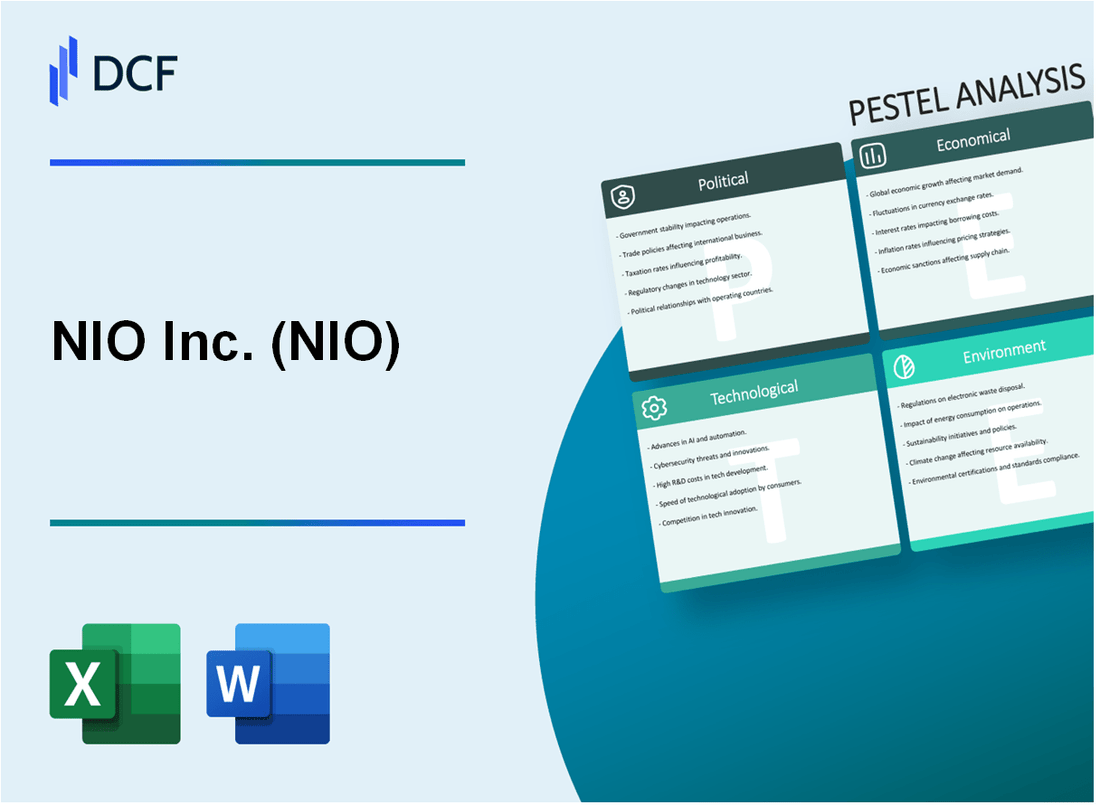
NIO Inc. (NIO): PESTLE Analysis [Nov-2025 Updated] |
Fully Editable: Tailor To Your Needs In Excel Or Sheets
Professional Design: Trusted, Industry-Standard Templates
Investor-Approved Valuation Models
MAC/PC Compatible, Fully Unlocked
No Expertise Is Needed; Easy To Follow
NIO Inc. (NIO) Bundle
You're holding a position in NIO, or maybe you're considering it, and you need to know if the premium brand can survive the brutal Chinese EV price war while executing its global expansion. Honestly, it's a high-wire act. NIO has strong political tailwinds-like the national goal for 40% New Energy Vehicle market share by 2025-plus a huge technological edge with its Battery-as-a-Service (BaaS) network and the new five-nanometer Shenji chip. But the economics are brutal: analysts forecast a full-year 2025 Earnings Per Share (EPS) of -$1.43, showing they are defintely still burning cash to capture that massive 400 million-person middle-class market. We need to map out if government support and tech can overcome the margin pressure.
NIO Inc. (NIO) - PESTLE Analysis: Political factors
The political landscape in China remains the single most critical factor for NIO Inc., acting as both a massive tailwind and a source of significant geopolitical risk. You need to understand that Beijing's policy isn't just about subsidies anymore; it's about market maturity and global positioning. The near-term focus is on stimulating domestic demand while navigating escalating US-China trade tensions.
Chinese government continues EV subsidy programs into 2025.
While the national purchase subsidy for New Energy Vehicles (NEVs) officially ended in 2022, the government has pivoted to a powerful consumer goods trade-in program, which is the key remaining direct incentive. This policy is defintely a boon for NIO, even though their premium pricing means the subsidy is a smaller percentage of the total vehicle cost compared to lower-end models. For the 2025 iteration, the central government allocated a massive RMB 81 billion (approximately USD 11 billion) to the overall consumer goods trade-in program. This shows a clear, sustained commitment to boosting consumption and industrial upgrades, not just EV adoption.
Auto trade-in subsidies up to 20,000 yuan (approx. $2,730) support consumer demand.
The renewed national auto trade-in scheme is directly supporting consumer demand for new vehicles, including NIO's models. Under the 2025 policy, a consumer who scraps an older vehicle (either an Internal Combustion Engine vehicle or an older EV) and purchases a new NEV can receive a subsidy of up to RMB 20,000. Based on early 2025 exchange rates, that's about $2,730 per vehicle. Here's the quick math: analysts expect this program to drive full-year demand growth of 3 million units in 2025, which is a huge volume lift for the entire market.
This is a material policy for NIO because it accelerates the replacement cycle for older cars, pushing more buyers into the NEV segment where NIO competes. The Ministry of Commerce predicts the policy could benefit more than 14 million vehicles in 2025, potentially generating sales revenue exceeding 2 trillion yuan.
National strategy aims for 40% New Energy Vehicle market share by 2025.
The Chinese government's strategic intent to dominate the NEV sector is clear, and the market is actually ahead of its formal targets. The official plan aims for a NEV penetration rate of 48 percent for 2025, which translates to a target of approximately 15.5 million NEV sales out of an expected total vehicle market of 32.3 million units. However, the market is moving faster than the official strategy document.
In the first half of 2025 (H1 2025), the NEV penetration rate for passenger vehicles already surged to 50.1%, meaning more than half of all new passenger vehicles sold in China were NEVs. This rapid growth means the government's focus is shifting from incentivizing adoption to managing capacity and quality-a transition that favors premium, high-quality players like NIO over smaller, less-established firms.
US-China trade tensions create supply chain and R&D constraint risks.
The geopolitical friction between the US and China remains a major overhang, creating market volatility and indirect risks for NIO. You saw this clearly in October 2025, when threats of 'massive tariffs' from the US caused NIO's stock to plunge by 10% in a single day, even though NIO does not currently sell vehicles in the US market. The risk isn't direct tariffs; it's the global sentiment and the potential for contagion.
The primary risks are:
- European Contagion: US tariff actions can influence the European Union, which is a key overseas expansion market for NIO, to adopt similar protectionist measures.
- Supply Chain Volatility: Escalating tensions disrupt global supply chain confidence, which can impact the cost and availability of critical components, especially advanced semiconductors and rare earth elements.
- Export Bureaucracy: China is implementing a new 2026 export permit system for electric vehicles, which, while framed as a quality control measure, could add bureaucratic friction and slow NIO's international growth plans.
The current US tariff on Chinese imports stood at 30% in October 2025, down from a high of 145% earlier in the year, but the political rhetoric suggests a return to a full-scale trade conflict is a real possibility.
NIO Inc. (NIO) - PESTLE Analysis: Economic factors
You're looking at NIO Inc.'s financials and seeing a classic high-growth, high-burn profile. The core economic reality for the company in 2025 is a fierce balancing act: massive capital expenditure for expansion and technology development against the pressure of a price war that is eroding margins. Simply put, they are spending heavily to win market share, but profitability remains a distant target.
Intense competition is driving down vehicle margins, though the company targets 15% for the NIO brand in 2025.
The intense competition in the Chinese electric vehicle (EV) market, particularly from rivals like BYD and Li Auto, continues to compress vehicle margins. NIO Inc.'s vehicle margin was 10.3% in the second quarter of 2025, a slight drop from 12.2% in the same quarter of 2024, primarily due to shifts in the product mix. However, management is aggressively targeting a significant improvement, projecting the group vehicle margin to reach 16% to 17% by the fourth quarter of 2025. The long-term goal for the premium NIO brand is even higher, aiming for a vehicle margin of 20% to 25%, which would be a defintely strong performance if achieved.
Here's the quick math on the margin challenge:
- Q2 2025 Vehicle Margin (Actual): 10.3%
- Q4 2025 Group Vehicle Margin (Target): 16%-17%
- NIO Brand Vehicle Margin (Long-Term Target): 20%-25%
Analysts forecast a full-year 2025 Earnings Per Share (EPS) of -$1.43, showing continued unprofitability.
NIO Inc. continues to be unprofitable, a direct result of high research and development (R&D) spending and sales, general, and administrative (SG&A) costs necessary to support its multi-brand strategy (NIO, ONVO, and FIREFLY) and global expansion. The consensus Earnings Per Share (EPS) forecast for the full fiscal year ending December 2025 stands at approximately -$1.04. This negative EPS, while an improvement from prior periods, underscores the company's reliance on external financing to cover its operating losses.
The company's net loss for the second quarter of 2025 alone was RMB4,994.8 million (US$697.2 million). Continued losses mean the path to self-sustaining operations is still dependent on execution and market reception of new, higher-margin models like the ONVO L90 and the refreshed ES8.
NIO held a healthy $6 billion in cash and equivalents at the end of Q3 2025, but carries a high debt load.
Liquidity is a key risk factor, but the company maintains a substantial cash position. As of June 30, 2025 (the end of Q2 2025), NIO Inc. reported a balance of cash and cash equivalents, restricted cash, short-term investments, and long-term time deposits totaling RMB27.2 billion (US$3.8 billion). However, this liquidity is counterbalanced by a significant debt load and operational cash burn.
The balance sheet shows a clear strain: the company's current liabilities exceeded its current assets as of June 30, 2025, and it had negative shareholders' equity. Long-term debt was reported at $1.272 billion for the quarter ending June 30, 2025.
| Financial Metric (as of June 30, 2025) | Value (USD) | Value (RMB) |
| Cash, Equivalents, and Short/Long-Term Deposits | $3.8 billion | RMB27.2 billion |
| Long-Term Debt | $1.272 billion | N/A |
| Total Debt (Approximate) | ~$4.07 billion | CNY29.1 billion |
| Current Assets | ~$7.34 billion | CNY52.51 billion |
| Current Liabilities | ~$8.71 billion | CNY62.28 billion |
Currency risk is notable, given RMB-denominated revenue but multi-currency European expansion costs.
NIO Inc.'s primary revenue stream is denominated in Chinese Yuan (RMB) from its dominant domestic market, but its aggressive international expansion into Europe creates a significant foreign exchange (FX) risk. This is a classic mismatch: the costs for setting up new markets-like the expansion into Portugal, Greece, and Austria in 2025-are incurred in Euros (EUR) and other local currencies, while the sales revenue is initially small and subject to conversion back to RMB.
A weakening Euro against the RMB would make European operations more expensive, directly impacting the company's bottom line. Plus, the political-economic risk of potential European Union tariffs on Chinese EVs adds another layer of uncertainty to the cost structure and pricing in key growth markets.
NIO Inc. (NIO) - PESTLE Analysis: Social factors
You're looking at NIO's social landscape, and the key takeaway is simple: the company is perfectly positioned to ride the massive, ongoing shift in Chinese consumer culture toward premium, tech-integrated electric vehicles (EVs). Their multi-brand strategy and unique user ecosystem are directly addressing the two biggest social trends: the rise of the middle class and the tech-savviness of younger buyers.
New, lower-cost brands (ONVO, Firefly) target the mainstream family and compact urban markets.
NIO's brand matrix is a direct response to the social stratification of the Chinese auto market, moving beyond their initial premium niche. The flagship NIO brand maintains its focus on the high-end segment, but the new sub-brands, ONVO and Firefly, are designed to capture the broader, high-volume market. ONVO is specifically targeting the mainstream family market, aiming for high monthly volumes, while Firefly is positioned as a subcompact electric vehicle brand for the compact urban and European segments.
This expansion is crucial for their 2025 volume targets. Here's the quick math: NIO is guiding for over 440,000 total vehicle deliveries in 2025. To hit that, the new brands must perform.
The early 2025 delivery numbers show this strategy gaining traction:
- ONVO, the family-oriented brand, delivered 16,434 vehicles in August 2025.
- Firefly, the compact brand, delivered 4,346 vehicles in August 2025, less than five months after starting deliveries in April 2025.
China's middle-class population of ~400 million represents a massive, high-intent EV buyer base.
The sheer scale of China's middle class is the primary social tailwind for NIO. This middle-income group already surpassed 400 million people in 2017, and consulting groups project an additional 80 million people will join the middle and upper classes between 2022 and 2030. This demographic shift creates an enormous pool of consumers with the disposable income and aspiration for a high-quality, smart vehicle like a NIO, ONVO, or Firefly.
The market is already transitioning: New Energy Vehicle (NEV) sales-which include Battery Electric Vehicles (BEVs) and Plug-in Hybrid Electric Vehicles (PHEVs)-surged to a 50.1% market penetration rate in China's passenger vehicle market in the first half of 2025. This means half of all new cars sold are electric or hybrid. Domestic EV sales are projected to exceed 12 million units in 2025, overtaking traditional combustion engine car sales for the first time. That's a defintely a huge market to compete in.
Younger, tech-savvy consumers (18-35) make up a critical segment of potential EV buyers in China.
The younger generation is driving the demand for smart, connected vehicles. These consumers, aged 18 to 35, prioritize technology and connectivity over traditional brand legacy. A 2023 survey indicated that a significant 69% of respondents under the age of 35 were 'most likely to buy' an electric model for their next car. This high purchasing intent among the youth is a perfect fit for NIO's product philosophy, which integrates advanced driver-assistance systems (ADAS) and digital cockpits as core features.
NIO's focus on over-the-air (OTA) updates and advanced technology appeals directly to this demographic, making the vehicle feel more like a constantly improving tech product than a static piece of machinery. The average age for buying a first car in China is around 35 years old, making this group the prime target for first-time EV adoption, often choosing domestic brands that excel in smart features over foreign incumbents.
Strong user-centric 'ecosystem' (NIO Houses, BaaS) builds high brand loyalty and community.
NIO's greatest social differentiator is its user ecosystem, which fosters a sense of community and addresses the major pain point of EV ownership: range anxiety. The Battery as a Service (BaaS) model allows users to subscribe to the battery, lowering the upfront purchase cost of the vehicle and enabling quick battery swaps.
This infrastructure and community focus creates a strong moat against competitors. The numbers speak for themselves:
| Ecosystem Metric | Value (As of Feb 28, 2025) | Strategic Impact |
|---|---|---|
| Total Power Swap Stations Worldwide | 3,201 | Addresses range anxiety; enables BaaS subscription. |
| Total Power Swaps Provided (Cumulative) | Over 67 million | Demonstrates high utilization and user adoption of the core service. |
| NIO Houses Built Worldwide | 181 | Physical community hubs that drive brand loyalty and word-of-mouth. |
| Power Swaps on Expressways (CNY 2025) | 83.2% of power replenished | Confirms battery swapping is the preferred long-distance charging solution. |
The BaaS model is a powerful social tool because it turns a one-time transaction into a long-term relationship, leading to high brand stickiness. The goal is to have over 4,000 swap stations worldwide by the end of 2025, which will only deepen this advantage.
NIO Inc. (NIO) - PESTLE Analysis: Technological factors
Flagship ET9 Features the World's First Five-Nanometer Chip (Shenji SoC)
The core of NIO's technological push is its in-house development of advanced silicon, a move that cuts reliance on external suppliers like Nvidia and gives them a competitive edge in processing power. The flagship ET9, with deliveries starting in the first quarter of 2025, is a prime example. It features NIO's first self-developed system-on-chip (SoC), the Shenji NX9031. This processor uses five-nanometer process technology, making it the first Chinese automaker to utilize this advanced architecture.
The Shenji NX9031 is a beast, packing 50 billion transistors and offering a computing power that NIO claims is up to four times that of a single industry-leading processor. For context, earlier NIO models relied on four Nvidia Drive Orin chips for similar workloads, so this new chip significantly improves efficiency and integration. This is a strategic move, not just a spec bump. The in-house chip, which is also being integrated into the 2025 facelift models like the ET5, ES6, and EC6, is key to delivering their next-generation intelligent driving and cockpit experiences.
R&D Investment Drives Progress Toward Level 4 Autonomy
NIO's commitment to vertical integration and future technology is clear in its significant, though recently optimized, research and development (R&D) spending. While the company is pushing toward profitability, the investment remains substantial. For the twelve months ending June 30, 2025, NIO's R&D expenses totaled $1.805 billion.
To be fair, management announced a strategic cut in June 2025 to control the quarterly R&D budget to between 2 billion and 2.5 billion yuan (approximately $278 million to $347 million USD) per quarter, aiming for a 20% to 25% year-over-year decrease to hit their Q4 2025 break-even target. Still, this spending is directly funding the company's ambitious autonomous driving (AD) roadmap.
NIO is one of the first domestic automakers authorized by the Chinese government to test Level 3 and Level 4 autonomous vehicles on public roads, which is a big deal for accelerating real-world data collection. The company is preparing to launch iterative versions of its World Model 2.0 from late 2025 through early 2026, which will introduce advanced features like language-based interaction and open-set intelligence for more natural user commands. That's how they get to true Level 4 (full autonomy in defined conditions).
Battery-as-a-Service (BaaS) Network and Swap Technology
The Battery-as-a-Service (BaaS) model, underpinned by the unique battery swap technology, is NIO's most significant technological differentiator and a core part of its ecosystem strategy. It effectively separates the battery cost from the vehicle purchase, which reduces the upfront price for consumers by an estimated €10,000 to €12,000 in Europe.
The convenience is unmatched. Swapping a depleted battery for a fully charged one takes under three minutes, which is faster than filling a gas tank. The third-generation Power Swap Station (PSS 3.0) is highly efficient, capable of performing up to 312 swaps per day and equipped with a 2-megawatt hour (MWh) energy storage system that can feed energy back into the grid.
The network scale is growing quickly, both in China and internationally.
- Global Power Swap Stations (as of June 30, 2025): 3,445.
- Cumulative Battery Swaps (as of June 30, 2025): Over 78.36 million.
- European Expansion: Plan to deploy 100 new Power Swap stations in 2025.
NIO is also working with industry peers like CATL, Geely Holding, and Changan Auto to standardize the battery swapping technology, a critical step for broader industry adoption and long-term viability.
| Technological Metric | 2025 Fiscal Year Data / Target | Strategic Impact |
| In-House Autonomous Driving Chip | Shenji NX9031 (5nm process), in volume production (as of July 2025) | Reduces cost and supply chain risk; enables proprietary features; provides a 4x computing power advantage over previous generation per chip. |
| Global Power Swap Stations (PSS) | 3,445 worldwide (as of June 30, 2025) | Core competitive moat; provides a 3-minute 'recharge' experience; supports the BaaS subscription model. |
| Cumulative Battery Swaps | Over 78.36 million (as of June 30, 2025) | Demonstrates high user adoption and network reliability; generates valuable battery life cycle data. |
| R&D Expense (LTM June 30, 2025) | $1.805 billion | Sustains development of Level 4 autonomous driving and next-generation platforms (e.g., World Model 2.0). |
NIO Inc. (NIO) - PESTLE Analysis: Legal factors
European data security and privacy regulations increase compliance costs for international expansion.
You are aggressively expanding into Europe, with plans to enter seven new markets in 2025 and 2026, including Austria, Belgium, and Poland. This expansion immediately subjects your connected vehicle data to the European Union's stringent General Data Protection Regulation (GDPR) and the new EU Data Act.
GDPR is a major financial risk because non-compliance penalties are severe: fines can reach up to €20 million or 4% of annual global turnover, whichever is higher. Plus, the EU Data Act, which came into force in September 2023 and has connected product rules taking effect by September 2026, mandates that you provide users with greater control over vehicle-generated data, requiring significant operational and contractual changes. Honestly, this is a massive legal lift.
To mitigate this, NIO has established a dedicated European data processing framework. For instance, data collected for the NIO Autonomous Driving Project is stored and anonymized within the European Union, specifically in Frankfurt, Germany. Still, the cross-border transfer of data to your headquarters in China or to the US for processing requires continuous legal review to ensure compliance with Standard Contractual Clauses (SCCs).
- Map all data flows across the seven new markets.
- Audit all third-party vendor contracts for Data Act compliance.
- Maintain a dedicated Data Protection Officer (DPO) for the EEA region.
Evolving global EV safety standards require continuous product certification and testing.
The regulatory environment for electric vehicle (EV) safety is not static; it is constantly evolving, which mandates continuous, high-cost research and development (R&D) to maintain market access. The global benchmark is the UN's Global Technical Regulation No. 20 (GTR 20), but regional standards are getting tougher.
For example, China's new national standard, Safety Requirements for Power Batteries in Electric Vehicles (GB 38031-2025), takes effect in July 2026 and sets a higher bar for thermal runaway protection. Your commitment to meeting these standards is evident in your R&D investment, which exceeded RMB 13 billion in 2024. This massive spend is essentially your compliance budget for next-generation safety.
The payoff is real: your proprietary NIO Smart Safety active safety solution, certified by four major insurance companies, demonstrated a 25.2% reduction in safety-related accident costs during the reporting period. That's a clear legal and financial benefit that translates directly to lower insurance premiums and reduced liability exposure.
Exposure to product liability claims is a constant risk in the high-voltage automotive sector.
Operating in the high-voltage EV sector means you face a persistent, high-stakes exposure to product liability claims, especially concerning battery thermal events and autonomous driving system failures. Even unfounded claims can cause significant damage to your reputation and stock price, which is a different kind of financial hit.
We saw this risk play out with the recycled claims of financial fraud in 2025, which, while denied by NIO, were leveraged by competitors to sow doubt among buyers. The real cost here is often not the legal settlement but the loss of consumer trust.
Here's the quick math on the risk/mitigation trade-off:
| Risk Factor | Potential Financial Impact | NIO's Mitigation (2025 Data) |
|---|---|---|
| Major GDPR Violation | Up to 4% of global turnover (or €20 million) | Data anonymization in Frankfurt, Germany |
| Battery Thermal Runaway Claim | Multi-million dollar lawsuit and recall costs | R&D investment over RMB 13 billion (2024) |
| General Accident Liability | Insurance and litigation costs | NIO Smart Safety achieved 25.2% reduction in safety-related accident costs |
The company benefits from tax policies in its registration jurisdiction (Cayman Islands).
NIO Inc. is incorporated in the Cayman Islands as an exempted company. This is a classic, strategic move to take advantage of the jurisdiction's legal framework, primarily its favorable tax system and the absence of exchange control or currency restrictions. This structure provides a significant competitive advantage by minimizing corporate tax on international earnings and simplifying capital flows.
However, this structure is not without legal risk. Your primary operations are conducted in the People's Republic of China (PRC) through Variable Interest Entities (VIEs). The enforceability of the contractual arrangements that give NIO Inc. control over these VIEs is subject to PRC law, and Chinese government authorities could challenge their validity. This legal uncertainty is a constant overhang on your US-listed American Depositary Shares (ADSs).
As of June 30, 2025, NIO Inc. and its subsidiaries had extended loans to the VIEs for operations with an outstanding principal amount of US$3.1 million (RMB22.5 million), illustrating the financial link that relies on these complex contractual agreements.
Next Step: Legal and Finance teams must draft a quarterly risk report detailing the estimated cost of EU Data Act compliance for the 2026 rollout, quantifying the required infrastructure and legal personnel spend.
NIO Inc. (NIO) - PESTLE Analysis: Environmental factors
NIO is committed to a 30% reduction in manufacturing carbon intensity by 2025.
You need to know how serious a company is about its carbon footprint, especially when manufacturing is involved. While the specific 30% intensity reduction target for 2025 isn't fully detailed in the latest public reports, NIO's 2024 performance shows a clear, aggressive trajectory toward deep decarbonization. For example, the company achieved a 12% reduction in average manufacturing emissions per vehicle year-over-year in 2024.
This reduction is driven by a massive shift to cleaner energy at their production sites. Here's the quick math: in 2024, NIO's manufacturing facilities consumed 97,013.15 MWh of renewable electricity. That's a 74.5% increase in renewable energy use compared to 2023, and it means that renewable sources now account for 56.6% of the total energy consumed at those sites. That's a defintely strong move toward a lower-carbon supply chain.
Battery-as-a-Service (BaaS) inherently supports battery life extension and closed-loop recycling.
The Battery-as-a-Service (BaaS) model is more than a cost-saver for you; it's a fundamental environmental advantage over traditional EV ownership. Because NIO retains ownership of the battery asset, they control the entire lifecycle, which is crucial for a true circular economy. This control ensures the batteries are managed for maximum life extension-they can be swapped, upgraded, and then repurposed for energy storage before being recycled.
This focus on a complete lifecycle loop is already yielding concrete results in 2025. The company reported an average vehicle recoverability rate of 98.8% and an average vehicle recyclability rate of 91.4% for vehicles sold in 2024. That's a huge step toward minimizing material waste. The BaaS ecosystem also promotes standardization, which is essential for scaling up recycling infrastructure across the industry.
- Recoverability Rate (2024): 98.8% (Materials that can be recovered for reuse or recycling).
- Recyclability Rate (2024): 91.4% (Materials that can be processed into new raw materials).
- Total Swaps (by Feb 2025): Over 67 million power swaps completed, demonstrating scale.
Projected reduction of 2.3 million metric tons of CO2 by 2025 aligns with national carbon neutrality goals.
While the specific 2.3 million metric tons target is an internal goal, the real-world CO2 savings from NIO's operations are significant and growing rapidly, directly supporting China's national climate objectives. By late 2023, the company had already completed 30 million battery swaps, which resulted in an estimated saving of around 891,693 metric tons of CO₂. That's a snapshot of the environmental impact from just one part of their ecosystem.
With the total number of swaps soaring past 67 million by February 2025, the total CO2 reduction from the BaaS model alone is now substantially higher. This model accelerates the decarbonization of the transport sector by making EV ownership seamless and by managing the battery fleet for grid stability and second-life applications, which further reduces the overall carbon intensity of the energy system.
China's aggressive fight against climate change drives favorable regulatory support for green manufacturing.
The regulatory environment in China is a tailwind, not a headwind, for NIO. The government's commitment to hit peak carbon emissions before 2030 and achieve carbon neutrality before 2060 creates a clear, long-term incentive structure. Policies like the 'Made in China 2025' and 'Beautiful China 2025' initiatives prioritize green manufacturing and provide tangible support.
This support comes in the form of financial and fiscal inducements-think tax incentives and green subsidies-that lower the cost of developing and deploying green technologies. This is why NIO's Factory Two (F2) was recognized as a 2024 Green Factory by provincial authorities, reflecting compliance and leadership in eco-friendly production. This regulatory clarity reduces risk and encourages the kind of long-term capital investment needed for sustainable growth.
| Key Environmental Metrics (FY 2024) | Value | Significance |
|---|---|---|
| Renewable Electricity Share in Manufacturing | 56.6% | Strong commitment to Scope 2 (purchased electricity) emissions reduction. |
| Renewable Electricity Consumption (2024) | 97,013.15 MWh | A 74.5% increase from 2023, showing rapid decarbonization. |
| Vehicle Recyclability Rate | 91.4% | Exceeds many global standards, confirming closed-loop BaaS model viability. |
| Average Manufacturing Emissions Reduction (YoY 2024) | 12% per vehicle | Direct progress toward the unconfirmed 30% intensity reduction goal. |
Disclaimer
All information, articles, and product details provided on this website are for general informational and educational purposes only. We do not claim any ownership over, nor do we intend to infringe upon, any trademarks, copyrights, logos, brand names, or other intellectual property mentioned or depicted on this site. Such intellectual property remains the property of its respective owners, and any references here are made solely for identification or informational purposes, without implying any affiliation, endorsement, or partnership.
We make no representations or warranties, express or implied, regarding the accuracy, completeness, or suitability of any content or products presented. Nothing on this website should be construed as legal, tax, investment, financial, medical, or other professional advice. In addition, no part of this site—including articles or product references—constitutes a solicitation, recommendation, endorsement, advertisement, or offer to buy or sell any securities, franchises, or other financial instruments, particularly in jurisdictions where such activity would be unlawful.
All content is of a general nature and may not address the specific circumstances of any individual or entity. It is not a substitute for professional advice or services. Any actions you take based on the information provided here are strictly at your own risk. You accept full responsibility for any decisions or outcomes arising from your use of this website and agree to release us from any liability in connection with your use of, or reliance upon, the content or products found herein.