

|
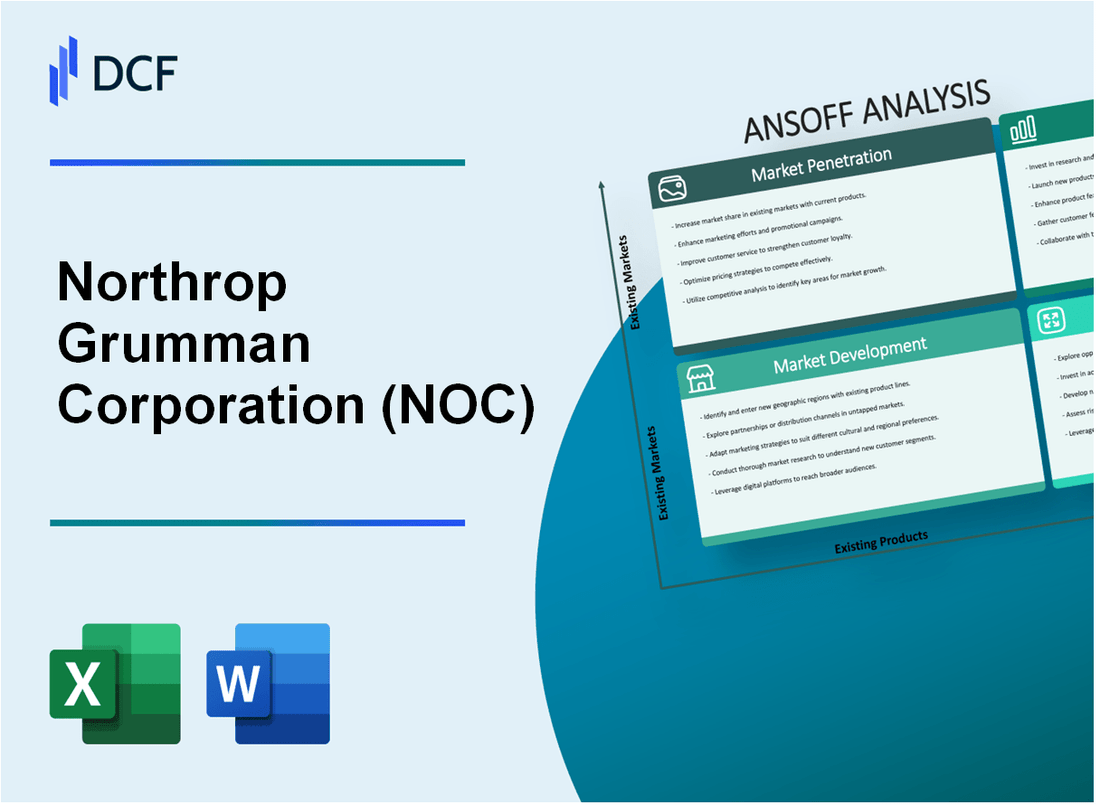
Northrop Grumman Corporation (NOC): ANSOFF MATRIX [Dec-2025 Updated] |
Fully Editable: Tailor To Your Needs In Excel Or Sheets
Professional Design: Trusted, Industry-Standard Templates
Investor-Approved Valuation Models
MAC/PC Compatible, Fully Unlocked
No Expertise Is Needed; Easy To Follow
Northrop Grumman Corporation (NOC) Bundle
You're looking at how Northrop Grumman Corporation plans to hit that ambitious \$42.05 billion sales goal, and honestly, it's a full-court press across the board. While the company recently trimmed its full-year 2025 guidance slightly, the underlying strategy detailed here shows serious intent to drive growth from every angle. We're seeing them double down on existing defense programs like Sentinel and B-21 for volume (Market Penetration), while aggressively pushing systems like IBCS into new allied nations, building on that strong 18% international sales jump seen in Q2 2025 (Market Development). Plus, they aren't just relying on current contracts; they're pouring investment into next-gen tech like the Glide Phase Interceptor and even making small, strategic bets in commercial space ventures. This matrix isn't just theory; it's the action plan to bridge the gap and secure that top-line number. Dig in below to see the concrete steps for each quadrant.
Northrop Grumman Corporation (NOC) - Ansoff Matrix: Market Penetration
You're looking at how Northrop Grumman Corporation is driving more volume from its existing defense markets, which is the essence of market penetration. This isn't about new customers or new products; it's about getting more from the contracts you already hold, often by improving efficiency or increasing delivery cadence.
For the Sentinel Intercontinental Ballistic Missile (ICBM) modernization program, the focus is on navigating the current cost structure to secure future domestic volume. The initial contract, awarded in September 2020, was for $13.3 billion to replace the Minuteman III system. However, by 2025, the estimated total cost has surged to $140.9 billion, representing an 81% increase over the original estimate of $77.7 billion. The per-unit cost, initially slated at $118 million in 2020, is now estimated at $162 million per unit. The program is currently undergoing a mandatory restructuring review expected by late 2025.
On the B-21 Raider front, the push for efficiency is directly tied to absorbing initial production costs to unlock higher future returns. The company reported a pre-tax loss of $477 million in the first quarter of 2025 on this program, bringing total reported losses to over $2 billion. This was partly due to a process change intended to enable a higher B-21 production rate. Congress has backed this acceleration with a legislative package in July 2025 allocating $4.5 billion specifically for expanding B-21 production capacity. The Air Force plans to purchase at least 100 B-21s.
Securing follow-on contracts for the Integrated Air and Missile Defense Battle Command System (IBCS) software is a clear penetration play into the existing U.S. Army and allied market. Northrop Grumman recently secured an Other Transaction Agreement (OTA) from the U.S. Army for IBCS software updates valued at approximately $481.3 million. This five-year contract, with work extending through December 30, 2029, obligated $347.6 million from Poland's fiscal 2024 Foreign Military Sales (FMS) funds at the time of award. This builds on prior work, including a separate $899.6 million contract to deliver the IBCS system for Poland's air defense programs.
The drive to nearly double solid rocket motor capacity by 2029 is a direct response to current high demand signals, ensuring Northrop Grumman captures the maximum volume from existing missile programs. The company plans to increase its solid-rocket motor production rate from 13,000 units per year as of 2024 to 25,000 in 2029. To support this, total solid rocket propellant output across its six major sites is targeted to grow from roughly 30 million pounds per year to nearly 50 million pounds by 2028. Since 2018, Northrop Grumman has invested more than $1 billion overall to increase these propulsion manufacturing capabilities.
Leveraging existing F-35 component production to capture more sustainment revenue is evident in the 2024 financial results. Northrop Grumman reported total sales of $41.0 billion for the full year 2024. This included a $448 million increase in F-35 production and sustainment volume compared to the prior year.
Here's a quick look at the recent contract activity supporting these penetration efforts:
| Program/Contract Type | Value (USD) | Awardee/Customer | Completion/Duration |
| IBCS Software Updates (OTA) | $481.3 million | U.S. Army / Poland FMS | Through Dec 30, 2029 |
| IBCS System Delivery to Poland | $899.6 million | Poland | Not specified |
| SRM Production Capacity Target | 25,000 units/year | Northrop Grumman | By 2029 |
| Total Propellant Output Target | Nearly 50 million pounds | Northrop Grumman | By 2028 |
| B-21 Production Acceleration Funding | $4.5 billion | U.S. Congress | Allocated in July 2025 |
| F-35 Production & Sustainment Sales Increase (2024) | $448 million | Northrop Grumman | Year-over-year |
The company is also focused on specific operational milestones to drive this penetration:
- Ramp up Sentinel ICBM modernization program to increase domestic volume.
- Increase B-21 Raider production efficiency to reduce long-term costs and accelerate delivery.
- Secure follow-on U.S. Army contracts for IBCS software, building on the $481 million award.
- Nearly double solid rocket motor capacity by 2029 to meet current high demand.
- Leverage existing F-35 component production to capture more sustainment revenue.
If onboarding takes 14+ days, churn risk rises, which is why hitting these production ramp targets is defintely key for margin recovery on fixed-price work like the B-21 LRIP lots.
Finance: finalize the 2026 capital expenditure plan for propulsion capacity expansion by end of Q1 2026.
Northrop Grumman Corporation (NOC) - Ansoff Matrix: Market Development
Northrop Grumman Corporation is actively pursuing Market Development by targeting new international customers for existing, proven systems.
The focus on key international markets is evident through specific program engagements and sales growth metrics.
- Targeted international sales efforts include nations such as Germany, Denmark, and the United Kingdom for the Integrated Battle Command System (IBCS) pitches, alongside existing major customers like Poland.
- The Integrated Air and Missile Defense Battle Command System (IBCS) is being pushed to new allies, with Northrop Grumman pitching the system to the European Sky Shield Initiative (ESSI) and NATO for its Air Command and Control System (ACCS) replacement effort.
The financial results from the second quarter of 2025 clearly demonstrate the momentum in this strategy.
The company capitalized on this international push, reporting 18% international sales growth in Q2 2025 year-over-year, compared to overall company organic sales growth guidance of approximately 3% for the full year 2025. Total second quarter 2025 sales reached $10.4 billion. International sales year-to-date growth stood at 14% as of Q2 2025.
Expansion of International Military Sales (IMS) for sustainment services is also a key action, exemplified by recent contract awards:
| Program/Service | Ceiling Value | Nations Included (Examples) | Obligated at Award | Completion Date |
| F-16 Radar Component Repair (IDIQ) | $303.6 million | Bahrain, Bulgaria, Greece, Korea, Slovakia, Taiwan, Morocco, Jordan | $2,704,534.08 | November 2030 |
| F-16 Radar Component Repair (Older Award) | $49.9 million | Chile, Egypt, Greece, Indonesia, Iraq, Morocco, Oman, Pakistan, Poland, Thailand, Turkey | N/A | July 30, 2030 |
The Integrated Battle Command System (IBCS) is a major driver for international market development, with Poland being the first international ally to field the system, achieving Initial Operational Capability in December 2024.
Specific contract values related to IBCS deployment in Poland include:
- A contract valued at $899.6 million for delivering the IBCS system for Poland's WISŁA medium-range and NAREW short-range air defense programs.
- Two contracts with a combined value of $1.4 billion to modernize capabilities for the US Army and Poland, with $347.6 million allocated for Poland's defense initiatives under the first contract.
- A possible Foreign Military Sale of $4 billion for IBCS to Poland was approved by the State Department in September 2023.
Strategic partnerships are being formed to secure further European market penetration, such as the Memorandum of Understanding signed in November 2025 with MBDA Deutschland to strengthen Germany's air and missile defense by integrating IBCS with MBDA's solutions. This collaboration aims to enhance defense capabilities for Germany and NATO partner nations.
The IBCS architecture is modular, supporting a "plug-and-fight" interface allowing different sensors and weapons to connect without significant modifications. Poland's IBCS integration enhances interoperability with US forces, creating one of the world's most advanced air defense systems.
Finance: review Q3 2025 international sales vs. domestic sales ratio by end of next week.
Northrop Grumman Corporation (NOC) - Ansoff Matrix: Product Development
You're looking at how Northrop Grumman Corporation is pushing new technology into the market, which is the Product Development quadrant of the Ansoff Matrix. This isn't just about minor upgrades; it's about developing entirely new capabilities for existing customers, like the Department of Defense.
Glide Phase Interceptor (GPI) Advancement
Northrop Grumman is advancing its Glide Phase Interceptor (GPI) development for the Missile Defense Agency (MDA) to counter hypersonic threats. The MDA selected Northrop Grumman as the sole contractor to continue development. The MDA requested $182 million for GPI in its fiscal 2025 budget request. A modification in late 2024 brought the total value of the research and development prototype agreement to $832.8 million, up from $291.9 million. The plan is for the missiles to reach initial operational capability by the end of 2029.
Improved Threat Detection System (ITDS) Progress
For Army aircraft survivability, Northrop Grumman is progressing into Phase II of the Improved Threat Detection System (ITDS) Other Transaction Agreement (OTA). Phase I testing, which included over 51 flight hours of live fire testing, concluded in May 2025. The Army approved the move to Phase II in July/August 2025. The scope for Phase II focuses on initial prototype delivery. The Abbreviated Capability Development Document (A-CDD) outlines a requirement for 10 prototypes to support test and integration, and 100 fieldable systems.
In-Space Satellite Refueling Demonstration
Northrop Grumman is developing and demonstrating in-space satellite refueling technology under the Space Force's Elixir contract. This builds on prior work for the Geosynchronous Auxiliary Support Tanker (GAS-T). The Elixir refueling payload will be integrated onto the ROOSTER-5 spacecraft. Separately, the Space Force awarded Northrop Grumman a multi-unit award for four of its proven ESPAStar spacecraft, with one of those buses set to host the Elixir demonstration payload. The core technical challenges being tackled are rendezvous and proximity operations, docking, and fuel transfer.
Physics AI for Design Efficiency
Northrop Grumman is investing in physics AI partnerships to design rockets and spacecraft components more efficiently. The company partnered with Luminary Cloud to use a physics-based AI model, powered by NVIDIA's PhysicsNeMo framework. This tool generates high-fidelity simulations of spacecraft subsystems, such as thruster nozzles, in seconds, a massive improvement over traditional computational fluid dynamics simulations that could take hours. This speed allows engineers to explore hundreds of design parameters instead of just 30 or 40. For context on investment scale, Northrop Grumman has strategic R&D investments reported around $3.2B in areas like AI/autonomy for 2025.
F/A-XX Sixth-Generation Fighter Competition
Northrop Grumman continues competing for the Navy's F/A-XX sixth-generation stealth fighter program against Boeing. Lockheed Martin was reportedly eliminated from the competition in March 2025. As of October 2025, a winner was expected soon, with the program in a source selection environment. The F/A-XX program received $76 million in funding for fiscal year 2026, while the Air Force's competing F-47 program received $3.4 billion in the same period. The Navy's requirement targets a design with a 25% increase in range compared to the F/A-18E/F.
Here's a quick look at some recent financial context for these development efforts:
| Metric | Value (Latest Reported) | Period/Context |
|---|---|---|
| Q2 2025 Revenue | $10.4 billion | Quarter ending September 30, 2025 |
| 2025 R&D Investment (AI/Autonomy Focus) | $3.2B | Projected for 2025 |
| 2025 Full-Year EPS Guidance (Raised) | $25 to $25.40 | Raised in July 2025 |
| 2025 Free Cash Flow Guidance (Raised) | $3.05B to $3.35B | For 2025 |
| F/A-XX FY2026 Funding | $76 million | Fiscal Year 2026 |
The ITDS program requires 100 fieldable systems eventually. The GPI agreement total value reached $832.8 million after a modification.
- ITDS Phase I testing involved over 51 flight hours.
- Physics AI simulation time reduced from hours to seconds.
- Northrop Grumman secured four ESPAStar spacecraft in a separate award related to Elixir.
- GPI Initial Operational Capability target is the end of 2029.
Northrop Grumman Corporation (NOC) - Ansoff Matrix: Diversification
You're looking at how Northrop Grumman Corporation is placing capital outside its traditional defense core, which is a classic diversification play. Honestly, the numbers show a clear strategy of pruning non-core assets to fuel growth in emerging, higher-margin areas, especially space.
Funding Diversification Through Divestiture
Northrop Grumman Corporation is actively reshaping its portfolio to focus on core technology differentiators. This is evidenced by the announced exit from its training services business. The company agreed to sell this unit to Serco for $327 million in cash, with the transaction expected to close mid-year 2025. This divested business portfolio generated approximately $300 million in annual revenues, meaning the cash infusion is directly available to fund new technology development in other areas. This divestiture allows Northrop Grumman Corporation to focus on businesses where technology and innovation are key differentiators.
Here's a quick look at the financial context surrounding this strategic shift:
| Metric | FY 2025 Guidance (Est.) | Q1 2025 Actual |
| Total Revenue Range | $41.7 billion to $41.9 billion | $9.5 billion |
| Free Cash Flow Guidance | $3.05 billion to $3.35 billion | -$1.82 billion (Q1) |
| Total Backlog | N/A | $92.8 billion |
| MTM-Adjusted EPS Guidance | $25.65 to $26.05 | $3.32 |
Targeted Investment in Commercial Space
To enter commercial space ventures, Northrop Grumman Corporation invested $50 million in Firefly Aerospace's Series D funding round. This capital is specifically earmarked to accelerate the production of Firefly's medium-lift vehicle, the Eclipse rocket. The Eclipse is designed with a capacity to deliver 16 metric tons to Low Earth Orbit (LEO). This move builds on existing partnerships, as the Eclipse vehicle incorporates avionics from Northrop Grumman Corporation's flight-proven Antares program, and the first launch is anticipated as early as 2026.
Applying Core Capabilities to New Markets
The strategy involves applying core sensor and cyber capabilities, honed in military contracts, to non-military critical infrastructure protection. While specific 2025 revenue figures for this new market segment aren't public, the shift is supported by the company's existing segment performance. For instance, in Q1 2025, the Space Systems segment saw sales drop by 18% to $2,568 million, suggesting a need to diversify revenue streams away from potentially slowing legacy programs.
- Aeronautics Systems Q1 2025 Sales: $2,814 million
- Mission Systems Q1 2025 Sales: $2,807 million
- Defense Systems Q1 2025 Sales: $1,805 million
Focus on High-Growth, Higher-Margin Autonomous Systems
Northrop Grumman Corporation is prioritizing high-growth, higher-margin autonomous systems, such as the Beacon platform, for new market segments. This aligns with the overall goal of margin expansion, as the company's FY 2025 MTM-adjusted EPS guidance is set between $25.65 and $26.05. The Defense Systems segment, which houses many of these capabilities, saw Q1 2025 sales increase by 4% to $1,805 million, indicating positive traction in that area.
Commercializing Advanced Materials
The plan includes pursuing commercial applications for advanced materials originally developed for defense platforms. This is a direct way to monetize existing intellectual property outside the defense budget cycle. The company's overall international sales grew 18% year-over-year in Q2 2025, which suggests a growing appetite in global commercial markets for Northrop Grumman Corporation's technology.
- International Sales Growth (YoY Q2 2025): 18%
- FY 2024 Revenue from International Sources: 12% of total sales
Disclaimer
All information, articles, and product details provided on this website are for general informational and educational purposes only. We do not claim any ownership over, nor do we intend to infringe upon, any trademarks, copyrights, logos, brand names, or other intellectual property mentioned or depicted on this site. Such intellectual property remains the property of its respective owners, and any references here are made solely for identification or informational purposes, without implying any affiliation, endorsement, or partnership.
We make no representations or warranties, express or implied, regarding the accuracy, completeness, or suitability of any content or products presented. Nothing on this website should be construed as legal, tax, investment, financial, medical, or other professional advice. In addition, no part of this site—including articles or product references—constitutes a solicitation, recommendation, endorsement, advertisement, or offer to buy or sell any securities, franchises, or other financial instruments, particularly in jurisdictions where such activity would be unlawful.
All content is of a general nature and may not address the specific circumstances of any individual or entity. It is not a substitute for professional advice or services. Any actions you take based on the information provided here are strictly at your own risk. You accept full responsibility for any decisions or outcomes arising from your use of this website and agree to release us from any liability in connection with your use of, or reliance upon, the content or products found herein.