

|
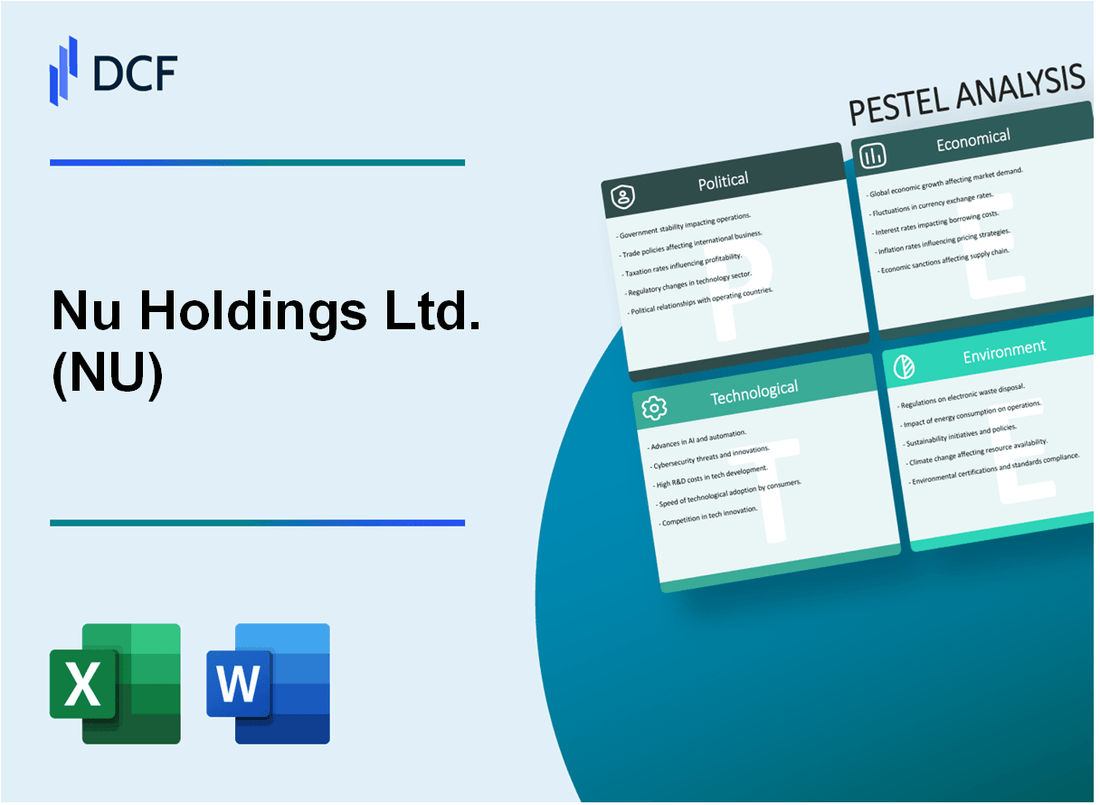
Nu Holdings Ltd. (NU): PESTLE Analysis [Nov-2025 Updated] |
Fully Editable: Tailor To Your Needs In Excel Or Sheets
Professional Design: Trusted, Industry-Standard Templates
Investor-Approved Valuation Models
MAC/PC Compatible, Fully Unlocked
No Expertise Is Needed; Easy To Follow
Nu Holdings Ltd. (NU) Bundle
You're looking for a clear, actionable breakdown of the forces shaping Nu Holdings Ltd. (NU) right now, and honestly, the near-term picture is all about regulatory navigation and market saturation versus explosive growth in new markets. As an analyst who's seen a few cycles, I can tell you that Nu's biggest risk isn't competition; it's the political and legal environment catching up to their speed. Still, the opportunity in Mexico and Colombia is defintely massive, and their tech stack is a serious moat. We're tracking a projected 2025 revenue of $14.5 billion and a customer base exceeding 95 million, but the projected 9.5% SELIC rate in Brazil is a real headwind on credit risk. Let's map out the six macro factors-Political, Economic, Sociological, Technological, Legal, and Environmental-that will determine if Nu can turn its massive scale into sustained, profitable dominance.
Nu Holdings Ltd. (NU) - PESTLE Analysis: Political factors
The political landscape for Nu Holdings Ltd. (NU) in 2025 is a high-stakes balancing act between government-driven financial inclusion mandates and rising regulatory and geopolitical volatility across its core markets. You need to see this environment not as a fixed barrier, but as a dynamic force that Nu is actively shaping, but which also carries significant policy risk.
The core takeaway is that while governments in Brazil, Mexico, and Colombia are pushing for the exact kind of low-cost, digital-first service Nu offers, they are also becoming more aggressive in imposing new taxes, data-sharing rules, and consumer protections. This means Nu's success hinges on regulatory agility, not just customer acquisition.
Shifting political stability in key markets (Brazil, Mexico, Colombia)
Political stability in Latin America is always a fluid variable, and 2025 is no exception. In Brazil, political friction between the Executive and Legislative branches creates policy uncertainty. For example, in June 2025, the Brazilian Congress revoked government decrees that had increased the Tax of Financial Operations (IOF) on credit and foreign exchange transactions, demonstrating the difficulty in implementing new fiscal measures that impact the financial sector. This back-and-forth makes long-term tax planning difficult. Plus, the political environment in Colombia remains a wildcard, with mentions of 2025 protests adding a layer of operational and market risk to Nu's promising expansion there.
Mexico is also seeing a major institutional shift. The approval of a sweeping antitrust reform, expected to take effect in July 2025, will dissolve the Federal Economic Competition Commission (COFECE) and replace it with a new authority under the Executive branch. This move introduces heightened political uncertainty and stricter enforcement thresholds, which can impact any large, dominant player like Nu as it continues to grow its customer base, which surpassed 13 million in Q3 2025. You must factor this political volatility into your discount rate.
Government pressure for financial inclusion and lower banking fees
Nu's entire business model is a direct response to government and public pressure for financial inclusion. This alignment is a massive political tailwind. Traditional banks in the region have historically operated with high fees, and Nu's average monthly cost to serve per active customer is remarkably low at just $0.80 as of Q2 2025, which is a powerful political talking point.
In Colombia, the government is actively supporting digital finance, with the central bank (Banco de la República) leading the development of a new low-value interoperable fast payment system (FPS) set to launch in May 2025. This infrastructure directly benefits Nu, as it relies on digital payments. The push is necessary because approximately 65% of Colombians still lack access to the formal credit system, creating a huge target market where Nu can be seen as a public good, not just a for-profit entity. That's a powerful position to be in.
Potential for new consumer protection laws impacting credit products
The regulatory focus is shifting from simply establishing fintech rules to aggressively protecting consumers in the credit market. In Mexico, the National Commission for the Protection and Defense of Financial Services Users (CONDUSEF) is an active watchdog, ensuring transparency in lending practices under the Ley de Protección y Defensa al Usuario de Servicios Financieros (Financial Services Users Protection Law). New regulations here could cap interest rates or mandate new disclosures, which directly impacts Nu's interest-earning portfolio, which expanded 55% year-over-year (FXN) to $15.7 billion as of June 30, 2025.
The situation in Colombia is a clear example of this tension. High interest rate caps, intended to protect consumers, are actually driving nearly 4 out of every 10 low-income Colombians to informal lenders who charge rates up to 360%. Nu is advocating for a review of this cap, but any change is a political decision that will either open up a massive, profitable market for formal credit or keep a lid on lending margins. Additionally, Brazil's Open Banking framework, while promoting competition, could force Nu to share its proprietary customer data advantage, a key asset that underpins its $4.0 billion Q3 2025 revenue.
Geopolitical tensions affecting cross-border capital flows
Geopolitical tensions, particularly those originating outside Latin America, are creating regulatory headwinds for capital and payment flows. The U.S.-China trade war and the potential for a new U.S. government to impose tariffs, such as a threatened 25% tariff on all Mexican imports, introduces a systemic risk that could lead to capital flight and currency depreciation across the region. A weaker Brazilian Real (BRL) or Mexican Peso (MXN) directly impacts Nu's dollar-denominated financial results for its U.S. investors.
Furthermore, increased scrutiny on illicit finance is forcing regulatory changes. The Mexican banking lobby is already moving to implement stricter controls on international transfers and remittances by the end of 2025 to align with U.S. anti-money laundering (AML) standards. This impacts Nu's cross-border payment operations and increases its compliance costs. The table below summarizes the key political risks and opportunities in Nu's primary markets:
| Market | Key Political/Regulatory Factor (2025) | Impact on Nu Holdings Ltd. (NU) |
|---|---|---|
| Brazil | Legislative deadlock over fiscal policy (e.g., IOF tax decrees revoked in June 2025); Open Banking rollout. | High tax uncertainty; Open Banking could erode data advantage, but Nu's 107.3 million customer base makes it a key player. |
| Mexico | Antitrust reform (July 2025) shifts power to Executive; Stricter AML on remittances (end of 2025). | Increased regulatory scrutiny on market dominance; Higher compliance costs for cross-border payments. |
| Colombia | Push for fast payment system (May 2025); Political debate on interest rate cap (up to 360% informal rate). | Direct tailwind from new digital infrastructure; Potential to unlock a large, underserved formal credit market if the cap is adjusted. |
The political environment is a double-edged sword: it creates the problem (financial exclusion) that Nu solves, but also imposes the rules that constrain its profitability. You need to focus on how Nu's regulatory affairs team manages the trade-off between being a market disruptor and a compliant partner.
Next Step: Strategy Team: Map out the cost-impact of a 5% increase in AML/KYC compliance spending for the Mexican and Colombian markets by Q1 2026.
Nu Holdings Ltd. (NU) - PESTLE Analysis: Economic factors
High interest rates (SELIC rate projected near 9.5% in Brazil) impacting credit risk
You need to look past the old forecasts for Brazil's benchmark interest rate, the SELIC (Sistema Especial de Liquidação e Custódia). While some models projected the SELIC rate near 9.5% for the 2025 fiscal year, the reality as of late 2025 is a much tighter monetary environment. The Central Bank of Brazil has maintained a restrictive stance, with the SELIC rate holding around 15% to combat persistent inflation.
This high-rate environment is a double-edged sword for Nu Holdings. On one hand, it boosts the company's net interest income (NII) from its lending portfolio. On the other, it significantly increases the cost of funding and, more critically, elevates credit risk. Here's the quick math: a higher SELIC rate means higher debt service costs for the average Brazilian consumer, which directly translates into higher default rates for unsecured credit products like credit cards and personal loans-the core of Nu's initial business model. While Nu Holdings has managed its asset quality better than incumbent banks, as evidenced by a risk-adjusted Net Interest Margin (NIM) of 9.9% in Q3 2025, the pressure is defintely mounting.
Strong revenue growth projected to hit $14.5 billion for the 2025 fiscal year
Nu Holdings is showing exceptional revenue momentum, a key indicator that its platform monetization strategy is working even under macroeconomic pressure. The company reported a record-breaking performance through the first three quarters of 2025. This strong trajectory makes the full-year revenue projection of $14.5 billion a highly achievable, if not conservative, target.
The growth is driven by a combination of customer base expansion-reaching 127 million customers by Q3 2025-and a significant increase in Monthly Average Revenue per Active Customer (ARPAC), which hit a record $13.4 in Q3 2025. The company's Interest-Earning Portfolio (IEP) also grew substantially, reaching $17.7 billion as of September 30, 2025.
| 2025 Fiscal Quarter | Reported Revenue (USD) | Net Income (USD) |
|---|---|---|
| Q1 2025 | $3.2 billion | $557.2 million |
| Q2 2025 | $3.7 billion | $637 million |
| Q3 2025 | $4.2 billion | $783 million |
| Q4 2025 (Projected) | ~$3.4 - $4.4 billion (Implied) | N/A |
| Full Year 2025 (Analyst Target) | $14.5 billion | N/A |
Inflation and currency volatility in Latin America affecting purchasing power
The economic landscape in Latin America is characterized by persistent inflation and significant currency volatility, which directly impacts the purchasing power of Nu Holdings' vast customer base. This is a crucial risk factor because it can reduce transactional volume and increase credit losses if consumers struggle to keep up with rising costs.
In Brazil, the primary market, inflation for 2025 is projected to be around 4.45% to 4.46%, which is near the Central Bank's target ceiling. Still, currency depreciation remains a concern, with the Brazilian Real expected to trade around 5.40 to the U.S. dollar by the end of 2025. The situation is more extreme in other key markets; for instance, Argentina's inflation is expected to remain high at 24% by the end of 2025, severely eroding consumer spending capacity. This volatility makes it harder for Nu to predict loan performance and manage its cross-border capital efficiently.
Increased competition driving down interchange fees and margin compression
The regulatory environment, coupled with aggressive competition, is putting significant pressure on the interchange fees that form a substantial part of Nu's non-interest revenue, particularly in its high-growth Mexican market. This trend is a clear headwind for margin compression.
Mexico's banking regulator and central bank have proposed new rules that would drastically cap interchange fees for card issuers, a move that disproportionately affects fintechs like Nu. This regulatory action, if approved, would force a change in the unit economics of their card-based products.
- Credit card interchange fee cap proposed at 0.6% (down from a weighted average of about 1.35%).
- Debit card interchange fee cap proposed at 0.3% (down from an average of about 0.45%).
- Nu's interchange fee income in Mexico was MXN 1,923 million in 2024, showing the magnitude of the potential hit.
Also, the rise of instant payment systems like Pix in Brazil is a major competitive factor. Pix is projected to surpass credit card volume for person-to-merchant (P2M) transactions by mid-2025, further squeezing the revenue generated from card-based transactions. The company must accelerate its diversification into higher-margin lending and insurance products to offset this structural decline in fee income.
Nu Holdings Ltd. (NU) - PESTLE Analysis: Social factors
The social landscape in Latin America is the primary tailwind driving Nu Holdings Ltd.'s (NU) exceptional growth. You need to focus on the deep-seated shift in consumer behavior away from traditional, high-fee banking toward digital-first, low-friction platforms.
Honestly, the company isn't just acquiring customers; it's capturing a massive, digitally-native population that was previously underserved. That's the core of the social opportunity here.
Customer base projected to exceed 95 million by year-end 2025
Forget the 95 million projection you might have heard; the reality is much stronger. Nu Holdings has already blown past that number, reporting a total customer base of 127 million globally as of the third quarter of 2025 (Q3 '25).
This growth is not just a vanity metric, but a direct reflection of social acceptance. In Brazil alone, the company serves over 60% of the adult population, making it the third-largest financial institution by customer count.
Here's the quick math on their regional footprint as of Q3 2025:
| Region | Customer Base (Q3 2025) | % of Adult Population Served |
|---|---|---|
| Brazil | 110.1 million | Over 60% |
| Mexico | 13.1 million | Around 14% |
| Colombia | Nearly 4 million | Around 10% |
| Total Global | 127 million | N/A |
High digital adoption rates among younger, unbanked populations
The company's growth is fundamentally tied to the high digital adoption rates across Latin America, especially among the young and the historically unbanked (those without a formal bank account). The region's digital revolution is accelerating, with mobile-first commerce driving demand for simple, app-based financial services.
The critical factor is engagement: Nu Holdings' monthly activity rate is consistently strong, standing at over 83% across its customer base in Q3 2025, and even higher at over 85% in Brazil. This tells you that customers aren't just opening an account; they are actively using it as their primary financial relationship.
The market opportunity remains huge, too. Despite the progress, approximately 91 million adults in Latin America still rely exclusively on cash and lack digital accounts, which is the exact demographic Nu Holdings was built to serve.
Growing demand for transparent, low-fee financial products
The social demand for transparent, low-fee financial products is a direct response to the high costs and complexity of incumbent banks in the region. This is where Nu Holdings' low-cost operating model creates a structural advantage that resonates deeply with consumers.
Traditional banking fees are a major barrier, cited by 57% of the unbanked in Latin America as a reason for not accessing financial services. Nu Holdings addresses this by maintaining an extremely low Monthly Average Cost to Serve Per Active Customer, which was just $0.7 in the first quarter of 2025. [cite: 14 in previous search]
This cost efficiency allows them to offer products with zero or minimal fees, which is a powerful social value proposition. It's a defintely clear case of a product meeting a massive, unmet social need.
Brand loyalty (Net Promoter Score) remains exceptionally high across all markets
Customer loyalty, measured by the Net Promoter Score (NPS), is the clearest indicator of Nu Holdings' social impact and a significant competitive moat. The company's focus on customer experience-no hidden fees, simple app, and transparent service-translates into massive advocacy.
In Brazil, the company reports an NPS of 90 as of the second quarter of 2025. For context, this score is nearly three times higher than the average for incumbent banks and other major local fintechs, demonstrating a level of customer delight that is rare in the financial sector.
- Net Promoter Score (NPS): 90 in Brazil (Q2 2025).
- Customer Savings: Customers saved over $11 billion in banking fees in 2023 due to the digital, low-cost model.
- Service Efficiency: Customers saved over 440 million hours of waiting in service queues over seven years.
The next step for you is to map this social momentum to the economic factors, particularly how this low-cost, high-loyalty model drives Average Revenue Per Active Customer (ARPAC) growth.
Nu Holdings Ltd. (NU) - PESTLE Analysis: Technological factors
Continued investment in AI/machine learning for credit scoring and fraud detection
Nu Holdings is strategically shifting to become an AI-first company, which is defintely a necessary move to maintain its competitive edge in credit risk and operational efficiency. This investment is not just a buzzword; it's deeply embedded in their proprietary models, like the internally developed Nuformer, which is their approach for building large, generalizable AI foundation models at scale. This allows them to simulate, experiment, and deploy new models faster than traditional banks.
The immediate payoff is visible in asset quality. Advancements in their AI and machine learning models have directly enhanced credit modeling precision, which contributes to better overall asset quality performance. For the broader fintech sector, investment in AI for fraud detection and risk management is critical, with this area attracting about $6.8 billion globally in 2024-representing 40% of all fintech AI investment. Nu Holdings' ability to operate on a low-cost, highly efficient platform, reflected in its Q3 2025 efficiency ratio of 27.7%, is a direct result of these AI-driven efficiencies.
Full rollout of Pix instant payment system in Brazil driving transaction volume
The full maturation of Brazil's instant payment system, Pix, is a major technological tailwind for Nu Holdings. Pix is now the cornerstone of the Brazilian financial ecosystem, having processed an estimated 64 billion transactions in 2024, which is 80% higher than the combined total of credit and debit card transactions. This massive, real-time transaction volume is a rich source of data for Nu's AI models.
In Q1 2025, Pix transactions were estimated at 6.3 billion in March alone, and the system continues to evolve. New features are expanding its utility: Pix NFC-enabled tap-to-pay is scheduled for rollout in 2025, and Pix Automatic launched on June 16, 2025, to handle recurring payments. Nu Holdings is capitalizing on this with its own innovations, like the Automated Pix with Smart Bill Search, launched in July 2025, which uses AI to streamline bill payments for its customers. That's a clear path to deeper user engagement.
Expansion of core platform (Cloud-native architecture) into new financial products
Nu Holdings' 100% cloud-native architecture is the foundational technology that enables its rapid product expansion and scalability across Latin America. This platform is built on a distributed, immutable stack, primarily leveraging the AWS ecosystem, which allows them to deliver products efficiently and at scale. The sheer scale is impressive: the platform runs on more than 85 Kubernetes clusters and ingests 1 petabyte of logs daily.
This architecture is the key to their product diversification and growth in new segments. Here's the quick math on how new products are scaling as of Q2 2025:
| Product/Customer Base | Q2 2025 Total Customers (Millions) | Year-over-Year (YoY) Growth (FXN) |
|---|---|---|
| Active Unsecured Loans | 13.6 million | +56% |
| Active Secured Loans | 6.8 million | +158% |
| Active Investments | 36.2 million | +70% |
| Active Crypto | 6.6 million | +41% |
This rapid, multi-product growth is only possible because their technology stack is built for speed and modularity, not legacy constraints.
Cybersecurity threats requiring constant, significant capital expenditure
The reliance on a cloud-native, real-time platform means cybersecurity is a non-negotiable, high-cost investment. Security is a core pillar of the Nu Holdings cloud-native structure, ensuring compliance and resilience. The external threat landscape requires constant, significant capital expenditure (CapEx) to stay ahead.
Global cybersecurity spending is projected to hit $213 billion in 2025, a figure driven largely by the need to secure cloud-based environments and manage new AI-related risks. This is a steep rise from $193 billion in 2024. For a digital-only bank, this spending is a cost of doing business, but it's also a competitive advantage if executed well. The focus areas for this CapEx are clear:
- Securing the multi-region cloud infrastructure.
- Investing in AI-driven fraud detection models.
- Maintaining compliance with evolving financial regulations across Brazil, Mexico, and Colombia.
What this estimate hides is the ongoing talent war for cybersecurity experts, which further inflates the true cost of maintaining a secure platform. Global spending on security software alone is expected to rise to $121 billion by 2026. Nu Holdings must keep pace with this trend to protect its 127 million customers.
Nu Holdings Ltd. (NU) - PESTLE Analysis: Legal factors
The legal and regulatory landscape for Nu Holdings Ltd. (NU) is a double-edged sword: it's both the foundation for their success in Brazil and the primary source of friction for their expansion in Mexico and Colombia. You need to view regulation not just as a cost center, but as a strategic moat. The rules are getting tighter across Latin America, pushing smaller, less-capitalized competitors out, but they also demand significant, ongoing investment from a market leader like NU.
Honestly, the biggest near-term legal risk is the compliance cost of new data privacy and capital rules, not a sudden ban on their core business. The firm has to be defintely on top of its game in its three core markets, which now serve over 127 million customers as of the 2025 third quarter.
Central Bank of Brazil (BCB) implementing new Open Banking phases
The Central Bank of Brazil's (BCB) Open Finance program-the expanded version of Open Banking-is a clear legal opportunity that NU is already capitalizing on. The BCB's 2025-2026 regulatory agenda prioritizes the evolution of this system, specifically pushing for credit portability and expanding the journey to include legal entities and investment products.
NU's early adoption shows a significant competitive advantage. As of an earlier phase, NU was the most active participant, recording 7.4 billion information requests from other institutions, which accounted for a massive 46% of all Open Finance communications in Brazil. This data flow is critical for their AI-driven credit underwriting. The ongoing phases will focus on:
- Improving the operational limits and monitoring quality of the Open Finance system.
- Discussing salary and investment portability in partnership with the Securities and Exchange Commission (CVM).
- Expanding the Open Finance journey to include corporate users (legal entities).
New data privacy regulations (LGPD in Brazil, similar in Mexico) increasing compliance costs
Compliance with stricter data privacy laws is a major operational cost for any data-intensive fintech. Brazil's Lei Geral de Proteção de Dados (LGPD) and Mexico's overhauled Federal Law on Personal Data Protection Held by Private Parties (LFPDPPP), effective March 21, 2025, are forcing a strategic pivot toward proactive data governance.
The financial penalties for non-compliance are substantial. Under the LGPD, fines can reach up to 2% of a business's revenue in Brazil for the previous fiscal year, capped at 50 million Brazilian Reais per violation. Furthermore, the National Data Protection Authority (ANPD) set a deadline of August 23, 2025, for companies to fully comply with new regulations on international data transfers, requiring mandatory use of Standard Contractual Clauses (SCCs) for cross-border data sharing. This is a direct challenge to a multinational like NU that relies on seamless data flow between its entities.
Here's the quick math on the risk:
| Regulation | Key 2025 Compliance Requirement | Maximum Penalty (Brazil) |
|---|---|---|
| LGPD (Brazil) | Mandatory Standard Contractual Clauses (SCCs) for international data transfer (Deadline: August 23, 2025) | Up to 50 million Brazilian Reais per violation |
| LFPDPPP (Mexico) | Stricter consent protocols and expanded privacy notices (Effective: March 21, 2025) | Large penalties reaching millions of pesos (enforcement under Ministry of Anti-Corruption) |
Potential for stricter capital requirements for Systemically Important Financial Institutions (SIFIs)
The Central Bank of Brazil (BCB) introduced sweeping regulatory reforms in November 2025 to strengthen oversight of fintechs and align them more closely with traditional banks. This is a direct response to the massive growth of firms like NU. The new rules, which will be phased in through January 2028, shift the calculation of minimum capital from the type of institution to the nature of financial activity.
Specifically, minimum capital thresholds for smaller banking entities are set to rise from 5.2 billion reais to 9.1 billion reais by 2028. This higher bar will challenge smaller fintechs, likely leading to market consolidation, but it also imposes a higher cost of doing business for NU. Plus, institutions that use the word 'bank' in their name-like Nubank-will face an additional capital component, a clear regulatory headwind. What this estimate hides is the strategic benefit: raising the barrier to entry for new competitors is a long-term advantage for an established giant like NU.
Regulatory approval processes slowing down new product launches in Mexico and Colombia
While NU has achieved major regulatory milestones, the approval process itself creates friction and delays in product time-to-market. In Mexico, Nu Mexico secured the crucial banking license approval from the National Banking and Securities Commission (CNBV) in April 2025. This is a massive win, unlocking high-margin products like payroll accounts (nómina), which could add 25% to Mexico's revenue in 2025. Still, the company must undergo a rigorous regulatory audit before receiving full authorization to begin operations under the new license. That audit period is a bottleneck.
In Colombia, the process was similar. Nu Colombia obtained regulatory approval to operate as a financing company in January 2024, which was a necessary precursor for the launch of its savings product, Cuenta Nu. This sequence demonstrates that while NU has the capital and expertise to navigate these approvals, the requirement to secure a specific license for each new product category (like savings or payroll) in each new country is a structural drag on their expansion velocity. The regulatory rigor ensures stability, but it definitely slows down the speed of innovation.
Nu Holdings Ltd. (NU) - PESTLE Analysis: Environmental factors
Growing investor pressure for clear Environmental, Social, and Governance (ESG) metrics
You need to understand that ESG is no longer a niche for specialized funds; it's a core risk and valuation driver for major institutional investors. The pressure on Nu Holdings Ltd. (NU) is escalating, especially from global asset managers who demand clear, quantifiable ESG metrics that align with international standards.
This investor demand is why Nu Holdings published an updated ESG Global Policy in August 2025. It's a direct response to capital market scrutiny, showing the company is formalizing its commitment to managing risks beyond just credit and liquidity. Honestly, if you don't have a clear ESG story today, you're leaving money on the table.
The focus is shifting from simply having a policy to demonstrating measurable performance, particularly on the 'E' and 'S' factors that are most material to a digital bank.
Low direct carbon footprint due to cloud-native, branchless model
The Environmental factor (E) for Nu Holdings is unique because its core business model is inherently low-carbon compared to traditional financial institutions. The company operates as a 100% digital, branchless platform, eliminating the massive real estate and utility footprint of brick-and-mortar banks.
This operational efficiency translates directly into minimal direct greenhouse gas (GHG) emissions (Scope 1 and 2). For context, in 2023, the company's reported Scope 1 emissions (direct sources like stationary combustion and fugitive emissions) totaled only 23.0 tCO2e (tons of carbon dioxide equivalent). That's a tiny fraction of a major incumbent bank's footprint. The company was also the first financial institution in Brazil and Mexico to achieve net-zero carbon emissions since its foundation, doing so in 2020 through annual offsetting.
What this estimate hides is the larger, indirect impact (Scope 3), such as emissions from their value chain and financed activities, which will be the next frontier for disclosure.
| GHG Emissions Scope | Description | 2023 Emissions (tCO2e) | Impact on NU |
|---|---|---|---|
| Scope 1 | Direct emissions (e.g., company vehicles, owned facilities) | 23.0 | Extremely low due to branchless model. |
| Scope 2 | Indirect emissions from purchased energy (electricity, heat) | Not specified in the snippet, but generally low for digital firms. | Low, primarily from data centers and offices. |
| Scope 3 | All other indirect emissions (e.g., financed emissions, supply chain) | Not specified in the snippet. | The largest potential risk area, especially regarding financed activities. |
Focus on social impact (S) through financial inclusion for underserved populations
For Nu Holdings, the 'S' in ESG-Social-is the most material factor and a key part of its value proposition. Its mission is to empower people by providing financial access to populations historically underserved by traditional banks in Latin America.
The numbers from 2025 are clear proof of this impact. As of the third quarter of 2025 (Q3'25), Nu Holdings reached 127 million customers globally. In Brazil alone, the customer base hit 110.1 million, serving over 60% of the adult population in the country.
This growth isn't just volume; it's about shifting market dynamics. Nearly 30% of adults in Brazil now consider Nu their primary financial institution, a massive market share gain that directly addresses financial exclusion.
- Total Global Customers (Q3'25): 127 million.
- Brazil Customer Base (Q3'25): 110.1 million.
- Brazil Adult Population Served: Over 60%.
- Monthly Average Cost to Serve Per Active Customer (Q2'25): $0.80.
Mandatory climate-related financial disclosures becoming standard in Brazil
The regulatory environment in Brazil is rapidly catching up with global standards, which translates into a clear, near-term compliance risk for Nu Holdings. The Brazilian Securities and Exchange Commission (CVM) adopted the International Sustainability Standards Board (ISSB) standards for sustainability disclosure.
This move makes climate-related financial disclosures a core legal requirement, not just a voluntary exercise. Mandatory reporting for publicly held companies in Brazil is set to begin in January 2026. This means Nu Holdings, as a publicly-traded entity, must prepare its 2025 fiscal year data for this new disclosure regime.
Also, the Central Bank of Brazil (BACEN) already requires financial institutions to maintain a Social, Environmental, and Climate Responsibility Policy (PRSAC), which means the foundational framework for climate risk management is already in place. This regulatory push will defintely increase the cost of compliance, but it also provides a clear framework for communicating Nu's low-carbon advantage to investors.
Disclaimer
All information, articles, and product details provided on this website are for general informational and educational purposes only. We do not claim any ownership over, nor do we intend to infringe upon, any trademarks, copyrights, logos, brand names, or other intellectual property mentioned or depicted on this site. Such intellectual property remains the property of its respective owners, and any references here are made solely for identification or informational purposes, without implying any affiliation, endorsement, or partnership.
We make no representations or warranties, express or implied, regarding the accuracy, completeness, or suitability of any content or products presented. Nothing on this website should be construed as legal, tax, investment, financial, medical, or other professional advice. In addition, no part of this site—including articles or product references—constitutes a solicitation, recommendation, endorsement, advertisement, or offer to buy or sell any securities, franchises, or other financial instruments, particularly in jurisdictions where such activity would be unlawful.
All content is of a general nature and may not address the specific circumstances of any individual or entity. It is not a substitute for professional advice or services. Any actions you take based on the information provided here are strictly at your own risk. You accept full responsibility for any decisions or outcomes arising from your use of this website and agree to release us from any liability in connection with your use of, or reliance upon, the content or products found herein.