
|
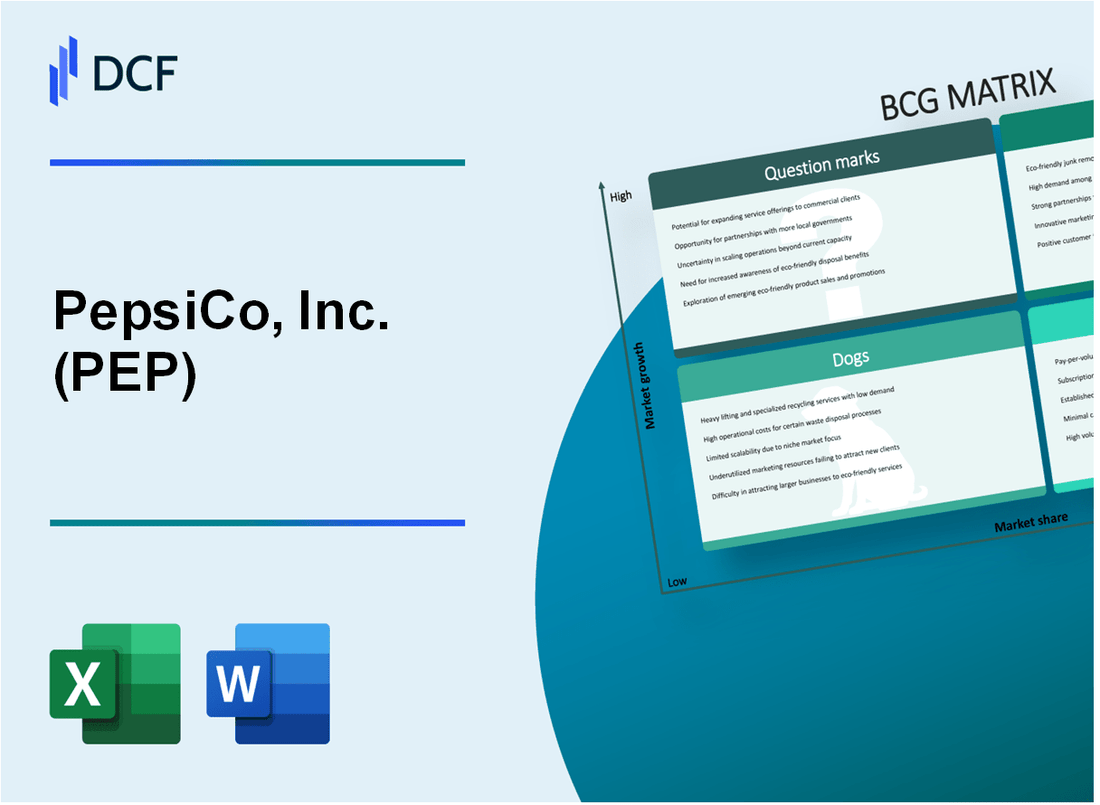
PepsiCo, Inc. (PEP): BCG Matrix [Dec-2025 Updated] |
Fully Editable: Tailor To Your Needs In Excel Or Sheets
Professional Design: Trusted, Industry-Standard Templates
Investor-Approved Valuation Models
MAC/PC Compatible, Fully Unlocked
No Expertise Is Needed; Easy To Follow
PepsiCo, Inc. (PEP) Bundle
The late 2025 portfolio review shows a classic tension: massive cash generation funding high-stakes growth bets. You've got powerhouses like the sports drink leader, holding a commanding 77% share, and the core snack division printing cash to support shareholder returns of about $8.6 billion planned for this year, built on a $92 billion revenue base from 2024. Still, the business is wrestling with legacy issues like the traditional full-sugar sodas and underperforming segments like Quaker Foods North America, which we've mapped as Dogs. The real action is in the Question Marks: heavy investment is flowing into recent plays like the $1.2 billion acquisition and functional drinks hitting $525 million in sales, but they need to prove their long-term worth. Let's map out exactly where the chips are falling across the four quadrants so you can see the near-term risks and opportunities clearly.
Background of PepsiCo, Inc. (PEP)
You're looking at PepsiCo, Inc. (PEP), a global giant in the food and beverage space, headquartered in Purchase, New York. Honestly, this company is massive, which is why we need a framework like the BCG Matrix to sort out its portfolio. As of the trailing twelve months ending September 30, 2025, PepsiCo posted total revenue of approximately $92.366B. That's up slightly from the full-year 2024 revenue of $91.854B.
PepsiCo, Inc. is definitely best known for its iconic brands, which span snacks and beverages. Think about the sheer ubiquity of Lay's, Doritos, Cheetos, and Quaker Oats alongside Pepsi, Gatorade, and their other drink offerings. This diversification is a key part of its strategy, making it the biggest competitor to The Coca-Cola Company (KO).
To get a clearer picture of where the money is coming from right now, let's look at the Q2 2025 segment results. For instance, the PepsiCo Beverages North America segment brought in $6.7 billion in revenue, though it was flat year-over-year. Meanwhile, PepsiCo Foods North America saw a 1% rise to $6.4 billion. Internationally, the Europe, Middle East and Africa segment showed strong growth, increasing 8% to reach $4.5 billion.
The company is clearly focused on productivity and cost optimization to drive profitability, especially as organic revenue growth for the first half of 2025 was guided to be in the low-single-digit range for the full year. On the shareholder side, you should know that PepsiCo has a long history of commitment here; they actually raised their dividend for 52 consecutive years as of the latest reports. That kind of consistency tells you a lot about the underlying cash generation, even if top-line growth has been more modest lately.
PepsiCo, Inc. (PEP) - BCG Matrix: Stars
Stars in the Boston Consulting Group Matrix represent PepsiCo, Inc. (PEP) business units operating in high-growth markets while simultaneously holding a leading market share. These units require significant investment to maintain their growth trajectory and market position, often resulting in cash flow that is reinvested back into the business.
Gatorade is positioned as a Star due to its commanding presence in the sports drink category. The brand maintains a dominant market share, cited around 77% in the high-growth sports drink category. This leadership position requires continued investment in innovation, such as extensions like Gatorade Zero and Gatorade Fit, to cater to health-conscious consumers and sustain its market lead. Globally, PepsiCo leads the sports drink market with a 24.6% share, anchored by this brand.
Pepsi Zero Sugar exemplifies a Star through its exceptional growth metrics in 2025. The brand delivered strong performance, achieving over 30.8% year-to-date sales growth in 2025, which nearly doubled the overall zero-sugar cola category growth over the same period. Furthermore, the company reported double-digit net revenue growth for Pepsi Zero Sugar in the July-September 2025 period. This indicates high market share capture in a growing segment, necessitating ongoing promotional and placement support.
The International Business segment, particularly in emerging markets, functions as a Star, demonstrating resilient growth that outpaces some domestic segments. PepsiCo's international beverages business saw an 11% revenue growth in the first quarter of 2025, with markets like India being key drivers. For international convenient foods, the organic revenue growth in Q1 2025 was 2%, with India, Brazil, Egypt, and Turkey leading gains. Overall international operations posted 5% organic revenue growth in Q1 2025, and the CEO expressed confidence in continued growth at a mid-single-digit rate for the balance of the year, with some markets achieving high single digits.
Core Frito-Lay brands, specifically Lay's and Doritos, maintain their Star status by dominating the savory snack market, which is a growing global category. Frito-Lay, as a subsidiary, controls a significant portion of the market, holding a 40% share of the U.S. savory snack market. In the U.S. potato chip segment, Frito-Lay controls nearly 50% of the market. For the 52 weeks ending May 18, 2025, Frito-Lay sales were nearly $5.9 billion, despite a modest 0.3% dip in that period. The savory snacks segment is projected to account for 38.5% of the total U.S. snacks market demand by value in 2025. You can see the market context below.
| Brand Group | Market Context | Key Metric/Value (2025 Data) |
| Frito-Lay (Overall) | U.S. Savory Snack Market Share | 40% |
| Lay's (Potato Chips) | U.S. Potato Chip Market Control (Parent) | Nearly 50% |
| Savory Snacks Segment | Projected U.S. Market Demand Share (Value) | 38.5% |
| Frito-Lay Sales | Sales Value (52 weeks ending May 18, 2025) | Nearly $5.9 billion |
These brands require investment to fend off competitors and capitalize on trends like localized flavors and healthier options, such as the introduction of new lines with no artificial flavors or colors.
The key characteristics supporting the Star categorization for these PepsiCo, Inc. (PEP) assets include:
- Gatorade: Dominant market share around 77% in its category.
- Pepsi Zero Sugar: Achieved over 30.8% year-to-date sales growth in 2025.
- International Business: International Beverages saw 11% revenue growth in Q1 2025.
- Lay's/Doritos: Frito-Lay controls 40% of the U.S. savory snack market.
If market share is kept, Stars are likely to grow into cash cows. Finance: finalize the Q4 2025 investment allocation plan for these four areas by next Tuesday.
PepsiCo, Inc. (PEP) - BCG Matrix: Cash Cows
You're analyzing the core engine of PepsiCo, Inc. (PEP), the segment that consistently prints cash to fund the riskier parts of the portfolio. Cash Cows, in the Boston Consulting Group (BCG) framework, are those business units operating in mature markets where PepsiCo holds a dominant market share, but where top-line growth is naturally slow. These units generate significantly more cash than they require for maintenance, making them indispensable for corporate funding.
The primary Cash Cows for PepsiCo, Inc. are its established, high-volume snack and beverage operations in North America. These units benefit from deep brand loyalty and established distribution networks, meaning promotional and placement investments can be relatively lean compared to growth-seeking Stars or Question Marks.
Frito-Lay North America (FLNA) is the quintessential example here. It commands a massive market share in the salty snack space, acting as a primary cash generator for the entire corporation. While volume has recently faced headwinds-for instance, Q4 2024 saw Frito-Lay sales drop by 0.6% year-over-year, and full-year 2024 organic revenue growth was only 2.0%-its pricing power and market leadership keep margins strong enough to deliver substantial cash flow. For context, FLNA (as part of the larger Performance Foods North America segment) contributed a reported division operating profit of $6.6B in 2024, representing 45% of the total division operating profit mix for that year. That's serious cash generation, even with volume dips.
The Core Carbonated Soft Drinks (CSD) Portfolio, housed primarily within PepsiCo Beverages North America (PBNA), fits this profile as well. The CSD market is mature, leading to low-single-digit volume growth expectations for 2025. Still, the high margins on these established brands provide a stable, high-margin cash stream. In 2024, PBNA's reported division operating profit was $2.3B, making up 15% of the total division operating profit mix.
These cash flows are critical for PepsiCo, Inc.'s overall financial health and shareholder commitment. Here is a look at the scale of the operation these Cash Cows support:
| Metric | Value (FY 2024/2025 Projection) |
| Total Net Revenue (FY 2024) | Approximately $92 billion (or $91.854B) |
| FLNA 2024 Division Operating Profit Contribution | $6.6 billion (45% of PFNA total) |
| PBNA 2024 Division Operating Profit Contribution | $2.3 billion (15% of total) |
| Projected Total Shareholder Return (2025) | Approximately $8.6 billion |
| Annualized Dividend Increase (2025) | 5% |
The strategy for these units is clear: maintain market position and efficiency, not aggressive growth spending. You want to 'milk' these gains passively while using the resulting capital to fund other areas. The company's commitment to this stability is evident in its shareholder returns.
The financial discipline required to support the entire enterprise stems directly from these mature segments. The cash generated helps cover corporate overhead, service debt, and fund strategic R&D. Consider the shareholder commitment:
- Annualized dividend increased to $5.69 per share for 2025 from $5.42 in 2024.
- This marks the 53rd consecutive annual dividend increase.
- Total planned return to shareholders in 2025 is about $8.6 billion.
- The 2024 payout ratio was reported around 78.38%, supported by $7.19 billion in free cash flow.
Investments here are focused on infrastructure that improves efficiency, which directly boosts the cash flow you need. For example, the company emphasized enhanced multiyear productivity initiatives in 2024 to expand gross and operating margins. That's how you maximize the return from a Cash Cow; you don't chase growth where the market won't give it to you, you optimize the cost structure you already have. If onboarding takes 14+ days, churn risk rises, but for these established brands, the risk is more about losing operational leverage.
PepsiCo, Inc. (PEP) - BCG Matrix: Dogs
Dogs are units or products with a low market share and low growth rates. They frequently break even, neither earning nor consuming much cash. Dogs are generally considered cash traps because businesses have money tied up in them, even though they bring back almost nothing in return. These business units are prime candidates for divestiture.
Quaker Foods North America (QFNA) fits this profile due to significant operational setbacks. Following a major recall that began in late 2023, the segment faced severe volume pressure. For instance, Q3 2024 saw the segment's volume drop by 13%. While Q4 2024 operating profit showed a 323% increase, this was primarily due to the favorable impact of prior-year charges associated with the recall, not underlying strength. In Q1 2024, the segment reported a GAAP operating profit loss of -$49 million, and GAAP revenue was down 24% for that quarter.
Traditional Pepsi-Cola (Regular) embodies the low-growth product facing secular decline. The sales volume for Pepsi sodas in the USA fell by 32% between 2010 and 2023. This trend has pushed the brand's U.S. carbonated soft drink market share down to 8% in 2024, resulting in Dr Pepper overtaking it for the second-place spot. The North America Beverages segment volume declined 3% in Q4 2024. Still, recent retail sales figures show classic Pepsi increased by 5.8%, and Pepsi Zero Sugar grew by double digits, suggesting minor pockets of life.
The Tropicana and Naked Juice brands, despite being part of a joint venture since 2021, represent a drag on the overall portfolio's perceived value and growth profile. PepsiCo retained a 39% noncontrolling stake in the unit, which generated about $3 billion in net revenue in 2020. The financial impact was evident in Q4 2024, where PepsiCo Beverages North America (PBNA) recorded an operating loss of $109m, largely due to impairment charges related to these brands. Furthermore, a substantial $1.86 billion impairment charge was absorbed in Q2 2025, though this was primarily tied to the Rockstar energy brand, illustrating the ongoing margin pressure in the non-core beverage space. For Naked Juice specifically, its Q2 2024 adjusted EBITDA declined 70% from the prior year due to $32 million in one-time costs.
Certain Legacy SKUs contribute to product sprawl, where revenue per item doesn't justify the complexity. This is reflected in the overall North America Beverages performance. PBNA volume declined 5% in Q1 2024. While PBNA revenue was flat at $6.8 billion in Q2 2025, the segment recorded an operating loss of $639 million in that quarter.
Here's a look at the specific performance indicators for these challenged units:
| Business Unit/Brand | Relevant Financial/Statistical Metric | Value/Amount | Timeframe/Context |
|---|---|---|---|
| Quaker Foods North America | Volume Decrease | 13% | Q3 2024 |
| Traditional Pepsi-Cola (USA) | Sales Volume Decline | 32% | 2010 to 2023 |
| PepsiCo CSD Market Share (U.S.) | Rank/Share | Third Place / 8% | 2024 |
| Tropicana/Naked Juice Unit | Divestiture Proceeds | $3.3 billion | 2021 Sale |
| PBNA Impairment Charge | Operating Loss Impact | $109 million | Q4 2024 |
| Naked Juice (Specific) | Adjusted EBITDA Decline | 70% | Q2 2024 vs Q2 2023 |
The low-growth, low-share nature of these areas is further highlighted by the overall company outlook:
- FY2025 expected organic revenue growth: low-single digit.
- Q2 2025 Net Revenue: $22.7 billion.
- FY2025 expected Core EPS change: -1.5% (revised guidance).
- Total PepsiCo FY2024 Revenue: $91.854B.
- PBNA Q2 2025 Operating Loss: $639 million.
Expensive turn-around plans usually do not help. These units tie up capital that could be better deployed in higher-growth areas. Finance: review the carrying value of the 39% stake in the former juice unit by next Tuesday.
PepsiCo, Inc. (PEP) - BCG Matrix: Question Marks
You're looking at the high-growth, low-market-share segment of PepsiCo, Inc. (PEP) portfolio-the Question Marks. These are the areas where PepsiCo is pouring cash, betting that today's high-demand, low-return ventures will become tomorrow's Stars. Honestly, these units consume capital because they are fighting for share in rapidly expanding categories, but the payoff, if they win, is substantial.
Consider the recent poppi acquisition. PepsiCo brought this fast-growing functional soda brand into the fold in March 2025 for a headline price of $1.95 billion, which nets out to about $1.65 billion after anticipated tax benefits. While the brand is a leader in the prebiotic soda space, its retail sales contribution is still relatively small compared to PepsiCo's giants, with the prompt citing current retail sales around $525 million. That's high growth, but the market share within the total beverage category remains low, demanding heavy investment to scale distribution.
The functional wellness trend is driving other Question Marks, too. You see this with new launches like Propel Protein Water and Pepsi Prebiotic. PepsiCo is using established platforms like Propel to innovate into functional hydration, and they just launched Pepsi Prebiotic Cola online in the fall of 2025, aiming to capture the gut-health movement. These are classic Question Mark plays: enter a hot, growing market, but you're behind the early movers, so you have to spend to get noticed and adopted quickly.
On the food side, the Siete Foods acquisition, completed in January 2025 for $1.2 billion, fits this quadrant perfectly. Siete Foods is a high-growth, better-for-you brand expanding PepsiCo's reach in authentic, health-conscious snacking. The investment is necessary to integrate their distribution and marketing muscle to rapidly grow their market share against established competitors in the premium snack space. It's a big spend to secure a foothold in a segment consumers are clearly prioritizing.
Furthermore, the ongoing push into the permissible snack portfolio requires significant cash infusion. This includes new or enhanced offerings like Doritos and Cheetos "NKD" and Sun Chips. PepsiCo expects Sun Chips alone to exceed $700 million in net revenue for 2025, and the overall permissible portfolio is already a massive business, exceeding $2 billion in annual sales. The investment here is about maintaining momentum and evolving core brands to meet clean-label demands, which is expensive but necessary to prevent these products from sliding into the Dog quadrant.
Here's a quick look at the capital allocation and growth profile for these specific Question Marks:
| Asset/Initiative | Acquisition/Investment Value (Approximate) | Growth Market Status | Current Sales/Revenue Context |
|---|---|---|---|
| poppi Acquisition | $1.95 billion (Gross Price) | High Growth (Prebiotic Soda) | Reported retail sales around $525 million |
| Siete Foods Acquisition | $1.2 billion | High Growth (Better-For-You Snacks) | Acquired to expand share in a growing segment |
| Sun Chips (Permissible) | Heavy Investment Required | High Growth (Healthier Snacking) | Projected to exceed $700 million in 2025 net revenue |
| Pepsi Prebiotic Cola | Investment in R&D/Launch Costs | High Growth (Functional Beverages) | New launch, low initial market share |
The core strategy for these Question Marks is clear: you either invest heavily to gain share quickly, or you divest. For PepsiCo, the action is overwhelmingly to invest, leveraging their scale to accelerate adoption. You need to see these move to Stars, or they become a drain.
The required actions for these units are centered on market penetration and brand discovery:
- Increase physical availability in all channels.
- Step up commercial activities and marketing spend.
- Focus innovation on functional benefits and clean labels.
- Ensure competitive pricing for everyday options.
- Rapidly scale distribution networks post-acquisition.
If onboarding takes 14+ days for new brands like Siete Foods, churn risk rises, so speed to shelf is critical. Finance: draft the 2026 capital expenditure allocation plan prioritizing these high-potential segments by Friday.
Disclaimer
All information, articles, and product details provided on this website are for general informational and educational purposes only. We do not claim any ownership over, nor do we intend to infringe upon, any trademarks, copyrights, logos, brand names, or other intellectual property mentioned or depicted on this site. Such intellectual property remains the property of its respective owners, and any references here are made solely for identification or informational purposes, without implying any affiliation, endorsement, or partnership.
We make no representations or warranties, express or implied, regarding the accuracy, completeness, or suitability of any content or products presented. Nothing on this website should be construed as legal, tax, investment, financial, medical, or other professional advice. In addition, no part of this site—including articles or product references—constitutes a solicitation, recommendation, endorsement, advertisement, or offer to buy or sell any securities, franchises, or other financial instruments, particularly in jurisdictions where such activity would be unlawful.
All content is of a general nature and may not address the specific circumstances of any individual or entity. It is not a substitute for professional advice or services. Any actions you take based on the information provided here are strictly at your own risk. You accept full responsibility for any decisions or outcomes arising from your use of this website and agree to release us from any liability in connection with your use of, or reliance upon, the content or products found herein.