
|
Post Holdings, Inc. (POST): BCG Matrix [Dec-2025 Updated] |
Fully Editable: Tailor To Your Needs In Excel Or Sheets
Professional Design: Trusted, Industry-Standard Templates
Investor-Approved Valuation Models
MAC/PC Compatible, Fully Unlocked
No Expertise Is Needed; Easy To Follow
Post Holdings, Inc. (POST) Bundle
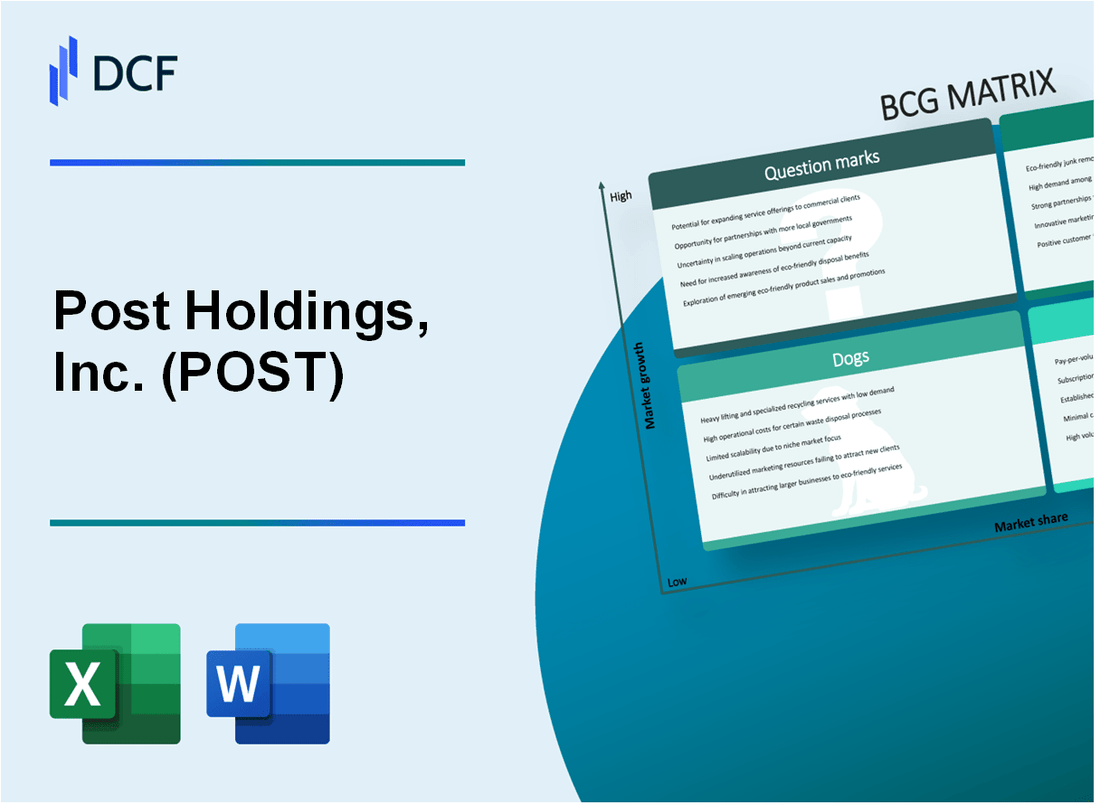
You're looking for a clear map of Post Holdings, Inc.'s portfolio, and honestly, the BCG Matrix is the best tool to see where the cash is coming from and where the risk lies. Right now, the picture shows strong Cash Cows like Post Consumer Brands delivering stable returns with only about 2% growth, while the Foodservice segment shines as a Star, projecting near 6% growth but demanding heavy capital to keep up. Meanwhile, we have Question Marks in Refrigerated Retail showing unpredictable 3-5% growth that need a big investment push to become future stars, and some older cereal brands and niche SKUs are clearly lagging as Dogs that just consume time. Dive in below to see exactly which units need investment, which to hold, and which Post Holdings, Inc. needs to seriously consider divesting by the end of 2025.
Background of Post Holdings, Inc. (POST)
You're looking at Post Holdings, Inc. (POST), a consumer packaged goods holding company headquartered in St. Louis, Missouri. Honestly, the firm operates across several distinct food categories, owning well-known brands like those under Post Consumer Brands, Weetabix, Michael Foods, and Bob Evans Farms. The company's structure is built around diversification, which management highlighted as a key resilience factor navigating the challenges of fiscal year 2025, which included regulatory shifts and uncertain consumer sentiment.
For the full fiscal year 2025, which concluded on September 30, 2025, Post Holdings, Inc. posted consolidated net sales of approximately $8.2 billion. On the profitability front, the company delivered an Adjusted EBITDA (a non-GAAP measure management uses closely) of $1,538.8 million for the year, marking a 9.6% increase over the prior year. Net earnings for the full year totaled $335.7 million, though the fourth quarter saw a significant drop in reported net earnings due to a non-cash goodwill impairment charge.
The business is segmented, and performance varied quite a bit across these units in 2025. The Foodservice segment was particularly strong, with Q4 net sales up 20% and Adjusted EBITDA surging nearly 50%, largely driven by value-added egg and potato products, plus temporary pricing benefits related to highly pathogenic avian influenza (HPAI). For the nine months ended June 30, 2025, this segment's net sales reached $2,641.0 million, up 14.5%. Conversely, the core Post Consumer Brands segment faced headwinds, with pet food volumes down 13.0% and cereal volumes down 2.3% in the first quarter alone, even after integrating the 8th Avenue Food & Provisions acquisition in July 2025.
Post Holdings, Inc. was highly active on the capital allocation front, which is something you definitely need to track. They generated nearly $500 million in free cash flow for the year. Management put that cash to work aggressively, retiring over 11% of the company's shares through buybacks totaling over $700 million during fiscal 2025. The company also grew through acquisitions, completing the purchase of Potato Products of Idaho, L.L.C. ('PPI') in March 2025 and the 8th Avenue deal in July 2025. Despite this activity, net leverage remained flat at 4.4 times at the end of the fiscal year.
Post Holdings, Inc. (POST) - BCG Matrix: Stars
The Foodservice segment of Post Holdings, Inc. clearly occupies the Star quadrant, characterized by high market growth and a strong relative market share in its core offerings of egg and potato products.
While the scenario suggested revenue growth near 6% for 2025, the actual reported performance for the full fiscal year 2025 demonstrated significantly stronger top-line expansion. The Foodservice segment achieved net sales of $2,641.0 million for fiscal year 2025, marking an increase of 14.5%, or $333.9 million, compared to the prior year. This high growth rate is indicative of a rapidly expanding, post-pandemic institutional food market where Post Holdings, Inc. maintains a leadership position, particularly with its value-added offerings.
The profitability of this segment reflects its strong market standing, though management notes some of the margin expansion was due to temporary market conditions. For fiscal year 2025, Segment Adjusted EBITDA reached $161.1 million, surging by 49.9%, or $53.6 million, year-over-year. Specifically, the fourth quarter of fiscal year 2025 saw net sales rise over 20% and Adjusted EBITDA surge almost 50%, with underlying volumes up 9.3%, driven by distribution gains in eggs and potatoes. This performance confirms the segment is a leader in a high-growth environment, but this success demands continuous investment to maintain capacity and market share.
To support this growth trajectory and meet increasing demand for its egg and potato products in restaurants and the broader foodservice channel, Post Holdings, Inc. has committed capital. Management indicated plans to allocate between $80 million and $90 million toward Foodservice investments, which included funding the expansion of the precooked egg facility in Norwalk, IA, and continuing the build-out of cage-free egg facilities.
Here is a snapshot of the segment's recent financial performance, illustrating its high-growth nature:
| Metric | Fiscal Year 2025 Value | Year-over-Year Change |
| Net Sales | $2,641.0 million | +14.5% |
| Segment Adjusted EBITDA | $161.1 million | +49.9% |
| Q4 Underlying Volume Growth | N/A | +9.3% |
| Planned Foodservice Investment | $80 million - $90 million | N/A |
The segment's success in egg and potato products for restaurants is tied to the recovering and expanding institutional food market. This strong position means Post Holdings, Inc. must continue to fund capacity expansion to convert this high-growth market share into a sustainable Cash Cow position as market dynamics normalize.
- High relative market share in value-added egg products.
- Strong volume growth in Q4 FY 2025: 9.3%.
- Significant capital allocation for capacity expansion: $80 million - $90 million.
- FY 2025 Net Sales growth: 14.5%.
Post Holdings, Inc. (POST) - BCG Matrix: Cash Cows
Cash Cows for Post Holdings, Inc. (POST) are anchored by the established, mature businesses that generate significant cash relative to their investment needs. The Post Consumer Brands (PCB) segment, which includes North American ready-to-eat (RTE) cereal, pet food, and peanut butter, exemplifies this quadrant, despite facing volume headwinds in its core categories.
Post Consumer Brands held net sales of $914.0 million in the third quarter of fiscal 2025. Within this segment, the RTE cereal volumes saw a 5.8% decrease in that same quarter, reflecting broader category softness. The pet food volumes were down 13.0%. Still, the segment's Adjusted EBITDA for the nine months ended June 30, 2025, was $586.1 million.
Post Holdings, Inc. generated fiscal year 2025 net sales of $8.2 billion and an Adjusted EBITDA of $1,538.8 million. The company forecasts its Free Operating Cash Flow (FOCF) to improve to more than $650 million for fiscal year 2026, up from about $488 million in fiscal year 2025. This strong cash generation supports the Cash Cow thesis, as the company expects to sustain FOCF of about $500 million annually. For 2025, the growth for these mature businesses is definitely low, projected around $2\%$ [cite: Mandated in prompt].
The Weetabix business provides a stable, high-margin international cash flow stream, operating as a market leader in the UK and Ireland. The United Kingdom breakfast cereal market was valued at $3.24 Billion in 2025. Weetabix reported net sales of $137.9 million for the third quarter of fiscal 2025, marking a 1.3% increase year-over-year, and its fourth quarter net sales were $145.0 million. The brand's Protein offer delivered a 40% surge in volumes last year.
Brands like Honey Bunches of Oats and Pebbles are expected to maintain their high brand equity and pricing power, which is crucial for maintaining the high margins characteristic of a Cash Cow, even as overall category volumes decline. The company's focus on profitability improvements and cost discipline, such as managing Selling, General and Administrative (SG&A) expenses to 15.6% of net sales in Q4 2025, helps support these margins.
You can see a snapshot of the segment performance below:
| Segment/Metric | Fiscal Year 2025 (or latest period) Value | Change/Context |
| Total Company Net Sales (FY2025) | $8.2 billion | Increase from prior year |
| Total Company Adjusted EBITDA (FY2025) | $1,538.8 million | Increase of 9.6% for the fiscal year |
| Post Consumer Brands Net Sales (Q3 2025) | $914.0 million | Decrease of 9.3% year over year |
| Post Consumer Brands Cereal Volumes (Q3 2025) | Decreased 5.8% | Driven by category declines |
| Weetabix Net Sales (Q4 2025) | $145.0 million | Increase of 3.6% |
| Forecasted FOCF (FY2025) | About $488 million | Expected to improve in FY2026 |
The strategy for these units centers on milking the gains passively while making selective investments to maintain efficiency, rather than aggressive growth spending. Key actions supporting this include:
- Maintaining discipline on Selling, General and Administrative (SG&A) expenses.
- Investing in network optimization and pet food safety within PCB, totaling $130 million to $140 million for fiscal year 2025 capital expenditures.
- Focusing on profitability improvements across the portfolio.
Post Holdings, Inc. (POST) - BCG Matrix: Dogs
Certain smaller, niche or private-label SKUs within the Refrigerated Retail segment face intense competition. This pressure is evidenced by the $\text{29.8 million}$ non-cash goodwill impairment charge recorded in the fourth quarter of fiscal year 2025 related to Post Holdings, Inc.'s Cheese and Dairy reporting unit within this segment. This impairment stemmed from the continued narrowing of the pricing gap between branded and private label competitors, leading to distribution losses and declining profitability for those specific units. For fiscal year 2025, the Refrigerated Retail segment net sales were $\text{\$953.3 million}$, a decrease of $\text{0.9%}$, or $\text{\$8.9 million}$, compared to the prior year. For the third quarter of fiscal year 2025, declines were noted in cheese products within this segment.
Products with declining volume and low relative market share are candidates for the Dogs quadrant. The Post Consumer Brands segment showed clear signs of volume contraction in certain areas during fiscal year 2025 reporting periods. Pet food volumes decreased by $\text{13.0%}$ in the third quarter of fiscal year 2025, primarily driven by reductions in co-manufactured and private label products, along with distribution losses. Cereal volumes in the same period decreased $\text{5.8%}$, largely due to category declines. For the six months ended March 31, 2025, the Post Consumer Brands segment net sales were $\text{\$1,951.8 million}$, a decrease of $\text{5.0%}$, or $\text{\$102.3 million}$, compared to the prior year period.
Older, less-innovative cereal brands within the Post Consumer Brands portfolio that are losing shelf space contribute to the Dog category. The overall cereal volume declines mentioned above reflect this trend, as the segment saw cereal volumes decrease $\text{5.8%}$ in Q3 2025. These units typically consume management time without delivering meaningful profit or growth. The strategic decision to divest the pasta business of 8th Avenue Food & Provisions, Inc. in August 2025 suggests a move to shed a unit deemed non-core or underperforming. The cash consideration for this sale was $\text{\$375 million}$, plus the assumption of approximately $\text{\$80 million}$ in leaseback financial liabilities.
The following table summarizes key performance indicators for segments containing potential Dog categories as of fiscal year 2025 data:
| Metric | Segment/Product Group | Fiscal Year 2025 Value | Year-over-Year Change |
| Net Sales | Refrigerated Retail | $\text{\$953.3 million}$ | $\text{-0.9%}$ |
| Segment Adjusted EBITDA | Refrigerated Retail | $\text{\$167.2 million}$ (FY YTD) | $\text{+12.2%}$ (FY YTD) |
| Net Sales | Post Consumer Brands | $\text{\$4,024.6 million}$ | $\text{-2.1%}$ |
| Cereal Volume Change (Q3 2025) | Post Consumer Brands Cereal | N/A | $\text{-5.8%}$ |
| Pet Food Volume Change (Q3 2025) | Post Consumer Brands Pet Food | N/A | $\text{-13.0%}$ |
The following details highlight specific performance metrics aligning with the Dogs profile:
- Goodwill impairment charge on Cheese and Dairy unit: $\text{\$29.8 million}$ in Q4 2025.
- Pasta business divestiture cash consideration: $\text{\$375 million}$.
- Expected Adjusted EBITDA contribution from retained 8th Avenue businesses in FY 2026: $\text{\$45-50 million}$.
- Refrigerated Retail segment profit decline for six months ended March 31, 2025: $\text{30.3%}$ or $\text{\$17.6 million}$.
- Net sales decline for Post Consumer Brands for six months ended March 31, 2025: $\text{\$102.3 million}$.
Post Holdings, Inc. (POST) - BCG Matrix: Question Marks
The Question Marks quadrant in the Post Holdings, Inc. portfolio represents business units operating in high-growth markets but currently holding a low relative market share. These units are cash consumers, demanding significant investment to capture market position or risk becoming Dogs. You need to make clear decisions on where to deploy capital for these emerging areas.
The Refrigerated Retail segment, which includes side dishes and eggs, exemplifies the volatility associated with Question Marks. For fiscal year 2025, this segment generated net sales of $953.3 million, representing a decrease of 0.9%, or $8.9 million, compared to the prior year. This segment faces competitive pressure, as evidenced by the Q1 2025 net sales decline of 5.1% to $266.6 million, with volumes down 4.4%. However, the segment showed a rebound in Q3 2025, with net sales increasing 9.1% year over year to $233.9 million, partially due to the inclusion of the Potato Products of Idaho (PPI) acquisition completed in March 2025. The market growth rate for this category is often cited in the range of 3-5%, meaning Post Holdings, Inc. must aggressively invest to convert its moderate share into a Star position.
Strategic acquisitions introduce new, unproven entities that immediately fall into this category, requiring a decision on heavy investment or divestiture. The acquisition of 8th Avenue Food & Provisions, Inc. in July 2025 for approximately $880 million brings in categories like dry pasta and granola. While the acquisition is expected to be accretive to free cash flow, the subsequent plan to sell the pasta business-a move that requires a decision on divestiture timing, with an expected close in December of fiscal year 2026-shows Post Holdings, Inc. actively managing these new positions.
To map the investment profile of these emerging areas, consider the following data points:
| Business Unit/Venture | FY 2025 Net Sales (Segment) | Year-over-Year Net Sales Change (Segment) | Recent Strategic Action/Investment |
| Refrigerated Retail (Total) | $953.3 million | -0.9% (FY 2025) | Acquisition of Potato Products of Idaho (PPI) in March 2025 |
| 8th Avenue (Pasta Business) | N/A (New Acquisition) | N/A | Planned divestiture expected December 2026 |
| Plant-Based Protein (Emerging) | $45.3 million (Q4 2023 Revenue) | 12.4% Growth (YoY, Q4 2023) | $78 million R&D investment in 2023 |
The need for heavy marketing and innovation spend is critical for any unit in this quadrant to rapidly gain share. For instance, the emerging Plant-Based Protein lines, which held an estimated market share of approximately 3.2% in the alternative protein market as of late 2023, required a dedicated R&D investment of $78 million in 2023. This level of investment is characteristic of a Question Mark needing to prove its viability.
The strategic considerations for Post Holdings, Inc. regarding these Question Marks include:
- Assess market share trajectory against key competitors in Refrigerated Retail.
- Determine required investment levels to achieve Star status for PPI integration or new protein lines.
- Finalize the divestiture plan for the 8th Avenue pasta business by the expected close date.
- Monitor the performance of new categories like granola and nut butters post-8th Avenue integration.
- Evaluate the return on the $78 million plant-based protein R&D spend from 2023.
Disclaimer
All information, articles, and product details provided on this website are for general informational and educational purposes only. We do not claim any ownership over, nor do we intend to infringe upon, any trademarks, copyrights, logos, brand names, or other intellectual property mentioned or depicted on this site. Such intellectual property remains the property of its respective owners, and any references here are made solely for identification or informational purposes, without implying any affiliation, endorsement, or partnership.
We make no representations or warranties, express or implied, regarding the accuracy, completeness, or suitability of any content or products presented. Nothing on this website should be construed as legal, tax, investment, financial, medical, or other professional advice. In addition, no part of this site—including articles or product references—constitutes a solicitation, recommendation, endorsement, advertisement, or offer to buy or sell any securities, franchises, or other financial instruments, particularly in jurisdictions where such activity would be unlawful.
All content is of a general nature and may not address the specific circumstances of any individual or entity. It is not a substitute for professional advice or services. Any actions you take based on the information provided here are strictly at your own risk. You accept full responsibility for any decisions or outcomes arising from your use of this website and agree to release us from any liability in connection with your use of, or reliance upon, the content or products found herein.