

|
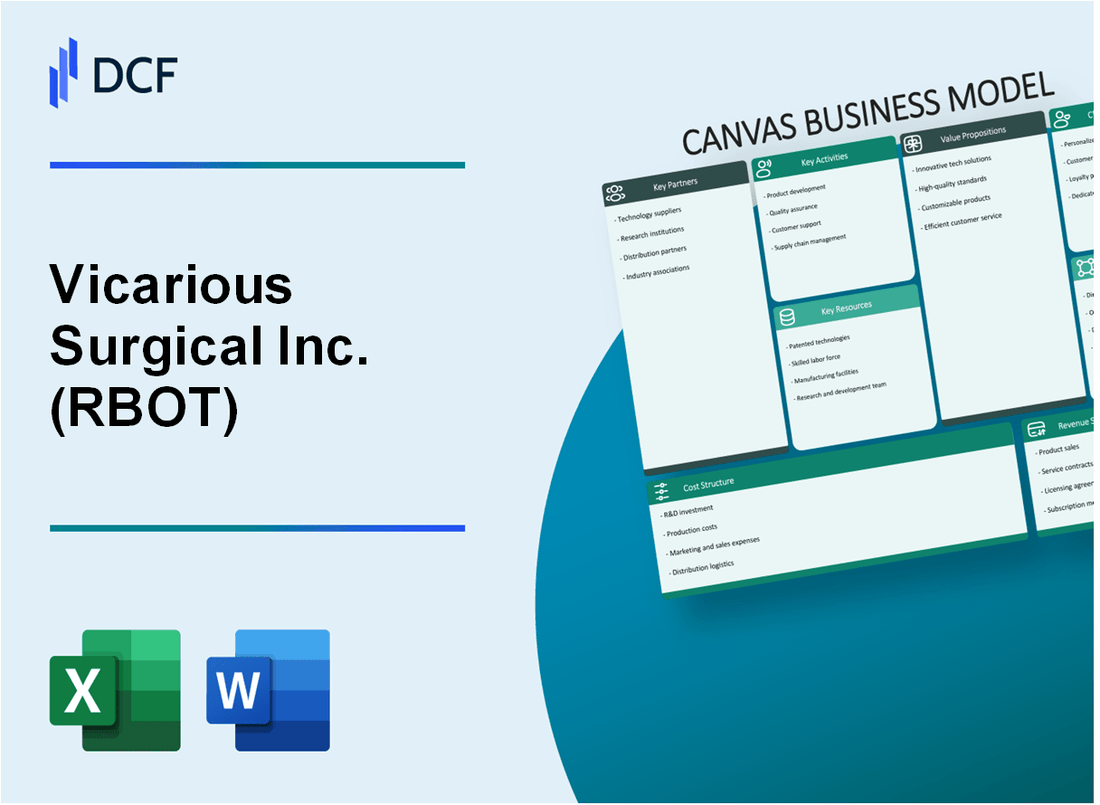
Vicarious Surgical Inc. (RBOT): Business Model Canvas [Dec-2025 Updated] |
Fully Editable: Tailor To Your Needs In Excel Or Sheets
Professional Design: Trusted, Industry-Standard Templates
Investor-Approved Valuation Models
MAC/PC Compatible, Fully Unlocked
No Expertise Is Needed; Easy To Follow
Vicarious Surgical Inc. (RBOT) Bundle
You're digging into the mechanics of a pre-revenue surgical robotics firm, and honestly, the Business Model Canvas for Vicarious Surgical Inc. right now isn't about sales; it's a pure execution play focused on capital preservation and R&D delivery. As an analyst who's seen countless capital-intensive journeys, I can tell you their immediate engine is about extending that runway-they were sitting on about $24.0 million in cash and short-term investments as of June 30, 2025, while burning through cash to finalize that production system design. To truly grasp how they plan to bridge the gap from heavy Research and Development expenses, like the $8.0 million they spent in Q3 2025, to the future recurring revenue from disposable instruments, you need to see the whole structure below.
Vicarious Surgical Inc. (RBOT) - Canvas Business Model: Key Partnerships
You're hiring before product-market fit, so your partnerships are the lifeline keeping the lights on while you finalize the production-equivalent system design.
Strategic development agreements with major hospital systems are critical for validating the platform in a real-world setting. While specific agreements with Intermountain Health aren't detailed in recent filings, the company has established a key clinical partnership with UMass Memorial Medical Center.
Clinical collaboration with UMass Memorial Medical Center for system optimization began with an agreement announced on May 12, 2025. This partnership is designed to support the adoption and utilization of the robotic system through several focused operational areas.
- Streamlining inventory management protocols.
- Standardization of pre-procedure processes.
- Enhancement of post-procedure care.
- Direct case observation for surgeons and system testing.
UMass Memorial Medical Center, the flagship academic medical center of UMass Memorial Health, is the largest not-for-profit hospital in Central Massachusetts, possessing 826 licensed beds. The company expects to treat its first clinical patients in 2025 and submit for FDA de novo classification by late 2026.
Outsourcing partners for select robot development functions to reduce internal burn became a formal strategy in late 2025 as part of a restructuring effort. This move aims to lower spending while the company targets design freeze of the production-equivalent system toward the end of 2026. The company reported a third-quarter 2025 net loss of $11.1 million, down from $17.1 million in Q3 2024. The full-year 2025 cash burn guidance was reduced to approximately $45 million, an improvement of $5 million from the previous guidance of $50 million. The cash burn rate for the third quarter of 2025 was $10.5 million.
Key technology investors providing capital and credibility include several well-known names, which is important for signaling market confidence during this development phase.
| Investor Entity | Investment Type/Role | Notable Financial Data Point |
| Bill Gates | Technology Luminary Backer | Part of the backing team |
| Khosla Ventures | Institutional Investor | Led Series A round of $16.8 million in March 2018 |
| Innovation Endeavors | Institutional Investor | First investment in March 2018 |
| AME Cloud Ventures (Jerry Yang) | Technology Luminary Backer | Part of the backing team |
| E15 VC (Philip Liang) | Institutional Investor | First investment on August 7, 2020 |
The company raised approximately $5.9 million in gross proceeds from a registered direct offering in October 2025. Vicarious Surgical Inc. has raised a total of $43.2 million over 7 funding rounds.
Finance: draft 13-week cash view by Friday.
Vicarious Surgical Inc. (RBOT) - Canvas Business Model: Key Activities
You're looking at a company deep in the execution phase, where every dollar spent directly impacts the timeline to market. For Vicarious Surgical Inc. (RBOT) as of late 2025, the Key Activities are all about hitting critical engineering and regulatory milestones while aggressively managing the burn rate. Here's the quick math on what's driving their operational focus right now.
Finalizing the design of the production-equivalent surgical system (Design Freeze)
The primary engineering activity centers on locking down the final specifications for the system intended for commercial use. This is the point where major design changes stop, allowing for scalable manufacturing setup. Management has set a clear, near-term target for this milestone. The main priority remains achieving design freeze of the production-equivalent system-the version that includes all features and specifications required for commercialization. They continue to target completion by year-end 2026. This target is being supported by identifying outsourcing opportunities and internal restructuring to maintain capital efficiency. Honestly, hitting that 2026 date is the single biggest technical dependency for the entire business plan.
Rigorous preclinical testing and system verification/validation
While specific, quantifiable data on the volume of preclinical tests completed isn't readily available in the latest reports, this activity is implicitly linked to achieving the design freeze. The company is aligning its organization around a leaner cost structure that supports this ongoing clinical path. The focus here is ensuring the system is robust enough to move forward successfully once the design is locked.
Preparing the De Novo regulatory submission for the FDA, likely for ventral hernia
The regulatory pathway is a major focus, though the timeline has shifted. Vicarious Surgical previously aimed to file a De Novo submission to the FDA in early 2025 for ventral hernia repair. However, the company has since delayed the clinical timeline, meaning they will no longer initiate first-in-human trials in 2025. Now, the company's filing with the FDA, along with other clinical milestones, will depend on the V1.0 clinical robot's First Clinical Use (FCU). The current expectation is to submit the De Novo filing with the FDA in 2026, contingent on the successful completion of the necessary clinical work.
Disciplined cost management and operational restructuring to extend cash runway
This is where the most concrete numbers are coming out, showing a clear pivot to financial discipline. The company is actively working to reduce its cash burn to support the development timelines. They successfully raised $5.9 million in a direct offering following Q3 2025, which helped bolster their position. The focus on operational efficiency has led to a revised full-year 2025 cash burn guidance of approximately $45 million, an improvement of $5 million from the previous guidance of $50 million. You'll want to watch the 2026 guidance, which they plan to release before the end of the year.
Here is a breakdown of the cost structure improvements seen in the third quarter of 2025 compared to the third quarter of 2024:
| Expense Category | Q3 2025 Amount (USD) | Year-over-Year Change |
| Total Operating Expenses | $11.5 million | Decrease of 35% |
| Research and Development Expenses | $8.0 million | Decrease of 26% |
| General and Administrative Expenses | $3.2 million | Decrease of 45% |
| Sales and Marketing Expenses | $0.4 million | Decrease of 71% |
The quarterly performance reflects this shift. The cash burn rate for the third quarter of 2025 was approximately $10.5 million. As of September 30, 2025, the company held $13.4 million in cash and investments. This disciplined approach is crucial, especially since earlier reports indicated the cash runway was tight, expecting to last only into Q1 2026 based on mid-2025 figures.
The reduction in losses is also evident when you look at the cumulative performance:
- Net loss for the first three quarters of 2025 was $39.67 million.
- This represents a narrowing of 19.53% from the $49.30 million net loss in the same period last year.
Finance: draft the expected 2026 cash burn scenario analysis by next Wednesday.
Vicarious Surgical Inc. (RBOT) - Canvas Business Model: Key Resources
You're looking at the core assets Vicarious Surgical Inc. (RBOT) relies on to execute its strategy. For a company in the pre-commercial robotics space, these resources are heavily weighted toward intellectual property and specialized human capital. Honestly, this is where the value is concentrated right now.
Proprietary Technology and Interface
The foundation of Vicarious Surgical Inc.'s offering is its proprietary single-port robotic technology, which integrates a virtual reality (VR) interface for the surgeon. This design aims to transport the surgeon into the patient's body, maximizing visualization and control during minimally invasive surgery (MIS).
Here are the concrete specs of the system that define this key resource:
- The Vicarious Surgical System is designed for all robotic motion to happen inside the patient through a single port.
- The system is capable of incision sizes as low as 1.2 cm.
- Current disposables require a 1.8 cm incision.
- Vicarious Surgical Inc. is developing and expects to launch disposables requiring a 1.5 cm incision.
- The surgical instruments offer 13 degrees of freedom, giving surgeons enhanced dexterity.
Extensive Intellectual Property Portfolio
The intellectual property (IP) portfolio is a critical barrier to entry. It represents years of development and the core defensibility of their platform. You need to track the granted patents closely, as those are the ones fully secured.
Here is the snapshot of their IP as of late 2025:
| IP Metric | Count/Percentage |
| Total Global Patents | 96 |
| Patents Granted (as of late 2025) | 13 |
| Active Patents | 84 |
| Unique Patent Families | 18 |
| Percentage of Active Patents | More than 87% |
The United States of America is where Vicarious Surgical Inc. has filed the maximum number of patents, which makes sense given its origin and R&D focus.
Financial Backing
While not a physical asset, the cash on hand is the resource that funds the R&D and talent. It dictates the runway for achieving the next major milestones, like regulatory clearance.
The balance sheet provided a clear picture as of the mid-year point:
Vicarious Surgical Inc. reported $24.0 million of cash and investments as of June 30, 2025. This followed a quarterly cash burn rate of $13.4 million for the second quarter of 2025. For the full year 2025, the guidance for cash burn was approximately $50 million, later updated to approximately $45 million due to disciplined cost management initiatives.
Specialized Human Capital
The talent pool is the engine driving the technology forward. For a company focused on complex medical devices, the specialized R&D and engineering talent focused on surgical robotics is irreplaceable in the short term. They are actively working to deliver a quality product fast, which means prioritizing spending in this area.
We see this focus reflected in their recent expense reporting:
- R&D Expenses for Q2 2025 were $9.1 million.
- R&D Expenses for Q1 2025 were $9.4 million.
- In 2024, the total investment in R&D was $37.4 million.
- This 2024 R&D spend represented 22.6% of its core business revenue.
The company is actively recruiting people who share the passion to improve patients' lives, indicating that maintaining and growing this specialized team is a top operational priority. Finance: draft 13-week cash view by Friday.
Vicarious Surgical Inc. (RBOT) - Canvas Business Model: Value Propositions
You're looking at the core reasons why a surgeon or hospital would choose the Vicarious Surgical System over established options. It boils down to smaller access, better movement, and a clearer view, all while aiming for a better total cost of ownership.
Single 1.5cm incision access for minimally invasive abdominal procedures.
The primary value proposition centers on the small access point. Vicarious Surgical Inc. is developing its system to utilize a single port requiring a 1.5 cm incision for the camera and two robotic instruments. This is smaller than the size of a dime. The system is technically capable of incision sizes as low as 1.2 cm, though the current disposables require a 1.8 cm incision as of the latest reports. This focus on minimal access is intended to reduce patient trauma and potentially shorten recovery times. The goal is to bring minimally invasive surgery to a new level of smallness.
Human-like surgical robot arms providing unrestricted dexterity and access.
The design aims to give surgeons the feeling of being transported inside the patient. The robotic arms are engineered to replicate a surgeon's natural upper body movements. Each arm incorporates an impressive 28 sensors to facilitate this replication. Furthermore, the surgical instruments in the Version 1.0 System offer 13 degrees of freedom, which is key for maneuverability inside the body. All robotic motion is designed to happen inside the patient through that single port, which is intended to reduce external collisions around the surgical field.
Immersive Virtual Reality (VR) surgeon console for enhanced 3D visualization.
Surgeons receive advanced stereoscopic imaging through an immersive 3D visualization console. This setup provides full responsiveness to the surgeon's movements, enhancing visualization and control. The system also features a 360° camera to maximize the view of the anatomy. This technology is a core component of transporting the surgeon virtually inside the patient.
Expected lower capital equipment cost compared to legacy robotic systems.
While specific, verified capital equipment cost figures for late 2025 are not public, the value proposition is built on the expectation of a lower initial investment compared to legacy systems. To frame the potential economic impact, data from 2022 suggested a revenue per procedure of approximately $3,319 was realized by a legacy robotic company. Vicarious Surgical Inc. is currently a pre-commercial company, reporting no revenue for Q2 2025, and has projected a full-year 2025 cash burn of approximately $45 million. The company's Q1 2025 operating expenses were $15.7 million. The lower capital outlay is a critical part of the overall economic argument for adoption.
Here's a look at the context of the company's financial focus in 2025:
| Financial Metric | Value (Late 2025 Data) | Context |
|---|---|---|
| Projected Full-Year 2025 Cash Burn | $45 million | Reduced from previous guidance of $50 million. |
| Q1 2025 Operating Expenses | $15.7 million | Reflecting cost management initiatives. |
| Q2 2025 Revenue | $0 | Pre-commercial stage. |
| Estimated Global Robotic Surgery Market Size (2025) | $8 billion | Market context for growth potential. |
The system's technical capabilities are designed to deliver value through procedural efficiency and patient benefit, which should translate into a compelling financial case once commercialized.
- Single incision access target: 1.5 cm.
- Maximum system capability: 1.2 cm trocar size.
- Current disposable requirement: 1.8 cm trocar size.
- Robot arm sensors: 28 per arm.
- Instrument degrees of freedom: 13.
- VR console feature: 360° camera.
Finance: draft 13-week cash view by Friday.
Vicarious Surgical Inc. (RBOT) - Canvas Business Model: Customer Relationships
You're in the thick of it now, moving from pure R&D toward clinical readiness. For Vicarious Surgical Inc., customer relationships at this late 2025 stage are less about mass sales and more about deep, strategic validation before the commercial launch. It's about proving the system works flawlessly in a real hospital setting, which requires a very hands-on approach with key stakeholders.
The foundation of this relationship strategy is built on high-touch collaboration with select institutions. You saw this clearly with the announcement of a new strategic partnership with UMass Memorial Medical Center, specifically designed to optimize the integration of the V1.0 robotic system into their hospital environments. This isn't just a handshake; it's about co-developing the perioperative workflow to ensure the system is efficient when it scales.
Direct engagement with Key Opinion Leader (KOL) surgeons is critical for refining the product before it hits the market widely. The feedback loop here is producing tangible results. For instance, ongoing hands-on testing, including cadaver work, has shown tangible product improvements. Specifically, surgeon feedback reported a large reduction in IPOM suturing time, dropping from roughly 40 minutes down to just 14 minutes. That's the kind of concrete data that builds confidence with future customers.
For investors, who are essentially crucial early-stage customers funding the journey, Vicarious Surgical Inc. maintains transparent communication. They are committed to straightforward communication, using regular updates on their LinkedIn page and investor relations website to detail progress and controlled builds more frequently than just quarterly calls. The company is focused on achieving design freeze of the production-equivalent system by year-end 2026, which is the foundation for everything that follows. The financial discipline shown in late 2025, revising the full-year cash burn guidance down to approximately $45 million from the initial $50 million, is also a direct communication of capital stewardship to this group.
Here's a quick look at how the sales and marketing function-which is heavily weighted toward relationship-building pre-commercialization-is tracking:
| Metric / Period | Sales & Marketing Expenses (USD) | Cash Position (USD) | Cash Burn Rate (USD) |
| Q1 2025 | $1,000,000 | Approx. $37,000,000 (End of Q1) | Approx. $12,000,000 (Q1) |
| Q2 2025 | $300,000 | Approx. $24,000,000 (End of Q2) | Approx. $13,400,000 (Q2) |
| Q3 2025 | $350,000 | Approx. $13,400,000 (End of Q3) | Approx. $10,500,000 (Q3) |
As for professional services and training support, since Vicarious Surgical Inc. is still pre-commercial, these are structured as anticipated needs rather than current revenue streams. The focus is on ensuring the system is ready for the first clinical patients, which is a pivotal moment anticipated in 2025. The company is aligning resources toward achieving design lock, which will then enable the next steps involving training protocols for widespread adoption.
The customer relationship strategy is currently focused on these key engagement points:
- Securing integration optimization via the UMass Memorial Medical Center partnership.
- Gathering candid feedback from KOL surgeons to improve system stability.
- Providing transparent updates on technical readiness to investors following outreach and capital raises.
- Focusing on achieving design freeze by year-end 2026 to set the stage for commercial support.
Finance: draft 13-week cash view by Friday.
Vicarious Surgical Inc. (RBOT) - Canvas Business Model: Channels
You're hiring before product-market fit, so every dollar spent on reaching surgeons and hospitals needs to be justified by future commercial readiness. As of late 2025, Vicarious Surgical Inc. is still pre-commercial, which heavily influences its channel spend.
The current channel activity reflects a focus on development and planning rather than mass market penetration, given the delayed first-in-human trials and the need to ensure the V1.0 clinical robot is 'design ready.'
The financial reality of this pre-commercial phase is clear in the Q3 2025 figures:
| Metric | Q3 2025 Value | Comparison/Context |
|---|---|---|
| Sales and Marketing Expenses | $0.4 million | A decrease of 71% from $1.2 million in Q3 2024. |
| Total Operating Expenses | $11.5 million | Reflecting disciplined cost management. |
| Revenue | $0 | No revenue reported for Q2 2025, confirming pre-commercial status. |
| Expected Full-Year 2025 Cash Burn | Approximately $45 million | Improved guidance from the previous $50 million expectation. |
The minimal current spend on the direct sales force is a deliberate choice, as the plan is to scale this channel post-FDA clearance. The current spend is largely focused on foundational awareness and relationship building.
Strategic development agreements are the primary mechanism for early adoption pathway definition:
- Direct sales force (minimal current spend, planned for post-FDA clearance).
- Strategic development agreements with hospital networks for initial adoption.
- Industry conferences and medical device trade shows for surgeon awareness.
- Direct-to-surgeon education and training programs (future).
The groundwork for initial adoption is being laid through existing high-profile partnerships established prior to 2025, which serve as crucial feedback conduits and future reference sites:
| Partner Type | Partner Example | Scale/Scope Detail |
|---|---|---|
| Center of Excellence (COE) | HCA Healthcare | One of the nation's leading providers comprising 182 hospitals. |
| COE | University Hospitals (UH) Ventures | A system with more than 20 hospitals and over 50 health centers. |
| Strategic Development Agreement | Intermountain Health | Access to the Intermountain Health network and collaboration with their surgeons. |
| Memorandum of Understanding (MOU) | Pittsburgh CREATES/UPMC | Access to academic and clinical resources at UPMC. |
Awareness building through industry presence is currently a lower priority than R&D, which is evident in the low Sales and Marketing spend of $0.4 million for Q3 2025. However, this channel is essential for future scale.
Future channels, like direct-to-surgeon education, are contingent on regulatory progress. If onboarding takes 14+ days, churn risk rises.
Finance: draft 13-week cash view by Friday.
Vicarious Surgical Inc. (RBOT) - Canvas Business Model: Customer Segments
You're looking at the customer base for Vicarious Surgical Inc. (RBOT) as of late 2025. Since the company is still in a heavy development and operational reset phase, the customer segments are currently focused on strategic partnerships and early adopters who can validate the technology, given that analysts forecast no revenue for fiscal 2025. The company's focus on cost management, with a full-year 2025 cash burn guidance reduced to approximately $45 million, suggests early customer engagement is likely tied to pilot programs or initial system placements rather than broad commercial sales volume.
The core customer profile is defined by the value proposition: substantially increasing surgical procedure efficiency, improving patient outcomes, and reducing healthcare costs, as the Vicarious Surgical System is designed for minimally invasive surgery through a single port, specifically targeting abdominal access and visualization.
Here's a breakdown of the key customer segments:
- Large US hospital systems seeking cost-effective robotic surgery platforms.
- General surgeons specializing in abdominal procedures, like ventral hernia repair.
- Healthcare providers focused on reducing post-operative complications and costs.
- Ambulatory Surgical Centers (ASCs) looking for a compact, portable system.
The financial reality of Vicarious Surgical Inc. (RBOT) in late 2025 directly informs the profile of the customers they can currently engage with:
| Financial Metric (As of Late 2025) | Value | Context for Customer Engagement |
|---|---|---|
| FY 2025 Projected Cash Burn | $45 million | Indicates a need for strategic, high-value early adopters or pilot sites to validate the platform before mass commercialization. |
| Q3 2025 Operating Expenses | $11.5 million | Reflects ongoing investment in the technology that the customer segments will ultimately use. |
| FY 2025 Revenue Forecast (Analyst Estimate) | $0 | Confirms customer engagement is likely pre-revenue, focusing on system deployment, training, and clinical data generation. |
| Trailing Twelve Months (TTM) EPS (as of Sep 30, 2025) | -$9.04 | Shows the company is still in an investment stage, meaning early customers are partners in development, not just buyers. |
| Employees | 172 | A relatively lean team size for a complex medical device company, implying customer support and implementation may be highly focused. |
For the segment of General surgeons specializing in abdominal procedures, the focus is on the system's design for minimally invasive surgery through a single port. The company's goal to improve efficiency directly addresses the surgeon's need for streamlined workflows.
The segment of Healthcare providers focused on reducing post-operative complications and costs is targeted by the company's foundational goal to improve patient outcomes and reduce healthcare costs. While specific cost-saving statistics from customer sites aren't public yet, the company's own cost optimization efforts-reducing Q3 2025 G&A expenses by 45% year-over-year-mirror the efficiency drive they promise to their hospital customers.
The segment of Ambulatory Surgical Centers (ASCs) is a future target, often requiring systems that are compact and portable. The company's development focus is on a novel surgical approach using proprietary human-like surgical robots.
Engagement with Large US hospital systems is critical for validation. The company has received financial backing from notable investors, including Bill Gates, Khosla Ventures, and Innovation Endeavors, suggesting early traction or interest from sophisticated entities that often pilot new technologies.
The current analyst consensus rating suggests investors should "reduce" RBOT shares, with 1 sell rating and 1 hold rating from 2 analysts covering the stock. This sentiment underscores that the customer segment engagement must be highly successful in the near term to shift market perception.
Finance: draft 13-week cash view by Friday.
Vicarious Surgical Inc. (RBOT) - Canvas Business Model: Cost Structure
You're looking at the core expenditures for Vicarious Surgical Inc. as they push toward commercialization and manage their capital runway. The cost structure is heavily weighted toward getting the Vicarious Surgical System ready for market, which means Research and Development (R&D) is a primary driver.
The company has been actively managing expenses, showing significant reductions in operating costs compared to the prior year. For instance, total operating expenses for the third quarter of 2025 were $11.5 million, a notable decrease of 35% from the third quarter of 2024 figure of $17.8 million. This reflects a concerted effort to align the organization around a leaner cost structure that supports the clinical path.
The full-year 2025 cash burn projection has been improved due to these disciplined cost management initiatives. Vicarious Surgical now expects the full-year 2025 cash burn to be approximately $45 million, which is an improvement from the previous guidance of $50 million. This cash usage is essential to fund the ongoing development activities.
Here's a breakdown of the key expense categories based on the third quarter of 2025 results:
- Dominant Research and Development (R&D) expenses totaled $8.0 million in Q3 2025.
- General and Administrative (G&A) expenses were reduced to $3.2 million in Q3 2025.
- Sales and marketing expenses were $0.4 million in Q3 2025.
- Manufacturing costs for the production-equivalent system and disposable instruments.
- Regulatory compliance and clinical trial costs (delayed but defintely upcoming).
The GAAP net loss for the third quarter of 2025 was $11.1 million. The company also raised $5.9 million in gross proceeds in a registered direct offering in October 2025 to further support operations.
You can see the quarterly expense comparison below. Remember, for a pre-revenue medical device company focused on development, R&D and G&A will naturally dominate the cost structure until commercial scale is reached.
| Expense Category | Q3 2025 Amount (USD) | Q3 2024 Amount (USD) |
| Research and Development (R&D) Expenses | $8.0 million | $10.8 million |
| General and Administrative (G&A) Expenses | $3.2 million | $5.7 million |
| Sales and Marketing Expenses | $0.4 million | $1.2 million |
| Total Operating Expenses | $11.5 million | $17.8 million |
The costs associated with manufacturing the production-equivalent system and the disposable instruments represent future variable costs that will scale with adoption, but for now, the fixed costs of development and compliance are the main focus. The upcoming clinical trials will introduce significant, non-recurring costs that must be factored into the cash management plan. Finance: draft 13-week cash view by Friday.
Vicarious Surgical Inc. (RBOT) - Canvas Business Model: Revenue Streams
You're looking at the revenue side of Vicarious Surgical Inc. (RBOT) as of late 2025, and honestly, the picture is what you'd expect for a company deep in the development and regulatory phase. The focus right now is on managing cash burn, not booking sales.
Zero revenue reported for the full fiscal year 2025 (pre-commercial stage).
As of the third quarter ended September 30, 2025, Vicarious Surgical Inc. has not yet generated product sales revenue. Analysts expected no revenue for fiscal 2025. The trailing twelve-month revenue as of September 30, 2025, is reported as $0. This is typical for a company focused on bringing a novel surgical robotics platform through development and regulatory clearance.
The financial reality for the first three quarters of 2025 reflects this pre-commercial status:
- GAAP net loss for Q3 2025 was $11.1 million.
- The projected full-year 2025 cash burn was revised to approximately $45 million.
- Cash and investments on hand as of September 30, 2025, stood at $13.4 million.
Future revenue from capital equipment sales of the robotic system.
The primary long-term revenue driver will be the sale of the Vicarious Surgical Robotic System itself. Since commercialization has not begun, the actual selling price is not yet public, but we have some insight into the potential economics based on management's earlier modeling from March 2025. This is what investors watch for once the system is cleared and launched.
Here's a look at the assumed procedure-level economics Vicarious Surgical Inc. has referenced, which underpins the value of the capital equipment sale:
| Metric | Assumed Value (March 2025 Investor Data) |
| Assumed Revenue Per Procedure (Legacy Robotic Company) | $3,319 |
| Addressable Abdominal Procedures (Annual Estimate) | More than 45 million |
| Total Addressable Market (Annual Estimate) | $150 billion |
Future recurring revenue from sales of disposable instruments (razor/razorblade model).
The recurring revenue stream is intended to come from the high-volume, single-use components of the system. Vicarious Surgical Inc.'s design incorporates the latest in 3D printing and injection moulding technology, which is intended to support this model by allowing for fully disposable sterile tips and tools to enhance economies of scale. This recurring revenue is critical for long-term margin stability, similar to the razor/razorblade structure seen in other medical device markets.
- The system design allows for trocar sizes as low as 1.2cm, though current disposables require 1.8cm trocar size.
- The recurring component is expected to be a significant driver of profitability once the installed base grows.
Potential service and maintenance contracts for installed systems.
Like most complex capital equipment, Vicarious Surgical Inc.'s robotic system will require service and maintenance contracts post-sale. While specific pricing tiers or guaranteed annual contract value (ACV) figures for these service agreements haven't been publicly detailed as of late 2025, this revenue stream is standard for the industry and represents a predictable, high-margin component of the overall business model once systems are deployed in hospitals.
- This revenue stream is contingent on securing initial capital equipment sales.
- It provides ongoing support and ensures system uptime for clinical use.
Disclaimer
All information, articles, and product details provided on this website are for general informational and educational purposes only. We do not claim any ownership over, nor do we intend to infringe upon, any trademarks, copyrights, logos, brand names, or other intellectual property mentioned or depicted on this site. Such intellectual property remains the property of its respective owners, and any references here are made solely for identification or informational purposes, without implying any affiliation, endorsement, or partnership.
We make no representations or warranties, express or implied, regarding the accuracy, completeness, or suitability of any content or products presented. Nothing on this website should be construed as legal, tax, investment, financial, medical, or other professional advice. In addition, no part of this site—including articles or product references—constitutes a solicitation, recommendation, endorsement, advertisement, or offer to buy or sell any securities, franchises, or other financial instruments, particularly in jurisdictions where such activity would be unlawful.
All content is of a general nature and may not address the specific circumstances of any individual or entity. It is not a substitute for professional advice or services. Any actions you take based on the information provided here are strictly at your own risk. You accept full responsibility for any decisions or outcomes arising from your use of this website and agree to release us from any liability in connection with your use of, or reliance upon, the content or products found herein.