

|
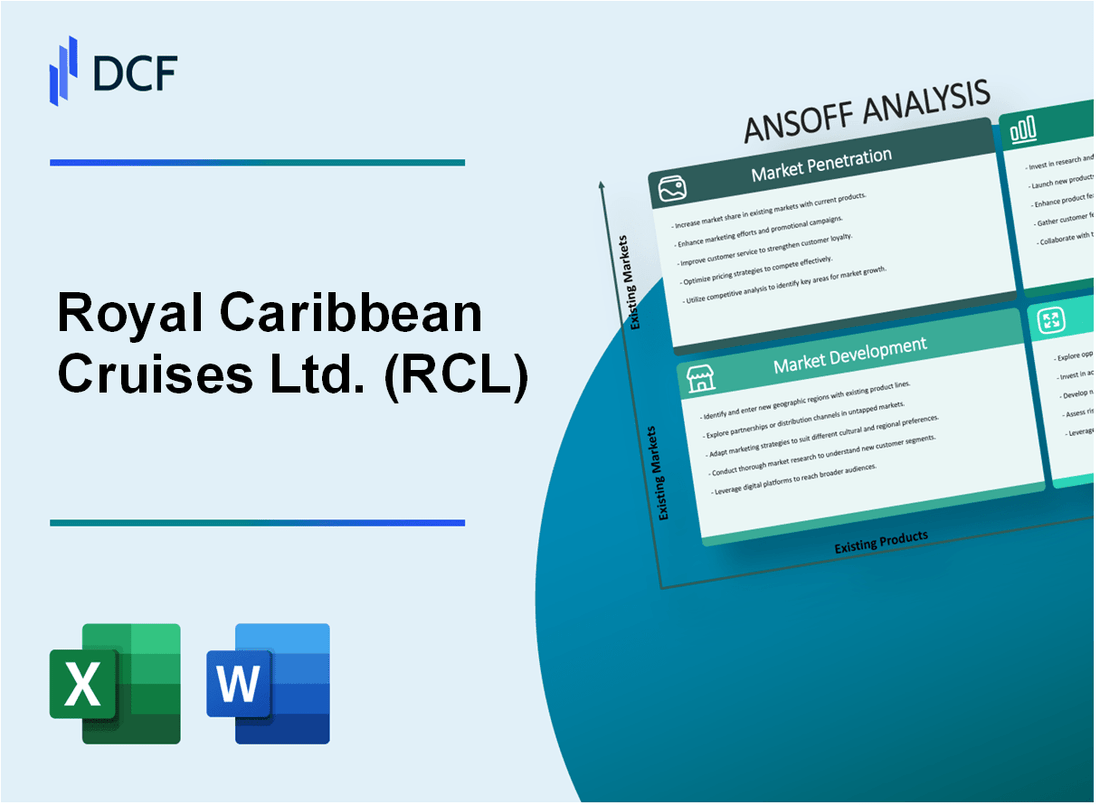
Royal Caribbean Cruises Ltd. (RCL): ANSOFF MATRIX [Dec-2025 Updated] |
Fully Editable: Tailor To Your Needs In Excel Or Sheets
Professional Design: Trusted, Industry-Standard Templates
Investor-Approved Valuation Models
MAC/PC Compatible, Fully Unlocked
No Expertise Is Needed; Easy To Follow
Royal Caribbean Cruises Ltd. (RCL) Bundle
You're looking for a clear map of how Royal Caribbean Cruises Ltd. (RCL) plans to monetize its huge new capacity, especially with the Icon Class ships coming online, and honestly, the Ansoff Matrix lays out a crystal-clear playbook for the next few years. We're not just talking about filling seats; the near-term focus is clearly on driving yield past the 105% double occupancy mark in existing Caribbean itineraries while simultaneously developing new global source markets and launching premium product tiers like the new private beach clubs. This isn't a time for guesswork; it's a disciplined, four-lane strategy to expand footprint and maximize revenue per available cruise day, and you need to see the specific actions they are taking in each quadrant below.
Royal Caribbean Cruises Ltd. (RCL) - Ansoff Matrix: Market Penetration
You're looking at how Royal Caribbean Cruises Ltd. (RCL) pushes more volume and value through its established Caribbean routes. This is about maximizing what they get from the ships they already have sailing in that core market.
Drive higher ticket prices and onboard spend on existing Caribbean itineraries.
The focus here is clearly on getting more money per guest, both for the cruise itself and once they are onboard. For the second quarter ended June 30, 2025, Passenger Ticket Revenues hit $3.20 billion, up from $2.89 billion the prior year. Onboard Revenues also saw a solid jump, reaching $1.34 billion, which is a 9.5% increase year-over-year. This growth in both streams fed directly into the overall Net Yield increase.
Increase occupancy rates beyond 105% (double occupancy) through targeted promotions.
The company is definitely filling its ships well beyond standard capacity. For the second quarter of 2025, the reported Load factor was 110%. This 110% figure is two percentage points higher than the prior year. This level of fill suggests successful promotions driving demand into existing capacity.
Expand dynamic pricing models to maximize revenue per available cruise day (RAD).
Maximizing revenue per available cruise day, or Net Yields, is a direct result of dynamic pricing and spend management. For the second quarter of 2025, Net Yields increased 5.3% as-reported. The outlook for the full year 2025 projects Net Yields to increase between 3.5% and 4.0% as-reported.
Leverage the 'Perfect Day at CocoCay' private island experience to boost short-cruise demand.
The private destination strategy is a major lever for driving demand in the Caribbean. Cleveland Research Center estimates that Perfect Day at CocoCay will generate $600 million in revenue in 2026. Royal Caribbean initially spent $400 million on the CocoCay development. Furthermore, Royal Caribbean has three more private destinations scheduled to open between 2025 and 2027. The strength of Caribbean sailings is noted as being particularly evident in bookings, where CocoCay is a winning combination.
Target first-time cruisers with shorter, high-value sailings on existing fleet capacity.
The success in the Caribbean is tied to the overall strength of the product mix. The Net Yield growth in the third quarter of 2025 is expected to be driven by an increase in both ticket and onboard spend across all key products. The company delivered memorable vacations to 2.3 million guests in Q2 2025, a 10% increase year-over-year.
Here's a quick look at some key 2025 performance metrics from the second quarter results:
| Metric | Value (Q2 2025) | Comparison/Context |
| Total Revenues | $4.5 billion | Up from $4.11 billion in Q2 2024 |
| Net Income | $1.2 billion | Up 42% compared to $858 million in Q2 2024 |
| Load Factor | 110% | Up two percentage points versus prior year |
| Net Yields Growth (as-reported) | 5.3% | Full Year 2025 Outlook: 3.5% to 4.0% increase |
| Adjusted EBITDA | $1.9 billion | Robust growth reported |
Finance: draft the Q3 2025 Net Yield vs. capacity growth variance analysis by Monday.
Royal Caribbean Cruises Ltd. (RCL) - Ansoff Matrix: Market Development
Market Development for Royal Caribbean Cruises Ltd. (RCL) centers on deploying existing, world-class hardware into new geographic areas or capturing new customer segments within existing regions. The financial performance in 2025 provides a strong backdrop for this expansion, with full-year capacity projected to grow by approximately 5.5% and Adjusted Earnings Per Share (EPS) guided to a range of $14.55-$15.55, representing about 28% growth year-over-year.
Establish new homeports in non-traditional US markets to capture drive-to-port customers.
Royal Caribbean International maintains a broad base of US homeports to capture drive-to customers, which is crucial given that approximately 80% of revenue comes from North America. The fleet deployment for 2025 includes sailings from nine US homeports. The operational footprint includes major hubs as well as ports that cater to specific regional demand.
- Homeports for 2025 include Miami, Fort Lauderdale, Tampa, Port Canaveral, Galveston, Baltimore, Cape Liberty, San Juan, and New Orleans.
- For example, Vision of the Seas offered a variety of 5-night to 12-night cruises from Baltimore, catering to guests preferring a more intimate experience away from the high-volume Florida ports.
Expand source markets in Asia and Europe for existing global fleet deployments.
The company explicitly structures its operations to serve these markets, as evidenced by the 'Europe and Asia (EA) Cruise Operations' business segment. The focus on Asia saw a significant deployment commitment for late 2025.
| Market | Ship Deployment | Duration | Key Destinations |
|---|---|---|---|
| Asia (Singapore) | Ovation of the Seas | October 2025 to March 2026 | Indonesia, Malaysia, Thailand |
| Europe | Allure of the Seas | Summer 2025 (pre-renovation) | Europe itineraries |
Ovation of the Seas will offer 3- to 8-night holidays from Singapore. This deployment supports the goal of capturing adventurous Asian travelers.
Introduce existing ships to new, emerging destinations like the Middle East or West Africa.
The strategy includes exploring emerging destinations to diversify itineraries beyond the core Caribbean and Europe. While specific 2025 deployment numbers for the Middle East or West Africa are not publicly detailed, the overall fleet expansion supports this capability. The company's total fleet size as of August 2025 is 29 ships for Royal Caribbean International alone.
Partner with international airlines to create fly-cruise packages for long-haul guests.
This tactic aims to convert long-haul international guests into confirmed bookings. The company is focused on driving demand from international guests, noting that the highly anticipated Star of the Seas, launching in August 2025, is expected to bring guests from Asia to the US.
Increase brand presence in South America to fill shoulder-season Caribbean sailings.
Royal Caribbean Cruises Ltd. has a stated commitment to the Latin America market, using specific ship deployments to target this region during periods when Caribbean demand might be softer for US-based travelers. The Serenade of the Seas deployment for late 2025 directly addresses this objective.
- Serenade of the Seas will sail from Cartagena, Colombia, starting October 5, 2025.
- The ship will complete 29 cruises from Colombia and 21 cruises from Panama through March 2026.
- Itineraries include port stops in Aruba, Curacao, Bonaire, and Panama.
The company noted that previous voyages in the region, such as those by Rhapsody of the Seas, were a success.
Royal Caribbean Cruises Ltd. (RCL) - Ansoff Matrix: Product Development
You're looking at how Royal Caribbean Cruises Ltd. (RCL) is developing new products to capture more revenue from its existing customer base. This is all about making the vacation itself better, more exclusive, and more technologically advanced, so guests spend more per trip.
Launch and scale the new Icon Class ships, like Star of the Seas, with novel onboard zones.
The second Icon Class vessel, Star of the Seas, began service in August 2025 from Port Canaveral, Florida, sailing 7-night Caribbean itineraries. This ship measures 248,663 gross tons, tying it as the world's largest cruise ship. It is designed to hold 9,950 passengers in total. The initial pricing for Caribbean adventures started at $1,038 per person. The ship is structured around eight distinct neighborhoods and features the Category 6 Waterpark, which is the largest waterpark ever built at sea, containing 6 record-breaking water slides.
The introduction of Star of the Seas is a major driver for capacity planning. Capacity for the third quarter of 2025 is expected to increase 2.9% compared to the third quarter of 2024, largely due to this ship's mid-August arrival. The late delivery of Star of the Seas moderates the overall 2025 capacity growth to around 3%. For the full year 2025, Royal Caribbean Cruises Ltd. expects total capacity change to be 5.5% compared to 2024. The company's Q2 2025 capacity was up 6% year over year, with a load factor reaching 110%.
The following table summarizes key specifications and initial financial indicators for the new product:
| Metric | Value | Context |
|---|---|---|
| Ship Class | Icon Class (Second Vessel) | Product Development |
| Ship Name | Star of the Seas | Product Development |
| Inaugural Month | August 2025 | Product Development |
| Passenger Capacity (Total) | 9,950 | Product Development |
| Gross Tonnage | 248,663 | Product Development |
| Projected 2025 Net Yield Growth | 3.5% to 4.0% | Supported by premium offerings |
| Q2 2025 Net Yields (As-Reported) | Up 5.3% | Compared to Q2 2024 |
| Expected 2025 Adjusted EPS Range | $14.35 to $14.65 | Full Year Guidance |
Develop and open new private destination experiences, such as the Royal Beach Club in Antigua.
Royal Caribbean Cruises Ltd. continues to invest in differentiated destinations. Capital expenditures for the full year 2025 are projected to be approximately $5 billion, with non-new ship related capital expenditures expected to be $1.6 billion, which covers land-based destination initiatives. The Royal Beach Club concept builds on the success of Perfect Day at CocoCay. The initial Royal Beach Club announced for Antigua, intended to open in 2021, is currently under review. The original projection for the Antigua project included an economic impact of approximately $80 million USD in direct revenue to the Government over 30 years and over $1 billion USD in indirect revenue over the same period. Separately, the investment for the Royal Beach Club development on Paradise Island is expected to surpass $165 million. This Paradise Island agreement allocates 1% of the annual gross revenue to a National Investment Fund, with local investors able to hold up to 49% equity. Furthermore, the Star of the Seas itinerary is expected to include the Royal Beach Club Cozumel, which is slated to open in 2026.
Introduce new premium cabin categories and exclusive suite neighborhoods for higher yield.
The focus on premiumization directly impacts yield metrics. The premium design of Star of the Seas, including new dining concepts, is a key factor supporting the projected Net Yield growth for 2025. Royal Caribbean Cruises Ltd. revised its full-year 2025 guidance upward, forecasting a projected Net Yield growth of 3.5% to 4.0%, which is supported by these premium offerings. In the second quarter of 2025, the company's Gross Margin Yields increased 11.0% as-reported.
Create new themed cruise experiences focused on wellness, culinary arts, or specific entertainment.
New entertainment and dining experiences are central to the product development strategy to elevate the guest experience. The Star of the Seas features the Broadway-style production of "Back to the Future: The Musical" in the Royal Theater. This ship also debuts the Lincoln Park Supper Club, a Chicago-themed dining and music experience. The ship's entertainment is centered around venues like the AquaDome.
Invest in fleet-wide technology upgrades for faster Wi-Fi and seamless digital guest services.
Technology integration is a continuous investment across the fleet. Digital engagement is critical, with 90% of bookings now occurring digitally via loyalty programs and mobile transactions. For mid-life refurbishments of Panamax-class ships, which include technology infrastructure upgrades, the capital required typically ranges from $50-100 million per vessel depending on the scope. Extrapolating this investment across the 28 vessels in the fleet as of Q3 2024 suggests a multi-year refurbishment pipeline that could require $1-2 billion in cumulative capital beyond newbuild commitments. The company's Q3 capital expenditure run rate was $334 million quarterly, equating to roughly $1.3 billion annualized.
Royal Caribbean Cruises Ltd. (RCL) - Ansoff Matrix: Diversification
You're looking at how Royal Caribbean Cruises Ltd. (RCL) moves beyond just selling cruise tickets, which is the core of this diversification quadrant. Honestly, the numbers show they're already putting serious capital to work outside the traditional vessel operation.
Acquire or develop a separate, non-cruise, land-based resort brand in key coastal markets.
Royal Caribbean Cruises Ltd. is definitely investing heavily in branded, land-based experiences to control more of the guest journey. They announced plans for the Royal Beach Club collection, with the first expected to open in 2025 in Nassau, Bahamas, and a second in 2026 in Cozumel, Mexico. Furthermore, they are developing Perfect Day Mexico, which is expected to open in 2027. To secure this, they acquired the Costa Maya Port and adjacent land in Mahahual, Mexico, in July 2025 for $292 million. The existing flagship destination, Perfect Day at CocoCay, is projected to welcome approximately 3.5 million guests in 2025. The Royal Beach Club Paradise Island is projected to handle 1 million to 1.5 million guests annually once fully operational.
Spin off the private destination model (e.g., Perfect Day) into a standalone hospitality consulting service.
While a formal spin-off isn't detailed, the success of their destination model is clear from the financial impact of existing assets. The company's overall capacity in the Caribbean, their core market, is projected to account for approximately 57 percent of total cruise capacity in 2026. The yields in the Caribbean for the fourth quarter of 2025 are projected to be up 37 percent compared to 2019 levels, showing the premium pricing power these exclusive destinations command. CFO Naftali Holtz noted that the Royal Beach Club product will be a very profitable business with attractive margins.
Invest in and operate luxury expedition travel outside of traditional cruise routes and vessels.
Royal Caribbean Cruises Ltd. is expanding its portfolio brands into different travel segments. They announced the launch of Celebrity River Cruises in January 2025, with an initial order of 10 ships planned to sail in 2027. This is a clear move into a different asset class and route structure. Separately, their Silversea brand has plans to develop a hotel in Puerto Williams, Chile, specifically to support its Antarctica expeditions. The company operates a global fleet of 68 ships across five brands as of September 2025.
Develop a proprietary training and certification program for maritime and hospitality staff to sell externally.
Specific external sales figures for a proprietary training program aren't public, but the investment in future capacity and personnel is substantial. The company has six new ships on order for its global brands, expected to deliver through 2028, adding nearly 29,000 berths. Their capital expenditures for 2025 are estimated to be around $5 billion, much of which supports this fleet expansion and associated infrastructure. They also have a 33 percent interest in Grand Bahama Shipyard and floating docks, which is crucial infrastructure for maintaining all those ships.
Enter the fractional ownership market for luxury yachts, a completely different asset class.
There are no reported figures for Royal Caribbean Cruises Ltd. entering the fractional yacht ownership market. However, their overall financial strength provides the capital base for such a move. Here's a quick look at their balance sheet health as of mid-2025.
| Metric | Value (as of June 30, 2025, unless noted) |
|---|---|
| Total Revenue (Q2 2025) | $4.538 billion |
| Net Income (Q2 2025) | $1.21 billion |
| Total Debt | $19.503 billion |
| Liquidity | $7.1 billion |
| Debt-to-Equity Ratio (Sept 2025) | 2.15 |
| Net Cash from Operating Activities (H1 2025) | $3.37 billion |
The company is actively managing its capital structure, having reduced total debt from $20.604 billion at the end of 2024. They also authorized a $1.0 billion common stock repurchase program back in February 2025.
The current operational performance supports these diversification ambitions. You can see the strong results from their core business in the second quarter of 2025:
- Diluted Earnings per Share (EPS) reached $4.41.
- Load factor for Q2 2025 was 110%.
- Net Yields increased 5.3% as-reported for Q2 2025 year-over-year.
- They declared a cash dividend of 75 cents per share for both Q1 and Q2 of 2025.
Disclaimer
All information, articles, and product details provided on this website are for general informational and educational purposes only. We do not claim any ownership over, nor do we intend to infringe upon, any trademarks, copyrights, logos, brand names, or other intellectual property mentioned or depicted on this site. Such intellectual property remains the property of its respective owners, and any references here are made solely for identification or informational purposes, without implying any affiliation, endorsement, or partnership.
We make no representations or warranties, express or implied, regarding the accuracy, completeness, or suitability of any content or products presented. Nothing on this website should be construed as legal, tax, investment, financial, medical, or other professional advice. In addition, no part of this site—including articles or product references—constitutes a solicitation, recommendation, endorsement, advertisement, or offer to buy or sell any securities, franchises, or other financial instruments, particularly in jurisdictions where such activity would be unlawful.
All content is of a general nature and may not address the specific circumstances of any individual or entity. It is not a substitute for professional advice or services. Any actions you take based on the information provided here are strictly at your own risk. You accept full responsibility for any decisions or outcomes arising from your use of this website and agree to release us from any liability in connection with your use of, or reliance upon, the content or products found herein.