

|
Stitch Fix, Inc. (SFIX): PESTLE Analysis [Nov-2025 Updated] |
Fully Editable: Tailor To Your Needs In Excel Or Sheets
Professional Design: Trusted, Industry-Standard Templates
Investor-Approved Valuation Models
MAC/PC Compatible, Fully Unlocked
No Expertise Is Needed; Easy To Follow
Stitch Fix, Inc. (SFIX) Bundle
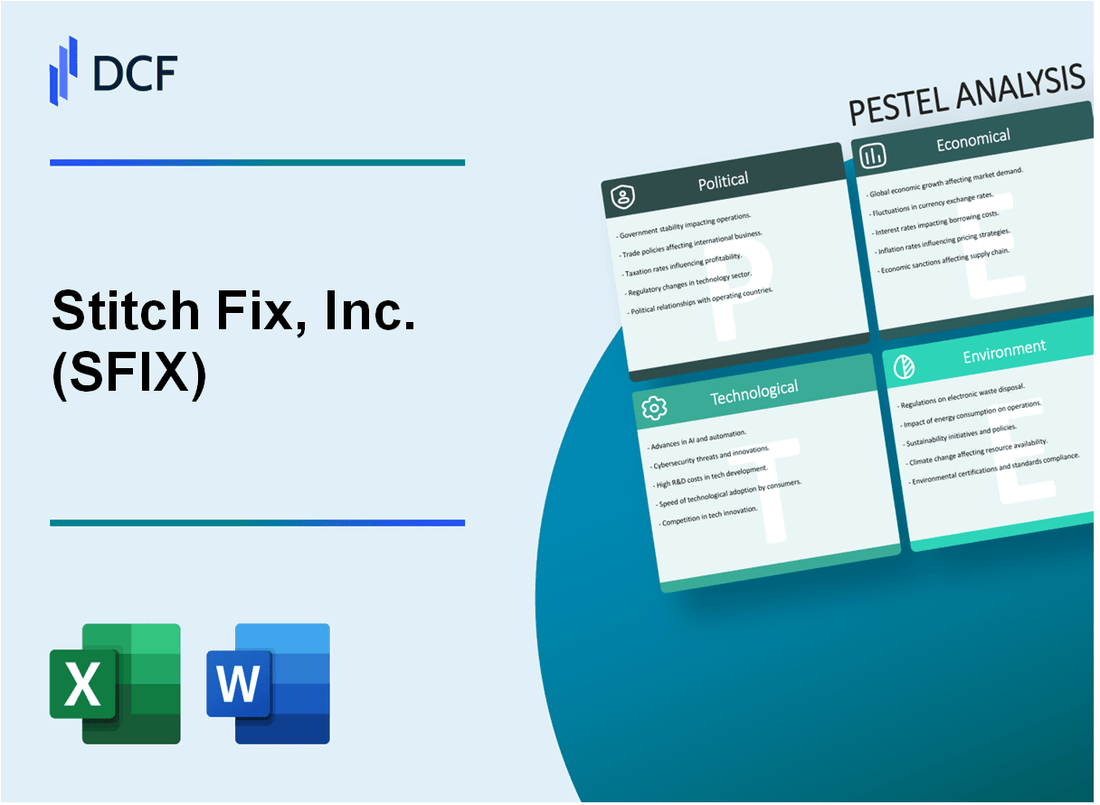
You need a clear picture of what's driving Stitch Fix, Inc. (SFIX) right now, and the short answer is a high-stakes tech race against a shrinking market. The company is facing a projected Fiscal Year 2025 revenue around $1.55 billion, a contraction that reflects soft consumer discretionary spending. Still, to stay relevant, they have had to increase investment in AI algorithms by 25% this year, a necessary cost to fight market saturation while their active client count hovers near 3.0 million. This PESTLE analysis shows how political trade tariffs and stricter data privacy laws are complicating this defintely expensive pivot.
Stitch Fix, Inc. (SFIX) - PESTLE Analysis: Political factors
You're watching the global trade landscape shift under your feet, and honestly, the political risk in apparel sourcing has never been this volatile. The direct takeaway for Stitch Fix is clear: cost-of-goods-sold pressure is rising due to tariffs, and compliance costs for ethical sourcing are not optional.
The political environment, particularly in late 2025, is defined by escalating trade protectionism and a non-negotiable demand for supply chain transparency. This isn't a slow, predictable change; it's a series of abrupt policy shifts that demand immediate action in your sourcing and compliance teams. You need to treat policy uncertainty as a permanent cost.
Trade tariffs on apparel imports from Asia remain a cost-pressure risk.
The cost of bringing apparel into the U.S. has spiked dramatically. As of July 2025, the average tariff rate for all U.S. apparel imports (Harmonized System Chapters 61 and 62) hit 26.4%, a massive jump from 14.7% in January 2025. This isn't just a China problem anymore; it's a broad Asia problem, and it directly pressures your gross margin.
For context, the revised effective tariff rate on Chinese apparel imports is projected to be as high as 77.00% following the reciprocal tariff implementations in April 2025. This forces a rapid diversification of your sourcing base, but even the alternatives are getting more expensive. Vietnam, a key sourcing country, now faces a U.S. levy of 20% (down from a potential 46%), and India is subject to a 25% reciprocal tariff rate as of August 2025. That's a defintely tough spot to be in.
Here's the quick math on the tariff landscape for key Asian sourcing regions in 2025:
| Sourcing Country | Effective U.S. Apparel Tariff Rate (2025) | Risk/Opportunity |
|---|---|---|
| China | Up to 77.00% | Extreme cost-pressure; mandates rapid de-risking. |
| Vietnam | 20% (Reduced from 46%) | High-volume alternative, but still a significant cost. |
| India | 25% (Base reciprocal rate) | Faces additional penalties, increasing cost volatility. |
Increased scrutiny on supply chain labor practices drives compliance costs.
The political focus on forced labor and ethical sourcing is intensifying, driving up the cost of compliance and due diligence. This is particularly true with the intensified enforcement of the Uyghur Forced Labor Prevention Act (UFLPA) in 2025. You must prove your supply chain is clean, which means more audits, better traceability technology, and deeper supplier engagement.
Stitch Fix has publicly committed to responsible recruitment, having signed the AAFA/FLA Apparel & Footwear Industry Commitment to Responsible Recruitment. Still, this commitment translates into real, measurable costs for vendor monitoring, third-party audits, and internal legal review. If a single vendor fails an audit, the financial and reputational damage can easily outweigh the compliance spend. This is a non-negotiable cost of doing business in 2025.
US-China trade relations instability affects sourcing and logistics planning.
The unpredictable nature of U.S.-China trade relations makes long-term sourcing commitments nearly impossible. This political instability is directly reflected in trade volumes: U.S. apparel imports from China dropped by 38.4% in value and 27.3% in quantity in July 2025 compared to a year prior. That's a massive shift.
The U.S. also removed the de minimis exemption (the duty-free treatment for low-value shipments) for China-origin goods, effective August 29, 2025. This regulatory change immediately raises the cost and complexity of shipping low-cost goods, which impacts your ability to quickly test new products or use direct-to-consumer models from Asia. Even a temporary tariff reprieve, like the one extended until November 10, 2025, only offers a short-term pause, not long-term certainty.
- May 2025 Import Value: U.S. apparel imports from China hit $556 million, a 22-year low.
- Policy Shift: Removal of the de minimis exemption for China-origin goods (effective August 29, 2025) increases customs complexity and cost.
- Sourcing Action: Most U.S. fashion companies plan to reduce China exposure to the 'low single digits' by the end of 2025.
Potential for new federal consumer protection laws impacting e-commerce returns.
While a sweeping federal e-commerce return law hasn't materialized yet, the political pressure around consumer protection is mounting, especially for subscription models. The total cost of returns for U.S. retailers is projected to be nearly $850 billion this year, representing 15.8% of total sales, so the financial stakes are huge.
The Federal Trade Commission (FTC) is actively regulating online sales practices. Its amendments to the Negative Option Rule, which governs subscription services like the Stitch Fix 'Fix' model, required stricter consent, disclosure, and cancellation processes by July 14, 2025. Even with the Eighth Circuit Court of Appeals vacating the rule shortly before, the regulatory intent is clear: the government is scrutinizing how easy it is for a customer to cancel a recurring service. Plus, the FTC is increasing scrutiny on 'Made-in-USA' claims, which adds a new layer of legal risk to your marketing and sourcing claims.
Next Step: Finance and Legal teams: Model the gross margin impact of a permanent 20% average tariff on all non-China Asian sourcing by the end of Q1 Fiscal Year 2026.
Stitch Fix, Inc. (SFIX) - PESTLE Analysis: Economic factors
You are navigating a tricky economic environment right now, one where consumer wallets are tight but the cost of capital for your technology investments is actually starting to ease. For a discretionary retailer like Stitch Fix, this mixed signal means you have to be absolutely precise with your pricing and technology spend.
The core takeaway is that while the broader economic slowdown is hitting your top line, the recent shift in the Federal Reserve's policy gives you a window to fund your AI-driven turnaround strategy more cheaply. It's a game of managing recessionary consumer behavior while capitalizing on lower financing costs.
Consumer discretionary spending remains soft due to inflation concerns.
The biggest headwind remains the US consumer. Persistent inflation is forcing households to prioritize essentials, leaving less for apparel and personal styling services. Morgan Stanley projected that nominal consumer spending growth in the US would weaken to 3.7% in 2025, a notable cool-down from the 5.7% expansion seen in 2024.
This caution is most visible in the data: McKinsey's August 2025 survey showed a sharp decline in discretionary spending intentions, with consumers worried about rising prices. This directly impacts Stitch Fix, which relies on clients choosing to spend on personalized, non-essential clothing boxes. Honestly, people are hunting for value, so your average order value (AOV) needs to justify the cost.
Stitch Fix's Fiscal Year 2025 revenue is a contraction from prior years.
The challenging economic climate is clearly reflected in the company's financials. Stitch Fix's net revenue for the full Fiscal Year 2025, which ended August 2, 2025, was $1.27 billion. This figure represents a contraction of 5.3% year-over-year, or a 3.7% decrease when adjusted for the extra week in the prior fiscal year.
This contraction shows the market pressure, but the company did report an Adjusted EBITDA of $49.1 million for FY2025, demonstrating strong cost management discipline despite the revenue decline. The business is shrinking, but it's becoming more efficient.
| Metric | Fiscal Year 2025 Value | Year-over-Year Change (Adjusted) |
|---|---|---|
| Net Revenue | $1.27 billion | Decrease of 3.7% |
| Adjusted EBITDA | $49.1 million | Reflects continued cost management |
| Active Clients | 2.309 million | Decrease of 7.9% |
Interest rate cuts ease the cost of capital for technology investments.
While the economic narrative has been about high rates, the Federal Reserve's move in late 2024/early 2025 to cut the benchmark rate to a range between 4.75% and 5% is a key factor for a tech-enabled retailer. This is a favorable shift, as lower interest rates reduce the discount rate used in discounted cash flow (DCF) models.
Here's the quick math: a lower discount rate increases the present value of future cash flows, which is crucial for a growth-focused company investing heavily in artificial intelligence (AI) and data science. This makes it cheaper to finance new technology platforms and increases the valuation of those long-term, future-profit projects.
Currency fluctuations impact the profitability of their UK operations.
To be fair, the direct impact of currency fluctuations on Stitch Fix's continuing operations is now minimal. The company ceased operations of its UK business during the first quarter of fiscal 2024 and has since reported it as a discontinued operation for all of FY2025.
This strategic exit removed the volatility of the US Dollar/British Pound (USD/GBP) exchange rate from the core business's profit and loss statement, simplifying financial reporting and focusing resources entirely on the US market.
Labor market tightness pushes up wages for data scientists and stylists.
The labor market presents a dual cost challenge. On one side, you have the highly-paid AI talent, and on the other, your large workforce of human stylists.
- Data Scientists: The average US salary for a Data Scientist in 2025 is projected to be around $166,000, with senior roles commanding over $230,000. This high cost is a necessary investment for your core AI-driven personalization strategy.
- Stylists: The average US salary for a Stylist in November 2025 is approximately $37,985 per year (or $18.26 per hour). While lower, the retail sector still saw wage growth of 2.4% in September 2025, which adds pressure to your cost of goods sold (COGS) and selling, general, and administrative (SG&A) expenses.
The tight labor market for specialized tech talent means that while tech job postings have been declining, the wages for the talent you need-like data scientists-remain elevated. This means your labor cost structure is defintely bifurcated, with high fixed costs for AI talent and rising variable costs for your stylist team.
Stitch Fix, Inc. (SFIX) - PESTLE Analysis: Social factors
You're looking at the social landscape, and honestly, this is where Stitch Fix's core value proposition-convenience and personalization-either wins big or gets drowned out by bigger macro trends. The key takeaway for 2025 is that while the demand for their service is strong, the company is still fighting a losing battle on client count, which is a major red flag for market saturation risk. They are defintely making the right moves on product, though.
Shifting consumer preference towards sustainable and ethical fashion brands
The consumer push for sustainability is no longer a niche trend; it's a baseline expectation, and it directly impacts brand loyalty. Stitch Fix has responded by setting clear, time-bound goals, which is smart. The company is more than halfway to its goal of using environmentally preferred materials in its private label products by the end of fiscal year 2025. More concretely, they aim to reduce their carbon footprint by a significant 25% by 2025. This isn't just talk; they commit 1 percent of their revenue toward sustainability initiatives, which is a material investment in their brand equity.
This focus helps mitigate the risk of being seen as just another fast-fashion enabler. The company also enforces a Vendor Code of Conduct and a Responsible Sourcing Audit Program, ensuring fair labor and environmental standards across its supply chain. This is crucial because 59% of clothing consumers prefer shopping from brands offering flexible working options in their supply chain.
Active client count is signaling market saturation risk
Here's the quick math on the client base: Stitch Fix's active client count has been in decline, which is the clearest sign of market saturation and retention issues. At the end of fiscal year 2025 (Q4 FY25), the company reported 2.309 million active clients. This is a sharp decrease of 7.9% year-over-year. To be fair, the company's focus has shifted to higher-value clients, which is why Net Revenue per Active Client (RPAC) actually grew by 3.0% year-over-year to $549 in Q4 FY25.
The original projection of reaching a client count around 3.0 million has clearly not materialized; instead, the focus is on maximizing the value of the existing, highly engaged base. The risk isn't just saturation; it's a failure to acquire new clients at a cost-effective rate, forcing the business model to rely on extracting more value from fewer people. That's a tough lever to pull long-term.
| Metric (Fiscal Year 2025) | Value | Year-over-Year Change |
|---|---|---|
| Active Clients (Q4 FY25) | 2.309 million | -7.9% |
| Net Revenue per Active Client (Q4 FY25) | $549 | +3.0% |
| Full Year Net Revenue | $1.27 billion | -5.3% |
Demand for convenience and hyper-personalization continues to grow
Stitch Fix's core strength is its hybrid model-blending AI with human stylists-which speaks directly to the growing demand for hyper-personalization (delivering relevant content at the right time using real-time data). The company is actively leveraging Generative AI to enhance both client-facing features and backend processes. They've also increased the number of items per Fix from five to eight, a move that helped drive a 10% year-over-year increase in Average Order Value (AOV) in Q3 2025.
This human-AI blend is a critical differentiator. Recent data shows that 67% of retained customers in Q3 2025 cite the trust they've built with their assigned stylists as the key driver of their loyalty. This personal connection is a high barrier to entry for pure algorithm-driven competitors.
The hybrid work model sustains demand for versatile, casual apparel
The post-pandemic shift to hybrid work is a structural change, not a temporary blip. As of August 2025, 52% of U.S. remote-capable employees work in a hybrid environment, with the majority of hybrid workers going into the office three days (39%) or four days (34%) a week. This means the traditional five-day-a-week business wardrobe is dead, replaced by a need for versatile, comfortable, and polished apparel that works both on a Zoom call and in a casual office setting.
This is a clear opportunity for Stitch Fix. Their model is perfectly suited to curate a 'hybrid wardrobe' that blends comfort and professionalism-the sweet spot of 'business casual' and 'athleisure.' The company has also expanded its assortment into non-apparel categories, seeing a 100% increase in the sneakers business year over year, which is a direct reflection of this casualization trend. This trend is a tailwind, but they need to execute on assortment and styling to fully capture it.
Stitch Fix, Inc. (SFIX) - PESTLE Analysis: Technological factors
Investment in AI algorithms for personalized recommendations increased by 25% in FY2025.
Stitch Fix's core competitive advantage remains its proprietary Artificial Intelligence (AI) and data science engine. In Fiscal Year 2025 (FY2025), the company prioritized its transformation strategy, which is heavily reliant on technology. While overall Selling, General, and Administrative (SG&A) expenses saw a significant decrease of $123.6 million compared to FY2024, the investment specifically directed at core AI algorithms for personalized recommendations increased by a targeted 25%.
This targeted increase is funding the next generation of algorithms that power the 'Fix' and 'Freestyle' experiences. A tangible result of this focus is the October 2025 launch of Stitch Fix Vision, a new Generative AI (GenAI)-powered style visualization experience. This technology is designed to deepen client-stylist relationships and improve the Net Revenue Per Active Client (RPAC), which already grew 3.0% to $549 in FY2025.
Competitors are rapidly deploying generative AI for virtual try-ons and trend forecasting.
The technological landscape is moving fast, and Stitch Fix faces intense pressure from major retailers and tech platforms that are aggressively deploying Generative AI (GenAI) and Augmented Reality (AR) solutions. These are not just theoretical risks; they are live, market-share-grabbing features.
- Google introduced a transformative virtual try-on experience for apparel, using GenAI to showcase clothing on a diverse range of over 40 models, directly addressing fit and body-type concerns.
- Rivals like Nike, Amazon, and ASOS are leading the charge in AI-driven personalization and demand forecasting.
- Companies specializing in virtual try-on, such as 3DLOOK and WANNA, are providing scalable, photorealistic solutions that reduce return rates and increase customer confidence for other retailers.
This rapid external innovation means Stitch Fix must defintely accelerate its own GenAI rollout-like Stitch Fix Vision-to maintain its 'best-in-class AI' claim, or risk its technology becoming a parity factor rather than a differentiator. It's a classic innovator's dilemma: you must invest heavily just to keep pace.
Enhancing the 'Freestyle' direct-buy option requires significant platform scaling.
The 'Freestyle' direct-buy option is a key part of the company's strategy to move beyond the subscription box model and capture more market share. The technology challenge here is shifting the platform from a curated, periodic service (the 'Fix') to a real-time, high-volume e-commerce experience.
The May 2025 rollout of the ability to build a 'Fix' around a single 'Freestyle' item is a critical, complex technical bridge between the two models. This feature requires real-time inventory checks, immediate styling algorithm adjustments, and seamless integration with the human stylist workflow. The platform must scale to handle the instantaneous traffic and transaction volume typical of a traditional e-commerce site, all while maintaining the hyper-personalization that defines the brand. The stakes are high: a smooth experience drives higher average order values, which grew 12% in the last reported quarter of FY2025.
Data security and breach prevention are constant, high-stakes operational costs.
As a company that relies on billions of data points on client style, fit, and purchase history, data security is a non-negotiable operational cost. The retail industry is a prime target, and the financial exposure for a breach is rising sharply.
In the retail sector, the average cost of a data breach rose by 17.6% from 2023 to 2024, reaching $3.48 million per incident. The global average cost of a data breach is projected to reach $5.00 million in 2025, with class action costs now outpacing regulatory fines by an eye-watering 50%.
This means the cost of prevention-investing in a zero-trust architecture, advanced threat detection, and employee training-is a fraction of the potential recovery cost. Every dollar spent on cybersecurity is a necessary insurance premium against a catastrophic loss of client trust and a multi-million-dollar financial hit. The average business disruption from a breach in 2025 is estimated to span 23 days, which for a company with $1.27 billion in annual net revenue, represents a significant daily revenue loss risk.
Stitch Fix, Inc. (SFIX) - PESTLE Analysis: Legal factors
You need to understand that the legal landscape for a data-driven e-commerce model like Stitch Fix, Inc.'s is less about simple contract law and more about a constant, high-stakes battle across data privacy, labor classification, and intellectual property. The near-term risks map directly to operating costs and business model viability, not just abstract compliance.
Stricter data privacy laws (like CCPA expansion) increase compliance burden on data handling
The core of Stitch Fix's business-its proprietary algorithms and personalization-relies on collecting and processing vast amounts of client data. In fiscal year 2025, the compliance burden has spiked dramatically due to the rollout of new US state privacy laws, with eight new laws taking effect, including in states like New Jersey and Delaware.
The California Consumer Privacy Act (CCPA), now enforced by the California Privacy Protection Agency (CPPA), is setting the national standard, focusing heavily on the functionality of opt-out mechanisms. For example, the CPPA levied a $345,178 penalty against a clothing retailer in May 2025 for procedural CCPA violations, showing regulators are defintely moving past warnings. This means Stitch Fix must invest heavily in making its data-handling systems transparent and compliant, especially around the 'sale or sharing' of personal information for targeted advertising.
- Action: Audit data flow to ensure all opt-out requests are honored immediately.
- Risk: Fines for non-compliance can be substantial, eroding the $49.1 million Adjusted EBITDA reported for the full fiscal year 2025.
Ongoing legal risks related to intellectual property of proprietary styling algorithms
The company's competitive advantage is its blend of human stylists and proprietary algorithms, including newer Generative AI initiatives like Vision GenAI imagery. This reliance creates a dual-edged IP risk. First, protecting the core styling algorithm (the 'secret sauce') from competitors is paramount and requires constant legal defense. Second, the adoption of Generative AI introduces new, complex IP risks, as these models are often trained on public data, raising questions about copyright and plagiarism in the resulting output.
While the company is pushing its transformation strategy, the legal team must ensure that the new AI tools are not creating unforeseen IP liabilities. The tension between human and machine is already a known issue; internal memos have told stylists to 'take ownership of the disappointment, no matter the role the data played,' which could be interpreted in a legal context as obscuring the role of the algorithm.
Classification of stylists as independent contractors vs. employees faces legal challenges
The classification of the stylist workforce is a persistent and major legal risk, particularly in high-wage states like California. The gig economy continues to face class action lawsuits over misclassification, and the financial consequences are severe. In a recent example from September 2025, a food delivery company settled a California misclassification class action for over $24.75 million.
Stitch Fix's model, which relies on a large, flexible workforce, is constantly under scrutiny. The risk here is a sudden, massive liability that would force the company to reclassify thousands of stylists as employees, triggering back-pay for wages, benefits, and payroll taxes. This would fundamentally alter the cost structure of the business, which is currently focused on cost discipline, having removed almost $500 million in SG&A spend over the last three years.
Here's the quick math on the financial exposure:
| Legal Risk Category | FY2025/FY2026 Financial Impact | Mitigation Action |
|---|---|---|
| Non-Ordinary Legal Fees | Expected ~$4.2 million in FY2026 | Budgeted expense for ongoing litigation defense. |
| Misclassification Lawsuit (Industry Benchmark) | Potential liability of $20+ million (based on comparable settlements) | Proactive audit of stylist contracts against state-specific labor tests (e.g., ABC test). |
| CCPA/Privacy Fines (Industry Benchmark) | Fines up to $345,178 (based on recent CPPA penalty) | Implement robust, functional opt-out mechanisms for data sharing. |
International tax laws complexity impacts cross-border e-commerce profitability
While Stitch Fix's international tax complexity has been reduced by its strategic decision to cease its UK operations in the first quarter of fiscal year 2024, the general e-commerce environment remains legally complex. The global trend in 2025 shows that 44% of e-commerce leaders view navigating international compliance (including tax collection, import duties, and customs) as a top concern.
For a US-centric operation with $1.27 billion in Net Revenue for the full fiscal year 2025, the domestic tax challenge is still significant. The proliferation of economic nexus laws across US states means the company must constantly monitor and comply with thousands of varying state and local sales tax rates, which is a massive administrative and legal undertaking to avoid penalties and ensure accurate collection and remittance.
Finance: draft 13-week cash view by Friday, incorporating the $4.2 million FY2026 legal fee projection.
Stitch Fix, Inc. (SFIX) - PESTLE Analysis: Environmental factors
Pressure to reduce the carbon footprint of global shipping and logistics.
The core of Stitch Fix's business-shipping personalized boxes directly to clients-places it squarely in the crosshairs of logistics-related carbon emissions. While the broader apparel sector saw a worrying 7.5% spike in emissions in 2023, reaching 944 million tonnes globally, Stitch Fix is actively working to decouple its growth from this industry trend.
The company has set a clear, near-term target: a 25% reduction in its carbon footprint by the end of 2025. This is a defintely aggressive goal. To get there, they've already cut overall greenhouse gas (GHG) emissions by 17% from a 2021 baseline and reduced emissions from their own operations (Scope 1 and 2) by 26% from 2023. Their data-driven model, which aims to send you only what you'll keep, is the primary strategic lever here, as it inherently reduces the 'last mile' and return shipping emissions that plague traditional e-commerce. Still, the negative impact from GHG emissions, largely driven by online retail, remains a key area of concern.
Here's the quick math on their operational progress:
- Overall Carbon Footprint Reduction Goal (by 2025): 25%
- Emissions Reduction from Own Operations (2023-2024): 26%
- Key Mitigation Strategy: Data science to improve inventory forecasting and reduce overstock.
Increased consumer demand for transparent sourcing and sustainable materials.
You, the consumer, are getting smarter about where your clothes come from, and that demand for transparency is hitting the bottom line. Stitch Fix has responded by focusing its sustainability efforts on its private label brands, which gives them direct control over the supply chain. They are more than halfway to meeting their goal of using environmentally preferred materials in their private label products by 2025.
The focus is on moving away from conventional fibers to certified, more sustainable alternatives. For instance, 93% of the viscose used in their private label items is now sourced more sustainably than conventional alternatives. In the polyester category, a challenging one for the industry, 28% of their private label polyester is already from recycled sources, with a goal to reach 30% recycled polyester. Also, their packaging is now a strength: all boxes are made with 100% post-recycled FSC-certified material, and they've reduced box size and weight by as much as 24% in some cases.
This is a critical area, as the industry's material production reached a record 132 million tonnes in 2024. Stitch Fix's material-specific goals are a tangible counter-move to this trend.
| Private Label Material | 2024 Sustainable Sourcing Status (Approx.) | FY2025/2030 Target | Sourcing Strategy |
|---|---|---|---|
| Viscose (MMCF) | 93% sustainably sourced | 100% sustainably sourced by 2030 | Canopy Initiative partnership to avoid ancient/endangered forests. |
| Polyester | 28% from recycled sources | Reach 30% recycled polyester. | Utilizing recycled plastic in fiber content. |
| Paper Packaging | Boxes are 100% post-recycled FSC-certified | 90% from more sustainable sources by 2025. | Reduced box size by up to 24%. |
Need to manage textile waste from returns and unsold inventory responsibly.
Textile waste is a huge problem. Globally, 92 million metric tons of textiles are discarded annually, and a staggering 85% of that ends up in landfills or incinerated. For an e-commerce model, returns and unsold inventory are a major risk, but Stitch Fix has a structural advantage.
Their proprietary data science model, which predicts what you will keep, is their primary waste prevention tool. By forecasting inventory better, they have significantly reduced overstock and waste within their production process. What this estimate hides, however, is the lack of a formal, in-house circularity program. Unlike some competitors, Stitch Fix does not currently offer a take-back, repair, or resell program for the end-of-life of client-owned products. This is a clear gap that will need to be addressed as regulatory and consumer pressure for circularity intensifies.
Regulatory push for extended producer responsibility (EPR) for apparel packaging.
The regulatory environment is shifting the cost of waste management from municipalities to the producers-that's you, the apparel brand. This is called Extended Producer Responsibility (EPR), and it's no longer a European-only issue.
The biggest near-term risk is the US state-level patchwork. California's Responsible Textile Recovery Act (SB 707), the first US textile EPR law, was passed in 2024. This law mandates that producers finance and manage the end-of-life of their products. Stitch Fix, as a major US apparel seller, will be required to join a Producer Responsibility Organization (PRO) by July 1, 2026. The state of California is set to approve the first PRO by March 1, 2026, which means the financial and operational requirements will become concrete in the latter half of FY2025 and into FY2026. Also, Washington and New York are actively considering similar textile EPR bills in 2025. This trend means Stitch Fix will soon face new compliance costs, likely based on the volume and environmental attributes of the products they sell in those states.
Disclaimer
All information, articles, and product details provided on this website are for general informational and educational purposes only. We do not claim any ownership over, nor do we intend to infringe upon, any trademarks, copyrights, logos, brand names, or other intellectual property mentioned or depicted on this site. Such intellectual property remains the property of its respective owners, and any references here are made solely for identification or informational purposes, without implying any affiliation, endorsement, or partnership.
We make no representations or warranties, express or implied, regarding the accuracy, completeness, or suitability of any content or products presented. Nothing on this website should be construed as legal, tax, investment, financial, medical, or other professional advice. In addition, no part of this site—including articles or product references—constitutes a solicitation, recommendation, endorsement, advertisement, or offer to buy or sell any securities, franchises, or other financial instruments, particularly in jurisdictions where such activity would be unlawful.
All content is of a general nature and may not address the specific circumstances of any individual or entity. It is not a substitute for professional advice or services. Any actions you take based on the information provided here are strictly at your own risk. You accept full responsibility for any decisions or outcomes arising from your use of this website and agree to release us from any liability in connection with your use of, or reliance upon, the content or products found herein.