
|
Sigma Lithium Corporation (SGML): Business Model Canvas [Dec-2025 Updated] |
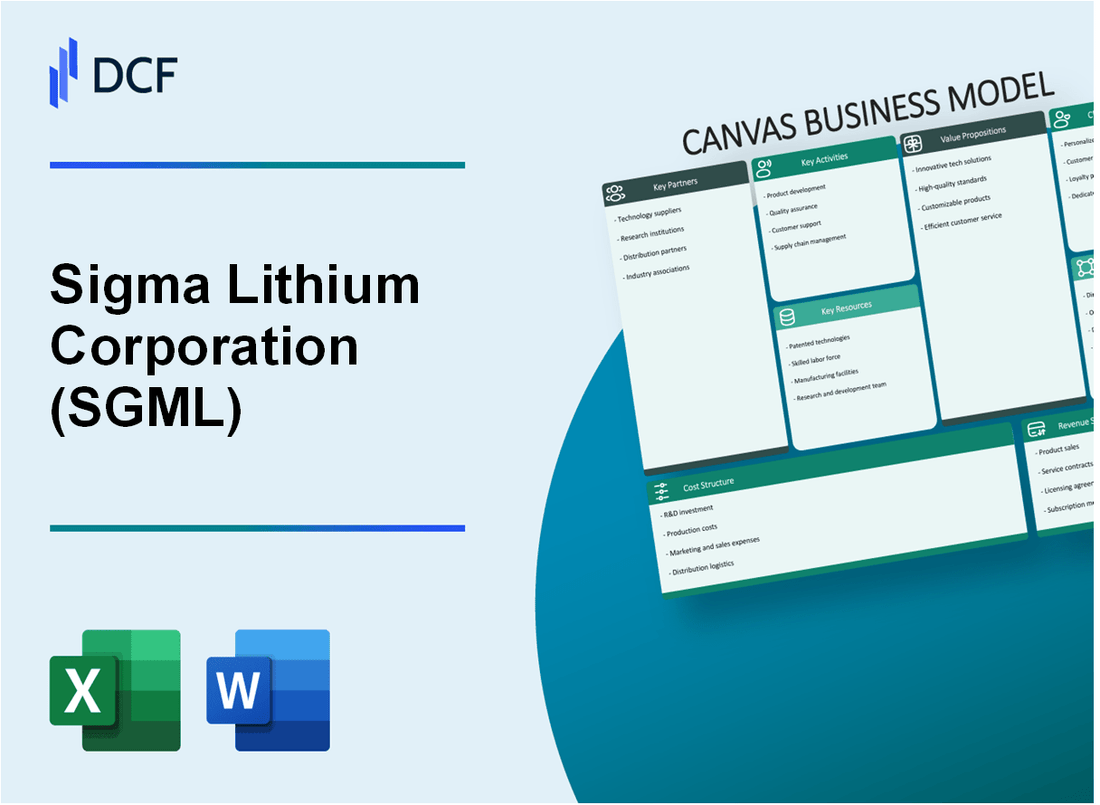
Fully Editable: Tailor To Your Needs In Excel Or Sheets
Professional Design: Trusted, Industry-Standard Templates
Investor-Approved Valuation Models
MAC/PC Compatible, Fully Unlocked
No Expertise Is Needed; Easy To Follow
Sigma Lithium Corporation (SGML) Bundle
You're digging into the mechanics of one of the market's most talked-about lithium plays, Sigma Lithium Corporation, and honestly, the core of their story isn't just the rock they mine; it's how they mine it. As a former head analyst, I can tell you their Business Model Canvas is anchored by a relentless focus on a $\mathbf{Quintuple\ Zero\ Green\ Lithium}$ value proposition, which helps them maintain an incredibly low Q2 2025 All-In Sustaining Cost (AISC) of just $\mathbf{\$594/t}$. This low-cost structure, combined with their current $\mathbf{270,000}$ tonnes/year Greentech plant and the strategic decision to keep production uncommitted to navigate price swings, sets them apart from peers still burning coal. So, if you want to see exactly how Sigma Lithium Corporation is structuring its key activities, resources, and revenue streams to double capacity to $\mathbf{520,000}$ tonnes/year while keeping ESG front-and-center, look no further than the breakdown below.
Sigma Lithium Corporation (SGML) - Canvas Business Model: Key Partnerships
Multilateral institutions and policymakers for ESG alignment
- Engaged in high-level dialogues with multilateral institutions and governments at COP30 in Belém, Brazil, in December 2025, focusing on energy transition and critical minerals.
- Reinforced the Quintuple Zero production model: zero tailings dams, 100% renewable energy, zero use of potable water, and zero hazardous chemicals.
- Secured a Triple Environmental License (LO, LP, LI) for the Barreiro mine, ensuring continuous mining operations throughout the 16-year term of the Brazilian Development Bank (BNDES) financing.
Equipment manufacturers for direct leasing and mining upgrades
- Executing Phase 2 expansion to double annual capacity from 270,000 tonnes to 520,000 tonnes of lithium oxide concentrate.
- Capital expenditure for the Phase 2 expansion is budgeted at USD 100 million.
- Equipment for the mine operation is noted as being leased from manufacturer at low rates.
- First production from the expanded capacity was expected in the first quarter of 2025.
Downstream clients providing financial and offtake support
Sigma Lithium Corporation maintained commercial flexibility, with 100% of its production uncommitted as of March 31, 2025, and June 30, 2025, while evaluating long-term prepayment and offtake agreements. The company is using this uncommitted status to secure financing, which would complement the BNDES reimbursement schedule.
| Offtake Type/Client Reference | Volume/Commitment Status (as of late 2025 data) | Financial Support Amount | Term/Notes |
| LG Energy Solution (Historical Term Sheet) | Guaranteed: 100,000 tonnes/year through 2027 | N/A | Six-year binding term sheet |
| LG Energy Solution (Historical Term Sheet) | Optional: Up to 50,000 tonnes/year through 2027 | N/A | Pricing linked to high purity lithium hydroxide market prices |
| Conventional Offtake with Prepayment | Negotiation in progress/Expected for 2025 | USD 51 M | 3 years |
| Conventional Offtake with Prepayment | Negotiation in progress/Expected for 2025 | USD 100 M | 3 years |
Local Brazilian communities for social license to operate (SLO)
- Commenced deployment of social capital expenditure (capex) to benefit local communities in 2023.
- Funded the construction of a school in partnership with local Municipalities.
- Funded the construction of a childcare unit in partnership with local Municipalities.
- Commissioned two NGOs to provide after-school educational and cultural activities for local children.
Trade partners for commercial flexibility and price settlements
- Reported CIF China cash operating costs of $442/t in Q2 2025, which was 12% below the $500/t target.
- Reported All-in Sustaining Cost (AISC) of $594/t in Q2 2025, which was 10% below the $660/t target.
- Q3 2025 production volume was 44,000 tonnes of lithium oxide concentrate.
- Reported production volume for the nine-month period ended September 30, 2025, was 260,000 tonnes.
- Interest payments made during the nine-month period ended September 30, 2025, totaled $2,930,000, including $1,918,000 for export prepayment agreements.
Sigma Lithium Corporation (SGML) - Canvas Business Model: Key Activities
Mining and processing of spodumene at Grota do Cirilo Operation
Sigma Lithium Corporation is executing mining and processing activities at its Grota do Cirilo operation in Minas Gerais, Brazil, which includes the operational Xuxa deposit and the planned Phase 2 at Barreiro. The company has delineated a proven and probable reserve base of 2.65 million tonnes in lithium carbonate equivalent across its property package in Brazil.
The operational pause for equipment modernization occurred from late September through October 2025, with operations resuming in early November 2025, projecting a return to full capacity within two to three weeks.
Operating the Greentech Industrial Lithium Plant at 270,000 tonnes/year
The state-of-the-art Greentech lithium beneficiation plant is currently operating at Phase 1 nameplate capacity of 270,000 tonnes of lithium oxide concentrate on an annualized basis.
Constructing Plant 2 to double capacity to 520,000 tonnes/year
Construction of the second line, Phase 2 Industrial Greentech Plant, is advancing with commissioning expected to begin in Q4 2025. The total annual production capacity is targeted to double to 520,000 tonnes of lithium concentrate upon completion. The capital expenditure for this expansion is US$100 million, which is fully funded via a US$100 million development bank credit line from BNDES. Foundation earthworks for the second plant are 100% complete.
Strategic commercial management to withhold sales during price volatility
Sigma Lithium Corporation is executing a deliberate commercial strategy to withhold product during periods of intense price volatility to preserve pricing power and protect long-term margins.
The operational and commercial performance metrics for 2025 reflect this strategy:
| Metric | Unit | FY 2025 Outlook | Q2 2025 Actual | Q3 2025 Actual |
| Plant 1 Production Volume | tonnes | 270,000 | 68,368 | N/A |
| Plant 2 Production Volume | tonnes | 30,000 | N/A | N/A |
| Total Production Volume | tonnes | 300,000 | 68,368 | 44,000 |
| Sales Volume | tonnes | N/A | 40,350 | 48,600 (Shipped) |
| Net Revenues | US$ | N/A | $21.1 million | US$28.5 million |
| CIF China Cash Operating Costs (Guidance/Actual) | US$/tonne | 500 | 442 | N/A |
| All-in Sustaining Costs (AISC) | US$/tonne | Below $660 (Target) | 594 | N/A |
The Q3 2025 Spodumene Output was 44,000 metric tonnes, a 27% year-over-year decline and a 36% sequential drop.
Executing the Quintuple Zero ESG model for sustainable production
Sigma Lithium Corporation produces Quintuple Zero Green Lithium, which is a production framework aiming to eliminate five elements:
- Zero tailings dams
- Zero toxic chemicals
- Zero potable water use (all water is recycled)
- Zero carbon-intensive energy (uses only hydro renewable energy)
- Zero carbon emissions from the production process
The company showcased this model at COP30 in Belém, Brazil, in late November 2025. Financial metrics reflecting this focus include a 35% cash gross margin reported in 1Q25 and a debt-to-equity ratio of 0.6 as of 1Q25.
Sigma Lithium Corporation (SGML) - Canvas Business Model: Key Resources
You're looking at the core assets that make Sigma Lithium Corporation tick right now, heading into the end of 2025. These aren't just line items on a balance sheet; they are the physical and human foundations supporting their production and expansion strategy.
The most tangible asset is the mineral rights package. Sigma Lithium Corporation owns 100% of the operating assets via its subsidiary, Sigma Mineracao S.A. The core resource base is anchored by the Grota do Cirilo mineral rights in Brazil. Specifically, the leasehold area is comprised of approximately 29 mineral rights spread over 185 square kilometers (km²). This is situated within the broader land package held by Sigma Brazil, which encompasses roughly 20,000 hectares. The resource base itself is substantial, with an audited NI 43-101 Mineral Resource estimate standing at 109 million tonnes at an average grade of 1.40% lithium oxide (Li2O) for measured & indicated resources.
The processing capability is centered around the Greentech Industrial Plant. This facility is a key differentiator because it delivers Quintuple Zero Green Lithium, meaning it operates with zero carbon intensive energy, aligning with the stated goal of being powered by 100% renewable energy. Phase 1 of this plant has a nameplate capacity of 270,000 tonnes per annum of lithium concentrate. Furthermore, the company is actively constructing a second plant to double this capacity, targeting a total of 520,000 tonnes of lithium concentrate annually.
Financially, liquidity management is critical, especially while funding expansion. As of June 30, 2025, Sigma Lithium Corporation reported cash and cash equivalents of $31.1 million. This cash position supported operational costs and a deleveraging effort, as the company reduced its short-term trade finance by approximately $6 million during the second quarter of 2025.
The company is also finding ways to extract value from existing material streams. There is a specific plan to monetize existing stockpiles through process optimization. This involves the incorporation of a reprocessing screening circuit intended to monetize approximately ~200,000 tonnes of inventoried processed ore grading at 1.5% Li2O, which is projected to deliver approximately ~22,000 tonnes of lithium concentrate.
The human capital is structured for efficiency. Sigma Lithium Corporation recently streamlined its leadership into seven core areas reporting directly to CEO Ana Cabral to enhance coordination and operational focus. This included appointing a sole Chief Financial Officer, Felipe Peres, who has a history of leading cost controls and capital investments for the plant expansion.
Here is a quick look at the operational scale and financial standing as of the mid-year point:
- Phase 1 Annualized Production Target (FY2025): 270,000 tonnes of lithium oxide concentrate.
- All-in Sustaining Costs (AISC) for 2Q25: $594/t.
- CIF China Cash Operating Costs for 2Q25: $442/t.
- Total Liabilities as of June 30, 2025: $166.9 million.
- Phase 2 Expansion Capacity Target: An additional 250,000 tpa of lithium concentrate.
The physical assets supporting this production profile can be summarized:
| Resource/Asset | Metric | Value |
|---|---|---|
| Mineral Rights Area | Number of Concessions | 29 |
| Mineral Rights Area | Leasehold Area | 185 km² |
| Greentech Plant (Phase 1) | Nameplate Capacity (Concentrate) | 270,000 tonnes/year |
| Greentech Plant (Phase 2 Target) | Capacity Increase (Concentrate) | 250,000 tonnes/year |
| Stockpiled Material for Reprocessing | Tonnage | ~200,000 tonnes |
| Stockpiled Material for Reprocessing | Projected Concentrate Output | ~22,000 tonnes |
Sigma Lithium Corporation (SGML) - Canvas Business Model: Value Propositions
You're looking at the core differentiators for Sigma Lithium Corporation as of late 2025. The value they bring to the electric vehicle battery supply chain is built on a foundation of extreme sustainability and cost discipline, which is rare in this sector right now.
Quintuple Zero Green Lithium
Sigma Lithium Corporation delivers what it calls Quintuple Zero Green Lithium, setting an international benchmark for responsible production. This commitment is not just marketing fluff; it's baked into the operational design of the Greentech Industrial Lithium Plant in Brazil. You can see the specifics of this commitment:
- Zero coal power, utilizing 100% renewable energy.
- Zero tailings dams, employing dry processing and gravity separation.
- Zero utilization of potable water, achieving 90% water recirculation.
- Zero use of hazardous chemicals.
- Zero accidents, with the Greentech plant reporting 735 days without Lost Time Injury (LTI) at the end of Q2 2025.
This focus on ESG leadership is a major value driver, especially as original equipment manufacturers (OEMs) scrutinize their Scope 3 emissions.
Low-cost production with Q2 2025 AISC at $594/t
Operational efficiency is a key part of the value proposition, allowing Sigma Lithium Corporation to maintain strong margins even when the market is tough. They are consistently beating their own cost targets. Here's the quick math on their Q2 2025 performance:
| Metric | Value (Q2 2025) | Target/Comparison |
| All-in Sustaining Cash Costs (AISC) | $594/t | 10% below target of $660/t |
| CIF China Cash Operating Costs | $442/t | 12% below target of $500/t |
| Q2 2025 Production Volume | 68,368 tonnes of lithium oxide concentrate | Slightly above quarterly target of 67,500t |
The company is actively working to further reduce costs, with upgrades begun in Q3 2025 expected to cut overall plant gate costs by approximately 20%. That's defintely something to watch.
High-purity, chemical-grade lithium concentrate for EV batteries
Sigma Lithium Corporation produces a product specifically tailored for the demanding needs of electric vehicle battery manufacturers. The current output from the Greentech plant is a high-purity concentrate. For instance, the Q2 2025 production showed an average grade of 5.2% Li₂O. Furthermore, the Phase 2 expansion is designed to produce up to 250,000 tonnes per annum of high purity 5.5% chemical grade coarse lithium concentrate. This focus on chemical-grade material positions them well for direct integration into battery precursor production.
Supply chain resilience through Brazilian operational concentration
All operations are concentrated at the Grota do Cirilo Operation in Minas Gerais, Brazil. This single-site focus, while presenting geographic concentration risk, allows for streamlined management and the realization of economies of scale, which directly supports the low-cost structure. Phase 1 capacity is 270,000 tonnes per year. The ongoing Phase 2 expansion is set to double this, bringing total annual capacity to 520,000 tonnes of lithium oxide concentrate.
Commercial flexibility with 100% uncommitted production
A significant element of Sigma Lithium Corporation's current value proposition is its commercial optionality. Despite being a major producer, the company has deliberately maintained a disciplined commercial strategy. As of the Q2 2025 results, 100% of its current and future production remains uncommitted. This means they retain full pricing power and flexibility to enter into offtake or prepayment agreements when management deems the terms optimal, which can also unlock financing potential for the Phase 2 build-out.
Sigma Lithium Corporation (SGML) - Canvas Business Model: Customer Relationships
You're looking at how Sigma Lithium Corporation manages its relationships with the entities that buy its product and those that influence its operating environment. This isn't just about selling concentrate; it's about strategic alignment with downstream partners and global governance bodies. Honestly, the numbers from late 2025 show a company actively managing its sales timing to protect its realized price.
Direct commercial engagement with large downstream clients centers on securing favorable terms and demonstrating operational reliability. Sigma Lithium Corporation reported net revenues increased by 69% quarter-on-quarter and 36% year-over-year in the third quarter of 2025. The company generated cash of $31 million from final price settlements of sales concluded throughout the year up to Q3 2025. Furthermore, there is an expected cash generation of approximately $33 million from the sale of 950,000 tonnes of high purity lithium materials, often called middlings. A key aspect of these relationships is funding operational upgrades; the cost to upgrade mining operations, totaling $25 million, is being fully covered by clients. This suggests deep commitment from buyers who are helping fund the next stage of production.
The company's approach to sales is definitely strategic, prioritizing value over volume at times. In the second quarter of 2025, sales volumes were 40,350 tonnes, a decrease of 34% compared to the first quarter of 2025, which management attributed to a disciplined commercial strategy of temporarily withholding product to preserve pricing power. This discipline seems to pay off; in Q3 2024, the company achieved 119% of the industry benchmark price following a strategic commercial shift. By Q3 2025, pricing had further increased by 33% versus the previous quarter.
| Metric | Period | Value | Context |
| Net Revenue Growth (QoQ) | 3Q25 | 69% | Indicates strong commercial uptake in the quarter |
| Cash from Final Price Settlements | By 3Q25 | $31 million | Cash generated from sales concluded throughout the year |
| Expected Cash from Middlings Sale | Post 3Q25 | $33 million | From approximately 950,000 tonnes of high purity materials |
| Sales Volume Change (QoQ) | 2Q25 | -34% | Deliberate withholding to preserve pricing power |
| Realized Price vs. Benchmark | 3Q24 | 119% | Result of a strategic commercial shift |
The focus on operational efficiency supports this pricing power. For instance, the All-in sustaining cash costs (AISC) in the first quarter of 2025 totaled $622/t, which was 6% below the target of $660/t. Similarly, CIF China cash operating costs were $458/t in 1Q25, coming in 8% below the $500/t target. This cost discipline is a key part of the value proposition for downstream partners.
High-level dialogue with global policymakers on ESG and critical minerals is a significant relationship channel, especially given the company's sustainability focus. In late November 2025, Sigma Lithium Corporation showcased its Quintuple Zero ESG model at COP30 in Belém, Brazil. This model emphasizes pioneering ESG practices, including zero tailings dams, 100% renewable energy, zero use of potable water, and zero hazardous chemicals. These ESG-driven strategies are linked to financial performance; the company achieved 24% adjusted EBITDA margins in 1Q25. The company's debt-to-equity ratio stood at 0.6 as of 1Q25, demonstrating financial resilience that appeals to ESG-focused capital.
Investor relations focused on ESG-linked valuation and financial resilience translates these operational achievements into market perception. The company reported its first quarterly profit of $4.7 million for 1Q25. Its profitability metrics for that quarter included a Cash gross margin of 35%, an EBITDA Margin of 21%, and an Adjusted EBITDA margin of 24%. The market reacted positively to recent results, with the stock showing a 30 day share price return of 87.02% as of early December 2025. However, the Price to Sales ratio trades at about 8 times sales, compared to an industry average of 1.9 times, suggesting valuation is heavily reliant on continued ESG narrative strength.
The company actively manages its balance sheet, which impacts its relationship with lenders and trade partners. As of September 30, 2025, Sigma Lithium Corporation had reduced its expensive short-term trade finance debt by 38% to $37 million. This followed a reduction of approximately $6 million in 2Q25, bringing the balance to $45.5 million as of June 30, 2025. In Q3 2025, the company reported reducing its short-term trade finance debt by 43%.
Community programs for social inclusion and local development are integral to maintaining the social license to operate in the Jequitinhonha Valley. The company highlights its socio-environmental initiatives alongside its ESG model. While specific dollar amounts for community spending aren't detailed in the commercial results, the emphasis on community engagement is cited as strengthening its social license, which in turn attracts ESG-focused investors.
- Reforestation initiatives are part of the sustainability approach.
- The Quintuple Zero model includes social responsibility as a core pillar.
- The company's operations are positioned as a model for socially responsible supply chains.
Finance: draft 13-week cash view by Friday.
Sigma Lithium Corporation (SGML) - Canvas Business Model: Channels
You're looking at how Sigma Lithium Corporation moves its product and communicates its value proposition to the world, which is critical given the global nature of the battery supply chain. The channels here aren't just trucks and ships; they include the financial conduits that keep the expansion funded.
Direct sales to diversified global trade partners and clients
Sigma Lithium Corporation focuses on direct sales, which helps maintain pricing power and control over the narrative around its premium, sustainable product. This strategy allows for direct engagement with end-users, like battery manufacturers, who increasingly demand ESG assurances.
The commercial strategy in 2025 involved disciplined withholding of product during periods of intense price volatility to protect long-term margins. For instance, in the second quarter of 2025, sales volumes totaled 40,350 tonnes, a 23% drop compared to the second quarter of 2024, reflecting this deliberate commercial stance. However, the third quarter of 2025 showed a rebound in commercial activity, with sales volume increasing by 21% quarter-over-quarter.
The financial results from the third quarter of 2025 highlight the success of this direct-to-partner channel, with net revenue rising by 69% quarter-over-quarter. The company generated $24 million from final price settlements, anticipated an additional $4 million from incremental settlements, and expected $33 million from the sale of high-purity lithium materials.
Sigma Lithium Corporation is actively diversifying its buyer base, which is a key channel risk mitigation strategy. This includes establishing commercial relationships with new South Korean industrial, trading, and battery manufacturing companies, alongside existing major buyers like a large Japanese industrial conglomerate.
Here's a look at the recent operational and commercial throughput:
| Metric | Q2 2025 Value | Q3 2025 Value | FY 2025 Target (Annualized) |
| Production (tonnes) | 68,368t | 44,000t (Output) | 270,000 tonnes |
| Sales Volume (tonnes) | 40,350t | Not explicitly stated (Volume up 21% QoQ) | N/A |
| Gross Sales Revenue (USD Million) | $21.1 million | N/A | N/A |
| Net Revenue Growth (QoQ) | -56% (Decrease) | 69% (Increase) | N/A |
The company's growth narrative includes forecasts of $600.1 million in revenue by 2028, which depends on scaling production, including the expansion of Plant 2 to reach a total nameplate capacity of 520,000 tonnes per year.
Global shipping routes for CIF China delivery
The logistics channel, specifically to the key Asian market, is tightly managed for cost efficiency. Sigma Lithium Corporation reports its costs on a CIF China basis, which includes ocean freight, insurance, and royalties, giving you a clear picture of the landed cost for a major portion of its sales.
The cost control in this channel has been excellent. In the second quarter of 2025, the CIF China cash operating costs were $442/t, which was 12% below the internal target of $500/t. This is a concrete number you can use for margin analysis.
To put that in context with other cost metrics from the same period:
- CIF China cash operating costs (Q2 2025): $442/t
- All-in sustaining cash costs (AISC) (Q2 2025): $594/t
- AISC vs. Prior Year (Q2 2025 vs Q2 2024): 24% lower than $779/t
- CIF China Cash Costs (Q1 2025): $458/t
Maintaining these low CIF costs is vital, especially when market prices fluctuate, as evidenced by the Q2 2025 revenue dip despite strong production cadence.
Investor and Global Banking Relations for capital market access
Access to capital markets is a crucial channel for funding the expansion from 270,000 tonnes to 520,000 tonnes capacity. Sigma Lithium Corporation maintains listings on multiple exchanges, ensuring broad access to international capital pools. You can track their engagement through their regular financial reporting cadence.
The company's investor relations channel was active in late 2025, with the Third Quarter 2025 Earnings Call taking place on November 14, 2025. The company is listed on the TSXV, NASDAQ, and BVMF (as S2GM34).
Key financial health indicators related to capital structure as of mid-2025:
- Short-term trade finance debt reduction (YTD Q3 2025): 43%
- Short-term trade finance debt reduction (YTD Q2 2025): Approximately $6 million reduction, bringing the balance to $45.5 million as of June 30, 2025.
- Total short and long-term debts (as of June 30, 2025): $166.9 million.
The forward-looking statements in investor presentations acknowledge the need to raise capital, noting that Sigma Lithium may conduct additional equity offerings or debt issuances in the future to fund expenditures.
Participation in global forums like COP30 to engage stakeholders
Engaging at high-level global forums is a deliberate channel to validate the company's ESG credentials with governments, multilateral institutions, and global companies, which directly supports securing long-term offtake agreements.
Sigma Lithium Corporation actively participated in policy discussions at COP30 in Belém, Brazil, starting around December 1, 2025. This platform was used to promote its pioneering 'Quintuple Zero' production model.
The core tenets of this model, which are communicated through this channel, are:
- Zero tailings dams
- 100% renewable energy
- Zero use of potable water
- Zero hazardous chemicals
The company's executives engaged in strategic dialogues with governments and industry leaders on critical mineral supply chains and climate-aligned industrial development. This engagement is intended to position Brazil, and by extension Sigma Lithium Corporation, as a standard-setter in clean lithium production.
Finance: draft 13-week cash view by Friday.
Sigma Lithium Corporation (SGML) - Canvas Business Model: Customer Segments
You're looking at the core buyers for Sigma Lithium Corporation's Quintuple Zero Green Lithium concentrate. The customer base is clearly segmented by their need for volume, geographic location, and increasingly, their commitment to Environmental, Social, and Governance (ESG) standards.
Global EV battery manufacturers (cathode and precursor producers)
This segment is crucial, as they are the ultimate destination for the battery-grade concentrate. Sigma Lithium Corporation has demonstrated its ability to secure significant, long-term commitments from this group. For instance, a binding offtake term sheet was signed with LG Energy Solution, Ltd (LGES), one of the world's largest EV battery component manufacturers. This agreement covers a guaranteed Take-or-Pay Quantity scaling up to 100,000 tons per year through 2027, based on Phase 1 production, with options for an additional 50,000 tons per year. This commitment underpins a significant portion of the initial production capacity.
The company's forward-looking commercial strategy in late 2025 involves tailoring different types of offtakes to cater to specific client needs across geographies, with 3 different kinds of offtakes being discussed with 3 very different kinds of clients this year. The overall production goal for FY 2025 is 300,000 tonnes, scaling to 520,000 tonnes by FY 2026 upon completion of the Phase 2 expansion.
Lithium refiners and processors, primarily in Asia (China)
This group represents the immediate off-takers who process the concentrate into battery-grade material, with a heavy focus on the Asian market, particularly China. Sigma Lithium Corporation's cost position is a key selling point to this segment, as it provides commercial leverage. The company's guidance for the Unit Operating Cost CIF China for FY 2025 was set at US$/tonne 500. This positions Sigma Lithium Corporation as one of the lowest-cost producers globally. For context on their cost competitiveness, the 9-month All-in Sustaining Cost (ASC) is on track to meet guidance, and the projected ASC for Plant 1 alone is $560 per tonne, which is expected to drop to approximately $500 once the full 550,000 tonnes production is achieved in 2027.
Here's a quick look at the production and cost metrics that drive value for these customers:
| Metric | FY 2025 Guidance/Actual | FY 2026 Outlook |
| Total Production Volume (tonnes) | 300,000 | 520,000 |
| Plant 1 Production (tonnes) | 270,000 | 270,000 |
| Plant 2 Production (tonnes) | 30,000 | 250,000 |
| Unit Operating Cost CIF China (US$/tonne) | 500 | N/A |
| All-in Sustaining Cost (ASC) (US$/tonne) | On track with guidance | $560 (Plant 1 only) |
ESG-focused institutional investors and financial institutions
While not direct purchasers of the physical product, this group is a critical segment for capital raising and valuation support. Sigma Lithium Corporation actively markets its ESG credentials, which include zero tailings dams, 100% renewable energy, zero use of potable water, and zero hazardous chemicals. This focus is intended to attract capital from ESG-sensitive funds. The company's financial structure is also a point of interest; its debt-to-equity ratio was reported at 0.6 in 1Q25, demonstrating a degree of financial resilience that ESG-focused investors prioritize.
The company's recent activities directly target this segment:
- Showcased its Quintuple Zero ESG Model at COP30 in Belém, Brazil in late November 2025.
- Reported a 35% cash gross margin in 1Q25.
- Achieved 21% EBITDA margins despite weaker lithium prices in 1Q25.
Governments and multilateral institutions focused on critical mineral supply
This segment is vital for project financing, regulatory support, and securing the supply chain for national strategic interests. Sigma Lithium Corporation has successfully engaged with Brazilian governmental bodies to support its expansion. A key example is securing a USD $100 million credit line from the National Brazilian Bank for Economic and Social Development (BNDES) to fully fund the construction of the Phase 2 expansion. Furthermore, the company's executives participated in high-level dialogues at COP30, engaging with governments and multilateral institutions on sustainable mineral supply chains and energy transition, reinforcing Brazil's potential to lead this market.
The company's operational base in Minas Gerais, Brazil, and its recent licensing for a second mine at the Grota do Cirilo property, show alignment with national development goals. The proven and probable reserve base delineated to date is 2.65 million tonnes in lithium carbonate equivalent across its property package in Brazil.
Sigma Lithium Corporation (SGML) - Canvas Business Model: Cost Structure
You're looking at the cost side of Sigma Lithium Corporation's business, which is heavily weighted toward maintaining low operating expenses while funding a major capacity expansion. The company's strategy centers on operational efficiency to weather lithium price cycles.
Low operating cash costs are a cornerstone of the cost structure, reflecting economies of scale from the existing operation. For the second quarter of 2025, the CIF China cash cost, which includes royalties, was reported at $442/t. This figure was 12% below the company's 2025 cost target of $500/t. Furthermore, the All-in Sustaining Costs (AISC) for Q2 2025 totaled $594/t, which was 10% below its target of $660/t.
The cost structure includes significant, yet disciplined, Capital expenditure for Plant 2 expansion. The total targeted Capex for the Phase 2 Industrial Greentech Plant, designed to double capacity to 520,000 tonnes per year, is $100 million. Actual spending in the first quarter of 2025 was $4.8 million, illustrating a low capex intensity per tonne of capacity built, supported by existing infrastructure.
Debt servicing costs are being actively managed through deleveraging efforts. As of June 30, 2025, the short-term trade finance balance was $45.5 million. The company reported paying down approximately $8,000,000 of short-term trade finance debt in Q2 2025, and further reduced this in the third quarter to $39 million. The net interest paid in Q2 2025 totaled $0.8 million, equating to approximately $12/t of quarterly production.
Logistics and freight costs for global product shipment are embedded within the CIF China cash cost. The company's focus on efficient logistics helped keep costs low, as evidenced by the Q2 2025 CIF China cost of $442/t.
Social and environmental programs represent a committed, non-operational cost component. The unaudited condensed interim consolidated financial statements for the six-month period ended June 30, 2025, show a Social programs provision of $504 (in thousands, based on context from the financial statements table structure). The Homecoming Employment Program is a key social initiative aimed at local employment, with approximately 72% of the total workforce coming from the Vale do Jequitinhonha region at an earlier reported milestone.
Here is a summary of the key cost components:
- CIF China Cash Operating Cost (Q2 2025): $442/t
- All-in Sustaining Costs (AISC) (Q2 2025): $594/t
- Total Phase 2 Plant Capex: $100 million
- Q1 2025 Capital Expenditures: $4.8 million
- Short-Term Trade Finance Balance (June 30, 2025): $45.5 million
- Short-Term Debt Facilities (Q3 2025): $39 million
- Net Interest Paid (Q2 2025): $0.8 million
- Social Programs Provision (H1 2025): $504 (in thousands)
The cost structure can be further broken down by nature of expense for the first half of 2025, as detailed in the interim financial statements:
| Cost/Expense Category (H1 2025) | Amount (in thousands USD) |
| Cost of goods sold | (58,407) |
| Sales expenses | (1,237) |
| General and administrative expenses | (9,095) |
| Other operating expenses, net | (5,026) |
| Financial expenses | (1,943) |
| Social programs provision | 504 |
The company's focus on low-cost production is evident when comparing the Q2 2025 CIF China cost to the expected FY 2025 Unit Operating Cost guidance for Cash Cost CIF China, which was set at $500/tonne.
Sigma Lithium Corporation (SGML) - Canvas Business Model: Revenue Streams
You're looking at the core ways Sigma Lithium Corporation brings in money right now, late in 2025. It's all about moving that high-purity concentrate and monetizing inventory.
The reported net revenues for the third quarter ended September 30, 2025, hit US$28.5 million. This revenue figure represented a 69% increase quarter-over-quarter and a 36% increase year-on-year.
A significant portion of the cash flow comes from finalizing sales prices with trade partners. Sigma Lithium generated $24 million from final price settlements of sales concluded by 3Q25. The company anticipated an additional cash generation of approximately $4 million from incremental settlements. Separately, a total of $31 million was generated from final price settlements of sales throughout the year.
There's also potential revenue tied up in material that can be reprocessed by clients. Sigma Lithium expected $33 million from the sale of 950,000 tonnes of high purity lithium materials, referred to as middlings.
The company is actively working on securing future revenue through long-term supply agreements. Sigma Lithium is negotiating three types of offtakes. One specific agreement mentioned involves a 20,000-ton commitment for $25 million. Other negotiations involve 3-4 year offtake agreements, with potential prepayment values of $100 million per 80,000-ton contract.
The future revenue picture is heavily tied to the completion of the capacity expansion. The second industrial plant, Plant 2, is scheduled for ramping-up in 2026, designed to double the total nameplate capacity to 520,000 tonnes of lithium oxide concentrate per year. This expansion, combined with Phase 3 commissioning in 2026, targets a total industrial capacity of 125,000 tons of LCE by year-end 2026. The Free Cash Flow Projection for 2026 is set at $132 million. Also, the All-in Sustaining Cost is expected to drop to $560 per ton in 2026.
Here's a quick look at the key revenue and projection figures we see:
| Revenue/Projection Metric | Amount/Value | Period/Context |
|---|---|---|
| Net Revenues | US$28.5 million | Q3 2025 |
| Cash from Final Price Settlements | $24 million (plus $4 million expected) | Sales concluded by 3Q25 |
| Expected Revenue from Middlings Sale | $33 million | Sale of 950,000 tonnes |
| Future Capacity Target (LCE) | 125,000 tons | By year-end 2026 |
| Projected Free Cash Flow | $132 million | For 2026 |
| Offtake Prepayment Potential | $100 million | Per 80,000-ton contract |
The company's operational discipline is also reflected in how they manage receivables, which bolsters immediate cash flow. Sigma Lithium converted trade account receivables into $21 million in cash and benefitted from an $8 million increase in the value of certain settled trade receivables sold by 3Q25, totaling $29 million.
The revenue generation strategy involves several components:
- Gross sales revenue from lithium oxide concentrate.
- Cash realized from final price settlements.
- Monetization of high-purity lithium middlings inventory.
- Securing prepayments from long-term offtake agreements.
Disclaimer
All information, articles, and product details provided on this website are for general informational and educational purposes only. We do not claim any ownership over, nor do we intend to infringe upon, any trademarks, copyrights, logos, brand names, or other intellectual property mentioned or depicted on this site. Such intellectual property remains the property of its respective owners, and any references here are made solely for identification or informational purposes, without implying any affiliation, endorsement, or partnership.
We make no representations or warranties, express or implied, regarding the accuracy, completeness, or suitability of any content or products presented. Nothing on this website should be construed as legal, tax, investment, financial, medical, or other professional advice. In addition, no part of this site—including articles or product references—constitutes a solicitation, recommendation, endorsement, advertisement, or offer to buy or sell any securities, franchises, or other financial instruments, particularly in jurisdictions where such activity would be unlawful.
All content is of a general nature and may not address the specific circumstances of any individual or entity. It is not a substitute for professional advice or services. Any actions you take based on the information provided here are strictly at your own risk. You accept full responsibility for any decisions or outcomes arising from your use of this website and agree to release us from any liability in connection with your use of, or reliance upon, the content or products found herein.