
|
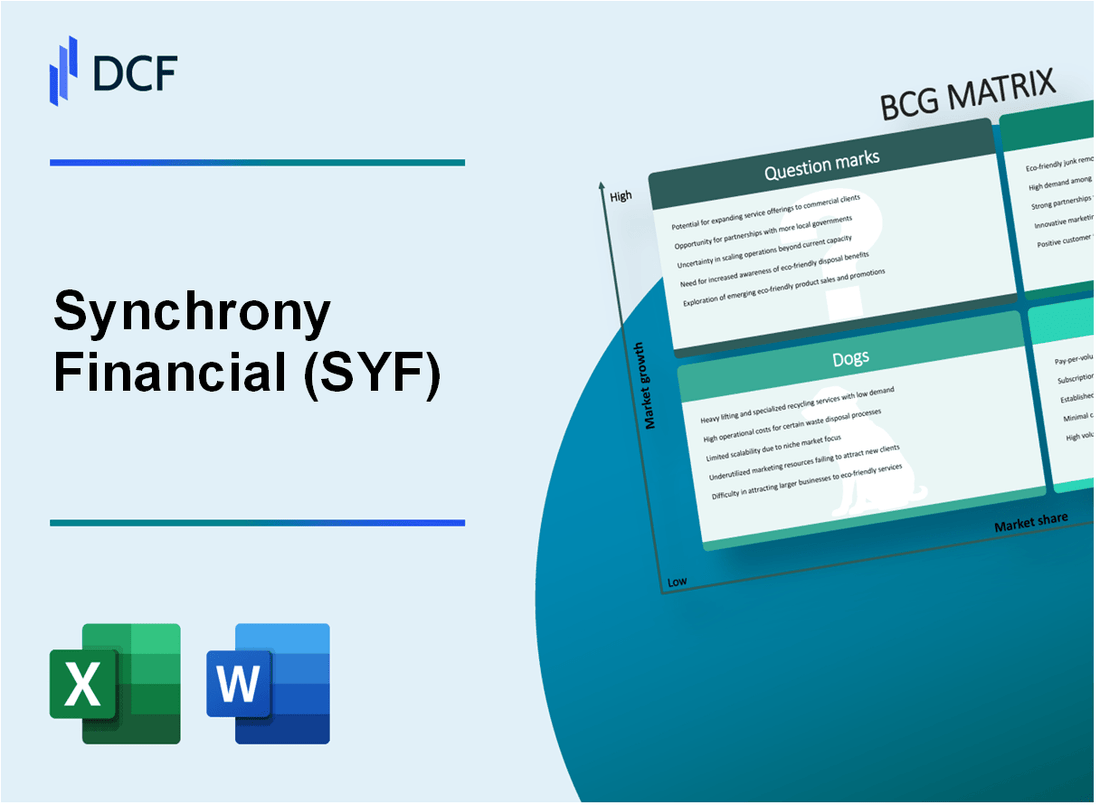
Synchrony Financial (SYF): BCG Matrix [Dec-2025 Updated] |
Fully Editable: Tailor To Your Needs In Excel Or Sheets
Professional Design: Trusted, Industry-Standard Templates
Investor-Approved Valuation Models
MAC/PC Compatible, Fully Unlocked
No Expertise Is Needed; Easy To Follow
Synchrony Financial (SYF) Bundle
You're looking at Synchrony Financial's engine room right now, and the Q3 2025 results paint a sharp picture of where capital is working hardest. We've mapped their key platforms onto the classic BCG Matrix to see which segments are the high-growth Stars, like the 5% growing Digital Platform, and which are the reliable Cash Cows, churning out a 15.62% Net Interest Margin and returning $971 million to shareholders. But it's not all smooth sailing; we also see clear Dogs dragging down performance, like the Home & Auto segment shrinking 6%, alongside exciting but unproven Question Marks like the new Buy Now, Pay Later ventures. Dive in below to see exactly which Synchrony Financial businesses demand investment and which ones are ready for a strategic trim.
Background of Synchrony Financial (SYF)
You're looking to map out Synchrony Financial (SYF)'s current standing, so let's start with what the company actually does. Synchrony Financial is a leading consumer financing company, sitting right at the heart of American commerce. They've been around for nearly a century, providing responsible access to credit and banking products across major sectors like health, home, auto, and retail. Plus, they support the operations of over 400,000 small and midsize businesses and health and wellness providers across the country. It's a big operation, built on partnerships.
The recent data, specifically from the third quarter of 2025, ending September 30, 2025, shows a company delivering solid results despite a cautious macro environment. For Q3 2025, Synchrony Financial posted net earnings of $1.1 billion, which translated to diluted earnings per share of $2.86. That's a strong showing, reflected in key profitability metrics: the return on average assets hit 3.6%, and the return on tangible common equity was a very healthy 30.6%. Honestly, the management team has been disciplined.
Digging into the core business drivers, net interest income grew 2% year-over-year to $4.7 billion, driven by a significant improvement in the net interest margin, which reached 15.62%, up 58 basis points. Purchase volume, which is essentially how much consumers spent using their cards, increased 2% to $46.0 billion in the quarter. However, you'll notice that average active accounts actually decreased by 3% to 68.3 million, and total loan receivables were down 2% to $100.2 billion. What this tells us is that the remaining customers are spending more per transaction, which is a key focus area.
Strategically, Synchrony Financial is heavily focused on upgrading its customer base-a move that started with tightening credit standards a year ago. This has paid off, leading to lower delinquencies and charge-offs, and management is confident enough to maintain an expected loss rate between 5.6% and 5.7% for the full year 2025. A major near-term catalyst is the rollout of the Walmart/OnePay credit card program, which is expected to be fully implemented by the end of 2025, alongside the integration of the recently acquired Versatile Credit platform. They've also secured 98% of their top partnerships until 2027 or beyond, which definitely locks in future revenue streams.
From a capital perspective, Synchrony Financial is actively returning cash to shareholders. Following a new authorization approved in September 2025, the company has a total remaining share repurchase authorization of $2.1 billion available through June 30, 2026. This aggressive buyback strategy, combined with strong earnings, has kept the valuation attractive; the stock was trading around a price-to-earnings ratio of 8.9x based on Q3 results. For the full year 2025, the company projects net revenue to land between $15 billion and $15.1 billion.
Synchrony Financial (SYF) - BCG Matrix: Stars
You're looking at the segments of Synchrony Financial (SYF) that are currently dominating high-growth markets and command a leading position. These are the Stars-the business units that demand significant capital investment to maintain their market share leadership, but they are the future Cash Cows if the market growth sustains itself until maturity. Honestly, the cash flow here is often a wash; what comes in from volume is immediately reinvested into promotion and placement to keep that growth engine running hot. The Digital Platform segment exemplifies this perfectly, showing the highest growth rate among all platforms in the third quarter of 2025.
The Digital Platform purchase volume growth in Q3 2025 hit 5.2% year-over-year, which was the top performer across all five sales platforms, clearly signaling the success of their e-commerce partnerships and refreshed value propositions. This segment ended Q3 2025 with period-end loan receivables rising 1.5% year-over-year. To give you a clearer picture of the key performance indicators driving these Star candidates, here's a quick look at the latest available figures:
| Segment | Q3 2025 Purchase Volume Growth (YoY) | Q3 2025 Period-End Loan Receivables Change (YoY) | Q1 2025 Purchase Volume Contribution |
| Digital Platform | 5.2% | 1.5% | N/A (Not specified for Q1) |
| Health & Wellness | 3% | 0.1% | N/A (Not specified for Q1) |
The Health & Wellness platform, anchored by CareCredit, is another clear Star candidate, especially given its penetration in specialized, high-growth verticals. This platform saw its purchase volume increase 3% in Q3 2025, with notable strength coming from the Pet and Audiology sub-segments. CareCredit itself is a powerhouse in specialized financing, supporting a network of over 270,000 healthcare providers as of the end of 2024, which speaks to its deep market share in elective healthcare services. Still, even with strong volume growth, the segment's period-end loan receivables were flat year-over-year in Q3 2025, inching up just 0.1%.
A core element of Synchrony Financial's overall business strength, and a key indicator of market leadership, is the performance of its Dual Cards and co-branded products. These products, which offer both private-label and general-purpose utility, represented a substantial 45% of the total purchase volume in Q1 2025. This high concentration in proprietary and co-branded financing is a classic characteristic of a market leader aiming to capture the full customer spend lifecycle. In Q3 2025, this category grew even stronger, accounting for 46% of total purchase volume, marking an 8% increase versus the prior year.
You should track these Star segments closely for continued investment impact. Key characteristics defining their Star status include:
- Digital Platform purchase volume growth of 5.2% in Q3 2025.
- Health & Wellness purchase volume growth of 3% in Q3 2025.
- CareCredit supports over 270,000 healthcare providers.
- Dual and co-branded cards comprised 45% of Q1 2025 purchase volume.
- Q3 2025 purchase volume growth of 2% across all five platforms.
Finance: draft 13-week cash view by Friday.
Synchrony Financial (SYF) - BCG Matrix: Cash Cows
You're analyzing the core engine of Synchrony Financial, the business units that dominate mature markets and print cash. For Synchrony Financial, the Core Private Label Credit Card portfolio is definitely the quintessential Cash Cow. This segment holds a high market share-Synchrony Financial is the country's largest private-label credit card issuer-but operates in a retail financing environment that shows signs of maturity, evidenced by a slight contraction in the overall loan book.
The profitability from this established base is clear. The Net Interest Margin (NIM) expanded to 15.62% in Q3 2025, indicating strong pricing power and high profitability from the existing loan assets, even as funding costs moderated. This high margin is what allows Synchrony Financial to generate substantial, reliable cash flow without needing massive promotional spending to chase new growth.
The loan receivables across the portfolio reflect this mature, steady state. Total loan receivables were $100.2 billion as of September 30, 2025, representing a 2% decrease year-over-year. While the overall balance contracted, the Diversified & Value platform loan receivables saw purchase volume grow 3%, suggesting stability and continued utilization in those specific retail partnerships, even if the total outstanding balances are managed down. Still, this business unit is the primary source of the cash the company uses elsewhere.
Here's a quick view of the key metrics supporting the Cash Cow status for Synchrony Financial in the third quarter of 2025:
| Metric | Value (Q3 2025) | Context |
| Net Interest Margin (NIM) | 15.62% | High profitability from existing assets. |
| Total Loan Receivables | $100.2 billion | Represents a mature, high-share asset base. |
| Year-over-Year Loan Receivable Change | -2% | Indicates market maturity/stable balance management. |
| Net Earnings | $1.1 billion | Strong cash generation capability. |
| Return on Equity (ROE) | 25.1% | High return on shareholder capital base. |
The ability to generate significant capital is the defining feature of a Cash Cow, and Synchrony Financial demonstrated this capacity. The company returned $971 million in capital to shareholders during Q3 2025. This return consisted of $861 million in share repurchases and $110 million in common stock dividends. This level of capital deployment shows management is 'milking' the segment effectively, returning excess cash to owners rather than aggressively reinvesting it into a low-growth area. The Board also approved an incremental $1.0 billion share repurchase authorization, reinforcing this strategy of supporting shareholder value from these reliable earnings streams.
You can see the efficiency of this operation in the underlying performance drivers:
- Purchase volume increased 2% to $46.0 billion.
- Loans 30+ days past due decreased 39 basis points to 4.39%.
- Net charge-offs decreased 90 basis points to 5.16%.
- Retailer share arrangements increased 12% to $1.0 billion.
Finance: draft the Q4 2025 cash flow projection focusing on the expected NIM trajectory by Monday.
Synchrony Financial (SYF) - BCG Matrix: Dogs
You're looking at the parts of Synchrony Financial that aren't pulling their weight in terms of growth, the ones that are stuck in low-growth markets with a small slice of the pie. These are the units where expensive turn-around plans rarely pay off, so the focus shifts to minimizing exposure and harvesting any remaining cash.
The Lifestyle platform loan receivables show this dynamic clearly. For the third quarter of 2025, this portfolio was down 3%. This contraction directly reflects softer consumer behavior, particularly in more discretionary spending areas. For instance, purchase volume within this platform saw a 3% decrease, which management tied to lower spend in categories like Outdoor power equipment and power sports-big-ticket items consumers are definitely delaying right now.
The Home & Auto platform is showing even more strain. Period-end loan receivables for this segment shrank by 6% in Q3 2025. This decline is significant, especially when you consider the strategic activity around the platform, like the prior sale of $0.2 billion in receivables and the pending acquisition of the Lowe's commercial co-branded credit card portfolio. You see the impact of past credit tightening showing up in these balance sheet numbers.
Here's a quick look at how these lower-share, lower-growth segments stacked up against the rest of the portfolio in terms of ending loan receivables for Q3 2025:
| Platform Segment | Q3 2025 Period-End Loan Receivables Change (YoY) | Context |
| Home & Auto | Down 6% | Contraction reflecting selective consumer pullback |
| Lifestyle | Down 3% | Reflects lower discretionary purchase volume |
| Diversified & Value | Flat (0% change) | Holding steady, suggesting relative stability |
| Health & Wellness | Flat (0% change) | Holding steady, supported by less elastic spending |
| Digital | Up 1% | Slight growth, positioning it better than Dogs |
These segments are definitely facing sustained pressure. It's not just a market hiccup; it's about where the consumer is directing their limited discretionary dollars. You can see the effect of Synchrony Financial's prior credit actions still working through the system, keeping balances in check and purchase volumes low in these specific areas.
- Selective consumer spending is prioritizing essentials over big-ticket durable goods.
- Prior credit actions continue to impact average active accounts, which were down 3% overall to 68.3 million.
- Discretionary categories like Outdoor and Specialty are seeing reduced spend.
- The pressure is on for these units to break even or consume minimal new capital.
The strategy here is clear: these are low-growth, low-share segments that require minimal new investment. The goal is to manage them strictly for cash flow, not for aggressive expansion. You don't want to tie up capital that could be better deployed in the Digital or Diversified & Value segments, which are showing better resilience or growth.
- Avoid expensive turn-around plans; they usually don't work in this quadrant.
- Manage for cash flow preservation, not market share gain.
- These units are prime candidates for divestiture if a clear path to positive growth isn't visible soon.
Finance: draft the 13-week cash flow view by Friday, isolating cash generation from the Home & Auto and Lifestyle platforms.
Synchrony Financial (SYF) - BCG Matrix: Question Marks
You're looking at the areas of Synchrony Financial (SYF) that are in high-growth markets but haven't yet secured a dominant market share-these are your Question Marks. These ventures are cash consumers right now, needing significant investment to capture market position before they risk slipping into the Dog quadrant. The overarching financial reality you must factor in is that the core portfolio is not expected to provide organic lift; Synchrony continues to expect flat ending receivables versus last year for the full year 2025. This means any success in these new areas must be large enough to overcome the portfolio run-off.
The launch of the new Walmart/OnePay program, which began rolling out in the fall of 2025, represents a massive investment aimed squarely at a potential Star. This strategic partnership, which includes both a general-purpose Mastercard and a Walmart-exclusive private label card, is designed to embed credit functionality directly into the OnePay app. As of the third quarter of 2025, the CEO noted that the initial results from this de novo program have been very encouraging, signaling a potential shift in market traction that warrants continued heavy investment.
Another key investment area is the Buy Now, Pay Later (BNPL) market, which is inherently high-growth but intensely competitive. Synchrony Financial's in-house BNPL platform is actively fighting for share; as of May 2025, it was integrated as a payment option at 20% of surveyed partners. To put that into perspective, approximately 25% of SYF's partners had non-SYF BNPL competitors integrated at checkout in that same analysis. The strategy here is clear: invest in the technology and partner adoption to quickly move this offering from a low-share Question Mark to a significant revenue contributor.
To bolster its technology foundation for these growth areas, Synchrony Financial acquired Versatile Credit around October 2025. Versatile Credit operates a multi-source financing platform, which is crucial for offering the flexible, multi-lender solutions that modern merchants demand, especially in big-ticket sectors like home improvement and elective medical. While the terms were not disclosed and the acquisition is expected to be immaterial to the Company's earnings per share, the strategic value lies in accelerating the technology roadmap for consumer financing solutions and controlling a key piece of the point-of-sale ecosystem. This platform, which generates between $10 million to $15 million in annual revenue, requires capital deployment to scale its integration across Synchrony's existing merchant base.
These Question Marks-the new Walmart program, the BNPL push, and the Versatile Credit integration-are all being funded against a backdrop of expected stagnation in the legacy portfolio. You need to watch the investment spend on these initiatives closely against the actual growth in their respective loan receivables to determine if they are on a path to becoming Stars or if they will require a divestment decision down the line.
| Metric | Value/Guidance (2025) | Context |
| Ending Loan Receivables (Q3 2025) | $100 billion | Reflects a 2% decrease year-over-year. |
| Full Year 2025 Ending Receivables Outlook | Flat vs. prior year | New ventures must overcome this portfolio run-off. |
| In-House BNPL Partner Integration (May 2025) | 20% of surveyed partners | Indicates low current market share in a high-growth segment. |
| Versatile Credit Annual Revenue (Estimate) | $10 million to $15 million | Scale of the acquired technology platform. |
| Walmart/OnePay Program Launch Timing | Fall 2025 | Major strategic investment expected to drive future growth. |
Disclaimer
All information, articles, and product details provided on this website are for general informational and educational purposes only. We do not claim any ownership over, nor do we intend to infringe upon, any trademarks, copyrights, logos, brand names, or other intellectual property mentioned or depicted on this site. Such intellectual property remains the property of its respective owners, and any references here are made solely for identification or informational purposes, without implying any affiliation, endorsement, or partnership.
We make no representations or warranties, express or implied, regarding the accuracy, completeness, or suitability of any content or products presented. Nothing on this website should be construed as legal, tax, investment, financial, medical, or other professional advice. In addition, no part of this site—including articles or product references—constitutes a solicitation, recommendation, endorsement, advertisement, or offer to buy or sell any securities, franchises, or other financial instruments, particularly in jurisdictions where such activity would be unlawful.
All content is of a general nature and may not address the specific circumstances of any individual or entity. It is not a substitute for professional advice or services. Any actions you take based on the information provided here are strictly at your own risk. You accept full responsibility for any decisions or outcomes arising from your use of this website and agree to release us from any liability in connection with your use of, or reliance upon, the content or products found herein.