

|
TransMedics Group, Inc. (TMDX): PESTLE Analysis [Apr-2026 Updated] |
Fully Editable: Tailor To Your Needs In Excel Or Sheets
Professional Design: Trusted, Industry-Standard Templates
Investor-Approved Valuation Models
MAC/PC Compatible, Fully Unlocked
No Expertise Is Needed; Easy To Follow
TransMedics Group, Inc. (TMDX) Bundle
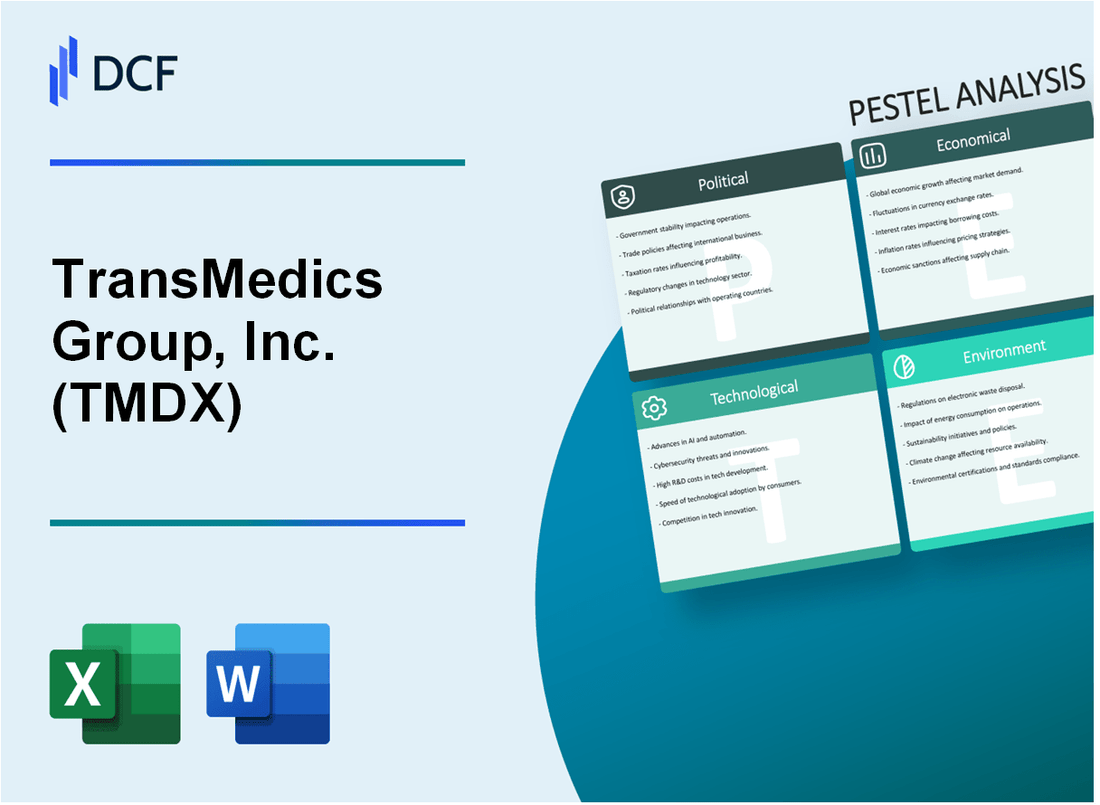
TransMedics Group, Inc. (TMDX) is sitting on a high-growth engine-the National OCS Program (NOP)-but its trajectory isn't a straight line. As a financial analyst, I see near-term revenue security, but also a significant legal cloud and operational pressures that you need to factor into your valuation. The question isn't just about the Organ Care System (OCS) technology; it's about the political, economic, and legal environment it operates in. Let's break down the macro forces shaping TMDX's 2025 outlook.
Political Factors: Regulatory Tailwinds and Scrutiny
The political landscape is a double-edged sword for TMDX. On one hand, US government reforms aimed at expanding the organ donor pool could directly boost your addressable market. More organs mean more potential NOP volume. On the other hand, the company has drawn scrutiny from figures like U.S. Representative Paul Gosar over allegations of price gouging and resource misappropriation. This kind of attention can quickly escalate into regulatory action.
Also, watch the international front. While the new NOP in Italy is a growth signal, it reminds us that global expansion is slow. Every new country means tackling fragmented regulatory and clinical standards. Plus, any change in UNOS (United Network for Organ Sharing) policies around organ allocation could immediately alter the demand and procurement rules for the National OCS Program. The political winds are strong, so don't ignore them.
Economic Factors: Growth vs. Margin Pressure
The economics look strong on the top line. Management projects full-year 2025 revenue guidance between $595 million and $605 million, which represents about 36% year-over-year growth. That's a defintely solid number that secures their market position.
However, the bottom line tells a more nuanced story. Q3 2025 gross margin was a solid 59%, an improvement, but scaling the logistics service (NOP) is inherently expensive and keeps margin pressure on. Here's the quick math: you need significant infrastructure-like the new global headquarters and manufacturing facility-to support this growth, and those investments will compress near-term profitability. Still, the company has a strong buffer, ending Q3 2025 with over $466.2 million in cash. They can afford the build-out.
Sociological Factors: The Life-Saving Mission as a Moat
The sociological factor is TMDX's most powerful, and often under-appreciated, asset. Their core mission-increasing organ utilization-is fundamentally life-saving and drives deep public and clinical acceptance. They are addressing a critical, growing public health need: getting more viable organs to end-stage failure patients.
High-profile success stories act as free marketing and drive adoption faster than any sales team could. Plus, the company has a positive social profile, reporting a gender-balanced workforce in the U.S. (50% women as of late 2022). This social license to operate is crucial in a highly scrutinized medical field. It's hard to bet against a company whose technology is fundamentally saving lives.
Technological Factors: Next-Gen Innovation and Competition
Technology is the core moat. The Organ Care System (OCS) remains the only FDA-approved, portable warm perfusion platform for heart, lung, and liver transplants. But they aren't resting. R&D is focused on next-generation products, specifically the OCS ENHANCE Heart and DENOVO Lung trials, scheduled to start in Q4 2025. The goal is ambitious: extending organ preservation time up to 24 hours, which would fundamentally change transplant logistics.
They're also building a digital layer: the OCS Connect™ digital ecosystem, launched in early 2025, enhances logistics and communication for transplant centers, making the NOP stickier. The one headwind is competition, particularly from OrganOx Metra in the liver perfusion segment, which could challenge TransMedics' liver revenue growth. You have to watch that liver segment closely.
Legal Factors: The Securities Class Action Overhang
This is the biggest near-term risk to the stock price, despite the strong financials. A securities class action lawsuit filed in 2025 alleges undisclosed illicit sales practices, including kickbacks and fraudulent overbilling. This legal risk remains a significant overhang on the stock price.
Beyond the lawsuit, the company must also navigate complex FDA post-market surveillance requirements for its OCS devices and secure new IDE (Investigational Device Exemption) approvals for next-gen tech. Plus, intellectual property defense is crucial to maintaining the competitive moat against other ex-vivo perfusion technologies. The legal department is working overtime, and you should price that risk into your models.
Environmental Factors: The Carbon Footprint of Logistics
The 'E' in PESTLE is becoming more relevant, even for a medical device company. TransMedics has formalized its commitment to sustainability with Board oversight and alignment to SASB standards. That's a good start.
However, the business model relies on a massive logistics network, including a fleet of 22 aircraft as of late 2025, and that carries a large carbon footprint. Environmental disclosures are still nascent; specific Greenhouse Gas (GHG) emissions data for its operations is not publicly available. While they are evaluating products to reduce environmental impacts, investors are increasingly demanding concrete, measurable data on their operational footprint. They need to publish those GHG numbers soon.
TransMedics Group, Inc. (TMDX) - PESTLE Analysis: Political factors
US government reforms in organ procurement could expand the donor pool, directly increasing TransMedics' addressable market.
You need to see the US government's drive to overhaul the Organ Procurement and Transplantation Network (OPTN) as a major tailwind for TransMedics Group. The Health Resources and Services Administration (HRSA) is pushing for modernization, aiming to increase safety, transparency, and the overall donor pool. This is defintely not a small change; it's a structural shift.
The 'Securing the Organ Procurement and Transplant Network Act' is key here, as it removed the mandate for the OPTN to be operated solely by a non-profit, opening the door for-profit entities like TransMedics Group to potentially play a larger, more innovative role. More viable organs mean more business for the National OCS Program (NOP). The company's management clearly sees this opportunity, raising their full year 2025 revenue guidance to a range of $595 million to $605 million, representing 36% growth at the midpoint over the prior year.
Allegations of price gouging and resource misappropriation have drawn scrutiny from U.S. Representative Paul Gosar.
Political scrutiny is a real risk, and TransMedics Group is already in the crosshairs. U.S. Representative Paul Gosar sent a letter in February 2024, alleging the company was gouging transplant centers and misappropriating corporate resources. This political pressure is serious because it can lead to regulatory action or Congressional hearings.
This kind of negative political attention immediately hits investor confidence. For example, following a critical report that echoed these concerns on January 10, 2025, TransMedics Group shares fell by $3.74 per share, or 5%, to a closing price of $68.81. The core of the price gouging allegation centers on the cost of the Organ Care System (OCS) disposable perfusion modules, which TransMedics Group stated were sold for $45,000 per case during the trial period-a number that has drawn significant attention from critics, even though the company denies direct billing to payors.
International expansion, like the new NOP in Italy, faces fragmented regulatory and clinical standards, slowing market entry.
Expanding the NOP model globally is a huge growth opportunity, but the political and regulatory landscape outside the US is fragmented, which slows things down. The European Union, for instance, lacks the single, centralized organ allocation body of the US, meaning TransMedics Group has to navigate 27+ different national health systems and regulations.
The initial launch of the Italian NOP hubs, expected before the end of 2025, is a concrete example of the necessary, phased approach. The company is deploying a dedicated ground transportation network in collaboration with Mercedes-Benz across four major hubs: Milan, Rome, Padua, and Bari. Even with the OCS technology holding the CE Mark (conforming to European health, safety, and environmental protection standards), building a full, end-to-end service like the NOP requires country-by-country clinical and logistical approval, which is a slow, costly political process.
Changes in UNOS (United Network for Organ Sharing) policies could alter organ allocation and procurement rules, impacting NOP volume.
The policies set by the United Network for Organ Sharing (UNOS), which operates the OPTN under a federal contract, directly control the flow of organs-the lifeblood of TransMedics Group's business. Recent and proposed changes in 2025 are a mixed bag of risk and opportunity.
The new multi-organ allocation policy is designed to standardize the process, covering approximately 98% of deceased donors who donate to multi-organ recipients. This standardization should bring more predictability. Also, the new rule reducing the number of organ offers a transplant hospital may accept per candidate from two to one (effective May 29, 2024) forces faster decisions and potentially increases the utilization of organs that might have been rejected under the old system, which favors the NOP's speed and preservation technology.
Here's a quick look at the political and regulatory impacts:
| Political/Regulatory Factor | Impact on TransMedics Group (TMDX) | Actionable Insight (2025) |
|---|---|---|
| OPTN Modernization (HRSA/HHS) | Expands addressable market by increasing the viable donor pool. Allows for-profit entities to compete for OPTN services. | Focus on securing new service contracts as the OPTN contract expires (December 29, 2025). |
| U.S. Rep. Gosar Scrutiny | Reputational damage and risk of regulatory investigation over pricing and business practices. Stock price fell 5% on January 10, 2025. | Maintain transparent pricing with transplant centers; prepare a robust defense of the NOP cost structure. |
| UNOS Policy Changes (Allocation) | New multi-organ allocation policy (approx. 98% coverage) and reduced offer acceptance limit (two to one) can increase NOP utilization. | Integrate NOP logistics to capitalize on the faster decision-making window created by the new offer limit. |
| International Regulatory Fragmentation | Slows market entry in Europe despite OCS CE Mark. Requires significant investment in country-specific NOP hubs (e.g., four major hubs in Italy). | Prioritize expansion in countries with centralized organ systems or favorable bilateral agreements. |
TransMedics Group, Inc. (TMDX) - PESTLE Analysis: Economic factors
Full-year 2025 revenue guidance is strong, projected between $595 million and $605 million, representing about 36% growth.
The economic outlook for TransMedics Group is defintely robust, anchored by a significant upward revision in its 2025 full-year revenue guidance. The company is now projecting revenue to land between $595 million and $605 million. This represents a powerful growth trajectory, with the midpoint of the guidance suggesting approximately 36% growth over the prior fiscal year. That's a clear signal of strong market penetration and increasing adoption of the Organ Care System (OCS) technology and the National OCS Program (NOP) logistics service.
Here's the quick math: Hitting the midpoint of $600 million means the core business model-integrating the OCS device with a dedicated organ transport network-is scaling effectively, which is the whole point of a high-growth med-tech company. This revenue strength provides a solid economic foundation to absorb the costs of future expansion.
Q3 2025 gross margin was 59%, a solid improvement, but scaling the logistics service (NOP) continues to put pressure on margins.
The company's gross margin for the third quarter of 2025 came in at a healthy 59%, a solid increase compared to 56% in the same quarter of 2024. This year-over-year improvement shows better operational efficiency in core product delivery. But, to be fair, the rapid expansion of the National OCS Program (NOP)-which is the proprietary, integrated logistics service-is still a heavy lift on profitability in the near term. The cost of running a dedicated, rapidly expanding air and ground transport network is substantial.
What this estimate hides is the sequential pressure: gross margin actually declined compared to the second quarter of 2025, due in part to lower activity levels and the sheer cost of scaling the infrastructure. Managing this trade-off between aggressive market share capture via NOP and short-term margin compression is a key economic challenge.
Significant infrastructure investments, including a new global headquarters and manufacturing facility, will compress near-term profitability.
TransMedics Group is making major strategic investments that are driving up operating expenses, which totaled $61.3 million in Q3 2025, up from $56.9 million in the prior-year period. These investments are necessary to support the next wave of growth, but they will compress operating margin in the short run. The focus is on building a foundation for a long-term target of achieving an operating margin at or approaching 30% by 2028.
Concrete examples of this infrastructure spend include:
- Expansion of the dedicated aviation fleet, which grew to 21 aircraft as of September 30, 2025, with another added in October.
- Increased Research and Development (R&D) investment to advance the next-generation OCS platforms.
- Strategic global expansion, such as the collaboration with Mercedes-Benz Group AG to deploy a dedicated organ transportation fleet in Italy for the first international NOP launch.
The company maintains a strong cash position, ending Q3 2025 with over $466.2 million in cash.
A major strength in the company's economic profile is its liquidity. TransMedics Group ended the third quarter of 2025 with a very strong cash position of over $466.2 million. This cash balance is crucial because it provides the capital necessary to fund the aggressive infrastructure build-out and R&D without relying heavily on external financing or diluting shareholders.
This financial firepower means the company can execute its long-term strategy-like the goal of reaching 10,000 U.S. NOP transplants by 2028-with confidence, even as it navigates the temporary margin pressure from its growth investments. A cash-rich balance sheet is a powerful competitive advantage in a capital-intensive, high-growth sector.
| Financial Metric (Q3 2025 Data) | Value | Context / Impact |
|---|---|---|
| Full-Year 2025 Revenue Guidance | $595 million to $605 million | Represents 36% growth at the midpoint, signaling strong market adoption. |
| Q3 2025 Gross Margin | 59% | Improved from 56% year-over-year, but sequential decline indicates pressure from logistics/infrastructure scaling. |
| Q3 2025 Operating Expenses | $61.3 million | Increased from $56.9 million in Q3 2024, driven by R&D and growth investments. |
| Cash Position (as of Sept. 30, 2025) | Over $466.2 million | Strong liquidity to fund aggressive expansion and R&D without significant external capital. |
TransMedics Group, Inc. (TMDX) - PESTLE Analysis: Social factors
When you look at TransMedics Group, Inc., the social factors are a powerful double-edged sword. On one side, the company's core mission is a clear social good, driving massive adoption and revenue growth. On the other, the high-stakes nature of their work and the complexity of the U.S. transplant system expose them to significant social and legal scrutiny, which you must factor into your risk model.
The fundamental social opportunity is the enormous, life-or-death need for more organs. TransMedics' Organ Care System (OCS) and its National OCS Program (NOP) directly address this by making previously unusable organs viable, which is a massive social win. This is why revenue is expected to be between $595 million and $605 million for the full year 2025, representing a strong 36% growth at the midpoint over the prior year.
The core mission-increasing organ utilization-is a powerful driver of public and clinical acceptance.
The company's technology transforms organ preservation from a decades-old static cold storage method to a dynamic, warm perfusion system. This shift is a game-changer for the public perception of organ donation, as it translates directly into more lives saved and fewer wasted organs. The social license to operate is incredibly strong because the mission is so clear: expand the donor pool and increase utilization.
This mission drives concrete, life-saving metrics:
- Total U.S. OCS cases completed in 2024 were 3,715, a 58% increase from 2023.
- The company is targeting to perform 10,000 U.S. NOP transplants in 2028, showing the massive anticipated social impact.
- The National OCS Program (NOP) logistics network, which includes a dedicated aviation fleet, was utilized in 78% of NOP transplants in the most recent quarter, ensuring organs get to recipients faster.
TransMedics' technology addresses the critical, growing public health need for more viable organs for end-stage failure patients.
The U.S. organ transplant waiting list remains long, and TransMedics' solution directly tackles the supply-side constraint. Their system allows for the safe transport and assessment of organs donated after circulatory death (DCD) and organs from distant locations, which would otherwise be discarded. The public health benefit is clear, and this is why their service revenue-driven by the logistics of the National OCS Program-is a core growth engine.
Here's the quick math on the financial impact of this social imperative:
| Metric (2025 Fiscal Year) | Q1 2025 Value | Q2 2025 Value | Q3 2025 Value |
|---|---|---|---|
| Total Revenue | $143.5 million | $157.4 million | $143.8 million |
| Year-over-Year Growth Rate | 48% | 38% | 32% |
| Net Income | $25.7 million | $34.9 million | $24.3 million |
The deceleration in the growth rate is expected as the market matures, but the sheer size of the revenue and net income figures shows the immense value the market places on this life-saving service.
The company reports achieving a gender-balanced workforce in the U.S. (50% women as of late 2022), supporting a positive social profile.
A commitment to diversity, equity, and inclusion (DE&I) is a key social factor for modern stakeholders. TransMedics' last public disclosure on this point, from its inaugural ESG report, stated the U.S. workforce was 50% women as of December 31, 2022. What this estimate hides is the lack of a 2024 or 2025 update, which is a transparency gap as the company has grown its global workforce to over 728 employees as of late 2024.
Maintaining a visible, balanced workforce is defintely critical for a company whose mission is so inherently social and humanitarian.
High-profile success stories drive adoption; the technology is fundamentally life-saving.
The most compelling social driver is the direct, visible success of the Organ Care System (OCS). An early, high-profile example that cemented the technology's potential was the successful transplantation of donor lungs retrieved from Hawaii and transported over 4,700 miles, functioning for approximately 20 hours outside the human body. That's a powerful narrative that cuts through the medical jargon.
However, you must be a realist: this positive social profile is vulnerable. In April 2025, a class-action lawsuit was filed in U.S. Federal Court alleging that the company engaged in fraudulent billing, used coercive tactics to market its OCS devices, and concealed safety concerns. This legal and public scrutiny, regardless of its outcome, introduces a major social risk that can erode trust among transplant centers and the public, potentially slowing the adoption rate of the National OCS Program (NOP). The social narrative is a risk factor now, too.
TransMedics Group, Inc. (TMDX) - PESTLE Analysis: Technological factors
The technology factor is TransMedics Group, Inc.'s (TMDX) core strength, but you need to watch for competitors closing the innovation gap, especially in the liver segment. The Organ Care System (OCS) remains a massive competitive moat, but the focus is rapidly shifting to the next generation of devices and the digital ecosystem to maintain market leadership.
The Organ Care System (OCS) is the only FDA-approved, portable warm perfusion platform for heart, lung, and liver transplants.
The OCS is defintely the technological foundation of TransMedics' business, and its unique status as the only FDA-approved, portable warm perfusion platform for all three major organs-heart, lung, and liver-is a significant barrier to entry for rivals. This technology moves organs from static cold storage to a state of near-physiologic function outside the body, which allows for viability assessment and extends the window for transport. This technological edge is the primary driver behind the company's impressive financial performance in 2025, with full year revenue guidance raised to a range of $595 million to $605 million, a 36% growth at the midpoint compared to the prior year.
Here's the quick math: Q3 2025 revenue hit $143.8 million, showing the consistent, high-volume adoption of OCS through the National OCS Program (NOP). The technology is not just a product; it's an entire vertically integrated service that includes the device, clinical specialists, and a dedicated logistics network of 21 owned aircraft as of September 30, 2025.
R&D focus is on next-generation OCS ENHANCE Heart and DENOVO Lung trials, starting in Q4 2025, aiming to extend preservation time up to 24 hours.
TransMedics is not sitting still; they are pushing the limits of organ preservation with their next-generation R&D pipeline. The company received conditional Investigational Device Exemption (IDE) approval from the FDA to initiate both the OCS ENHANCE Heart and DENOVO Lung pivotal trials in Q4 2025.
The ENHANCE Heart trial, which is expected to enroll over 650 patients, aims to demonstrate the superiority of OCS Heart perfusion over traditional static cold storage methods. The core goal here is to support even more prolonged heart perfusion, potentially pushing preservation times up to 24 hours. This is a crucial technological step because every hour added to the preservation window dramatically increases the number of viable donor organs and the geographic reach for transplant centers. This future growth is being funded by increased R&D investment, which was a primary driver of the $61.3 million in operating expenses recorded in Q3 2025.
- OCS ENHANCE Heart: Trial size exceeds 650 patients.
- Trial Start: Both trials begin in Q4 2025.
- Goal: Demonstrate superiority and support prolonged perfusion.
Launch of the OCS Connect™ digital ecosystem (early 2025) enhances logistics and communication for transplant centers.
Technology isn't just hardware; it's the software and logistics that tie it all together. TransMedics launched its first-in-class digital ecosystem, OCS Connect™ (also referred to as NOP ACCESS™), across major NOP transplant programs in 2025. This mobile app, available on native iOS and Android, provides a HIPAA-compliant, secure channel for real-time communication and logistics transparency between the transplant center and the TransMedics NOP team.
This digital layer is a significant technological advantage, transforming a complex, high-stakes logistical process into a transparent one. It allows clinicians to view on-demand updates on the organ's preservation condition, procedure status, and the estimated time of arrival (ETA) of the donor organ to their center. This digital integration is a key component of the company's strategy to achieve and surpass its target of 10,000 U.S. NOP transplants in 2028.
Competition exists, notably from OrganOx Metra in the liver perfusion segment, which could challenge TransMedics' liver revenue growth.
While TransMedics dominates the overall portable perfusion market, the liver segment faces direct and credible technological competition from OrganOx Metra. OrganOx Metra is also an FDA-approved Normothermic Machine Perfusion (NMP) device for liver transplants. This is a real threat. OrganOx Metra has already facilitated over 6,000 transplants globally.
The key technological differentiator here is the operational model. TransMedics' OCS Liver system is primarily used in its fully integrated NOP, where the company manages the entire process. OrganOx Metra, however, is the only NMP device in the U.S. that supports a back-to-base usage model, where the procured liver is brought back to the transplant center using traditional cold storage and then placed on the NMP device at the hospital. This flexibility could appeal to transplant centers that prefer to keep the perfusion process under their direct control, potentially challenging TransMedics' liver revenue growth, which is a major component of their total projected $595 million to $605 million 2025 revenue.
| Technological Factor | TransMedics OCS | OrganOx Metra (Competitor) |
|---|---|---|
| FDA Approval Status | Only portable warm perfusion for Heart, Lung, Liver. | FDA approved for Liver NMP. |
| Primary Use Model | Integrated National OCS Program (NOP) - end-to-end service. | Supports 'Back-to-Base' model (hospital-centric perfusion). |
| Digital Ecosystem | OCS Connect™ / NOP ACCESS™ (real-time logistics, secure messaging). | No comparable national, integrated digital ecosystem. |
| Next-Gen R&D Focus | OCS ENHANCE Heart (650+ patients) & DENOVO Lung trials (Q4 2025 start). | Acquired by Terumo Corporation (Oct 2025) to accelerate innovation. |
TransMedics Group, Inc. (TMDX) - PESTLE Analysis: Legal factors
A securities class action lawsuit filed in 2025 alleges undisclosed illicit sales practices, including kickbacks and fraudulent overbilling.
You need to be clear about the immediate legal risk, and for TransMedics Group, Inc., it's the pending securities class action. The lawsuit, Jewik v. TransMedics Group, Inc., was filed in the U.S. District Court for the District of Massachusetts in early 2025, alleging that the company and its executives misled investors.
The core of the complaint is that the company's rapid growth was defintely fueled by undisclosed illicit sales practices, including kickbacks to medical providers, fraudulent overbilling of hospitals, and coercive tactics to drive revenue. The class period-the time frame investors claim they were misled-spans from February 28, 2023, to January 10, 2025.
The case is ongoing, and the Defendants filed a Motion to Dismiss the Amended Complaint on October 7, 2025. This kind of litigation creates a significant and costly distraction for senior management, plus it forces the company to allocate substantial resources to legal defense, which could otherwise be deployed for R&D or market expansion.
The company must navigate complex FDA post-market surveillance requirements for its OCS devices and new IDE approvals.
The regulatory burden is a constant, complex legal factor in the medical device space, and TransMedics Group's Organ Care System (OCS) is no exception. Beyond initial Pre-Market Approval (PMA), the company faces rigorous post-market surveillance (PMS) requirements, which are now under a microscope due to allegations in the securities suit that the company concealed safety issues and lacked safety oversight.
Still, on the growth side, the company is actively pursuing new indications, which requires navigating the Investigational Device Exemption (IDE) process. In August 2025, the FDA granted conditional IDE approval for the Next-Generation OCS ENHANCE Heart trial. This trial is massive, expected to enroll over 650 patients, and its Part B aims to demonstrate the superiority of OCS Heart perfusion over static cold storage for Donation After Brain Death (DBD) hearts. The company is also initiating the DENOVO Lung trial in Q4 2025.
Here's the quick math on regulatory complexity: each new trial exponentially increases the legal and compliance overhead, but it's the only way to expand the total addressable market (TAM).
Intellectual property defense is crucial to maintaining the competitive moat against other ex-vivo perfusion technologies.
Protecting the intellectual property (IP) that underpins the OCS technology is crucial for maintaining the company's competitive advantage (moat) in the ex-vivo organ perfusion market. This involves a global portfolio of patents, including those for preserving a lung ex vivo using both perfusion and ventilation, with patents issued in the United States, Europe, Japan, and other key markets.
The company has actively used strategic acquisitions to strengthen its IP position. For example, in 2023, TransMedics Group acquired assets and IP related to the Ex-Vivo Organ Support System (EVOSS) and LifeCradle Heart Preservation Transport System from Bridge to Life Ltd. This move was a proactive legal defense mechanism, consolidating competing technologies and IP into the OCS platform to deter future infringement challenges and secure the next-generation OCS technology. Losing any major patent litigation would open the door to competitors and devastate the company's pricing power and market share.
The legal risk remains a significant overhang on the stock price despite strong financial results.
The ongoing legal and regulatory scrutiny is a material risk that acts as a cap on the stock's valuation. While the company is delivering blockbuster financial performance in 2025, the legal overhang persists.
For the full year 2025, TransMedics Group raised its revenue guidance to a range of $595 million to $605 million, with the midpoint at $600 million. In Q3 2025 alone, the company reported revenue of $143.8 million and a net income of $24.3 million. This is strong execution. But, the stock price reaction to positive news is tempered by the constant threat of litigation and regulatory fines.
The market is clearly discounting future cash flows due to this uncertainty. You can see the disconnect between the operational success and the persistent legal risk in the following key 2025 data points:
| Metric | Value (2025 Data) | Legal Context |
|---|---|---|
| Full-Year 2025 Revenue Guidance (Midpoint) | $600 million | Strong growth, but a potential target for damages if the class action is successful. |
| Q3 2025 Net Income | $24.3 million | Indicates profitability, but a portion of this will be diverted to legal defense costs. |
| New Clinical Trial Enrollment | Over 650 patients (OCS ENHANCE Heart) | Requires intense FDA collaboration and compliance, increasing regulatory risk exposure. |
| Securities Lawsuit Status | Motion to Dismiss filed October 7, 2025 | The legal risk is active and will not be resolved in the near term. |
The action item here is to model a range of potential legal settlement costs-even a small percentage of the $600 million revenue guidance would be a material hit-to truly understand the risk to shareholder equity.
TransMedics Group, Inc. (TMDX) - PESTLE Analysis: Environmental factors
Formalized Sustainability Commitment and Oversight
You need to know that TransMedics Group, Inc. has defintely formalized its commitment to sustainability, embedding it within the corporate governance structure. This isn't just a marketing exercise; the Nominating and Corporate Governance Committee of the Board of Directors has been designated to oversee the company's policies on corporate social responsibility and environmental sustainability.
This commitment is grounded in a recognized reporting standard. The company's inaugural Environmental, Social & Governance (ESG) report is aligned with the Sustainability Accounting Standards Board (SASB) standard for the Medical Equipment & Supplies industry. This alignment gives investors a clear, industry-specific framework to evaluate the company's non-financial performance.
Massive Logistics Network and Carbon Footprint
The core of TransMedics' business model, the National OCS Program (NOP), relies on a massive, dedicated logistics network, which is a significant environmental factor. The speed required for organ transplantation necessitates air travel, and this is where the major carbon footprint lies.
As of late 2025, specifically October 29, 2025, the company owned a fleet of 22 aircraft to transport donor organs nationwide. This fleet expansion is directly tied to their financial growth, as the expansion and utilization of this aviation fleet fueled the increase in NOP service revenue, contributing to a total revenue of $143.8 million in the third quarter of 2025. This is a classic trade-off: life-saving speed versus environmental impact.
| Metric | 2025 Fiscal Year Data (Latest Available) | Environmental Implication |
|---|---|---|
| Owned Aircraft Fleet Size | 22 fixed-wing aircraft (as of October 29, 2025) | Significant Scope 1 and 3 Greenhouse Gas (GHG) emissions from jet fuel consumption. |
| Q3 2025 Total Revenue | $143.8 million | Revenue growth is directly linked to increased fleet utilization and flight volume. |
| Full Year 2025 Revenue Guidance (Midpoint) | $600 million (Range: $595 million to $605 million) | Continued high demand and logistical intensity for the National OCS Program. |
| Public GHG Emissions Data | Not publicly available | High risk of regulatory or investor scrutiny due to disclosure gap on primary environmental impact. |
Nascent Environmental Disclosures and GHG Data
While the formal structure for ESG is in place, the actual environmental disclosures are still nascent. The company has not yet made specific Greenhouse Gas (GHG) emissions data for its operations publicly available. This is a critical risk area.
For a business whose primary environmental impact is clearly tied to its dedicated air fleet, the lack of Scope 1 (direct emissions) and Scope 3 (indirect, supply chain) data creates a transparency gap. Investors and regulators increasingly demand this data to assess climate-related risk. It's a clear vulnerability in their ESG profile right now.
Product Lifecycle Evaluation for Impact Reduction
Beyond the logistics network, the company is starting to look at the environmental impact of its core product, the Organ Care System (OCS). They are evaluating their medical devices to reduce environmental impacts across the product lifecycle.
This evaluation focuses on areas like materials sourcing, energy use during manufacturing, and end-of-life disposal for the OCS platform. Here's the quick math: managing the lifecycle impact of a specialized medical device is easier to control than mitigating the emissions from a growing fleet of 22 jets.
- Evaluate products for environmental impact reduction.
- Optimize materials and energy use in manufacturing.
- Address end-of-life disposal for medical devices.
What this estimate hides is that the environmental benefit from a more sustainable OCS device will likely be dwarfed by the emissions from the NOP's aviation network, so the primary action must be on the logistics side.
Disclaimer
All information, articles, and product details provided on this website are for general informational and educational purposes only. We do not claim any ownership over, nor do we intend to infringe upon, any trademarks, copyrights, logos, brand names, or other intellectual property mentioned or depicted on this site. Such intellectual property remains the property of its respective owners, and any references here are made solely for identification or informational purposes, without implying any affiliation, endorsement, or partnership.
We make no representations or warranties, express or implied, regarding the accuracy, completeness, or suitability of any content or products presented. Nothing on this website should be construed as legal, tax, investment, financial, medical, or other professional advice. In addition, no part of this site—including articles or product references—constitutes a solicitation, recommendation, endorsement, advertisement, or offer to buy or sell any securities, franchises, or other financial instruments, particularly in jurisdictions where such activity would be unlawful.
All content is of a general nature and may not address the specific circumstances of any individual or entity. It is not a substitute for professional advice or services. Any actions you take based on the information provided here are strictly at your own risk. You accept full responsibility for any decisions or outcomes arising from your use of this website and agree to release us from any liability in connection with your use of, or reliance upon, the content or products found herein.