

|
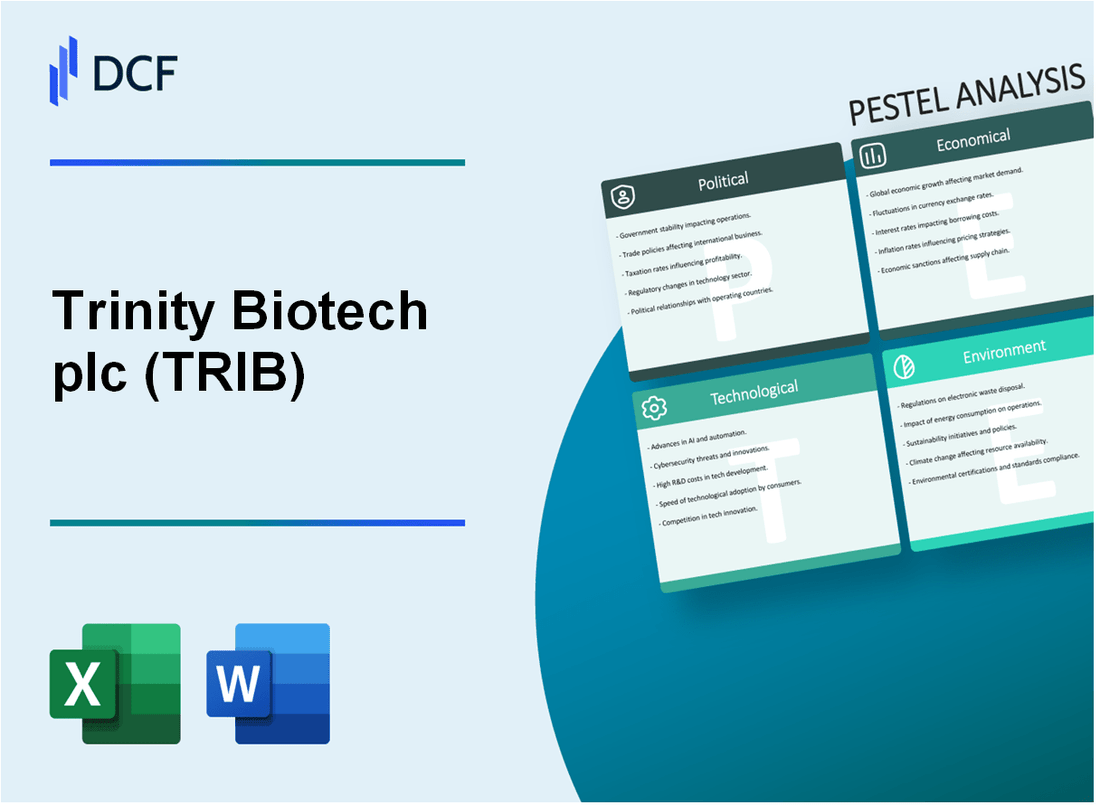
Trinity Biotech plc (TRIB): PESTLE Analysis [Nov-2025 Updated] |
Fully Editable: Tailor To Your Needs In Excel Or Sheets
Professional Design: Trusted, Industry-Standard Templates
Investor-Approved Valuation Models
MAC/PC Compatible, Fully Unlocked
No Expertise Is Needed; Easy To Follow
Trinity Biotech plc (TRIB) Bundle
You're looking for a clear-eyed view of Trinity Biotech plc (TRIB), and honestly, the landscape for a specialized diagnostics player is a mixed bag right now. The near-term is all about navigating regulatory shifts and managing debt, but the long-term opportunity in point-of-care (POC) testing is defintely still there.
Trinity Biotech plc is a classic turnaround story right now: a diagnostics company trying to pivot its core business while under significant financial pressure. The key takeaway for 2025 is that the operational restructuring is showing early signs of working, with a projected shift to positive Adjusted EBITDA and cash flow from operations starting in Q3 2025, but the looming debt and complex regulatory environment, especially the EU's IVDR, create a high-stakes, high-risk situation. You need to focus on how they manage their debt load against a projected 2025 revenue of around $69.9 million, which shows modest growth but is still a fraction of the target market.
Political
- Increased FDA scrutiny on Laboratory Developed Tests (LDTs) raises compliance costs and market access hurdles in the US.
- US government healthcare spending policies directly impact reimbursement rates for key diagnostic products.
- As an Irish-based company, Trinity Biotech plc faces dual-jurisdiction tax and trade policies, adding complexity to global operations.
- Global trade tensions affect supply chain costs and raw material access, which is a real cost drag.
Economic
- High debt load, with a focus on refinancing or restructuring in 2025, remains the biggest financial risk.
- Revenue is projected to be around $69.9 million for the 2025 fiscal year, showing modest growth as the restructuring takes hold.
- Inflationary pressures increase manufacturing and distribution costs, squeezing already thin margins.
- A strong US dollar negatively impacts revenue translated from European sales, a factor they can't control.
- Global economic slowdown could reduce routine healthcare spending, slowing sales of non-essential diagnostics.
Sociological
- Rising global prevalence of diabetes drives demand for their core HbA1c testing products.
- Increased public health focus on infectious disease surveillance and rapid testing boosts demand for products like TrinScreen HIV.
- Growing consumer preference for decentralized, point-of-care (POC) diagnostics aligns perfectly with their strategic shift.
- Aging populations in developed markets increase demand for diagnostic screening, a long-term tailwind.
Technological
- Significant investment is required for the transition to new, advanced POC platforms, which strains capital.
- Competition from faster, more automated molecular diagnostics systems is intense; they need to keep up.
- Focus on R&D for next-generation diabetes and infectious disease assays, including the $13 billion Continuous Glucose Monitoring (CGM) market, is a major growth driver.
- Need to integrate diagnostic devices with digital health platforms is crucial for future relevance.
Legal
- European Union's In Vitro Diagnostic Regulation (IVDR) requires extensive product re-certification by 2025, a massive compliance cost and potential sales bottleneck.
- Potential for intellectual property litigation in the competitive diagnostics space is a constant threat.
- Compliance costs for new FDA device clearance pathways are substantial, impacting time-to-market.
- Strict data privacy laws (e.g., GDPR) govern patient data handling, adding operational complexity.
Environmental
- Need for sustainable manufacturing practices to reduce waste and energy use is becoming a mandate, not an option.
- Regulations on medical waste disposal for diagnostic kits and consumables are strict and costly.
- Investor and public pressure for transparent Environmental, Social, and Governance (ESG) reporting is rising.
- Climate change impacts supply chain stability and facility operations, a risk often overlooked.
Next Step: Finance: Draft a detailed debt-refinancing scenario analysis against the projected $69.9 million 2025 revenue by the end of the quarter.
Trinity Biotech plc (TRIB) - PESTLE Analysis: Political factors
Increased FDA scrutiny on Laboratory Developed Tests (LDTs).
The US Food and Drug Administration (FDA) is defintely moving to increase its oversight of Laboratory Developed Tests (LDTs), which are diagnostic tests designed, manufactured, and used within a single laboratory. This shift is a major political headwind for any diagnostics company with a US footprint, including Trinity Biotech plc (TRIB).
The FDA's proposed rule, which aims to phase out its long-standing policy of enforcement discretion, treats LDTs more like traditional medical devices. This means tests will require premarket review, quality system regulation, and adverse event reporting. For Trinity Biotech, whose tests are used in laboratories globally, this creates a significant compliance and cost burden.
Here's the quick math: Preparing a premarket approval (PMA) application for a complex diagnostic test can cost a company between $1.5 million and $10 million per test, plus take 3 to 5 years. If a significant portion of Trinity Biotech's US revenue relies on LDT-like sales or services, this new regulatory path will slow down product launches and increase R&D expenses substantially in 2025 and beyond.
US government healthcare spending policies impact reimbursement rates.
The US government's drive to control healthcare spending, primarily through the Centers for Medicare & Medicaid Services (CMS), directly impacts the reimbursement rates for diagnostic tests. The Protecting Access to Medicare Act (PAMA) continues to be the primary mechanism for these cuts, and its effects are compounding.
The latest PAMA data reporting cycle is set to continue the downward pressure on the Clinical Laboratory Fee Schedule (CLFS). For example, the weighted average reduction for some high-volume molecular pathology tests has been in the range of 10% to 15% in previous cycles, and the trend for 2025 is for further reductions or at least a freeze at the lower rates. This is a direct hit to the gross margins of Trinity Biotech's US-based testing services.
What this estimate hides is the ripple effect: private payers often follow Medicare's lead, so a 10% Medicare cut can translate into a 5% to 7% reduction across all US commercial contracts within a year. You need to model a conservative 5% blended rate cut into your 2025 US revenue projections for diagnostic services.
Irish-based company faces dual-jurisdiction tax and trade policies.
As an Irish-domiciled company with significant US operations, Trinity Biotech faces a complex dual-jurisdiction political landscape, particularly around corporate taxation. The global political consensus, driven by the Organisation for Economic Co-operation and Development (OECD), is moving toward a minimum corporate tax rate.
The implementation of the OECD's Pillar Two initiative-a global minimum corporate tax rate of 15%-is a key factor in 2025. Ireland's historical corporate tax rate of 12.5%, a major competitive advantage, is effectively being replaced by this global minimum for large multinational enterprises. While Trinity Biotech's current effective tax rate may be higher or lower depending on its specific structure, the political certainty of a 15% global minimum removes a long-term strategic advantage.
The shift creates tax uncertainty and requires significant restructuring of inter-company agreements and transfer pricing policies. Still, the US-Ireland tax treaty remains stable, which helps, but the global political push for tax harmonization is the bigger factor.
Here is a simplified view of the tax policy shift:
| Policy Factor | Pre-2025 Context (Approx.) | 2025 Political Reality (OECD Pillar Two) |
| Irish Corporate Tax Rate | 12.5% statutory rate | 15% global minimum for large MNEs |
| Tax Planning Certainty | High certainty based on Irish law | Lower certainty; subject to global 'top-up' tax rules |
| Compliance Cost | Standard Irish/US filings | Significantly increased complexity and cost |
Global trade tensions affect supply chain costs and raw material access.
The ongoing geopolitical tensions, particularly between the US and China, continue to affect global trade and, consequently, the supply chain for medical diagnostics. Trinity Biotech relies on a global network for raw materials, components (like specialized plastics and reagents), and finished goods manufacturing.
The political use of tariffs and export controls creates volatility. For instance, tariffs on certain goods imported from China into the US have added a direct cost of 7.5% to 25% to specific components used in diagnostic kits. While companies try to absorb or mitigate these costs, the political risk of sudden tariff hikes or export bans remains high.
Supply chain diversification is the clear action here, but it's expensive and slow. Moving manufacturing or sourcing from a low-cost, high-risk region to a higher-cost, lower-risk region can increase per-unit production costs by 8% to 12% in the near term. Plus, access to critical, specialized reagents is increasingly subject to national security-driven export controls, which can halt production entirely.
The key supply chain risks driven by political instability include:
- Sudden 15%+ tariff imposition on key components.
- Increased shipping and logistics costs due to trade route instability.
- Delayed regulatory approval for raw materials sourced from politically sensitive regions.
Trinity Biotech plc (TRIB) - PESTLE Analysis: Economic factors
High Debt Load and 2025 Restructuring Focus
Honestly, the most immediate economic factor for Trinity Biotech plc is the massive debt overhang. The company entered 2025 with a significant total debt of around $93.72 million, which is a heavy burden for a company with a smaller market capitalization. This debt load is the single biggest risk to the balance sheet.
The good news is that management and its primary lender, Perceptive Advisors, have been proactive. They've spent much of 2025 in restructuring talks, which is defintely the right move.
- Amended the credit agreement in February and May 2025 to secure additional liquidity.
- Extended the loan maturity date to July 27, 2026, buying crucial time.
- Welcomed a proposal in October 2025 from Perceptive Advisors to convert a portion of the outstanding debt and obligations into equity (a debt-to-equity swap).
This proposed equitization is a strategic effort to strengthen the balance sheet and reduce the high net financing expenses, which hit $2.3 million in Q1 2025 alone. You need to watch the final terms of this conversion, as it will fundamentally change the company's capital structure.
Revenue Trajectory and 2025 Projections
The revenue picture for 2025 is a story of a tough start followed by a projected recovery, showing modest growth overall. The company's comprehensive transformation plan-which included operational restructuring and offshored manufacturing-temporarily depressed the first quarter.
Here's the quick math on the near-term revenue recovery:
| Period | Revenue Figure | Commentary |
|---|---|---|
| Q1 2025 Actual | $7.6 million | Transitional quarter, impacted by deferred manufacturing and uncertainty over HIV test demand. |
| Q2 2025 Guidance | $11 million to $12 million | Significant quarter-on-quarter increase expected as the new manufacturing structure ramps up. |
| Trailing Twelve Months (TTM) Revenue (Oct 2025) | $61.56 million | The most recent full-year run-rate figure, showing a baseline for the company's current scale. |
Management expects revenues to increase back to a comparable level to 2024 over the course of late Q2 to Q3 2025, but with much improved profitability due to the cost-saving measures. The growth is not explosive yet, but the turn toward Adjusted EBITDA-positive operations starting in Q2 2025 is a critical financial inflection point.
Inflationary Pressures and Cost Management
Inflation is not just a consumer problem; it's a manufacturing cost problem for Trinity Biotech. While the US headline inflation (CPI) is moderating toward the 3.0 percent range as of late 2025, the cost of doing business in healthcare is still rising sharply.
Specifically, the projected medical cost trend for the US Group market in 2025 is elevated at 8.5%. This pressure hits everything from raw materials for diagnostic kits to distribution logistics. To combat this, the company implemented a restructuring plan that included consolidating and offshoring manufacturing and corporate services, which helped reduce Selling, General, and Administrative (SG&A) expenses.
Strong US Dollar and Currency Translation Risk
As an Irish company reporting in US Dollars but with substantial international sales, a strong US dollar acts as a headwind against reported revenue. The USD has remained strong through 2025, with the US Dollar to Euro (USD/EUR) exchange rate hovering around 0.868 EUR per 1 USD in November 2025.
What this means is that every Euro of sales generated in Europe translates into fewer US Dollars when reported on the income statement. This currency translation risk is a constant drag on the top line, even if local-currency sales volumes are healthy. It's a non-operational factor that still impacts your investment returns.
Global Economic Slowdown and Healthcare Spending
A global economic slowdown directly impacts Trinity Biotech's international sales, particularly in the diagnostics segment. You see this most clearly in government and aid-funded programs.
- Uncertainty over the U.S. Executive Order on Reevaluating and Realigning United States Foreign Aid caused the company to minimize production of its rapid HIV tests (TrinScreen HIV) in Q1 2025.
- In key international markets, like the African continent, an economic slowdown is contributing to significant reductions in public health spending and a 70 percent drop in Official Development Assistance (ODA) since 2021.
Since the TrinScreen HIV test is a flagship international product, this reduction in government and aid-based funding for large-scale testing programs is a clear and present risk. You can't just assume demand for routine healthcare diagnostics is recession-proof when the primary payer is a financially constrained government or aid organization.
Trinity Biotech plc (TRIB) - PESTLE Analysis: Social factors
Rising global prevalence of diabetes drives demand for HbA1c testing.
You're seeing an undeniable demographic tidal wave here, and it's a huge driver for diagnostics companies like Trinity Biotech plc. The sheer number of people living with diabetes globally is staggering. By 2025, projections show the global diabetes prevalence will reach an estimated 1.31 billion individuals. That's a massive patient pool that requires constant, reliable monitoring.
This reality directly fuels the market for Glycated Hemoglobin (HbA1c) testing, which is the gold standard for long-term glucose control. The global HbA1c testing market is currently valued at USD 2.34 billion in 2025. Honestly, the push for earlier screening, especially in the US, means the demand for these tests will only intensify, making this a defintely stable growth area.
| HbA1c Testing Market Metrics (2025) | Value | Growth Driver |
|---|---|---|
| Global Market Value (2025) | USD 2.34 billion | Rising diabetes prevalence |
| Geriatric Cohort CAGR (to 2030) | 7.04% | Increased susceptibility to diabetes in older adults |
| Point-of-Care Share (2024) | 76.53% | Need for prompt results and healthcare decentralization |
Increased public health focus on infectious disease surveillance and rapid testing.
The lessons learned from recent global health crises have permanently shifted public health priorities toward rapid, decentralized infectious disease surveillance. Governments and health organizations are now heavily investing in systems that can track and mitigate outbreaks faster, and that means more demand for rapid diagnostic kits.
The global infection surveillance solutions market is valued at USD 950.78 million in 2025, and it's on a steep upward trajectory, forecasted to grow at a compound annual growth rate (CAGR) of 15.40% from 2025 to 2034. This focus on quick, actionable data translates directly into a need for Trinity Biotech plc's infectious disease testing products. The infectious disease segment already accounted for a significant 25.4% of the global point-of-care diagnostics revenue share in 2024.
Growing consumer preference for decentralized, point-of-care diagnostics.
Patients and providers both want faster answers and more convenience, so the trend toward point-of-care (POC) diagnostics-testing done right where the patient is-is huge. This shift is driven by the desire to reduce hospital stays and enable immediate clinical decision-making. The global point-of-care diagnostics market is estimated to be valued at a substantial USD 44.1 billion in 2025.
This market is projected to grow at a healthy CAGR of 6.8% through 2035. Point-of-care devices are particularly dominant in key areas for Trinity Biotech plc, holding a 76.53% market share in the HbA1c testing devices segment in 2024. This is a clear signal: the future of diagnostics is leaving the centralized lab.
Here's what's driving this preference:
- Faster results lead to quicker treatment adjustments.
- Decentralization reduces the burden on major hospital laboratories.
- Home-based testing is becoming more accurate and user-friendly.
Aging populations in developed markets increase demand for diagnostic screening.
In developed economies, the population is getting older, fast. The population aged 65 and older is projected to grow by almost 3% annually through 2030. This demographic shift is a massive tailwind for diagnostic companies because older adults have a much higher incidence of chronic conditions.
Consider this: approximately 93% of adults aged 65 and older had at least one chronic condition in 2023. Managing these conditions-like diabetes, cardiovascular issues, and Alzheimer's-requires frequent, reliable diagnostic screening. The overall global population screening market is estimated at USD 26.10 billion in 2025. Furthermore, the broader preventive healthcare technologies and services market is projected to reach $341.51 billion in 2025, showing a strong CAGR of 15.2% from 2024. This isn't just about treating the sick; it's about screening the aging population early to manage their health proactively. That's the real opportunity.
Trinity Biotech plc (TRIB) - PESTLE Analysis: Technological factors
Significant investment required for transition to new, advanced POC platforms.
You're seeing Trinity Biotech plc pivot hard toward next-generation diagnostics, but that shift demands serious capital. The company's focus on the Continuous Glucose Monitoring (CGM) platform, CGM+, and other advanced Point-of-Care (POC) technologies is driving a substantial increase in development spending. Here's the quick math: Trinity Biotech plc expects its capital expenditure on development projects in the 2025 fiscal year to be in the range of US$10 million to US$12 million.
This investment is crucial for moving from traditional lab-based tests to advanced biosensor and molecular platforms. Still, that funding is a significant drain on current operating cash flow. For context, the company reported an operating loss of $6.5 million in the first quarter of 2025 alone, demonstrating the immediate cost of this technological transition.
The entire strategy hinges on the successful commercialization of these new platforms to generate returns on this multi-million dollar investment. It's a high-stakes bet on future technology.
- Fund CGM+ development, targeting the $13.28 billion global CGM market in 2025.
- Advance the preeclampsia screening test, a key pipeline product.
- Support late-stage development of the EpiCapture prostate cancer test.
Competition from faster, more automated molecular diagnostics systems.
The core business faces intense pressure from major players who dominate the molecular diagnostics (MDx) space with highly automated, high-throughput systems. Your traditional infectious disease and clinical laboratory assays are competing against giants like Roche Diagnostics, Abbott Laboratories, and Danaher Corporation.
These competitors use massive R&D budgets and economies of scale to push out platforms that offer faster turnaround times and greater automation than many of Trinity Biotech plc's existing products. For instance, Danaher's subsidiary, Cepheid, utilizes the GeneXpert system, which provides rapid, sample-to-answer MDx testing. Hologic Inc. also offers platforms optimized for high-throughput pathogen detection.
This competition means Trinity Biotech plc must not only innovate but also accelerate the market entry of its own new MDx products, like the EpiCapture prostate cancer test, to avoid being marginalized in the race for automation and speed. The market demands speed and simplicity.
| Competitor | Key Technological Advantage | Impact on Trinity Biotech plc |
|---|---|---|
| Roche Diagnostics | Pioneering molecular & sequencing platforms, large R&D spend. | Challenges Trinity Biotech plc's traditional assay portfolio and sets a high bar for new product innovation. |
| Danaher Corporation (Cepheid) | Automated, rapid sample-to-answer MDx systems (e.g., GeneXpert). | Directly competes with Trinity Biotech plc's infectious disease POC and clinical lab segments on speed and ease of use. |
| Abbott Laboratories | Strong presence in both infectious disease and diabetes diagnostics (e.g., FreeStyle Libre). | Creates a formidable rival in the critical diabetes/CGM market, demanding superior technology from the new CGM+ platform. |
Focus on R&D for next-generation diabetes and infectious disease assays.
The company's R&D strategy is now laser-focused on two high-growth, high-impact areas: diabetes management and infectious disease. The most significant development is the CGM+ platform, which is an AI-native continuous glucose monitoring system.
This device is designed to be a multi-sensor wearable, moving beyond simple glucose readings to integrate heart activity, body temperature, and physical activity data. It's a clear move to position the company at the intersection of chronic disease management and the burgeoning $260 billion AI wearables market.
In infectious disease, the focus is on optimizing the existing portfolio for profitability. The transfer of manufacturing for the flagship rapid HIV test, TrinScreen HIV, to an outsourced and offshored site, commencing in Q1 2025, is a technological and operational move expected to improve gross margins and financial performance.
Need to integrate diagnostic devices with digital health platforms.
The future of diagnostics is not just in the assay itself, but in the data it generates. Trinity Biotech plc understands this, which is why the new CGM+ platform is explicitly designed as an AI-native platform.
This strategy requires seamless integration with digital health platforms to provide real-time analytics and behavioral coaching, transforming a diagnostic tool into a chronic disease management solution. The company's collaboration with a medical artificial intelligence (AI) company, PulseAI, is a defintely necessary step to build out this AI-driven health & wellness analytics platform for the CGM solution.
The value proposition shifts from selling a test kit to selling a continuous, data-driven insight service. This integration is essential for competing with major digital health players and tapping into the broader AI in Healthcare market, which is forecast to reach approximately $200 billion by 2030.
Trinity Biotech plc (TRIB) - PESTLE Analysis: Legal factors
European Union's In Vitro Diagnostic Regulation (IVDR) requires extensive product re-certification by 2025.
The European Union's In Vitro Diagnostic Regulation (IVDR) is the single most critical near-term regulatory challenge for Trinity Biotech plc, a company with significant European market exposure. This regulation is a complete overhaul of the previous directive, forcing re-certification for nearly all existing products, which is a massive administrative and financial undertaking. The key deadline you need to track is May 26, 2025.
By this date, all legacy In Vitro Diagnostic (IVD) devices must have a Quality Management System (QMS) that is fully compliant with the IVDR. Also, for high-risk devices, specifically Class D IVDs, and any IVDs holding an existing IVDD CE Certificate, the manufacturer must have submitted a formal application to a Notified Body. Meeting this May 2025 application deadline is the only way to secure the extended transitional period, which runs until December 2027 for Class D devices. Missing this window means products could be pulled from the EU market immediately, a defintely material risk to revenue.
Here's the quick math on the compliance burden:
- Deadline for IVDR-compliant QMS: May 26, 2025
- Deadline for Notified Body application (for Class D/IVDD CE products): May 26, 2025
- Estimated average initial compliance cost for a mid-to-large company like Trinity Biotech: $1.3 million for legal and policy updates alone.
Compliance costs for new FDA device clearance pathways are substantial.
Operating in the US market means navigating the Food and Drug Administration (FDA) clearance pathways, and the user fees for Fiscal Year (FY) 2025 are a clear, concrete cost of doing business. Trinity Biotech plc must budget for these fees to bring new or modified In Vitro Diagnostic (IVD) devices to market. For a typical Class II IVD, the most common route is the 510(k) clearance, but novel technologies, like the Company's Continuous Glucose Monitoring (CGM) program, may require the more expensive De Novo pathway.
The total cost to bring a moderate-risk Class II device to market-including R&D, clinical trials, and regulatory consulting-is estimated to be between $2 million and $30 million. This is a huge capital outlay, especially when the Company reported a net loss of $8.8 million in the first quarter of 2025. You must ensure the regulatory budget is ring-fenced.
| FDA Submission Pathway (FY 2025) | Standard User Fee | Small Business User Fee |
|---|---|---|
| 510(k) Clearance (Class II) | US $24,335 | US $6,084 |
| De Novo Classification Request | US $162,235 | US $40,559 |
| Annual Establishment Registration Fee | US $9,280 | US $9,280 (No waiver) |
The annual establishment registration fee alone is $9,280, which must be paid every year between October 1 and December 31.
Potential for intellectual property litigation in the competitive diagnostics space.
The diagnostic and biotechnology space is a minefield of intellectual property (IP) disputes, and Trinity Biotech plc is constantly exposed to the risk of patent infringement claims. The Company's focus on innovative areas, such as its Continuous Glucose Monitoring (CGM) technology, increases this exposure. While there is no specific, ongoing IP litigation against the Company in 2025, the industry trend is toward heightened scrutiny.
The rise of the European Unified Patent Court (UPC) in 2024 has made it easier for competitors to pursue pan-European patent litigation, increasing the potential damages exposure. A single adverse ruling in the UPC could affect sales across multiple EU member states. In the US, the Federal Circuit continues to issue influential rulings, like those in 2025 that are redefining patent scope and litigation risk in the biotech sector. Dealing with just one major IP investigation can divert management's attention and consume significant resources, irrespective of the outcome.
Strict data privacy laws (e.g., GDPR) govern patient data handling.
Since Trinity Biotech plc operates globally and handles sensitive patient diagnostic data, compliance with strict data privacy laws like the European Union's General Data Protection Regulation (GDPR) and the California Consumer Privacy Act (CCPA) is a non-negotiable operational cost. The Company must maintain GDPR compliance at all times, as noted in its own risk disclosures.
The average cost of a GDPR fine in 2024 was about €2.8 million, a 30% jump from the prior year, so the financial risk of a breach is escalating fast. In the US, CCPA violations carry a penalty of up to $7,500 per incident, with no cap on the total penalty. Given the volume of patient data a diagnostics company processes, this risk is compounded. You need to ensure the annual budget accounts for continuous compliance efforts.
The ongoing costs for compliance are significant:
- Annual compliance audits can cost between $50,000 and $500,000, depending on the complexity of the data systems.
- Handling a single Data Subject Access Request (DSAR)-where a patient asks for their data-costs businesses an average of $1,500.
Finance: draft 13-week cash view by Friday, explicitly modeling the Q2 2025 IVDR compliance costs.
Trinity Biotech plc (TRIB) - PESTLE Analysis: Environmental factors
Need for sustainable manufacturing practices to reduce waste and energy use.
You're operating a diagnostics manufacturing business, so the pressure to adopt sustainable practices is increasing, even for a company focused on a financial turnaround. Trinity Biotech's operational restructuring, which involved consolidating and offshoring/outsourcing manufacturing to reduce the cost base, shifts the direct environmental reporting burden but increases the complexity of Scope 3 (value chain) emissions oversight.
The company's stated policy in its 2024 Annual Report (filed in 2025) is a general commitment to reducing waste and minimizing environmental risks by employing safe technologies and operating procedures, including engaging specialist service providers. However, without a public 2025 Environmental, Social, and Governance (ESG) report, investors cannot quantify the company's progress on key metrics like energy consumption or waste-to-landfill reduction at its facilities in Bray (Ireland), Kansas City, Buffalo, or Jamestown (USA).
The strategic challenge is clear: how do you drive down the cost of goods sold (COGS) while investing in more efficient, lower-carbon processes? The industry trend is toward quantifiable targets:
- Energy Use: Transitioning to renewable energy sources is critical to lower Scope 2 emissions.
- Waste Reduction: Designing diagnostic kits for less plastic and easier material segregation.
- Manufacturing Footprint: Ensuring outsourced partners meet strict, auditable sustainability standards.
Regulations on medical waste disposal for diagnostic kits and consumables.
The regulatory environment for medical waste is tightening globally, directly impacting the cost structure of Trinity Biotech's diagnostic kits. The company's products, such as the Uni-Gold rapid HIV test and various autoimmune test kits, generate bio-hazardous/infectious waste and sharps that require specialized disposal.
The global medical waste management market size is estimated at $39.8 billion in 2025, driven by the increasing volume of disposable medical products like diagnostic kits. In the US, the largest market for healthcare waste, the average disposal cost is approximately $790 per ton, with the country producing over 3.5 million tons of healthcare waste yearly. This cost is a non-negotiable component of your product life cycle.
The European Bio-Medical Waste Management Market, estimated at $23.07 billion in 2025, is driven by strict regulatory measures like the European In Vitro Diagnostic Medical Device Regulation (Regulation (EU) 2017/746), which mandates rigorous oversight on product safety and disposal. This regulatory pressure means that any cost savings from offshoring manufacturing must be balanced against the rising cost of compliant waste disposal for the end-user, which ultimately affects the product's market acceptance.
Investor and public pressure for transparent Environmental, Social, and Governance (ESG) reporting.
While Trinity Biotech is a smaller-cap company, the pressure from investors and lenders for robust ESG reporting is a growing risk that can hinder access to capital. Your primary focus in 2025 is achieving a financial turnaround, with Q1 2025 revenue at $7.6 million and a projected Adjusted EBITDA-positive status starting Q3 2025.
However, the lack of a dedicated, quantifiable ESG report is a vulnerability. Investors increasingly use ESG metrics to screen investments, and a simple risk disclosure is no longer sufficient. You need to translate your general commitment into concrete data. Here's the quick math: a major institutional investor may screen out companies without a clear Scope 1 and 2 emissions reduction target, regardless of a strong financial forecast, limiting your potential investor pool.
The market is demanding a clear, measurable commitment to sustainability, not just compliance. This is a defintely a factor in long-term valuation.
Climate change impacts supply chain stability and facility operations.
Climate change poses a significant and growing risk to the global supply chain, which could materially increase your cost of goods sold and disrupt production schedules. This is especially relevant now that you rely on offshored and outsourced manufacturing for key products like the Uni-Gold rapid HIV test.
The financial impact of climate events is accelerating: global economic losses from natural catastrophes rose to $162 billion in the first half of 2025, an increase from $156 billion the previous year. For Trinity Biotech, this translates into tangible risks:
| Risk Category | Impact on Trinity Biotech's Operations | Actionable Risk Mitigation |
|---|---|---|
| Extreme Weather Events | Disruption to logistics (shipping delays) for raw materials and finished diagnostic kits, especially from offshored sites. | Supplier diversification and dual-sourcing strategies. |
| Rising Energy Costs | Increased operating costs at manufacturing facilities in Ireland and the US (Kansas City, Buffalo) due to volatile energy markets. | Investment in energy-efficient equipment and long-term renewable energy contracts. |
| Raw Material Scarcity | Potential unavailability or increased cost of key components and chemicals used in diagnostic kit reagents. | Hedging strategies and securing long-term contracts for critical raw materials. |
The shift to outsourced manufacturing means you must now include climate risk assessments of your contract partners in your overall strategic risk management, as their disruption becomes your disruption.
Disclaimer
All information, articles, and product details provided on this website are for general informational and educational purposes only. We do not claim any ownership over, nor do we intend to infringe upon, any trademarks, copyrights, logos, brand names, or other intellectual property mentioned or depicted on this site. Such intellectual property remains the property of its respective owners, and any references here are made solely for identification or informational purposes, without implying any affiliation, endorsement, or partnership.
We make no representations or warranties, express or implied, regarding the accuracy, completeness, or suitability of any content or products presented. Nothing on this website should be construed as legal, tax, investment, financial, medical, or other professional advice. In addition, no part of this site—including articles or product references—constitutes a solicitation, recommendation, endorsement, advertisement, or offer to buy or sell any securities, franchises, or other financial instruments, particularly in jurisdictions where such activity would be unlawful.
All content is of a general nature and may not address the specific circumstances of any individual or entity. It is not a substitute for professional advice or services. Any actions you take based on the information provided here are strictly at your own risk. You accept full responsibility for any decisions or outcomes arising from your use of this website and agree to release us from any liability in connection with your use of, or reliance upon, the content or products found herein.