

|
Tractor Supply Company (TSCO): 5 FORCES Analysis [Nov-2025 Updated] |
Fully Editable: Tailor To Your Needs In Excel Or Sheets
Professional Design: Trusted, Industry-Standard Templates
Investor-Approved Valuation Models
MAC/PC Compatible, Fully Unlocked
No Expertise Is Needed; Easy To Follow
Tractor Supply Company (TSCO) Bundle
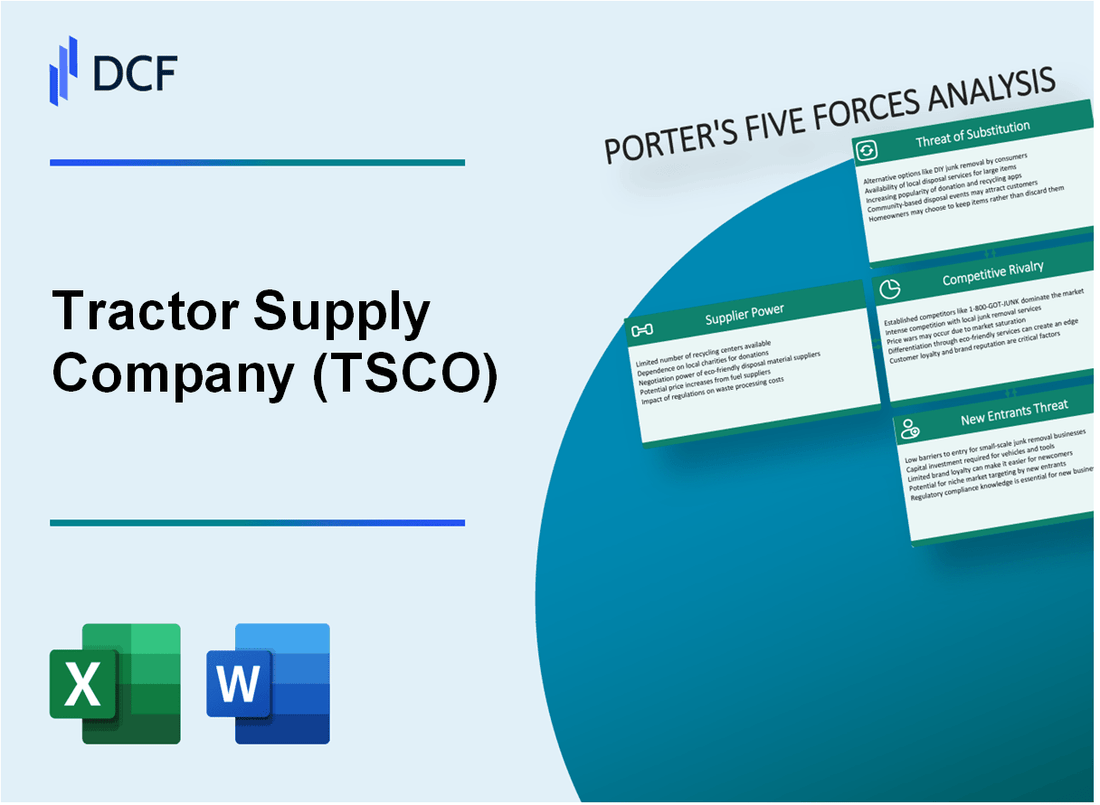
You're looking for the real story behind Tractor Supply Company's market stance heading into late 2025, right? After two decades analyzing retail, I can tell you the landscape is a mix of solid defense and mounting pressure. While their 22 million Neighbor's Club members and planned 90 new stores for 2025 show growth intent, the projected comparable store sales increase of just 1.4% to 2.4% signals that rivalry and the threat of substitutes-like that $45.3 billion e-commerce market for rural goods-are definitely biting. To truly map out where the value is, you need to see how their supplier leverage stacks up against customer price sensitivity, especially since needs-based CUE sales make up 40-45% of sales. Below, I've broken down the five forces so you can see the precise levers moving the needle for Tractor Supply Company right now.
Tractor Supply Company (TSCO) - Porter's Five Forces: Bargaining power of suppliers
You're analyzing the supplier side of Tractor Supply Company's business, and honestly, it's a mixed bag of leverage points and external pressures. The power held by suppliers isn't uniform; it depends heavily on the product category.
Limited specialized equipment suppliers like John Deere hold high power. When you look at the broader agricultural and outdoor power equipment sector, manufacturers of highly specialized, branded machinery often dictate terms because their products are essential and difficult to substitute quickly. Tractor Supply Company's scale, however, provides a significant counterweight.
Tractor Supply Company's large annual procurement spend gives them strong negotiation leverage. Consider the scale: Fiscal Year 2024 Net Sales were nearly $14.9 billion, and Q2 2025 Net Sales reached $4.44 billion. This massive purchasing volume allows Tractor Supply Company to demand favorable terms, pricing, and service levels from many of its general merchandise vendors.
Largely U.S.-sourced assortment provides stability against global supply chain disruptions. Management highlighted this as a key differentiator in Q1 and Q2 2025, positioning the company well to navigate external pressures, including shifting tariffs. This domestic focus inherently reduces the bargaining power of overseas suppliers who might otherwise hold leverage over shipping or component costs.
Strategic vendor partnerships, like with Bad Boy Mowers, secure exclusive product access. Tractor Supply Company actively cultivates these relationships, recognizing that deep collaboration drives differentiation. For instance, Bad Boy Mowers earned the 2025 Company Partner of the Year award for its role in leading the retailer to a record year in outdoor power equipment through creative supply chain solutions. This exclusivity limits the supplier's ability to sell the same differentiated product to direct competitors.
New tariff policies create cost uncertainty for vendor pricing in 2025. The introduction of new tariffs in 2025 significantly complicated supplier negotiations and cost structures. Management confirmed that tariff costs remained a notable pressure point as of Q3 2025, noting they were only halfway through the tariff impact cycle. The estimated full-year 2025 EPS impact from tariffs, net of mitigation efforts, was roughly negative $0.75. For certain imported goods, import taxes of up to 25% on key materials like steel and aluminum increased manufacturing costs passed down the chain.
Here's a quick look at the financial context that frames these supplier negotiations:
| Metric | Value (As of Latest 2025 Data) | Source Context |
|---|---|---|
| FY 2024 Net Sales | Nearly $14.9 billion | Scale for procurement leverage |
| Q2 2025 Net Sales | $4.44 billion | Recent revenue base |
| Estimated FY 2025 EPS Impact from Tariffs (Net) | Negative $0.75 | Direct cost pressure from external factors |
| Q3 2025 Gross Margin Rate | 37.4% | Result of cost management against pressures |
| Maximum Import Tax Cited on Key Materials | Up to 25% | Tariff-related cost uncertainty for imported goods |
Tractor Supply Company mitigates supplier power by rewarding top performers, which solidifies their access to the best products and supply chain execution. The 2025 vendor awards illustrate this strategic alignment:
- Company Partner of the Year: Bad Boy Mowers.
- Innovation Partner of the Year: Carry-On Trailer.
- Digital Partner of the Year: Interstate Batteries.
- Seasonal Division Partner of the Year: Scotts Miracle-Gro.
Still, the need to take 'surgical price increases' as of Q3 2025 shows that some supplier cost increases, driven by factors like tariffs, are being passed on, indicating that supplier power is not entirely neutralized. Finance: draft 13-week cash view by Friday.
Tractor Supply Company (TSCO) - Porter's Five Forces: Bargaining power of customers
You're looking at the customer side of the equation for Tractor Supply Company (TSCO) right now, and it's a mixed bag of strong loyalty versus clear price sensitivity. Honestly, the sheer size of the customer base locks in a lot of revenue, but they are definitely watching their wallets.
The Neighbor's Club program is a massive anchor for Tractor Supply Company. As of early 2024, the over 30 million members represented more than three-quarters of sales for the retailer. For calendar 2025, member levels were set based on 2024 activity. This creates a strong base, especially since top-tier members, like Hometown Heroes, receive 2% back on purchases every day.
Still, customers are showing price awareness, which you can see clearly in the average ticket figures early in 2025. For instance, the first quarter of 2025 saw a comparable average ticket decline of 2.9%. To be fair, that pressure eased significantly by the third quarter of 2025, which posted a comparable average ticket growth of 1.2%.
Transaction count, however, has been a consistent driver of comparable store sales growth. In the third quarter of 2025, comparable average transaction count was up 2.7%. This contrasts with the first quarter of 2025, where the comparable average transaction count still managed a 2.1% increase despite the ticket decline.
The strength of needs-based purchasing acts as a buffer against discretionary spending pullbacks. Core categories, specifically consumable, usable and edible (C.U.E.) products, showed continued momentum driving comparable store sales growth in the first quarter, second quarter, and third quarter of 2025.
Here's the quick math on how transaction counts and average ticket have moved across the first three quarters of 2025:
| Metric | Q1 2025 | Q2 2025 | Q3 2025 |
|---|---|---|---|
| Comparable Average Transaction Count Change | +2.1% | +1.0% | +2.7% |
| Comparable Average Ticket Change | -2.9% | +0.5% | +1.2% |
The loyalty program's structure definitely works to mitigate customer power by rewarding frequency and spend:
- 200 points earns a $2 Reward.
- Preferred Plus Neighbors earn 2% back on purchases daily.
- Hometown Heroes automatically receive Preferred Plus Neighbor status.
- TSC Credit Card holders earn 5% in rewards at Tractor Supply and Petsense.
Digital tools definitely help customers shop around, but the loyalty structure and the nature of the goods-often immediate needs for rural life-keep switching costs relatively high for the core customer base.
Finance: draft 13-week cash view by Friday.
Tractor Supply Company (TSCO) - Porter's Five Forces: Competitive rivalry
You're looking at the competitive landscape for Tractor Supply Company, and honestly, the rivalry here is intense. It's not just the regional farm stores; you've got mass retailers like Walmart and Lowe's actively encroaching on the rural lifestyle niche. Lowe's, for instance, reported a 1.7% dip in revenue in a recent quarter, showing the broader market pressures, but they are still a massive player with the resources to challenge Tractor Supply Company in specific product categories like pet and livestock supplies in certain rural locations.
Tractor Supply Company maintains a dominant position, holding an estimated 40.7% market share within the farm supply stores segment. This leadership is crucial, especially when the total industry revenue is projected to hit $38.1 billion in 2025. Still, that leadership is hard-won and requires constant defense.
The growth in comparable store sales, a key metric for organic health, is modest, reflecting the competitive environment. For the full fiscal 2025, management has narrowed its guidance to a projected increase of 1.4% to 2.4%. To give you a real-time look, the third quarter of 2025 actually saw a stronger 3.9% increase, which is encouraging, but the full-year forecast suggests some near-term softness or continued pressure.
This narrowing competitive gap definitely puts pressure on margins. You see this when you look at the cost of staying competitive while investing in growth. For the third quarter of 2025, the gross margin rate was 37.4%, up just 15 basis points from the prior year's 37.2%, showing that differentiation efforts are necessary just to maintain a slight edge on profitability.
The strategy to counter this rivalry is clear: aggressive physical expansion. Tractor Supply Company is pushing forward with approximately 90 new stores planned for the 2025 fiscal year. This move is about getting closer to the customer base and making it inconvenient for them to choose a mass retailer.
Here's a quick look at the expansion and performance context:
| Metric | Value/Range | Context/Period |
| Planned New Tractor Supply Stores (2025) | 90 | Fiscal 2025 Plan |
| FY 2025 Comparable Store Sales Guidance | 1.4% to 2.4% | Narrowed Fiscal 2025 Outlook |
| Q3 2025 Comparable Store Sales Growth | 3.9% | Actual Performance |
| US Farm Supply Industry Revenue (2025 Est.) | $38.1 billion | Industry Size Estimate |
| Q3 2025 Gross Margin Rate | 37.4% | Actual Performance |
The competitive response from Tractor Supply Company centers on several key differentiators that they are pushing hard:
- Loyalty program membership growth to 41 million members in Q2 2025.
- Continued rollout of the Project Fusion store layout.
- Focus on core categories like Consumable, Usable, Edible (C.U.E.) products.
- Strategic acquisition of Allivet, adding over $100 million in expected 2025 sales.
Finance: draft 13-week cash view by Friday.
Tractor Supply Company (TSCO) - Porter's Five Forces: Threat of substitutes
You're looking at how easily a customer can walk away from Tractor Supply Company and get what they need elsewhere, and honestly, the options are multiplying fast. The threat of substitutes is significant because the core needs of the rural lifestyle customer-feed, tools, basic hardware, and pet supplies-are not exclusive to Tractor Supply Company.
E-commerce for rural products reached $45.3 billion in 2023, offering an easy substitute. While that 2023 number shows the scale of the digital shift, by 2025, the broader Agricultural E-Commerce Market is projected to be worth around $20 billion, indicating continued digital penetration into farm and ranch supply chains. This online accessibility means customers can bypass the physical store experience for replenishment and specialized items, which is a constant pressure point on Tractor Supply Company's foot traffic and pricing power.
Customers can choose equipment rental over purchasing, a growing $50 billion market. To be fair, the actual equipment rental market is much larger, especially in construction, which directly impacts the larger equipment Tractor Supply Company might sell or service. For instance, the global construction equipment rental market was estimated at $141.42 billion in 2025. This asset-light model is a clear substitute for capital expenditure, particularly for smaller operations or those with fluctuating needs.
General retailers offer substitutes for non-specialized items like tools and hardware. Think about your everyday hardware needs or basic pet food; big-box stores and even mass-market online platforms can capture that spend. Tractor Supply Company's defense here relies on its specialized inventory depth and service, but the sheer convenience of a one-stop generalist shop remains a threat for non-core purchases.
The Allivet acquisition directly addresses the online pet pharmacy substitute threat. Tractor Supply Company closed this deal expecting Allivet to eventually generate an extra $1 billion in revenue at full scale. This move is a direct counter to pure-play online pharmacies, integrating a necessary, recurring purchase-pet and animal medications-into the Tractor Supply Company ecosystem, which already serves 37 million Neighbor's Club members, three-quarters of whom are pet owners. This integration also expanded the company's total addressable market by $15 billion.
Increasing trend toward precision farming tech diminishes the need for some traditional equipment. This is a structural shift in the customer base. By 2025, over 60% of large farms globally are projected to adopt AI-powered precision agriculture technologies. In the US, the market share for precision agriculture is a dominant 85.30%. As farmers adopt tech that optimizes input use and automates tasks, the demand for certain traditional, non-precision equipment that Tractor Supply Company stocks could see its growth rate slow or even decline in those segments.
Here's a quick look at the scale of these substitute markets compared to Tractor Supply Company's recent performance:
| Substitute Market/Metric | Latest Real-Life Figure (as of late 2025) | Source Context |
|---|---|---|
| Tractor Supply Company Q3 2025 Net Sales | $3.72 billion | Record quarterly revenue |
| Global Equipment Rental Market Size (2025 Est.) | $141.42 billion | Construction Equipment Rental Market |
| Large Farm Precision Ag Adoption (2025 Projection) | Over 60% | Adoption rate for AI-powered precision agriculture technologies |
| Allivet Revenue Potential (Full Scale) | $1 billion | Expected incremental revenue for Tractor Supply Company |
| Agricultural E-Commerce Market (2025 Est.) | $20 billion | Projected market size |
The pressure from these substitutes is multifaceted. You have pure digital players, large generalists, and technological shifts within the core agricultural customer base all pulling demand away from traditional channels. Tractor Supply Company's strategy, as evidenced by the Allivet buy, is to integrate these substitute channels or offerings directly, turning a threat into a captured revenue stream. Still, managing the margin pressure from online price competition on commodity items will remain a constant challenge.
Tractor Supply Company (TSCO) - Porter's Five Forces: Threat of new entrants
The threat of new entrants for Tractor Supply Company remains relatively low, primarily due to the substantial structural barriers already erected by the incumbent's scale and established presence in niche, rural trade areas. A potential competitor would face an uphill battle trying to replicate the physical footprint and logistical backbone Tractor Supply Company has spent decades building.
High capital investment required to build a national distribution and store network. Establishing a network capable of serving the rural customer base requires massive upfront capital expenditure. This isn't just about real estate; it involves securing land in often less-developed areas, constructing stores optimized for bulky goods like feed and fencing, and, critically, building out the dedicated distribution centers necessary to service those locations efficiently. Tractor Supply Company is currently operating a network of 2,380 stores as of November 10, 2025, with a stated long-term goal of reaching 3,200 locations. The sheer scale of this existing infrastructure represents a significant sunk cost barrier.
TSCO's scale, with over 2,300 stores, creates significant economies of scale. This scale translates directly into purchasing power and logistical advantages that new entrants cannot immediately match. The ability to order inventory in massive volumes allows Tractor Supply Company to secure lower per-unit costs from suppliers, which is difficult for a smaller, newer competitor to achieve. Furthermore, the company is actively expanding its physical presence, planning to open 90 new namesake stores by the end of 2025.
The following table summarizes the scale metrics that create this entry barrier:
| Metric | Data Point | Context/Source Year |
|---|---|---|
| Current Store Count (as of Nov 2025) | 2,380 stores | 2025 |
| Long-Term Store Target | 3,200 locations | 2030 Strategy |
| Total Addressable Market (TAM) | $225 billion | 2025 Estimate |
| Neighbor's Club Membership | Over 22 million members | 2025 |
Brand recognition and the Neighbor's Club loyalty program create a strong moat. Tractor Supply Company has cultivated a deep, specific brand identity tied to the rural lifestyle, which is not easily copied. The Neighbor's Club loyalty program, boasting over 22 million members, locks in repeat business through rewards and personalized offers. This program is deeply integrated into the customer experience, making the switching cost-in terms of lost rewards and familiarity-a real consideration for a potential customer base.
The total addressable market is large at $225 billion, attracting potential entrants. While the barriers are high, the sheer size of the market-estimated at $225 billion-provides a significant incentive for well-capitalized players to attempt entry. This large prize money suggests that deep-pocketed retailers or private equity groups might attempt to carve out a niche, perhaps focusing on a specific geography or product category first.
Zoning and real estate for rural locations present a unique, defintely high barrier to entry. Tractor Supply Company strategically locates its stores in rural and semi-rural areas, often away from major big-box centers. Securing the right real estate parcels that meet the specific size requirements and zoning regulations for this type of retail operation in these less-dense markets is challenging. New entrants must navigate local planning boards and compete for the limited, suitable parcels that cater to the specific needs of the 'Life Out Here' customer.
- Securing suitable land in non-urban trade areas is complex.
- Local zoning often favors established community-serving retailers.
- The required store format is specialized, not easily adaptable from standard retail shells.
- Competitors must overcome the established 'neighborhood hub' perception.
Finance: review the projected capital expenditure for the 2026 store pipeline against the current cash position by next Tuesday.
Disclaimer
All information, articles, and product details provided on this website are for general informational and educational purposes only. We do not claim any ownership over, nor do we intend to infringe upon, any trademarks, copyrights, logos, brand names, or other intellectual property mentioned or depicted on this site. Such intellectual property remains the property of its respective owners, and any references here are made solely for identification or informational purposes, without implying any affiliation, endorsement, or partnership.
We make no representations or warranties, express or implied, regarding the accuracy, completeness, or suitability of any content or products presented. Nothing on this website should be construed as legal, tax, investment, financial, medical, or other professional advice. In addition, no part of this site—including articles or product references—constitutes a solicitation, recommendation, endorsement, advertisement, or offer to buy or sell any securities, franchises, or other financial instruments, particularly in jurisdictions where such activity would be unlawful.
All content is of a general nature and may not address the specific circumstances of any individual or entity. It is not a substitute for professional advice or services. Any actions you take based on the information provided here are strictly at your own risk. You accept full responsibility for any decisions or outcomes arising from your use of this website and agree to release us from any liability in connection with your use of, or reliance upon, the content or products found herein.