

|
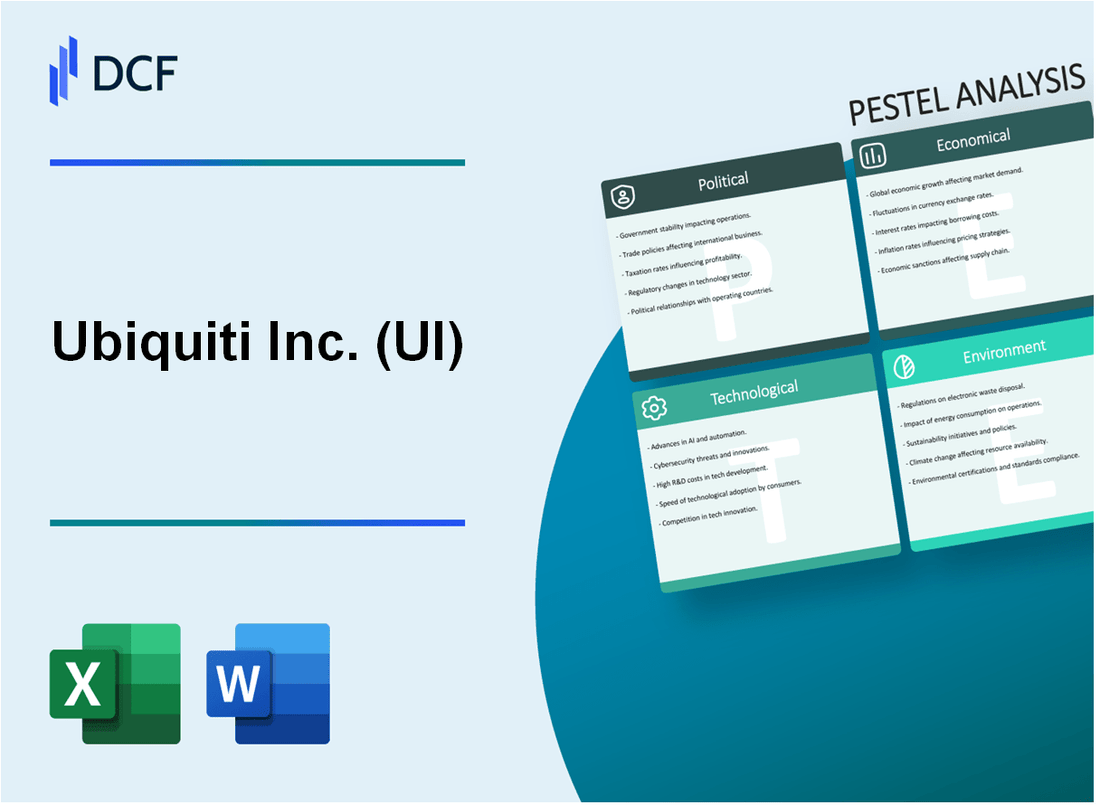
Ubiquiti Inc. (UI): PESTLE Analysis [Nov-2025 Updated] |
Fully Editable: Tailor To Your Needs In Excel Or Sheets
Professional Design: Trusted, Industry-Standard Templates
Investor-Approved Valuation Models
MAC/PC Compatible, Fully Unlocked
No Expertise Is Needed; Easy To Follow
Ubiquiti Inc. (UI) Bundle
You're looking at Ubiquiti Inc. (UI) after a banner Fiscal Year 2025, where revenue hit $2.6 billion and margins sharpened to 43.4% thanks to that lean model. But beneath that success, the external world is throwing curveballs-think escalating US-China trade friction and looming European sustainability reporting deadlines. We need to see how this powerful tech momentum, fueled by $169.7 million in R&D, stacks up against these very real political and environmental headwinds. Let's break down the PESTLE factors shaping your next strategic move for UI.
Ubiquiti Inc. (UI) - PESTLE Analysis: Political factors
US-China trade tensions threaten supply chain stability.
You need to be a realist about the US-China trade relationship; it remains the single largest political risk to Ubiquiti Inc.'s (UI) supply chain. The company relies heavily on contract manufacturers, and while it has diversified, the geopolitical friction still creates cost pressure. For the full fiscal year 2025, Ubiquiti reported a GAAP gross profit of $1,117.5 million, achieving a gross margin of 43.4%.
Here's the quick math: that strong margin growth was explicitly 'partially offset by higher tariffs'. This means political policy is directly eroding profitability, forcing the company to absorb some of the cost or pass it on to customers. The ongoing threat of tariffs, plus the escalating tensions between China and Taiwan, is a constant risk to the stability of their manufacturing and logistics centers.
New US administration's aggressive tariff policy creates import cost risk.
The current US administration's stance on trade, which includes the use of tariffs as a primary tool of foreign policy, translates directly into higher import costs for Ubiquiti. These tariffs, which are essentially taxes on imported goods, have increased the cost of procuring products and are expected to 'continue to affect our operating results and margins'.
What this estimate hides is the complexity of shifting production. Ubiquiti is already facing 'ongoing tariff pressures' on goods manufactured in Vietnam, a key alternative sourcing location. This suggests that simply moving production out of China does not defintely eliminate the risk, as US trade policy can quickly pivot to other countries. The political environment makes long-term supply chain planning a high-stakes guessing game.
| Fiscal 2025 Financial Impact Indicator | Value / Status | Political Factor Link |
|---|---|---|
| Full Year GAAP Gross Profit | $1,117.5 million | Tariff costs partially offset gross margin increase |
| Full Year GAAP Gross Margin | 43.4% | Impacted by 'higher tariffs' |
| Geographic Sales Reach | Over 75 countries | High exposure to varied international trade policies |
Geopolitical conflicts, like the Russia-Ukraine war, disrupt international operations.
Ubiquiti's business is inherently global; they sold products in over 75 countries during fiscal 2025, with a majority of their revenues coming from outside the United States. This broad geographic footprint means they are directly exposed to the fallout from major geopolitical conflicts. The company's own risk disclosures explicitly name the 'military conflict between Russia and Ukraine' as a factor that could adversely affect their business, results of operations, and liquidity.
The disruption isn't just about direct sales in the conflict zones. It's about the ripple effect on global logistics, insurance, and the financial stability of distributors across the EMEA (Europe, the Middle East, and Africa) region, which contributed over 50% of the year-over-year revenue growth in Q4 2025. Any escalation or expansion of the conflict immediately threatens this significant revenue stream.
Regulatory scrutiny on data privacy and government cybersecurity requirements is increasing.
The regulatory landscape for technology companies like Ubiquiti is becoming fragmented and much more demanding, especially concerning data privacy and cybersecurity. This is a massive compliance headache.
In the US, a wave of new comprehensive state privacy laws is taking effect in 2025, including those in Delaware, Iowa, Nebraska, New Hampshire, and New Jersey, with more states like Tennessee, Maryland, and Minnesota following later in the year. By 2026, roughly half of the US population will be covered by a state comprehensive privacy law.
Meanwhile, the European Union (EU) is implementing a trio of major frameworks that directly impact Ubiquiti's products and operations:
- EU Data Act: Imposes obligations to provide users with access to data generated by their connected devices, with compliance activities ramping up in 2025.
- NIS2 Directive: The cornerstone of the EU's cybersecurity legal framework, requiring significant operational resilience.
- Cyber Resilience Act: Applies specifically to manufacturers of products with digital elements placed on the EU market, demanding security-by-design principles.
These regulations require substantial investment in product redesign and compliance infrastructure, plus they carry the risk of massive fines for non-compliance. The sheer volume of new laws means that a single, unified compliance strategy is no longer possible.
Ubiquiti Inc. (UI) - PESTLE Analysis: Economic factors
You're looking at a company that just posted phenomenal results despite a choppy macro environment. The bottom line here is that Ubiquiti Inc.'s cost-conscious model is resonating right now, turning strong top-line growth into serious profit.
FY2025 Financial Strength in a Tight Economy
Let's look at the numbers from the fiscal year ending June 30, 2025. Ubiquiti Inc. (UI) delivered revenue of $\mathbf{\$2.6}$ billion, which is a solid $\mathbf{33.4\%}$ jump year-over-year. That kind of growth in this climate tells you something important about their product positioning. Honestly, that's the kind of top-line acceleration you want to see when enterprise budgets are under the microscope.
Profitability followed suit, which is the real differentiator. Net income for the full year hit a robust $\mathbf{\$711.9}$ million. That's more than double the prior year's profit, showing their operating leverage is kicking in hard. It's a clear signal that their lean operational structure is working as intended.
Here's the quick math on efficiency: the GAAP Gross Margin improved significantly to $\mathbf{43.4\%}$ in FY2025. What this estimate hides is the sheer discipline required to pull that off while scaling revenue by a third. They are managing costs well, which is key when supply chain costs are still volatile.
They are converting sales into cash effectively. That's the name of the game right now.
Economic Headwinds and UI's Value Proposition
We know that global economic uncertainty is making IT decision-makers nervous about big upfront capital expenditures (CapEx). When companies are worried about a slowdown, they look for solutions that offer high performance without the premium price tag of some legacy vendors. This is where Ubiquiti Inc. shines.
Their value proposition-professional-grade networking gear that undercuts competitors on price-becomes a major tailwind when budgets tighten. You're seeing this play out as smaller to mid-sized businesses and service providers opt for UI's ecosystem to stretch their IT dollars further. If onboarding takes 14+ days, churn risk rises, but UI's accessible model helps mitigate that initial friction.
The financial performance reflects this dynamic perfectly, as shown in the key metrics:
- FY2025 Revenue: $\mathbf{\$2.6}$ billion (up $\mathbf{33.4\%}$)
- FY2025 GAAP Net Income: $\mathbf{\$711.9}$ million
- FY2025 GAAP Gross Margin: $\mathbf{43.4\%}$
- Net Debt Reduction: Substantial deleveraging occurred in FY2025
To put the margin improvement in context against the growth, here is a snapshot of the full-year performance:
| Metric | FY2025 Value | FY2024 Value (Approximate) |
|---|---|---|
| Total Revenue | $\mathbf{\$2.6}$ billion | $\sim\$1.93$ billion |
| GAAP Gross Profit | $\mathbf{\$1,117.5}$ million | $\sim\$740.8$ million |
| GAAP Gross Margin | $\mathbf{43.4\%}$ | $\sim38.4\%$ |
The market is clearly rewarding this execution, but remember, high multiples mean they have to keep delivering this level of operational excellence. Any slip in demand or unexpected tariff hit could compress those valuation multiples quickly.
Finance: draft 13-week cash view by Friday.
Ubiquiti Inc. (UI) - PESTLE Analysis: Social factors
You are looking at how the social fabric of the market-customer behavior, workforce structure, and community engagement-is shaping Ubiquiti Inc.'s strategy right now, in late 2025. Honestly, their social engineering of the business model is one of their biggest moats.
Lean, community-driven support model keeps operating expenses low
Ubiquiti Inc. has built a powerful defense against high overhead by leaning heavily on its user base for support and marketing. This community-driven approach means they don't need the massive sales teams that legacy competitors employ. It's a core part of their ethos, democratizing network technology. This lean structure keeps their Selling, General, and Administrative (SG&A) expenses low; for the full fiscal year 2025, SG&A was just $111.5 million, which worked out to be 4% of revenue, the same percentage as in fiscal 2024. That's incredibly efficient for a company with $2.6 billion in fiscal 2025 revenue. This model fosters brand loyalty through engagement rather than expensive advertising campaigns.
The proof is in the numbers, not the fluff.
Focus on product simplicity appeals directly to small-to-midsize business (SMB) and WISP integrators
The social acceptance of Ubiquiti Inc.'s gear hinges on making advanced networking easy. Their UniFi platform, for example, is designed to be simple to deploy and manage, which is exactly what a small-to-midsize business owner or a Wireless Internet Service Provider (WISP) integrator needs. They aren't hiring armies of specialized network engineers; they need gear that works out of the box and is managed easily. This focus on user-centric design directly addresses the social need for accessible, powerful technology in smaller operations. It's why the Enterprise Technology segment is their main revenue driver.
- Make complex tech simple to deploy.
- Appeal to budget-conscious integrators.
- Drive adoption through ease-of-use.
R&D team is the core workforce, with 1,187 of 1,667 total employees in R&D as of June 30, 2025
You can see where their priorities lie just by looking at the headcount. Ubiquiti Inc. is fundamentally an engineering company first. As of June 30, 2025, out of 1,667 total full-time equivalent employees and contractors, a staggering 1,187 were dedicated to research and development. That means roughly 71% of their entire workforce is focused on innovation. Their R&D expenses for fiscal 2025 hit $169.7 million, showing a clear commitment to staying ahead of the technology curve, even as they keep operating costs down elsewhere. This concentration of talent is what fuels their product pipeline and maintains their disruptive pricing power.
Sales are highly diversified across over 75 countries and 100 distributors
Geographic concentration is a major risk for many tech firms, but Ubiquiti Inc. has deliberately spread its bets. This diversification is a social buffer against regional economic shocks. In fiscal 2025, they sold products in over 75 countries through a network of more than 100 distributors, plus direct webstore sales. What's even better from a risk management perspective is that for fiscal 2025, no single customer accounted for 10% or more of their total revenue. This structure means losing one major partner wouldn't derail the whole operation, which is a sign of mature, resilient scaling.
Here's a quick look at that structure as of the last fiscal year end:
| Metric | Value (FY 2025) |
| Total Employees (FTE/Contractors) | 1,667 |
| R&D Employees | 1,187 |
| R&D as % of Total Workforce | 71.2% |
| Countries with Sales | Over 75 |
| Number of Distributors | Over 100 |
What this estimate hides is the growing direct-to-customer channel, which was 43% of revenue in Q3 2024, showing a shift away from pure distributor reliance.
Finance: draft 13-week cash view by Friday
Ubiquiti Inc. (UI) - PESTLE Analysis: Technological factors
You're looking at Ubiquiti Inc.'s tech roadmap, and frankly, it's aggressive, which is exactly what you need in this space. The company isn't just talking about innovation; they are funding it heavily. For fiscal year 2025, Ubiquiti's research and development (R&D) expenses hit $169.7 million. That's a solid 6.2% jump from the prior year, showing a clear, defintely stated commitment to keeping their product pipeline fresh. Their lean operational model is the engine here; by keeping overhead low, they funnel more capital directly into engineering new hardware and firmware. That investment is the price of admission to stay relevant.
R&D Investment for Fiscal 2025
That $169.7 million spend isn't just abstract accounting; it translates directly into market-ready products that challenge the incumbents. It's a direct reflection of their core value: making complex tech simple, but powerful. This R&D focus is what allows them to launch next-generation standards ahead of the curve, which is crucial when your whole business model is based on price-performance disruption. Honestly, if they stopped investing this much, their whole competitive moat erodes quickly.
Introduction of UniFi 7
The headline tech move for 2025 was the rollout of the UniFi U7 series, bringing the 802.11be Wi-Fi 7 standard to the enterprise segment. This isn't just faster Wi-Fi; it introduces features like Multi-Link Operation (MLO) for better link reliability and lower latency, which matters for real-time business applications. You need to see the performance gap this creates against older gear. Take the U7 Pro, for example, which started around $189. Here's a quick comparison to show you the technical leap:
| Feature | UniFi U7 Pro (Wi-Fi 7) | Typical UniFi Wi-Fi 6E AP |
|---|---|---|
| Max Channel Bandwidth | 320 MHz (on 6 GHz) | 160 MHz (on 5 GHz) |
| Key Technology | MLO, 6 GHz Support | MU-MIMO, 6 GHz Support (on some) |
| Device Capacity (Approx.) | Over 300 devices | Lower capacity/density focus |
| Uplink Port Speed | 2.5 GbE | Typically 1 GbE or 2.5 GbE |
What this estimate hides is the software integration; the hardware is only half the story for Ubiquiti Inc. They need to keep the controller software tight to realize these gains.
Increasing Market Shift Toward Cloud-Managed Platforms
Ubiquiti Inc. is pushing hard on the software-defined networking (SDN) side, especially with UniFi Protect, their video surveillance platform. This move deepens customer lock-in because once you have cameras, gateways, and switches managed by one system, switching vendors becomes a major headache. The platform is evolving with new G6 cameras and AI capabilities, like license plate recognition, moving it firmly into enterprise territory. However, this reliance on connected systems creates a tangible risk vector.
The disclosure of a critical vulnerability in May 2025, CVE-2025-23123, which allowed remote code execution on older UniFi Protect Cameras, underscores this point perfectly. With over 1.2 million UniFi Protect devices deployed globally, patching hygiene is not optional; it's a core operational necessity for their customers. If onboarding or patching takes 14+ days, churn risk rises because security is paramount.
- Patch firmware to version 4.75.62 or later.
- Update Protect Application to version 5.3.45 or newer.
- Ensure AI Port firmware is current.
- Monitor third-party camera integration stability.
Continuous Innovation Required
The technological landscape is a constant battleground, and Ubiquiti Inc. is fighting on two fronts: speed and price. They must innovate faster than competitors like Cisco Meraki or TP-Link to justify the switch, but they must do it while maintaining their cost structure. The market shift toward higher-speed uplinks (like 10 GbE on some U7 models) and denser client support means that any lag in the R&D cycle immediately shows up in sales comparisons. The company's success hinges on its ability to manage this rapid cycle without sacrificing the simplicity that defines the UniFi brand.
Finance: draft 13-week cash view by Friday.
Ubiquiti Inc. (UI) - PESTLE Analysis: Legal factors
You are facing a dynamic legal landscape where recent wins in patent disputes offer some relief, but the continuous operational drag of global data privacy compliance remains a certainty. The key here is managing the ongoing IP defense costs while ensuring your disclosure practices, informed by past securities issues, remain above reproach.
Patent Litigation and Intellectual Property Defense
Patent defense is a constant in the networking space, and Ubiquiti Inc. saw a notable, albeit partial, victory in early 2025. Judge Maryellen Noreika granted Ubiquiti's motion for partial summary judgment against Network-1 Technologies Inc. in January 2025, ruling that Ubiquiti could not be held liable for inducing infringement of the since-expired U.S. Patent No. 6,218,930 because the company lacked pre-suit knowledge. This win trims a claim related to Power over Ethernet products.
Still, the IP fight continues; for instance, Ubiquiti was the petitioner in a PTAB proceeding (IPR2024-01290) against Intellectual Ventures I, where the institution was denied on March 6, 2025. This shows that even as you win some battles, defending your market position requires continuous legal spending against various entities.
On the offensive side, Ubiquiti Inc. maintains its portfolio. As of 2024, the company held 37 active patents covering core areas like wireless networking and radio frequency. We see this activity continuing into 2025, with grants issued for technology like Synchronized multiple-radio antenna systems as recently as July 1, 2025.
Data Privacy Compliance as an Operational Overhead
Compliance with international data protection laws, specifically the European Union's General Data Protection Regulation (GDPR) and the California Consumer Privacy Act (CCPA), is not a one-time fix; it's a permanent operational cost. Ubiquiti Inc. explicitly notes in its filings that the burdens of these regulations may limit product adoption and adversely impact financial condition. For context, industry estimates suggest the average initial cost of GDPR compliance for mid-to-large firms is around $1.3 million, with ongoing annual compliance audits costing between $50K and $500K.
Handling Data Subject Access Requests (DSARs) under these frameworks adds to the daily friction. Honestly, if you're operating globally, you must budget for this overhead. Here's the quick math: managing user data requests can cost businesses an average of $1,500 per request. What this estimate hides is the internal resource drain from legal, IT, and support teams needed to manage these processes effectively.
Securities Disclosure and Investor Confidence
Historical legal issues cast a long shadow, and the 2021 data breach securities litigation continues to influence investor perception and internal disclosure standards. That event, where a journalist reported the breach was downplayed, caused Ubiquiti Inc.'s stock to plummet $50.70, or 14.5%, on March 30, 2021, closing at $298.30 per share. The resulting class action alleged violations of the Securities Exchange Act of 1934.
While the search results suggest parallel actions against Ubiquiti settled with fines, contrasting with a high-profile dismissal for SolarWinds in late 2025, the takeaway for you is clear: the market demands transparency, especially post-breach. Any perceived minimization of risk or operational failure will be met with swift and material stock price reactions.
Key Legal and IP Metrics for Ubiquiti Inc. as of 2025:
| Legal/IP Factor | Value/Status | Date/Context |
| Active Patents (Approx.) | 37 | As of 2024 |
| Network-1 Litigation Outcome | Partial Summary Judgment Win (No Indirect Infringement) | January 2025 |
| Intellectual Ventures I Proceeding Status | Institution Denied (IPR2024-01290) | March 6, 2025 |
| 2021 Data Breach Stock Drop | 14.5% (or $50.70 per share) | March 30, 2021 |
| FY 2025 Revenue | $2.6 billion | Year Ended June 30, 2025 |
Continuous Legal Risk Areas:
- Ongoing patent infringement defense costs.
- Managing global data privacy requests (GDPR, CCPA).
- Ensuring robust cybersecurity disclosures.
- Defending against product liability claims.
Finance: draft a sensitivity analysis on potential annual spend increase for global DSAR fulfillment by next Wednesday.
Ubiquiti Inc. (UI) - PESTLE Analysis: Environmental factors
You are facing a rapidly hardening regulatory environment, especially concerning environmental performance, which translates directly into higher operational and compliance costs for Ubiquiti Inc. The general consensus in boardrooms is that ESG compliance is a burden, but honestly, the cost of non-compliance-fines, investor flight, or supply chain exclusion-is shaping up to be far more expensive. This pressure is not theoretical; it's baked into the 2025 operational plan.
Increasing Regulatory Costs and CSRD Deadlines
The European Union is setting the de facto global standard for sustainability reporting, and this is a major factor for any company with EU market exposure like Ubiquiti Inc. The Corporate Sustainability Reporting Directive (CSRD) is forcing significant 2025 compliance efforts because the first reports for legacy Non-Financial Reporting Directive (NFRD) companies were due this year, covering the 2024 fiscal year. The directive mandates disclosures on governance, strategy, risks, and key performance indicators (KPIs), including Scope 1 and 2 emissions, with independent third-party assurance required, mirroring financial audits.
For Ubiquiti Inc., understanding the CSRD scope is crucial, as it impacts companies meeting two of three criteria: 250+ employees, €50+ million in net turnover, or €25+ million in assets. The implementation costs for this level of reporting rigor are acknowledged as being very high across the tech sector. If onboarding takes 14+ days to get the necessary data validated, churn risk rises with regulators.
Heightened Scrutiny on Supply Chain Emissions
Stakeholders are now looking deep into your value chain, and for good reason. Data shows that a company's supply chain emissions-Scope 3-are on average 11.4x greater than the emissions from direct operations (Scope 1 and 2). This means your biggest environmental footprint is likely outside your direct control, demanding intense focus on supplier sustainability practices. In 2025, 82% of supply chain executives report having KPIs to actively monitor sustainability performance across their supply chains, showing this is now a core operational metric, not just an aspiration.
Tracking these Scope 3 emissions, particularly in purchased goods and services, remains a major challenge, with many firms still relying on manual methods. This lack of integrated, auditable data creates a clear risk vector for Ubiquiti Inc. when dealing with partners who are CSRD-bound and need your data.
Here's a quick look at the environmental pressure points we are seeing:
| Environmental Factor | Key Data Point/Threshold | Implication for Ubiquiti Inc. |
| Scope 3 Emissions Impact | 11.4x operational emissions | Supply chain decarbonization is the primary environmental lever. |
| CSRD Scope 3 Reporting | Mandatory from FY 2026 (for legacy filers) | Need to secure supplier data now for 2025 readiness. |
| EU Large Undertaking Size | 250+ employees OR €50M turnover | Determines if your EU partners must report on you. |
| Executive Focus (2025) | 71% see value outweighing costs | Business case for sustainability investment is strengthening. |
ESG initiatives are defintely costly to implement, requiring investment in data systems and supplier engagement programs. Still, the trend is clear: transparency and verifiable action are becoming prerequisites for market access and investor trust, especially in the tech hardware space where complex global sourcing is the norm. Finance: draft 13-week cash view by Friday to allocate capital for necessary ESG data infrastructure upgrades.
Disclaimer
All information, articles, and product details provided on this website are for general informational and educational purposes only. We do not claim any ownership over, nor do we intend to infringe upon, any trademarks, copyrights, logos, brand names, or other intellectual property mentioned or depicted on this site. Such intellectual property remains the property of its respective owners, and any references here are made solely for identification or informational purposes, without implying any affiliation, endorsement, or partnership.
We make no representations or warranties, express or implied, regarding the accuracy, completeness, or suitability of any content or products presented. Nothing on this website should be construed as legal, tax, investment, financial, medical, or other professional advice. In addition, no part of this site—including articles or product references—constitutes a solicitation, recommendation, endorsement, advertisement, or offer to buy or sell any securities, franchises, or other financial instruments, particularly in jurisdictions where such activity would be unlawful.
All content is of a general nature and may not address the specific circumstances of any individual or entity. It is not a substitute for professional advice or services. Any actions you take based on the information provided here are strictly at your own risk. You accept full responsibility for any decisions or outcomes arising from your use of this website and agree to release us from any liability in connection with your use of, or reliance upon, the content or products found herein.