

|
Vipshop Holdings Limited (VIPS): PESTLE Analysis [Nov-2025 Updated] |
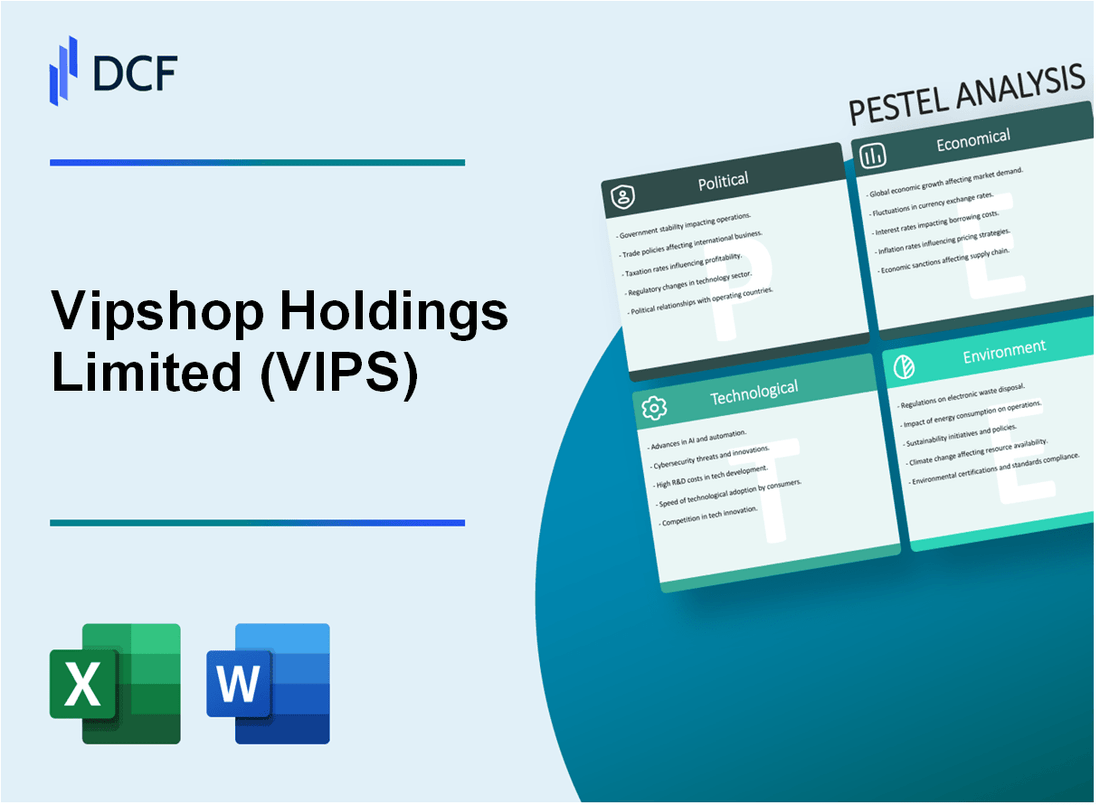
Fully Editable: Tailor To Your Needs In Excel Or Sheets
Professional Design: Trusted, Industry-Standard Templates
Investor-Approved Valuation Models
MAC/PC Compatible, Fully Unlocked
No Expertise Is Needed; Easy To Follow
Vipshop Holdings Limited (VIPS) Bundle
You're looking at Vipshop Holdings Limited (VIPS) and the picture is a classic risk/reward trade-off: The Chinese government's tight regulatory grip remains the primary headwind, but the slowing economy is actually making their off-price model a massive winner. We project 2025 full-year revenue to hit nearly 95 billion RMB (about $13 billion USD) because value-for-money is the new consumer mantra, but that growth is constantly shadowed by Anti-Monopoly Law enforcement and rising PIPL (Personal Information Protection Law) compliance costs. To truly understand VIPS's strategic runway, you need to map these Political and Legal constraints against the powerful Economic and Sociological tailwinds driving their discount flash sales, and that's defintely worth a deep dive.
Vipshop Holdings Limited (VIPS) - PESTLE Analysis: Political factors
Geopolitical tensions between China and the US affect investor sentiment and ADR status.
You're operating a US-listed company with core operations in China, so you are defintely in the crosshairs of the intensifying US-China geopolitical rivalry. This tension directly impacts Vipshop's American Depositary Share (ADS) status via the Holding Foreign Companies Accountable Act (HFCAA), which mandates US regulatory access to audit working papers.
The market is clearly pricing in this risk, but there is still strong institutional interest. For example, Krane Funds Advisors significantly increased its Vipshop stake in the third quarter of 2025, with the position's value rising to $320.42 million as of November 10, 2025. Still, the company is actively mitigating the delisting risk. Vipshop is reportedly considering a secondary share sale in Hong Kong as early as 2026, a move common among Chinese tech firms to hedge against potential delisting from the New York Stock Exchange (NYSE). The market capitalization of Vipshop's US shares was approximately US$10.2 billion as of November 2025, following a year-to-date share price increase of about 47%. This strategic move is a direct response to political uncertainty.
Central government's focus on Common Prosperity pressures large tech firms.
The central government's 'Common Prosperity' initiative, which aims to reduce wealth inequality and promote equitable resource distribution, remains a core political mandate. For large technology firms, this translates into pressure to increase corporate social responsibility spending and avoid monopolistic practices that inflate prices or suppress wages. Vipshop's business model as an online discount retailer for brands inherently aligns with the goal of providing value to the mass consumer base, which somewhat mitigates the direct regulatory heat seen by high-margin or luxury-focused platforms.
Here's the quick math: Vipshop's non-GAAP net margin attributable to shareholders for the first quarter of 2025 was 8.8%, which is relatively healthy but not excessive compared to some peers, making it less of a target for wealth redistribution penalties. However, the regulatory environment requires a constant focus on compliance and social contribution.
State-backed media scrutiny of consumer pricing and data practices.
Government scrutiny is now focused on 'low-price disorderly competition,' a political term for excessive price wars that can hurt smaller businesses and lead to poor labor practices. While Vipshop's flash sales model is built on discounts, it must navigate this scrutiny carefully. The political push is for orderly, sustainable competition, not just the lowest price.
The government's focus on consumer data privacy and security is also a permanent fixture. While no major 2025 fines were levied against Vipshop specifically for data practices, the regulatory risk is high across all e-commerce platforms. Any perceived misuse of the data from its 41.3 million active customers in Q1 2025 would immediately invite regulatory action.
Government support for domestic brands benefits Vipshop's focus on local inventory.
The government is actively supporting domestic consumption and the growth of Chinese brands, which is a clear opportunity for Vipshop. Vipshop's model, which focuses on selling discounted branded inventory, benefits directly from policies designed to stimulate spending, especially in a disinflationary environment.
This political support manifests in concrete fiscal measures:
- Central government-backed trade-in programs offer consumer rebates of up to ¥2,000 (US$274) per item for eligible home appliances and electronics.
- Major e-commerce peers, like Alibaba's Taobao, launched a $7 billion subsidy program over 12 months starting in July 2025 to stimulate consumption.
These subsidies, while competitive, drive traffic and sales volume into the e-commerce ecosystem, which Vipshop can capitalize on by partnering with domestic brands to offload inventory and participate in the politically-driven consumption boost.
| Political Factor | FY 2025 Impact & Metric | Actionable Insight |
|---|---|---|
| US-China Geopolitical Tension (ADR Risk) | Vipshop's market cap at US$10.2 billion (Nov 2025); considering Hong Kong secondary listing. | Monitor the HK listing progress; it's a hedge against HFCAA delisting risk. |
| Common Prosperity Initiative | Q1 2025 Non-GAAP Net Margin: 8.8%. | Maintain moderate margins and increase social contribution to align with political goals. |
| Government Consumption Stimulus | E-commerce sector benefiting from up to ¥2,000 consumer rebates on goods. | Aggressively participate in government-backed trade-in and subsidy programs to drive Gross Merchandise Volume (GMV). |
Vipshop Holdings Limited (VIPS) - PESTLE Analysis: Economic factors
You're looking at Vipshop Holdings Limited's economic foundation, and the clear takeaway is this: China's economic deceleration is actually a tailwind for the discount retail model, but it comes with a significant margin squeeze from competition and rising costs. Vipshop is positioned to capture the value-seeking consumer, but its profitability hinges on managing its fulfillment expenses and defending its niche.
China's slowing GDP growth pushes consumers toward value and discount platforms.
The macroeconomic picture in China is one of subdued domestic demand, which directly impacts consumer behavior. Citi cut China's 2025 GDP growth forecast to 4.2% from 4.7%, which is below Beijing's target of 'about 5%.'. This slowdown, coupled with a high youth unemployment rate-soaring to 18.9% in August 2025-means consumers are tightening their belts.. This shift is a boon for Vipshop's off-price model.
The consumer focus is squarely on value. Total retail sales of consumer goods only rose 4.0% year-on-year in January and February 2025, a modest pace that confirms the cautious spending environment.. Vipshop's core business of branded flash sales is perfectly suited to this reality. Honestly, a slowing economy is where the discount retailer shines.
Inflationary pressures on operational costs, especially logistics and warehousing.
While the consumer price index (CPI) has been soft, operational costs are a different story, putting pressure on Vipshop's margins. Fulfillment expenses for the third quarter of 2025 hit RMB 1.9 billion, up from RMB 1.7 billion in the prior year period.. This increase isn't just volume; it reflects inflation in the supply chain.
As a percentage of total net revenues, fulfillment costs climbed to 8.7% in Q3 2025, compared to 8.4% a year earlier.. Global supply chain costs are projected to rise up to 7% above general inflation by the end of 2025, driven by elevated domestic labor expenses across warehousing and distribution.. This means Vipshop must defintely find more efficiency to protect its bottom line.
Stronger RMB against the USD affects reported earnings for US-listed shares.
The exchange rate volatility for the Chinese Yuan (RMB) against the US Dollar (USD) creates a translation risk for Vipshop, which is listed on the NYSE. The general forecast for the USD/CNY rate in 2025 is a fluctuation between 7.10 and 7.50, with some analysts, like UBS, projecting it to reach 7.5 by the first half of 2025, indicating depreciation pressure on the RMB..
A weaker RMB (higher USD/CNY rate) means that Vipshop's core earnings, which are primarily in RMB, translate into fewer US Dollars when reported to US investors. For instance, the exchange rate used for Q3 2025 non-GAAP net income was approximately 1 USD = 7.11 RMB. If the RMB continues to depreciate toward 7.50, the reported USD earnings will be negatively impacted, even if the RMB performance is strong. This is a pure translation effect, but it matters to US-based shareholders.
High competition from Alibaba and JD.com limits pricing power and margin expansion.
The Chinese e-commerce market is fiercely competitive, and while Vipshop occupies the relatively niche off-price branded apparel segment, the pressure from giants is intense. Alibaba's Gross Merchandise Volume (GMV) share fell to 32% in 2024, and JD.com's declined to 21.9%, showing the overall market is fragmenting.. The rise of social commerce platforms like PDD Holdings, which now holds 23.1% of the market, further intensifies the price war..
This competition limits Vipshop's pricing power and compresses margins, forcing it to absorb some cost increases. The company's gross margin for Q3 2025 was 23.0%, a drop from 24.0% in the prior year period.. The good news is Vipshop's niche focus has historically provided a buffer, but the bigger platforms have the financial resources to expand into off-price if they choose to..
Vipshop's 2025 net income is projected to exceed 10 billion RMB ($1.4 billion USD).
Despite the headwinds of slowing growth and rising costs, Vipshop's focus on profitability and its Super VIP membership program are paying off. The company is confident in its financial health, evidenced by its commitment to shareholder returns. For the full fiscal year 2025, Vipshop's net income is projected to exceed 10 billion RMB (approximately $1.4 billion USD at a 7.14 RMB/USD exchange rate). The company's non-GAAP net income for the first three quarters of 2025 already shows strong performance, and management is committed to a balanced approach of growth and profit..
Here's the quick math on recent performance:
- Q3 2025 Non-GAAP Net Income: RMB 1.5 billion ($210.9 million USD).
- Q2 2025 Non-GAAP Net Income: RMB 2.1 billion ($290.0 million USD).
This strong bottom-line growth, even with modest revenue increases, demonstrates disciplined cost management and a successful strategy of catering to the value-conscious consumer.
| Economic Factor Metric | 2025 Data/Projection | Implication for Vipshop |
|---|---|---|
| China GDP Growth Forecast | ~4.2% (Citi Cut) | Drives consumers to value/discount retailers. |
| Youth Unemployment Rate (Aug 2025) | 18.9% | Weighs on consumer sentiment, boosting demand for off-price. |
| Q3 2025 Fulfillment Expenses (YoY Change) | RMB 1.9 billion (+11.8% YoY) | Direct cost inflation pressure on margins. |
| Q3 2025 Gross Margin | 23.0% (Down from 24.0% YoY) | Indicates margin pressure from competition and costs. |
| USD/CNY Exchange Rate Forecast (1H 2025) | Up to 7.50 (Depreciation pressure on RMB) | Negative impact on reported USD earnings for US-listed shares. |
Finance: Track Q4 fulfillment expense as a percentage of revenue by January 2026 to confirm if cost-control initiatives are working.
Vipshop Holdings Limited (VIPS) - PESTLE Analysis: Social factors
Growing middle-class demand for branded, yet affordable, luxury and apparel.
You need to understand that Vipshop Holdings Limited's entire model is perfectly positioned for the great Chinese consumer shift: the rise of the aspirational, value-conscious middle class. This group wants branded quality but is increasingly price-sensitive, which is why the off-price model works so well. Honestly, the days of purely ostentatious luxury are fading; it's about smart value now.
The sheer scale of this demographic shift is staggering. McKinsey forecasts that the number of upper-middle and high-income families-those with an annual household income over RMB 160,000 (about $21,900)-is projected to reach 260 million by 2030. More immediately, the number of high-income cities is set to grow from 55 in 2020 to 82 by the end of 2025. This affluence isn't just in Beijing or Shanghai anymore; it's spreading. In fact, consumers in Tier 2 cities recently spent an average of RMB 253,800 (or $35,000) on luxury items over the past year, actually surpassing their Tier 1 counterparts. That's a huge market that values accessible luxury, and Vipshop is their go-to source for it.
Increased consumer defintely preference for 'smart shopping' and discount flash sales.
The economic environment in 2025 favors the 'smart shopper'-someone who is financially literate and sees a deep discount on a genuine brand as a mark of intelligence, not necessity. Vipshop's core business of daily flash sales, offering branded products at discounts ranging from 10%-90% off the original price, capitalizes directly on this mindset. It's a treasure hunt with a guaranteed payoff.
Here's the quick math on that preference: Vipshop's Gross Merchandise Volume (GMV) for Q3 2025 rose by a healthy 7.5% year-over-year to RMB 43.1 billion (approximately $6.0 billion). Total orders placed during the quarter increased to 166.4 million, up 1.5% from the previous year. This growth, even in a cautious consumer environment, proves the resilience and appeal of the flash-sale model. People are buying, but they are buying smart.
Higher social awareness of sustainable fashion drives demand for inventory clearance.
Sustainability is no longer a niche concept in China; it's a major social driver. This is a massive, unspoken tailwind for Vipshop. When you sell inventory clearance, you are essentially providing a high-impact form of circular fashion (giving unsold goods a second life) without the stigma of traditional secondhand retail. It's a win-win.
The data shows this is a deeply held value: over 60% of Chinese consumers consider sustainability when purchasing apparel. Among luxury consumers, 85% state that sustainability is important, and a significant 42% are willing to pay a premium for sustainable luxury products. While Vipshop doesn't market itself as a pure sustainability play, its business model inherently reduces waste for its 29,000 brand partners by efficiently moving unsold inventory. This is a powerful, ethical narrative that resonates with the modern consumer's desire to reduce their fashion footprint.
Shift in demographics favors younger, mobile-first shoppers who seek curated deals.
The most lucrative part of Vipshop's customer base is young, urban, and highly engaged. They are digital natives who live on their phones and expect a personalized, seamless experience. The company's focus on its Super VIP (SVIP) membership program is a direct response to this demographic shift, and it's paying off.
The Super VIP program is the key to loyalty and high-value transactions. Look at the profile:
- Customer Base is ~75% Women.
- 70%+ of customers are Post-80s and -90s (Millennials and Gen Z).
- 60%+ of customers live in Tier 1-3 Cities.
The active Super VIP customer count for the full year 2024 was 8.8 million, representing a year-over-year growth of 16%. Critically, these SVIP members accounted for 51% of online spending in a recent quarter. Their average shopping frequency is >7x that of Non-SVIP customers, and their average revenue per user (ARPU) is >8x higher. This is a highly effective segmentation strategy that targets the most valuable, mobile-first shoppers who are defintely looking for curated, exclusive deals.
| Vipshop Customer Engagement Metrics (Q3 2025) | Amount/Value | YoY Change |
|---|---|---|
| Total Net Revenues | RMB 21.4 billion (US$3.0 billion) | +3.4% |
| Gross Merchandise Volume (GMV) | RMB 43.1 billion | +7.5% |
| Active Customers | 40.1 million | +1.3% |
| Total Orders | 166.4 million | +1.5% |
| Super VIP Members (FY 2024) | 8.8 million | +16% |
| SVIP % of Online Spending (Recent Qtr) | 51% | N/A |
Vipshop Holdings Limited (VIPS) - PESTLE Analysis: Technological factors
Heavy investment in AI for personalized recommendations and inventory prediction.
Vipshop Holdings Limited is leaning heavily into Artificial Intelligence (AI) to maintain its competitive edge in the branded discount space, focusing on operational efficiency and customer experience. While total Technology and Content expenses for the third quarter of 2025 were RMB 438.6 million (US$61.6 million), a slight dip from the prior year, management has indicated that AI is a core growth driver.
The strategic focus is on leveraging AI to enhance merchandising capabilities, drive the Gross Merchandise Value (GMV) growth, and improve search and personalization. This means the AI models are being used to predict which flash sales will resonate with the company's 40.1 million active customers, who placed 166.4 million total orders in Q3 2025. The goal is to optimize the flash-sale model by matching inventory to demand more precisely, which is crucial for a business built on limited-time, deep-discount offers.
Continuous upgrade of proprietary logistics network and last-mile delivery.
Owning the logistics network, rather than relying solely on third parties, is a key strategic asset for Vipshop, but it demands continuous technological investment. Fulfillment expenses for the third quarter of 2025 rose to RMB 1.9 billion, representing 8.7% of total net revenues, up from 8.4% in the prior year period.
This increased spending tracks with the company's drive to speed up deliveries and simplify the returns process, which is essential for apparel-focused e-commerce. The proprietary network, which includes regional logistics hubs and local distribution centers, relies on an automated warehouse management system (WMS) to closely monitor fulfillment. The sustained investment is necessary to compete with the speed and reliability offered by rivals like JD.com and the instant retail models emerging in the Chinese market.
Need to integrate live-streaming and short-form video to compete with Douyin and Kuaishou.
The most significant technological challenge is adapting to the 'shoppertainment' model, where content drives commerce. China's live-streaming e-commerce market is projected to reach 6.5 trillion RMB (approximately $940 billion USD) in 2025, and Vipshop's core model is under pressure from social commerce platforms.
Rivals like Douyin (China's TikTok) and Kuaishou, which have hundreds of millions of daily active users, have seamlessly integrated short-form video and live-streaming into their platforms, driving massive, impulse-based conversions. Vipshop must accelerate its integration of these formats to capture the attention of younger, trend-driven consumers and prevent customer migration. It's a clear case of needing to be where the eyeballs are, and right now, the eyeballs are watching live streams.
- Douyin: Focuses on interest-based e-commerce and cross-domain resources.
- Kuaishou: Builds trust-based e-commerce, strong in lower-tier cities.
- Vipshop: Must find a way to make the flash-sale experience as interactive and entertaining as a live broadcast without compromising its brand-discount niche.
Data security and privacy technology requirements are rising sharply.
The regulatory environment in China is forcing all major network data handlers, including Vipshop, to significantly upgrade their data security technology and compliance frameworks. The Network Data Security Management Regulation, which took effect on January 1, 2025, clarifies and strengthens the existing Personal Information Protection Law (PIPL) and Data Security Law (DSL).
The technical and managerial burden is substantial. The company must implement data localization, meaning personal information collected in China should be stored domestically. Furthermore, explicit consent is required for data collection and processing, and cross-border data transfers face stricter security assessments. Failure to comply with the PIPL can result in severe penalties, including fines up to 5% of annual revenue or RMB 50 million. This is not just a compliance issue; it's a major technology and capital expenditure item that requires a dedicated senior management focus.
Here's the quick math on the compliance risk:
| Regulation | Effective Date | Key Technological Requirement | Maximum Penalty (PIPL) |
|---|---|---|---|
| Network Data Security Management Regulation | January 1, 2025 | Data Localization, Security Assessments, Incident Reporting | Up to RMB 50 million or 5% of annual revenue |
The defintely increasing compliance costs and technical requirements for data protection are a non-negotiable headwind for all large e-commerce players in 2025.
Vipshop Holdings Limited (VIPS) - PESTLE Analysis: Legal factors
Stricter enforcement of China's Anti-Monopoly Law against platform exclusivity agreements.
The regulatory environment in China continues to scrutinize platform practices, specifically the historical use of exclusivity agreements, often called 'choosing one from two' (二选一). While Vipshop Holdings Limited (VIPS) paid a fine in 2021 related to unfair competition, the trend is toward zero tolerance for practices that stifle competition or harm consumer choice. This means the risk of future, larger fines remains a crucial factor in 2025.
Here's the quick math on the past action: In early 2021, the State Administration for Market Regulation (SAMR) fined Vipshop 3 million RMB (approximately $460,000 USD at the time) for unfair competition acts related to platform exclusivity. This was relatively small, but it signaled a major shift. To be fair, the real risk is seeing fines on the scale of major competitors, which have reached 4% of their annual domestic revenue-a figure that could translate to billions of dollars for the largest platforms. Vipshop must defintely maintain a clean record, or the 2025 penalty could be a much larger percentage of its revenue.
The key takeaway is simple: Anti-monopoly compliance is now a top-tier operational cost, not just a legal one.
New Personal Information Protection Law (PIPL) increases data compliance costs.
China's Personal Information Protection Law (PIPL), effective since late 2021, dramatically increased the legal and financial burden for any company handling user data, which is core to Vipshop's e-commerce model. PIPL mandates explicit consent, tight cross-border transfer rules, and strict data minimization principles. The compliance effort requires significant investment in data infrastructure and new personnel.
The financial risk is substantial. PIPL allows for fines up to 50 million RMB or 5% of a company's prior year's annual turnover for serious violations. For Vipshop's fiscal year 2024 revenue of approximately $14.5 billion USD (unaudited estimate), a 5% fine would be a catastrophic penalty of around $725 million USD. This is why data governance spending is non-negotiable.
Compliance actions for 2025 include:
- Appointing a dedicated Data Protection Officer.
- Conducting mandatory annual Privacy Impact Assessments.
- Revising user consent mechanisms for data collection.
- Implementing strict data localization and encryption protocols.
E-commerce Law mandates greater platform responsibility for merchant conduct.
The Chinese E-commerce Law places significant responsibility on platforms like Vipshop for the conduct of the third-party merchants operating on their site. This means Vipshop is legally liable for failing to take necessary measures when it knows, or should have known, that a merchant is infringing on consumer rights or intellectual property (IP). This shifts the platform's role from a neutral venue to an active regulator.
This mandate directly impacts Vipshop's operational costs in 2025, requiring more resources for vetting and monitoring. For example, if a merchant sells a defective product, and Vipshop fails to provide the merchant's true identity, the platform can be held directly liable for compensation. This liability risk is quantified in the increased spending on legal and customer service departments.
Here is a simplified view of the increased platform responsibility:
| Area of Responsibility | Legal Mandate under E-commerce Law | Vipshop's 2025 Action |
|---|---|---|
| Consumer Protection | Joint liability for failure to disclose merchant information. | Enhanced merchant identity verification protocols. |
| Intellectual Property (IP) | Duty to take necessary action upon notice of infringement. | Accelerated takedown procedures (target <24 hours). |
| Product Quality | Platform liability for products sold without proper licenses. | Mandatory submission of quality certification for key categories. |
Intellectual property (IP) protection laws require vigilance against counterfeit goods.
As a flash-sale platform focused on branded apparel and quality goods, Vipshop's business model depends entirely on consumer trust in the authenticity of its products. China's IP protection laws, which have been steadily strengthening, require constant and expensive vigilance against counterfeit goods, especially from third-party sellers. Failure to police counterfeits can lead to massive fines, civil lawsuits from major brands, and a devastating loss of consumer confidence.
Vipshop has invested heavily in its proprietary anti-counterfeiting technology and processes. The cost of this vigilance is baked into the company's operating expenses. For instance, the annual budget allocated to IP protection, including technology, legal staff, and third-party monitoring services, is a significant line item. While the exact 2025 figure is proprietary, industry estimates for major Chinese e-commerce platforms show IP protection spending exceeding $100 million USD annually. Vipshop must keep its IP infringement rate near zero.
The legal framework supports brands, so Vipshop must act fast.
Vipshop Holdings Limited (VIPS) - PESTLE Analysis: Environmental factors
Pressure to reduce carbon footprint from packaging and last-mile delivery vehicles.
The operational footprint of a massive e-commerce player like Vipshop Holdings Limited is under constant scrutiny, especially concerning logistics and packaging. The good news is the company is moving fast. In 2024, Vipshop achieved a 43% year-over-year reduction in total greenhouse gas (GHG) emissions and a 40% decline in emissions intensity, which is a defintely strong move in the right direction. This reduction comes from key changes in their own operations (Scope 1 and 2), like running their Guangzhou headquarters entirely on renewable electricity in 2024.
Last-mile delivery is where the rubber meets the road-literally. To cut down on fuel emissions, Vipshop increased the proportion of new energy vehicles (NEVs) in its urban distribution fleet to 35% in 2024, a significant jump of 15% year-on-year. For packaging, they are focusing on material reuse, with their reusable delivery boxes circulating over 800,000 times in 2024. That's a lot of cardboard and plastic saved from a single-use lifecycle.
Focus on sustainable sourcing and supply chain transparency for apparel brands.
As a discount retailer specializing in apparel, Vipshop's biggest environmental risk lies in its Scope 3 emissions-the emissions from its supply chain, particularly the manufacturing of the branded products it sells. The company has a clear target to achieve a 50% reduction in Scope 3 carbon emission intensity by 2030.
To be fair, managing thousands of third-party brands is hard, but the pressure from investors and consumers to ensure ethical and sustainable sourcing is only getting stronger. Vipshop is leveraging its platform to push sustainability upstream, helping brand partners and suppliers improve their operational efficiencies and curb energy consumption. For instance, they collaborated with over 200 curated brands under the 'Made for Vipshop' initiative in 2024, which is a direct channel to influence product design and sourcing practices. This focus on supply chain management is a key reason their Dow Jones Sustainability Index (DJSI) score is strong.
E-commerce waste reduction targets set by the Chinese government.
The regulatory environment in China is forcing a rapid shift in e-commerce logistics, moving away from single-use packaging. The national policy mandates that major e-commerce players must transition to recyclable, reusable, or compostable packaging materials by 2030. This isn't a suggestion; it's a hard deadline that requires massive capital investment and process overhaul.
Near-term, the 2025 targets are even more concrete for operations: by the end of 2025, non-biodegradable plastic bags, plastic tapes, and disposable plastic woven bags are prohibited in postal express outlets nationwide. The government also set a goal for the scale of application of recyclable express packaging to reach 10 million units by the end of 2025. For context, the total carbon emissions from the entire Chinese e-commerce industry are expected to hit 116 million tons in 2025, so the government has a huge incentive to enforce these rules.
| Environmental Metric | 2024 Performance/Target | Significance for Vipshop (VIPS) |
|---|---|---|
| GHG Emissions Reduction (Y-o-Y) | 43% reduction in total GHG emissions | Demonstrates strong internal control and progress toward 2030 carbon neutrality goal. |
| New Energy Vehicles (NEVs) in Urban Fleet | 35% proportion of NEVs | Directly mitigates last-mile delivery carbon footprint and regulatory risk. |
| Reusable Delivery Boxes Circulation | Over 800,000 times circulated | Contributes to the national target of 10 million units of recyclable express packaging by 2025. |
| Scope 3 Carbon Emission Intensity Goal | 50% reduction by 2030 | Major long-term challenge requiring deep integration with thousands of brand partners. |
Increased consumer and investor scrutiny of ESG (Environmental, Social, and Governance) reporting.
The market is prioritizing ESG performance as a core risk and opportunity factor. Investors are using ESG ratings to screen investments, and Vipshop's standing is strong, which helps keep capital costs low and attracts sustainability-focused funds. For example, the company's MSCI ESG rating was maintained at 'AA' as of November 2024, which places it as a leader among over 300 companies in the consumer discretionary industry. Their S&P Global ESG Score, updated in September 2025, is 61.
This scrutiny means transparency is non-negotiable. Any misstep in environmental compliance or a lack of detail in their ESG reporting could trigger a rapid repricing of the stock. Investors are looking for continuous improvement, not just one-off wins. They are focused on:
- Verifiable data on carbon reduction efforts and targets.
- Clear metrics on packaging waste reduction and material switches.
- Evidence of supply chain due diligence beyond just compliance.
The 'AA' rating is a competitive advantage, but it also sets a high bar for maintaining performance in a rapidly changing regulatory landscape. You can't afford to slow down on these initiatives.
End with a concrete next step and an owner: Strategy Team: Draft a contingency plan for a 15% increase in PIPL compliance costs by the end of Q1 2026.
Disclaimer
All information, articles, and product details provided on this website are for general informational and educational purposes only. We do not claim any ownership over, nor do we intend to infringe upon, any trademarks, copyrights, logos, brand names, or other intellectual property mentioned or depicted on this site. Such intellectual property remains the property of its respective owners, and any references here are made solely for identification or informational purposes, without implying any affiliation, endorsement, or partnership.
We make no representations or warranties, express or implied, regarding the accuracy, completeness, or suitability of any content or products presented. Nothing on this website should be construed as legal, tax, investment, financial, medical, or other professional advice. In addition, no part of this site—including articles or product references—constitutes a solicitation, recommendation, endorsement, advertisement, or offer to buy or sell any securities, franchises, or other financial instruments, particularly in jurisdictions where such activity would be unlawful.
All content is of a general nature and may not address the specific circumstances of any individual or entity. It is not a substitute for professional advice or services. Any actions you take based on the information provided here are strictly at your own risk. You accept full responsibility for any decisions or outcomes arising from your use of this website and agree to release us from any liability in connection with your use of, or reliance upon, the content or products found herein.