
|
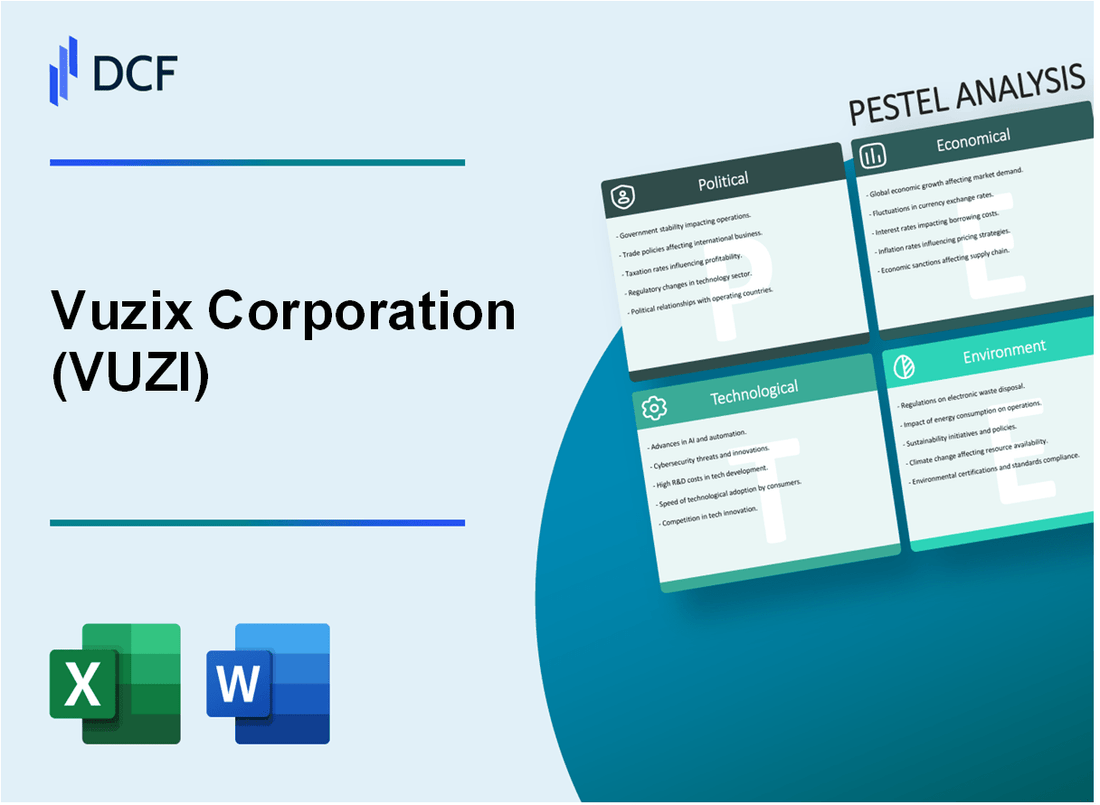
Vuzix Corporation (VUZI): PESTLE Analysis [Nov-2025 Updated] |
Fully Editable: Tailor To Your Needs In Excel Or Sheets
Professional Design: Trusted, Industry-Standard Templates
Investor-Approved Valuation Models
MAC/PC Compatible, Fully Unlocked
No Expertise Is Needed; Easy To Follow
Vuzix Corporation (VUZI) Bundle
You're looking for a clear-eyed assessment of Vuzix Corporation (VUZI) in late 2025, and here's the quick math: the company is successfully pivoting from a niche hardware vendor to a critical OEM component and enterprise solution provider, but profitability remains a near-term challenge. While the strategic shift toward providing waveguides and AI-enabled reference designs is strong, backed by $22.6 million in cash as of September 30, 2025, the Q3 2025 net loss of $7.4 million shows the road to consistent profit is defintely still ahead. You need to map the risks in this complex, fast-moving market where regulatory and social acceptance issues are just as real as the technology-let's break down the full PESTLE picture.
Vuzix Corporation (VUZI) - PESTLE Analysis: Political factors
Growing pipeline of contracts with US defense contractors for waveguide and optical components.
You can't talk about Vuzix Corporation's political landscape without starting with the defense sector. The company's technology-specifically its waveguides and optical components-is a key enabler for next-generation military head-up displays (HUDs), and that's a massive, long-term opportunity.
In the third quarter of 2025, Vuzix was awarded a six-figure development order from a leading U.S. defense contractor. This contract is for customized waveguides to power a new lightweight HUD for military personnel, which is defintely a strong signal. Management expects this work to transition into production deliveries, with revenue contributions starting in Q4 2025.
Analysts are watching this closely, projecting that upcoming custom head-mounted display programs could represent a total revenue opportunity between $40 million and $400 million over time. That's a huge potential swing. The projected average selling price for these defense units is around $4,000 per unit, indicating a strong margin profile compared to commercial products.
Global trade tensions and tariffs can disrupt the supply chain for components, like microLEDs.
The global political climate, especially U.S.-China trade tensions, is creating significant supply chain volatility that directly impacts your cost of goods sold. As an electronics manufacturer, Vuzix relies on complex international supply chains for critical components like microLEDs (Micro Light-Emitting Diodes) and semiconductors.
The current U.S. administration's tariffs of up to 25% on certain electronics and semiconductor imports from China are a major headwind. This kind of duty can raise production costs by 15% to 25% for manufacturers. Honestly, navigating these duties is a logistical nightmare.
Vuzix is actively responding by discussing 'supply chain and tariff issues' with strategic partners like Quanta Computer to increase production capacity. This shows they know the risk is real. The general electronics industry saw logistics cost increases of 10% to 15% for an estimated 60% of U.S. companies in the past year due to these tariffs. You need to factor that into your 2026 margin forecasts.
Government procurement for enterprise AR is a major revenue driver in North America.
While the defense sector gets the headlines, steady government procurement for enterprise Augmented Reality (AR) is a reliable revenue stream in North America. These agencies use smart glasses for everything from remote inspections to maintenance, and they are sticky customers once onboarded.
A concrete example is the U.S. Department of Labor's Occupational Safety and Health Administration (OSHA), which expanded its deployment of Vuzix M400 smart glasses with a follow-on order in late 2024. OSHA uses these devices to boost operational efficiency and safety during field inspections across its nationwide presence. This is pure enterprise AR being driven by public sector needs.
Vuzix has also strategically partnered with BUNDLAR to provide no-code AR content creation for enterprise, public safety, and government applications. This positions them to capture more of the non-defense public sector budget. For context, Vuzix's total Q3 2025 revenue was $1.2 million, and while the exact government portion isn't broken out, these public sector wins are crucial for stabilizing the enterprise product sales, which totaled $896,274 in Q3 2025.
Increased government scrutiny on AI and data security affects all smart device manufacturers.
As Vuzix pivots to 'AI-powered smart glasses,' it moves directly into the crosshairs of new government scrutiny on Artificial Intelligence (AI) and data security. This is a critical political risk that requires proactive compliance spending.
Federal regulators have been busy in 2025. For example, the National Institute of Standards and Technology (NIST) announced a revision to NIST IR 8259 (Foundational Cybersecurity Activities for IoT Product Manufacturers) in May 2025, specifically proposing guidance to clarify data management across AI components. Also, President Trump's Executive Order 14306 in June 2025 refocused AI cybersecurity efforts on identifying and managing vulnerabilities.
This isn't just a federal issue; states are moving fast, too. Texas passed the Texas Responsible AI Governance Act (TRAIGA) (HB 149) in 2025, which prohibits the development or deployment of AI systems with the 'intent' or 'sole intent' to engage in certain harmful activities. Smart device manufacturers like Vuzix must ensure their AI-enabled products comply with this patchwork of new state and federal rules, or they risk significant fines and market exclusion.
Here's a quick look at the key political drivers and their financial impact:
| Political Factor | 2025 Financial/Operational Impact | Actionable Insight |
|---|---|---|
| US Defense Contracts | Awarded a six-figure development order in Q3 2025. Potential long-term revenue opportunity of $40M to $400M. | Focus R&D on meeting military-grade specifications to unlock the $400M pipeline. |
| Global Trade Tariffs | U.S. tariffs of up to 25% on electronics/semiconductors. Discussing 'supply chain and tariff issues' with partners. | Accelerate supply chain diversification away from tariff-impacted regions to mitigate cost increases of 10% to 15%. |
| Government Procurement | Expanded deployment by U.S. Department of Labor (OSHA). Q3 2025 Product Sales: $896,274. | Use the OSHA success story as a template for other federal and state public safety/inspection agencies. |
| AI & Data Security Scrutiny | New compliance burden from NIST IR 8259 and Executive Order 14306 in 2025. | Invest in compliance and security teams to ensure AI-powered glasses meet new federal and state data management standards. |
Vuzix Corporation (VUZI) - PESTLE Analysis: Economic factors
Financial Stability and Cost Discipline
The economic picture for Vuzix Corporation is a classic growth-stage scenario: high market potential but persistent net losses, offset by strong cash reserves and aggressive cost management. You're looking at a company that is intentionally trading near-term revenue for long-term strategic positioning in the Augmented Reality (AR) space, and their balance sheet reflects that calculated risk.
The company is showing progress on the efficiency side. For the third quarter (Q3) of 2025, the net loss narrowed to $7.4 million, a significant improvement from the $9.2 million loss reported in the same period a year ago. This reduction came partly from a 22% year-over-year decrease in total operating expenses, which is defintely a win for financial efficiency.
The core of their financial strength, however, lies in liquidity. As of September 30, 2025, Vuzix held a robust $22.6 million in cash and cash equivalents. That cash position gives them a long operational runway to execute their strategic shift without immediate pressure from the market or creditors, especially since the company is currently debt-free. That's a crucial buffer in a capital-intensive sector.
Revenue Transition and Strategic Investment
Near-term revenue figures show the pain of a strategic pivot. Total revenue for the first quarter (Q1) of 2025 was $1.6 million, a 21% decrease year-over-year. This drop is a direct result of Vuzix deliberately moving away from selling older smart glasses models, like the M400, to focus on high-margin OEM (Original Equipment Manufacturer) and waveguide component sales. The shift is a necessary step to become a core technology provider, not just a hardware vendor.
A major economic de-risking factor is the strategic capital infusion from Quanta Computer, which completed its $20 million investment in Q3 2025. This funding is ear-marked to support the scaling of their OEM waveguide manufacturing operations and advance new OEM programs. Here's the quick math on their recent financial performance:
| Metric (2025) | Q1 2025 Value | Q3 2025 Value |
|---|---|---|
| Total Revenue | $1.6 million | $1.2 million |
| Net Loss | $8.6 million | $7.4 million |
| Cash & Equivalents | $15.2 million (Mar 31) | $22.6 million (Sep 30) |
| Operating Expenses | $8.1 million | $7.1 million (20% YoY reduction) |
Market Opportunity and Growth Trajectory
The macroeconomic tailwind for Vuzix is the massive growth in the Enterprise Augmented Reality (AR) market. This isn't a niche anymore; it's a global industrial shift. The overall Enterprise AR market is projected to grow at a solid 30.21% Compound Annual Growth Rate (CAGR) from 2025 to 2030, with the market size estimated at $112.91 billion in 2025. The software segment alone is expected to see a 28.62% CAGR from 2025 to 2035.
This explosive growth validates Vuzix's focus on being a key component supplier for waveguides and display engines, which are the most critical, high-value parts of AR smart glasses. The market opportunity is huge, but it's competitive.
Key economic opportunities Vuzix is capitalizing on:
- Waveguide Scaling: The Quanta Computer investment directly funds the scaling of OEM waveguide manufacturing, positioning Vuzix to capture a large share of the hardware segment's revenue, which held 62.3% of the Enterprise AR market in 2024.
- Defense Contracts: Securing a six-figure development order from a leading U.S. defense contractor provides a stable, high-value revenue stream outside of the volatile commercial sector.
- Enterprise Adoption: New volume purchase orders from a major global online retailer show that large-scale enterprise deployments are finally gaining traction.
Vuzix Corporation (VUZI) - PESTLE Analysis: Social factors
Enterprise adoption is strong in logistics and field service, driving clear Return on Investment (ROI) for customers like Amazon.
Vuzix's primary social impact is felt within the enterprise sector, where its smart glasses are a hands-free tool that measurably changes worker productivity and safety. This is a crucial distinction from the consumer market, where social acceptance is low. In logistics and field service, the focus is purely on a clear Return on Investment (ROI).
For example, in May 2025, Amazon publicly highlighted the use of Vuzix smart glasses to support its Reliability and Maintenance Engineering (RME) teams in large-scale logistics facilities. The glasses enable a 'see what I see' function, letting central experts virtually diagnose and resolve complex equipment issues in real time. This remote collaboration model accelerates repairs and enhances productivity, which is a tangible benefit that surpasses traditional customer benchmarks. Vuzix's Q1 2025 enterprise sales showed a sequential improvement over Q4 2024, indicating this segment is gaining traction, even as the company's total Q1 2025 revenue decreased to $1.6 million, a 21% decrease from the comparable 2024 period. This enterprise success is defintely a bright spot.
Here's the quick math on the enterprise value proposition:
- Reduce equipment downtime by enabling faster, remote diagnosis.
- Improve first-time fix rates by providing digital manuals in the worker's line of sight.
- Enhance worker safety by keeping both hands free for tasks.
Consumer acceptance is hampered by privacy concerns over always-on cameras and recording in public.
The consumer market for smart glasses, while a long-term goal for Vuzix via its OEM partnerships, faces a significant social headwind: privacy. The public is increasingly uneasy about discreet, always-on recording capabilities, which blur the line between casual use and covert surveillance.
The debate intensified in 2025 following high-profile incidents involving competitors' products, such as the widely reported case of a customer discovering a beautician wearing camera-enabled smart glasses during a private service. This type of incident fuels Gen Z's vocal pushback against digital exposure. While consumer-focused competitors like Meta are projected to sell four million units of their Ray-Ban smart glasses by the end of 2025, showing some market appetite, the overwhelming sentiment among non-owners is anxiety over being filmed without consent.
The social tension creates a significant adoption barrier for any smart glasses that include a camera, regardless of the manufacturer, forcing Vuzix to prioritize its enterprise models, which operate in controlled, consent-based environments.
The rise of AI-enabled smart glasses sparks debate over social inequality and a cognitive divide.
The integration of Artificial Intelligence (AI) into smart glasses has elevated the social debate from privacy to fundamental inequality. In July 2025, a major tech CEO's remark that 'glasses are basically going to be the ideal form factor for AI' and that those without them could face a 'cognitive disadvantage' became a flashpoint. This frames the technology not as an accessory, but as a mandatory tool for competitive performance, potentially widening the economic and cognitive gap.
The core social risk is a new form of workplace inequality. If employers begin to mandate or heavily reward the use of AI eyewear for tasks-a possibility already prompting HR conversations-workers who cannot afford, or choose not to wear, the devices could be at a measurable disadvantage. Vuzix is contributing to this trend by actively integrating AI, for example, through a June 2025 partnership with Sphere Technology to bring AI-powered mixed reality to its M400 and M4000 smart glasses, targeting high-value industrial verticals like manufacturing and healthcare.
The company addresses accessibility by offering XanderGlasses for the estimated 48 million people in the U.S. with hearing loss.
The company has found a strong, positive social niche in accessibility, which acts as a powerful counter-narrative to the privacy and inequality concerns of general-purpose smart glasses. Vuzix supplies the Vuzix Shield smart glasses as a private-label product, XanderGlasses, which provides real-time captions of in-person conversations directly in the wearer's field of view.
This solution targets the estimated 48 million people in the U.S. who experience hearing loss, including veterans and the aging population. The Xander deal is a critical strategic move for Vuzix, especially considering its 2024 total revenue of $5.8 million was a 52% year-over-year decline, making new revenue streams vital. Xander placed its largest re-order to date for the Vuzix Shield glasses in March 2025, validating the strong demand for this assistive technology.
The product's design also addresses a key social concern: privacy. XanderGlasses are 100% self-contained and do not require a smartphone or cloud connectivity, ensuring a high degree of user privacy. However, the adoption barriers remain, as the product is priced at approximately $695, and broader insurance coverage is limited.
Here is a breakdown of the XanderGlasses' social and financial impact:
| Metric | Value/Detail (2025 Fiscal Year Data) | Social Significance |
|---|---|---|
| Target U.S. Market | 48 million people with hearing loss | Addresses a major, underserved accessibility need. |
| Product Cost | Approximately $695 (XanderGlasses) | High cost is an adoption barrier despite the clear benefit. |
| Vuzix 2024 Revenue | $5.8 million (52% YoY decline) | Accessibility partnership is crucial for revenue diversification and growth. |
| Adoption Signal | Largest re-order placed by Xander in March 2025 | Strong, validated demand for the product solution. |
Vuzix Corporation (VUZI) - PESTLE Analysis: Technological factors
You need to understand how Vuzix Corporation's core technology and its competitive landscape map out for 2025, and the takeaway is clear: Vuzix is doubling down on its optical advantage and OEM partnerships, but the sheer scale of investment from Big Tech presents an existential threat to their long-term market share.
Launched Ultralite Pro and Ultralite Audio OEM platforms, integrating AI and Qualcomm's Snapdragon AR1 Gen 1
Vuzix has made a smart, decisive move to position itself as a key supplier for the next generation of smart glasses, not just a finished product vendor. At CES 2025, they debuted two new reference designs in partnership with Quanta Computer, shifting focus toward Original Equipment Manufacturer (OEM) platforms. This is defintely the right play to scale.
The Ultralite Pro OEM Platform is a great example, powered by Qualcomm's Snapdragon AR1 Gen 1 platform. This chipset is critical because it enables seamless Artificial Intelligence (AI) interaction, supporting dual full-color Avegant LCoS projectors for a vivid 3D augmented reality (AR) experience. The companion Ultralite Audio OEM Platform is designed for extended use, utilizing a monochrome microLED projector to achieve an impressive battery life of up to two days, while still offering AI-driven features like voice assistants and real-time language translation.
Proprietary waveguide technology features an ultra-thin 1.0mm full-color design for sleeker glasses
The company's core technological strength lies in its proprietary waveguide optics-the transparent lens that projects the digital image. This is their moat. At CES 2025, Vuzix showcased a full-color waveguide that is only 1.0mm-thin, which is a huge leap toward creating smart glasses that actually look like normal eyewear. They even unveiled a super-slim 0.7mm waveguide prototype, pushing the envelope further. This miniaturization is the key to consumer adoption.
This technology integrates Vuzix's proprietary Incognito technology for discreet, high-performance AR displays and offers a field of view (FoV) ranging from 30 to 40 degrees. This focus on thin, high-performance optics is what attracts major OEM partners, as it solves the problem of bulky, unwearable AR headsets that have plagued the industry for years.
Acquisition of a new waveguide R&D facility centralizes optical innovation in Silicon Valley
To protect and accelerate this optical advantage, Vuzix made a strategic capital investment in April 2025 by acquiring an advanced waveguide Research & Development (R&D) facility in Milpitas, California, right in the heart of Silicon Valley. This move centralizes their optical innovation and strengthens their position as a key supplier for big tech Original Design Manufacturers (ODMs) and OEMs.
Here's the quick math: The total cost of this expansion is in the low seven figures in 2025, which is a manageable but significant investment for Vuzix. The facility is equipped with state-of-the-art tools, including an advanced ion milling machine, which is essential for scaling the fabrication of their high-quality waveguide tools. This acquisition is about control and speed in a rapidly evolving market.
Faces intense competition from tech giants like Meta and Google, which are heavily investing in consumer AR/AI
The biggest risk is the sheer financial firepower of competitors. While Vuzix is innovating, companies like Meta and Google (Alphabet) are pouring astronomical sums into the same space, even if it's currently unprofitable. This is the reality of the AR/AI arms race.
To be fair, Meta's Reality Labs division, which houses its AR/VR efforts, reported a staggering $4.43 billion loss on only $470 million in revenue in Q3 2025, with accumulated losses over $70 billion since 2020. They are buying market share. Still, their capital expenditure (capex) outlook for 2025 was raised to between $64 billion and $72 billion to support their AI infrastructure. Alphabet (Google) is also in the game, increasing its capex forecast to $85 billion for 2025, focused heavily on AI infrastructure and models like Gemini. This is a scale Vuzix simply cannot match.
Here is a snapshot of the competitive investment landscape for 2025:
| Tech Giant | 2025 Capital Expenditure (Capex) Outlook | Primary Focus |
|---|---|---|
| Alphabet (Google) | Up to $85 billion | AI infrastructure, Gemini models, Cloud expansion |
| Meta Platforms | $64 billion to $72 billion | AI buildout, Mega data centers, Reality Labs (AR/VR) |
This massive spending means the market will be flooded with new AR/AI consumer products, putting intense pressure on Vuzix to maintain its technological lead and secure high-volume OEM deals. Their future hinges on remaining the undisputed leader in optical component quality and miniaturization.
Next Step: Strategy Team: Model the impact of a 20% price cut on Meta's consumer AR glasses on our OEM pipeline by Friday.
Vuzix Corporation (VUZI) - PESTLE Analysis: Legal factors
You're operating Vuzix Corporation (VUZI) right at the intersection of hardware, AI, and data, so your legal exposure is changing fast. The biggest takeaway for 2025 is that your strong intellectual property (IP) portfolio is a critical defense, but the cost of compliance with global data privacy laws-especially given the nature of smart glasses-is a persistent and growing financial burden.
We've seen a clear focus on cost discipline in the latest financials, but you can't skimp on legal defense or compliance. For the third quarter ended September 30, 2025, the General and Administrative (G&A) expense, which includes most of your corporate legal and compliance costs, was $2.6 million. That's a 41% decrease from the comparable 2024 period, but you must ensure that efficiency isn't creating a compliance gap in a rapidly evolving regulatory environment.
Must navigate complex, evolving data privacy regulations like GDPR and CCPA due to biometric and location data collection
Your smart glasses are inherently designed to collect and process data in the real world, which puts you directly in the crosshairs of global data privacy regulators. The devices often capture biometric data (like eye movement), precise location details, and behavioral patterns in enterprise settings. Honestly, that's sensitive information.
Vuzix Corporation is already committed to complying with the major regulations, including the European Union's General Data Protection Regulation (GDPR) and the California Consumer Privacy Act (CCPA), as amended by the California Privacy Rights Act (CPRA). The risk isn't just in your own apps; it's in the third-party applications available on the Vuzix App store, where you must rely on their documentation for compliance, which is a potential weak link. If a third-party app causes a violation, the reputational damage still falls on your brand.
| Regulation | Jurisdiction | Primary Compliance Impact on Vuzix |
|---|---|---|
| General Data Protection Regulation (GDPR) | European Union (EU) | Requires explicit, informed consent for processing personal data; mandates robust safeguards for location and biometric data. |
| California Consumer Privacy Act (CCPA/CPRA) | California, US | Grants consumers rights to know, delete, and opt-out of the sale or sharing of their personal information. |
| New York SHIELD Act | New York, US | Requires reasonable security measures to protect private information of New York residents. |
Product liability risk exists from potential user distraction and obscured vision in industrial settings
Your primary market is the enterprise-warehousing, logistics, and medical-where safety is paramount. When you introduce a device that overlays digital information onto a worker's field of vision, you take on a significant product liability risk. The introduction of the new LX1 enterprise smart glasses, purpose-built for the warehousing and logistics industry, highlights this exposure.
While your products are designed to enhance safety and productivity, a single accident attributed to user distraction or a device malfunction could lead to a costly, high-profile lawsuit. The key is in the fine print of your enterprise contracts and the quality of your user training. If a worker gets injured because the augmented reality (AR) overlay obscured a hazard, you're defintely in for a legal battle. This is a near-term risk that your legal team must continuously mitigate through strong indemnification clauses and rigorous safety certifications.
Extensive patent portfolio of over 450 patents and patents pending is a key defense against IP challenges
Your intellectual property (IP) is the bedrock of Vuzix Corporation's valuation, especially as the AI-powered smart glasses market accelerates. As of the March and June 2025 reports, Vuzix holds more than 425 patents and patents pending globally, plus numerous IP licenses in optics, head-mounted displays, and AR wearables. That's a strong defensive moat.
This extensive portfolio acts as a major deterrent against competitors attempting to copy your core waveguide and display engine technology. The increase in Research and Development (R&D) expense to $2.9 million for Q3 2025, a 26% jump year-over-year, shows you are actively investing in new IP to stay ahead. This is a smart move; your R&D spending today is your legal defense fund tomorrow.
Need for clear legal frameworks around Intellectual Property (IP) for AR content overlaid on real-world objects
The convergence of AI and AR is creating a new frontier for IP law. As Vuzix partners with companies like Ramblr to deploy AI agent solutions that provide real-time, natural language guidance overlaid on the real world, the question of who owns the IP for that 'augmented' experience becomes complex. Is the IP in the underlying AI model, the AR content, or the resulting real-world data?
The current legal landscape lacks clear precedents for AR content that is dynamically generated and overlaid. Your legal strategy must focus on securing airtight agreements with content creators and platform partners to clearly define ownership and licensing terms for any AR content, especially when it is created or modified by an AI agent on your smart glasses. This ambiguity is both a risk and an opportunity to shape future industry standards through strategic patent filings.
- Define content ownership in all partner agreements.
- Secure licensing for all third-party AR applications.
- Focus new patent filings on AI-driven AR interaction methods.
Next Step: Legal Counsel: Conduct a Q4 2025 audit of all third-party App Store privacy policies and update all OEM/ODM contracts to include a mandatory, clear IP ownership clause for AI-generated AR content by the end of the fiscal year.
Vuzix Corporation (VUZI) - PESTLE Analysis: Environmental factors
Product deployment in the renewable energy sector, assisting with solar panel maintenance and efficiency.
Vuzix's smart glasses are a strong environmental asset because they directly enable efficiency gains in the rapidly growing renewable energy sector. You can't improve what you can't see, and that's where the augmented reality (AR) overlay helps. For example, in solar farms, the glasses are used for real-time Soiling Detection of Solar Panels, where an integrated AI evaluates the panel cleanliness and calculates the precise impact on energy efficiency. This shifts maintenance from reactive to predictive.
This kind of hands-free, data-driven maintenance is crucial for maximizing the output of green infrastructure. Plus, the glasses use Geo-Tagging Based Guidance to instantly identify panels via QR codes or RFIDs, guiding field staff through vast facilities. This operational optimization ensures that solar and alternative energy assets, like those managed by customers such as CH Four Biogas, perform at their peak, which is the whole point of investing in renewables in the first place.
Smart glasses reduce carbon footprint by enabling remote inspections, cutting thousands of miles of travel for field engineers.
The biggest near-term environmental win for Vuzix is the massive reduction in travel, which directly cuts a customer's carbon footprint. Honestly, it's a simple math problem: fewer trips equals fewer emissions. Remote inspections, or 'see what I see' telemaintenance, eliminate the need to fly or drive experts to a remote site just to look at a problem.
One customer, CH Four Biogas, noted that a single two-hour inspection previously required three flights and a rental car. By deploying Vuzix smart glasses, the company aims to reduce travel to rural installations by thousands of miles a year. Across the maintenance industry, this remote support model is proven to reduce costly and carbon-intensive 'truck rolls' by 30% or more, which also saves up to 40% on repair costs. That's a clear win-win for the planet and the P&L.
Collaboration with Materialise leverages 3D printing, which can reduce the manufacturing cycle from 18 months to 3 months.
The shift to advanced manufacturing processes, like the 3D printing collaboration with Materialise, is a significant environmental opportunity. Traditional manufacturing for complex eyewear involves extensive tooling, material waste, and long lead times. By leveraging additive manufacturing (3D printing), Vuzix is moving toward a more sustainable, on-demand production model.
This process cuts the design and production cycle for new smart eyewear models from the industry's typical 18 months down to just 3 months. That speed comes with a lower environmental cost, as 3D printing generally reduces material waste by 30-50% compared to subtractive methods. This agility means less inventory obsolescence and a smaller physical manufacturing footprint overall.
Manufacturing processes for high-tech optics and micro-displays present a challenge for end-of-life product recycling.
To be fair, the environmental challenge for Vuzix, and the entire AR industry, lies in the end-of-life management of complex, miniaturized electronics. Smart glasses are dense, high-tech devices, and the components-like the specialized waveguides and micro-displays (LCoS and microLED)-are not designed for easy disassembly or recycling.
The core issue is that manufacturing accounts for up to 85% of an electronic device's lifetime environmental impact, and the complex circuitry and optics contain precious and rare earth metals. Moreover, the industry trend of using non-replaceable lithium-ion batteries can effectively 'brick' the entire device when the battery fails, pushing it into the e-waste stream, which is already growing five times faster than documented recycling can handle. This structural barrier means Vuzix must eventually invest heavily in a circular economy solution for its products. The challenge is clear:
- Non-Replaceable Components: Many smart glasses use dense, non-serviceable components.
- Material Complexity: High-tech optics and micro-displays (like Vuzix's waveguides) are difficult to separate into recyclable material streams.
- E-Waste Growth: Global electronic waste is outpacing recycling infrastructure by a factor of 5:1.
Disclaimer
All information, articles, and product details provided on this website are for general informational and educational purposes only. We do not claim any ownership over, nor do we intend to infringe upon, any trademarks, copyrights, logos, brand names, or other intellectual property mentioned or depicted on this site. Such intellectual property remains the property of its respective owners, and any references here are made solely for identification or informational purposes, without implying any affiliation, endorsement, or partnership.
We make no representations or warranties, express or implied, regarding the accuracy, completeness, or suitability of any content or products presented. Nothing on this website should be construed as legal, tax, investment, financial, medical, or other professional advice. In addition, no part of this site—including articles or product references—constitutes a solicitation, recommendation, endorsement, advertisement, or offer to buy or sell any securities, franchises, or other financial instruments, particularly in jurisdictions where such activity would be unlawful.
All content is of a general nature and may not address the specific circumstances of any individual or entity. It is not a substitute for professional advice or services. Any actions you take based on the information provided here are strictly at your own risk. You accept full responsibility for any decisions or outcomes arising from your use of this website and agree to release us from any liability in connection with your use of, or reliance upon, the content or products found herein.