

|
TeraWulf Inc. (WULF): ANSOFF MATRIX [Dec-2025 Updated] |
Fully Editable: Tailor To Your Needs In Excel Or Sheets
Professional Design: Trusted, Industry-Standard Templates
Investor-Approved Valuation Models
MAC/PC Compatible, Fully Unlocked
No Expertise Is Needed; Easy To Follow
TeraWulf Inc. (WULF) Bundle
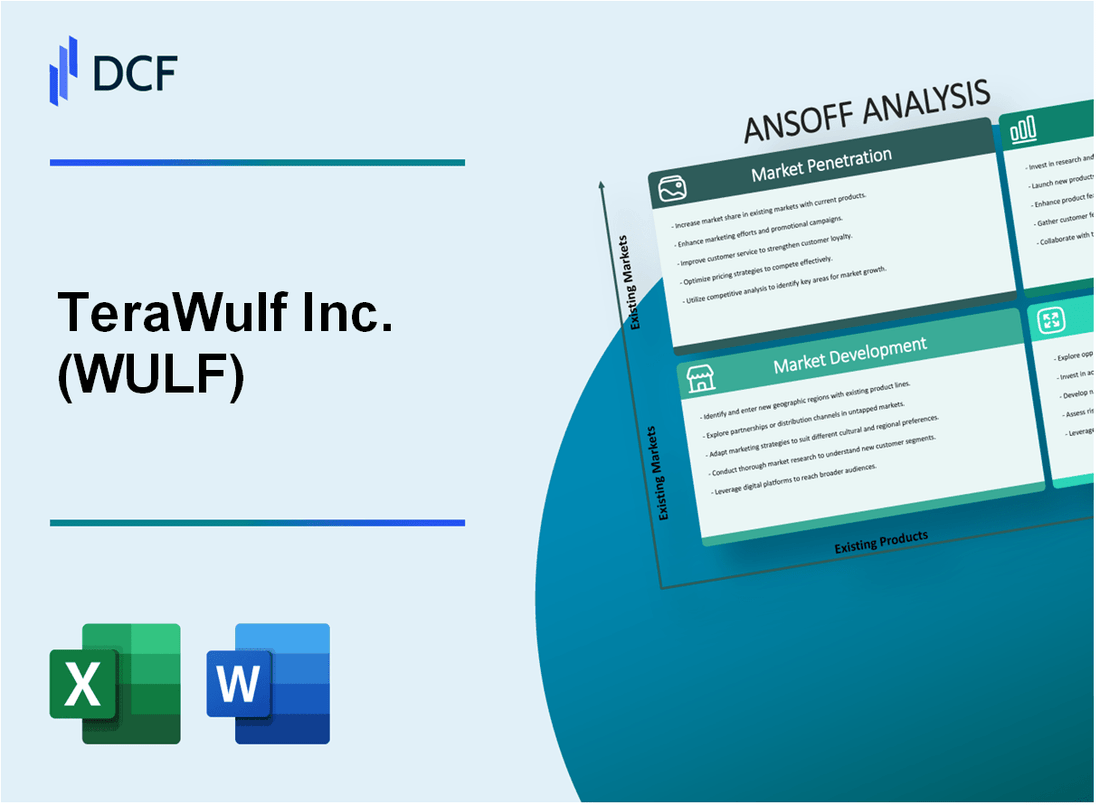
Honestly, you're spot on to focus on TeraWulf Inc.'s strategic pivot; the Q3 2025 numbers confirm it, showing $50.6 million in revenue, with $7.2 million already rolling in from initial HPC lease revenue. This isn't just about squeezing more hash rate out of existing miners anymore. This Ansoff Matrix maps out their aggressive, multi-pronged strategy: they are moving from pure Bitcoin mining (Market Penetration) to becoming a major AI infrastructure player by developing new compute products and diversifying into massive new sites like the Abernathy JV. It's a clear roadmap from today's operations to tomorrow's valuation, so let's break down the next moves below.
TeraWulf Inc. (WULF) - Ansoff Matrix: Market Penetration
You're looking at how TeraWulf Inc. (WULF) plans to sell more of its current offering-Bitcoin mining and HPC hosting-into its existing markets, which is the essence of Market Penetration. This means squeezing more output from the assets you already have, like the Lake Mariner facility.
Increase operational hash rate beyond 12.8 EH/s through miner optimization
The immediate focus here is tuning the installed base to push past the reported capacity figures. As of June 2025, TeraWulf Inc. (WULF) reported installed capacity reached 12.8 EH/s. This followed a Q2 2025 operational hash rate of 12.2 EH/s. The goal is to see that operational number climb higher than 12.8 EH/s through optimization, building on the momentum from hardware upgrades.
Aggressively utilize demand response programs to lower the effective power cost below $0.05/kWh
Demand response (DR) is key to hitting those lower power cost targets. For instance, TeraWulf Inc. (WULF) saw DR proceeds total $2.8 million in Q1 2025. The company has provided guidance for the second half of 2025, projecting power costs at Lake Mariner to be $0.05/kWh. Furthermore, the Lake Mariner site has an internal target for fully loaded power costs of approximately $0.045/kWh year-round. This contrasts with the Q2 2025 average power cost of $0.053/kWh.
Complete the miner refresh program at Lake Mariner with new, more efficient S21 Pro models
You saw the miner refresh program advancing significantly. As of November 2024, TeraWulf Inc. (WULF) had installed approximately 7,400 S21 Pro miners, replacing older S19 Pro/J-Pro and M30s+ models. This was part of a larger effort where Building 4 was scheduled to house approximately 10,000 S21 and S21 Pro miners upon completion. Completing this deployment is critical for improving the overall fleet efficiency, which directly impacts the hash rate and power cost per Bitcoin mined.
Maximize uptime at the 245 MW Lake Mariner facility to increase self-mined BTC output
The Lake Mariner facility is the core asset here, with 245 MW of energized capacity as of Q1/Q2 2025. The full buildout potential for this site is up to 750 MW. Maximizing uptime means translating that power capacity into more Bitcoin. In Q2 2025, TeraWulf Inc. (WULF) self-mined 485 Bitcoin. The efficiency gains from the hardware refresh and stable power contracts should help drive this output higher, especially since the Q1 2025 power cost per Bitcoin was $66,084.
Here's a quick look at the operational snapshot around the middle of 2025:
| Metric | Value (2025) | Reference Point |
| Installed Hash Rate | 12.8 EH/s | June 2025 |
| Operational Hash Rate | 12.2 EH/s | Q2 2025 End |
| Lake Mariner Energized Capacity | 245 MW | Q1/Q2 2025 |
| Target Power Cost | $0.05/kWh or $0.045/kWh | H2 2025 Guidance/Target |
| BTC Self-Mined | 485 BTC | Q2 2025 |
The success of this strategy definitely hinges on keeping those operational costs down while the hardware is running at peak performance. Finance: review the Q3 2025 power cost variance against the $0.05/kWh guidance by next Tuesday.
TeraWulf Inc. (WULF) - Ansoff Matrix: Market Development
You're looking at the numbers for TeraWulf Inc. (WULF) as they push into new markets with their existing digital infrastructure services. Here's the quick math on their Market Development moves as of late 2025.
Expanding Footprint and Interconnection Capacity
- TeraWulf Inc. (WULF) has secured interconnection approval at the Lake Mariner Facility to draw up to 500 MW from the grid, with additional approvals pending to reach up to 750 MW.
- As of September 30, 2025, the Lake Mariner Campus had energized 245 MW of Bitcoin-mining capacity.
- The Lake Mariner site is situated on the former 700 MW Somerset coal-fired power plant location.
- New site development, like the Abernathy Data Campus, targets an initial 240 MW of HPC capacity with potential expansion to 600 MW.
The shift to HPC hosting is a clear move into a new market segment for their existing infrastructure capabilities.
| Metric | Value (Q2 2025 or Latest) | Context/Site |
|---|---|---|
| Q3 2025 Revenue | $50.6 million | GAAP |
| Q2 2025 BTC Mining Capacity | 12.8 EH/s | Up 45.5% year-over-year |
| Lake Mariner Energized Capacity (Mining) | 245 MW | As of September 30, 2025 |
| HPC Capacity Energized (Mining) | 22.5 MW | At Lake Mariner as of September 30, 2025 |
| Total Contracted IT Load (Fluidstack) | 360 MW | As of 2025 |
| Available Capacity Across Sites | 800-850 MW | For future contracts |
Targeting Institutional Hosting Clients
- TeraWulf Inc. (WULF) is targeting 200-250 MW of operational HPC hosting capacity by year-end 2026.
- The company announced contracts to deliver 72.5 MW of gross HPC hosting infrastructure to Core42 in 2025.
- The Core42 leases are projected to generate approximately $1.1 billion in contracted revenue over ten years.
- Three ten-year Fluidstack leases at Lake Mariner total approximately $6.7 billion in contracted lease payments.
The company aims to deploy 150-200 MW of new HPC capacity annually going forward. If onboarding takes 14+ days, churn risk defintely rises.
Securing Long-Term Power Agreements in New Regions
- The Lake Mariner Facility has an agreement with the Power Authority of the State of New York (NYPA) for 90 MW of high load factor power under a ten-year term.
- The Lake Mariner location operates in NYISO Zone A, where 89% of the energy was zero-carbon generation as of 2025.
- The Lake Hawkeye campus location has approximately 90% of its electricity generated from zero-carbon resources.
- The power cost per bitcoin self-mined rose to $45,555 in Q2 2025, compared to $22,954 in Q2 2024, showing cost volatility.
Energy Arbitrage and Grid Services
- In December 2024, operational performance was impacted by curtailment due to participation in cash-generating demand response programs.
- The company's Q2 2025 power cost averaged $0.053/kWh, impacted by a June heat wave in the Northeast.
Finance: draft 13-week cash view by Friday.
TeraWulf Inc. (WULF) - Ansoff Matrix: Product Development
Accelerate the deployment of the 72.5 MW GPU-optimized capacity for Core42 at Lake Mariner in 2025.
The Core42 lease covers 72.5 megawatts of gross capacity, equivalent to 60 megawatts of critical IT load. The rollout was scheduled to occur over the first three quarters of 2025. This agreement includes a 10-year initial term with two five-year renewal options. The base revenue was quoted at $125 per kilowatt-month, which is $1.5 million per megawatt per year, with a 3% annual escalator. The Core42 contract represents potential revenue exceeding $1 billion over the 10-year term, with a contract value of roughly $1 billion.
Convert existing Bitcoin mining infrastructure capacity to HPC hosting to meet the 450 MW Fluidstack contract demand.
TeraWulf Inc. secured Fluidstack leases, backed by Google, providing 450 MW gross capacity, which is about 360 MW net. The initial Lake Mariner Fluidstack agreements pledge over 200 MW of critical IT load, representing approximately $3.7 billion in committed revenue over the initial 10-year terms. An option was exercised for an additional 160 MW of critical IT load at the CB-5 site. Furthermore, a joint venture for the Abernathy, Texas campus involves a 25-year hosting commitment for 168 MW of critical IT load, valued at approximately $9.5 billion in contracted revenue. Google provides a $3.2 billion financial backstop for the initial Fluidstack lease obligations.
Develop specialized, high-density data center solutions for AI/Machine Learning workloads.
The total contracted HPC IT load secured within the past 10 months (as of late October 2025) now exceeds 510 MW of critical IT load. The company's total operational capacity at Lake Mariner reached 245 MW as of Q1/Q2 2025. The cost to deliver HPC hosting capacity using existing site infrastructure was stated at approximately $7.2 million per critical MW. The Abernathy joint venture project cost is pegged between $8 million to $10 million per megawatt of critical IT load. Bitcoin mining power costs averaged approximately 5 cents per kWh during Q3 2025.
Target additional HPC customers to reach the goal of 200-250 MW operational capacity by year-end 2026.
TeraWulf Inc. is targeting 200-250 MW operational capacity by year-end 2026. The combined Core42 and initial Fluidstack agreements account for over 420 MW of committed HPC infrastructure. The company is targeting an additional 250 MW to 500 MW of contracted capacity annually.
| Metric | Capacity (MW Gross/IT Load) | Contract Value/Term | Timeline/Target |
| Core42 Deployment | 72.5 MW Gross (60 MW Critical IT Load) | Revenue exceeding $1 billion over 10 years | Deployment in 2025 |
| Fluidstack Lake Mariner | 450 MW Gross (approx. 360 MW Net) | $3.7 billion initial revenue over 10 years (up to $8.7 billion with options) | Phased delivery through 2026 |
| Fluidstack Abernathy JV | 168 MW Critical IT Load | Approx. $9.5 billion contracted revenue over 25 years | Expected online H2 2026 |
| Total Contracted HPC IT Load | Exceeds 510 MW | Combined potential value in billions | Targeting 200-250 MW operational by year-end 2026 |
TeraWulf Inc. (WULF) - Ansoff Matrix: Diversification
You're looking at TeraWulf Inc. (WULF) making a hard pivot from a pure-play digital asset miner to a major player in high-performance computing (HPC) infrastructure. This diversification, or market development/product development depending on how you slice it, is all about locking in long-duration, credit-enhanced revenue streams. Honestly, the numbers here show a clear strategy to de-risk the business from volatile crypto mining margins.
The move into new geographic markets is a big part of this. For instance, the Abernathy Joint Venture (JV) in Texas is key to establishing a new HPC campus outside the New York footprint. This venture, partnered with Fluidstack and Google, is initially designed for 240 MW of capacity, but it has the potential to scale up to 600 MW. TeraWulf Inc. holds up to a 51% controlling interest in this JV, which is anchored by a 25-year lease. Here's the quick math on the scale: the initial 168 MW of critical IT load is expected to be delivered in the second half of 2026, representing approximately $9.5 billion in contracted revenue to the joint venture over that term.
This diversification is also about securing future optionality. Separately from the initial Abernathy build, TeraWulf Inc. secured the exclusive right to partner with Fluidstack for up to 51% ownership in a future Fluidstack-led project of approximately 200 MW. This is how you build a pipeline; securing rights to future capacity on similar commercial terms means you're creating a repeatable development model. As of the third quarter of 2025, these moves, combined with existing deals, pushed the total contracted HPC platform past 510 MW of critical IT load. The company is targeting an additional 250 MW to 500 MW of contracted critical IT load annually going forward.
The expansion into a third major region is cemented by the Cayuga site lease in Lansing, New York. You're looking at an 80-year ground lease for approximately 183 acres, which unlocks the right to develop up to 400 MW of capacity. The initial investment was structured as $95 million in TeraWulf common stock plus $3 million in cash, totaling $98 million. Crucially, 138 MW of predominantly zero-carbon power is expected to be ready for service in 2026, with electricity costs averaging below $0.05 per kilowatt-hour. This site benefits from Upstate New York's power mix, which is nearly 90% zero-carbon. They are also planning a 67 MW solar installation and an 800 MWh battery energy storage system there.
To put the scale of this diversification into perspective, here is a snapshot of the capacity expansion milestones as of late 2025:
| Site/Project | Capacity (MW) | Ownership/Term | Key Financial/Metric |
|---|---|---|---|
| Lake Mariner (Existing HPC) | 22.5 MW (Energized as of Q3 2025) | N/A | Core42 leases represent $1.1 billion contracted revenue over 10 years. |
| Abernathy JV (New Market) | Initial 240 MW (with 168 MW critical IT load in H2 2026) | 51% controlling interest / 25-year lease | Approximately $9.5 billion in contracted revenue to the JV. |
| Cayuga Site (Third Region) | Up to 400 MW total rights (with 138 MW ready in 2026) | 80-year lease | Electricity cost below $0.05/kWh. |
| Future Fluidstack Project | Up to 51% interest in next ~168 MW project | Future Right | Contributes to the overall 510 MW contracted platform. |
While the strategy is clearly focused on infrastructure leasing-evidenced by the $7.2 million in initial HPC lease revenue in Q3 2025 and the reported 72% gross profit margin on that segment-the exploration into offering cloud-based compute services directly to end-users remains a strategic area to watch. For now, the hard numbers show TeraWulf Inc. is doubling down on being the landlord for AI compute, not the direct cloud provider. The shift is about capturing the high-margin, long-duration cash flows from infrastructure hosting, which is a defintely different risk profile than their legacy mining business.
You should definitely track the delivery schedule for that 138 MW at Cayuga and the 168 MW at Abernathy, as those are the near-term revenue drivers that will test the profitability of this diversification. Finance: draft the pro-forma cash flow impact of the $3.2 billion Senior Secured Notes closing by Friday.
Disclaimer
All information, articles, and product details provided on this website are for general informational and educational purposes only. We do not claim any ownership over, nor do we intend to infringe upon, any trademarks, copyrights, logos, brand names, or other intellectual property mentioned or depicted on this site. Such intellectual property remains the property of its respective owners, and any references here are made solely for identification or informational purposes, without implying any affiliation, endorsement, or partnership.
We make no representations or warranties, express or implied, regarding the accuracy, completeness, or suitability of any content or products presented. Nothing on this website should be construed as legal, tax, investment, financial, medical, or other professional advice. In addition, no part of this site—including articles or product references—constitutes a solicitation, recommendation, endorsement, advertisement, or offer to buy or sell any securities, franchises, or other financial instruments, particularly in jurisdictions where such activity would be unlawful.
All content is of a general nature and may not address the specific circumstances of any individual or entity. It is not a substitute for professional advice or services. Any actions you take based on the information provided here are strictly at your own risk. You accept full responsibility for any decisions or outcomes arising from your use of this website and agree to release us from any liability in connection with your use of, or reliance upon, the content or products found herein.