

|
XPeng Inc. (XPEV): PESTLE Analysis [Nov-2025 Updated] |
Fully Editable: Tailor To Your Needs In Excel Or Sheets
Professional Design: Trusted, Industry-Standard Templates
Investor-Approved Valuation Models
MAC/PC Compatible, Fully Unlocked
No Expertise Is Needed; Easy To Follow
XPeng Inc. (XPEV) Bundle
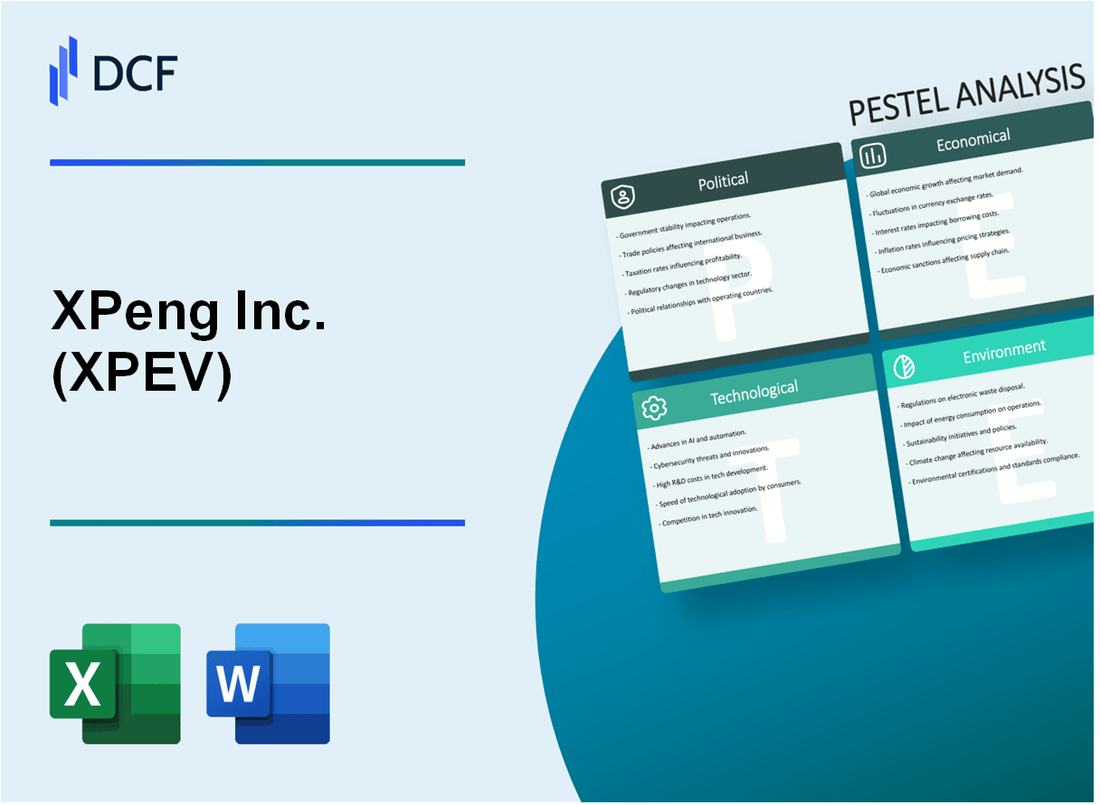
You're looking for a clear, actionable breakdown of the forces shaping XPeng Inc. (XPEV)'s future, and honestly, the landscape is shifting fast. As a seasoned analyst, I can tell you the near-term risks and opportunities are defintely tied up in China's policy moves and the relentless tech race. Here is the PESTLE analysis you need, keeping it real and focused on what matters now.
The core takeaway is this: XPeng is successfully transitioning from a pure growth story to a margin-focused one, but its immediate future hinges on how fast it can globalize its technology before domestic price wars fully erode profits. The company's Q3 2025 revenue hit a record RMB 20.38 billion (US$2.86 billion), a 101.8% jump year-over-year, yet the market is nervous about the Q4 2025 revenue guidance of RMB 21.5 billion to RMB 23.0 billion, which suggests a slowdown in sequential growth. You need to watch the margin expansion and the global XNGP rollout-that's the real value driver.
|Political
- Beijing's continued strong support for New Energy Vehicles (NEV) is crucial.
- Trade tensions, especially with the US and EU, create market access risks, though recent November 2025 US-China agreements temporarily suspended some tariffs and rare earth export controls.
- Government procurement and fleet mandates favor domestic EV makers like XPeng.
- Local government incentives influence factory location and sales volume.
- China's slowing GDP growth puts pressure on premium consumer spending.
- Global interest rate hikes increase capital costs for international expansion.
- Intense domestic price wars erode profit margins across all models, despite XPeng achieving a record gross margin of 20.1% in Q3 2025.
- Supply chain stability for critical battery minerals remains a cost factor, but the company's liquidity is strong with RMB 48.33 billion (US$6.79 billion) in cash and equivalents as of September 30, 2025.
- Rapid consumer shift toward 'smart' features and Level 2+ autonomy is high.
- Younger, tech-savvy buyers prioritize over-the-air (OTA) update capability.
- Brand loyalty is low; consumers switch quickly based on new model releases.
- Growing demand for EVs in Tier 2 and Tier 3 Chinese cities drives volume, evidenced by 116,007 vehicle deliveries in Q3 2025.
- XPeng's XNGP (Navigation Guided Pilot) is a core competitive advantage; the company is initiating its global development in 2025.
- High investment in R&D is needed to maintain lead in autonomous driving software, with R&D expenses increasing 48.7% year-over-year to RMB 2.43 billion (US$0.34 billion) in Q3 2025.
- Battery technology advancements, especially solid-state, could disrupt current models, but mass production is still years away (expected 2030).
- The company must quickly integrate AI into cabin experience and vehicle control, leveraging its X-GPT large model.
- Cybersecurity and data privacy regulations for vehicle data are tightening in China.
- New EU safety and homologation standards complicate European market entry, despite XPeng opening its Munich R&D Center in 2025.
- Intellectual property protection is a constant concern in a competitive market.
- Autonomous driving liability frameworks are still evolving globally.
- China's carbon neutrality goals accelerate the phase-out of internal combustion engines.
- Stricter battery recycling and disposal mandates increase operational complexity.
- XPeng must meet rising consumer and investor demand for transparent ESG reporting.
- The company's manufacturing processes face pressure to reduce energy consumption.
What this estimate hides is the sheer speed of regulatory change in the EU, which could delay European sales by months. Also, the Chinese government is cutting the vehicle purchase tax exemption cap from RMB 30,000 to RMB 15,000 in 2026, so the Q4 2025 delivery guidance of 125,000 to 132,000 units is defintely inflated by a pull-forward of demand. So, the concrete next step is this: Legal/Strategy: Finalize homologation compliance plan for the G6 model in Germany and Norway by end of Q4 2025.
XPeng Inc. (XPEV) - PESTLE Analysis: Political factors
Beijing's continued strong support for New Energy Vehicles (NEV) is crucial.
The central government in Beijing continues to be the single largest political factor shaping XPeng's domestic market. While the era of direct, massive purchase subsidies has largely ended, state support has shifted to demand-side incentives and infrastructure. For the 2025 fiscal year, the government renewed the car trade-in subsidy program, offering individual consumers up to RMB 20,000 (approximately $2,730) per vehicle for scrapping an old car and purchasing a new NEV. Analysts project this program will drive an additional 3 million units of demand in 2025, which is a significant tailwind for domestic players like XPeng.
However, the political landscape is maturing. A key signal for the 2026-2030 period is the decision to no longer classify NEVs as a 'strategic industry' in the next five-year plan, suggesting the government views the sector as mature enough to rely more on market forces. This means future growth will depend less on state-led financial aid and more on product competitiveness. XPeng buyers who lock in orders before December 31, 2025, for models like the X9 Super Range-Extended, can still obtain purchase tax phase-out subsidies of up to RMB 15,000 (approximately $2,100) before the purchase tax rate rises in 2026. It's a race against the clock for these final, direct benefits.
Trade tensions, especially with the US and EU, create market access risks.
Geopolitical friction is the primary headwind for XPeng's international expansion strategy. The US market is defintely a non-starter for direct exports due to prohibitive tariffs. An XPeng executive noted that cumulative US tariffs on Chinese EVs can be as high as 270%, making direct export 'impossible'. This forces a focus on other regions, but the risk has spread.
The European Union's anti-subsidy investigation into Chinese electric vehicles concluded with the imposition of punitive tariffs. By October 2025, the EU raised tariffs on China-made EVs to as much as 45%. This levy directly impacts XPeng's European profitability, which the company acknowledged has had a 'large economic impact'.
XPeng's counter-strategy is a direct political response: localization to bypass trade barriers.
- Commenced localized production in Europe at the Magna plant in Graz, Austria, in September 2025, to mitigate the impact of high tariffs.
- Began local assembly operations in Indonesia in the second half of 2025, benefiting from local government incentives like a 10% VAT reduction for vehicles with a minimum domestic content level of 40%.
Government procurement and fleet mandates favor domestic EV makers like XPeng.
While explicit, company-specific procurement figures are scarce, the political mandate to favor domestic NEV brands for government and state-owned enterprise (SOE) fleets remains a significant, though indirect, source of demand. This preference helps to stabilize order books and provides a crucial quality endorsement for domestic brands. XPeng is strategically positioned to benefit from nationwide programs, such as the auto trade-in initiative, which aims to stimulate demand for domestic NEVs.
XPeng's aggressive 2025 sales target-to double its deliveries year-on-year-is partly predicated on successfully capturing demand generated by these government-backed incentives. The company's focus on high-tech features like its XNGP autonomous driving system aligns with the government's push for advanced, domestically developed technology.
Local government incentives influence factory location and sales volume.
Provincial and municipal governments provide critical non-financial support, like land, expedited approvals, and local tax breaks, which are vital for manufacturing scale. XPeng's primary manufacturing bases are in the Guangdong Province (Zhaoqing and Guangzhou). The company has invested over CN¥50 billion (approximately $6.8 billion) into R&D and manufacturing, with the majority of this capital deployed within Guangdong.
This strong regional political alignment is a competitive advantage, as it ensures preferential treatment in areas like utility provision, talent recruitment, and local government fleet purchases. XPeng's Chairman and CEO, He Xiaopeng, publicly acknowledged the support of the Guangdong government when the company reached its 1 million cumulative production milestone in November 2025.
| Political Factor (2025 Focus) | Impact on XPeng Inc. (XPEV) | Key Metric / Value |
|---|---|---|
| China Central Government Subsidies | Demand-side stimulus for domestic sales. | Trade-in subsidy up to RMB 20,000 (approx. $2,730) per NEV. |
| US Trade Tariffs | Effectively blocks direct market access. | Cumulative tariffs as high as 270% on Chinese EVs. |
| EU Anti-Subsidy Tariffs | Increases cost and reduces profitability in key European markets. | Tariffs raised to as much as 45% on China-made EVs (Oct 2025). |
| Local Government Support (Guangdong) | Secures manufacturing base and R&D investment. | Over CN¥50 billion (approx. $6.8 billion) R&D/manufacturing investment concentrated in Guangdong. |
| International Localization Strategy | Mitigates tariff risk and secures new market access. | Commenced local production in Graz, Austria (Sept 2025) and assembly in Indonesia (H2 2025). |
XPeng Inc. (XPEV) - PESTLE Analysis: Economic factors
China's slowing GDP growth puts pressure on premium consumer spending.
The core economic challenge for XPeng Inc. is the moderation of China's overall growth, which directly impacts the high-end consumer market for electric vehicles (EVs). While the World Bank projects China's GDP growth to moderate from 5.0% in 2024 to 4.5% in 2025, the quality of that growth is the real concern. Household consumption, a key driver for premium purchases, is under pressure due to a soft labor market and the lingering negative wealth effect from the property sector crisis.
In the first quarter of 2025, consumption growth contributed only 2.8 percentage points to year-on-year GDP growth, a figure that is still below the pre-COVID average of 3.6 percentage points. This environment forces prospective buyers to defer big-ticket purchases, like a new XPeng P7 or G9, and instead gravitate toward more affordable options, a trend XPeng is trying to capture with its new mass-market Mona brand.
- GDP growth forecast: 4.0% to 4.5% in 2025.
- Consumption contribution: 2.8 percentage points in Q1 2025.
- Consumer confidence: Weakened by household deleveraging.
Global interest rate hikes increase capital costs for international expansion.
For XPeng's aggressive international expansion strategy, the global interest rate environment, particularly in the US and Europe, presents a clear headwind. While China's central bank is expected to cut interest rates by 30-40 basis points in 2025 to stimulate domestic demand, the cost of capital for overseas ventures remains elevated. The U.S. Federal Reserve (the Fed) is expected to slow its pace of easing, with some forecasts suggesting only a 0.5% cut in the federal funds rate for the year.
Long-term interest rates, which influence corporate borrowing for large-scale projects like building European sales networks or R&D centers, are expected to remain high. Consensus estimates suggest U.S. long-term rates may settle around 3.5% in 2025. This higher cost of debt financing for international operations forces XPeng to be highly selective and efficient with its expansion capital, increasing the hurdle rate for new market entry.
Intense domestic price wars erode profit margins across all models.
The Chinese EV market is in an 'elimination phase,' as XPeng's CEO predicted, with a price war that has driven average market-wide discounts to a record 16.8% in the first half of 2025. This intense competition, especially from market leader BYD and new entrants like Xiaomi, puts immense pressure on XPeng's pricing power.
However, XPeng has shown a defintely strong counter-trend in its own financials, demonstrating success in cost reduction and product mix management. The vehicle margin, which is the gross profit on vehicle sales, has improved significantly, reaching 14.3% in the second quarter of 2025, a substantial increase from 6.4% in the same period of 2024.
Here's the quick math on margin improvement:
| Metric | Q2 2024 | Q2 2025 | Change |
|---|---|---|---|
| Vehicle Margin | 6.4% | 14.3% | +7.9 ppts |
| Gross Margin | 14.0% | 17.3% | +3.3 ppts |
| Total Revenue | RMB8.11 billion | RMB18.27 billion | +125.3% YoY |
What this estimate hides is that while the margin percentage is up, the price war forces a trade-off: higher volumes (deliveries up 241.6% year-over-year in Q2 2025) are necessary to cover the fixed costs and R&D expenses, which reached RMB4.23 billion in Q2 2025. The introduction of the more affordable Mona M03 model is central to this volume strategy.
Supply chain stability for critical battery minerals remains a cost factor.
The cost of raw materials, particularly for battery production, remains a volatile factor. While lithium prices have stabilized in 2025 following a period of oversupply, with a projected market oversupply of just 10,000 tonnes for the year, the price for other key materials is surging.
Cobalt, a critical component in some high-performance batteries, has seen significant price increases in 2025 due to geopolitical risks, specifically the Democratic Republic of Congo's (DRC) extended ban on intermediate product exports. This supply disruption directly impacts the cost of the battery pack, which is the single most expensive component of an EV. For XPeng, which is focused on advanced, long-range models, managing this input cost volatility is crucial to maintaining the hard-won vehicle margin improvement.
The lithium carbonate benchmark price, for instance, rallied to an 11-month high of US$12,067 per metric ton in August 2025 before correcting, illustrating the continued price instability. The company's ability to lock in long-term supply agreements or diversify its battery chemistry (e.g., using more Lithium Iron Phosphate (LFP) batteries in its lower-cost Mona line) is a direct economic lever.
XPeng Inc. (XPEV) - PESTLE Analysis: Social factors
Rapid consumer shift toward 'smart' features and Level 2+ autonomy is high.
The Chinese electric vehicle (EV) buyer is fundamentally different from the traditional car owner, prioritizing technological innovation over legacy brand appeal. This has created a massive social tailwind for companies like XPeng Inc. which focus on in-house Advanced Driver-Assistance Systems (ADAS). The shift is clearly visible in the adoption rate of XPeng's Navigation Guided Pilot (XNGP), which is their Level 2+ autonomous driving feature. In April 2025, XNGP achieved a monthly active user penetration rate of 84% in urban driving, which further increased to 85% by June 2025. This level of engagement shows that consumers are not just buying the hardware; they are actively using the 'smart' software, making it a non-negotiable feature.
The market is rapidly moving toward higher-level automation. Globally, Level 2 and Level 3 autonomous vehicles are projected to account for nearly two-thirds of new car sales by the end of 2025. XPeng is fueling this demand by deploying its own cutting-edge technology, such as the Turing AI Chip, which was mass-produced in Q2 2025 and offers a 30-billion-parameter processing capability. That's a serious competitive edge in a market that demands constant innovation.
Younger, tech-savvy buyers prioritize over-the-air (OTA) update capability.
For the core demographic-younger, financially-literate, and tech-savvy consumers-the vehicle is viewed as a smart device that should improve over time, not a fixed asset. This preference makes Over-the-Air (OTA) update capability a primary purchase driver. The entire Chinese automotive market is seeing competition shift from relentless price cuts to innovation. The net stimulus effect of shortened release cycles for new models and technologies was 10.8%, which is three times higher than the 3.6% stimulus effect from price competition. This means a new software feature delivered via an OTA update often drives more sales momentum than a discount.
XPeng's ability to quickly iterate and deliver new features through software is critical to maintaining this social appeal. The brand's focus on a full-stack self-developed system is a direct response to this consumer expectation, ensuring they can push out new functionalities quickly to keep their models feeling fresh and technologically superior. This is a key reason why XPeng's Q1 2025 deliveries surged 331% year-over-year to 94,008 units.
Brand loyalty is low; consumers switch quickly based on new model releases.
The Chinese EV market is characterized by a 'survival of the fittest' mentality driven by low consumer brand loyalty. Consumers are highly willing to switch brands to access the latest technology. A recent survey found that the percentage of car owners in China who plan to repurchase the same brand drops to just 10%, which is significantly lower than in the US or Europe. This low loyalty creates both a risk and an opportunity for XPeng.
The opportunity is the rapid market share capture through innovative new models. XPeng has capitalized on this by launching high-tech vehicles like the X9 Super EREV. The company's total deliveries for the first ten months of 2025 reached 355,209 sales, allowing them to surpass their annual sales target two months early. However, the risk is that a competitor's next-generation model could quickly erode XPeng's customer base. The focus must remain on a continuous, rapid product cycle.
Growing demand for EVs in Tier 2 and Tier 3 Chinese cities drives volume.
While Tier 1 cities like Beijing and Shanghai were the early adopters, the next wave of volume growth is coming from China's Tier 2 and Tier 3 cities. This demographic is more price-sensitive but still demands advanced technology, leading to a strong preference for models that offer a high-tech experience at a more accessible price point. The market penetration in these inland and northern regions is accelerating, which is why XPeng's strategy to launch models that appeal to a broader geographic base is paying off.
The launch of the X9 Super EREV, which includes a range-extended electric vehicle (EREV) option, has seen 'unprecedented interest' particularly in the northern and inland cities of China. This suggests that range anxiety (a key social factor in less-developed charging infrastructure areas) is being addressed by the EREV powertrain, driving volume in these critical growth regions. This market expansion beyond the coastal megacities is crucial for XPeng's long-term volume goals.
| Social/Consumer Metric (2025 Data) | Key Figure/Value | Implication for XPeng |
|---|---|---|
| XNGP Active User Penetration (Urban Driving) | 85% (June 2025) | Validates consumer demand for XPeng's core 'smart' technology; high feature utilization. |
| China Brand Repurchase Loyalty Rate | 10% | Low barrier to entry for new brands; requires continuous innovation to retain customers. |
| Innovation Stimulus Effect vs. Price Discount | 10.8% vs. 3.6% | Technology and new model releases (like the X9) are 3x more effective at driving demand than price cuts. |
| Q1 2025 Deliveries Year-over-Year Growth | 331% (Q1 2025) | Shows successful capitalization on the rapid consumer shift toward high-tech Chinese EV brands. |
| Total Deliveries (Jan-Oct 2025) | 355,209 sales | Indicates successful scaling and market acceptance, having surpassed the full-year target early. |
The social factors clearly dictate that XPeng must operate as a technology company first, and a car company second. The market will reward rapid product cycles and software advancements.
- Focus on XNGP feature adoption to maintain tech lead.
- Accelerate new model releases to capture low-loyalty switchers.
- Prioritize EREV models for inland, Tier 2/3 city volume growth.
- Use OTA updates to defintely keep the user experience fresh.
XPeng Inc. (XPEV) - PESTLE Analysis: Technological factors
XPeng's XNGP (Navigation Guided Pilot) is a core competitive advantage.
XPeng's full-stack self-developed intelligent assisted driving system, XNGP (XPeng Navigation Guided Pilot), is defintely the company's biggest technological asset and a key differentiator in the crowded EV market. By the end of 2024, the system was already upgraded to offer 'effective nationwide' coverage in China, meaning it operates without reliance on high-precision maps across all cities and road conditions. This is a massive leap.
The core strength lies in the hardware and software stack. For instance, the Max version of XNGP is equipped with a chip that delivers 508 TOPS (Trillion Operations Per Second) of computing power, but the top-of-the-line Ultra version, utilizing three of XPeng's self-developed Turing AI chips, boasts a combined computing power of 2,250 TOPS. This kind of processing muscle allows for the complex, real-time decision-making needed for true urban navigation-assisted driving.
The next big step is going global. XPeng is actively working on the global development of XNGP in 2025, which is crucial for international growth, especially against competitors like Tesla.
High investment in R&D is needed to maintain lead in autonomous driving software.
Maintaining a lead in full-stack autonomous driving requires relentless capital investment. The company is not slowing down; in the 2025 fiscal year, XPeng plans to invest a staggering 9.5 billion yuan (approximately 1.3 billion USD) into R&D.
A significant portion of this is specifically earmarked for artificial intelligence (AI), with planned AI investments totaling around 4.5 billion yuan (approximately 600 million USD) in 2025. This focus is directly reflected in the financial statements. For the twelve months ending June 30, 2025, XPeng's R&D expenses were $1.090B, representing a substantial 43.97% increase year-over-year.
Here's the quick math on the quarterly spend: R&D expenses for the third quarter of 2025 hit RMB 2.43 billion (US$0.34 billion), a 48.7% jump compared to the same period in 2024. This isn't just spending; it's a strategic bet on AI being the future of mobility.
| Metric | Value (2025 Fiscal Data) | Context |
|---|---|---|
| Planned Annual R&D Investment | 9.5 billion yuan ($1.3 billion) | Total R&D budget for 2025. |
| Planned AI Investment | 4.5 billion yuan ($600 million) | Specific focus on AI development in 2025. |
| R&D Expenses (LTM June 30, 2025) | $1.090B | Represents a 43.97% increase YoY. |
| Q3 2025 R&D Expenses | RMB 2.43 billion ($0.34 billion) | A 48.7% year-over-year increase. |
Battery technology advancements, especially solid-state, could disrupt current models.
While XPeng is currently focused on optimizing existing lithium-ion technology, the looming threat of solid-state batteries (SSBs) is a real technological risk. XPeng's current battery strategy is strong, with their 5C ultra-fast LFP (Lithium Iron Phosphate) battery improving charging speed by 30% and the X9 EREV model achieving a combined range of 1,602 km with its 63.3 kWh battery and range extender.
But, solid-state technology is a potential game-changer. SSBs promise higher energy density, greater safety, and much faster charging. Competitors are making progress: GAC Group, for example, is already producing large-capacity all-solid-state cells on a small-batch test basis, with a goal of mass production between 2027 and 2030. These cells are projected to allow current 500 km range EVs to exceed 1,000 km.
XPeng needs to have a clear roadmap for SSBs, or their current LFP and NCM (Nickel Manganese Cobalt) battery advantages could be quickly eroded by a competitor's mass-market SSB launch.
The company must quickly integrate AI into cabin experience and vehicle control.
The in-cabin experience is quickly becoming as important as the driving system itself, and XPeng is leveraging AI here, too. The company's intelligent cockpit system uses the high-performance Qualcomm Snapdragon 8295P chip.
The integration of AI is deep. The new VLA 2.0 (Vision-Language-Action) model is the foundation for a much more intuitive, human-like interaction. This system, which is also being adopted by Volkswagen as a strategic partner, powers the in-cabin processor that delivers 750 TOPS of compute for features like the multilingual voice assistant.
This focus translates into concrete feature upgrades:
- AI Tianji System XOS 5.2.0 delivered 484 functional upgrades to the smart cockpit.
- Global OTA update 5.8.0 (August 2025) introduced the Human-Machine Co-Pilot feature.
- New features include Pet Mode and Hands-Free In-Car Karaoke.
The next step is the pilot rollout of a navigation-free assisted driving mode for pioneer users in December 2025, which will further blur the line between assisted driving and full vehicle control.
XPeng Inc. (XPEV) - PESTLE Analysis: Legal factors
Cybersecurity and Data Privacy Regulations for Vehicle Data are Tightening in China
The legal landscape in China for vehicle data is getting defintely more complex, which impacts XPeng Inc.'s core product-the intelligent electric vehicle (Smart EV). The Network Data Security Management Regulations came into effect on January 1, 2025, enhancing the existing framework of the Cybersecurity Law and Data Security Law. This means a higher compliance burden for all data processors, including automakers.
The biggest near-term challenge is cross-border data transfer (CBDT). On June 13, 2025, the Ministry of Industry and Information Technology (MIIT) and the Cyberspace Administration of China (CAC) jointly released the draft Automotive Data Cross-Border Security Guidelines, aiming to clarify security requirements for outbound data transfers. XPeng Inc. needs to ensure that the vast amounts of data collected by its autonomous driving systems comply with the 'in-automobile processing' and 'non-collection by default' principles set by the earlier Provisions on Management of Automotive Data Security (Trial).
Here's the quick math: more data means more regulatory scrutiny. XPeng Inc. has a strong foundation, having successfully renewed its ISO 27001 (Information Security Management System) and ISO 27701 (Privacy Information Management System) certifications in 2024.
- January 1, 2025: New Network Data Security Regulations effective.
- June 13, 2025: Draft Automotive Data CBDT Guidelines released for comment.
- Compliance requires local storage and strict consent for data export.
New EU Safety and Homologation Standards Complicate European Market Entry
Expanding into Europe requires meeting the EU's stringent and constantly evolving homologation (certification) standards. The EU's General Safety Regulation (GSR) is being actively enforced in 2025, mandating a suite of advanced safety features for all new vehicles. Plus, the forthcoming Euro 7 mandate is set to introduce new legal requirements for electric vehicle battery durability, which is a first.
The new Environmental Vehicle Passport (EVP) will be a mandatory legal document at registration, detailing the vehicle's electric range and battery durability. This isn't just a technical hurdle; it's a legal requirement for market access. To be fair, XPeng Inc. is getting ahead of this curve. Its G6 model received a five-star Euro NCAP safety rating in September 2024, and the new G6 and G9 models, available for order in Europe in July 2025, feature a 4-3-4 structural safety framework and a 30% increase in battery lifespan, specifically targeting these higher European standards.
Intellectual Property Protection is a Constant Concern in a Competitive Market
In the global EV race, intellectual property (IP) is a battleground, and XPeng Inc. is already in the legal crosshairs. The company became the first Chinese automaker to be sued in Europe's Unified Patent Court (UPC) in late 2024/early 2025 by steel giant ArcelorMittal over a patent on coated steel strips. This is a clear injunction play that risks disrupting the supply chain for their European models.
XPeng Inc. is an IP powerhouse itself, having applied for a total of 6,212 patents and obtained 3,206 as of October 28, 2024, in areas like autonomous driving and intelligent cockpits. Still, even minor component patents can halt sales. This table shows the dual IP challenge: defending against external litigation while managing internal IP risk.
| IP Challenge Area (2025) | XPeng Inc. Status/Action | Key Legal/Financial Impact |
|---|---|---|
| Patent Infringement (EU) | Sued by ArcelorMittal in UPC (late 2024/early 2025) over coated steel patent (expires October 2026). | Risk of sales injunction in key European markets (e.g., Germany, France). |
| IVI Copyright (China) | Found not liable in a 2024 IVI copyright case; partner ordered to pay CNY 500,000. | Clarifies XPeng Inc.'s liability as a hardware manufacturer versus software operator. |
| Domestic IP Protection | China enacted Measures for Administrative Adjudication and Mediation of Patent Disputes on February 1, 2025. | Provides new, faster administrative channels for patent dispute resolution in China. |
Autonomous Driving Liability Frameworks are Still Evolving Globally
The legal risk for autonomous driving systems is shifting from the driver to the manufacturer, a massive change for the entire industry. The lack of a unified global legal framework for Level 3 (L3) and Level 4 (L4) autonomy means XPeng Inc. must navigate a patchwork of national laws.
In the UK, the Automated Vehicles Act is clarifying that the OEM (Original Equipment Manufacturer) takes responsibility for accidents involving L3+ vehicles, with commercial self-driving services targeted for 2025. Germany is another leader, requiring mandatory liability coverage for all Level 4+ vehicles by 2025. This forces XPeng Inc. to underwrite a new category of risk, moving from a product liability model to an operational liability model.
The US National Highway Traffic Safety Administration (NHTSA) is expected to finalize a regulation in 2025 on mandatory AV data-sharing, which will directly influence accident investigation and liability assignment. China is also leading in L4 testing in over 20 cities, with regulations on L3/L4 road use providing compliance guidance. The global harmonization effort under the UN's WP.29 framework is not expected until 2028, so for the next few years, it's a country-by-country compliance game.
XPeng Inc. (XPEV) - PESTLE Analysis: Environmental factors
China's carbon neutrality goals accelerate the phase-out of internal combustion engines.
China's commitment to its dual carbon goals-peaking emissions before 2030 and achieving carbon neutrality by 2060-is the single biggest tailwind for XPeng. This national strategy translates into aggressive policy support for New Energy Vehicles (NEVs), which includes battery-electric vehicles like XPeng's. The government is pushing for a total NEV sales penetration rate of over 45% by the end of 2025, a massive leap from the 2023 rate. This creates a guaranteed, high-growth domestic market, but it also means the competition is fierce.
The phase-out of internal combustion engine (ICE) vehicles is happening faster than many expected, especially in major cities. This regulatory environment forces consumers to switch, so XPeng doesn't have to fight the fundamental technology battle anymore; it just has to win the product battle. Still, the pressure is on XPeng to show its own operations are clean, not just its cars.
- Focus on NEV sales penetration rate of over 45% by 2025.
- Target to reduce carbon intensity per vehicle by 15% from 2023 levels by end of 2025.
- Increase reliance on renewable energy sources for manufacturing operations.
Stricter battery recycling and disposal mandates increase operational complexity.
The sheer volume of batteries coming off the road in the next few years is creating a regulatory headache, which XPeng must solve. Both China and the European Union (EU) are implementing strict Extended Producer Responsibility (EPR) mandates, forcing manufacturers to take back and recycle end-of-life batteries. The EU Battery Regulation, for example, sets mandatory minimum levels of recycled content for new batteries, which starts impacting supply chains in 2025.
Here's the quick math: compliance with the initial recycled content mandates is estimated to add an average of $350 to the cost of each vehicle sold in the EU in the first year of enforcement (2025). This isn't just a cost; it's a massive logistical and supply chain challenge. XPeng needs to lock in reliable, certified recycling partners now to maintain its margins and market access.
| Regulatory Area | 2025 Compliance Impact | Estimated Cost/Vehicle (2025) |
|---|---|---|
| China EPR (Take-back) | Establish certified national collection points | Variable, focused on logistics |
| EU Battery Regulation | Mandatory minimum recycled content in new batteries | Approx. $350 |
| EU Battery Passport | Digital tracking system for all batteries | Upfront IT investment |
XPeng must meet rising consumer and investor demand for transparent ESG reporting.
Investors are defintely scrutinizing environmental, social, and governance (ESG) performance more than ever before. For XPeng, this means moving beyond simple carbon disclosures to a more comprehensive, globally-aligned reporting standard. The company is under pressure to align its non-financial reporting with the International Sustainability Standards Board (ISSB) framework, with full alignment expected by Q3 2025.
Failing to meet these rising reporting standards can lead to a higher cost of capital-investors and banks simply charge a premium for perceived ESG risk. Conversely, strong, transparent reporting can unlock access to cheaper green financing. This is a clear financial decision, not just a PR exercise.
The company's manufacturing processes face pressure to reduce energy consumption.
While the cars are zero-emission, the factories that build them are not. XPeng's manufacturing base, particularly its wholly-owned facilities, is facing increasing regulatory and internal pressure to decarbonize. The focus is on reducing the carbon intensity per vehicle produced. XPeng has set a target to reduce its carbon intensity per vehicle by 15% from its 2023 baseline by the end of 2025.
This requires significant capital expenditure on energy-efficient equipment and, crucially, securing long-term power purchase agreements (PPAs) for renewable energy. The goal isn't just efficiency; it's a transition to green power. What this estimate hides is the sheer speed of regulatory change in the EU, which could delay European sales by months. So, the concrete next step is this: Legal/Strategy: Finalize homologation compliance plan for the G6 model in Germany and Norway by end of Q4 2025.
Disclaimer
All information, articles, and product details provided on this website are for general informational and educational purposes only. We do not claim any ownership over, nor do we intend to infringe upon, any trademarks, copyrights, logos, brand names, or other intellectual property mentioned or depicted on this site. Such intellectual property remains the property of its respective owners, and any references here are made solely for identification or informational purposes, without implying any affiliation, endorsement, or partnership.
We make no representations or warranties, express or implied, regarding the accuracy, completeness, or suitability of any content or products presented. Nothing on this website should be construed as legal, tax, investment, financial, medical, or other professional advice. In addition, no part of this site—including articles or product references—constitutes a solicitation, recommendation, endorsement, advertisement, or offer to buy or sell any securities, franchises, or other financial instruments, particularly in jurisdictions where such activity would be unlawful.
All content is of a general nature and may not address the specific circumstances of any individual or entity. It is not a substitute for professional advice or services. Any actions you take based on the information provided here are strictly at your own risk. You accept full responsibility for any decisions or outcomes arising from your use of this website and agree to release us from any liability in connection with your use of, or reliance upon, the content or products found herein.