

|
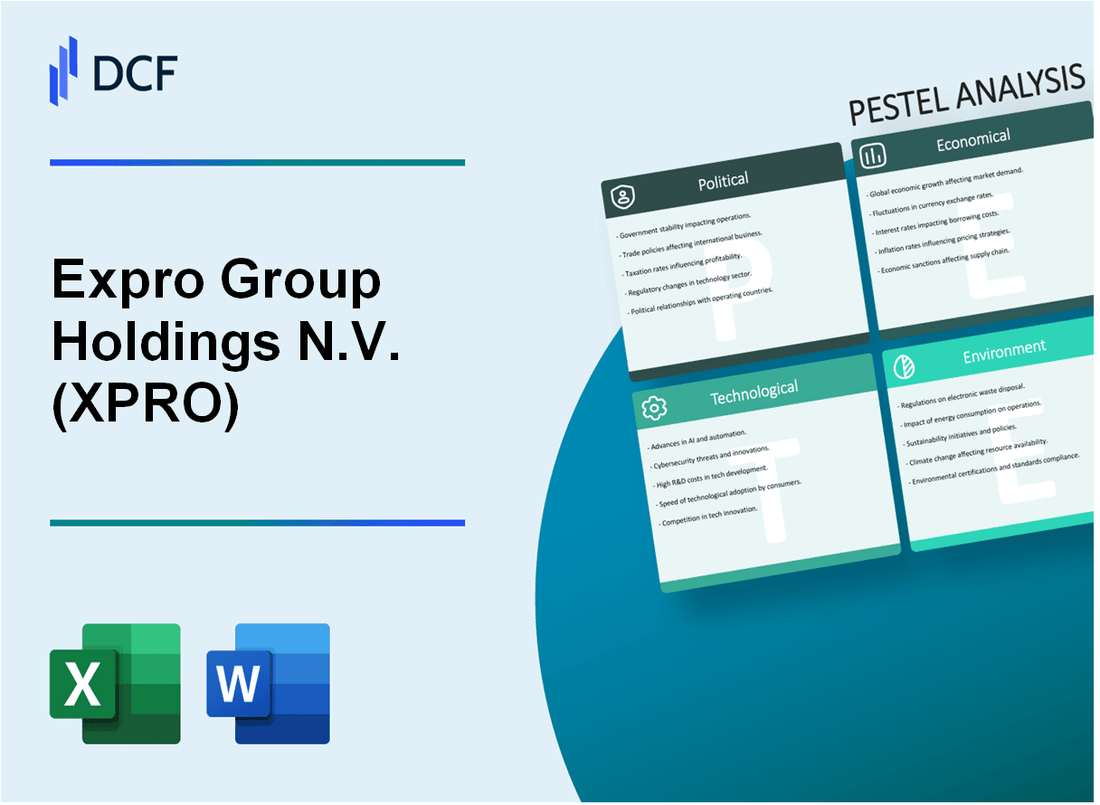
Expro Group Holdings N.V. (XPRO): PESTLE Analysis [Nov-2025 Updated] |
Fully Editable: Tailor To Your Needs In Excel Or Sheets
Professional Design: Trusted, Industry-Standard Templates
Investor-Approved Valuation Models
MAC/PC Compatible, Fully Unlocked
No Expertise Is Needed; Easy To Follow
Expro Group Holdings N.V. (XPRO) Bundle
You're looking for a clear, actionable breakdown of the external forces shaping Expro Group Holdings N.V. (XPRO), and that means cutting through the noise to the core risks and opportunities. As a seasoned analyst, I see a company that's successfully monetizing its deepwater technology, but it still operates in an industry facing intense geopolitical and regulatory pressure. The near-term outlook is strong, driven by a robust backlog, but the long-term hinges on successfully navigating the energy transition's political and legal headwinds.
Political Analysis
The political landscape is the single biggest near-term risk for Expro. Geopolitical tensions, especially in the Middle East and Europe, are defintely fueling energy price volatility, which can quickly shift customer spending plans. Plus, with operations spanning over 50+ countries, a significant chunk of revenue is exposed to local political instability and the risk of contract revision, which is a constant headache for international energy services companies. You also need to watch US administration policy; any new moratoria on federal Outer Continental Shelf drilling could immediately slow down a key growth area. Customer consolidation among operators might also slightly weigh on US rig activity in 2025. It's a high-stakes game of global chess.
Economic Analysis
Economically, Expro is showing solid momentum and clear visibility. The company raised its full-year 2025 Adjusted EBITDA guidance to between $350 million and $360 million, a strong signal of operational efficiency and demand. Here's the quick math: that guidance translates to a healthy margin in the current environment. Also, the Adjusted Free Cash Flow guidance increased to between $110 million and $120 million for 2025, which gives them capital flexibility. The strong order backlog of approximately $2.3 billion is crucial; it provides solid revenue visibility well into 2026. This is all supported by an expected 7% rise in global offshore activity in 2025, which plays right into Expro's deepwater focus. Cash flow is king, and they're generating it.
Sociological Analysis
Managing a global workforce of approximately 8,500 employees across multiple jurisdictions is a complex talent management challenge. Honestly, without an absolute core value commitment to safety and wellbeing, field operations face immediate and severe reputational risk. The industry's perception shift toward ESG (Environmental, Social, and Governance) is also directly influencing investor and institutional lender interest-if your ESG score dips, your cost of capital rises. For 2025, the focus on promoting diversity and inclusion is a key part of their social responsibility strategy. You can't win major contracts today without a credible ESG story.
Technological Analysis
Technology is Expro's competitive edge, especially in deepwater. The deployment of the ELITE Composition™ service in late 2025 is a game-changer; it offers rapid, on-site fluid measurements, directly reducing expensive rig time for customers. They also have the award-winning VIGILANCE™ Intelligent Safety and Surveillance Solution, which enhances rig-floor safety with 10-centimeter accuracy. Advanced deepwater technology, like the BRUTE® Packer System, targets the extreme high-pressure, high-tensile environments that few competitors can handle. Plus, autonomous systems like iTONG™ are being deployed to enhance operational efficiency and reduce costs in deepwater. They are selling efficiency, not just equipment.
Legal Analysis
The legal environment is getting more restrictive and costly. Increasing complexity of EU and US data privacy and security laws, such as GDPR (General Data Protection Regulation), means ongoing compliance costs are non-negotiable. More critically, there's a constant risk of new or stricter environmental, health, and safety (EHS) laws that could significantly increase operating costs across the board. You must also anticipate potential new legislation imposing carbon taxes or GHG (Greenhouse Gas) cap-and-trade programs in operating jurisdictions. Offshore regulatory initiatives could even limit or prohibit drilling in key areas like the U.S. Gulf of Mexico. Legal risk is operational risk in this sector.
Environmental Analysis
Expro has set aggressive, long-term environmental goals: a 50% reduction in greenhouse gas emissions by 2030 and achieving Net Zero CO2e emissions by 2050. This isn't just PR; it drives R&D investments toward solutions that support customers' carbon reduction objectives, which is where the future revenue lies. The business model is strategically positioned to support a lower carbon future through efficiency and innovative solutions. Still, the operational risks are real, including potential spills of regulated substances, which could result in significant liabilities. What this estimate hides is the massive capital expenditure required to hit that 2030 goal. The transition is a cost, but it's also the only way to stay relevant.
Expro Group Holdings N.V. (XPRO) - PESTLE Analysis: Political factors
You're looking for a clear view of the political landscape, and honestly, for Expro Group Holdings N.V., the picture is one of high-stakes volatility, but with a recent, significant upside shift in US policy. The core risk is that nearly all of Expro's growth is tied to international and offshore markets, which are inherently exposed to political instability and contract risk.
For the full year 2025, Expro reaffirmed its revenue guidance at circa $1.7 billion and Adjusted EBITDA of at least $350 million, which shows confidence, but that confidence rests on navigating a complex global political environment.
Geopolitical tensions in the Middle East and Europe increase energy price volatility.
The ongoing conflicts in Europe and the Middle East are the primary drivers of energy price volatility right now. For a global service provider like Expro, this means unpredictable customer spending and operational headaches, plus a heightened risk of cyberattacks.
Expro's business is heavily exposed to these regions, which is clear when you look at the Q2 2025 segment revenue breakdown. The Middle East & North Africa (MENA) segment delivered $91 million in revenue in Q2 2025, and the Europe, Sub-Saharan Africa, & South America (ESSA) segment brought in $132 million.
The key takeaway is that an escalation in the Russia-Ukraine conflict or the Israel-Hamas war could instantly disrupt a significant portion of Expro's revenue base, even if the higher oil prices initially look good for the industry. Geopolitical risk is not just about price; it's about access and security.
US administration policy risks new moratoria on federal Outer Continental Shelf drilling.
This risk has actually flipped on its head in late 2025. While the previous administration had a highly restrictive plan with only three sales, the current US administration has announced a major push toward expansion of federal Outer Continental Shelf (OCS) drilling.
The Department of the Interior is moving to terminate the prior limited plan and replace it with a new, expansive 11th National OCS Oil and Gas Leasing Program by October 2026. The draft proposal includes plans for as many as 34 offshore lease sales across approximately 1.27 billion acres through 2031, which is a massive, pro-drilling signal.
Here's the quick math on the shift:
| OCS Leasing Program | Former Administration Plan (2024-2029) | Current Administration Draft Proposal (2026-2031) |
|---|---|---|
| Total Lease Sales | 3 (Lowest number ever) | Up to 34 |
| Acres Proposed | Limited to Gulf of Mexico | Approximately 1.27 billion acres |
| Geographic Scope | Gulf of Mexico only | Pacific Coast, Alaska, and Gulf of Mexico |
The risk isn't a moratorium anymore; it's the political and legal fight from environmental groups and some state governments who will try to block this expansion.
International operations in 50+ countries expose revenue to local political instability and contract revision risk.
Expro's global footprint is a double-edged sword: it diversifies risk, but it also multiplies it. The company's operations span over 50 countries, meaning a significant portion of its revenue is subject to the whims of local politics, national oil company (NOC) budget cycles, and contract renegotiations.
The NOCs, which are often the primary customers in these regions, are subject to political directives that can change overnight. This exposure is a constant drag on risk-adjusted returns.
- Nationalization Risk: Governments in politically unstable regions may revise contracts or increase local content requirements, impacting margins.
- Currency Fluctuation: Revenue earned in local currencies, especially in volatile economies, is exposed to rapid devaluation against the US Dollar.
- Regulatory Uncertainty: Changes in tax laws or environmental regulations can suddenly increase the cost of operations in any of the dozens of countries where Expro works.
Customer consolidation among operators may slightly weigh on US rig activity in 2025.
The trend of major oil and gas operators consolidating-think ExxonMobil and Chevron acquiring smaller players-is a key factor limiting US onshore rig activity. When a major buys a smaller company, they typically focus on the best assets and cut redundant drilling programs to prioritize capital efficiency and shareholder returns.
This focus on efficiency, like drilling longer laterals, means companies can produce more oil with fewer rigs. The US active rig count fell from 750 in December 2022 to just 517 by October 2025. Industry forecasts suggest the US Lower 48 rig count will remain largely flat, expected at around 587 rigs in 2025, down slightly from 598 in 2024. That consolidation-driven efficiency is a headwind for oilfield service companies like Expro that rely on rig volume. It's a classic case of efficiency gains masking a decline in activity for service providers.
Expro Group Holdings N.V. (XPRO) - PESTLE Analysis: Economic factors
You're looking for a clear read on Expro Group Holdings N.V.'s economic stability and growth drivers, and the numbers from the end of 2025 tell a compelling story of financial discipline meeting a multi-year offshore upcycle. The key takeaway is that Expro has successfully translated market strength into superior cash flow and a massive, multi-year backlog, providing a strong cushion against near-term oil price volatility.
Full-year 2025 Adjusted EBITDA guidance raised to between $350 million and $360 million.
The management team's confidence is clear; they raised the full-year Adjusted EBITDA (Earnings Before Interest, Taxes, Depreciation, and Amortization) guidance to between $350 million and $360 million, based on their Q3 2025 results. This is a critical metric, as it shows the core profitability of the business-how much cash the operations are generating before financing and capital structure adjustments. It signals that their operational efficiency programs, like the Drive 25 initiative, are defintely paying off, helping them expand margins even amid a complex global market.
Here's the quick math on the expected profitability:
| Financial Metric (Full-Year 2025 Guidance) | Range |
|---|---|
| Adjusted EBITDA | $350 million - $360 million |
| Adjusted Free Cash Flow | $110 million - $120 million |
| Expected Revenue (Circa) | $1.60 billion - $1.65 billion |
Adjusted Free Cash Flow guidance increased to between $110 million and $120 million for 2025.
The increase in Adjusted Free Cash Flow (FCF) guidance to between $110 million and $120 million is arguably the most important signal for shareholders. FCF is the cash left over after a company pays for its operating expenses and capital expenditures (CapEx), and it's what funds dividends, share buybacks, and debt reduction. Management has committed to returning approximately one-third of this FCF to shareholders, which demonstrates a disciplined capital allocation strategy. The business is generating cash at a record pace, which limits the need for external financing and strengthens the balance sheet.
Strong order backlog of approximately $2.3 billion provides solid revenue visibility into 2026.
A substantial order backlog of approximately $2.3 billion is a massive economic stabilizer. This figure represents signed contracts that will convert to revenue over the next several years, giving Expro a high degree of revenue visibility. This backlog is a clear competitive advantage, insulating the company from the quarter-to-quarter whims of the spot commodity market. It's a multi-year foundation that allows for strategic planning and investment.
What this estimate hides is the breakdown, which shows the long-term nature of their contracts:
- Q4 2025: $380 million in confirmed revenue.
- 2026: $1 billion, providing strong visibility for the next fiscal year.
- 2027 and Beyond: $950 million, securing long-term revenue streams.
Offshore activity is expected to rise by 7% in 2025, supporting Expro's deepwater focus.
While the overall global upstream investment is plateauing, Expro's core markets-international and offshore-are showing targeted strength. Deepwater and offshore shelf projects, which account for about 70% of Expro's revenue, are driving the economic growth.
The specific economic drivers for Expro's deepwater focus are:
- Deepwater investments are projected to increase by 3% in 2025, with key developments in Suriname, Mexico, and Türkiye.
- Offshore shelf investments are forecast to grow by 2% in 2025, fueled by activity in regions like Indonesia, Qatar, and Russia.
- Drillship utilization, a proxy for ultra-deepwater activity, is expected to climb to 97% in 2025, indicating a severely tightening market for high-specification rigs and services.
This market tightness translates directly into pricing power for specialized service providers like Expro, which is a major factor supporting the expanded EBITDA margins.
Expro Group Holdings N.V. (XPRO) - PESTLE Analysis: Social factors
You're operating in a global energy services market where talent, safety, and social license are now just as critical as your technology. The key takeaway for Expro Group Holdings N.V. is that while your safety metrics are world-class, the pressure to deliver quantifiable diversity and inclusion (D&I) progress in 2025 is intensifying, especially from institutional investors focused on ESG.
Sociological
Expro Group Holdings N.V. must manage a complex human capital equation, with approximately 8,500 employees operating across more than 50 countries as of early 2025. This massive global footprint means that talent management is multi-jurisdictional, requiring localized compensation, benefits, and labor relations, plus a unified corporate culture to hold it all together. Honestly, managing a workforce spread from the Gulf of Mexico to the Middle East is a daily exercise in logistical complexity.
Global workforce of approximately 8,500 employees requires complex, multi-jurisdictional talent management
The sheer scale of the workforce, which was 8,500 employees as of December 31, 2024, necessitates robust and decentralized Human Resources systems. This is not just about payroll; it's about navigating varying labor laws, managing collective bargaining agreements in certain international areas, and ensuring consistent application of the company's core values across diverse cultures. This complexity raises the cost of compliance and training compared to a purely domestic operation.
Core value commitment to safety and wellbeing is critical for field operations and managing reputational risk
Safety is a non-negotiable core value for Expro Group Holdings N.V., especially since operational failures directly translate to catastrophic reputational and financial risk. The company rigorously tracks its safety performance using industry-standard metrics like the Lost Time Injury Frequency (LTIF) rate and the Total Recordable Case Frequency (TRCF) rate (both normalized per million man-hours worked).
For the full year 2024, the company demonstrated exceptional performance in LTIF, a critical indicator of severe injuries. Here's the quick math on recent safety performance:
| Metric | Definition | 2024 Rate | 2023 Rate |
|---|---|---|---|
| Lost Time Injury Frequency (LTIF) | Frequency of injuries resulting in lost work time | 0.00 | 0.06 |
| Total Recordable Case Frequency (TRCF) | Frequency of all recordable workplace injuries | 1.05 | 0.61 |
The 2024 LTIF of 0.00 is a phenomenal result, indicating zero lost-time injuries for the year, which is a key competitive differentiator when bidding for major contracts. Still, the TRCF rose to 1.05 in 2024 from 0.61 in 2023, suggesting an increase in less severe, but still recordable, workplace incidents that needs to be addressed to maintain the long-term trend of safety improvement.
Industry perception shift toward ESG (Environmental, Social, and Governance) influences investor and institutional lender interest
The energy services sector is under intense scrutiny, and Expro Group Holdings N.V.'s commitment to sustainability, reflected in its ESG initiatives, is crucial for capital access. Increasing focus on ESG has led to enhanced interest from investors, major banks, and institutional lenders, who now actively review social performance results. A strong social pillar, driven by safety and D&I, directly supports the company's valuation and its ability to secure favorable financing terms for its operations.
- ESG-driven capital: Poor social metrics can increase the cost of capital.
- Reputational risk: Safety incidents or D&I failures pose a direct threat to the company's social license to operate.
- Stakeholder review: Performance is reviewed by a wide range of stakeholders, not just customers.
Focus on promoting diversity and inclusion is a key part of the 2025 social responsibility strategy
Promoting diversity and inclusion (D&I) is a stated objective of the company's 2025 social responsibility strategy. The company values diversity in its workforce and aims to attract, develop, and retain the best talent to create an inclusive working environment. This is defintely a business imperative, as diverse perspectives lead to better solutions in a technology-driven sector.
While specific 2025 internal metrics are not always public, the company's D&I efforts include supporting Employee Resource Groups and ensuring equal employment opportunities. The challenge for Expro Group Holdings N.V. is to translate this commitment into measurable progress, particularly in increasing the representation of women and minorities in senior technical and leadership roles, which remains a challenge across the entire energy industry.
Finance: Draft a brief on the potential impact of the 2024 TRCF increase on 2025 insurance premiums by the end of the quarter.
Expro Group Holdings N.V. (XPRO) - PESTLE Analysis: Technological factors
As a seasoned financial analyst, I see Expro Group Holdings N.V. (XPRO) making smart, targeted technology investments that directly map to operational efficiency and safety, which is defintely a key driver for deepwater clients. These aren't just incremental updates; they are step-changes in critical areas like fluid analysis, rig-floor safety, and well construction.
The company's focus on automation and real-time data translation is a clear competitive advantage, positioning them well against peers who are still relying on older, slower processes. This is how you drive margin growth in the energy services sector.
Deployment of the ELITE Composition™ service in late 2025 offers rapid, on-site fluid measurements, reducing rig time.
You need fast, accurate data to make multi-million-dollar decisions, and waiting months for lab results just doesn't cut it anymore. Expro's new ELITE Composition™ service, which saw its first successful deployment in Cyprus in November 2025, changes that equation.
This innovative technology delivers laboratory-standard fluid measurements directly at the rig site, cutting the turnaround time from what traditionally took several months due to international shipping and regulatory hurdles to approximately eight hours. This immediate data availability is crucial because it supports the calibration of wireline logs and enables dynamic reservoir modeling right on the rig, accelerating the entire planning process for future development.
Award-winning VIGILANCE™ Intelligent Safety and Surveillance Solution enhances rig-floor safety with 10-centimeter accuracy.
Safety is not just a compliance issue; it's an operational cost-saver, and Expro's VIGILANCE™ Intelligent Safety and Surveillance Solution is a clear leader here. The system won the Best Health, Safety or Environmental Contribution - Upstream at the 2025 Gulf Energy Awards in Houston, which is a strong industry signal.
The core value is its precision: VIGILANCE™ tracks both equipment and personnel movement in real-time with an accuracy of 10-centimeters. This level of precision is vital for managing the hazardous 'red zone' on the rig floor, where multiple pieces of heavy equipment are constantly in motion, directly addressing a main key performance indicator for enhancing personnel safety.
Advanced deepwater technology, like the BRUTE® Packer System, targets extreme high-pressure, high-tensile environments.
The deepwater environment is where the highest margins are, but it demands the most robust technology. The launch of the most advanced BRUTE® High-Pressure, High Tensile Packer System in 2025 is a strategic move to capture this high-spec market, particularly supporting 20k deepwater projects.
The new BRUTE® Armor Packer System, which was first successfully deployed in the Gulf of America in April 2025, is engineered for the highest differential pressures in the market-with a rating of 12,850 psid for the 12.25" variant. Also, the new 20"/22" Packer System, deployed in June 2025, offers twice the element expansion capability of traditional mechanical packers, allowing operators to set higher in the wellbore and save rig time.
Autonomous systems like iTONG™ are being deployed in deepwater to enhance operational efficiency and reduce costs.
Automation is the future of well construction, and the iTONG™ autonomous Tubular Running Services (TRS) system delivers immediate, quantifiable efficiency gains. Its first deepwater deployment in Sub-Sahara Africa in June 2025 for client Eni demonstrated a massive operational improvement.
Here's the quick math on the deepwater deployment:
- Connection make-up times were cut by 50%.
- 'Park-to-park' connection times dropped from 180 seconds to just 90 seconds.
- The estimated cost savings per well project are approximately $200,000.
This one-button, remote-operated solution eliminates the need for personnel in the hazardous Red Zone, which is a major safety and efficiency win. The system uses machine learning to ensure optimal make-up parameters, improving well integrity and reducing backouts.
| Technology | Core Function | 2025 Operational Metric | Financial/Time Benefit |
|---|---|---|---|
| ELITE Composition™ Service | On-site Fluid Analysis | Lab-standard results in approx. 8 hours | Reduces traditional lab time of several months. |
| iTONG™ Autonomous System | Tubular Running Services (TRS) | Connection make-up time cut by 50% (to 90 seconds) | Estimated savings of approx. $200,000 per deepwater well project. |
| VIGILANCE™ Solution | Rig-Floor Safety Surveillance | Real-time tracking with 10-centimeter accuracy | Enhances safety; mitigates risk in the hazardous 'red zone'. |
| BRUTE® Packer System (12.25") | Deepwater Well Construction | Rated for 12,850 psid pressure | Enables work in extreme 20k deepwater projects; saves rig time. |
Expro Group Holdings N.V. (XPRO) - PESTLE Analysis: Legal factors
Increasing complexity of EU and US data privacy and security laws (like GDPR) necessitates ongoing compliance costs.
You are operating in a world where data is as critical as drilling fluid, so the legal risks around data privacy are rapidly escalating. For a global company like Expro Group Holdings N.V. that handles sensitive operational and employee data across jurisdictions, managing compliance with the EU's General Data Protection Regulation (GDPR) and a patchwork of new US state laws is a constant, expensive challenge. Honestly, this is a major operational drag.
The compliance cost is not just about avoiding fines, which can be up to 4% of annual global turnover under GDPR. Studies cited in late 2025 suggest that GDPR compliance alone can increase the overall costs for a large business by an average of 20%. This figure doesn't even account for the new EU Cyber Resilience Act or the EU AI Act, which impose strict cybersecurity and testing obligations on connected products and high-risk AI systems that Expro may use in its digital oilfield services.
The complexity is compounded by uncertainty, such as the ongoing legal challenges to the EU-U.S. Data Privacy Framework (DPF), which, if invalidated, would disrupt transatlantic data transfers and force a costly reliance on alternative mechanisms like Standard Contractual Clauses (SCCs) for data flowing from the EU.
Risk of new or stricter environmental, health, and safety (EHS) laws that could increase operating costs.
The fundamental legal risk remains the constant tightening of Environmental, Health, and Safety (EHS) regulations globally. Expro's own filings for the period ending September 30, 2025, acknowledge that their operations are subject to numerous, complex laws governing environmental protection and occupational health and safety, and that compliance is 'complex and costly.'
The trend is clear: governments are moving toward more stringent restrictions and limitations on activities that impact the environment, which translates directly into higher capital expenditures and operating expenses for oilfield service providers. This includes everything from waste handling and disposal requirements to new rules on worker exposure and equipment certification.
- Failure to comply can result in significant sanctions.
- Penalties include civil penalties and criminal prosecution.
- New EHS rules often require costly capital upgrades.
Potential for new legislation imposing carbon taxes or GHG cap-and-trade programs in operating jurisdictions.
While the long-term global risk of carbon pricing remains, the near-term 2025 legislative environment in the US has actually created a favorable legal tailwind for the oil and gas sector, which benefits Expro's customers. The 'One Big Beautiful Bill Act' (OBBBA), enacted in July 2025, has significantly altered the landscape, pushing back punitive measures and boosting incentives.
Here's the quick math on the US legislative shift:
| Regulatory Factor | Pre-OBBBA (IRA) Status | Post-OBBBA (2025) Status | Impact on Expro's Customers |
|---|---|---|---|
| Methane Emissions Fee | Scheduled to begin soon | Delayed until 2035 (for 2034 emissions) | Significantly reduces near-term operating costs. |
| Section 45Q Tax Credit (EOR) | Up to $60 per metric ton of CO2 | Increased to $85 per metric ton of CO2 | Boosts the economics of Enhanced Oil Recovery (EOR) projects, a service Expro provides. |
| Intangible Drilling Costs (IDCs) | Only a portion deductible | Full deduction reinstated | Lowers tax burden for E&P customers, freeing up capital for drilling. |
This shift means the immediate risk of a US federal carbon tax or cap-and-trade program has been defintely postponed, and instead, the industry is seeing a subsidy for carbon capture utilized in Enhanced Oil Recovery (EOR), a service Expro provides.
Offshore regulatory initiatives could limit or prohibit drilling in key areas like the U.S. Gulf of Mexico.
Contrary to the risk of prohibition, 2025 saw a significant regulatory easing in the U.S. Gulf of Mexico (GOM), a key operating area for Expro. The Interior Department, following the 'Unleashing American Energy' executive order, implemented new rules in April 2025 to simplify drilling operations.
This initiative targets a specific technical hurdle, making it easier for operators to produce from multiple reservoirs at once. This single regulatory change is projected to boost GOM oil output by over 100,000 additional barrels a day over the next decade, which is a clear opportunity for Expro's drilling and well intervention services.
The key change was an increase in the allowable pressure differential for 'Downhole Commingling' in the Paleogene (Wilcox) reservoirs, moving the limit from 200 psi to 1500 psi. Less regulatory friction means more drilling activity, so this is a major near-term positive. The long-term risk of future administrations imposing restrictions still exists, but the 2025 action is decisively pro-production.
Expro Group Holdings N.V. (XPRO) - PESTLE Analysis: Environmental factors
You're looking at Expro Group Holdings N.V.'s environmental posture, and the takeaway is clear: the company is actively re-tooling its business model to align with the energy transition, but it still carries the substantial operational liability inherent to the oilfield services sector. Their long-term decarbonization targets are aggressive, but the near-term success hinges on quickly scaling their R&D investments into commercial, low-carbon solutions.
Company goal is to reduce greenhouse gas emissions by 50% by 2030 and achieve Net Zero CO2e emissions by 2050.
Expro has set firm, public targets for its own carbon footprint, moving beyond vague commitments to clear, measurable goals. The primary objective is a 50% reduction in carbon intensity by the year 2030, with the ultimate aim of achieving Net Zero CO2e emissions by 2050. This is a serious commitment that directly impacts capital allocation and operational strategy for the next two decades. To be fair, they have already started making progress; the company reported a reduction of 11% in its Scope 1 and Scope 2 greenhouse gas (GHG) emissions from a 2021 baseline, which shows they are moving the needle.
Here's the quick math on their long-term goals:
| Metric | Target | Deadline | Progress (from 2021 baseline) |
|---|---|---|---|
| Carbon Intensity Reduction | 50% | 2030 | 11% reduction (Scope 1 & 2) |
| Net Emissions | Net Zero CO2e | 2050 | Requires sustained, high-impact technology adoption |
R&D investments are increasingly focused on solutions that support customers' carbon reduction objectives.
The company understands that its future growth is tied to helping its customers-the major oil, gas, and geothermal operators-hit their own environmental targets. This is why R&D dollars are being strategically redirected. While the most recent publicly disclosed percentage is from 2022, it's a telling figure: 47% of Expro's 2022 Research and Development Technology budget was explicitly allocated to carbon reduction projects. This focus is a strong indicator of where their $83.7 million in total 2024 capital expenditures is ultimately headed.
This investment is not just about incremental efficiency; it's about developing new, less carbon-intensive ways to operate. This is defintely a smart move.
The business model is positioned to support a lower carbon future through efficiency and innovative solutions.
Expro's business model is shifting from a pure oilfield services provider to a 'well expert' focused on efficiency and lower-carbon solutions across the entire well life cycle. They are actively advancing their portfolio to provide customers with cost-effective, innovative solutions that produce resources more efficiently and with a lower carbon footprint. This means focusing on high-growth, energy transition-aligned areas like:
- Flare Reduction: Technologies to capture and monetize gas that would otherwise be burned off.
- Geothermal Energy: Applying their deep well expertise to tap into this clean energy source.
- Plug and Abandonment (P&A): Safely decommissioning old wells, a critical environmental service.
- Digitalization: Using data and automation, like their Galea™ system, to replace more carbon-intensive, manual operations.
The company is not abandoning traditional energy, but it is using its core competency to pivot toward a lower-carbon world. That's a resilient strategy.
Operational risks include potential spills of regulated substances, which could result in significant liabilities.
As a global energy services provider, Expro faces material, non-negotiable operational risks related to the environment. The primary concern is the potential for accidental releases or spills of regulated substances, which can happen during drilling, well testing, or intervention activities. The regulatory environment is only getting stricter, meaning any failure to comply with environmental laws can result in severe sanctions.
These sanctions include administrative and civil penalties, criminal prosecution, and the required incurrence of capital expenditures for remediation. The risk is serious because certain environmental laws impose joint and several strict liability (liability without regard to fault). While the specific dollar amount for environmental liabilities is typically undisclosed until a loss is probable and estimable, the company's financial reports consistently list 'Commitments and contingencies' (Note 17 in the March 31, 2025, filing) as a key area of potential financial exposure. The cost of a major spill, including clean-up and third-party claims for property or natural resource damage, could result in significant, unbudgeted liabilities.
Disclaimer
All information, articles, and product details provided on this website are for general informational and educational purposes only. We do not claim any ownership over, nor do we intend to infringe upon, any trademarks, copyrights, logos, brand names, or other intellectual property mentioned or depicted on this site. Such intellectual property remains the property of its respective owners, and any references here are made solely for identification or informational purposes, without implying any affiliation, endorsement, or partnership.
We make no representations or warranties, express or implied, regarding the accuracy, completeness, or suitability of any content or products presented. Nothing on this website should be construed as legal, tax, investment, financial, medical, or other professional advice. In addition, no part of this site—including articles or product references—constitutes a solicitation, recommendation, endorsement, advertisement, or offer to buy or sell any securities, franchises, or other financial instruments, particularly in jurisdictions where such activity would be unlawful.
All content is of a general nature and may not address the specific circumstances of any individual or entity. It is not a substitute for professional advice or services. Any actions you take based on the information provided here are strictly at your own risk. You accept full responsibility for any decisions or outcomes arising from your use of this website and agree to release us from any liability in connection with your use of, or reliance upon, the content or products found herein.