

|
Yalla Group Limited (YALA): PESTLE Analysis [Nov-2025 Updated] |
Fully Editable: Tailor To Your Needs In Excel Or Sheets
Professional Design: Trusted, Industry-Standard Templates
Investor-Approved Valuation Models
MAC/PC Compatible, Fully Unlocked
No Expertise Is Needed; Easy To Follow
Yalla Group Limited (YALA) Bundle
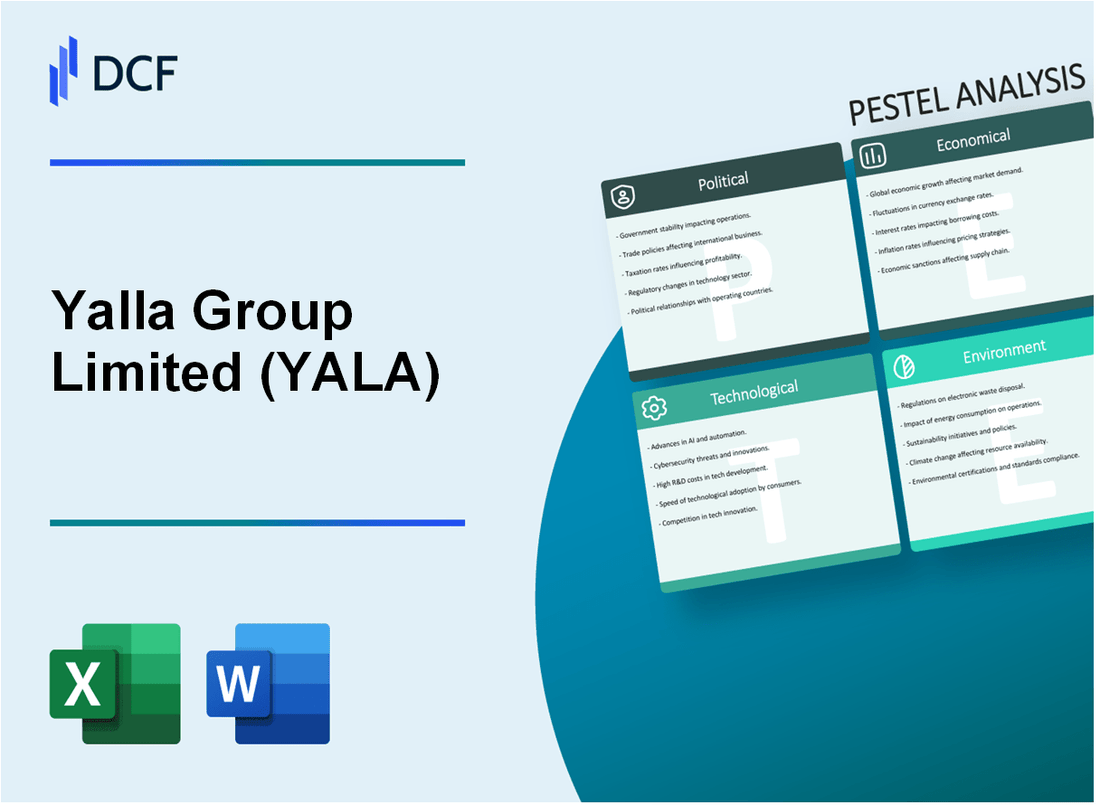
You want to know the real forces shaping Yalla Group Limited (YALA) in 2025, and honestly, the picture is one of high profits against high geopolitical risk. Yalla is a dominant, cash-rich MENA social gaming leader with a projected full-year 2025 net margin of about 40%, but that success is constantly tested by a volatile operating region and a concerning 9.7% drop in paying users. Let's dig into the Political, Economic, Social, Technological, Legal, and Environmental factors that will defintely drive their stock price next year.
Political Factors: Geopolitical Risk and Regulatory Stability
The biggest near-term risk for Yalla is political, full stop. Operating primarily in the volatile MENA (Middle East and North Africa) region means geopolitical instability is a constant factor that can disrupt operations or user sentiment overnight. Still, the company benefits from a favorable regulatory environment in the UAE, where its headquarters are located.
To be fair, they have a dual political dependency: the stability of the UAE for the business hub and China for core operations and development. Plus, any government censorship or content restrictions on social platforms in key markets could immediately impact their Average Monthly Active Users (MAUs).
Economic Factors: Profitability vs. User Dip
Economically, Yalla is a powerhouse. They reported a strong Q3 2025 net margin of 45.4%, and we project their full-year 2025 net margin to land around 40%. Here's the quick math: they are highly profitable because their cost structure is low relative to their in-game purchase revenue.
The opportunity is massive, with the MENA gaming market projected to hit $7.1 billion in 2025. But this estimate hides a critical risk: their paying user base fell 9.7% to 11.4 million in Q3 2025. That's a clear action signal-they need to convert more MAUs to paying users. Still, their liquidity is robust, with a cash position of $690.9 million as of Q1 2025, giving them a huge buffer for acquisitions or R&D.
Sociological Factors: Cultural Relevance and Youth Demographics
Yalla has nailed the sociological factor. Their Average Monthly Active Users (MAUs) grew 8.1% to 43.4 million in Q3 2025, showing their products resonate deeply. The demand in the region is for localized, voice-centric social and gaming experiences, which is exactly what Yalla and Yalla Ludo provide.
Cultural relevance is key to their stickiness. They specifically tailor products for Arabic users, even launching the WeMuslim app. And honestly, the high youth population in MENA is a demographic tailwind that will continue to drive demand for digital entertainment for years to come.
Technological Factors: AI Investment and Diversification
The company is smart about technology, strategically investing in AI development to analyze user behavior and enhance operational efficiency. They aren't just sitting on their successful chat and Ludo apps; they are actively expanding the product ecosystem to maintain user engagement.
A clear action is their strategic shift to launch new mid-core and hard-core games like Turbo Match. This is a crucial move to diversify from casual gaming and capture more wallet share. But they face stiff competition from global giants like Tencent and Zynga, plus regional rivals. That's a constant battle for developer talent and user attention.
Legal Factors: Tax Advantage and Regulatory Compliance
Yalla is exposed to evolving data privacy and content censorship laws across multiple MENA jurisdictions, so compliance costs are rising. On the upside, they benefit significantly from the UAE's low corporate tax rate, which was only 1.5% in 2025. That's a massive competitive advantage.
The risk of adverse regulatory changes concerning virtual currencies and in-game purchases is real, as those mechanics drive the bulk of their revenue. Plus, due to its NYSE listing, the company must comply with US regulations, adding another layer of legal complexity and scrutiny.
Environmental Factors: Low Direct Impact and ESG Focus
As a purely software and online service company, Yalla's direct environmental impact is generally low. Still, they are paying attention to the 'E' in ESG (Environmental, Social, and Governance), outlining a focus on environmental stewardship in their 2024 ESG Report published in April 2025.
Their commitment is mostly operational: promoting paperless operations and reducing its digital carbon footprint. What this estimate hides is that their indirect impact-the energy consumption of millions of users' devices-is much harder to measure or control. But for now, this factor is a minor concern.
Yalla Group Limited (YALA) - PESTLE Analysis: Political factors
Geopolitical risk from operating primarily in the volatile MENA region
You have to be a realist about the Middle East and North Africa (MENA) region; while it's a massive growth engine-Yalla Group Limited's Q2 2025 revenue hit $84.6 million-it's also inherently volatile. This geopolitical risk is a constant overhang. Any sudden conflict, diplomatic fallout, or trade disruption in a key market like Saudi Arabia or Egypt can instantly impact user engagement and monetization, even if the company's headquarters are in the relatively stable UAE.
The company's success is tied to its ability to localize, but that hyper-localization also means higher exposure to individual country risks. To be fair, Yalla Group is trying to mitigate this by expanding outside MENA, with initiatives like the Yalla Parchis game targeting South America.
Favorable regulatory environment in the UAE, where the company is headquartered
The UAE headquarters is a defintely strategic advantage. The country actively courts tech companies, and Yalla Group benefits directly from a favorable tax structure. For the 2025 fiscal year, the UAE's low corporate tax rate is a key financial tailwind, noted at just 1.5% for tech firms.
This structure is not just about tax savings; it's structural. Yalla Group Limited is a holding company, and its ability to pay dividends to shareholders is directly dependent on the profits generated by its UAE subsidiaries, which collect the vast majority of user payments for virtual currencies.
Dependence on the political and regulatory stability of both the UAE and China for core operations
Yalla Group's operational model is a classic dual-base structure that introduces a unique set of political dependencies. While the UAE is the financial and operational hub, the company's core development and engineering expertise often stem from its China-based subsidiaries.
This means stability is needed on two fronts. You need the UAE to maintain its business-friendly, low-tax environment, but you also need China's regulatory landscape to remain predictable for the R&D and talent pipeline. This efficiency is what drives the high Q2 2025 Net Margin of 43.2%.
Here's the quick map of this dual-base risk:
- UAE Risk: Sudden changes to data sovereignty laws or corporate tax exemptions.
- China Risk: Increased scrutiny on overseas-listed tech companies or restrictions on capital/talent flow.
Potential for government censorship or content restrictions on social platforms in key markets
This is arguably the most acute political risk for a social networking and gaming company in the MENA region. Yalla Group must constantly navigate a patchwork of strict content control, cybersecurity, and data privacy laws across multiple jurisdictions.
The political climate in the region is pushing for tighter online control. For example, the 2025 'Untrue Content' Law approved in Iran, a country in the broader region, shows the extreme end of this trend. This law raises possible prison terms for spreading online content deemed untrue to up to 15 years, with authorities even having the power to treat severe cases as capital offenses. While Yalla Group may not operate directly in every country, this sets a high-risk precedent for content moderation and compliance across the entire region.
The sheer volume of user-generated content across 42.4 million average Monthly Active Users (MAUs) in Q2 2025 makes content compliance a massive, non-negotiable operational burden.
| Factor | Primary Location | 2025 Financial/Operational Impact | Near-Term Actionable Risk |
|---|---|---|---|
| Corporate Tax Benefit | UAE (Headquarters) | Low corporate tax rate of 1.5%; directly boosts net income. | Risk of UAE corporate tax rate rising above the current low threshold. |
| Development & Talent Base | China (Subsidiaries) | Enables high operational efficiency, contributing to 43.2% Q2 Net Margin. | Increased regulatory pressure from the Chinese government on overseas-listed tech firms. |
| Content Compliance | MENA (Key Markets) | Directly affects user acquisition and retention; risk of service ban. | Heightened censorship laws, such as the Iran 'Untrue Content' Law, carrying penalties up to 15 years. |
Yalla Group Limited (YALA) - PESTLE Analysis: Economic factors
Strong profitability with a Q3 2025 net margin of 45.4%.
You need to look past the top-line revenue growth-which is modest-and focus on Yalla Group Limited's exceptional profitability. In the third quarter of 2025, the company reported a GAAP net margin of 45.4%. This is a defintely high-quality margin, reflecting a disciplined approach to cost management and a highly efficient, capital-light business model, especially within its core social networking and gaming services.
This margin performance drove net income to $40.7 million for Q3 2025, a 3.9% increase year-over-year. The key takeaway here is that Yalla is a cash-generating machine, not a growth-at-any-cost operation. That level of margin is rare in the tech space.
Full-year 2025 net margin is projected to reach about 40%.
While the Q3 margin was very strong, management's full-year 2025 net margin projection is slightly lower, anticipated to reach about 40%. This slight moderation accounts for increased investment in new growth initiatives, particularly in their expanding game portfolio and the application of Artificial Intelligence (AI) to enhance their platforms.
Here's the quick math: They are intentionally trading a few margin points for future revenue streams. This strategic investment is a near-term drag on the margin but is critical for long-term diversification beyond their flagship voice-chat app, Yalla, and their popular game, Yalla Ludo.
Massive MENA gaming market projected to hit $7.1 billion in 2025.
The Middle East and North Africa (MENA) region represents a massive economic opportunity for Yalla Group Limited. The broader MENA games market has been valued at a significant scale, with some reports indicating the market has recently surpassed $7.1 billion in revenue. This is a high-growth territory, with a young, digitally-native population and rapidly increasing internet penetration.
The market is characterized by high engagement, with mobile gaming dominating the landscape-a perfect fit for Yalla's core products. This huge, growing addressable market provides a powerful tailwind for the company, even if they only capture a small fraction of the overall spending.
Declining paying user base, which fell 9.7% to 11.4 million in Q3 2025.
The most significant near-term risk is the contraction in the paying user base, which is a direct threat to the monetization engine. The number of paying users declined by 9.7% year-over-year, falling to 11.4 million in the third quarter of 2025. This drop signals a potential issue with the conversion rate or the long-term engagement of their highest-value users.
While the average monthly active users (MAUs) grew to 43.4 million in Q3 2025, the paying user decline suggests that the new, broader user base is not converting to paid services at the same rate as before. This trend puts pressure on the average revenue per paying user (ARPPU) to compensate for the smaller pool of paying customers.
| Metric | Q3 2025 Value | Year-over-Year Change |
|---|---|---|
| GAAP Net Margin | 45.4% | Up 1.4 percentage points |
| Net Income | $40.7 million | Up 3.9% |
| Paying Users | 11.4 million | Down 9.7% |
| Average MAUs | 43.4 million | Up 8.1% |
Robust liquidity with a cash position of $690.9 million as of Q1 2025.
The company's balance sheet is incredibly strong, providing a substantial buffer against market volatility and funding for strategic expansion. As of the end of the first quarter of 2025 (March 31, 2025), Yalla Group Limited reported a total cash position-including cash and cash equivalents, restricted cash, term deposits, and short-term investments-of $690.9 million. This is a huge war chest.
This robust liquidity gives management significant optionality. They are effectively debt-free, with negligible total debt of only $0.8 million as of Q1 2025. This financial strength supports their ongoing share repurchase program and allows them to pursue acquisitions or large-scale product development without external financing pressure. This is a critical competitive advantage, especially when looking at the capital requirements for new game development.
- Maintain a high net margin of around 40% for the full year 2025.
- Cash per share is approximately $4.33 against a share price of $6.81 (as of mid-2025).
- The company has $73.1 million remaining for its share repurchase program through May 2026.
Yalla Group Limited (YALA) - PESTLE Analysis: Social factors
The social factors for Yalla Group Limited are a powerful tailwind, driven by a young, digitally-native population in the Middle East and North Africa (MENA) region that craves localized, community-focused digital experiences. Your investment thesis here should center on Yalla's deep cultural relevance, which is defintely a high barrier to entry for global competitors.
Strong user base growth, with Average Monthly Active Users (MAUs) increasing 8.1% to 43.4 million in Q3 2025
User base expansion remains a core strength for Yalla Group, showing that their localized strategy is working. In the third quarter of 2025, the company reported Average Monthly Active Users (MAUs) of 43.4 million, which is a solid 8.1% increase year-over-year from 40.2 million in Q3 2024. This growth is a clear indicator of the platform's sticky nature, even as the number of paying users declined by 9.7% to 11.4 million in the same period. Here's the quick math: the company is effectively broadening its top-of-funnel reach, but monetization conversion is the near-term challenge to watch.
This user growth is particularly impressive considering the scale, and it highlights the massive, untapped potential of the MENA digital market. You can see the user engagement metrics in this table:
| Metric | Q3 2025 Value | Year-over-Year Change |
|---|---|---|
| Average Monthly Active Users (MAUs) | 43.4 million | +8.1% |
| Paying Users | 11.4 million | -9.7% |
| Total Revenue | US$89.6 million | +0.8% |
High demand for localized, voice-centric social and gaming experiences like Yalla and Yalla Ludo
Yalla Group's success is rooted in its understanding of social dynamics in the MENA region. The flagship applications, Yalla and Yalla Ludo, are designed specifically to replicate and enhance traditional social interactions. Yalla is a voice-centric group chat platform, mirroring the region's preference for voice communication over text.
Yalla Ludo, a casual gaming application, features online versions of popular regional board games and includes localized majlis functionality, which is a virtual space for social gatherings and conversation. This focus on voice-first, culturally familiar content is what keeps users engaged and distinguishes Yalla from global platforms. They've built a digital majlis-that's the whole story.
Cultural relevance is key, with products tailored for Arabic users, including the WeMuslim app
The company's commitment to cultural relevance goes beyond its core social and gaming apps. The broader Yalla ecosystem includes applications specifically tailored to the cultural and religious needs of its Arabic user base. The most notable example is the WeMuslim app, a spiritual companion platform that provides essential tools like accurate prayer times, the full Quran with audio, and a Qibla compass.
This product line is a strategic moat (a competitive advantage). The WeMuslim app alone is a favorite of over 50 million Muslims, showcasing Yalla's ability to build trust and deep engagement by supporting users in observing their customs. This level of integration into daily life is a powerful driver of long-term user loyalty and ecosystem health. The product portfolio includes:
- Yalla: Voice-centric group chat platform.
- Yalla Ludo: Casual gaming with localized majlis (social gathering) functionality.
- YallaChat: Instant messaging (IM) product tailored for Arabic users.
- WeMuslim: Spiritual companion app supporting religious customs for over 50 million Muslims.
High youth population in MENA drives demand for digital entertainment
The demographic structure of the MENA region provides a fundamental, long-term social advantage for Yalla Group. The region has a disproportionately young population, which is inherently more inclined toward digital entertainment and social networking. This demographic dividend creates a massive, continuously replenishing pool of potential users for Yalla's platforms. The success of the company's expanding game portfolio, including new titles like Turbo Match and upcoming mid-core and hard-core games, directly capitalizes on this high youth demand for digital leisure. This is a structural advantage that won't change anytime soon.
Yalla Group Limited (YALA) - PESTLE Analysis: Technological factors
Significant investment in AI development to analyze user behavior and enhance operational efficiency.
You can't run a massive social and gaming platform like Yalla Group Limited without a serious tech backbone, and their 2025 financials show a clear doubling down on artificial intelligence (AI). This isn't just buzzword compliance; it's a core strategy to drive down costs and sharpen user acquisition. Look at the numbers: the company's technology and product development expenses in the third quarter of 2025 hit US$8.6 million, marking a significant 21.4% increase from the same period last year.
This increased spend is directly funding a larger headcount for tech staff and, crucially, the development of AI algorithm models. These models are specifically tailored to the cultural nuances of the Middle East and North Africa (MENA) region, helping to refine management practices and optimize user acquisition strategies. The payoff is already visible in their profitability, with the net margin increasing to 45.4% in Q3 2025, an expansion of 1.4 percentage points year-over-year, which management credits partly to these efficiency improvements.
Here's the quick math on the R&D commitment:
| Metric | Q3 2025 Value | Year-over-Year Change |
|---|---|---|
| Technology & Product Development Expenses | US$8.6 million | +21.4% |
| R&D as % of Total Revenues | 9.6% | Up from 8.0% |
| Net Margin (Efficiency Indicator) | 45.4% | Up 1.4 percentage points |
Strategic shift to launch new mid-core and hard-core games like Turbo Match to diversify from casual gaming.
The days of relying solely on casual titles like Yalla Ludo are fading; 2025 is defintely Yalla's 'Year of the Game,' marking a strategic pivot to mid-core and hard-core gaming. This is a smart move because these genres typically generate a much higher lifetime value (LTV) per user, which is essential after seeing a decline in paying users.
The company soft-launched its first self-developed mid-core game, Turbo Match, in the third quarter of 2025. This car-themed game, along with two match-three titles and a roguelike game called Boom Survivor, is part of a robust pipeline. While the full revenue impact is not yet in the 2025 figures-management expects a substantial contribution starting in the first half of 2026-the shift is critical for future growth. Game services revenue in Q3 2025 was US$33.8 million, showing the existing segment's strength as they build out the new portfolio.
Continued expansion of the product ecosystem beyond chat and Ludo to maintain user engagement.
Yalla Group Limited understands that user stickiness comes from an integrated ecosystem, not just one app. They are actively expanding their product offerings to cater to the diverse needs of the Arabic-speaking demographic. This is how they drove their average Monthly Active Users (MAUs) up to 43.4 million in Q3 2025, an 8.1% increase year-over-year.
The ecosystem now extends well beyond the core social and casual gaming platforms:
- YallaChat: An instant messaging (IM) product designed specifically for Arabic users.
- WeMuslim: A specialized application that helps Arabic users observe their religious customs.
- Casual Games: Titles like Yalla Baloot and 101 Okey Yalla that sustain local gaming communities.
- New Additions: Yalla Jackaroo became a main mobile application in Q2 2025.
This diversification is key to maintaining their revenue base, with chatting services still generating the lion's share at US$55.5 million in Q3 2025. You have to keep feeding the community new reasons to stay.
Competition from global giants (e.g., Tencent, Zynga) and regional rivals is defintely a challenge.
The technological landscape in the MENA region is highly competitive, and Yalla Group Limited faces pressure from both global powerhouses and nimble regional players. Global giants like Tencent and Zynga are constantly eyeing the MENA gaming market, which is projected to be worth $1.2 billion and grow at a 15% Compound Annual Growth Rate (CAGR) through 2030. That kind of growth attracts everyone.
The challenge is not theoretical; the company saw its number of paying users decline by 9.7% to 11.4 million in Q3 2025 from 12.6 million in the same period of 2024. This drop, despite MAU growth, signals a saturation point in core casual markets and highlights the need for the mid-core game shift to boost user monetization. Regional rivals like Tamatem in Jordan and Jahez in Saudi Arabia also pose a threat, leveraging their own local expertise. The technology race is about localization and innovation, and Yalla must execute its AI and mid-core strategy flawlessly to defend its turf.
Yalla Group Limited (YALA) - PESTLE Analysis: Legal factors
Exposure to evolving data privacy and content censorship laws across multiple MENA jurisdictions.
Yalla Group Limited operates a social networking and gaming platform, which places it directly in the crosshairs of rapidly evolving content and data laws across the Middle East and North Africa (MENA) region. The core risk is navigating a patchwork of regulations that are often culturally and politically sensitive, requiring significant investment in content moderation and data compliance.
Specifically, the enforcement of new media and data laws in key markets creates a high-stakes compliance environment. For instance, Saudi Arabia's General Authority for Media Regulation (GAMR) implemented new Media Rules in September 2025, which explicitly prohibit content that is inconsistent with national identity, uses offensive language, or flaunts luxury. Given Yalla's virtual goods revenue model, which often involves users gifting virtual luxury items, this presents a direct operational risk. Similarly, the UAE's Federal Decree-Law No. 55 of 2025 on Media Regulation led to enforcement actions by the National Media Office (NMO) in August 2025, with potential fines up to AED 1 million (or approximately $272,000) for violations.
This is not a single law; it's a regional trend. You must manage this divergence:
- Saudi Arabia (KSA): Personal Data Protection Law (PDPL) enforcement began in September 2024, emphasizing strict data localization and user rights.
- Jordan: Personal Data Protection Law enforcement is in effect as of March 16, 2025.
- Kuwait: PDPL will come into full effect on February 26, 2025.
Benefits from the UAE's low corporate tax rate, which was 1.5% in 2025.
While some external analysis may cite a 1.5% corporate tax rate for Yalla Group, the actual benefit stems from the UAE's tiered corporate tax structure and the company's Free Zone status. The standard UAE mainland corporate tax rate for the 2025 fiscal year is 9% on taxable profits exceeding AED 375,000 (approximately $102,000), with a 0% rate on profits below that threshold. The true advantage for Yalla, whose subsidiaries are primarily located in the UAE Free Zones, is the potential to qualify as a Qualifying Free Zone Person (QFZP) and benefit from a 0% corporate tax rate on their qualifying income.
Here's the quick math on the new global minimum tax rule:
| Tax Regulation Factor | Threshold/Rate (2025) | Yalla Group Relevance |
| UAE Standard Corporate Tax Rate | 9% (on profit > AED 375,000) | Applies to non-qualifying Free Zone or mainland income. |
| UAE Domestic Minimum Top-Up Tax (DMTT) | 15% (effective Jan 1, 2025) | Only for MNEs with global consolidated revenue > €750 million (approx. $793 million). |
| Yalla Group Q2 2025 Revenue | $84.6 million | Annualized revenue is well below the $793 million threshold, meaning the 15% DMTT is avoided. |
The company avoids the new 15% global minimum tax that impacts larger multinational enterprises (MNEs) because its consolidated global revenue, which was $84.6 million in Q2 2025, is significantly below the €750 million (about $793 million) threshold. This tax shield is a defintely a competitive advantage over much larger tech rivals.
Risk of adverse regulatory changes concerning virtual currencies and in-game purchases, which drive revenue.
Yalla Group's primary revenue source is its virtual goods model, where users purchase virtual currencies to buy in-app items and gifts. This model is highly exposed to the rapidly changing regulatory landscape for virtual assets (VAs) across MENA. In Q2 2025, chatting services revenue, the primary driver of virtual goods sales, was $53.6 million.
The risk is not a single ban, but the regulatory divergence and the focus on financial crime. The MENA region is a 'crypto regulation frontier' in 2025, with jurisdictions taking starkly different approaches:
- UAE: Has a sophisticated framework (VARA) for virtual assets, requiring licensing and adherence to Anti-Money Laundering (AML) and Counter-Terrorism Financing (CFT) standards.
- Saudi Arabia, Qatar, and Kuwait: Maintain more restrictive or cautious positions on virtual assets, with some outright bans on institutional engagement.
Any adverse change in how a key market classifies in-game virtual currencies-moving, for example, from a simple digital good to a regulated financial instrument-would trigger massive compliance costs, mandatory Know Your Customer (KYC) checks for all transactions, and potentially require a complete overhaul of the monetization system. The current regulatory uncertainty demands a proactive, jurisdiction-by-jurisdiction compliance strategy.
Compliance required with US regulations due to its NYSE listing.
As a Foreign Private Issuer (FPI) listed on the New York Stock Exchange (NYSE: YALA), Yalla Group must comply with US securities laws, primarily the Securities Exchange Act of 1934. This mandates timely and accurate disclosure through specific filings with the U.S. Securities and Exchange Commission (SEC).
Key compliance requirements include:
- Filing an annual report on Form 20-F.
- Filing current reports on Form 6-K for material information (e.g., Q1 2025 financial results were announced in May 2025, and Q2 2025 results in August 2025).
- Adhering to NYSE listing standards, including corporate governance rules and specific financial requirements.
A specific near-term risk to monitor is the NYSE's updated guidance from January 2025, which includes an SEC-approved rule amendment regarding reverse stock splits and delisting procedures. While not an immediate threat, it tightens the financial and structural requirements for all listed companies, including FPIs, to maintain their listing status.
Yalla Group Limited (YALA) - PESTLE Analysis: Environmental factors
Inherently Low Direct Environmental Footprint
As a purely software and online service company, Yalla Group Limited's direct environmental impact is naturally low-it doesn't operate factories, run a physical supply chain, or manage large vehicle fleets. This is a key structural advantage, but it doesn't eliminate all environmental responsibility. The primary concern for a company of this scale is its digital carbon footprint (Scope 3 emissions), which stems mainly from the energy consumption of data centers and cloud service providers that host its platforms, Yalla and Yalla Ludo.
The core business is digital, so the environmental risk is tied to energy efficiency, not material waste. That's the quick math.
Commitment to Digital Carbon Footprint Reduction
Yalla Group's 2024 ESG Report, published in April 2025, outlines a clear commitment to environmental stewardship, focusing on minimizing its digital footprint. The strategy centers on operational efficiency and energy sourcing, recognizing that data center energy is the largest indirect environmental factor.
The company is actively working on two fronts to reduce its environmental impact:
- Expanding the use of renewable energy sources for its operations.
- Integrating Artificial Intelligence (AI) for greater operational efficiency, which helps reduce the energy needed per user transaction.
While the 2024 ESG Report did not specify quantitative metrics for carbon emissions or renewable energy percentage, the sheer scale of the digital operation underscores the importance of these efficiency efforts. For context, the platform served an average of 43.4 million Monthly Active Users (MAUs) in the third quarter of 2025, all generating data that requires processing power.
Promoting Paperless Operations
A central pillar of the company's environmental strategy is promoting paperless operations across its administrative and internal functions. This internal focus minimizes Scope 1 and Scope 2 emissions associated with office consumables and waste.
The near-total elimination of paper in daily business processes is a tangible action that aligns with the broader global trend toward digital-first enterprise resource planning (ERP). This commitment is a low-cost, high-impact action for any software company.
What this estimate hides is the lack of a reported metric, but the nature of the business means the environmental gains are substantial compared to a manufacturing firm. The financial scale of this entirely digital business model in 2025 illustrates the minimal physical resource requirement:
| Metric (Q3 2025) | Value | Context of Digital Scale |
|---|---|---|
| Total Revenue | $89.6 million | Revenue generated almost entirely from digital transactions (chat and game services). |
| Net Income | $40.7 million | High profitability with minimal physical infrastructure overhead. |
| Average Monthly Active Users (MAUs) | 43.4 million | The entire user base is served through digital infrastructure, not physical goods. |
The focus remains on managing the energy demands of a rapidly expanding user base, which grew 8.1% year-over-year in Q3 2025, a growth that directly translates to increased data processing needs. The clear action for the company is to formalize and disclose its Scope 3 emissions data by the next reporting cycle.
Disclaimer
All information, articles, and product details provided on this website are for general informational and educational purposes only. We do not claim any ownership over, nor do we intend to infringe upon, any trademarks, copyrights, logos, brand names, or other intellectual property mentioned or depicted on this site. Such intellectual property remains the property of its respective owners, and any references here are made solely for identification or informational purposes, without implying any affiliation, endorsement, or partnership.
We make no representations or warranties, express or implied, regarding the accuracy, completeness, or suitability of any content or products presented. Nothing on this website should be construed as legal, tax, investment, financial, medical, or other professional advice. In addition, no part of this site—including articles or product references—constitutes a solicitation, recommendation, endorsement, advertisement, or offer to buy or sell any securities, franchises, or other financial instruments, particularly in jurisdictions where such activity would be unlawful.
All content is of a general nature and may not address the specific circumstances of any individual or entity. It is not a substitute for professional advice or services. Any actions you take based on the information provided here are strictly at your own risk. You accept full responsibility for any decisions or outcomes arising from your use of this website and agree to release us from any liability in connection with your use of, or reliance upon, the content or products found herein.