

|
V-Mart Retail Limited (VMART.NS): PESTLE Analysis [Apr-2026 Updated] |
Totalmente Editável: Adapte-Se Às Suas Necessidades No Excel Ou Planilhas
Design Profissional: Modelos Confiáveis E Padrão Da Indústria
Pré-Construídos Para Uso Rápido E Eficiente
Compatível com MAC/PC, totalmente desbloqueado
Não É Necessária Experiência; Fácil De Seguir
V-Mart Retail Limited (VMART.NS) Bundle
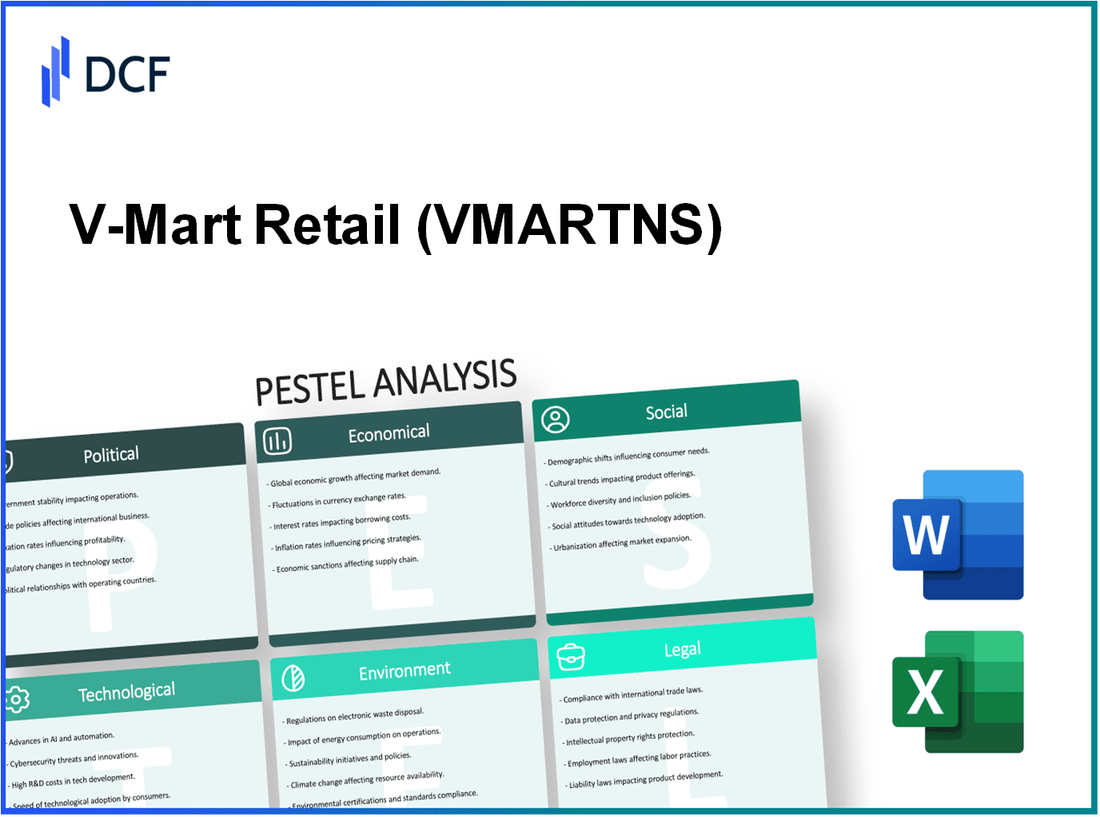
V-Mart sits at a sweet spot-deep penetration in Tier‑2/3 India, strong omnichannel gains and tech‑driven inventory control, plus supply‑side tailwinds from PM MITRA and PLI-yet its regional concentration, margin sensitivity to wage, tax and compliance shifts, and reliance on the value segment make it vulnerable; rising rural incomes, youth demographics and trade incentives offer clear growth levers, while stricter environmental rules, input‑cost volatility and intensifying retail competition pose immediate threats. Continue to see how these forces shape V‑Mart's strategy and valuation.
V-Mart Retail Limited (VMART.NS) - PESTLE Analysis: Political
Taxation policies materially shape V‑Mart's retail pricing, margin and sourcing incentives. India's Goods and Services Tax (GST) regime places textiles and apparel across multiple slabs (commonly 5%, 12% and 18%), creating differential pricing pressure across product segments. Direct and indirect tax compliance (GST input credit, state entry taxes historically) affects working capital: delayed input credits can increase cash conversion cycle by several weeks. Corporate tax policy and surcharges determine after‑tax returns; changes to tax rates or dispute resolution processes can affect net margins and repatriation of profits from subsidiaries.
Free trade agreements (FTAs) and bilateral trade pacts reduce customs duties on fabrics and raw materials, directly affecting V‑Mart's cost structure for imported inputs and finished goods. Under typical FTAs duties on certain textiles/fabrics can fall from tariff levels of 10-20% to 0-5%, narrowing the landed cost gap between domestic and imported inputs. Lower import duties can shift procurement towards cross‑border sourcing, while rules of origin and documentation requirements determine the extent of cost savings.
Local sourcing mandates and "Make in India" incentives encourage regional supply‑chain stability and reduced import dependence. Government procurement preference and state industrial policies that provide tax concessions, land allotment or power subsidies to textile parks increase the competitiveness of Indian suppliers. Schemes promoting domestic capacity expansion increase the availability of tier‑1 and tier‑2 vendor partners within a 200-800 km radius of V‑Mart's store clusters, lowering lead times and freight costs.
Foreign investment caps continue to shape competitive dynamics in Indian multi‑brand retail. FDI policy that allows foreign direct investment in multi‑brand retail under prescribed conditions (historically up to 51% with sourcing and local partner requirements; subject to periodic policy review) limits large foreign retailer entry and protects mid‑sized domestic chains like V‑Mart from direct multinational scale competition in many formats. Restrictions on single‑brand versus multi‑brand retail, and on FDI in retail real estate leasing structures, influence capital‑raising strategies and JV structuring.
Government schemes bolster textile supply chains and export ambitions that indirectly benefit V‑Mart through stronger supplier networks and export‑oriented capacity. Key national initiatives include Production Linked Incentive (PLI) schemes for textiles (aggregate outlays in the order of ₹10,000-₹12,000 crore), PM MITRA textile parks (planned 7-10 parks with fiscal incentives and common infrastructure), and Skill India/SAMARTH upskilling programmes for garment workers. India's textile and apparel exports reached approximately USD 44-46 billion in FY2022-23, indicating scale and global demand that feed back into domestic supplier investment and technology adoption.
| Political Factor | Policy Detail | Direct Impact on V‑Mart |
|---|---|---|
| GST slabs | Multiple rates (commonly 5%, 12%, 18%) on textiles/apparel | Pricing complexity across SKUs; margin pressure on low‑price segments; compliance/working capital implications |
| FTAs / Tariff reductions | Duties on certain fabrics reduced from ~10-20% to ~0-5% under FTAs | Lower landed cost for imports; potential shift in sourcing mix; need to manage origin documentation |
| Local sourcing mandates | State and central incentives for domestic manufacturing | Stronger local vendor base; reduced lead times; lower logistics cost |
| FDI caps in retail | Conditional FDI rules for multi‑brand retail (limits and sourcing conditions) | Protection from large global entrants; influences JV and capital strategy |
| Textile support schemes | PLI (~₹10-12k crore), PM MITRA parks, skill programmes | Improved supplier capacity, quality, and export orientation; potential cost competitivity gains |
- Regulatory risk: sudden tariff or trade policy shifts can change landed costs by an estimated 3-8% on imported garments.
- Compliance burden: GST reconciliations and state‑level trade regulations can increase administrative costs by 0.5-1.5% of revenue.
- Localization opportunity: greater Make in India incentives could lower procurement lead times by 10-30% for core SKUs.
V-Mart Retail Limited (VMART.NS) - PESTLE Analysis: Economic
Growth and inflation set the pricing and consumer spending context for V-Mart. India real GDP growth averaged near 7.0% in FY2023-24 (estimated 6.5-7.5%), while headline CPI inflation has moderated to roughly 5.0-6.0% in the same period. For an affordable-fashion retailer focused on Tier 2/3 towns, sustained GDP growth expands consumer wallets, while above-target inflation compresses margins and forces promotional pricing and tighter assortment cost control.
| Indicator | Value (FY2023-24) | Relevance to V-Mart |
|---|---|---|
| Real GDP growth (India) | ~7.0% | Expands overall consumption demand and store expansion feasibility |
| Headline CPI inflation | ~5.5% | Drives input and operating cost inflation; affects pricing strategy |
| Rural wage growth (Nominal) | ~6-8% YoY | Supports increased discretionary spend in V-Mart core catchments |
| Per capita nominal income (India) | ~INR 1.6-1.8 lakh per annum | Frames affordability thresholds for product tiers |
| Unemployment rate (urban+rural) | ~7.0% (labour force survey variants) | Impacts disposable income and monthly consumption patterns |
| Credit card penetration (cards per 1,000 adults) | ~100-150 cards/1,000 | Facilitates higher-ticket purchases and EMI-led buying in Tier 2 cities |
Rural wage growth and rising per capita income expand affordable fashion demand. Strong nominal wage gains in agriculture and rural non-farm sectors (6-8% YoY) have translated into higher spend on apparel and household items. V-Mart's value-oriented price bands (average ticket INR ~350-700) capture this incremental demand; higher per capita incomes shift a portion of expenditure from essentials to clothing and discretionary categories.
- Average transaction value (estimate) - INR 350-700 per customer for core apparel.
- Rural consumption share - 30-40% of V-Mart's catchment demand in many locations.
- Elasticity - modest positive elasticity of demand with income growth in low-income segments.
Credit card penetration boosts high-ticket purchases in Tier 2 cities. Increased access to plastic and BNPL/EMI solutions supports purchase of higher-value items such as winter outerwear, footwear bundles, and seasonal bulk buys. Where card penetration reached ~100-150 cards per 1,000 adults, discretionary spend per shopping trip increases by an estimated 10-20% versus cash-only scenarios.
Unemployment trends and disposable income influence retail growth. Periods of rising unemployment or informal-sector job stress compress disposable income, reduce frequency of store visits and force a shift to deeper discounting. Conversely, employment upticks and normalised wages increase shopping frequency and average spend - crucial for V-Mart's same-store-sales growth (SSSG) and margin recovery.
Real GDP growth supports expansion, with steady monetary policy backing. A growth trajectory near 6.5-7.5% combined with RBI's measured monetary stance (policy repo in a mid-single-digit range during FY2023-24) provides predictability for capex and store roll-out financing. Lower and stable policy rates reduce borrowing costs for franchise partners and contribute to improved return on new store investment.
V-Mart Retail Limited (VMART.NS) - PESTLE Analysis: Social
The youth-majority demographic in India (median age ~28 years; approximately 50% of the population below 25 and ~65% below 35) materially shapes demand patterns for V-Mart: higher propensity for frequent purchases of affordable, trendy apparel and fast-moving consumer fashion at value retail formats. Price sensitivity combined with trend-led consumption drives V-Mart's core assortment strategy (value fashion, private label expansion, frequent newness) and supports higher inventory turn targets (industry benchmark for value retail: 6-8 turns/year vs. 4-5 for department stores).
Urbanization-India's urban population stood near 35-36% in recent years with urban areas contributing ~63% of GDP-combined with the spread of organized retail (organized retail penetration in India rising from ~8% a decade ago to ~12-16% in recent estimates) is shifting shopping patterns from informal markets to mall and high-street organized formats. V-Mart's store expansion into tier II and III cities leverages this shift: penetration in smaller cities offers lower real estate costs and higher growth rates (tier II/III retail growth often 8-12% CAGR vs. 4-6% in metros).
Rising female labour force participation and increased purchasing autonomy among women (female labor force participation rate reported near 20-25% in urban areas, with higher participation in certain states and increasing informal/retail employment) elevates demand for women's wear, including ethnic and ready-to-wear segments. V-Mart's women's wear contribution to sales mix has been a key lever-retail data peers indicate women's apparel can represent 40-60% of category sales in value retail stores-necessitating expanded sizes, styles, and price points tailored to working women seeking convenience and value.
Festive spending cycles (notably Diwali, Dussehra, Eid, Navratri, and regional festivals) create pronounced seasonality: organized retailers typically report sales uplift of 15-40% during the festive quarter (Q3-Q4). For V-Mart, festive-driven SKU planning, working capital management, and targeted promotions are critical; inventory and markdown strategies must be calibrated to capture high-margin festival demand while avoiding post-festive excess stock.
Brand loyalty programs and digital engagement are gaining traction among value-conscious shoppers. Loyalty and membership schemes-store-level loyalty cards, app-based rewards, and targeted SMS/WhatsApp campaigns-can increase average transaction value (ATV) by an estimated 10-20% and frequency of visits by 15-25% for active members. V-Mart's omnichannel initiatives and loyalty investments are social levers to convert cost-sensitive shoppers into repeat customers.
| Social Factor | Key Data/Stat | Implication for V-Mart |
|---|---|---|
| Youth-majority demographic | Median age ~28; ~65% population under 35 | Demand for affordable, trend-led assortments; higher SKU velocity; focus on private labels |
| Urbanization & organized retail uptake | Urban population ~35-36%; organized retail penetration ~12-16% | Expansion in tier II/III cities; store-led growth and omnichannel pickup points |
| Female labour participation | Female LFPR ~20-25% (urban), rising informal employment in retail | Product mix tilt to women's wear; convenience formats and extended assortments |
| Festive spending cycles | Sales uplift 15-40% during festive quarter | Seasonal inventory build, promotional calendar, margin management |
| Brand loyalty programs | Loyal customers: ATV +10-20%, visit frequency +15-25% | Investment in CRM, app, and loyalty yields higher retention and CLV |
Key consumer behavior signals and operational responses:
- Shift to value + style: prioritize fast SKU refresh cycles, private label sourcing, and fashion trends monitoring.
- Smaller-city focus: adapt store formats (smaller footprints ~8,000-12,000 sq.ft.), localized assortments, and flexible staffing.
- Women-centric strategies: expand workwear, ethnic wear, accessories; employ localized merchandising by region.
- Festive readiness: optimize inventory turns, peak-season staffing, targeted marketing windows 30-45 days pre-festival.
- Digital loyalty: scale app/CRM, personalize promotions, leverage transaction data for merchandising and credit/EMI offerings.
V-Mart Retail Limited (VMART.NS) - PESTLE Analysis: Technological
Digital payments, mobile penetration, and 5G enable omnichannel retail: V-Mart benefits from India's rapidly rising smartphone and digital payments adoption. As of 2023-24, smartphone penetration in urban India approached ~70% and UPI instantaneous payments exceed multiple billion transactions monthly, enabling seamless in-store and online payment experiences. 5G roll-out and improving mobile broadband (average download speeds rising year-on-year) reduce latency for mobile apps, live inventory checks, and video-rich marketing; this underpins V-Mart's mobile-first customer journeys and click-and-collect models across ~350+ stores (FY2024 store count range).
AI stock replenishment and real-time inventory enhance efficiency: Implementation of machine-learning demand forecasting and automated replenishment engines reduces stock-outs and markdowns. Typical retail AI implementations report 10-25% improvement in forecast accuracy and 5-15% inventory carrying cost reduction. For V-Mart, integrating POS-level sales signals with weather, festival calendar and regional demographic data allows SKU-level reorder triggers and dynamic safety stock adjustments across DCs and stores.
| Technology | Use Case | Key Metric / Typical Impact | V-Mart Relevance |
|---|---|---|---|
| UPI & Digital Wallets | Frictionless in-store & online payments | UPI volumes: billions/month; ~5-15% uplift in conversion vs cash | Increased average basket capture and reduced cash handling |
| Mobile Apps & PWA | Personalized offers, geo-targeting, click-and-collect | App users drive higher LTV; conversion uplift 2-3x vs web | Core channel for loyalty and repeat purchases |
| AI Forecasting | Demand prediction & automated replenishment | Forecast accuracy +10-25%; inventory turnover +5-10% | Optimizes assortments across tier-2/tier-3 stores |
| Warehouse Automation | Sorting, picking, packing to reduce lead time | Order processing time cut 20-50% | Reduces fulfillment costs for e-commerce orders |
| Open Marketplaces & APIs | Third-party seller onboarding, catalog expansion | SKU breadth increases 2-5x; marketplace GMV growth 15-40% | Expands assortment without proportional inventory risk |
| Data Security / Compliance | PCI-DSS, ISO 27001, data encryption & access controls | Reduced breach risk; regulatory alignment with IT Rules | Protects customer trust and avoids regulatory fines |
Logistics automation cuts order processing times: Automation at regional distribution centres - barcode/RFID scanning, conveyor-fed sorting, and WMS-driven slotting - shortens order-to-delivery cycles. Typical automated DCs lower fulfillment cycle by 20-40% and reduce picking errors by 30-80%. For omnichannel orders and increasing B2C parcel volumes, such gains materially lower last-mile costs and improve on-time rates above 90% targets.
Open digital marketplaces expand seller and product reach: Integrating marketplace models and API-based seller onboarding lets V-Mart scale assortments rapidly without equivalent capital inventory investment. Marketplace strategies frequently double product SKUs while keeping inventory-backed SKUs stable; increases in cross-sell and average order value of 10-25% are commonly observed. Multi-vendor catalog management, seller SLAs and marketplace analytics become critical operational controls.
- Core technologies: POS-integrated ERP, cloud-based WMS, CRM with unified customer profiles, AI/ML forecasting engines, and headless commerce APIs.
- Performance targets: reduce stock-outs to <5% for top-selling SKUs; maintain inventory days-of-stock optimized per category (target 20-60 days depending on seasonality).
- Investment needs: phased capex + opex for DC automation, app modernization, and security controls - typically 1-3% of annual revenue for medium-sized retail digital transformation programs.
Data security investments align with evolving regulatory standards: As customer data volumes grow across e-commerce, loyalty programs and digital payments, V-Mart must enforce encryption-at-rest, tokenization for payment data, role-based access, regular penetration testing, and adherence to Indian IT Rules/GDPR-like principles where applicable. Proactive compliance reduces potential fines (which can range in materiality depending on regulations) and limits reputational damage from breaches. Insurance and incident response readiness complement technical controls to contain financial impact.
V-Mart Retail Limited (VMART.NS) - PESTLE Analysis: Legal
Data protection, labor codes, and e-commerce rules shape compliance. The Digital Personal Data Protection Act, 2023 (DPDP Act) and the Information Technology Act obligations require structured data governance for customer PII across V-Mart's ~280+ stores and omnichannel systems. Non-compliance exposure includes regulatory investigations, compensation orders and reputational loss; a single breach affecting 100,000 customer records can trigger multi-million-rupee remediation costs, notification duties and class-action risks. E‑commerce compliance under the Consumer Protection (E‑commerce) Rules, 2020 and the Consumer Protection Act, 2019 mandates transparent pricing, mandatory return/refund windows and mandated grievance redressal timelines for the company's online sales (~10-15% of FY revenue in modern retail peers).
| Legal Area | Applicable Law/Regulation | Primary Requirement | Potential Financial Impact |
|---|---|---|---|
| Data Protection | DPDP Act 2023; IT Act | Consent, data minimization, breach notification | Remediation, compensation, fines; breach response cost ≈ ₹0.5-3 crore per major incident |
| E‑commerce Compliance | Consumer Protection (E‑commerce) Rules 2020 | Information disclosure, returns, grievance redressal | Fines, merchant delisting; revenue at risk from suspension |
| Labor & Employment | Code on Wages 2019; Industrial Relations Code; State Minimum Wage laws | Minimum wages, statutory benefits, record-keeping | Wage bill increase 3-8% following state revisions; penalty exposure for non-compliance |
| Competition & IP | Competition Act 2002; Trade Marks Act 1999 | Anti-competitive conduct prohibition; trademark registration and policing | CCI penalties; loss of brand exclusivity; litigation costs |
| Product Standards | BIS, FSSAI, Legal Metrology | Labeling, safety, weights & measures, food safety | Recalls, fines, inventory write-offs; audit costs |
- Key compliance actions required: maintain data processing records, conduct DPIAs, encrypt customer PII, implement incident response playbooks and vendor data processing agreements.
- Labor compliance steps: update payroll to reflect state minimum wage changes, reclassify contractual workers per labor codes, maintain statutory registers (ESI, PF, gratuity where applicable).
- E‑commerce specific: publish seller details, ensure MRPs and discounts are accurate, maintain 24‑hour grievance response and monthly reporting to authorities.
Intellectual property and competition laws safeguard brands and fair play. V‑Mart's private labels and merchandising strategies rely on trademark registrations (dozens of marks across apparel and lifestyle categories) and design protection. Enforcement against counterfeits and unauthorized sellers is material: brand policing budgets for mid‑sized retailers typically run 0.2-0.5% of annual sales; litigation or CCI inquiries for exclusive supply arrangements can lead to fines and corrective orders. The Competition Commission of India actively reviews resale price maintenance, exclusive territories and buyer‑seller abuses-practices that affect franchise or store-level procurement.
Quality certifications and environmental audits raise regulatory standards. Compliance with Legal Metrology for packaged goods, BIS for applicable products and FSSAI for any food items in stores is mandatory. Environmental audits under state pollution control boards and municipal waste management rules require solid waste segregation, EPR (extended producer responsibility) coordination for packaging (as per Plastic Waste Management Rules) and periodic reporting. Non-compliance can result in penalties ranging from ₹50,000 to several lakhs per incident and forced corrective orders; typical audit remediation budgets for retail chains vary from ₹10 lakh to ₹1 crore depending on scope.
Wage revisions affect cost structures in key states. Recent state-level minimum wage revisions (year‑on‑year increases generally in the 4-8% band across major retail states) directly inflate store-level labor costs. For V‑Mart, where personnel costs historically represent ~8-12% of net sales in brick‑and‑mortar operations, a 5% uplift in wages can increase consolidated operating costs by ~0.4-0.6 percentage points. Compliance also raises administrative overhead-additional payroll controls, statutory filings (PF/ESI) and compliance audits-adding one‑time system costs estimated at ₹30-60 lakh for mid‑sized retail IT upgrades.
Trademark and standardization pressures influence product labeling and sourcing. Mandatory disclosure rules (manufacturer/importer details, country of origin, MRP, net quantity, ingredients/allergens for food) and Bureau of Indian Standards references for specific categories compel stricter supplier agreements and QC sampling. Sourcing adjustments to meet standardization can increase procurement costs: re‑certification, B2B testing and batch-level traceability typically add 0.5-1.5% to COGS for affected SKUs. Labeling non-conformance can lead to product detentions, recall campaigns and inventory write-offs; recall incidents in Indian retail have historically cost firms ₹10-100 lakh depending on scale.
V-Mart Retail Limited (VMART.NS) - PESTLE Analysis: Environmental
Plastic recycling mandates and energy targets drive sustainability costs: India's Plastic Waste Management Rules and Extended Producer Responsibility (EPR) regime require branded retailers and their suppliers to finance collection and recycling of packaging waste. For V‑Mart this increases direct compliance costs (EPR registration, collection contracts) and indirect supplier management costs. Estimated incremental annual cost pressure for a mid‑sized retail chain can range from low single‑digit percentage points of annual operating expenditure to higher amounts depending on packaging intensity; for V‑Mart this could translate into an additional ₹5-25 crore annually based on packaging volumes and current market recycling rates.
Solar adoption and non-fossil energy goals reshape operations: National renewable energy targets (government targets commonly cited at ~450-500 GW renewables by 2030) and state‑level net‑metering policies make rooftop solar economically attractive for large-format stores. V‑Mart's growing store portfolio (hundreds of stores and distribution centers) faces potential CAPEX for rooftop solar and battery solutions. Typical rooftop solar payback in India (commercial rates) is 3-7 years; expected CO2 avoidance per 100 kW installed is ~120-150 tonnes/year. A phased program of deploying 100-500 kW systems at 200 stores could require CAPEX in the order of ₹40-250 crore and reduce grid electricity spend by an estimated 10-25% for those sites.
Mandatory ESG reporting and green building certifications influence store design: Regulatory and investor pressure are increasing mandatory disclosures (SEBI's Business Responsibility and Sustainability Report (BRSR) framework) and expectations for green building practices. V‑Mart must expand sustainability reporting, audit processes, and incorporate energy‑efficient HVAC, LED lighting, and insulation in new stores. Typical incremental design and construction premium for green‑certified retail fit‑outs ranges from 3-8% of construction cost. For a 2,000-4,000 sq. ft. store, this may add ₹0.5-3.0 lakh per store at rollout scale.
Sustainable fiber adoption and eco‑friendly products gain momentum: Consumer demand is shifting toward sustainable textiles (organic cotton, recycled polyester) and low‑impact home goods. Sourcing such fibers often increases product cost: recycled polyester and certified cotton can cost 10-40% more than conventional alternatives depending on scale and certifications (GOTS, GRS). Private label and category mix adjustments can impact gross margins; a targeted sustainable private label rollout may reduce gross margin on those SKUs in the near term but support price premiums and loyalty over time.
Waste and water use regulations push for efficiency and compliance: Municipal waste disposal rules, sewage discharge norms for commercial establishments, and water use restrictions in stressed basins require investment in on‑site segregation, recycling contractors, and water‑efficient fixtures. For a multi‑store retailer like V‑Mart, centralized waste management contracts and rainwater harvesting / water recycling at larger stores and warehouses lower risk. Implementing store-level waste segregation and water savings measures can yield operational savings of 5-15% on water and waste disposal budgets while meeting compliance.
| Environmental Factor | Regulatory Drivers | Impact on V‑Mart | Estimated Financial Implication |
|---|---|---|---|
| Plastic & Packaging EPR | Plastic Waste Management Rules; EPR for packaging | Compliance costs, supplier contracts, reporting | Incremental ₹5-25 crore p.a. (estimate) depending on volumes |
| Rooftop Solar & Renewables | National renewables targets; state net‑metering | CAPEX for solar, OPEX savings, energy independence | CAPEX ₹40-250 crore for broad rollout; 10-25% site energy savings |
| ESG Reporting & Green Buildings | SEBI BRSR; investor expectations; green building standards | Enhanced reporting, design premiums, certification costs | 3-8% construction premium; ₹0.5-3.0 lakh extra per typical store fit‑out |
| Sustainable Fibers & Products | Market/consumer trends; voluntary certifications (GOTS, GRS) | Higher sourcing cost, SKU mix changes, potential price premiums | 10-40% higher cost on sustainable fiber SKUs; margin impact varies |
| Waste & Water Regulations | Municipal waste rules; local water discharge norms | Investment in segregation, recycling, water savings tech | Operational savings 5-15% on waste/water budgets; initial investment varies |
- Priorities for near term: register under EPR frameworks, conduct supplier packaging audits, and pilot rooftop solar on high‑consumption stores.
- Medium term: integrate BRSR KPIs, retrofit LED and HVAC efficiency measures across 30-50% of stores, implement centralized waste management contracts.
- Long term: commit to a percent‑based target for recycled/sustainable fiber in private‑label apparel, expand on‑site renewable capacity to cover a material share of store electricity consumption, and seek green building certifications for flagships and distribution centers.
Disclaimer
All information, articles, and product details provided on this website are for general informational and educational purposes only. We do not claim any ownership over, nor do we intend to infringe upon, any trademarks, copyrights, logos, brand names, or other intellectual property mentioned or depicted on this site. Such intellectual property remains the property of its respective owners, and any references here are made solely for identification or informational purposes, without implying any affiliation, endorsement, or partnership.
We make no representations or warranties, express or implied, regarding the accuracy, completeness, or suitability of any content or products presented. Nothing on this website should be construed as legal, tax, investment, financial, medical, or other professional advice. In addition, no part of this site—including articles or product references—constitutes a solicitation, recommendation, endorsement, advertisement, or offer to buy or sell any securities, franchises, or other financial instruments, particularly in jurisdictions where such activity would be unlawful.
All content is of a general nature and may not address the specific circumstances of any individual or entity. It is not a substitute for professional advice or services. Any actions you take based on the information provided here are strictly at your own risk. You accept full responsibility for any decisions or outcomes arising from your use of this website and agree to release us from any liability in connection with your use of, or reliance upon, the content or products found herein.