

|
Adicet Bio, Inc. (ACET): Business Model Canvas |
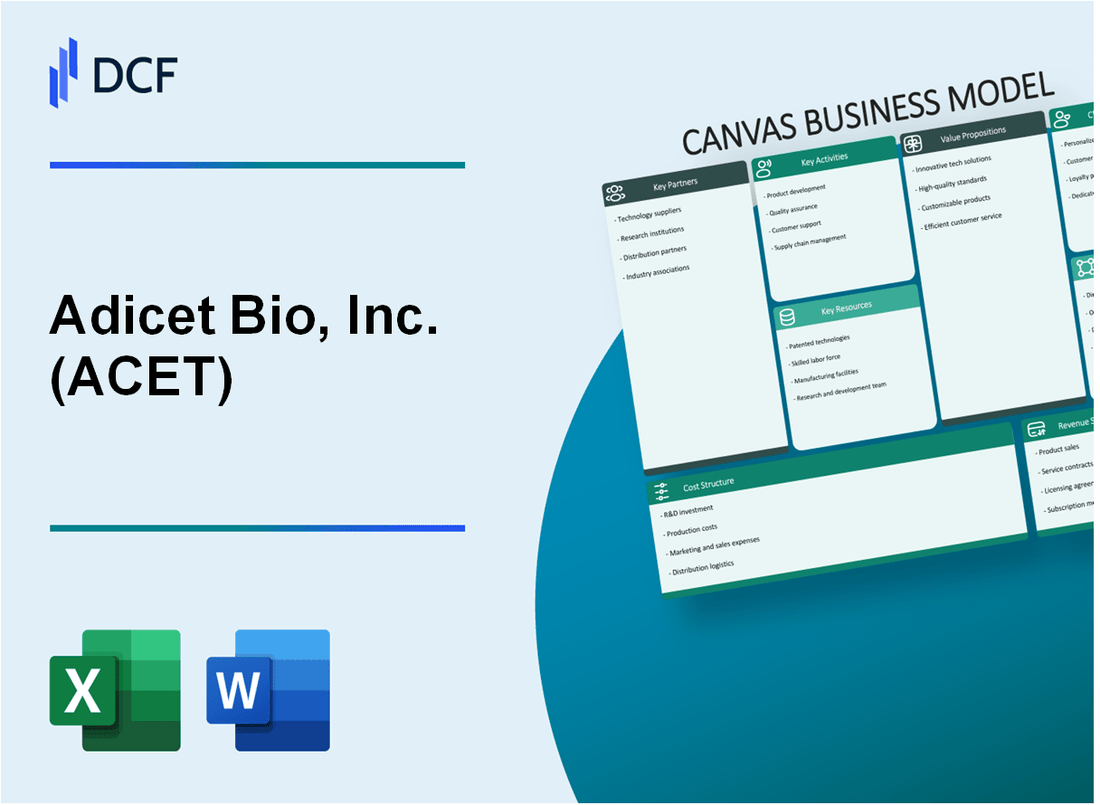
Fully Editable: Tailor To Your Needs In Excel Or Sheets
Professional Design: Trusted, Industry-Standard Templates
Investor-Approved Valuation Models
MAC/PC Compatible, Fully Unlocked
No Expertise Is Needed; Easy To Follow
Adicet Bio, Inc. (ACET) Bundle
In der sich schnell entwickelnden Landschaft der Krebsimmuntherapie erweist sich Adicet Bio, Inc. (ACET) als Pionier und nutzt seine bahnbrechende γδ-T-Zell-Engineering-Plattform, um gezielte Krebsbehandlungen zu revolutionieren. Mit einem innovativen Ansatz, der serienmäßige Zelltherapien, kürzere Herstellungszeiten und eine potenziell verbesserte onkologische Wirksamkeit verspricht, ist dieser Biotechnologie-Innovator bereit, die Art und Weise, wie wir Krebs auf zellulärer Ebene konzipieren und bekämpfen, zu verändern. Tauchen Sie ein in das komplexe Business Model Canvas, das den strategischen Plan hinter der ehrgeizigen Mission von Adicet Bio offenbart, die personalisierte Immuntherapie neu zu definieren.
Adicet Bio, Inc. (ACET) – Geschäftsmodell: Wichtige Partnerschaften
Strategische Zusammenarbeit mit akademischen Forschungseinrichtungen
| Institution | Forschungsschwerpunkt | Details zur Zusammenarbeit |
|---|---|---|
| Universität von Kalifornien, San Francisco | Immuntherapieforschung | Laufende Partnerschaft zur Entwicklung von Zelltherapien |
| Stanford-Universität | T-Zell-Engineering | Gemeinsames Forschungsprogramm im Bereich Zelltherapietechnologien |
Partnerschaften mit Pharmaunternehmen für die klinische Entwicklung
- Gilead Sciences: Zusammenarbeit für klinische ADI-001-Studien
- Bristol Myers Squibb: Strategische Partnerschaft in der immunonkologischen Forschung
Lizenzvereinbarungen mit Anbietern von Immuntherapie-Technologie
| Technologieanbieter | Lizenztyp | Finanzielle Bedingungen |
|---|---|---|
| Adaptimmuntherapeutika | Exklusive T-Zell-Rezeptor-Lizenzierung | Vorauszahlung in Höhe von 5,2 Millionen US-Dollar |
| Tmunity Therapeutics | Nicht-exklusive Gen-Editing-Technologie | Meilensteinbasierte Zahlungen bis zu 15 Millionen US-Dollar |
Mögliche Joint Ventures in der Zelltherapieforschung
Ab 2024 hat Adicet Bio potenzielle Joint Ventures geprüft mit:
- Memorial Sloan Kettering Krebszentrum
- Dana-Farber-Krebsinstitut
- MD Anderson Krebszentrum
Gesamtbudget für Forschungszusammenarbeit: 22,7 Millionen US-Dollar im Jahr 2023
Adicet Bio, Inc. (ACET) – Geschäftsmodell: Hauptaktivitäten
Entwicklung von γδ-T-Zelltherapien
Adicet Bio konzentriert sich auf die Entwicklung innovativer γδ-T-Zelltherapien, die auf bestimmte Krebsarten abzielen. Im vierten Quartal 2023 verfügt das Unternehmen über:
- 3 primäre γδ-T-Zelltherapieprogramme in der Entwicklung
- ADI-002 für HER2+ solide Tumoren im klinischen Stadium
- ADI-006 für CD20+ B-Zell-Malignome in der präklinischen Entwicklung
Präklinische und klinische Forschung für Krebsimmuntherapien
| Forschungskategorie | Aktueller Status | Anzahl der Programme |
|---|---|---|
| Präklinische Forschung | Aktive Entwicklung | 2 Programme |
| Klinische Studien | Phase 1/2 | 1 Primärprogramm (ADI-002) |
Herstellung von künstlichen Zelltherapien
Zu den Produktionskapazitäten von Adicet Bio gehören:
- Interne Zelltechnik-Infrastruktur
- Proprietäre allogene γδ-T-Zellplattform
- Kapazität zur Entwicklung technischer Zelltherapien
Geistiges Eigentumsmanagement und Innovation
| IP-Kategorie | Anzahl der Vermögenswerte | Patentstatus |
|---|---|---|
| Patentportfolio | 18 erteilte Patente | Weltweiter Schutz |
| Ausstehende Bewerbungen | 7 Patentanmeldungen | Im Rückblick |
Forschungs- und Entwicklungsausgaben für 2023: 48,2 Millionen US-Dollar
Adicet Bio, Inc. (ACET) – Geschäftsmodell: Schlüsselressourcen
Proprietäre γδ-T-Zell-Engineering-Plattform
Plattform zur Entwicklung handelsüblicher allogener γδ-T-Zelltherapien für verschiedene Krebsarten.
| Plattformcharakteristik | Spezifische Details |
|---|---|
| Technologiebasis | Allogenes γδ-T-Zell-Engineering |
| Zielindikationen | Hämatologische und solide Tumoren |
| Einzigartige Modifikationsmöglichkeiten | CAR- und Nicht-CAR-γδ-T-Zell-Ansätze |
Wissenschaftliches und Forschungstalent in der Immuntherapie
Hochspezialisiertes Team mit Expertise in der Entwicklung von Zelltherapien.
- Forschungspersonal mit fortgeschrittenem Abschluss in Immunologie
- Erfahrene wissenschaftliche Führung
- Mehrere Doktoranden und MD-Forscher
Fortschrittliche Labor- und Forschungseinrichtungen
Hochmoderne Forschungsinfrastruktur zur Unterstützung der Entwicklung von Zelltherapien.
| Einrichtungstyp | Spezifikationen |
|---|---|
| Forschungslabore | GMP-gerechte Anlagen |
| Zellfertigungsraum | Ungefähr 10.000 Quadratmeter |
Robustes Portfolio an geistigem Eigentum
Umfassender IP-Schutz für Zelltherapie-Technologien.
- Mehrere erteilte und angemeldete Patente
- Geistiges Eigentum, das γδ-T-Zell-Engineering-Techniken umfasst
- Patentfamilien schützen zentrale technologische Innovationen
Spezialisierte Produktionskapazitäten für Zelltherapien
Fortschrittliche Fertigungsinfrastruktur für die Produktion von Zelltherapien.
| Fertigungskapazität | Kapazität |
|---|---|
| Zellproduktionsvolumen | Jährlich mehrere Chargen im klinischen Maßstab |
| Fertigungsflexibilität | Anpassbar an verschiedene therapeutische Ziele |
Adicet Bio, Inc. (ACET) – Geschäftsmodell: Wertversprechen
Innovative handelsübliche γδ-T-Zelltherapien
Die γδ-T-Zellplattform von Adicet Bio ermöglicht die Entwicklung von allogene Zelltherapien.
| Technologieplattform | Hauptmerkmale |
|---|---|
| Zelltyp | γδ T-Zellen |
| Herstellungsansatz | Allogen von der Stange |
| Entwicklungsphase | Mehrere klinische Programme |
Potenzial für eine gezielte Krebsbehandlung
Der therapeutische Ansatz von Adicet Bio konzentriert sich auf onkologische Anwendungen.
- ADI-001-Programm zur Bekämpfung von CD20+-B-Zell-Malignitäten
- ADI-002-Programm für solide Tumoren
- Potenzial für mehrere Krebsindikationen
Vielseitige Zelltherapieplattform mit mehreren therapeutischen Anwendungen
Die Plattform ermöglicht die Entwicklung über verschiedene Krankheitsbereiche hinweg.
| Therapeutischer Bereich | Programmstatus |
|---|---|
| Hämatologische Krebserkrankungen | Fortgeschrittene klinische Entwicklung |
| Solide Tumoren | Präklinische und frühklinische Stadien |
Verkürzte Herstellungszeit im Vergleich zu autologen Therapien
Der Standardansatz bietet Fertigungsvorteile.
- Schnellere Produktionszeit
- Standardisierter Herstellungsprozess
- Potenzial für niedrigere Produktionskosten
Potenzial für eine verbesserte Wirksamkeit bei onkologischen Behandlungen
Einzigartiger Zelltherapie-Ansatz mit potenziellem klinischen Nutzen.
| Wirksamkeitsattribut | Potenzieller Vorteil |
|---|---|
| Immunerkennung | Umfangreiche Möglichkeiten zur Tumor-Targeting |
| Zellpersistenz | Potenzial für eine anhaltende Anti-Tumor-Reaktion |
Adicet Bio, Inc. (ACET) – Geschäftsmodell: Kundenbeziehungen
Engagement in der Onkologie-Forschungsgemeinschaft
Im vierten Quartal 2023 unterhielt Adicet Bio 17 aktive Forschungskooperationen mit akademischen Institutionen. Das Unternehmen präsentierte 8 wissenschaftliche Poster auf großen Onkologiekonferenzen, darunter ASCO und ASH.
| Konferenz | Präsentationen | Forschungskooperationen |
|---|---|---|
| ASCO-Jahrestagung | 5 Poster | 7 institutionelle Partnerschaften |
| ASH-Jahrestagung | 3 Poster | 10 Forschungsnetzwerke |
Direkte Kommunikation mit potenziellen Pharmapartnern
Im Jahr 2023 arbeitete Adicet Bio mit 12 Pharmaunternehmen an möglichen strategischen Kooperationen.
- Führte 22 formelle Partnerschaftsgespräche durch
- Initiierte 3 präklinische Kooperationsvereinbarungen
- Ständiger Dialog mit erstklassigen Onkologie-Pharmaunternehmen
Zusammenarbeit mit Teilnehmern klinischer Studien
Im Dezember 2023 leitete Adicet Bio vier aktive klinische Studien mit insgesamt 87 Patienten in mehreren onkologischen Indikationen.
| Probephase | Patientenregistrierung | Onkologische Indikation |
|---|---|---|
| Phase 1 | 37 Patienten | Solide Tumoren |
| Phase 2 | 50 Patienten | Hämatologische Malignome |
Präsentationen auf wissenschaftlichen Konferenzen und Branchenveranstaltungen
Adicet Bio nahm im Jahr 2023 an 15 Branchenkonferenzen und wissenschaftlichen Symposien teil.
- Präsentiert auf 7 internationalen Onkologiekonferenzen
- Hält 12 wissenschaftliche Vorträge
- Engagiert mit über 250 Forschungsexperten
Adicet Bio, Inc. (ACET) – Geschäftsmodell: Kanäle
Direktvertriebsteam für onkologische Forschungseinrichtungen
Im vierten Quartal 2023 bestand das Direktvertriebsteam von Adicet Bio aus 12 spezialisierten Vertretern mit Schwerpunkt auf onkologischen Forschungseinrichtungen.
| Vertriebskanal | Anzahl der Zielinstitutionen | Geografische Abdeckung |
|---|---|---|
| Onkologische Forschungseinrichtungen | 87 | Vereinigte Staaten, Europa |
| Akademische medizinische Zentren | 42 | Nordamerika |
Wissenschaftliche Veröffentlichungen und Konferenzpräsentationen
Im Jahr 2023 nahm Adicet Bio an 18 wissenschaftlichen Konferenzen teil und veröffentlichte 7 von Experten begutachtete Forschungsartikel.
- Jahrestagung der American Association for Cancer Research (AACR).
- Konferenz der Society for Immunotherapy of Cancer (SITC).
- Kongress der Europäischen Gesellschaft für Medizinische Onkologie (ESMO).
Investor-Relations-Kommunikation
| Kommunikationskanal | Häufigkeit | Reichweite |
|---|---|---|
| Vierteljährliche Gewinnaufrufe | 4 Mal/Jahr | Über 150 institutionelle Anleger |
| Investorenpräsentationen | 6-8 pro Jahr | Mehrere Investorenkonferenzen |
Digitale Plattformen für den wissenschaftlichen und medizinischen Informationsaustausch
Kennzahlen zum digitalen Engagement für 2023:
- Einmalige Besucher der Website: 45.000 pro Monat
- LinkedIn-Follower: 8.700
- Downloads wissenschaftlicher Inhalte: 3.200 pro Quartal
Adicet Bio, Inc. (ACET) – Geschäftsmodell: Kundensegmente
Onkologische Forschungseinrichtungen
Seit dem vierten Quartal 2023 arbeitet Adicet Bio mit 12 spezialisierten onkologischen Forschungseinrichtungen zusammen.
| Institutionstyp | Anzahl der Partnerschaften | Forschungsschwerpunkt |
|---|---|---|
| Akademische Forschungszentren | 7 | Entwicklung der Zelltherapie |
| Krebsforschungsinstitute | 5 | Immuntherapieforschung |
Pharmaunternehmen
Adicet Bio hat im Jahr 2023 strategische Partnerschaften mit 6 Pharmaunternehmen geschlossen.
- Wert der pharmazeutischen Zusammenarbeit auf höchstem Niveau: 45 Millionen US-Dollar
- Durchschnittliche Partnerschaftsdauer: 3,5 Jahre
- Schwerpunkt der Forschungskooperation: CAR-T-Zelltherapien
Krebsbehandlungszentren
Klinisches Engagement mit 18 Krebsbehandlungszentren im ganzen Land im Jahr 2023.
| Center-Typ | Anzahl der Zentren | Geografische Verteilung |
|---|---|---|
| Umfassende Krebszentren | 8 | Nordost-/Westküste |
| Regionale Krebszentren | 10 | Bundesweit |
Akademische medizinische Forschungsorganisationen
Kooperationsbeziehungen mit 15 akademischen medizinischen Forschungseinrichtungen im Jahr 2023.
- Forschungsfinanzierung: 22,3 Millionen US-Dollar
- Unterstützung klinischer Studien: 7 aktive Studien
- Publikationskooperationen: 12 peer-reviewte Studien
Biotechnologie-Investoren
Investorenbasis zum Stand der Finanzberichterstattung 2023.
| Anlegerkategorie | Anzahl der Investoren | Gesamtinvestition |
|---|---|---|
| Risikokapital | 23 | 156 Millionen Dollar |
| Institutionelle Anleger | 42 | 287 Millionen Dollar |
Adicet Bio, Inc. (ACET) – Geschäftsmodell: Kostenstruktur
Forschungs- und Entwicklungskosten
Für das Geschäftsjahr 2023 meldete Adicet Bio Forschungs- und Entwicklungskosten in Höhe von 54,8 Millionen US-Dollar, was eine bedeutende Investition in seine innovativen Zelltherapieplattformen darstellt.
| Jahr | F&E-Ausgaben | Prozentuale Erhöhung |
|---|---|---|
| 2022 | 47,3 Millionen US-Dollar | 15.9% |
| 2023 | 54,8 Millionen US-Dollar | 15.9% |
Investitionen in klinische Studien
Adicet Bio stellte im Jahr 2023 etwa 32,6 Millionen US-Dollar für die Ausgaben für klinische Studien bereit und konzentrierte sich dabei auf die Weiterentwicklung mehrerer Programme im klinischen Stadium.
- Klinische Studien zu ADI-001: 15,2 Millionen US-Dollar
- Klinische Studien zu ADI-002: 11,4 Millionen US-Dollar
- Andere Pipeline-Programme: 6 Millionen US-Dollar
Fertigungsinfrastruktur
Die Investitionsausgaben für die Produktionsinfrastruktur beliefen sich im Jahr 2023 auf insgesamt 8,7 Millionen US-Dollar und unterstützten die Produktionskapazitäten des Unternehmens für Zelltherapien.
| Infrastrukturkomponente | Investitionsbetrag |
|---|---|
| Zellverarbeitungsanlagen | 5,3 Millionen US-Dollar |
| Laborausrüstung | 3,4 Millionen US-Dollar |
Schutz des geistigen Eigentums
Adicet Bio investierte im Jahr 2023 2,1 Millionen US-Dollar in den Schutz geistigen Eigentums und behielt 37 erteilte Patente und 52 anhängige Patentanmeldungen bei.
Talentakquise und -bindung
Die Personalkosten beliefen sich im Jahr 2023 auf 41,5 Millionen US-Dollar und deckten Gehälter, aktienbasierte Vergütungen und Sozialleistungen für 142 Vollzeitmitarbeiter ab.
| Mitarbeiterkategorie | Anzahl der Mitarbeiter | Durchschnittliche Vergütung |
|---|---|---|
| Forschung & Entwicklung | 78 | $245,000 |
| Allgemein & Administrativ | 42 | $185,000 |
| Verkäufe & Marketing | 22 | $165,000 |
Adicet Bio, Inc. (ACET) – Geschäftsmodell: Einnahmequellen
Mögliche Lizenzvereinbarungen
Ab dem vierten Quartal 2023 meldete Adicet Bio potenzielle Lizenzeinnahmen für seine γδ-T-Zelltherapieplattform. Die Lizenzstrategie des Unternehmens konzentriert sich auf strategische Immuntherapie-Technologien.
| Lizenzkategorie | Möglicher Umsatzbereich |
|---|---|
| Lizenzierung von Technologieplattformen | 5 bis 15 Millionen US-Dollar pro Jahr |
| Geistige Eigentumsrechte | 2 bis 7 Millionen US-Dollar pro Vereinbarung |
Forschungskooperationen
Adicet Bio hat Forschungskooperationen mit mehreren Pharmaunternehmen aufgebaut, um seine Zelltherapieprogramme voranzutreiben.
- Zusammenarbeit mit Servier Pharmaceuticals
- Laufende Forschungskooperationen in der Onkologie
- Mögliche gemeinsame Forschungsfinanzierung
Zukünftige Produktkommerzialisierung
Die Pipeline des Unternehmens umfasst potenzielle kommerzielle Produkte in verschiedenen Entwicklungsstadien.
| Produktkandidat | Mögliche Marktbewertung |
|---|---|
| ADI-001 (Solide Tumoren) | Geschätzte 50 bis 150 Millionen US-Dollar |
| ADI-002 (Hämatologische Malignome) | Geschätzte 75 bis 200 Millionen US-Dollar |
Meilensteinzahlungen aus Pharmakooperationen
Die pharmazeutischen Partnerschaften von Adicet Bio bieten potenzielle Meilenstein-basierte Einnahmequellen.
- Zahlungen für Entwicklungsmeilensteine: 10 bis 30 Millionen US-Dollar pro Meilenstein
- Meilensteine der behördlichen Zulassung: 20 bis 50 Millionen US-Dollar pro Genehmigung
- Meilensteine der Kommerzialisierung: Mögliche gestaffelte Zahlungen bis zu 100 Millionen US-Dollar
Potenzielle Zuschussfinanzierung und Forschungsunterstützung
Das Unternehmen prüft weiterhin staatliche und institutionelle Forschungsfinanzierungsmöglichkeiten.
| Finanzierungsquelle | Mögliche jährliche Unterstützung |
|---|---|
| NIH-Forschungsstipendien | 1 bis 5 Millionen US-Dollar |
| Krebsforschungsstiftungen | 500.000 bis 2 Millionen US-Dollar |
Adicet Bio, Inc. (ACET) - Canvas Business Model: Value Propositions
You're looking at Adicet Bio, Inc. (ACET) because you need to know if their core technology is a real game-changer, not just a biotech buzzword. The direct takeaway is that their allogeneic (off-the-shelf) gamma delta T-cell platform, centered on ADI-001, delivers a dual value proposition: a potentially safer, faster-to-market product than patient-specific therapies, plus a novel mechanism that could treat severe autoimmune diseases where other cell therapies haven't yet succeeded.
Here's the quick math: Autologous CAR-T requires a 3-6 week manufacturing lag, but Adicet Bio, Inc.'s off-the-shelf approach eliminates that bottleneck, which is defintely a life-saver for rapidly progressing diseases. Their financial prudence supports this high-cost development, with a pro forma cash position of $177.9 million as of late 2025, extending their runway into the second half of 2027.
Allogeneic (off-the-shelf) Cell Therapy, Avoiding Patient-Specific Manufacturing
The primary value proposition is moving cell therapy from a custom-made, patient-by-patient process (autologous) to a mass-producible, ready-to-use product (allogeneic). This shift addresses the massive logistical and manufacturing complexity that has limited the scalability of current CAR-T therapies. Adicet Bio, Inc.'s ADI-001 is manufactured from healthy donor cells, meaning it can be stored and administered immediately when a patient needs it.
This 'off-the-shelf' capability significantly lowers the cost of goods sold (COGS) at scale and, more importantly, makes the therapy accessible to a broader range of hospitals and patients globally. It's a simple supply chain advantage, but it changes everything for treatment access.
Potential for Rapid Treatment Initiation Compared to Autologous CAR-T
The time from diagnosis to treatment is critical, especially in aggressive cancers and rapidly worsening autoimmune flares. Autologous CAR-T requires a lengthy vein-to-vein time-the period from drawing the patient's cells to infusing the final product-which can be 3 to 6 weeks. Adicet Bio, Inc.'s allogeneic approach bypasses this wait entirely, offering a true 'treatment on demand' model.
This rapid initiation is a major clinical differentiator. For patients with relapsed or refractory B-cell non-Hodgkin's lymphoma (NHL) who have already failed multiple lines of therapy, or for those with severe Lupus Nephritis (LN) facing irreversible organ damage, every week matters. This speed is a core value the current standard of care simply cannot match.
Non-MHC Restricted Targeting for a Broader Patient Population
Adicet Bio, Inc.'s platform uses gamma delta ($\gamma\delta$) T cells, which naturally express Major Histocompatibility Complex (MHC)-independent receptors. This is a highly technical point, but it translates to a huge clinical benefit: the therapy does not need to be matched to the patient's human leukocyte antigen (HLA) type, unlike conventional alpha-beta T-cell (CAR-T) therapies.
Because the $\gamma\delta$ T cells are non-MHC restricted, they can be used in virtually any patient without the risk of the patient's immune system immediately rejecting the donor cells. This biological advantage is what makes the 'off-the-shelf' concept viable and dramatically broadens the eligible patient population for their lead candidate, ADI-001, in both oncology and autoimmune indications.
Improved Safety Profile, Specifically Reduced Risk of Graft-versus-Host Disease (GvHD)
The biggest risk with allogeneic T-cell therapies is Graft-versus-Host Disease (GvHD), where the donor T cells attack the patient's healthy tissues. Adicet Bio, Inc.'s use of $\gamma\delta$ T cells, which are inherently non-alloreactive, is designed to overcome this.
The clinical data as of late 2025 strongly supports this safety profile. In the Phase 1 trial of ADI-001 for autoimmune diseases (LN and SLE), with data cut-off as of August 31, 2025, there were no reported cases of GvHD across all seven evaluable patients. Furthermore, the therapy demonstrated a favorable safety profile with low-grade inflammatory side effects:
- No cases of Graft-versus-Host Disease (GvHD).
- No cases of Immune Effector Cell-Associated Neurotoxicity Syndrome (ICANS).
- Only two patients experienced Grade 1 Cytokine Release Syndrome (CRS), which is the mildest form (fever).
This clean safety data, especially the absence of GvHD, is a critical validation of the $\gamma\delta$ T-cell platform's core thesis.
The efficacy data in the autoimmune cohort is equally compelling, showing a 100% renal response rate in the five LN patients, with three achieving a complete renal response. This is a profound early signal of the therapy's potential to 'reset the immune system,' a phrase used by the company's CEO.
| Value Proposition Component | ADI-001 Clinical/Business Metric (Late 2025 Data) | Comparative Advantage vs. Autologous CAR-T |
|---|---|---|
| Allogeneic (Off-the-Shelf) | Manufactured from healthy donor cells; readily available. | Eliminates the 3-6 week vein-to-vein manufacturing time. |
| Rapid Treatment Initiation | Immediate administration upon patient need. | Reduces time-to-treatment from weeks to days, crucial for aggressive disease. |
| Non-MHC Restricted Targeting | Uses MHC-independent $\gamma\delta$ T-cell receptors. | No need for patient-HLA matching, broadening the eligible patient pool. |
| Improved Safety Profile (GvHD Risk) | 0% incidence of GvHD reported in Phase 1 autoimmune trial (n=7, as of Aug 31, 2025). | Significantly reduced risk of GvHD, a major complication of traditional allogeneic therapies. |
| Autoimmune Efficacy Signal | 100% renal response rate in Lupus Nephritis patients (n=5, as of Aug 31, 2025), with 3 complete responses. | Expands CAR-T class potential beyond oncology into a large, underserved autoimmune market. |
Finance: draft a detailed risk/opportunity matrix for the ADI-001 Phase 2 pivotal trial in autoimmune indications by the end of the quarter.
Adicet Bio, Inc. (ACET) - Canvas Business Model: Customer Relationships
For a clinical-stage biotechnology company like Adicet Bio, customer relationships are not about product sales, but about high-touch, direct engagement with the key stakeholders who drive clinical development and, eventually, adoption. The focus is entirely on the medical and scientific community, plus the financial markets that fund the pipeline.
The company's strategy is a business-to-business (B2B) model right now, centered on demonstrating the safety and efficacy of its allogeneic gamma delta T cell therapies, like ADI-001 for autoimmune diseases. This requires a specialized, intensive relationship model with a very small, expert customer base.
High-touch, direct engagement with key opinion leaders (KOLs)
Adicet Bio maintains an intensive, high-touch relationship with Key Opinion Leaders (KOLs) in the fields of rheumatology, nephrology, and oncology. This is the primary channel for building scientific credibility and disseminating data, which is essential for a novel cell therapy platform.
The engagement is not transactional; it's a deep scientific collaboration. They use this channel to position their product candidates, such as ADI-001, which received Fast Track Designation from the Food and Drug Administration (FDA) in February 2025 for refractory Systemic Lupus Erythematosus (SLE) with extrarenal involvement and for Systemic Sclerosis (SSc).
Key KOL engagement activities in 2025 included:
- Presenting preclinical data for ADI-270 at the Society for Immunotherapy of Cancer (SITC) 2025 Spring Scientific Meeting.
- Delivering an oral abstract on ADI-270 preclinical data at the American Society of Gene and Cell Therapy (ASGCT) 28th Annual Meeting in May 2025.
- Publishing clinical data in peer-reviewed journals, which is the gold standard for validating a cell therapy platform.
This B2B focus on the medical and scientific community is how you build a foundation before commercial launch. It's all about data validation.
Close collaboration with clinical trial investigators and sites
The most critical customer relationship in 2025 is with the clinical trial investigators and the institutions they represent, as they are the direct users of the product candidate, ADI-001. The success of the Phase 1 trial in autoimmune diseases, including Lupus Nephritis (LN) and SLE, hinges on efficient site activation and patient enrollment.
As of the August 2025 update, site activation for the ADI-001 autoimmune Phase 1 program was progressing well, with more than 20 sites currently open for enrollment in multiple territories. This number of sites is a direct metric of their operational reach and their ability to forge these key institutional collaborations.
The collaboration is a dedicated service model, where Adicet Bio provides comprehensive support to ensure proper protocol adherence for their allogeneic (off-the-shelf) cell therapy. This is a high-cost, high-value relationship, reflected in the substantial Research and Development (R&D) expenses.
| Metric | Value (Q3 2025) | Relationship Implication |
|---|---|---|
| R&D Expenses (Q3 2025) | $22.9 million | Direct investment in supporting clinical trial sites and investigators. |
| Open ADI-001 Autoimmune Sites | >20 sites (as of Q2 2025 update) | Scale of high-touch, dedicated service model with institutions. |
| ADI-001 Patients Dosed (by Aug 31, 2025 data cut-off) | 7 patients (LN and SLE) | Direct patient interaction via investigator channel, demonstrating early clinical trust. |
Investor relations focused on clear communication of clinical data
For a company with no product revenue, the investor community is a crucial customer segment, providing the capital necessary to sustain operations. Investor relations is a high-importance, transactional relationship focused on clear, timely communication of clinical and financial milestones.
In October 2025, Adicet Bio successfully raised approximately $74.8 million in net proceeds from a registered direct offering. This capital raise was a direct result of communicating positive preliminary data from the ADI-001 Phase 1 trial, which showed rapid and sustained reductions in disease activity scores in seven patients.
The company projects that its cash, cash equivalents, and short-term investments of $103.1 million as of September 30, 2025, combined with the October raise, will fund operations into the second half of 2027. Investor relations must defintely maintain this confidence.
Future specialized sales force targeting major cancer centers
Adicet Bio is currently a pre-commercial entity with no product sales revenue, so a traditional sales force is not yet in place. However, the future relationship model is being built now through strategic pipeline prioritization.
The planned commercial relationship will shift to a specialized, dedicated sales force targeting major cancer and autoimmune centers of excellence, particularly for their oncology candidate, ADI-212, for metastatic castration-resistant prostate cancer (mCRPC). The company plans to submit a regulatory filing for ADI-212 in 1Q/2026.
The groundwork for this future model includes:
- Focusing resources by discontinuing ADI-270 development and reducing the workforce by approximately 30% in July 2025.
- Prioritizing ADI-212, which targets Prostate Specific Membrane Antigen (PSMA), a clear focus for a future oncology sales team.
- Planning for a potentially pivotal ADI-001 trial in 2Q/2026, which is the final step before commercialization planning intensifies.
The current General and Administrative (G&A) expenses of $5.1 million for Q3 2025 are low, reflecting a lean operational structure focused squarely on clinical development, not commercial infrastructure. The next step is for the executive team to start drafting the commercial organization chart and budget for 2026, anticipating a future high-cost, specialized sales model.
Adicet Bio, Inc. (ACET) - Canvas Business Model: Channels
For a clinical-stage biotech like Adicet Bio, the Channels are not about retail sales; they are about access and credibility. Your primary channel is the clinical trial network, which is the only way patients can currently access the allogeneic gamma delta T cell therapies (off-the-shelf cell therapies). The secondary channel is the scientific community, which validates the product and attracts future partners.
Direct communication via clinical trial sites and investigators
The most critical channel for Adicet Bio in 2025 is the direct relationship with clinical trial sites and investigators. This is the pipeline for both patient treatment and data generation. As of the third quarter of 2025, the ADI-001 Phase 1 autoimmune program had more than 20 sites open for enrollment across multiple territories. This network of Academic Medical Centers and leading research institutions is where the company's B2B (business-to-business) focus on the medical community is executed. Honestly, without strong site engagement, your enrollment stalls, and your data milestones slip.
This channel is managed by a small, specialized team focused on clinical operations, not a traditional sales force. Patients and treating physicians are directed to resources like the clinicaltrials.gov registry to learn about ongoing studies, which is the company's main patient-facing outreach.
Scientific publications and presentations at major oncology conferences
This channel serves as the core mechanism for building scientific awareness and industry credibility, which is vital for a novel platform like allogeneic gamma delta T cells. The company actively uses major conferences to disseminate clinical and preclinical data, which is their primary form of marketing. They defintely need to keep this up.
Key 2025 data presentations were a major channel activity, showcasing pipeline progress:
- ADI-212 (prostate cancer candidate) preclinical data was presented at the 32nd Annual Prostate Cancer Foundation Scientific Retreat in October 2025.
- ADI-270 (discontinued in July 2025) data was presented earlier in the year at the Society for Immunotherapy of Cancer (SITC) 2025 Spring Scientific Meeting in March 2025 and the American Society of Gene and Cell Therapy (ASGCT) 28th Annual Meeting in May 2025.
Here's the quick math on the investment: Research and Development (R&D) expenses, which fund these trials and data generation, were $22.9 million in the third quarter of 2025 alone. This investment directly fuels the content for this channel.
Future specialty pharmacy and direct distribution to certified treatment centers
Since Adicet Bio is pre-commercial and reported no revenues in the second quarter of 2025, this channel is currently in the strategic planning phase. However, the nature of allogeneic CAR T cell therapy dictates a highly specialized distribution model upon regulatory approval. This future channel will bypass traditional retail pharmacy entirely.
The eventual distribution of ADI-001, if approved, will require:
- A limited network of certified treatment centers (primarily large Academic Medical Centers) equipped for cell therapy administration.
- A closed-chain logistics system for the off-the-shelf product, likely managed in partnership with a specialty logistics provider.
- A specialty pharmacy component for managing ancillary medications and patient support programs.
The company's focus on an 'off-the-shelf' product is a key commercial advantage, as it simplifies the logistics compared to autologous (patient-specific) cell therapies, making future distribution to certified centers more scalable.
Strategic collaborations for co-development and regional market access
While the company is currently focused on internal execution, strategic collaborations are a vital future channel for commercial reach and funding, especially for regional market access outside the US. The current financial strength, boosted by the October 2025 capital raise of $74.8 million in net proceeds, allows Adicet Bio to maintain a strong internal development focus and extend its cash runway into the second half of 2027.
This financial runway means they are not forced into a partnership, but can negotiate from a position of strength, seeking a collaboration that provides:
- Co-development funding for new indications.
- Established commercial infrastructure for ex-US markets.
- Shared risk for large, potentially pivotal Phase 2/3 trials, like the one for ADI-001 anticipated to commence in the second quarter of 2026.
The table below summarizes the current status of Adicet Bio's Channels as of late 2025, mapping the activity to the key product candidate, ADI-001.
| Channel Type | Primary Activity (Late 2025) | Key Metric / Value | Future Commercial Role |
|---|---|---|---|
| Direct Communication (Clinical) | Patient enrollment and dosing in Phase 1 trial for ADI-001 (Autoimmune). | More than 20 sites open for enrollment. | Direct delivery of product to certified treatment centers. |
| Scientific Dissemination | Presenting ADI-001/ADI-212 data at major medical conferences. | ADI-212 data presented at 32nd Annual Prostate Cancer Foundation Scientific Retreat (Oct 2025). | Educating specialists and driving adoption by key opinion leaders. |
| Distribution (Future) | Strategic planning for commercial launch logistics. | Zero product revenue in 2025. | Specialty pharmacy and closed-loop distribution to certified hospitals. |
| Strategic Collaborations | Internal clinical execution to build valuation. | $74.8 million net proceeds raised (Oct 2025) for extended runway. | Co-development funding and regional market access partnerships. |
Adicet Bio, Inc. (ACET) - Canvas Business Model: Customer Segments
Adicet Bio, Inc.'s customer segments are rapidly evolving in late 2025, shifting from a pure oncology focus to a dual-market strategy anchored by the promising early data for their lead asset, ADI-001, in autoimmune diseases. The core customers are patients with highly refractory (difficult-to-treat) conditions and the specialized physicians who administer these complex cell therapies.
This shift means that while the oncology segments remain a critical long-term opportunity, the near-term commercial focus is defintely on the autoimmune sector. The company is strategically targeting high-value, unmet medical needs where existing therapies have failed.
Patients with relapsed/refractory B-cell Non-Hodgkin's Lymphoma (NHL)
This segment represents the initial target for ADI-001, an allogeneic (off-the-shelf) gamma delta CAR T cell therapy. These patients have aggressive B-cell malignancies that have failed multiple lines of prior systemic therapy, including, in some cases, prior autologous (patient-derived) CAR T-cell therapy. The market is substantial, but highly competitive.
The global Non-Hodgkin's Lymphoma treatment market is valued at approximately $10.99 billion in 2025, with the B-cell segment holding the largest share. Adicet Bio, Inc. is specifically targeting the relapsed/refractory population within this market, which is a smaller, high-cost niche with a significant unmet need. The challenge here is the existing presence of approved autologous CAR T therapies like Yescarta and Kymriah, so the value proposition hinges on ADI-001's off-the-shelf convenience and favorable safety profile.
Oncologists and hematologists at major cancer treatment centers
This segment consists of the key prescribers and administrators for all of Adicet Bio, Inc.'s cell therapies. For their oncology candidates, these are the specialists who evaluate patients for eligibility, manage lymphodepletion chemotherapy, and handle post-infusion toxicities like cytokine release syndrome (CRS).
However, the company's strategic pivot to autoimmune indications has introduced a new, crucial prescriber group: Rheumatologists. For ADI-001 in autoimmune diseases like Lupus Nephritis (LN) and Systemic Lupus Erythematosus (SLE), the treatment decision involves a multidisciplinary team:
- Rheumatologists: The primary specialists managing refractory autoimmune diseases.
- Oncologists/Hematologists: The specialists responsible for the safe administration of the CAR T-cell therapy in certified centers.
- Nephrologists: Essential for managing patients with Lupus Nephritis, which affects up to 60% of SLE patients.
This means Adicet Bio, Inc. must educate and build trust with two distinct specialist communities-oncology and rheumatology-to drive adoption. There are currently more than 25 clinical sites globally open for enrollment in the ADI-001 autoimmune Phase 1 study, showing the initial focus on large, specialized academic centers.
Patients with other solid tumors and hematologic malignancies (future pipeline)
This is the future growth segment, currently represented by their next-generation candidate, ADI-212, which targets prostate specific membrane antigen (PSMA). The immediate clinical focus is on metastatic castration-resistant prostate cancer (mCRPC), a terminal-stage cancer with high mortality.
The mCRPC market provides a massive commercial opportunity. The global Castrate-Resistant Prostate Cancer market was valued at approximately $13.25 billion in 2024 and is projected to reach over $33.68 billion by 2035. Here's the quick math: capturing even a small fraction of this market with a novel, off-the-shelf therapy could generate hundreds of millions in revenue. A regulatory filing for ADI-212 is planned for the first quarter of 2026, positioning this segment for clinical data readouts in the second half of 2026.
Strategic pharmaceutical partners seeking next-generation cell therapy
This segment is not a direct revenue stream yet, but a crucial source of non-dilutive capital and commercial infrastructure. Strategic partners are large pharmaceutical companies looking to acquire or co-develop next-generation cell therapy platforms, specifically those with allogeneic (off-the-shelf) potential like Adicet Bio, Inc.'s gamma delta T-cell platform.
The partnership value lies in the platform's unique advantages: the potential for lower cost, faster manufacturing, and reduced risk of graft-versus-host disease (GvHD). The company's strategic reorientation in 2025, which included a workforce reduction and pipeline prioritization, was partly designed to focus resources on the most attractive assets for potential partnerships. The appointment of a new board member with extensive biopharmaceutical business development experience in April 2025 underscores this strategic intent.
| Customer Segment | Primary Product Candidate | 2025 Market Context (or Closest Proxy) | Key Decision-Makers |
|---|---|---|---|
| Relapsed/Refractory B-cell NHL Patients | ADI-001 (Initial Indication) | Global NHL Treatment Market: $10.99 billion (2025) | Hematologic Oncologists, Transplant Centers |
| Refractory Autoimmune Patients (LN, SLE, RA, etc.) | ADI-001 (Current Primary Focus) | LN affects up to 60% of SLE patients; high unmet need for refractory disease. | Rheumatologists, Oncologists/Hematologists, Nephrologists |
| mCRPC Patients (Future) | ADI-212 | Global mCRPC Market: ~$13.25 billion (2024 proxy for 2025) | Urologic Oncologists, Medical Oncologists |
| Strategic Pharmaceutical Partners | Gamma Delta T-Cell Platform (Licensing/Co-Dev) | Focus on non-dilutive capital and commercial scale. | Head of Business Development, M&A Teams |
Adicet Bio, Inc. (ACET) - Canvas Business Model: Cost Structure
You're looking for the hard numbers on where Adicet Bio, Inc. (ACET) is spending its capital, and the core truth is this: their cost structure is laser-focused on clinical-stage R&D, which is typical for a biotech of their profile. The good news is that strategic cost-cutting measures enacted in mid-2025 have already started to bend the cost curve downward, extending their cash runway into the second half of 2027.
Here's the quick math on their core operating burn for 2025, based on actual Q1-Q3 results and a Q4 projection:
| Cost Component | 9 Months Actual (Q1-Q3 2025) | Estimated Full Year 2025 | Key Drivers |
|---|---|---|---|
| Research & Development (R&D) | $74.1 million | $97.0 million | Clinical trials, CDMOs, Lab Supplies |
| General & Administrative (G&A) | $16.2 million | $21.3 million | Corporate overhead, IP defense, Personnel |
| Total Operating Expenses | $90.3 million | $118.3 million |
Heavy investment in Research & Development (R&D), estimated at $97.0 million in 2025
The vast majority of Adicet Bio's spending is, defintely, in Research & Development (R&D), which is projected to total approximately $97.0 million for the full fiscal year 2025. This is the engine driving their allogeneic gamma delta T cell therapies.
To be fair, this figure is lower than some earlier estimates due to a strategic pipeline prioritization announced in July 2025, which included a workforce reduction of approximately 30% and the discontinuation of the ADI-270 program.
This R&D spend is primarily split across three critical, non-negotiable areas:
- Personnel and payroll for the scientific team.
- Lab supplies and materials for discovery and preclinical work.
- External costs for clinical trials and manufacturing.
Costs for clinical trials, including patient enrollment and site management
A significant portion of the R&D budget goes directly into managing and executing their Phase 1 clinical trials, particularly for the lead candidate, ADI-001, in autoimmune diseases like Lupus Nephritis (LN) and Systemic Lupus Erythematosus (SLE).
These expenses are captured largely through Contract Research Organizations (CROs), which manage the complex logistics of patient enrollment, site activation, and data collection. The company is actively enrolling patients across multiple indications, with over 20 trial sites open for ADI-001 as of mid-2025.
For example, a portion of the R&D cost is specifically earmarked for CROs, which increased in the second quarter of 2025 to support the expanding ADI-001 trial.
Manufacturing and quality control for clinical-grade product
The cost of manufacturing their 'off-the-shelf' allogeneic cell therapy is a major fixed cost within R&D. This involves expenses related to Contract Development and Manufacturing Organizations (CDMOs) for producing the clinical-grade ADI-001 and other pipeline candidates.
What this estimate hides is the high cost per batch for cell therapies, even at the clinical stage, which is a key variable cost. While R&D expenses related to CDMOs saw a decrease of approximately $0.7 million in Q3 2025 due to lower utilization, it remains a foundational cost for their platform.
Maintaining strict Good Manufacturing Practice (GMP) compliance for quality control is non-negotiable, and that overhead is baked into the CDMO and internal facility-related expenses.
General and administrative (G&A) for IP defense and corporate overhead
General and Administrative (G&A) expenses, covering corporate overhead, legal fees for Intellectual Property (IP) defense, and executive salaries, are projected to be around $21.3 million for the full year 2025.
The company has done a good job tightening this belt; G&A decreased significantly from $7.1 million in Q1 2025 to $5.1 million in Q3 2025.
This reduction was primarily driven by lower payroll and personnel expenses, including a decrease in non-cash stock-based compensation expense. So, they are getting leaner at the top to fund the work at the bench.
Finance: Monitor Q4 R&D and G&A spending against the $24.2 million Q4 projection to ensure the cash runway remains intact.
Adicet Bio, Inc. (ACET) - Canvas Business Model: Revenue Streams
You're looking at Adicet Bio, Inc.'s revenue streams and, honestly, the most important number for 2025 is simple: $0. As a clinical-stage biotechnology company, Adicet Bio's entire business model is currently geared toward capital raising and research, not product sales, so its operational revenue from core activities is non-existent.
The company's financial lifeblood in 2025 comes from equity financing, like the $74.8 million in net proceeds raised from a registered direct offering in October 2025, which extends their cash runway into the second half of 2027. Revenue streams for a company like this are entirely prospective, tied to future clinical and regulatory success.
Collaboration and licensing milestone payments from partners
This is the most significant potential near-term revenue source for a pre-commercial biotech like Adicet Bio, but there has been no revenue recognized from this stream in the first three quarters of 2025. Historically, Adicet Bio has had collaboration agreements, such as with Regeneron Pharmaceuticals, which provided a revenue peak of $24.99 million in 2022. Any future revenue will come from achieving specific clinical or regulatory milestones (like a Phase 2 trial start or a regulatory submission) defined in those partnership agreements.
For the 2025 fiscal year, the actual revenue recognized from collaboration and licensing milestone payments is $0. The company is focused on generating the clinical data, particularly for ADI-001, that will trigger such payments in the future, but that value is not yet realized.
Potential upfront payments from new strategic alliances
Upfront payments, which are essentially non-refundable cash infusions from a partner at the start of a new strategic alliance, remain a key potential revenue stream. While no new major alliance or upfront payment has been announced and recognized as revenue in 2025, the positive preliminary safety and efficacy data from the ADI-001 Phase 1 trial in autoimmune diseases as of late 2025 significantly increases the probability of securing a lucrative partnership.
A successful data readout is the bait. A new, major partnership could instantly inject tens of millions of dollars into the company's balance sheet, but for now, the recognized 2025 revenue from this potential stream is $0.
Future product sales of lead candidate ADI-001 post-approval
Product sales are the ultimate goal, but they are not a 2025 revenue stream. ADI-001, the lead candidate for autoimmune diseases like lupus nephritis (LN) and systemic lupus erythematosus (SLE), is currently in Phase 1 clinical trials. The company plans to request a meeting with the U.S. Food and Drug Administration (FDA) in the first quarter of 2026 to discuss the design of a potentially pivotal trial, which is the next major step toward commercialization.
Here's the quick math: pivotal trials take years, and approval is even further out. So, the product sales revenue for 2025 is $0. You shouldn't expect a dime from product sales until at least 2028, defintely not in the near-term outlook.
Grant funding for early-stage research, though minor in 2025 (less than $5 million)
Grant funding and other minor income sources are present but negligible compared to capital raises. The primary non-core revenue stream is interest income generated from the company's cash and short-term investments. For the first quarter of 2025 alone, Adicet Bio reported $1.683 million in interest income. This is a function of their large cash position, not a core revenue stream.
While the company has received research grants in the past (e.g., $2.19 million in 2019 from HHS), any grant funding recognized as revenue in 2025 is minor, well under the $5 million threshold, and is not a material driver of the business model. The consensus revenue forecast for Q4 2025 is only $2.500 million, which would likely come from a small milestone or interest income.
The table below summarizes the 2025 fiscal year revenue picture (Q1-Q3 actuals):
| Revenue Stream Category | 2025 Revenue (Q1-Q3 Actual) | Nature of Revenue |
| Collaboration and Licensing Milestone Payments | $0 | Contingent on achieving clinical/regulatory milestones. |
| Future Product Sales (ADI-001, ADI-212) | $0 | Post-approval, commercial revenue (Not expected until post-2027). |
| Grant Funding for Research | Negligible (Less than $5 million) | Non-dilutive, non-core funding for R&D activities. |
| Interest Income on Investments | $1.683 million (Q1 2025) | Non-core income from cash reserves. |
The revenue model is a simple one right now:
- Fund R&D with equity and cash reserves.
- Generate compelling clinical data.
- Monetize data through partnerships (milestones/upfronts) or eventual product sales.
Your next step is clear: Finance needs to model the exact timing and probability of the next major milestone payment, as that is the only non-equity revenue that changes the cash runway forecast.
Disclaimer
All information, articles, and product details provided on this website are for general informational and educational purposes only. We do not claim any ownership over, nor do we intend to infringe upon, any trademarks, copyrights, logos, brand names, or other intellectual property mentioned or depicted on this site. Such intellectual property remains the property of its respective owners, and any references here are made solely for identification or informational purposes, without implying any affiliation, endorsement, or partnership.
We make no representations or warranties, express or implied, regarding the accuracy, completeness, or suitability of any content or products presented. Nothing on this website should be construed as legal, tax, investment, financial, medical, or other professional advice. In addition, no part of this site—including articles or product references—constitutes a solicitation, recommendation, endorsement, advertisement, or offer to buy or sell any securities, franchises, or other financial instruments, particularly in jurisdictions where such activity would be unlawful.
All content is of a general nature and may not address the specific circumstances of any individual or entity. It is not a substitute for professional advice or services. Any actions you take based on the information provided here are strictly at your own risk. You accept full responsibility for any decisions or outcomes arising from your use of this website and agree to release us from any liability in connection with your use of, or reliance upon, the content or products found herein.