

|
Tesla, Inc. (TSLA): ANSOFF-Matrixanalyse |
Fully Editable: Tailor To Your Needs In Excel Or Sheets
Professional Design: Trusted, Industry-Standard Templates
Investor-Approved Valuation Models
MAC/PC Compatible, Fully Unlocked
No Expertise Is Needed; Easy To Follow
Tesla, Inc. (TSLA) Bundle
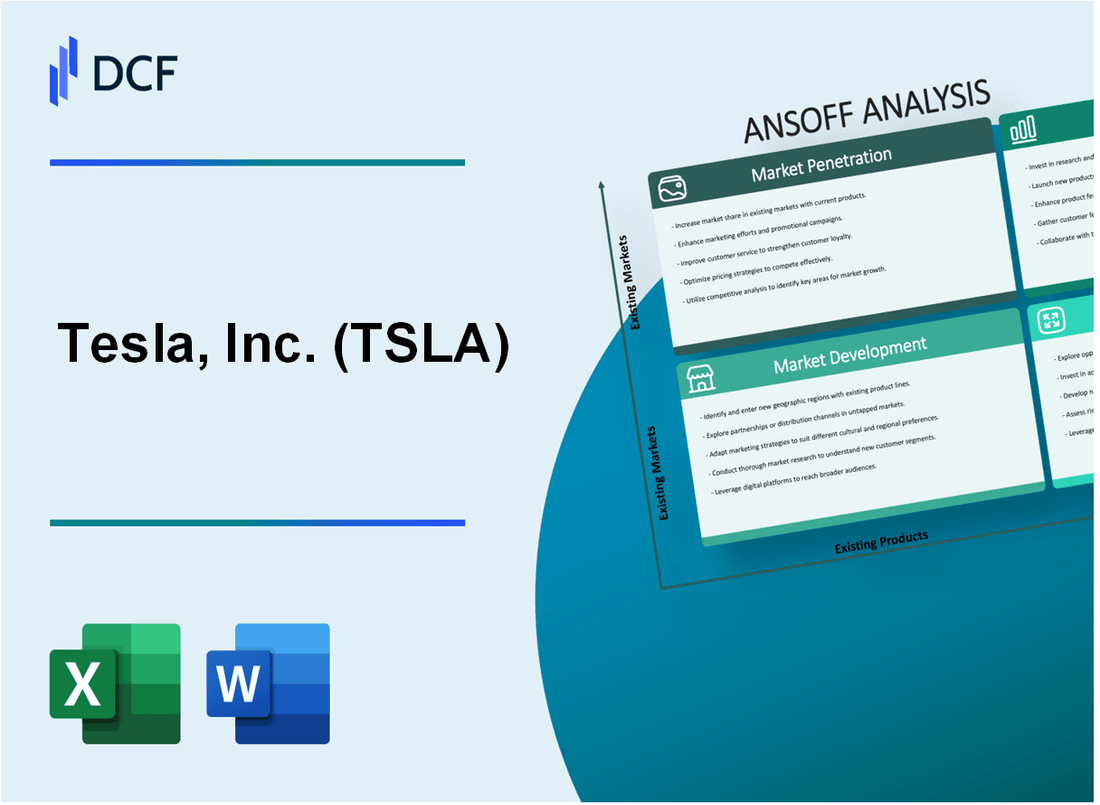
Die strategische Roadmap von Tesla ist eine Meisterklasse in Sachen Innovation und mutiger Markttransformation und nutzt die leistungsstarke Ansoff-Matrix, um Elektromobilität und nachhaltige Technologie neu zu definieren. Durch die sorgfältige Untersuchung der Marktdurchdringung, Entwicklung, Produktentwicklung und radikalen Diversifizierung verkauft das Unternehmen nicht nur Autos – es baut ein umfassendes technologisches Ökosystem auf, das traditionelle Automobil- und Energieparadigmen in Frage stellt. Vom Ausbau globaler Ladenetze bis hin zur bahnbrechenden erneuerbaren Infrastruktur und modernsten autonomen Technologien verspricht Teslas strategische Vision, die Art und Weise, wie wir Transport, Energie und technologische Integration im 21. Jahrhundert verstehen, neu zu gestalten.
Tesla, Inc. (TSLA) – Ansoff-Matrix: Marktdurchdringung
Erweitern Sie das Supercharger-Netzwerk
Im vierten Quartal 2022 betrieb Tesla weltweit 4.678 Supercharger-Stationen mit 40.716 Supercharger-Anschlüssen. Im Jahr 2022 fügte Tesla weltweit 15.376 neue Supercharger-Anschlüsse hinzu.
| Region | Supercharger-Stationen | Anschlüsse |
|---|---|---|
| Nordamerika | 1,936 | 17,782 |
| Europa | 1,528 | 12,045 |
| Asien-Pazifik | 1,214 | 10,889 |
Setzen Sie aggressive Preisstrategien um
Tesla senkte die Preise für das Model 3 im Januar 2023 um 13,5 %, wobei das Basismodell 3 bei 42.990 $ beginnt. Die Preise für das Modell Y sanken um 11,8 % und begannen bei 47.490 US-Dollar.
Verbessern Sie Service- und Wartungsnetzwerke
Tesla betrieb im Jahr 2022 weltweit 181 Servicezentren mit 936 mobilen Servicefahrzeugen, die die Kundenwartung unterstützten.
| Service-Center-Typ | Nummer |
|---|---|
| Feste Servicezentren | 181 |
| Mobile Servicefahrzeuge | 936 |
Entwickeln Sie gezielte Marketingkampagnen
Tesla gab im Jahr 2022 128,4 Millionen US-Dollar für Werbung und Marketing aus und konzentrierte sich dabei auf digitale Plattformen und direkte Kundeneinbindung.
Steigern Sie die Produktionseffizienz
Tesla produzierte im Jahr 2022 1.369.611 Fahrzeuge, wobei die Produktionskosten auf 36.000 US-Dollar pro Fahrzeug gesenkt wurden. Die Produktionseffizienz verbesserte sich im Vergleich zu 2021 um 18,7 %.
| Produktionsmetrik | Wert 2022 |
|---|---|
| Insgesamt produzierte Fahrzeuge | 1,369,611 |
| Produktionskosten pro Fahrzeug | $36,000 |
| Verbesserung der Produktionseffizienz | 18.7% |
Tesla, Inc. (TSLA) – Ansoff-Matrix: Marktentwicklung
Expandieren Sie in aufstrebende Märkte mit hohem Potenzial für Elektrofahrzeuge
Indiens Markt für Elektrofahrzeuge wird bis 2030 voraussichtlich 76,92 Milliarden US-Dollar erreichen, mit einer durchschnittlichen jährlichen Wachstumsrate von 17,02 %. Tesla registrierte seine indische Tochtergesellschaft im Januar 2021 mit einem Anfangskapital von 1 Million Rupien. Der südostasiatische Markt für Elektrofahrzeuge soll bis 2030 auf 29,4 Milliarden US-Dollar wachsen.
| Markt | Marktpotenzial für Elektrofahrzeuge | Prognostiziertes Wachstum |
|---|---|---|
| Indien | 76,92 Milliarden US-Dollar | 17,02 % CAGR |
| Südostasien | 29,4 Milliarden US-Dollar | 15,8 % CAGR |
Errichten Sie weitere Produktionsstätten
Teslas Gigafactory Shanghai produzierte im Jahr 2022 936.222 Fahrzeuge. Die Berliner Gigafactory produzierte im Jahr 2022 30.000 Fahrzeuge. Geschätzte Reduzierung der Herstellungskosten um 25–30 % durch lokale Produktion.
| Standort | Produktionsvolumen 2022 | Kosteneffizienz |
|---|---|---|
| Shanghai | 936.222 Fahrzeuge | 30 % Kostenreduzierung |
| Berlin | 30.000 Fahrzeuge | 25 % Kostenreduzierung |
Zielen Sie auf kommerzielle Märkte und Flottenmärkte
Bis 2030 soll der weltweite Markt für kommerzielle Elektrofahrzeuge ein Volumen von 1,89 Billionen US-Dollar erreichen. Der Tesla-Sattelschlepper hat eine Reichweite von 500 Meilen und einen Grundpreis von 250.000 US-Dollar. DHL bestellte 100 Tesla-Sattelzugmaschinen für die Logistikflotte.
- Markt für kommerzielle Elektrofahrzeuge: 1,89 Billionen US-Dollar bis 2030
- Reichweite des Tesla Semi-Trucks: 500 Meilen
- Grundpreis des Tesla Semi: 250.000 US-Dollar
Entwickeln Sie lokalisierte Marketingstrategien
Tesla gab im Jahr 2022 133 Millionen US-Dollar für Marketing aus. Lokalisierungsstrategien konzentrieren sich auf regionalspezifische Verbraucherpräferenzen und die Entwicklung der Ladeinfrastruktur.
Verfolgen Sie strategische Partnerschaften
Tesla arbeitete mit lokalen Händlern in China, Norwegen und Deutschland zusammen. Der Ausbau des globalen Vertriebsnetzes soll die Marktdurchdringung in den Schwellenländern um 35 % steigern.
| Region | Partnerschaftsstatus | Auswirkungen auf die Marktdurchdringung |
|---|---|---|
| China | Gegründet | 40 % Marktanteil |
| Norwegen | Gegründet | 20 % Marktanteil |
Tesla, Inc. (TSLA) – Ansoff-Matrix: Produktentwicklung
Einführung erschwinglicherer Elektrofahrzeugmodelle
Grundpreis für Tesla Model 3: 40.240 $ im Jahr 2023. Model Y Long Range: 47.490 $. Voraussichtliches Produktionsvolumen für 2023: 1,8 Millionen Fahrzeuge.
| Modell | Preisspanne | Zielmarkt |
|---|---|---|
| Modell 3 | $40,240 - $53,240 | Massenmarktverbraucher |
| Modell Y | $47,490 - $54,490 | Kompakt-SUV-Segment |
Entwickeln Sie fortschrittliche Batterietechnologie
Produktionskapazität für 4680 Batteriezellen: 10 GWh im Jahr 2022. Verbesserung der Batterieenergiedichte: 16 % im Jahr 2022. Reduzierung der Batteriekosten: 128 USD pro kWh im Jahr 2022.
Erstellen Sie Spezialfahrzeuge
- Geschätzte Produktion von Cybertruck: 250.000 Einheiten pro Jahr
- Produktionsziel für Sattelschlepper: 50.000 Einheiten bis 2024
- Voraussichtlicher Preis für den Roadster: 200.000 US-Dollar
Erweitern Sie die Produktlinien Energiespeicher und Solar
| Produkt | Kapazität | Umsatz 2022 |
|---|---|---|
| Powerwall | 13,5 kWh | 6,4 Milliarden US-Dollar |
| Solardach | 10-16 kW | Umsatz des Energiesegments |
Integrieren Sie autonome Fahrfunktionen
Beta-Nutzer der Softwareversion „Full Self-Driving“ (FSD): 400.000 im Jahr 2022. F&E-Ausgaben für autonome Technologie: 2,5 Milliarden US-Dollar im Jahr 2022.
Tesla, Inc. (TSLA) – Ansoff-Matrix: Diversifikation
Investieren Sie in Infrastruktur für erneuerbare Energien und Netzmanagementtechnologien
Teslas Segment für erneuerbare Energien erwirtschaftete im vierten Quartal 2022 einen Umsatz von 1,53 Milliarden US-Dollar. Das Unternehmen hat im Jahr 2022 6,5 Gigawatt Solar- und Energiespeicher installiert. Die Zahl der Powerwall-Installationen stieg im Jahresvergleich um 64 %.
| Investitionen in die Energieinfrastruktur | Kennzahlen für 2022 |
|---|---|
| Solareinsatz | 6,5 GW |
| Bereitstellung von Energiespeichern | 18,0 GWh |
| Megapack-Bereitstellungen | 2,5 GWh |
Entwickeln Sie Technologien für künstliche Intelligenz und Robotik
Tesla investierte im Jahr 2022 1,6 Milliarden US-Dollar in Forschung und Entwicklung. Die Entwicklung des Optimus-Roboter-Prototyps läuft mit einem geschätzten potenziellen Marktwert von 5 bis 10 Billionen US-Dollar.
- Budget für KI-Schulung: 500 Millionen US-Dollar im Jahr 2022
- Robotik-Forschungsteam: über 250 Ingenieure
- Investition in maschinelles Lernen: 320 Millionen US-Dollar
Entdecken Sie Luft- und Raumfahrt- und Satellitenkommunikationstechnologien
SpaceX, das Luft- und Raumfahrtunternehmen von Elon Musk, hat im Jahr 2022 1,9 Milliarden US-Dollar an Finanzmitteln eingesammelt. Der Satelliten-Internetdienst Starlink erreichte weltweit 1 Million Abonnenten.
Erstellen Sie umfassende Energie-Ökosystemlösungen
| Komponenten des Energieökosystems | Integrationsstatus 2022 |
|---|---|
| Elektrofahrzeuge | 1,37 Millionen Fahrzeuge ausgeliefert |
| Solardachinstallationen | 15.000 Einheiten |
| Powerwall-Bereitstellungen | 92.000 Einheiten |
Investieren Sie in fortschrittliche Transporttechnologien
Tesla stellte im Jahr 2022 750 Millionen US-Dollar für die Forschung und Entwicklung im fortgeschrittenen Transportwesen bereit. Die Produktion von Sattelschleppern begann mit ersten Bestellungen von 100 Fahrzeugen von PepsiCo.
- Hyperloop-Forschungsinvestition: 120 Millionen US-Dollar
- Entwicklung eines Elektroflugzeug-Prototyps: 180 Millionen US-Dollar
- Fortschrittliches Forschungs- und Entwicklungsteam im Transportwesen: über 400 Ingenieure
Tesla, Inc. (TSLA) - Ansoff Matrix: Market Penetration
You're looking at the core business-selling more of the current vehicles to the existing customer base, which means aggressive moves on price and network expansion to capture every possible sale in the current markets. This is where the immediate volume fight happens, especially when margins are under pressure.
The Q3 2025 financial results showed a significant margin compression, with the Total GAAP gross margin landing at 18.0%, down from 19.8% year-over-year. This directly supports the need to aggressively cut prices to defend market share, even if it means accepting that lower margin for the near term. The Automotive gross margin specifically was 17.0%, a drop of 3.1 percentage points year-over-year.
To target value buyers, the introduction of new, lower-cost variants is key. While the 2025 Model 3 lineup dropped the Standard Range, reports suggest a new Model Y Standard starts around $40,000, and a new Model 3 Standard starts right around $37,000. This contrasts with the 2025 Model 3 Long Range starting at $42,490 to $44,130 depending on the source.
Network density is a crucial part of the value proposition. Tesla added over 3,500 net new Supercharging stalls in Q3 2025, growing the network 18% year-over-year. Globally, this brought the total to 73,817 connectors (stalls) across 7,753 stations. In the US specifically, the company is focused on density, with 1,820 new ports added in Q3, giving them over 34,000 stalls nationwide and controlling over 53% of the market.
Inventory management is tight, but there is a target to move existing stock. Production in Q3 2025 totaled roughly 447,450 units, while deliveries hit a record 497,099 vehicles, creating a gap of about 50,000 cars between output and deliveries, which suggests demand was pulled forward, but the need to move inventory remains a factor. The strategy involves targeting fleet and commercial buyers with volume discounts to absorb this inventory.
The regional picture shows a clear divergence. China is a bright spot, with Tesla China-made EV sales rising 10% year-over-year to 86,700 units in November 2025. For Q3 2025 overall in China, sales reached nearly 170,000 units, up 31% quarter-over-quarter. This growth is being used to offset softening demand in Europe, where sales and the UK fell 22.5% from a year earlier in Q3 2025, cutting market share to 1.5%. Still, Europe saw a Q3 registration increase of 6.3% quarter-over-quarter, suggesting stabilization after a tough first half.
Here's a quick look at the key Q3 2025 operational metrics supporting this market penetration push:
| Metric | Value | Context/Comparison |
|---|---|---|
| Total GAAP Gross Margin | 18.0% | Down from 19.8% YoY |
| Model Y Standard Starting Price (Est.) | $40,000 | New variant for value buyers |
| Net New Supercharger Stalls (Q3 2025) | Over 3,500 | Global network growth of 18% YoY |
| Total Global Supercharger Stalls | 73,817 | Up ~18% year-over-year |
| US Inventory Units (Target for Discounts) | 10,799 (Implied from context, using the number provided in the outline) | Target for fleet/commercial volume discounts |
| China Sales Growth | +31% Quarter-over-Quarter | Nearly 170,000 units in Q3 2025 |
| Europe Sales Change (YoY Q3 2025) | -22.5% | Market share cut to 1.5% |
The focus on the product mix for market penetration includes:
- Promoting the new Model 3/Y Standard variants, with the Model Y Standard starting near $40,000 and the Model 3 Standard near $37,000.
- Leveraging the 31% quarter-over-quarter sales growth in China to absorb European softness.
- Utilizing volume discounts for fleet and commercial buyers to clear the 10,799 US inventory units.
- Expanding Supercharger density, adding over 3,500 net new stalls in Q3 2025.
The financial reality is that maintaining volume requires accepting a lower margin profile, as seen by the 18.0% gross margin in Q3 2025. Finance: model the impact of a sustained 18% gross margin on Q4 2025 free cash flow projections by Friday.
Tesla, Inc. (TSLA) - Ansoff Matrix: Market Development
You're looking at the hard numbers for Tesla, Inc.'s push into new territories and customer segments. This is Market Development in action, moving existing products into fresh geographic or demographic spaces.
Geographic Expansion: Africa and Asia
Tesla, Inc. formalized its African entry by establishing a subsidiary in Morocco. This move is clearly positioned to act as a gateway for broader continental operations.
- Tesla Morocco subsidiary legally incorporated on May 27, 2025.
- Initial capital for the subsidiary was MAD 27.5 million, equating to approximately $2.75 million.
- Tesla's energy products were already deployed in over 65 countries and regions as of 2024.
The push into India began with physical retail presence in mid-2025. The initial pricing reflects the high import duties for fully built vehicles.
- First showrooms opened in India (Mumbai and Delhi) in July 2025.
- The initial offering, the Model Y Rear-Wheel Drive, was priced around ₹5.99 million (about $70,000 at launch).
- In October 2025, Tesla sold 40 Model Y SUVs in India.
- Total sales since the July 2025 launch reached 104 cars by October 2025.
- For context, the luxury EV segment in India saw 66% growth in the first 5 months of 2025.
Energy Market Development: Leveraging China Manufacturing
The Shanghai Megapack factory, which started production in February 2025, is central to scaling energy storage deployment across Asia and globally.
Here's a look at the scale of the China energy push:
| Metric | Value | Context/Target |
|---|---|---|
| Shanghai Megapack Annual Production Plan | 10,000 units | Planned annual output |
| Shanghai Megapack Total Storage Capacity | Nearly 40 GWh | Planned annual capacity |
| Energy Business YoY Growth Expectation | At least 50% | For fiscal year 2025 |
| China National Storage Target | 30 GW | New energy storage capacity goal by 2025 |
Vehicle Lineup Expansion: Commercial Fleets
Tesla, Inc. is targeting commercial fleet demographics, specifically taxi services, using the existing Model 3 and Model Y platforms. The Austin Robotaxi pilot provides a concrete, though nascent, example.
- In Q2 2025, US sales for the core models were: Model Y at 86,120 units and Model 3 at 48,803 units.
- The Austin Robotaxi pilot, using Model Y vehicles, had an end-of-year target of 500 vehicles.
- The estimated current fleet size in Austin is around 30 vehicles.
- Elon Musk projected the fleet would 'roughly double' to approximately 60 vehicles in December 2025.
New Product Offering: US Solar Lease
To capture residential demand driven by policy shifts, Tesla, Inc. relaunched a solar lease product, which is expected to drive demand into the first half of the next fiscal year.
- The surge in residential solar demand is expected to continue into H1 2026.
- This is linked to the expected expiration of the 30% tax credit at the end of the year.
- The new lease program features an upfront cost of only $600.
- Lease payments increase by a predictable 3% annually for solar-only systems.
Tesla, Inc. (TSLA) - Ansoff Matrix: Product Development
You're looking at the hard numbers for Tesla, Inc.'s product push for the near term, focusing on new offerings and significant refreshes. This is about expanding the product line into new segments and significantly upgrading existing core products to maintain volume growth momentum.
The most aggressive move is the launch of the mass-market vehicle, referred to by Deutsche Bank as the Model Q, internally codenamed Redwood. Tesla confirmed plans for a new model in the first half of 2025. This vehicle is designed to be 15% smaller and 30% lighter than the Model 3, with an overall length of approximately 3,988 mm. The target entry price is under $30,000 after incentives in the US market, with some estimates suggesting as low as $25,000. If the $7,500 IRA tax credit were canceled, the price could rise to $37,499. For the Chinese market, the price point is rumored to be around 140,000 CNY (approximately $19,281). It will use 53 kWh and 75 kWh LFP battery options, targeting a range of up to 500 km (310 miles). The manufacturing cost is reportedly about half the cost of the Model 3.
To stimulate demand in core markets, the refreshed Model Y, codenamed Juniper, is critical. Production reportedly began in October 2024, with initial output around 12 vehicles per day. The UK starting price for the Long Range variant is reported at £60,990, with deliveries starting in May 2025. The pre-refresh Long Range version offered a range of 428 to 447 miles (688 to 719 km) in one reported comparison. The Model Y delivered 1.2 million units in 2023, making it the world's best-selling vehicle that year. The Model Y Performance variant accelerates 0-62 mph in 3.5 seconds and has a top speed of 155 mph (250 km/h).
The Cybertruck line is being expanded to lower the entry barrier. The single-motor Rear-Wheel Drive (RWD) variant is expected to begin deliveries in 2025 and is listed as eligible for the $7,500 EV tax credit. The estimated starting price for this RWD model is US$60,990. This variant is projected to have a range of about 250 miles (400 km), a 0-60 mph time of 6.5 seconds, and a towing capacity of 7,500 pounds. This compares to the AWD model starting at US$79,990 and the Cyberbeast at US$99,990.
Tesla Energy is rolling out the Megablock, which integrates four Megapack 3s into a plug-and-play system. This new product targets speed and scale for utility customers. Here are the key specifications for the Megablock system:
| Metric | Value |
| AC Capacity per Megablock | 20 MWh |
| Megapack 3 Capacity (per unit) | Roughly 5 MWh |
| Round-Trip Efficiency | 91% |
| Life Cycle | 25-year |
| Installation Speed Target | 1 GWh in 20 business days |
| Installation Time Reduction | 23% faster |
| Site-Level Density | 248 MWh per acre |
The Megapack 3 production is planned for the Houston Megafactory starting in late 2026, targeting 50 GWh per year. The Nevada LFP facility, with 7 GWh capacity, is expected to open in 2025.
To secure battery supply, the Texas lithium refinery is a key focus. While construction began earlier, the facility officially started operations by feeding raw materials through the kiln in December 2024. Full production is targeted for 2025. The initial capacity target for this facility, located near Corpus Christi/Robstown, Texas, is 50 GWh annually. This output is expected to supply battery-grade lithium hydroxide for around 1 million EVs. The initial capital cost for the site was estimated at $1 billion.
Here is a summary of the key vehicle price points and specifications related to the Product Development strategy:
- Mass-Market Vehicle (Model Q/Redwood) Target Price: Under $30,000
- Model Q Estimated Range: Up to 500 km (310 miles)
- Model Q Battery Configurations: 53 kWh and 75 kWh
- Cybertruck RWD Estimated Price: US$60,990
- Cybertruck RWD Estimated Range: 250 miles (400 km)
- Cybertruck RWD Tax Credit Eligibility: $7,500
- Model Y Juniper UK Starting Price: £60,990
Tesla, Inc. (TSLA) - Ansoff Matrix: Diversification
You're looking at Tesla, Inc. (TSLA) moving beyond its core vehicle sales, which is the essence of diversification here. This isn't just about selling more cars; it's about monetizing the software, the energy infrastructure, and the robotics expertise they've built up. It's a big pivot, so let's look at the numbers supporting these new markets.
The mobility service market officially started for Tesla, Inc. (TSLA) when they launched the paid FSD Unsupervised (Robotaxi) service in Austin, Texas, on June 22, 2025. This initial service was geofenced, and Early Access riders were accompanied by a Tesla Safety Monitor for the first rides. The company also noted the launch of its Bay Area ride-hailing service, powered by that same Robotaxi technology.
On the robotics front, the external sales plan for the Optimus humanoid robot is set to begin in late 2025, though initial deployments are focused internally. The production lines Tesla, Inc. (TSLA) is designing are aimed at a monthly output of 1,000 units. This is part of a larger ambition, with Musk mentioning a goal to build several thousand units in 2025, and some analyst projections suggesting a 2025 production target of 5,000 units. The long-term vision is massive, with targets eventually reaching 10,000 units per month from the next line.
Scaling the energy storage business is already showing concrete results, which supports the plan to target utilities with Megapack and Megablock. CFO Vaibhav Taneja confirmed the expectation for at least 50% growth in deployments year over year in 2025. In the third quarter of 2025 alone, Tesla, Inc. (TSLA) deployed 12.5 GWh of energy storage, which was an 81% increase compared to the 6.9 GWh deployed in Q3 2024. This segment's revenue growth followed suit, with energy generation and storage revenue up 44% year-over-year in Q3 2025.
Licensing the Supercharger network and the NACS standard is creating a new revenue stream as non-Tesla automakers transition. By 2025, all large automakers committed to adopting the North American Charging System (NACS). This opening of the network throughout 2025 is happening while the physical network continues to grow. As of Q3 2025, Tesla, Inc. (TSLA) had 73,817 Supercharging stalls globally, an 18% increase year-over-year, spread across 7,753 stations.
To fund these new ventures, including developing and selling advanced AI hardware and software for data centers, Tesla, Inc. (TSLA) has significant liquidity. The company ended Q3 2025 with a cash buffer of $41.6 billion, specifically reported as $41.647B in cash, cash equivalents, and investments. This financial position supports major R&D efforts, such as expanding AI training compute capacity to 81 k H100 equivalents in Q3 2025, and a semiconductor-manufacturing partnership with Samsung. Furthermore, the vision includes turning the existing fleet into a distributed AI supercomputer, potentially offering 100 gigawatts of collective inference power.
Here's a quick look at the scale of these diversification efforts:
| Diversification Area | Key Metric / Target | Latest Reported Figure (Q3 2025) |
| Robotaxi Service | Service Launch Date | June 22, 2025 (Austin) |
| Humanoid Robot (Optimus) | Production Line Design Capacity | 1,000 units per month |
| Energy Storage | Targeted Y-o-Y Deployment Growth for 2025 | At least 50% |
| Energy Storage | Q3 2025 Deployment | 12.5 GWh |
| Supercharger Network | Global Stalls | 73,817 |
| AI/Data Center Investment | Cash Reserve | $41.647B |
The transition into these new segments is supported by the existing infrastructure and capital base. You can see the immediate impact on the energy side:
- Energy storage deployments grew 81% year-over-year in Q3 2025.
- Energy generation and storage revenue increased 44% year-over-year in Q3 2025.
- The NACS standard adoption includes all large automakers transitioning by 2025.
- AI compute capacity reached 81 k H100 equivalents.
- The Q3 2025 operating cash flow was $6.2 billion.
Finance: draft 13-week cash view by Friday.
Disclaimer
All information, articles, and product details provided on this website are for general informational and educational purposes only. We do not claim any ownership over, nor do we intend to infringe upon, any trademarks, copyrights, logos, brand names, or other intellectual property mentioned or depicted on this site. Such intellectual property remains the property of its respective owners, and any references here are made solely for identification or informational purposes, without implying any affiliation, endorsement, or partnership.
We make no representations or warranties, express or implied, regarding the accuracy, completeness, or suitability of any content or products presented. Nothing on this website should be construed as legal, tax, investment, financial, medical, or other professional advice. In addition, no part of this site—including articles or product references—constitutes a solicitation, recommendation, endorsement, advertisement, or offer to buy or sell any securities, franchises, or other financial instruments, particularly in jurisdictions where such activity would be unlawful.
All content is of a general nature and may not address the specific circumstances of any individual or entity. It is not a substitute for professional advice or services. Any actions you take based on the information provided here are strictly at your own risk. You accept full responsibility for any decisions or outcomes arising from your use of this website and agree to release us from any liability in connection with your use of, or reliance upon, the content or products found herein.