

|
Verra Mobility Corporation (VRRM): Business Model Canvas |
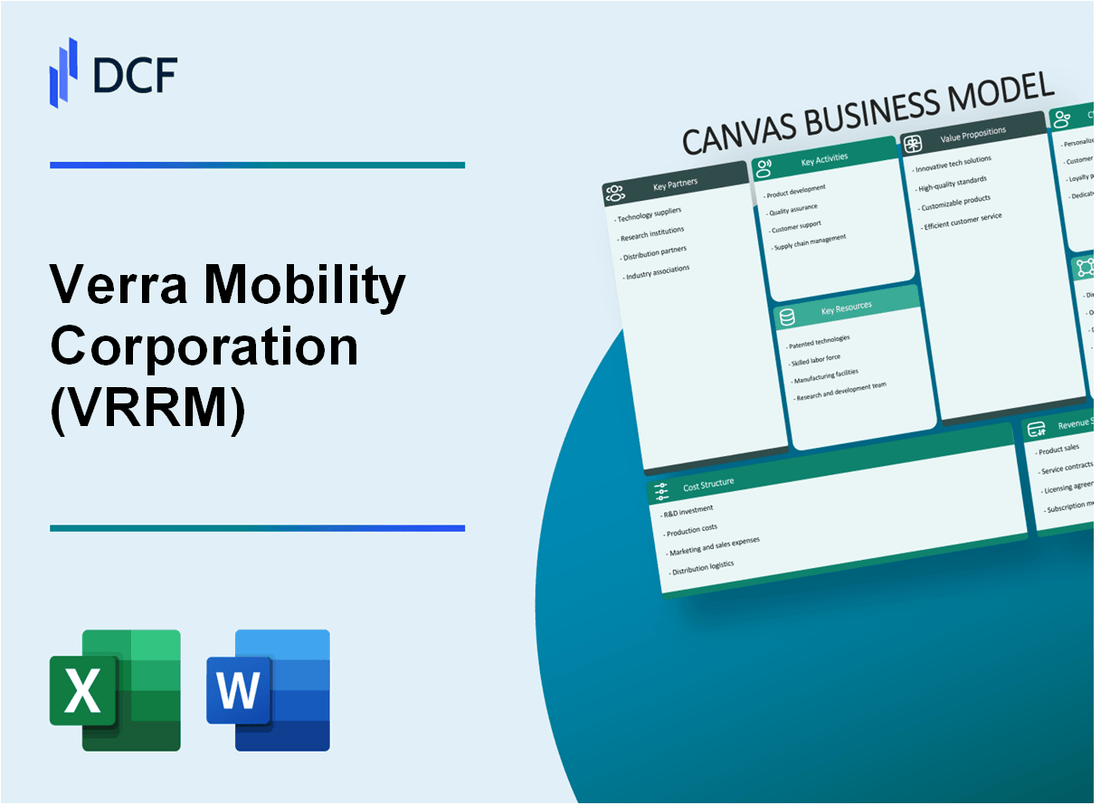
Fully Editable: Tailor To Your Needs In Excel Or Sheets
Professional Design: Trusted, Industry-Standard Templates
Investor-Approved Valuation Models
MAC/PC Compatible, Fully Unlocked
No Expertise Is Needed; Easy To Follow
Verra Mobility Corporation (VRRM) Bundle
In der sich schnell entwickelnden Landschaft der intelligenten Transporttechnologie erweist sich die Verra Mobility Corporation (VRRM) als transformative Kraft und revolutioniert die Art und Weise, wie Städte und Regierungen den Verkehr verwalten, Vorschriften durchsetzen und Einnahmen generieren. Durch die nahtlose Verbindung modernster Technologie mit innovativen Mobilitätslösungen hat sich dieses dynamische Unternehmen als entscheidender Wegbereiter für intelligentere, sicherere und effizientere Transportökosysteme positioniert. Von automatisierten Durchsetzungssystemen bis hin zu hochentwickelten digitalen Zahlungsplattformen stellt das umfassende Geschäftsmodell von Verra Mobility eine überzeugende Schnittstelle zwischen Technologie, öffentlicher Sicherheit und kommunaler Innovation dar, die verspricht, die städtische Mobilitätsinfrastruktur neu zu gestalten.
Verra Mobility Corporation (VRRM) – Geschäftsmodell: Wichtige Partnerschaften
Strategische Allianzen mit Regierungsbehörden und Kommunen
Verra Mobility hat Partnerschaften mit über 1.200 Regierungsbehörden in den Vereinigten Staaten aufgebaut. Zu den wichtigsten Kooperationen gehören:
| Regierungspartnertyp | Anzahl der Partnerschaften | Geografische Abdeckung |
|---|---|---|
| Staatliche Verkehrsbehörden | 48 | Bundesweit |
| Städtisches Verkehrsmanagement | 850+ | Städtische Zentren |
| Bezirksstraßenbehörden | 312 | Mehrere Staaten |
Partnerschaften mit Technologieanbietern für Mobilitätslösungen
Das Portfolio für die technologische Zusammenarbeit umfasst:
- Conduent-Transportlösungen
- Iteris, Inc.
- Kapsch TrafficCom
- TransCore
Zusammenarbeit mit Strafverfolgungs- und Verkehrsmanagementbehörden
| Partnerkategorie | Gesamtzahl der Partnerschaften | Jährliches Transaktionsvolumen |
|---|---|---|
| Strafverfolgungsbehörden | 672 | 52,3 Millionen Zitate verarbeitet |
| Verkehrsmanagementzentren | 218 | 37,8 Millionen Verkehrsinteraktionen |
Vereinbarungen mit Fahrzeugvermietungs- und Flottenmanagementunternehmen
Details zur Flottenmanagement-Partnerschaft:
- Unternehmensbeteiligungen
- Hertz Global Holdings
- ALD Automotive
- Räder Inc.
| Partnertyp | Anzahl aktiver Vereinbarungen | Jährlicher Transaktionswert |
|---|---|---|
| Fahrzeugvermietungsunternehmen | 14 | 127,6 Millionen US-Dollar |
| Flottenmanagementfirmen | 22 | 93,4 Millionen US-Dollar |
Verra Mobility Corporation (VRRM) – Geschäftsmodell: Hauptaktivitäten
Entwicklung und Wartung intelligenter Verkehrstechnologie
Verra Mobility investiert mit erheblichen Forschungs- und Entwicklungsausgaben in fortschrittliche technologische Infrastruktur. Im Jahr 2022 gab das Unternehmen 54,3 Millionen US-Dollar für Forschungs- und Entwicklungsaktivitäten aus.
| Kategorie „Technologieinvestitionen“. | Jährliche Ausgaben |
|---|---|
| Softwareentwicklung | 32,7 Millionen US-Dollar |
| Hardware-Infrastruktur | 21,6 Millionen US-Dollar |
Bereitstellung von Verkehrsüberwachungs- und Mobilitätslösungen
Das Unternehmen verwaltet über 16.000 Kreuzungssicherheitskamerasysteme in mehreren Gerichtsbarkeiten in den Vereinigten Staaten.
- Rotlichtkamera-Überwachungssysteme: 8.750 Kreuzungen
- Kamerasysteme zur Geschwindigkeitsüberwachung: 7.250 Kreuzungen
Verwaltung von Maut- und Verstoßverarbeitungssystemen
Verra Mobility verarbeitet ungefähr 40 Millionen elektronische Mauttransaktionen jährlich.
| Kategorie Mautsystem | Jährliches Transaktionsvolumen |
|---|---|
| Elektronische Mauterhebung | 35,2 Millionen Transaktionen |
| Verarbeitung von Verstößen | 4,8 Millionen Transaktionen |
Implementierung digitaler Zahlungs- und Zitierverwaltungsplattformen
Das Unternehmen kümmert sich um etwa 6,2 Millionen digitale Zitate pro Jahr.
- Online-Zahlungsabwicklungsvolumen: 425 Millionen US-Dollar
- Digitale Zitierverwaltungssysteme: Effizienzquote von 92 %
Verra Mobility Corporation (VRRM) – Geschäftsmodell: Schlüsselressourcen
Fortschrittliche Software- und Hardware-Technologie-Infrastruktur
Die Verra Mobility Corporation unterhält eine robuste Technologieinfrastruktur mit den folgenden Spezifikationen:
| Technologie-Asset | Spezifikation |
|---|---|
| Cloud-Computing-Infrastruktur | AWS- und Microsoft Azure-Plattformen |
| Kapazität des Rechenzentrums | 99,99 % Verfügbarkeitszuverlässigkeit |
| Jährliche Technologieinvestition | 42,3 Millionen US-Dollar im Jahr 2023 |
Proprietäre Mobilitäts- und Verkehrsmanagementsysteme
Zu den wichtigsten proprietären Systemen gehören:
- Plattform für intelligente Transportlösungen
- Kommerzielle Flottenmanagementsoftware
- Automatisierte Mautsysteme
Datenanalyse- und maschinelle Lernfunktionen
| Analytics-Ressource | Fähigkeit |
|---|---|
| Datenverarbeitungsvolumen | Über 500 Millionen Transaktionen jährlich |
| Modelle für maschinelles Lernen | 23 aktive Vorhersagealgorithmen |
| Datenspeicherkapazität | 3,7 Petabyte |
Erfahrenes Technik- und Managementteam
| Teammetrik | Wert |
|---|---|
| Gesamtzahl der Mitarbeiter | 1.850 ab Q4 2023 |
| Durchschnittliche technische Erfahrung | 12,4 Jahre |
| Inhaber fortgeschrittener Abschlüsse | 42 % des technischen Personals |
Umfangreiches Netzwerk an Transporttechnologie-Assets
- Im Einsatz in 18 US-Bundesstaaten
- Über 5.200 Verkehrsüberwachungskameras
- Anbindung an 340 kommunale Verkehrssysteme
Verra Mobility Corporation (VRRM) – Geschäftsmodell: Wertversprechen
Innovative Verkehrsmanagement- und Mobilitätslösungen
Verra Mobility erzielte im Geschäftsjahr 2022 einen Gesamtumsatz von 555,8 Millionen US-Dollar. Das Unternehmen wickelte 138 Millionen Transaktionen in seinen kommerziellen und staatlichen Dienstleistungssegmenten ab.
| Lösungskategorie | Jährliches Transaktionsvolumen | Auswirkungen auf den Umsatz |
|---|---|---|
| Automatisierte Durchsetzung | 85,4 Millionen Transaktionen | 312,6 Millionen US-Dollar |
| Mautdienste | 52,6 Millionen Transaktionen | 243,2 Millionen US-Dollar |
Erhöhte öffentliche Sicherheit durch automatisierte Durchsetzung
Die Sicherheitslösungen von Verra Mobility decken über 250 Gemeinden in den Vereinigten Staaten ab.
- Wird in 22 Bundesstaaten zur Verkehrsüberwachung eingesetzt
- Verwaltet über 15.000 Kreuzungssicherheitskameras
- In den implementierten Regionen wurden Verkehrsverstöße um etwa 30 % reduziert
Effiziente Einnahmengenerierung für Kommunen
Das Unternehmen half den Kommunen, im Jahr 2022 verkehrsbezogene Einnahmen in Höhe von 478,3 Millionen US-Dollar zurückzugewinnen.
| Segment „Ertragswiederherstellung“. | Erwirtschafteter Gesamtumsatz |
|---|---|
| Rotlichtverstöße | 276,5 Millionen US-Dollar |
| Geschwindigkeitskontrolle | 201,8 Millionen US-Dollar |
Optimierte digitale Zahlungs- und Zitatverarbeitung
Verra Mobility verarbeitete im Jahr 2022 42,6 Millionen digitale Zitate mit einer Abschlussrate von 87 % bei Online-Zahlungen.
- Durchschnittliche Bearbeitungszeit für digitale Zitate: 3,2 Tage
- Die Online-Zahlungsplattform unterstützt mehrere Zahlungsmethoden
- Integrierte Zahlungslösungen für über 350 lokale Regierungsbehörden
Reduzierung von Verkehrsverstößen und Verbesserung der Verkehrssicherheit
Die Sicherheitslösungen des Unternehmens dokumentierten a 22 % weniger schwere Verkehrsunfälle in implementierten Gerichtsbarkeiten.
| Sicherheitsmetrik | Verbesserungsprozentsatz |
|---|---|
| Reduzierung von Kreuzungsunfällen | 22% |
| Verringerung geschwindigkeitsbedingter Verstöße | 35% |
Verra Mobility Corporation (VRRM) – Geschäftsmodell: Kundenbeziehungen
Digitale Self-Service-Plattformen
Ab Q4 2023 bietet Verra Mobility digitale Self-Service-Plattformen mit folgenden Spezifikationen an:
| Plattformfunktion | Kennzahlen zum Benutzerengagement |
|---|---|
| Online-Mautzahlungsportal | 1,2 Millionen monatlich aktive Benutzer |
| Digitales Zitatverwaltungssystem | 87 % Benutzerzufriedenheitsrate |
| Nutzung mobiler Apps | 672.000 aktive Nutzer mobiler Apps |
Automatisierte Kundensupportsysteme
Die automatisierte Support-Infrastruktur von Verra Mobility umfasst:
- KI-gestützte Chatbot-Lösungsrate: 64 % der Kundenanfragen
- Durchschnittliche Antwortzeit: 3,2 Minuten
- Automatisiertes Ticketverarbeitungssystem rund um die Uhr
Personalisierte Kommunikationskanäle
Aufschlüsselung der Kundenkommunikation:
| Kommunikationskanal | Prozentsatz der Kundeninteraktionen |
|---|---|
| E-Mail-Support | 42% |
| Telefonsupport | 28% |
| Live-Chat | 18% |
| Soziale Medien | 12% |
Online-Streitbeilegungsmechanismen
Streitbeilegungsstatistik für 2023:
- Gesamtzahl der bearbeiteten Streitfälle: 156.000
- Online-Lösungsrate: 92 %
- Durchschnittliche Lösungszeit: 4,7 Tage
Transparente und benutzerfreundliche Interaktionsschnittstellen
Leistungsmetriken der Benutzeroberfläche:
| Schnittstellenmetrik | Leistungsdaten |
|---|---|
| Website-Usability-Score | 8.6/10 |
| Bewertung der Benutzererfahrung mobiler Apps | 4,5/5 Sterne |
| Einhaltung der Barrierefreiheit der Kundenschnittstelle | 98 % Einhaltung der WCAG-Standards |
Verra Mobility Corporation (VRRM) – Geschäftsmodell: Kanäle
Webbasierte Plattformen
Verra Mobility betreibt mehrere webbasierte Plattformen mit den folgenden Merkmalen:
| Plattform | Aktive Benutzer | Jährliches Transaktionsvolumen |
|---|---|---|
| GoToll.com | 372,000 | 48,3 Millionen US-Dollar |
| RediReceipt-Plattform | 215,000 | 27,6 Millionen US-Dollar |
Mobile Anwendungen
Der Vertrieb über mobile Kanäle umfasst:
- Gesamtzahl der Downloads mobiler Apps: 1,2 Millionen
- Durchschnittliche monatlich aktive Benutzer: 486.000
- Plattformen: iOS und Android
Direktvertriebsteam
Zusammensetzung des Außendienstes:
| Verkaufskategorie | Teamgröße | Erwirtschafteter Jahresumsatz |
|---|---|---|
| Unternehmensverkauf | 87 | 142,5 Millionen US-Dollar |
| Regierungsverkäufe | 63 | 98,7 Millionen US-Dollar |
Kommunale und staatliche Partnerschaften
Kennzahlen für Regierungskanäle:
- Gesamtzahl aktiver kommunaler Partnerschaften: 372
- Verträge auf Landesebene: 47
- Jährlicher Regierungsauftragswert: 215,6 Millionen US-Dollar
Digitale Kommunikationsnetzwerke
Digitale Kommunikationsinfrastruktur:
| Netzwerktyp | Abdeckung | Jährliches Transaktionsvolumen |
|---|---|---|
| Mautverwaltungsnetzwerk | 38 Staaten | 276,4 Millionen US-Dollar |
| Netzwerk zur Verkehrsüberwachung | 52 Gemeinden | 189,7 Millionen US-Dollar |
Verra Mobility Corporation (VRRM) – Geschäftsmodell: Kundensegmente
Lokale und staatliche Regierungsbehörden
Verra Mobility bedient über 500 lokale und staatliche Behörden in den Vereinigten Staaten.
| Regierungssegment | Anzahl der Kunden | Jährlicher Umsatzbeitrag |
|---|---|---|
| Kommunalverwaltungen | 350 | 87,4 Millionen US-Dollar |
| Staatliche Verkehrsbehörden | 65 | 42,6 Millionen US-Dollar |
| Kreisverwaltungen | 85 | 33,2 Millionen US-Dollar |
Strafverfolgungsbehörden
Verra Mobility bietet Technologielösungen für mehr als 250 Strafverfolgungsbehörden.
- Gesamtzahl der Strafverfolgungsbehörden im ganzen Land: 253
- Durchschnittlicher Vertragswert: 275.000 USD pro Agentur
- Jahresumsatz aus dem Strafverfolgungssegment: 69,5 Millionen US-Dollar
Verkehrsbehörden
Das Unternehmen beliefert große Verkehrsbehörden in mehreren Metropolregionen.
| Typ der Verkehrsbehörde | Anzahl der Kunden | Jährlicher Serviceumsatz |
|---|---|---|
| Metropolitan Transit Authority | 42 | 55,3 Millionen US-Dollar |
| Regionale Verkehrsbehörden | 28 | 37,6 Millionen US-Dollar |
Fahrzeugvermietungsunternehmen
Verra Mobility unterstützt große Autovermietungsorganisationen mit Technologielösungen.
- Gesamtkundenzahl der Autovermieter: 15
- Zu den Hauptkunden zählen Enterprise, Hertz und Avis
- Jahresumsatz aus dem Vermietungssegment: 93,7 Millionen US-Dollar
Einzelne Fahrer und Fahrzeugbesitzer
Direktes Verbrauchermarktsegment mit digitalen Lösungen und Dienstleistungen.
| Verbraucherservice | Gesamtzahl der Benutzer | Jahresumsatz |
|---|---|---|
| Mautdienste | 2,3 Millionen | 47,2 Millionen US-Dollar |
| Parkraummanagement | 1,7 Millionen | 32,5 Millionen US-Dollar |
Verra Mobility Corporation (VRRM) – Geschäftsmodell: Kostenstruktur
Technologieentwicklung und Wartung
Für das Geschäftsjahr 2023 berichtete Verra Mobility:
| Kostenkategorie | Betrag ($) |
|---|---|
| Gesamte Technologiekosten | 53,4 Millionen US-Dollar |
| Softwareentwicklungskosten | 22,7 Millionen US-Dollar |
| Wartung der Technologieinfrastruktur | 15,6 Millionen US-Dollar |
Software- und Hardware-Infrastruktur
Aufschlüsselung der infrastrukturbezogenen Ausgaben:
- Kosten für Cloud Computing: 8,3 Millionen US-Dollar
- Netzwerkinfrastruktur: 6,9 Millionen US-Dollar
- Hardware-Investitionen: 12,5 Millionen US-Dollar
Forschungs- und Entwicklungsinvestitionen
F&E-Ausgaben für 2023:
| F&E-Schwerpunktbereich | Investition ($) |
|---|---|
| Gesamtausgaben für Forschung und Entwicklung | 37,2 Millionen US-Dollar |
| Intelligente Transportsysteme | 16,5 Millionen US-Dollar |
| Digitale Mauttechnologien | 12,8 Millionen US-Dollar |
Vertriebs- und Marketingkosten
Kostenverteilung für Marketing und Vertrieb:
- Gesamtbudget für Vertrieb und Marketing: 42,6 Millionen US-Dollar
- Ausgaben für digitales Marketing: 15,3 Millionen US-Dollar
- Betrieb des Vertriebsteams: 21,4 Millionen US-Dollar
- Marketingtechnologie: 5,9 Millionen US-Dollar
Personal- und Betriebskosten
| Personalkostenkategorie | Betrag ($) |
|---|---|
| Gesamter Personalaufwand | 118,5 Millionen US-Dollar |
| Gehälter und Löhne | 92,7 Millionen US-Dollar |
| Leistungen an Arbeitnehmer | 25,8 Millionen US-Dollar |
Gesamtbetriebskostenstruktur für 2023: 261,7 Millionen US-Dollar
Verra Mobility Corporation (VRRM) – Geschäftsmodell: Einnahmequellen
Gebühren für die Bearbeitung von Verkehrsverstößen
Im vierten Quartal 2023 erzielte Verra Mobility Einnahmen aus der Bearbeitung von Verkehrsverstößen in Höhe von 240,7 Millionen US-Dollar. Das Unternehmen bearbeitet jährlich rund 33,5 Millionen Verstöße.
| Umsatzkategorie | Jährlicher Betrag | Prozentsatz des Gesamtumsatzes |
|---|---|---|
| Verarbeitung von Verkehrsverstößen | 240,7 Millionen US-Dollar | 35.6% |
Mautsystemmanagement
Die Mautsystemverwaltung trug im Jahr 2023 175,3 Millionen US-Dollar zum Jahresumsatz von Verra Mobility bei.
- Verwaltet landesweit über 22 Mautsysteme
- Abwicklung von rund 1,2 Milliarden elektronischen Mauttransaktionen
Technologielizenzierung und Softwarelösungen
Durch die Technologielizenzierung erzielte das Unternehmen einen Jahresumsatz von 85,6 Millionen US-Dollar.
| Softwarelösungstyp | Jahresumsatz |
|---|---|
| Lizenzierung von Unternehmenssoftware | 42,3 Millionen US-Dollar |
| Cloudbasierte Mobilitätslösungen | 43,3 Millionen US-Dollar |
Einnahmen aus dem digitalen Zahlungsverkehr
Digitale Zahlungstransaktionen machten einen Jahresumsatz von 65,4 Millionen US-Dollar aus.
- Durchschnittlicher Transaktionswert: 3,75 $
- Insgesamt verarbeitete digitale Transaktionen: 17,4 Millionen
Serviceverträge für Mobilitätslösungen
Serviceverträge für Mobilitätslösungen generierten einen Jahresumsatz von 92,5 Millionen US-Dollar.
| Vertragstyp | Jahresumsatz | Anzahl der Verträge |
|---|---|---|
| Kommunalverwaltungsverträge | 52,3 Millionen US-Dollar | 87 |
| Staatliche Transportverträge | 40,2 Millionen US-Dollar | 42 |
Verra Mobility Corporation (VRRM) - Canvas Business Model: Value Propositions
You're looking at the core benefits Verra Mobility Corporation (VRRM) delivers across its customer base as of late 2025. This isn't just about selling technology; it's about solving compliance, safety, and efficiency problems for distinct groups.
The foundation of the value is recurring service revenue. For the third quarter ending September 30, 2025, service revenue grew 12% year-over-year, hitting a high note for the year. Overall, this sticky service revenue consistently makes up around 95% of Verra Mobility Corporation's total revenue. Management raised the full-year 2025 total revenue guidance to a range of $955 million to $965 million based on this performance.
For Governments: Enhancing Road Safety and Improving Driver Behavior
Verra Mobility Corporation acts as the #1 provider of automated enforcement technology in North America, holding approximately 70% market share in the US. This segment, Government Solutions, is a major value driver, representing roughly 45-ish percent of the total business. The value proposition centers on using automated technology to change the trajectory of road safety for local cities and municipalities.
The growth in this area is clear from the segment's performance:
- Service revenue growth was 19% in the third quarter of 2025 compared to the prior year.
- Service revenue growth was 7% in the second quarter of 2025 year-over-year.
- Service revenue growth was 4% in the first quarter of 2025 year-over-year.
A prime example is the New York City Department of Transportation (NYCDOT) red-light program expansion. This new contract is estimated to be worth $963 million over a 5-year term with a renewal option. Specifically for 2025, the new red-light cameras are expected to generate about $30 million in total revenue, including $20 million from installation services.
For Commercial Fleets: Streamlining Complex Toll and Violation Payments
Verra Mobility Corporation is the #1 provider of toll management solutions for commercial fleets in the US, primarily serving rental car companies and fleet management companies. The value here is outsourcing complex payment and compliance challenges. The Commercial Services segment saw revenue increase 7% in Q3 2025 compared to Q3 2024.
The scale of toll processing is significant, with Verra Mobility Corporation processing over 300 million toll transactions annually for fleets. This directly translates to administrative and cost savings for fleet operators. For instance, one case study showed a mid-sized fleet reduced its toll management costs by 20%. The company claims its Toll Processing and Administration can result in 50-80 percent savings over traditional methods.
For Drivers: Providing Seamless, Pay-as-You-Go Tolling
Drivers, especially those renting vehicles, get a frictionless experience. The technology allows tolls to be automatically paid electronically, letting drivers use fast lanes instead of waiting at booths. This is enabled by the fact that the company processes over 300 million toll transactions annually globally.
The market is moving toward this convenience, as the transition to cashless toll roads in the US is already about 70% to 75% penetrated. Verra Mobility Corporation supports this by offering interoperable tolling on all-electronic roads across the US, Ireland, Italy, and Spain. The company even launched AutoKinex for secure, in-vehicle payments on November 20, 2025.
For Parking Operators: End-to-End Commercial Parking Management Solutions (T2 Systems)
Through its Parking Solutions segment, which includes T2 Systems, Verra Mobility Corporation offers integrated software, transaction processing, and hardware for parking operators like universities and municipalities. The value is end-to-end oversight, from permit management to enforcement and payment processing.
Here are the latest revenue figures for this segment:
| Period Ending | Total Revenue | Segment Profit Margin |
| Q3 2025 (Sept 30) | $22.1 million | 17% |
| Q2 2025 (June 30) | $19.9 million | 16% |
| Q1 2025 (Mar 31) | $20.0 million | 15% |
T2 Systems helps operators achieve outcomes like higher occupancy, higher yield through live demand data, and leaner operations via standardized workflows. Cities like Glendale, CA, and Missoula, MT, use T2 Systems' solutions to implement dynamic pricing.
Generating Recurring Service Revenue for Municipalities
The enforcement and tolling services create a steady stream of revenue derived from fines and fees processed on behalf of government entities. This is a key component of the overall financial health. For the full year 2025, the company projects adjusted EBITDA in the range of $410 million to $420 million.
The expected growth from the NYC contract alone highlights this recurring value:
- Annual service revenue from the NYC contract is expected to grow from about $135 million in 2024, to a range of $165 million to $185 million by 2027.
- The company booked $21 million of incremental annual recurring revenue bookings during one quarter of 2025 due to strong legislative support for photo enforcement.
The Commercial Services segment profit margin was 66% in Q2 2025, showing exceptional efficiency in its core service delivery. Finance: draft 13-week cash view by Friday.
Verra Mobility Corporation (VRRM) - Canvas Business Model: Customer Relationships
When you look at how Verra Mobility Corporation (VRRM) manages its customer relationships, you see a clear split between long-term government partnerships and high-volume outsourced fleet services. It's not a one-size-fits-all approach; they tailor the interaction based on the customer segment's needs.
For government entities, the relationship is definitely long-term and high-touch contractual. You're the number one provider of automated enforcement technology in North America, holding an approximately 70% market share in the United States for things like red-light and speed cameras. These relationships are built on multi-year commitments, which is why the Government Solutions segment saw its service revenue grow by 19% in the third quarter of 2025. A prime example is the New York City Department of Transportation (NYCDOT) contract, which has an estimated total contract value of approximately $963 million for the initial five-year term, with an option for a five-year renewal. Even with the current contract extended only through December 31, 2025, the segment maintains a strong foundation, showing a contract renewal rate of about 97% as of Q2 2025.
The outsourced service model for Rental Car Companies (RACs) and Fleet Management Companies (FMCs) is all about managing liability and complexity. Verra Mobility handles the entire toll and violation liability for these fleets, which is critical because vehicles in the U.S. account for over 5.7 billion toll trip transactions, representing nearly 60% of all fleet violations. This is a deep integration, especially for RACs, where you manage regional toll transponder installation and vehicle association-a highly complex process. To be fair, this segment saw some headwinds; revenue from fleet management company customers was partially offset by customer churn in Q3 2025. Still, the Commercial Services segment pulled in total revenue of $117.3 million in Q3 2025.
For the Parking Solutions customers, the relationship leans heavily on Software-as-a-Service (SaaS) support. This is where you help manage parking more efficiently, addressing the fact that U.S. drivers spend about 17 hours annually searching for parking, costing them roughly $345 per driver in wasted resources. Increased revenue from these SaaS product offerings helped drive a 7% revenue increase for the segment in Q3 2025, reaching $22.1 million in total revenue.
Here's a quick look at how the segments stacked up in the third quarter of 2025, showing the scale of these customer interactions:
| Customer Segment | Q3 2025 Total Revenue (in millions USD) | Year-over-Year Service Revenue Growth | Key Relationship Feature |
|---|---|---|---|
| Government Solutions | $122.6 | 19% | Long-term enforcement contracts (e.g., NYCDOT estimated 5-year value of $963 million) |
| Commercial Services | $117.3 | 7% | Outsourced toll/violation management for RACs/FMCs, handling 5.7B+ U.S. toll transactions |
| Parking Solutions | $22.1 | Increase driven by SaaS offerings | SaaS support for efficiency and congestion reduction |
You maintain dedicated account management for the large FMC base, which is crucial for services like title and registration processing, a function you provide in 18 states as of the end of 2024. The overall strategy is clear: lock in mission-critical government work while providing indispensable, high-volume processing for the commercial fleet sector. That's how you keep the service revenue growing at 12% overall in Q3 2025.
Verra Mobility Corporation (VRRM) - Canvas Business Model: Channels
You're looking at how Verra Mobility Corporation gets its services and products into the hands of its diverse customer base as of late 2025. It's a mix of old-school direct selling to government bodies and cutting-edge integration directly into new vehicles. Honestly, the numbers from the third quarter of 2025 really show where the current revenue engine is running.
The channels are clearly segmented across the company's operational structure. For government work, it's a direct sales approach, but the scale comes from securing large, multi-year contracts. The Commercial Services side relies on direct relationships with fleet managers and rental companies, plus a growing international footprint, like the recently mentioned expanded partnership with rental car companies in Italy.
The newest, and perhaps most forward-looking, channel is the integrated technology partnership. The launch of AutoKinex with Stellantis is a prime example, embedding payment technology for tolls, parking, and fueling directly into 2021 model-year and newer Chrysler, Dodge, Jeep, and Ram vehicles in the U.S. This bypasses the need for separate hardware or apps for those drivers.
Here's a quick look at how the major revenue-generating channels stacked up based on the third quarter 2025 segment results:
| Segment Focus/Primary Channel | Q3 2025 Total Revenue (USD) | Service Revenue YoY Growth (Q3 2025) | Key Channel Metric/Activity |
|---|---|---|---|
| Government Solutions (Direct Gov. Agencies) | $122.6 million | 19% | U.S. Automated Enforcement Market Share: ~70% |
| Commercial Services (Fleet & Rental Sales) | $117.3 million | 7% (Total Revenue Growth) | Tolling activity and product adoption drove growth |
| Parking Solutions (Online/Direct Software) | $22.1 million | N/A (Total Revenue Growth 7%) | Growth driven by Software as a Service (SaaS) offerings |
The Government Solutions channel, which comes from direct sales to state and local agencies for enforcement technology, saw strong service revenue growth of 19% year-over-year in the third quarter of 2025. This was heavily influenced by the New York City Department of Transportation red-light expansion change order. That segment alone brought in $122.6 million in total revenue for the quarter.
The Commercial Services channel, dealing with fleet owners and rental car companies, generated $117.3 million in total revenue for Q3 2025, showing a 7% increase year-over-year. This channel relies on direct sales and service delivery for tolling and utilization management.
For the Parking Solutions business, which uses online and direct channels for its software and hardware, the total revenue for the third quarter of 2025 was $22.1 million. The growth here is increasingly tied to recurring Software as a Service revenue streams.
The OEM integration channel, represented by the AutoKinex platform, is a newer direct-to-driver path facilitated through automakers. While specific revenue figures for this new channel weren't broken out separately in the Q3 2025 segment data, the overall company reported total revenue of $261.9 million for that quarter, with total service revenue growing 12% year-over-year.
You should note the geographic reach, as it impacts channel strategy:
- The majority of the business, particularly the automated enforcement, is North American, with Verra Mobility Corporation reporting an approximately 70% market share in its principal U.S. business.
- Commercial Services operations also extend into Europe, with growth noted from European operations in Q3 2025.
- The company also operates in Australia and New Zealand.
If onboarding for the new AutoKinex platform takes longer than expected, the near-term revenue impact from that OEM channel could be muted. Finance: draft 13-week cash view by Friday.
Verra Mobility Corporation (VRRM) - Canvas Business Model: Customer Segments
You're looking at the customer base for Verra Mobility Corporation (VRRM) as of late 2025, and honestly, it's heavily weighted toward government and commercial fleet operations. The company is projecting full-year 2025 total revenue between $955 million and $965 million, with service revenue-the sticky, recurring kind-making up about 95% of that total.
The customer segments are clearly defined across the three operating divisions. Here's how the revenue breaks down based on the latest reported quarterly figures, which gives you a real-time view of where the action is:
| Customer Segment Group | Q3 2025 Total Revenue | Year-over-Year Revenue Growth (Q3) | Q3 2025 Segment Profit Margin |
| Government Solutions | $122.6 million | 28% | 26% |
| Commercial Services | $117.3 million | 7% | 67% |
| Parking Solutions | $22.1 million | 7% | 17% |
The Government Solutions segment is seeing explosive growth, driven by legislative tailwinds and major contract wins. You're defintely seeing the impact of public safety initiatives here.
- Municipalities, school districts, and government agencies in North America and Australia are the core users of automated enforcement systems.
- Service revenue in this segment grew 19% in the third quarter of 2025.
- The New York City Department of Transportation (NYCDOT) red-light expansion program is a huge near-term driver, expected to contribute about $30 million in total revenue for the full year 2025.
- The recently finalized five-year NYC contract is valued at $963 million and expands service to 600 intersections and 300 new bus-lane cameras, which is a 25% increase in recurring service revenue versus 2024.
For Commercial Services, the customer base is centered on the travel and fleet ecosystem. This segment is expected to see revenue growth around mid-single digits for the full year 2025.
- Rental car companies (RACs), fleet management companies (FMCs), and direct fleets are the primary clients.
- Growth in Q3 2025 came from increased product adoption and tolling activity, though this was partially offset by lower revenue from FMCs due to customer churn.
- The segment profit margin held steady at 67% for Q3 2025.
The Parking Solutions group serves institutional and commercial operators. While smaller in revenue contribution, it's showing stability and a shift toward software.
- Customers include universities, healthcare facilities, and commercial parking operators.
- Total revenue for this segment in Q3 2025 was $22.1 million, a 7% increase year-over-year.
- The segment profit margin was 17% in the third quarter of 2025.
Finally, the emerging customer group involves Automobile manufacturers for connected vehicle services. This is a future-facing segment where Verra Mobility Corporation is embedding its technology directly into the vehicle hardware.
- The company announced a partnership with Stellantis to embed its tolling technology inside their vehicles, allowing drivers to pay tolls directly from the dashboard.
Finance: draft 13-week cash view by Friday.
Verra Mobility Corporation (VRRM) - Canvas Business Model: Cost Structure
You're looking at the core expenses that drive Verra Mobility Corporation's operations as of late 2025. Understanding where the cash goes is key to assessing profitability, especially with major contract negotiations underway.
The cost structure is heavily influenced by service delivery, overhead, and ongoing investment in technology and infrastructure. Here are the hard numbers we see in the latest filings and announcements.
- High cost of service revenue, which was reported at $4.783 million for the first quarter of 2025 (Q1 2025).
- Significant capital expenditures are required for the physical assets supporting the business, with Capital Expenditures (purchases of installation and service parts and property and equipment) expected to be approximately $110 million for the full year 2025.
- Operating expenses, which include the overhead of running the business, totaled $73.739 million in Q1 2025.
- Interest expense on debt is a persistent cost, with the company reporting Net Debt at $893.4 million as of June 30, 2025.
- Technology development and R&D is a necessary investment, evidenced by the recent November 2025 launch of the AutoKinex™ in-vehicle commerce platform, which partners with automakers like Stellantis.
Let's break down the Q1 2025 operating costs to see the immediate pressure points. Remember, these figures are in thousands for the three months ended March 31, 2025.
| Cost Component | Q1 2025 Amount (in thousands) | Equivalent Amount (in millions) |
| Cost of Service Revenue (excl. D&A) | $4,783 | $4.783 million |
| Cost of Product Sales | $8,032 | $8.032 million |
| Selling, General and Administrative Expenses (SG&A) | $51,501 | $51.501 million |
| Interest Expense, net | $16,636 | $16.636 million |
The Selling, General and Administrative Expenses (SG&A) alone accounted for $51.501 million of the total operating expenses in the first quarter. This is the fixed and semi-fixed cost base you have to cover before you even get to the variable costs of servicing contracts.
On the debt side, the Net Debt figure of $893.4 million as of June 30, 2025, shows the leverage position that drives the interest expense. To put that debt in context, the total debt was around US$1.03 billion at that time, offset by cash of about US$150.4 million. The interest expense for Q1 2025 was $16.636 million. That's a real, recurring cash outflow you must service.
For the technology investment, while a specific R&D line item isn't explicitly broken out in the Q1 statement snippets, the push for new solutions like AutoKinex, which integrates payment technology for tolling, parking, fueling, and EV charging, clearly requires substantial internal development spending. This is a strategic cost aimed at diversifying revenue away from pure enforcement contracts, like the one with the New York City Department of Transportation (NYCDOT), which is expected to have an estimated total contract value of $963 million for its initial five-year term. Finance: draft 13-week cash view by Friday.
Verra Mobility Corporation (VRRM) - Canvas Business Model: Revenue Streams
You're looking at how Verra Mobility Corporation (VRRM) actually brings in the money, and as of late 2025, it's clearly segmented across its core service areas. Honestly, the numbers show a strong reliance on recurring service revenue, which is what you want to see in this kind of business.
The total revenue for the third quarter of 2025 hit $261.9 million, which was a solid 16 percent jump year-over-year. This performance led the company to increase its full-year 2025 revenue guidance to a range between $925 million and $935 million.
Here is a breakdown of the key revenue components from the third quarter of 2025:
- Commercial Services revenue from toll and violations management totaled $117.3 million in Q3 2025.
- Government Solutions segment generated total revenue of $122.6 million in Q3 2025.
- Parking Solutions segment brought in total revenue of $22.1 million in Q3 2025.
The growth in Government Solutions was particularly strong, showing a 28 percent increase compared to the same period in 2024. This was largely driven by service revenue growth of 19 percent, heavily influenced by the New York City DOT (NYCDOT) red-light expansion program.
You can see the Q3 2025 segment performance laid out here:
| Revenue Stream | Q3 2025 Revenue (Millions USD) | Year-over-Year Change |
| Commercial Services | $117.3 | 7% increase |
| Government Solutions | $122.6 | 28% increase |
| Parking Solutions | $22.1 | 7% increase |
Product sales, which represent one-time hardware revenue, also played a role in the quarter's top-line growth. Specifically, product revenue increased by approximately $9.4 million compared to the prior year period. For the Government Solutions segment, this product revenue increase of about $9.4 million was largely driven by $6.3 million from the NYCDOT red-light expansion program.
To be fair, the Parking Solutions segment's 7 percent revenue increase to $22.1 million was due primarily to an increase in those one-time product sales compared to Q3 2024.
The overall picture is that service revenue-the recurring part-is the engine, making up about 94 percent of total revenue on a Trailing Twelve Months (TTM) basis as of Q3 2025. Finance: draft 13-week cash view by Friday.
Disclaimer
All information, articles, and product details provided on this website are for general informational and educational purposes only. We do not claim any ownership over, nor do we intend to infringe upon, any trademarks, copyrights, logos, brand names, or other intellectual property mentioned or depicted on this site. Such intellectual property remains the property of its respective owners, and any references here are made solely for identification or informational purposes, without implying any affiliation, endorsement, or partnership.
We make no representations or warranties, express or implied, regarding the accuracy, completeness, or suitability of any content or products presented. Nothing on this website should be construed as legal, tax, investment, financial, medical, or other professional advice. In addition, no part of this site—including articles or product references—constitutes a solicitation, recommendation, endorsement, advertisement, or offer to buy or sell any securities, franchises, or other financial instruments, particularly in jurisdictions where such activity would be unlawful.
All content is of a general nature and may not address the specific circumstances of any individual or entity. It is not a substitute for professional advice or services. Any actions you take based on the information provided here are strictly at your own risk. You accept full responsibility for any decisions or outcomes arising from your use of this website and agree to release us from any liability in connection with your use of, or reliance upon, the content or products found herein.