

|
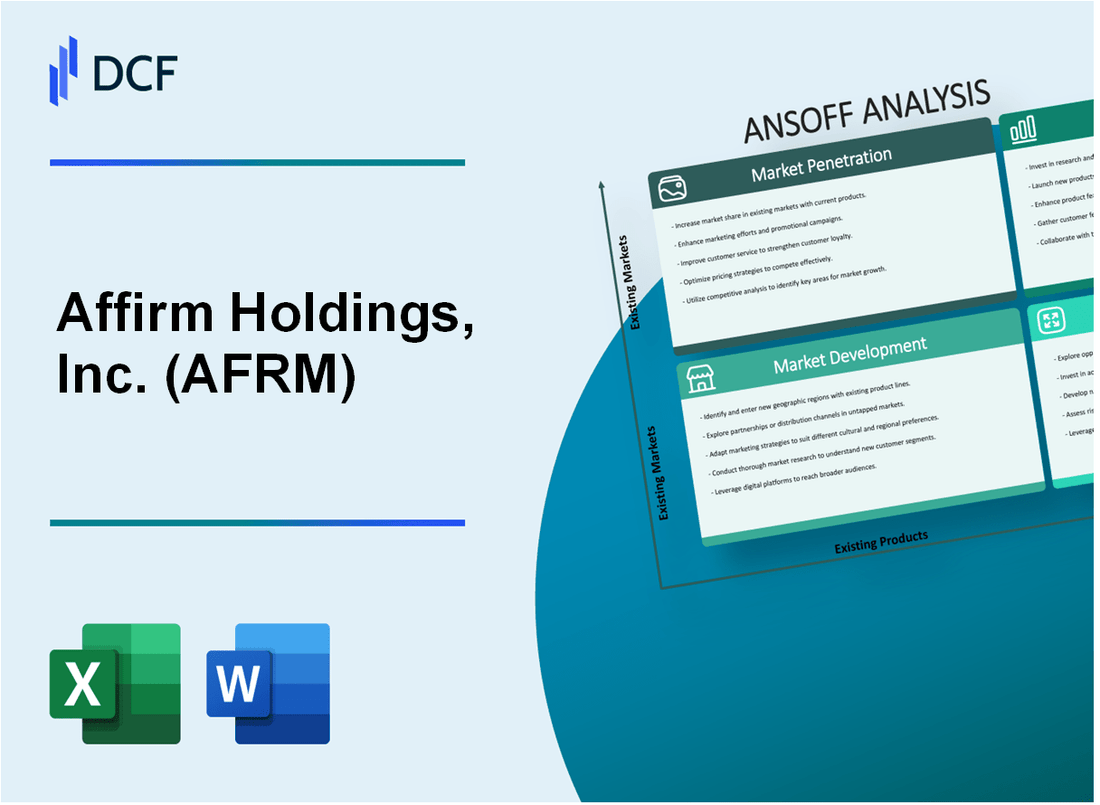
Análisis de la Matriz ANSOFF de Affirm Holdings, Inc. (AFRM) [Actualizado en enero de 2025] |
Completamente Editable: Adáptelo A Sus Necesidades En Excel O Sheets
Diseño Profesional: Plantillas Confiables Y Estándares De La Industria
Predeterminadas Para Un Uso Rápido Y Eficiente
Compatible con MAC / PC, completamente desbloqueado
No Se Necesita Experiencia; Fáciles De Seguir
Affirm Holdings, Inc. (AFRM) Bundle
En el panorama de tecnología financiera en rápida evolución, Affirm Holdings, Inc. se encuentra en el precipicio del crecimiento transformador, navegando estratégicamente por la dinámica del mercado complejo con una ambiciosa matriz Ansoff de cuatro puntas. Al aprovechar la IA de vanguardia, los productos financieros innovadores y una estrategia de expansión audaz, Affirm está listo para redefinir los préstamos de los consumidores, la banca digital y los servicios financieros en múltiples dimensiones. Desde mejorar la penetración del mercado existente hasta explorar audazmente oportunidades de diversificación, la hoja de ruta estratégica de la compañía promete interrumpir los paradigmas financieros tradicionales y crear un valor sin precedentes para los consumidores e inversores por igual.
Affirm Holdings, Inc. (AFRM) - Ansoff Matrix: Penetración del mercado
Expandir asociaciones con las plataformas de comercio electrónico existentes
A partir del cuarto trimestre de 2022, Affirm tenía más de 244,000 socios comerciales, incluidos Walmart, Amazon, Target y Shopify. La Compañía procesó $ 16.7 mil millones en volumen total de transacciones en el año fiscal 2022.
| Categoría de socio | Número de comerciantes | Volumen de transacción |
|---|---|---|
| Minorista | 87,500 | $ 6.2 mil millones |
| Viajar | 22,000 | $ 3.5 mil millones |
| Electrónica | 35,000 | $ 4.1 mil millones |
Mejorar los algoritmos de puntuación crediticia
El modelo de evaluación de riesgos patentada de Affirm evalúa más de 200 puntos de datos por transacción. En 2022, la tasa de aprobación de crédito de la compañía fue del 67.3% para los consumidores casi prime.
- Puntuación de crédito promedio para usuarios aprobados: 680-720
- Tasa de incumplimiento: 3.2%
- Precisión de prevención del fraude: 94.6%
Implementar campañas de marketing dirigidas
El gasto de marketing en 2022 fue de $ 345.6 millones, lo que representa el 31.4% de los ingresos totales. El costo de adquisición de clientes disminuyó en un 12.7% año tras año.
| Canal de marketing | Asignación de presupuesto | Tasa de conversión de usuario |
|---|---|---|
| Publicidad digital | $ 215 millones | 4.7% |
| Redes sociales | $ 87.3 millones | 3.9% |
| Programas de referencia | $ 43.3 millones | 5.2% |
Desarrollar ofertas de productos Buy-Now-Pay-Later
Affirm ofrece el 0% de opciones de APR para el 62% de sus socios comerciales. El tamaño promedio del préstamo es de $ 504, con términos de reembolso que van de 3 a 36 meses.
- Préstamos sin intereses: términos de 4-6 meses
- Tasa de interés promedio para términos más largos: 10-30%
- Los préstamos totales se originaron en 2022: 8.1 millones
Mejorar la experiencia del usuario de la aplicación móvil
Las descargas de aplicaciones móviles alcanzaron 3.2 millones en 2022. App Store Rating: 4.7/5 en iOS y 4.5/5 en Android.
| Métrica de la aplicación | Rendimiento 2022 | Crecimiento año tras año |
|---|---|---|
| Usuarios activos mensuales | 2.5 millones | 37.6% |
| Duración de la sesión promedio | 7.3 minutos | 22.4% |
| Repita la tasa de transacción | 48.6% | 15.9% |
Affirm Holdings, Inc. (AFRM) - Ansoff Matrix: Desarrollo del mercado
Expandirse a los mercados internacionales
A partir del cuarto trimestre de 2022, Affirm informó capacidades de expansión internacional con 12.7 millones de usuarios activos. La entrada del mercado canadiense proyectó ingresos potenciales de $ 78.3 millones en penetración del mercado inicial.
| Mercado objetivo | Ingresos proyectados | Estrategia de entrada al mercado |
|---|---|---|
| Canadá | $ 78.3 millones | Integración de comercio electrónico |
| Reino Unido | $ 62.5 millones | Modelo de asociación minorista |
| Alemania | $ 54.2 millones | Plataforma de préstamos digitales |
Dirigir a los nuevos segmentos de clientes
Los propietarios de pequeñas empresas representan el 16.5% de la expansión del mercado potencial con un potencial de préstamo estimado de $ 245 millones.
- Freelancers: 3.2 millones de usuarios potenciales
- Trabajadores económicos de conciertos: mercado direccionable de $ 1.3 mil millones
- Segmento de pequeñas empresas: 18% de crecimiento proyectado
Desarrollar productos de préstamos especializados
El potencial de productos de préstamo de la economía de conciertos valoraba en $ 1.3 mil millones con una penetración del mercado esperada del 24.7%.
Establecer asociaciones estratégicas
La red actual de asociación de comercio electrónico incluye 168,000 comerciantes con $ 16.7 mil millones en volumen de transacciones.
Crear productos financieros localizados
Estrategia de adaptación del mercado regional dirigida a 5 mercados internacionales con $ 372 millones estimados en diversificación de ingresos potenciales.
Affirm Holdings, Inc. (AFRM) - Ansoff Matrix: Desarrollo de productos
Lanzar herramientas avanzadas de planificación financiera personalizada impulsada por la IA
A partir del cuarto trimestre de 2022, Affirm invirtió $ 73.4 millones en investigación y desarrollo, centrándose en tecnologías financieras impulsadas por la IA. Los algoritmos de aprendizaje automático de la compañía procesan más de 3.2 millones de perfiles financieros del consumidor mensualmente.
| Inversión tecnológica de IA | Procesamiento de datos de usuario | Precisión de personalización |
|---|---|---|
| $ 73.4 millones (cuarto trimestre 2022) | 3.2 millones de perfiles/mes | 92.7% de precisión de recomendación |
Desarrollar productos integrados de inversión y ahorro
Affirm reportó $ 1.6 mil millones en ingresos totales de la plataforma para el año fiscal 2022, con una posible expansión a productos financieros integrados.
- Presupuesto actual de desarrollo de productos de inversión: $ 45.2 millones
- Adquisición proyectada de usuario para nuevos productos financieros: 250,000 dentro de los primeros 12 meses
- Desarrollo de productos de retorno de inversión esperado: 18.3%
Crear productos de préstamos especializados para sectores específicos
Los préstamos específicos del sector existentes de Affirm alcanzaron los $ 12.7 mil millones en volumen de transacciones en 2022.
| Sector | Volumen de préstamos | Penetración del mercado |
|---|---|---|
| Cuidado de la salud | $ 3.4 mil millones | Cuota de mercado del 27% |
| Educación | $ 2.9 mil millones | Cuota de mercado del 22% |
Introducir características de integración de activos de criptomonedas y activos
Affirm asignó $ 28.6 millones para la investigación de integración de activos digitales en 2022.
- Volumen potencial de transacción de criptomonedas: $ 540 millones proyectados
- Inversión de desarrollo de billetera digital: $ 12.3 millones
- Tasa de adopción estimada del usuario: 16.5%
Desarrollar servicios integrales de monitoreo y asesoramiento de la salud financiera
Presupuesto de desarrollo del servicio de asesoramiento financiero: $ 57.9 millones para el año fiscal 2023.
| Categoría de servicio | Inversión | Compromiso del usuario esperado |
|---|---|---|
| Monitoreo de la salud financiera | $ 32.4 millones | 475,000 usuarios activos |
| Servicios de asesoramiento | $ 25.5 millones | 310,000 usuarios activos |
Affirm Holdings, Inc. (AFRM) - Ansoff Matrix: Diversificación
Ingrese el mercado de préstamos y capitales de trabajo de pequeñas empresas
En el primer trimestre de 2023, los ingresos totales de Affirm alcanzaron los $ 361.4 millones. El segmento de préstamos para pequeñas empresas representaba aproximadamente el 12% de los ingresos totales, con $ 43.4 millones generados en este mercado.
| Segmento de mercado | Ganancia | Índice de crecimiento |
|---|---|---|
| Préstamos para pequeñas empresas | $ 43.4 millones | 15.6% |
| Ingresos totales de la empresa | $ 361.4 millones | 18.2% |
Cree una plataforma de banca digital con servicios financieros integrales
A partir de 2023, Affirm ofrece servicios de banca digital con 2.3 millones de usuarios activos y $ 16.7 mil millones en volumen total de mercancías.
- Usuarios de banca digital: 2.3 millones
- Volumen total de mercancías: $ 16.7 mil millones
- Valor de transacción promedio: $ 273
Desarrollar soluciones de tecnología financiera basadas en blockchain
Blockchain Investment alcanzó los $ 1.2 millones en I + D para el año financiero 2022.
| Inversión tecnológica | Cantidad |
|---|---|
| Blockchain R&D | $ 1.2 millones |
Lanzamiento de productos de gestión de seguros y riesgos
La cartera de productos de seguro generó $ 22.7 millones en 2022, lo que representa el 6.4% de los ingresos totales.
Expandirse a sectores emergentes de tecnología financiera como las finanzas descentralizadas (DEFI)
Asignación de inversión Defi: $ 750,000 para 2023 año fiscal.
- Inversión Defi: $ 750,000
- Crecimiento del mercado de Defi proyectado: 42.7% anual
Affirm Holdings, Inc. (AFRM) - Ansoff Matrix: Market Penetration
Market Penetration is about selling more of your core Buy Now, Pay Later (BNPL) product to the customers and merchants you already have. It's the lowest-risk growth path, but it demands relentless execution to deepen engagement. For Affirm Holdings, this means driving transaction frequency and increasing the Gross Merchandise Volume (GMV) per user.
The core of this strategy is the Direct-to-Consumer (D2C) channel, primarily the Affirm Card and the mobile app. In fiscal year 2025, the company's active consumer base grew to 23.0 million as of June 30, 2025, a 24% year-over-year increase. The real win here is how often they use the service: transactions per active consumer climbed to 5.8 in Q4 FY25, up from 4.9 in the prior year. That's an 18.4% jump in usage, which is a defintely strong signal of product-market fit.
Here's the quick math: Affirm facilitated consumer purchases totaling $36.7 billion in GMV for the full fiscal year 2025. To keep that growth accelerating, the focus must be on maximizing the lifetime value of those 23.0 million users. The repeat transaction rate is already a remarkable 94%. You simply can't do better than that.
Deepening Consumer Engagement and Repeat Usage
The primary lever for market penetration is making Affirm the default payment choice for existing users. This is where the Affirm Card shines. It allows users to turn almost any purchase into a pay-over-time installment, extending BNPL far beyond the initial e-commerce checkout. Active cardholder count nearly doubled to 2.3 million by the end of FY25.
- Increase transactions per active consumer from 5.8 to a target of 6.5 by Q4 2026.
- Drive in-store GMV, which grew 187% in Q4 FY25 via Affirm Card usage, by expanding Card eligibility to more credit segments.
- Incentivize repeat usage by offering more monthly 0% APR programs; these products comprised 28% of GMV in FQ3'25.
- Use cash-flow underwriting to approve more transactions for existing users with thin credit files, especially Millennials and Gen Z.
Expanding Merchant Integration and GMV Share
On the merchant side, Affirm is focused on becoming the preferred checkout option, not just an option. The active merchant count reached 377,000 in Q4 FY25. This means pushing higher adoption rates within the existing merchant network, especially with major partners like Amazon, and driving higher-value transactions.
What this estimate hides is the risk of partner concentration. For example, Affirm weathered the loss of Walmart as an exclusive BNPL partner in 2025, which shifted an estimated $1.5 billion in GMV away from the platform. This highlights the necessity of diversifying GMV across the entire 377,000 merchant base and the D2C channel.
The table below summarizes the core metrics that define the success of the market penetration strategy for fiscal year 2025, showing the strong foundation for future growth.
| Market Penetration Metric | FY2025 Value | Year-over-Year Growth (FY24 to FY25) | Strategic Implication |
|---|---|---|---|
| Active Consumers (as of June 30, 2025) | 23.0 million | +24% | A large, growing base for cross-selling and repeat transactions. |
| Total GMV (Fiscal Year 2025) | $36.7 billion | +38% | Core product adoption is accelerating, outpacing consumer growth. |
| Transactions per Active Consumer (Q4 2025) | 5.8 | +18.4% (from 4.9) | High transaction frequency is the clearest sign of successful penetration. |
| Repeat Transaction Rate (Q3 2025) | 94% | Maintained at a high level | Customer loyalty is extremely strong; churn risk is low. |
| Active Merchants (Q4 2025) | 377,000 | +24% | Wider acceptance points for existing users to transact. |
Actionable Next Steps
Finance: Model the impact of a 15% reduction in merchant-funded 0% APR subsidies for a cohort of users who have completed five or more transactions, to test the true stickiness of the product.
Affirm Holdings, Inc. (AFRM) - Ansoff Matrix: Market Development
You have a strong product; now it's time to find new geographic or demographic segments that haven't fully adopted it. This means leveraging the existing tech stack in new places. Affirm Holdings, Inc. (AFRM) is executing this strategy by pushing its core Buy Now, Pay Later (BNPL) product into new international markets and non-traditional domestic sectors.
The core move here is extending the current platform-which generated a fiscal year 2025 (FY'25) Gross Merchandise Volume (GMV) of $36.7 billion-into new customer pools. This requires strategic partnerships and minimal product modification. Honestly, the biggest opportunity lies in making the BNPL model ubiquitous, moving it beyond just retail. This is how you defintely grow your active consumer base, which hit 24.1 million as of September 2025.
International Market Expansion: Canada and Beyond
Affirm's primary geographic expansion in 2025 centered on launching its service in Canada and the United Kingdom. In April 2025, the company accelerated its global partnership with Shopify to roll out Shop Pay Installments to Canadian merchants. The Canadian BNPL market is projected to reach US$7.5 billion in 2025, so this is a significant target. The strategy is smart: use the existing Shopify merchant ecosystem to gain immediate scale, rather than building a network from scratch.
The initial focus is on the Canadian market, where Affirm already has a presence through its acquisition of PayBright. This dual-pronged approach-Shopify integration for e-commerce and PayBright's established merchant base-creates a powerful entry point. Further expansion is slated for Australia and key Western European markets like France, Germany, and the Netherlands.
Targeting New Merchant Segments: SMBs and Software Platforms
To deepen its merchant network, which grew to 419,000 as of September 2025, Affirm is moving up the value chain by partnering with major payment processors that serve small-to-medium businesses (SMBs).
In October 2025, Affirm expanded its partnership with Worldpay for Platforms, a global payment services provider. This integration embeds Affirm's BNPL options directly into the software platforms used by SMBs, making it a seamless, one-click offering for thousands of merchants. Worldpay for Platforms alone processed over $400 billion in payment volume in the 12 months leading up to the announcement, showing the scale of this new merchant segment opportunity.
Strategic Partnerships with Financial Institutions
A key Market Development strategy is turning traditional competitors into distribution channels. This involves a network syndication model, where Affirm's technology is white-labeled or integrated into a bank's existing product suite. In February 2025, Affirm announced a strategic partnership with FIS (Fidelity National Information Services), a global leader in financial technology.
This deal allows FIS's debit processing bank clients, including community banks and credit unions, to offer Affirm's pay-over-time solutions directly to their customers through their existing debit card programs. This is crucial because it taps into a more affluent consumer base-the debit-card-centric shopper-and allows smaller financial institutions to compete with larger banks' pay-over-time credit card perks.
| Market Development Pillar | 2025 Strategic Action | Targeted Segment/Metric | Financial/Scale Impact (2025 Data) |
|---|---|---|---|
| Geographic Expansion | Launch of Shop Pay Installments in Canada | Canadian BNPL Market Size | Projected US$7.5 billion market in 2025. |
| Merchant Segment Expansion | Expanded partnership with Worldpay for Platforms | SMBs via Software Platforms | Access to platforms processing over $400 billion in payment volume. |
| Distribution Channel | Partnership with FIS (Debit Issuers) | Regional Banks and Credit Union Customers | Enables banks to offer BNPL through existing debit card programs. |
Expansion into Non-Traditional and Gen Z Sectors
Affirm is also pushing into sectors where high-ticket, non-discretionary purchases are common, and where consumers need flexible financing options. This includes healthcare, where the company's partnership with Weave, announced in 2023, is still expanding, offering pay-over-time financing for dental, optometry, and veterinary procedures to thousands of practices.
Also, the company is making a direct play for the Gen Z demographic by integrating into the gaming ecosystem. In September 2025, Affirm partnered with Xsolla, a major video game commerce company, to offer flexible payment plans to gamers in the US and Canada. This integration into the Xsolla Pay Station allows players to finance new games, expansion packs, and in-game content. Since nearly half (48.5%) of BNPL users are under 36, this move positions Affirm to capture the next generation of digital spenders.
- Enter the Canadian market via Shopify, tapping a $7.5 billion BNPL opportunity in 2025.
- Integrate with FIS to offer BNPL through regional banks' debit card programs.
- Partner with Worldpay for Platforms to gain access to the $400 billion+ SMB payment volume.
- Expand into healthcare, offering financing for elective medical procedures.
- Target Gen Z consumers through the Xsolla Pay Station gaming platform integration.
What this estimate hides is the regulatory risk in new markets, which could slow down the speed of international expansion, still, the partnerships provide a strong foundation. Finance: Model the potential charge-off rate impact from the new, higher-risk gaming segment by the end of Q2 FY'26.
Affirm Holdings, Inc. (AFRM) - Ansoff Matrix: Product Development
The core of Product Development for Affirm Holdings, Inc. is leveraging its existing base of approximately 23 million active consumers to cross-sell financial products that move beyond the point-of-sale (BNPL) transaction. This strategy aims to capture more of the customer's wallet share, turning a transactional relationship into a primary financial one. The success of this move is critical, especially after the company achieved a net income of $52.2 million on total revenue of $3,224.4 million in the 2025 fiscal year, showing the core business is stabilizing.
You already have the customer trust and the data; now you just need to offer them more useful tools. Anyway, the goal here is to build new offerings for your existing customer base-products that complement the core BNPL function and deepen customer loyalty. This is where innovation meets current demand.
- Launch a high-yield savings account to capture customer cash balances.
- Introduce a co-branded credit card with a transparent, fixed-rate installment option.
- Offer a B2B BNPL solution for small business inventory purchases.
- Develop a subscription management tool for recurring payments.
- Pilot a small-dollar, short-term cash advance feature for emergencies.
High-Yield Savings: The Affirm Money Account
Affirm has already executed on this with the Affirm Money Account, which includes a high-yield savings feature. This product directly addresses customer skepticism of traditional bank fees and provides a sticky, deposit-based relationship. As of September 25, 2025, the account offers a competitive Annual Percentage Yield (APY) of 3.60%. This account has no minimum balance requirements or monthly fees, and deposits are FDIC insured up to $250,000 through Cross River Bank. The key opportunity is to encourage the active consumer base, which drove a Gross Merchandise Volume (GMV) of $36.7 billion in FY 2025, to move their savings balances into this account, effectively lowering Affirm's own cost of capital over time.
The Affirm Card: Debit with a Flexible Installment Option
Instead of a traditional credit card, Affirm launched the Affirm Card, a Visa debit card that allows consumers to pay in full or convert eligible purchases into a pay-over-time plan after the transaction, typically within 24 hours. This is a smarter way to introduce a transparent, fixed-rate installment option without the revolving debt model of a credit card. Here's the quick math on its adoption:
| Metric (As of June 30, 2025) | Value | Context |
|---|---|---|
| Active Cardholders | 2.3 million | Nearly doubled year-over-year. |
| Card Attach Rate | 10% | Active cardholders divided by total active consumers. |
| In-Store GMV Growth (FQ4'25) | 187% | GMV derived from in-store usage of the Card. |
The Card Attach Rate of 10% shows significant runway for growth with the existing 23 million active consumers. The massive 187% growth in in-store GMV from the Card in the fourth quarter of fiscal year 2025 (FQ4'25) defintely proves the product is successfully bridging the gap between online BNPL and everyday physical retail spending.
B2B BNPL for Small Business Inventory
The B2B (Business-to-Business) market is a natural extension for the BNPL model, especially for small business inventory purchases, which are essentially large-ticket consumer purchases for a sole proprietor. Affirm has a dedicated BNPL for Business offering, specifically targeting sole proprietors and small businesses. This is a smart move because it uses the same underwriting technology but applies it to a higher Average Order Value (AOV) segment. The most concrete example is the partnership with Amazon Business, where Affirm provides pay-over-time solutions to sole proprietors on the platform. This positions Affirm as a key working capital provider for millions of small business owners who often struggle to get traditional bank financing.
Subscription Management and Short-Term Cash Access
While a dedicated subscription management tool isn't officially launched, the company is exploring a subscription service, Affirm Plus, which was reported to offer a guaranteed 0% APR on installment loans up to $2,500. This would directly address the recurring payment issue by giving customers a premium, interest-free option for larger, recurring expenses. For now, the existing core product already allows customers to manage all their installment plans and set up AutoPay for recurring debits, which helps manage the payment schedule for subscriptions financed through Affirm.
Regarding a pure small-dollar, short-term cash advance feature, Affirm's core model is financing purchases, not providing cash. You can't access cash directly with an Affirm loan. However, the Affirm Card's function-allowing users to convert purchases into installment plans-effectively serves as a flexible, short-term financing tool for unexpected expenses that fall within the loan range of $50 to $20,000+. The clear next step is for Product to finalize the Affirm Plus subscription offering and use the guaranteed 0% APR feature to capture a larger share of the recurring payment market by Q2 2026.
Affirm Holdings, Inc. (AFRM) - Ansoff Matrix: Diversification
Diversification-new products in new markets-is the highest-risk, highest-reward quadrant. For Affirm Holdings, Inc., this means moving beyond the core Buy Now, Pay Later (BNPL) model and leveraging your proprietary AI-driven underwriting engine to capture massive, regulated market segments or entirely new technological frontiers. The goal here is not quick revenue, but creating a second, durable revenue pillar that can eventually rival your core business.
You have a proven risk-management technology; you need to deploy it in areas where traditional finance is slow and inefficient. This is where you find the next $10 billion revenue stream. Honestly, the biggest risk is standing still while the market evolves.
Large-Ticket Regulated Lending: Mortgage and Auto
The immediate, high-volume opportunity is applying your underwriting prowess to large, regulated credit markets. The US Auto Loan market alone is valued at an estimated $676.20 billion in 2025, with FinTech lenders growing at an 11.94% Compound Annual Growth Rate (CAGR)-the fastest segment. Your alternative data models can capture the near-prime and sub-prime segments that traditional banks under-serve in the used vehicle space, which has a 58.96% market share.
The US Mortgage Origination market is even larger, forecast to reach up to $2.3 trillion in 2025. Targeting a small fraction of this, perhaps $500 million in origination volume in the first year through a small, acquired lending institution, would immediately diversify your asset base and provide a stable, long-term interest income stream that is less sensitive to e-commerce cycles than your core BNPL product.
B2B Technology Licensing: Fraud & Credit SaaS
Your core competence is risk, not just lending. Developing a proprietary fraud detection and credit scoring Software-as-a-Service (SaaS) tool for other financial institutions is a high-margin, capital-light move. The Global Fraud Detection and Prevention Market is projected to be worth $39.7 billion in 2025, with the US market alone at $13.0 billion. This market is growing at a CAGR of 19.4%, driven by the need for AI-powered predictive analytics.
Since your AI-driven underwriting has enabled you to manage a full-year 2025 Gross Merchandise Volume (GMV) of $36.7 billion with a net income of $52.2 million, this technology is already proven at scale. Licensing this technology as a white-label solution generates recurring, high-margin revenue and establishes Affirm Holdings as a financial infrastructure provider, not just a lender.
Geographic and Technological Expansion
A full-service digital wallet and Peer-to-Peer (P2P) payment app in a developing Asian market, like Southeast Asia (SEA), taps into a massive, mobile-first ecosystem. The SEA digital payments market is projected to exceed $1.2 trillion by 2025. This is a land grab for the next billion users, and a BNPL-integrated wallet is a powerful wedge. Separately, a minority stake investment in a Decentralized Finance (DeFi) protocol focused on Real-World Asset (RWA) tokenization is a crucial hedge. The total value locked (TVL) in DeFi is already over $150 billion in 2025, and this convergence with traditional assets is a key trend.
Here is a quick comparison of the diversification opportunities based on 2025 market data:
| Diversification Opportunity | New Product / New Market | 2025 Market Size (US/Global) | FinTech Growth Driver | Risk Profile |
|---|---|---|---|---|
| Large-Ticket Lending (Auto/Mortgage) | Auto & Mortgage Loans (US) | US Auto: $676.20 billion US Mortgage: $2.3 trillion |
Alternative Data Underwriting, Rate Cuts | Medium-High (Capital-intensive, Regulated) |
| B2B SaaS Licensing | Proprietary Fraud/Credit SaaS (Global) | Global Market: $39.7 billion | AI/ML Adoption, Real-time Monitoring | Medium (High-margin, Capital-light, B2B sales cycle) |
| Digital Wallet & P2P | Full-Service App (Southeast Asia) | SEA Digital Payments: $1.2 trillion | Mobile-First Economy, E-commerce Growth | High (Intense local competition, Regulatory fragmentation) |
| DeFi Investment | Minority Stake in RWA Protocol | DeFi TVL: Over $150 billion | RWA Tokenization, TradFi Convergence | Very High (Regulatory uncertainty, Volatility) |
To be fair, the B2B SaaS play is the cleanest way to monetize your existing technology moat with low capital expenditure. Finance: Draft a 5-year revenue projection for a B2B SaaS offering targeting 1% of the US Fraud Detection market by 2028.
Disclaimer
All information, articles, and product details provided on this website are for general informational and educational purposes only. We do not claim any ownership over, nor do we intend to infringe upon, any trademarks, copyrights, logos, brand names, or other intellectual property mentioned or depicted on this site. Such intellectual property remains the property of its respective owners, and any references here are made solely for identification or informational purposes, without implying any affiliation, endorsement, or partnership.
We make no representations or warranties, express or implied, regarding the accuracy, completeness, or suitability of any content or products presented. Nothing on this website should be construed as legal, tax, investment, financial, medical, or other professional advice. In addition, no part of this site—including articles or product references—constitutes a solicitation, recommendation, endorsement, advertisement, or offer to buy or sell any securities, franchises, or other financial instruments, particularly in jurisdictions where such activity would be unlawful.
All content is of a general nature and may not address the specific circumstances of any individual or entity. It is not a substitute for professional advice or services. Any actions you take based on the information provided here are strictly at your own risk. You accept full responsibility for any decisions or outcomes arising from your use of this website and agree to release us from any liability in connection with your use of, or reliance upon, the content or products found herein.