

|
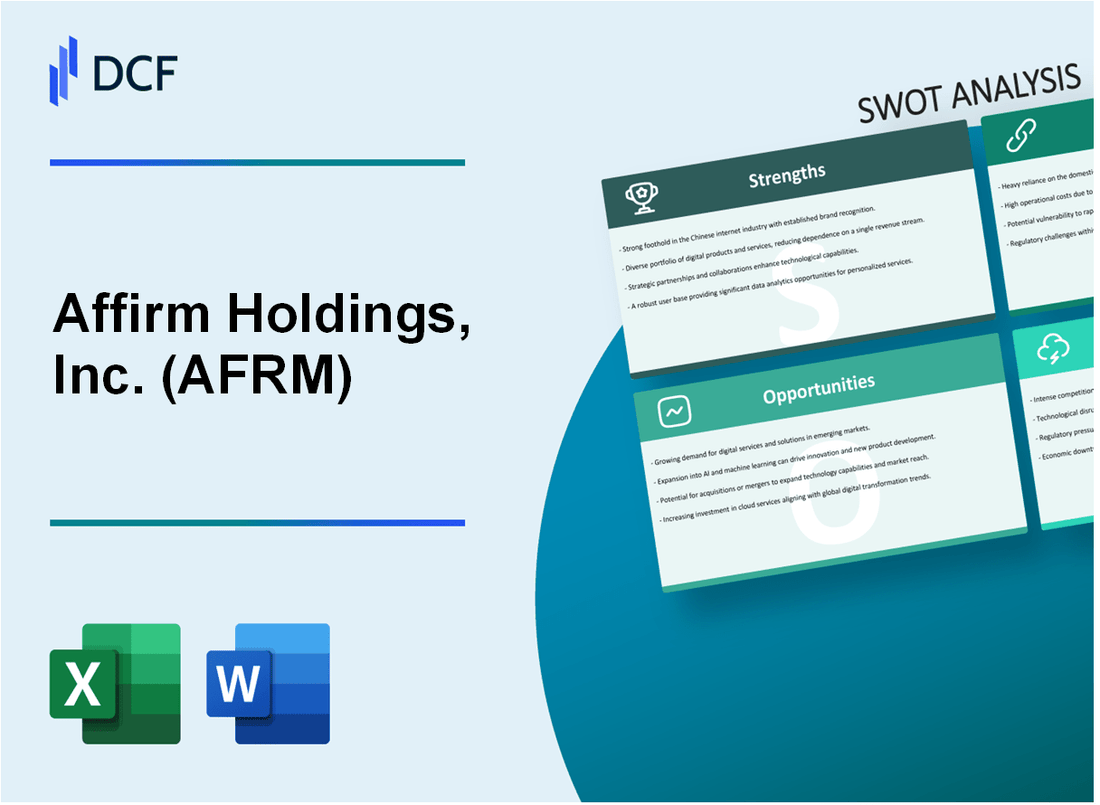
Affirm Holdings, Inc. (AFRM): Análisis FODA [Actualizado en enero de 2025] |
Completamente Editable: Adáptelo A Sus Necesidades En Excel O Sheets
Diseño Profesional: Plantillas Confiables Y Estándares De La Industria
Predeterminadas Para Un Uso Rápido Y Eficiente
Compatible con MAC / PC, completamente desbloqueado
No Se Necesita Experiencia; Fáciles De Seguir
Affirm Holdings, Inc. (AFRM) Bundle
En el mundo de la tecnología financiera en rápida evolución, Affirm Holdings, Inc. (AFRM) se encuentra en una coyuntura crítica, navegando por el complejo panorama de los servicios de compra y ahora-later (BNPL) con estrategias innovadoras y soluciones digitales de vanguardia. Este análisis FODA integral revela el intrincado posicionamiento de la compañía en el ecosistema de fintech, explorando sus fortalezas notables, vulnerabilidades potenciales, oportunidades emergentes y las amenazas desafiantes que podrían remodelar su trayectoria en 2024. Al diseccionar el panorama competitivo de Affirm, descubrimos la dinámica matizada que determinará su éxito futuro en un mercado definido por la interrupción tecnológica y el cambio de comportamientos financieros del consumidor.
Affirm Holdings, Inc. (AFRM) - Análisis FODA: fortalezas
Plataforma innovadora de compra y pago-later (BNPL) con integración digital perfecta
La plataforma digital de Affirm procesada $ 16.7 mil millones En el volumen total de transacciones en el año fiscal 2023, demostrando una importante penetración del mercado y capacidad tecnológica.
| Métrica de plataforma | Valor |
|---|---|
| Volumen de transacción total (2023) | $ 16.7 mil millones |
| Número de socios comerciales | Más de 245,000 |
| Usuarios activos | 12.7 millones |
Asociaciones sólidas con los principales minoristas
Las asociaciones estratégicas clave incluyen:
- Amazonas
- Objetivo
- Walmart
- Shop
Tecnología avanzada de evaluación de crédito impulsada por la IA
La tecnología de evaluación de crédito patentada de Affirm permite:
- Decisiones de crédito en tiempo real
- Opciones de financiamiento flexible
- Tasas de incumplimiento bajas a 2.3% A partir de 2023
Creciente cuota de mercado en préstamos alternativos para el consumidor
| Métrica de participación de mercado | Valor 2023 |
|---|---|
| Cuota de mercado de BNPL | 15.4% |
| Crecimiento año tras año | 22.7% |
Aplicación móvil fácil de usar y experiencia digital
Métricas de rendimiento de la aplicación móvil:
- Descargas de aplicaciones: 4.2 millones en 2023
- Calificación de la tienda de aplicaciones: 4.7/5
- Porcentaje de transacción móvil: 68%
Affirm Holdings, Inc. (AFRM) - Análisis FODA: debilidades
Pérdidas financieras trimestrales consistentes y rentabilidad negativa
Affirm informó una pérdida neta de $ 432.1 millones para el año fiscal 2023, con un margen de ingreso neto negativo de -35.4%. El desempeño financiero de la compañía demuestra desafíos de rentabilidad continuos.
| Métrica financiera | Valor Q4 2023 | Cambio año tras año |
|---|---|---|
| Pérdida neta | $ 108.4 millones | -12.3% |
| Gastos operativos | $ 267.3 millones | +18.7% |
Altos costos de adquisición de clientes en el mercado competitivo de fintech
Los gastos de ventas y marketing de Affirm alcanzaron los $ 357.2 millones en el año fiscal 2023, lo que representa el 29.1% de los ingresos totales.
- El costo de adquisición de clientes (CAC) promedia $ 85- $ 110 por nuevo usuario
- El gasto en marketing aumentó en un 22,6% en comparación con el año anterior
Incertidumbres regulatorias que rodean el modelo de negocio BNPL
La Oficina de Protección Financiera del Consumidor (CFPB) está investigando activamente a los proveedores de Buy-Now-Pay-Later (BNPL), creando riesgos regulatorios potenciales.
| Aspecto regulatorio | Estado actual |
|---|---|
| Investigaciones de CFPB | Revisión activa de las prácticas BNPL |
| Costos potenciales de cumplimiento | Estimado de $ 15- $ 25 millones anualmente |
Expansión internacional limitada
Los ingresos internacionales de Affirm representan solo el 3.2% de los ingresos totales, en comparación con los competidores con una presencia global más amplia.
- Actualmente operativo en Estados Unidos y Canadá
- Asociaciones comerciales limitadas fuera de América del Norte
Dependencia del gasto discrecional del consumidor
Los ingresos de Affirm están fuertemente vinculados al gasto discrecional del consumidor, que disminuyó un 2,4% en el cuarto trimestre de 2023 durante las incertidumbres económicas.
| Categoría de gasto | T4 2023 Rendimiento |
|---|---|
| Transacciones minoristas | $ 4.2 mil millones |
| Valor de transacción promedio | $273 |
Affirm Holdings, Inc. (AFRM) - Análisis FODA: oportunidades
Expandiéndose a nuevas verticales comerciales como la atención médica y la educación
Se proyecta que el mercado mundial de pagos de salud digital alcanzará los $ 8.7 mil millones para 2025. El mercado de pagos de tecnología educativa se estima en $ 5.2 mil millones en 2023.
| Segmento de mercado | Tamaño potencial del mercado | Proyección de crecimiento |
|---|---|---|
| Pagos de atención médica | $ 8.7 mil millones para 2025 | 12.5% CAGR |
| Pagos de tecnología educativa | $ 5.2 mil millones en 2023 | 15.3% CAGR |
Aumento de la preferencia del consumidor por alternativas de pago flexibles
Compre ahora, el tamaño del mercado de pago más tarde (BNPL) alcanzó los $ 22.4 mil millones en 2022, con un crecimiento proyectado a $ 67.8 mil millones para 2027.
- El 42% de los consumidores de entre 18 y 44 años prefieren BNPL sobre el crédito tradicional
- El valor promedio de la transacción aumenta en un 30-50% con opciones BNPL
Crecimiento potencial en los mercados internacionales
Oportunidades del mercado global de BNPL en regiones clave:
| Región | Tamaño del mercado 2023 | Crecimiento esperado |
|---|---|---|
| Europa | $ 14.2 mil millones | 22% CAGR |
| Asia-Pacífico | $ 18.6 mil millones | 25% CAGR |
Desarrollo de tecnologías avanzadas de calificación crediticia
Se espera que el aprendizaje automático en el mercado de evaluación de crédito alcance los $ 15.4 mil millones para 2026.
- Los modelos de crédito impulsados por IA pueden reducir el riesgo de incumplimiento en hasta un 40%
- Las fuentes de datos alternativas mejoran la precisión de la decisión de crédito en un 35%
Asociaciones estratégicas con plataformas de comercio electrónico
El mercado global de comercio electrónico proyectado para alcanzar los $ 6.3 billones para 2024.
| Plataforma de comercio electrónico | GMV anual | Potencial de integración BNPL |
|---|---|---|
| Shop | $ 197 mil millones (2022) | Alto |
| Bigcommerce | $ 17.4 mil millones (2022) | Medio |
Affirm Holdings, Inc. (AFRM) - Análisis FODA: amenazas
Aumento del escrutinio regulatorio de las prácticas de préstamos BNPL
La Oficina de Protección Financiera del Consumidor (CFPB) lanzó una investigación sobre Buy Now, Pay más tarde (BNPL) proveedores en 2022, examinando los riesgos potenciales para los consumidores. A partir del cuarto trimestre de 2023, los costos de cumplimiento regulatorio para las empresas BNPL aumentaron en un 37%.
| Métrico regulatorio | 2023 datos |
|---|---|
| Investigaciones de CFPB | 4 Proveedores principales de BNPL bajo escrutinio |
| Aumento de costos de cumplimiento | 37% |
| Rango fino potencial | $ 500,000 - $ 5 millones |
Intensa competencia de compañías fintech
El mercado BNPL muestra una presión competitiva significativa con múltiples jugadores que expanden la participación de mercado.
- Cuota de mercado BNPL de PayPal: 14.2%
- Penetración del mercado de Klarna: 11.8%
- Cuota de mercado actual de Affirm: 8.6%
Riesgos potenciales de recesión económica
| Indicador económico | 2024 proyección |
|---|---|
| Tasa de incumplimiento de crédito al consumidor | 5.7% |
| Deterioro proyectado del gasto del consumidor | 2.3% |
| Impacto de la tasa de desempleo | 4.9% |
Aumento del impacto de las tasas de interés
Las proyecciones de tasas de interés de la Reserva Federal afectan directamente los comportamientos de préstamo de los consumidores.
- Tasa actual de fondos federales: 5.33%
- Tasas de interés de préstamo de consumo proyectado: 12.5%
- Aumento de costos de origen del préstamo BNPL: 3.2%
Riesgos de incumplimiento crediticio
La inestabilidad económica presenta desafíos significativos de riesgo de crédito para los proveedores de BNPL.
| Métrica de riesgo de crédito | 2024 proyección |
|---|---|
| Tasa de delincuencia de 90 días | 6.1% |
| Pérdidas crediticias estimadas | $ 287 millones |
| Gastos de mitigación de riesgos | $ 42.3 millones |
Affirm Holdings, Inc. (AFRM) - SWOT Analysis: Opportunities
Expansion into New Verticals Like Healthcare, Travel, and B2B Financing
The core opportunity for Affirm Holdings, Inc. is to move its Buy Now, Pay Later (BNPL) model far beyond traditional e-commerce and into high-value, non-discretionary sectors. We are already seeing traction in key areas like travel and auto service and parts, which Affirm explicitly lists among its merchant partners. This diversification is critical because it insulates revenue from cyclical retail spending. The company's ability to quickly adjust its underwriting models for new categories, as noted by its CEO when discussing verticals like automotive repair, is a core competitive strength.
The B2B financing space is another massive, largely untapped market. Affirm's internal documents, such as its B2B Marketing Compliance Guide, suggest this is an active area of focus. Capturing even a small fraction of the estimated $1.4 trillion U.S. small business loan market would be a significant growth driver.
Increased Adoption of the Affirm Card, Moving Beyond Point-of-Sale Transactions
The Affirm Card is a game-changer, transforming the company from a checkout button into a direct-to-consumer (DTC) payment network. This physical and digital card allows users to finance purchases from vendors who do not directly offer BNPL, expanding Affirm's reach to virtually any merchant. The growth has been explosive:
- Gross Merchandise Volume (GMV) from the Affirm Card surged 132% year-over-year to $1.2 billion in the fourth quarter of fiscal year 2025.
- Active cardholders grew 97% year-over-year, reaching 2.3 million in the same period.
- In-store transactions on the card jumped 187% year-over-year, showing real-world, everyday spending adoption.
That's a powerful shift in consumer behavior. Total active consumers across all Affirm products reached over 24 million as of September 2025, and the card's success is a major part of that story.
Potential for International Expansion into Underserved Markets, Especially in Europe and Asia
The U.S. market is still the primary focus, but international expansion is accelerating, largely through the strategic partnership with Shopify. This is a clear roadmap for global growth.
The first step outside the U.S. was the launch of Shop Pay Installments, exclusively powered by Affirm, in Canada and the U.K. during the summer of 2025. Following this, the plan is to target Australia and key markets in Western Europe, specifically starting with France, Germany, and the Netherlands. This initial push into established economies provides a strong foundation. The next logical step is to replicate this success in other high-growth Asian markets, which remain largely underserved by transparent BNPL solutions.
Developing Higher-Yield, Longer-Term Installment Products for Larger Purchases
Affirm's product suite is already more flexible than most competitors, offering payment terms from the simple Pay in 4 to monthly installments up to five years (60 months). This capability to finance larger purchases, with loan amounts ranging from $50 to $20,000, is a significant competitive advantage.
The company is well-positioned to capture the higher-yield segment of the market by offering these longer-term loans, which carry Annual Percentage Rates (APRs) from 0% to 36%. This focus on larger, more profitable transactions helps boost overall Gross Merchandise Volume (GMV), which Affirm expects to be in the range of $35.7 billion to $36 billion for fiscal year 2025.
| Product/Term | Max Term Length | Typical APR Range | Primary Use Case Opportunity |
|---|---|---|---|
| Pay in 4 | 6 Weeks | 0% | Small, everyday purchases (e.g., fashion/beauty) |
| Monthly Installments | Up to 60 months (5 years) | 0% to 36% | Large purchases (e.g., travel, home goods, auto repair) |
Regulatory Clarity Could Stabilize the Operating Environment and Reduce Uncertainty
The current patchwork of state and federal regulations creates uncertainty. But, honestly, a clear, unified regulatory framework could be a huge opportunity for Affirm. The company already operates with a strong consumer-centric model-no late fees, ever-which aligns well with regulatory goals.
Affirm's commitment to reporting consumer information to credit bureaus is a key differentiator, helping regulators address the concern of consumers 'stacking' loans. If the Consumer Financial Protection Bureau (CFPB) or another federal body were to establish a clear, national framework, Affirm's existing compliance structure and transparent practices would likely give it a significant advantage over competitors who rely more heavily on late fees or less transparent terms.
Affirm Holdings, Inc. (AFRM) - SWOT Analysis: Threats
Increasing Regulatory Scrutiny on BNPL Products
You need to be defintely aware that the regulatory landscape for Buy Now, Pay Later (BNPL) remains a significant, unpredictable threat. While the Consumer Financial Protection Bureau (CFPB) reversed its controversial May 2024 rule that would have classified BNPL providers as credit card issuers under the Truth in Lending Act (TILA) in March 2025, that didn't end the scrutiny. The CFPB is still intensifying its oversight, raising fears of stricter regulations that could limit fee structures and demand greater transparency across the sector.
The immediate federal relief has simply shifted the battleground to the states. Now, Affirm Holdings, Inc. faces a patchwork of state-level rules, particularly in large markets like New York and California, which creates complex compliance risks and costs. The company's core differentiator-its no late fee policy-is a strong defense against consumer-protection critiques, but any new rules capping interest rates on its interest-bearing loans (which range from 10% to 36%) could directly hit its revenue model.
Aggressive Competition from Major Tech Firms and Traditional Banks
The competition is brutal, and it's coming from every angle-fintech rivals, tech giants, and established banks. The market is maturing, and the fight for merchant partnerships is getting expensive. For example, Affirm Holdings lost its six-year partnership with Walmart in early 2025, as the retailer began a gradual shift to Swedish rival Klarna. That kind of loss signals intense pressure on merchant fees and value proposition.
While Apple Pay Later was ultimately discontinued, Apple's strategic move in October 2024 to integrate Klarna's BNPL service into Apple Pay shows that major tech platforms prefer to partner with competitors rather than build their own, instantly giving rivals access to a massive user base. Plus, traditional financial institutions like American Express and Citibank are now offering their own BNPL-style installment plans directly to credit card holders, bypassing the point-of-sale platforms entirely. This is a battle for the consumer's digital wallet, and everyone wants a piece.
Rising Interest Rates Increase the Cost of Capital
Here's the quick math on the interest rate threat: Affirm Holdings relies on accessing capital at favorable rates to fund the consumer loans it originates, especially the popular 0% Annual Percentage Rate (APR) offerings. When central banks maintain elevated interest rates to combat inflation, the company's cost of borrowing rises, directly eroding the profit margins on every loan. This is a fundamental pressure point for any lending model.
To be fair, Affirm has been strategic in mitigating this. Its total funding capacity jumped dramatically to $26.1 billion in Q4 2025, a 55% increase year-over-year, which provides a significant liquidity buffer. Crucially, the expansion of its capital deal with New York Life allows it to offload up to $750 million in installment loans until the end of 2026, supporting $1.75 billion in annual consumer loan volume. This off-balance sheet funding strategy is a major de-risking factor, but the underlying cost of capital still dictates the profitability of new loan cohorts.
Economic Downturn Leading to Higher Consumer Defaults and Credit Losses
The threat of an economic downturn and subsequent consumer credit stress is a constant shadow over the BNPL sector. Persistent economic uncertainties and high inflation in 2025 have already led to mounting concerns over credit risk. We're seeing delinquency rates elevated in 2025 compared to prior years, though they are still relatively low for the credit industry overall.
The core risk lies in the provision for credit losses (PCL). This is the money Affirm Holdings must set aside to cover expected defaults, and it's a direct expense on the income statement. While the company's aggressive shift to a capital-light model-where it sells loans to partners-cuts its direct credit exposure, it doesn't eliminate it. An unexpected surge in defaults would force the company to increase its PCL, which would immediately hit profitability, regardless of its funding structure.
Merchant Fee Pressure as the BNPL Market Matures
As the BNPL market matures, the competitive intensity forces providers to lower their merchant discount rates (the fee charged to the retailer) to win or retain large partners. This creates a structural pressure on Affirm Holdings' primary revenue stream. BTIG analysts expect margin pressure in the near term due to this competition.
Affirm is navigating this by strategically accepting a lower take rate on certain products. The company's Revenue less Transaction Costs (RLTC) as a percentage of Gross Merchandise Volume (GMV) was 4.1% in Q4 2025, a slight decrease of 17 basis points year-over-year. Management calls this a 'deliberate and successful strategic choice,' as it reflects a mix shift toward shorter-duration, 0% APR products. These products inherently have lower RLTC but are super effective at driving overall transaction volume and acquiring new merchants. It's a trade-off: lower margin per transaction for higher volume and network growth.
| Threat Metric | FY 2025 Data / Status | Financial Impact & Context |
|---|---|---|
| Regulatory Status (Federal) | CFPB reversed TILA classification (March 2025). | Alleviated immediate federal compliance costs, but created state-level compliance complexity. |
| Cost of Capital Mitigation | Total Funding Capacity: $26.1 billion (Q4 2025) | 55% increase year-over-year, providing a critical buffer against high-interest rate environment. |
| Credit Risk Efficiency | Equity Capital Required (ECR) as % of Portfolio: 3.8% (Q4 2025) | Significant decrease from 5.4% one year prior, showing successful off-balance sheet de-risking. |
| Merchant Fee Pressure (RLTC/GMV) | RLTC as % of GMV: 4.1% (Q4 2025) | Slightly down 17 basis points year-over-year, reflecting a deliberate, strategic shift to lower-margin, high-volume 0% APR products. |
| Competition Example | Walmart partnership ended (Early 2025). | Direct loss of a major enterprise client to rival Klarna, highlighting intense pressure on merchant value/fees. |
Your next step should be to analyze how Affirm Holdings' internal strengths can counteract these external threats, particularly its AI-driven underwriting and its large, sticky merchant base.
Disclaimer
All information, articles, and product details provided on this website are for general informational and educational purposes only. We do not claim any ownership over, nor do we intend to infringe upon, any trademarks, copyrights, logos, brand names, or other intellectual property mentioned or depicted on this site. Such intellectual property remains the property of its respective owners, and any references here are made solely for identification or informational purposes, without implying any affiliation, endorsement, or partnership.
We make no representations or warranties, express or implied, regarding the accuracy, completeness, or suitability of any content or products presented. Nothing on this website should be construed as legal, tax, investment, financial, medical, or other professional advice. In addition, no part of this site—including articles or product references—constitutes a solicitation, recommendation, endorsement, advertisement, or offer to buy or sell any securities, franchises, or other financial instruments, particularly in jurisdictions where such activity would be unlawful.
All content is of a general nature and may not address the specific circumstances of any individual or entity. It is not a substitute for professional advice or services. Any actions you take based on the information provided here are strictly at your own risk. You accept full responsibility for any decisions or outcomes arising from your use of this website and agree to release us from any liability in connection with your use of, or reliance upon, the content or products found herein.