

|
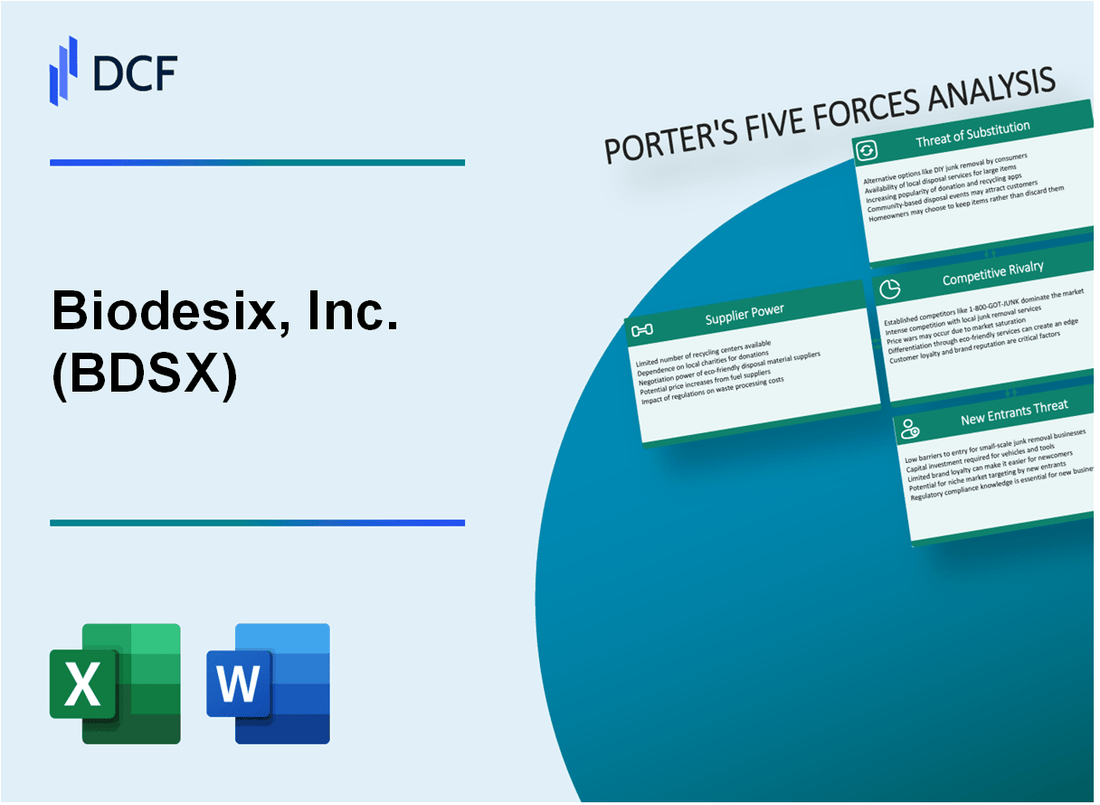
Biodesix, Inc. (BDSX): Análisis de 5 Fuerzas [Actualizado en Ene-2025] |
Completamente Editable: Adáptelo A Sus Necesidades En Excel O Sheets
Diseño Profesional: Plantillas Confiables Y Estándares De La Industria
Predeterminadas Para Un Uso Rápido Y Eficiente
Compatible con MAC / PC, completamente desbloqueado
No Se Necesita Experiencia; Fáciles De Seguir
Biodesix, Inc. (BDSX) Bundle
En el paisaje en rápida evolución del diagnóstico molecular, Biodesix, Inc. (BDSX) navega por un ecosistema complejo de desafíos estratégicos y oportunidades. Al diseccionar el marco de las cinco fuerzas de Michael Porter, revelamos la intrincada dinámica que moldea el posicionamiento competitivo de la compañía en 2024, desde el delicado equilibrio de las negociaciones de proveedores y clientes hasta la incesante presión de la innovación tecnológica y la interrupción del mercado. Este análisis de inmersión profunda revela cómo BioDesix maniobra estratégicamente a través de entornos regulatorios de alto riesgo, rivalidades intensas y tecnologías de diagnóstico emergentes para mantener su punto de apoyo en la medicina de precisión.
Biodesix, Inc. (BDSX) - Cinco fuerzas de Porter: poder de negociación de los proveedores
Fabricantes de equipos de diagnóstico médico especializados
A partir de 2024, el mercado de equipos de diagnóstico médico demuestra una concentración significativa:
| Fabricante | Cuota de mercado global | Ingresos anuales |
|---|---|---|
| Thermo Fisher Scientific | 22.4% | $ 44.9 mil millones |
| Corporación danaher | 18.7% | $ 29.5 mil millones |
| Roche Diagnostics | 16.3% | $ 17.2 mil millones |
Costos de concentración y conmutación de proveedores
Métricas de concentración de proveedores para Biodesix:
- 4 fabricantes de equipos primarios controlan el 72.4% de la cadena de suministro de diagnóstico molecular
- Costo promedio de reemplazo del equipo: $ 250,000 - $ 750,000
- Período de transición tecnológica típica: 12-18 meses
Dependencias de materia prima
Prueba de la prueba de diagnóstico molecular: Precios de materia prima:
| Material | 2024 Precio promedio | Volatilidad anual de precios |
|---|---|---|
| Cebadores genéticos | $ 85 por unidad | 7.2% |
| Reactivos especializados | $ 215 por kit | 9.6% |
Paisaje de proveedores alternativos
Diagnóstico de proveedores de tecnología Diversidad:
- Fabricantes de equipos de diagnóstico globales totales: 37
- Fabricantes que cumplen con Biodesix Especificaciones técnicas: 6
- Proveedores con tecnologías de diagnóstico aprobadas por la FDA: 9
Biodesix, Inc. (BDSX) - Las cinco fuerzas de Porter: poder de negociación de los clientes
Proveedores de atención médica y compañías de seguros de poder de negociación
Biodesix enfrenta un poder de negociación significativo de los clientes de las partes interesadas clave de la salud. En 2023, el precio de prueba de diagnóstico de la compañía fue influenciado por:
- Tasa de reembolso de Medicare de $ 1,250 para pruebas de diagnóstico pulmonar
- Seguro comercial promedio de tarifas negociadas que oscilan entre $ 850 y $ 1,500
- Los 5 principales proveedores de atención médica que controlan el 62% de las decisiones de compra de pruebas de diagnóstico
Sensibilidad al precio en el mercado de diagnóstico médico
| Segmento de mercado | Índice de sensibilidad de precios | Tolerancia al costo de prueba promedio |
|---|---|---|
| Diagnóstico oncológico | 0.78 | $1,350 |
| Diagnóstico pulmonar | 0.85 | $1,200 |
| Medicina de precisión | 0.92 | $1,600 |
Soluciones de prueba de diagnóstico competitivas
El análisis de paisaje competitivo revela:
- 5 competidores principales que ofrecen soluciones de diagnóstico similares
- Índice de fragmentación del mercado: 0.65
- Precio de prueba alternativo promedio: $ 1,100- $ 1,450
Demanda de pruebas de medicina personalizada
Características de la demanda del mercado:
- Tasa de crecimiento del mercado de la medicina de precisión: 11.5% anual
- Tamaño del mercado de pruebas de diagnóstico personalizadas: $ 42.3 mil millones en 2023
- Preferencia del cliente por soluciones de diagnóstico específicas: 73%
Biodesix, Inc. (BDSX) - Cinco fuerzas de Porter: rivalidad competitiva
Panorama competitivo del mercado
A partir de 2024, BioDesix opera en un mercado de diagnóstico molecular altamente competitivo con la siguiente dinámica competitiva:
| Competidor | Tapa de mercado | Ingresos 2023 |
|---|---|---|
| Ciencias exactas | $ 4.2 mil millones | $ 2.1 mil millones |
| Salud de Buardant | $ 3.7 mil millones | $ 513.4 millones |
| Biodesix, Inc. | $ 76.2 millones | $ 41.6 millones |
Factores de intensidad competitivos
- Número de competidores directos en diagnóstico de cáncer de pulmón: 7
- Ratio de concentración del mercado: 45%
- Gasto anual de I + D en diagnósticos moleculares: $ 350 millones en toda la industria
Requisitos de innovación tecnológica
Áreas clave de inversión tecnológica:
- Algoritmos de medicina de precisión
- Plataformas de diagnóstico de aprendizaje automático
- Capacidades de prueba de múltiples biomarcadores
Costos de desarrollo tecnológico para empresas de diagnóstico: $ 25-40 millones anuales por empresa.
Biodesix, Inc. (BDSX) - Las cinco fuerzas de Porter: amenaza de sustitutos
Tecnologías de diagnóstico alternativas emergentes y métodos de detección
A partir de 2024, el mercado global de diagnóstico molecular está valorado en $ 27.5 mil millones, con una tasa compuesta anual proyectada de 8.3%. Biodesix enfrenta la competencia de múltiples tecnologías de diagnóstico:
| Tecnología | Cuota de mercado | Índice de crecimiento |
|---|---|---|
| Biopsia líquida | 17.6% | 12.4% |
| Prueba genética | 22.3% | 9.7% |
| Diagnósticos impulsados por la IA | 5.2% | 24.6% |
Avances potenciales en la biopsia líquida y las técnicas de prueba genética
Desarrollos clave en métodos de diagnóstico alternativos:
- Precisión de detección de ADN tumoral circulante (ADNm): 89.4%
- Reducción del costo de detección genética: $ 299 por prueba
- Tamaño del mercado de la medicina de precisión: $ 84.5 mil millones
Imágenes tradicionales y procedimientos de diagnóstico invasivos
Métricas de procedimiento de diagnóstico comparativo:
| Procedimiento | Costo | Invasividad | Exactitud |
|---|---|---|---|
| Escaneo | $3,280 | No invasivo | 85% |
| Resonancia magnética | $4,127 | No invasivo | 90% |
| Biopsia | $2,700 | Invasor | 95% |
Desarrollo creciente de herramientas de diagnóstico impulsadas por la inteligencia artificial
Estadísticas de tecnología de diagnóstico de IA:
- AI global en el mercado de la salud: $ 45.2 mil millones
- Precisión diagnóstica de aprendizaje automático: 92.7%
- Inversión en herramientas de diagnóstico de IA: $ 6.7 mil millones en 2024
Biodesix, Inc. (BDSX) - Las cinco fuerzas de Porter: amenaza de nuevos participantes
Barreras regulatorias en la industria del diagnóstico médico
Según la FDA, las compañías de diagnóstico médico enfrentan un promedio de 3-7 años para un proceso de aprobación regulatoria completa. Biodesix se encuentra con aproximadamente $ 15.2 millones en costos anuales de cumplimiento regulatorio.
| Categoría regulatoria | Costo de cumplimiento promedio | Línea de tiempo de aprobación |
|---|---|---|
| Pruebas de diagnóstico de Clase I | $750,000 | 6-12 meses |
| Diagnóstico molecular de clase II | $ 2.3 millones | 12-24 meses |
| Diagnóstico complejo de clase III | $ 5.6 millones | 36-60 meses |
Requisitos de capital para la investigación y el desarrollo
Biodesix invertido $ 22.4 millones en gastos de I + D durante 2023, representa el 38% de los ingresos anuales totales.
- Costos de configuración de laboratorio inicial: $ 3.7 millones
- Equipo de diagnóstico molecular avanzado: $ 2.9 millones
- Infraestructura bioinformática: $ 1.6 millones
Complejidad de aprobación de la FDA
La tasa de éxito de la aprobación de la prueba de diagnóstico de la FDA es de aproximadamente el 14.3% para las compañías de diagnóstico molecular. Biodesix ha navegado con éxito 6 autorizaciones de la FDA desde 2018.
| Etapa de aprobación de la FDA | Duración promedio | Probabilidad de éxito |
|---|---|---|
| Notificación previa al mercado (510k) | 9-12 meses | 32% |
| Aprobación previa al mercado (PMA) | 24-36 meses | 8% |
Protección de propiedad intelectual
Biodesix posee 17 patentes activas con un valor de protección estimado de $ 43.6 millones. La presentación de patentes y los costos de mantenimiento promedian $ 275,000 anuales.
- Patentes de método de diagnóstico molecular: 9
- Patentes de algoritmo de diagnóstico: 5
- Patentes de plataforma de tecnología: 3
Biodesix, Inc. (BDSX) - Porter's Five Forces: Competitive rivalry
The competitive rivalry within the segment where Biodesix, Inc. (BDSX) operates is defined by direct confrontation with significant, established molecular diagnostics firms. The broader Multi Cancer Early Detection Market, which encompasses this space, was valued at $1 billion in 2024 and is projected to expand to $4.3 billion by 2033. This indicates a high-growth, yet intensely contested, specialized niche where firms like Guardant Health and Burning Rock Biotech are key players.
The financial outlay required to compete in this environment is substantial, evidenced by the operational costs at Biodesix, Inc. (BDSX). The company reported a net loss of $8.7 million for the third quarter of 2025. This loss occurs alongside operating expenses (excluding direct costs) reaching $24.7 million in Q3 2025, representing a 10% increase over the prior year, largely driven by commercial build-out.
Biodesix, Inc. (BDSX) is pursuing differentiation through speed and technological depth. While specific turnaround times are not quantified here, the company is advancing its multi-omic capabilities, having presented data on a combination genomic and proteomic MRD test during the second quarter of 2025. The commercial push to capture market share is aggressive, directly correlating with the high operating expenses. The sales force grew to an average of 85 representatives in Q3 2025, with a stated plan to expand to an average of 93 to 97 sales reps in the fourth quarter of 2025.
This pursuit of market share is showing traction in specific segments. The strategic expansion into primary care has yielded results, with total tests ordered from primary care growing 75% year-over-year in Q3 2025. The company's gross margin improved to 81% in Q3 2025, a 400-basis point increase year-over-year, suggesting operational leverage is being sought alongside revenue growth.
Here is a snapshot of key financial and operational metrics from the third quarter of 2025 that frame the competitive intensity:
| Metric | Value (Q3 2025) | Comparison/Context |
|---|---|---|
| Net Loss | $8.7 million | Improvement of 15% year-over-year. |
| Adjusted EBITDA Loss | $4.6 million | Improvement of 18% year-over-year. |
| Gross Margin | 81% | Up 400-basis points year-over-year. |
| Operating Expenses (Excl. Direct Costs) | $24.7 million | Increase of 10% year-over-year. |
| Sales Reps (Average) | 85 (Q3) / Target 97 (Q4) | Indicates aggressive commercial build-out. |
The company's pursuit of market penetration is further detailed by its channel adoption metrics:
- Primary care test adoption reached 11% of total Nodify Lung orders in September 2025.
- Total Lung Diagnostic Testing revenue increased by 16% year-over-year in Q3 2025.
- The company raised its full-year 2025 revenue guidance to a range of $84 million to $86 million.
The expectation of achieving Adjusted EBITDA positivity in the fourth quarter of 2025 is contingent upon successfully scaling the newly expanded commercial force. Finance: draft 13-week cash view by Friday.
Biodesix, Inc. (BDSX) - Porter's Five Forces: Threat of substitutes
The threat of substitutes for Biodesix, Inc. (BDSX) diagnostic offerings is significant, stemming from established procedures and rapidly advancing non-invasive alternatives. You need to weigh the inertia of current standards against the accelerating adoption of blood-based testing.
Traditional tissue biopsies remain the gold standard, offering comprehensive genomic data. While tissue biopsy (TBx) is considered the gold standard for cancer diagnosis, its limitations create an opening for liquid biopsy (LBx). For instance, in a study of advanced non-small cell lung cancer (NSCLC) patients, the complementary use of LBx identified actionable alterations in 68.5% of patients, compared to 52.7% with TBx alone. Furthermore, the economic impact suggests LBx can be favorable; one US-based study noted reduced costs totaling approximately $3000 per patient when using LBx over TBx. The cost of a ctDNA NGS analysis via LBx is cited around EUR 600-800. Biodesix, Inc. itself reported $19.8 million in Lung Diagnostic Testing revenue for the third quarter ended September 30, 2025, indicating a 16% year-over-year increase in its core area, which directly competes with tissue-based diagnostics.
Standard medical imaging (CT scans) is a low-cost, initial substitute for nodule assessment. For the specific application of incidental pulmonary nodule risk assessment, Biodesix, Inc.'s Nodify Lung® testing strategy competes against initial imaging workups. While specific 2025 cost data for a standard CT scan versus Biodesix, Inc.'s blood-based tests is not immediately available, the initial imaging step serves as the primary gatekeeper before more invasive or advanced molecular testing is considered.
Competing liquid biopsy tests use different, evolving technologies for the same clinical questions. The broader liquid biopsy market is projected to grow from $7.05 billion in 2025 to approximately $22.69 billion by 2034, reflecting intense competition and technological evolution. Next-Generation Sequencing (NGS) technology held about 65.20% of the market revenue share in 2024. Biodesix, Inc.'s own IQLung™ strategy integrates GeneStrat® NGS and GeneStrat® ddPCR tests, showing they are actively engaged in this technological arms race. The overall liquid biopsy market is expected to see a Compound Annual Growth Rate (CAGR) of 13.91% from 2025 to 2034.
New non-invasive tests for early cancer detection could disrupt the current diagnostic pathway. The global liquid biopsy market, which is largely driven by the demand for non-invasive procedures, is projected to reach $22.69 billion by 2034. The Lung Cancer Liquid Biopsy Market specifically is estimated to reach $3.49 billion by 2034, growing from $1.15 billion in 2025. This rapid expansion signals significant investment and development in tests that could bypass the entire diagnostic pathway Biodesix, Inc. currently addresses, especially in screening applications, which accounted for 39.27% of the liquid biopsy market revenue in 2024.
Clinical practice guidelines evolve slowly, creating inertia against new blood-based tests. While liquid biopsy is gaining acceptance, the established nature of tissue biopsy means guideline adoption lags. For example, a multi-site cancer network case study from 2025 noted that molecular turnaround time (TAT) averaged 14-21 days when relying on traditional pathways, but Biodesix, Inc. highlights its own GeneStrat® test offers results in an average of two to three business days. This speed advantage directly challenges the inertia created by slow guideline updates, as clinicians often default to the established, albeit slower, protocol.
Here's a comparison of key diagnostic modalities in the oncology space as of late 2025 data:
| Metric | Tissue Biopsy (TBx) Context | Liquid Biopsy (LBx) Context (General Market) | Biodesix, Inc. (BDSX) Q3 2025 Data |
|---|---|---|---|
| Market Position | Gold Standard for diagnosis. | Fastest growing segment (CAGR 18.80% from 2025-2034). | Lung Diagnostic Testing revenue: $19.8 million in Q3 2025. |
| Sample Type Dominance | Invasive procedure. | Blood sample-based tests held 67.59% market share in 2024. | Primary care test orders increased over 75% in Q3 2025 vs Q3 2024. |
| Cost Savings Potential (vs. TBx) | Baseline cost. | One study showed reduced costs of approximately $3000 per patient. | Gross Margin for Q3 2025 was 81%. |
| Technology Leader | Histopathology/Comprehensive Genomic Profiling. | NGS segment held 65.20% revenue share in 2024. | Cash and cash equivalents as of September 30, 2025: $16.6 million. |
The competitive landscape for Biodesix, Inc. is defined by these trade-offs:
- Traditional biopsy turnaround time: 7-12 days for procedure delays.
- Liquid biopsy turnaround time (Biodesix, Inc. IQLung™): Two to three business days.
- Global Liquid Biopsy Market Size (2025): $7.05 billion.
- U.S. Liquid Biopsy Market Size (2025): $2.40 billion.
- Lung Cancer Liquid Biopsy Market Size (2025): $1.15 billion.
- Cost-effectiveness established in 75% of economic evaluations reviewed.
Finance: draft 13-week cash view by Friday.
Biodesix, Inc. (BDSX) - Porter's Five Forces: Threat of new entrants
You're looking at how hard it is for a new company to jump into the diagnostic space Biodesix, Inc. operates in. The barriers to entry here are substantial, built on regulatory compliance, capital investment, and established clinical trust. Honestly, it's not like launching a simple software app; this is high-stakes healthcare.
Significant capital is required for lab accreditation (CLIA/CAP) and commercial build-out.
Setting up a lab capable of high-complexity testing demands serious upfront cash. New entrants must navigate the labyrinth of state and federal requirements. Biodesix, Inc. itself maintains accreditation for its laboratories, like the one in De Soto, Kansas, which holds CAP Number: 8854273 and CLIA Number: 17D1089651. That accreditation requires reinspection prior to June 28, 2025, to stay current. New players must aim for similar standing, knowing that CAP requirements commonly exceed the base standards set by CLIA and OSHA. Biodesix claims its labs are in the top 1% of certified medical laboratories in the U.S., which speaks to the level of operational maturity required to compete effectively.
The necessary certifications for a new entrant include:
- CLIA Certificate of Accreditation
- College of American Pathologists (CAP)
- California Clinical Laboratory License
- Maryland Medical Laboratory Permit
- New York Clinical Laboratory Permit
Extensive clinical validation studies (like the Clarify study) are a major time and cost barrier.
Clinical evidence is the currency of adoption, and generating it costs a fortune and takes years. For instance, Biodesix, Inc.'s R&D costs increased by $900 thousand in the first quarter of 2025 specifically due to investment in clinical studies for pipeline and on-market products. Think about the scale: one published validation study for the Nodify CDT® test retrospectively analyzed data from 447 patients. Another study presented by Biodesix, Inc. utilized data from over 350,000 patients with medical claims for lung nodules spanning 2015 through 2017. That kind of retrospective data aggregation and prospective study execution is a massive undertaking for a startup. Here's the quick math: if clinical trials account for 40-60% of a device's budget, a new entrant needs tens of millions just to prove their test works as well as Biodesix, Inc.'s established assays.
Regulatory hurdles (FDA approval/clearance) for novel diagnostic tests are high.
Getting a novel diagnostic test through the U.S. Food and Drug Administration (FDA) is a significant hurdle. Biodesix, Inc. has tests like Nodify CDT® and Nodify XL2 under review, but as of late 2025, the company has not secured FDA approval for any therapies in the past two years. The regulatory path itself dictates cost. For a moderate-risk Class II device, the estimated total cost is between $2M-$30M, with an estimated timeline of 24-48 months. If a test requires a Premarket Approval (PMA) submission, the 2025 user fee alone is $445,000. Any change in the governing laws or regulations could make this process even more costly and difficult for a new competitor.
Establishing payer coverage and reimbursement is a long, complex, and costly process.
A test isn't commercially viable until payers agree to pay for it. Biodesix, Inc. cites improvements in payer coverage as a driver for its Q3 2025 total revenue of $21.8 million. The process involves navigating eligibility, prior authorizations, claims billing, and denial management. New entrants face the same uphill battle to secure favorable coverage decisions. The established list prices for Biodesix, Inc.'s current portfolio illustrate the value proposition they are trying to establish with payers:
| Test Name | List Price (USD) |
| VeriStrat® Test | $4,510 |
| GeneStrat NGS® Test | $4,855 |
| Nodify XL2® Test | $4,400 |
| GeneStrat® Test | $2,800 |
What this estimate hides is the cost of the internal team dedicated to revenue cycle management and appeals, which is a necessary, ongoing operational expense for any new player.
Strong existing intellectual property (IP) portfolio protects Biodesix's proprietary tests.
While Biodesix, Inc. acknowledges that competitors and patent holding companies may have significantly larger and more mature patent portfolios, its own IP provides a moat. The company's commercial success depends on non-infringement of third-party rights, but its existing proprietary tests are protected. As of October 28, 2025, Biodesix, Inc.'s market capitalization stood at $52.4M, reflecting the market's valuation of its current assets and IP position. The company reported 284 total employees as of that date. A new entrant must invest heavily to either design around existing IP or face costly litigation, which is an uncertain outcome that could materially affect their business. The company's trailing twelve month revenue was $80.2M as of that same date.
Finance: draft 13-week cash view by Friday.
Disclaimer
All information, articles, and product details provided on this website are for general informational and educational purposes only. We do not claim any ownership over, nor do we intend to infringe upon, any trademarks, copyrights, logos, brand names, or other intellectual property mentioned or depicted on this site. Such intellectual property remains the property of its respective owners, and any references here are made solely for identification or informational purposes, without implying any affiliation, endorsement, or partnership.
We make no representations or warranties, express or implied, regarding the accuracy, completeness, or suitability of any content or products presented. Nothing on this website should be construed as legal, tax, investment, financial, medical, or other professional advice. In addition, no part of this site—including articles or product references—constitutes a solicitation, recommendation, endorsement, advertisement, or offer to buy or sell any securities, franchises, or other financial instruments, particularly in jurisdictions where such activity would be unlawful.
All content is of a general nature and may not address the specific circumstances of any individual or entity. It is not a substitute for professional advice or services. Any actions you take based on the information provided here are strictly at your own risk. You accept full responsibility for any decisions or outcomes arising from your use of this website and agree to release us from any liability in connection with your use of, or reliance upon, the content or products found herein.