

|
Bright Scholar Education Holdings Limited (BEDU): Análisis FODA [Actualizado en Ene-2025] |
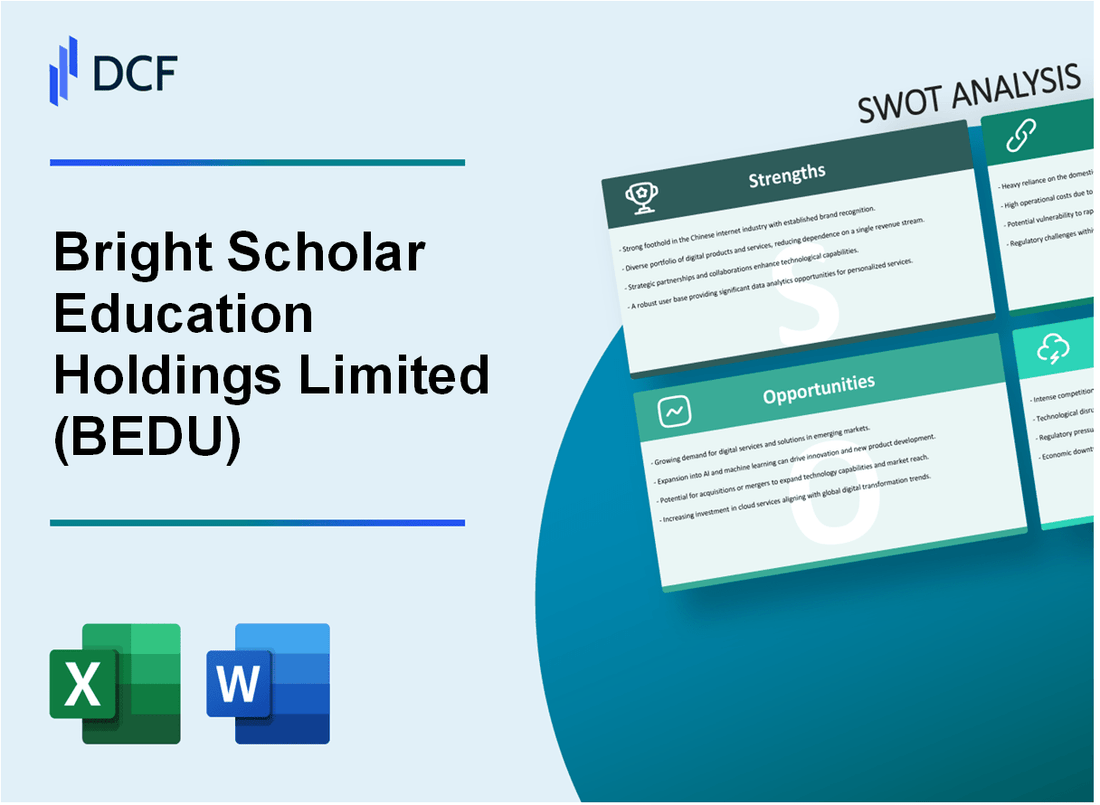
Completamente Editable: Adáptelo A Sus Necesidades En Excel O Sheets
Diseño Profesional: Plantillas Confiables Y Estándares De La Industria
Predeterminadas Para Un Uso Rápido Y Eficiente
Compatible con MAC / PC, completamente desbloqueado
No Se Necesita Experiencia; Fáciles De Seguir
Bright Scholar Education Holdings Limited (BEDU) Bundle
En el panorama dinámico de la educación privada china, Bright Scholar Education Holdings Limited (BEDU) surge como una potencia estratégica, navegando por los complejos desafíos del mercado con enfoques innovadores y modelos comerciales resistentes. Este análisis FODA completo revela las intrincadas capas del posicionamiento competitivo de Bedu, revelando un retrato matizado de un proveedor líder de servicios educativos listos en la intersección de oportunidades y transformación estratégica en el ecosistema educativo en rápido evolución de China.
Bright Scholar Education Holdings Limited (BEDU) - Análisis FODA: Fortalezas
Proveedor de servicios educativos privados K-12 privados en China
A partir de 2024, Opera Bright Scholar Education 57 escuelas en toda China, incluyendo:
| Tipo de escuela | Número de escuelas |
|---|---|
| Escuelas K-12 | 41 |
| Jardín de infantes | 16 |
Modelo de servicio educativo diversificado
La cartera educativa de la compañía incluye:
- Escuelas internacionales
- Escuelas bilingües
- Jardín de infantes
- Programas de educación después de la escuela
Fuerte desempeño financiero
Destacados financieros para el año fiscal 2023:
| Métrica financiera | Cantidad |
|---|---|
| Ingresos totales | $ 342.5 millones |
| Lngresos netos | $ 47.3 millones |
| Inscripción de estudiantes | 44,257 |
Equipo de gestión experimentado
Características de gestión clave:
- Experiencia de gestión promedio de más de 15 años en el sector educativo
- Equipo de liderazgo con antecedentes en educación internacional
- Enfoque estratégico en la expansión del mercado urbano
Reputación de marca y presencia en el mercado
Concentración geográfica:
| Región | Número de escuelas |
|---|---|
| Provincia de Guangdong | 22 |
| Llevar a la fuerza | 8 |
| Otras regiones | 27 |
Bright Scholar Education Holdings Limited (BEDU) - Análisis FODA: debilidades
Alta dependencia del mercado de la educación china
A partir de 2023, Bright Scholar Education Holdings Limited deriva aproximadamente el 98.7% de sus ingresos exclusivamente del mercado de la educación china. La compañía opera 84 escuelas en 41 ciudades en China, con una mínima presencia internacional.
| Concentración de mercado | Porcentaje |
|---|---|
| Ingresos del mercado chino | 98.7% |
| Número total de escuelas | 84 |
| Ciudades de operación | 41 |
Desafíos regulatorios significativos
El sector de la educación privada china enfrenta estrictas limitaciones regulatorias después del 2021 Ley de educación privada, que impactó dramáticamente las instituciones educativas con fines de lucro.
- Restricciones en el desarrollo del plan de estudios
- Limitaciones en la inversión extranjera
- Requisitos obligatorios de registro sin fines de lucro
Estructura de costos operativos
Los gastos operativos de Bright Scholar para mantener múltiples campus escolares representan aproximadamente el 62.4% de los ingresos totales en 2023, lo que indica altos costos de infraestructura y mantenimiento.
| Categoría de gastos | Porcentaje de ingresos |
|---|---|
| Gastos operativos | 62.4% |
| Mantenimiento del campus | 27.3% |
| Salarios del personal | 35.1% |
Vulnerabilidad demográfica
La disminución de las tasas de natalidad de China plantea desafíos significativos. La tasa nacional de natalidad cayó a 6.77 por cada 1,000 personas en 2022, lo que potencialmente reduce la futura inscripción de los estudiantes.
Integración de tecnología limitada
En comparación con los competidores de EDTech emergentes, la plataforma de aprendizaje digital de Bright Scholar representa solo el 8.2% del total de métodos de entrega educativa, significativamente más bajas que las tendencias de transformación digital de la industria.
| Método de entrega de aprendizaje | Porcentaje |
|---|---|
| Aula tradicional | 91.8% |
| Plataforma de aprendizaje digital | 8.2% |
Bright Scholar Education Holdings Limited (BEDU) - Análisis FODA: oportunidades
Aumento de la demanda de educación internacional y bilingüe de alta calidad en China
Según el Informe de Desarrollo de Educación de China 2023, se prevé que el mercado de educación internacional en China alcance los 500 mil millones de RMB para 2025. El segmento de educación bilingüe está experimentando una tasa de crecimiento anual del 15.7%.
| Segmento del mercado educativo | Tamaño del mercado (2023) | Tasa de crecimiento proyectada |
|---|---|---|
| Educación internacional | 380 mil millones de RMB | 15.7% |
| Educación bilingüe | 220 mil millones de RMB | 16.3% |
Posible expansión en ciudades emergentes de nivel 2 y nivel 3
Se espera que la población de clase media en las ciudades de nivel 2 y nivel 3 crezca un 22% anual, creando oportunidades de mercado educativas significativas.
- Ciudades de nivel 2 con expansión potencial del mercado: Chengdu, Hangzhou, Wuhan
- Crecimiento estimado de la población de clase media en estas ciudades: 8.5 millones para 2025
- Gasto promedio de educación doméstica en ciudades de nivel 2: 45,000 RMB por año
Desarrollo de plataformas de aprendizaje en línea e híbridas
El mercado educativo en línea en China se valoró en 267.1 mil millones de RMB en 2023, con una tasa de crecimiento anual compuesta proyectada del 13.5% hasta 2026.
| Segmento de educación en línea | Valor de mercado 2023 | CAGR proyectado |
|---|---|---|
| Aprendizaje en línea K-12 | 98.3 mil millones de RMB | 14.2% |
| Plataformas de aprendizaje híbrido | 45.6 mil millones de RMB | 12.8% |
Posibles asociaciones estratégicas con instituciones educativas internacionales
Las asociaciones educativas internacionales actuales en China han aumentado en un 37% desde 2020, con 215 acuerdos de colaboración educativos transfronterizos activos.
- Inversión promedio en programas de asociación internacional: 12.5 millones de USD
- Países principales para asociaciones educativas: Estados Unidos, Reino Unido, Canadá
- Retorno estimado de colaboraciones educativas internacionales: 18-22%
Creciente interés de los padres en programas educativos integrales y orientados a nivel mundial
El gasto de los padres en programas de educación global integrales aumentó en un 26.4% en 2023, llegando a 156 mil millones de RMB en todo el país.
| Tipo de programa educativo | Gastos de mercado 2023 | Crecimiento interanual |
|---|---|---|
| Plan de estudios internacional | 72.3 mil millones de RMB | 28.6% |
| Programas de competencia global | 45.7 mil millones de RMB | 24.9% |
Bright Scholar Education Holdings Limited (BEDU) - Análisis FODA: amenazas
Entorno regulatorio estricto para la educación privada en China
En septiembre de 2021, China implementó el Regulaciones sobre supervisión y administración de educación privada, que transformó fundamentalmente el panorama de la educación privada.
| Impacto regulatorio | Restricciones específicas |
|---|---|
| Restricciones con fines de lucro | Conversión obligatoria sin fines de lucro para escuelas privadas K-12 |
| Limitaciones de inversión extranjera | Reducción de la participación del capital extranjero en instituciones educativas |
Políticas gubernamentales potenciales que limitan las ganancias en las instituciones educativas
El gobierno chino Nueva ley educativa ha impuesto limitaciones significativas a los modelos de ingresos de educación privada.
- Prohibición de tutoría adicional de temas durante los fines de semana y feriados
- Restricción en programas de capacitación académica después de la escuela
- Tapas de precio obligatorias en servicios educativos
Aumento de la competencia de los proveedores educativos
| Tipo de competencia | Cuota de mercado | Índice de crecimiento |
|---|---|---|
| Escuelas privadas locales | 42.3% | 5.7% anual |
| Proveedores de educación internacional | 18.6% | 3.9% anual |
Incertidumbres económicas que afectan la educación privada
Los desafíos económicos de China han impactado directamente las capacidades de gasto educativo de los padres.
- El gasto promedio de educación del hogar disminuyó en un 12,4% en 2022
- Gasto per cápita en educación privada reducida de ¥ 24,500 a ¥ 21,300
Desafíos demográficos que afectan la inscripción de los estudiantes
| Indicador demográfico | Datos 2022 | Impacto proyectado 2025 |
|---|---|---|
| Tasa de natalidad | 6.77 por 1,000 población | Disminución de la inscripción potencial del 15% |
| Población en edad escolar | 282 millones | Reducción esperada a 265 millones |
Bright Scholar Education Holdings Limited (BEDU) - SWOT Analysis: Opportunities
You're looking for where Bright Scholar Education Holdings Limited can find its next wave of growth, and honestly, the path is clearly outside of their traditional domestic model. The opportunity lies in leveraging their existing global footprint and shifting capital toward high-margin, internationally-focused services and government-supported sectors like vocational training.
The company's strategic pivot is already visible in the Q2 FY2025 results, where net income from continuing operations surged by an impressive 223.6% to GBP3.2 million, despite a drop in total revenue. This shows a focus on efficiency that makes new, profitable expansion a clear next step.
Accelerate expansion into Southeast Asia and Europe for non-PRC revenue growth.
Your best bet for stable, high-margin revenue is to double down on the international market, especially as the Overseas Study Counselling segment is already performing well. This segment's revenue grew by 5.8% year-over-year to GBP9.6 million in Q1 FY2025, and then by a further 6.2% to GBP11.9 million in Q2 FY2025. This growth signals strong demand for non-PRC services.
The 'dual-engine' growth strategy-expanding schools and global recruitment-must prioritize high-growth regions like Southeast Asia (e.g., Vietnam, Malaysia, Thailand) and solidify the existing presence in the UK and US. This diversifies risk away from domestic regulatory pressures. Global recruitment initiatives are already targeting new markets like Nepal and Malaysia, which is defintely the right move.
| Segment | Q1 FY2025 Revenue (GBP in millions) | Q2 FY2025 Revenue (GBP in millions) | QoQ Change (Q2 vs Q1) |
|---|---|---|---|
| Schools | 25.7 | 26.6 | +3.5% |
| Overseas Study Counselling | 9.6 | 11.9 | +24.0% |
| Others (Vocational/Digital/Domestic K-12) | 9.4 | 5.3 | -43.6% |
| Total Revenue from Continuing Operations | 44.7 | 43.8 | -2.0% |
Capitalize on the rising global demand for high-quality, internationally-focused education.
The market for international education is not just large; it's growing fast, and Bright Scholar Education Holdings Limited is positioned to capture a bigger piece. As of January 2025, the international school market generates an estimated $67.3 billion USD in total annual fee income globally, showing a substantial 22% increase since 2020. This is a massive, premium market.
The global K-12 education sector is projected to grow at a 3.5% CAGR, so investing in the existing network of over 100 international and bilingual K-12 schools will yield returns. You need to focus on the following to capture this demand:
- Integrate more globally recognized curricula like the International Baccalaureate (IB) or A-Levels.
- Increase revenue per enrollment, which saw a strong 14.2% year-over-year improvement at the US schools in Q2 FY2025.
- Target the growing number of local, middle-class families in Asia who now constitute a significant part of the 7.4 million international school students worldwide.
Expand vocational education services, a sector supported by the Chinese government.
The Chinese government is heavily incentivizing vocational education (VE) to meet labor market demands, making this a clear, politically-supported opportunity. The Post-Secondary Education sector, which includes VE, is projected to grow at a 4% CAGR, and the Workforce Training segment at a 6.5% CAGR through 2030.
Here's the quick math: while the 'Others' segment-where most domestic non-K12 services, including vocational, reside-contracted by 45.9% to just GBP5.3 million in Q2 FY2025, this segment needs a strategic injection. The contraction was a deliberate scale-back of low-margin domestic K-12, so the opportunity is to pivot the remaining capacity to high-demand vocational programs (e.g., healthcare, advanced manufacturing, IT skills) that qualify for government subsidies and have a clear, high-employment outcome.
Monetize digital education tools and content for a wider, lower-cost market reach.
Digital education offers a path to scale without the high capital expenditure of building new schools. You have the foundation: in 2024, Bright Scholar Education Holdings Limited invested $3 million in educational technology, including online learning platforms. This is an asset ready for monetization.
The overall market for AI in education is expected to grow at a staggering 45% CAGR, and adopting blended or hybrid learning models can reduce operational costs by up to 40%. The opportunity is to create a new, high-margin, digital-only revenue stream that targets the lower-cost market segment globally. This involves:
- Developing subscription-based, AI-powered tutoring platforms for international curricula.
- Offering certified online vocational courses to the massive, underserved global workforce training market.
- Translating the intellectual property (IP) from the premium K-12 schools into scalable digital content licenses.
Bright Scholar Education Holdings Limited (BEDU) - SWOT Analysis: Threats
Further, unexpected regulatory tightening in the PRC affecting non-compulsory education.
You've seen the regulatory whiplash in China's education sector, so the primary threat is not the current policy, but the risk of an unexpected, severe policy reversal. While the government has quietly eased some tutoring restrictions to support employment, the core regulatory framework remains restrictive, especially for international curricula.
The Patriotic Education Law, which took effect in January 2024, mandates that all educational resources reflect Chinese history and culture, ideology, and politics. This creates a direct operational risk for Bright Scholar Education Holdings Limited's international schools, which rely on foreign curricula to prepare students for overseas universities. Any new, unexpected expansion of these rules into the high school (post-compulsory) segment, or a sudden re-enforcement of the ban on foreign-owned entities controlling non-compulsory schools, could immediately impact the company's domestic revenue stream, which is still substantial.
Economic slowdown in China impacting high-end private school enrollment.
The slowdown in China's economic growth, coupled with a demographic decline, directly pressures the high-end private education market. Wealthy parents are becoming more cost-sensitive, and the sheer number of potential students is dropping fast. This isn't just theory; we have hard numbers:
- National births are projected to fall from approximately 9.54 million in 2024 to between 7.3 million and 7.8 million in 2025.
- The market is already consolidating, with roughly 14,800 kindergartens closing in 2024 alone, according to public reports.
This enrollment slump forces private schools to compete fiercely for a shrinking pool of affluent students, driving up marketing costs and pressuring tuition fees. For Bright Scholar, which relies on premium pricing, a sustained economic downturn will erode its domestic enrollment base and profitability, especially in its Domestic Kindergartens and K-12 Operation Services segment.
Intense competition in international markets from established global education providers.
Bright Scholar Education Holdings Limited's strategy relies heavily on its Overseas Schools and Complementary Education Services (overseas study consulting) for growth, especially after domestic regulatory changes. But this international expansion pushes them into a highly competitive global market dominated by established players.
In the overseas study consulting space, they compete directly with massive, global education service providers like IDP Education, which guided over 113,000 students in 2023 alone. In the physical school market, their overseas schools in the UK and US face deep-rooted, high-reputation institutions like Brighton College and Repton School. To be fair, Bright Scholar is a major player, holding the second position among 36 active competitors in China's K-12 sector as of April 2025, but the global stage is a different ballgame. Maintaining a competitive edge in these markets requires constant, high-capital investment in facilities and faculty, which strains cash flow.
Financial distress or default of Country Garden creating a severe capital and reputational spillover risk.
The most immediate and severe threat is the ongoing financial crisis at Country Garden Holdings, the company's former controlling shareholder and primary business partner. Bright Scholar Education Holdings Limited's entire domestic footprint was built by leveraging Country Garden's residential communities, often without paying fees for the facilities. That symbiotic relationship is now a massive liability.
Country Garden defaulted on its $11 billion in offshore bonds late last year and is currently fighting a liquidation petition in Hong Kong. As of November 2025, a US bankruptcy judge delayed recognition of Country Garden's restructuring plan, which aims to cut over $11.0 billion in debt. This instability poses a dual threat:
- Operational Risk: The legal prohibition on related-party transactions in the PRC limits Bright Scholar's ability to continue its cost-efficient collaboration with Country Garden for new schools.
- Reputational/Capital Risk: A formal liquidation or a messy default by Country Garden would create a severe reputational spillover. Parents associate the two brands, and the collapse of a major property developer could trigger panic withdrawals or a sharp drop in new enrollment at Bright Scholar's domestic schools, which would directly impact their liquidity.
Here's the quick math on their recent liquidity: Bright Scholar's cash and cash equivalents stood at GBP46.3 million as of February 28, 2025. A sudden, large-scale enrollment drop could quickly deplete this buffer, especially if the company has to take on unexpected costs for facilities previously provided by Country Garden.
| Threat Vector | Near-Term Impact (FY2025/2026) | Quantifiable Data Point |
|---|---|---|
| Regulatory Tightening (PRC) | Increased compliance costs; potential revenue loss from non-compliant curricula. | Patriotic Education Law effective January 2024; potential for new restrictions on high school curricula. |
| Economic Slowdown in China | Enrollment slump in high-end domestic schools; pressure on tuition fees. | Projected national births in 2025: 7.3 million to 7.8 million (down from 9.54 million in 2024). |
| Intense International Competition | Higher customer acquisition costs for Overseas Schools and Complementary Services. | Overseas study consultant IDP Education guided over 113,000 students in 2023, showing market scale. |
| Country Garden Financial Distress | Reputational damage; loss of cost-efficient facility access; liquidity drain. | Country Garden defaulted on $11 billion in offshore bonds; US judge delayed restructuring recognition in November 2025. |
Disclaimer
All information, articles, and product details provided on this website are for general informational and educational purposes only. We do not claim any ownership over, nor do we intend to infringe upon, any trademarks, copyrights, logos, brand names, or other intellectual property mentioned or depicted on this site. Such intellectual property remains the property of its respective owners, and any references here are made solely for identification or informational purposes, without implying any affiliation, endorsement, or partnership.
We make no representations or warranties, express or implied, regarding the accuracy, completeness, or suitability of any content or products presented. Nothing on this website should be construed as legal, tax, investment, financial, medical, or other professional advice. In addition, no part of this site—including articles or product references—constitutes a solicitation, recommendation, endorsement, advertisement, or offer to buy or sell any securities, franchises, or other financial instruments, particularly in jurisdictions where such activity would be unlawful.
All content is of a general nature and may not address the specific circumstances of any individual or entity. It is not a substitute for professional advice or services. Any actions you take based on the information provided here are strictly at your own risk. You accept full responsibility for any decisions or outcomes arising from your use of this website and agree to release us from any liability in connection with your use of, or reliance upon, the content or products found herein.