

|
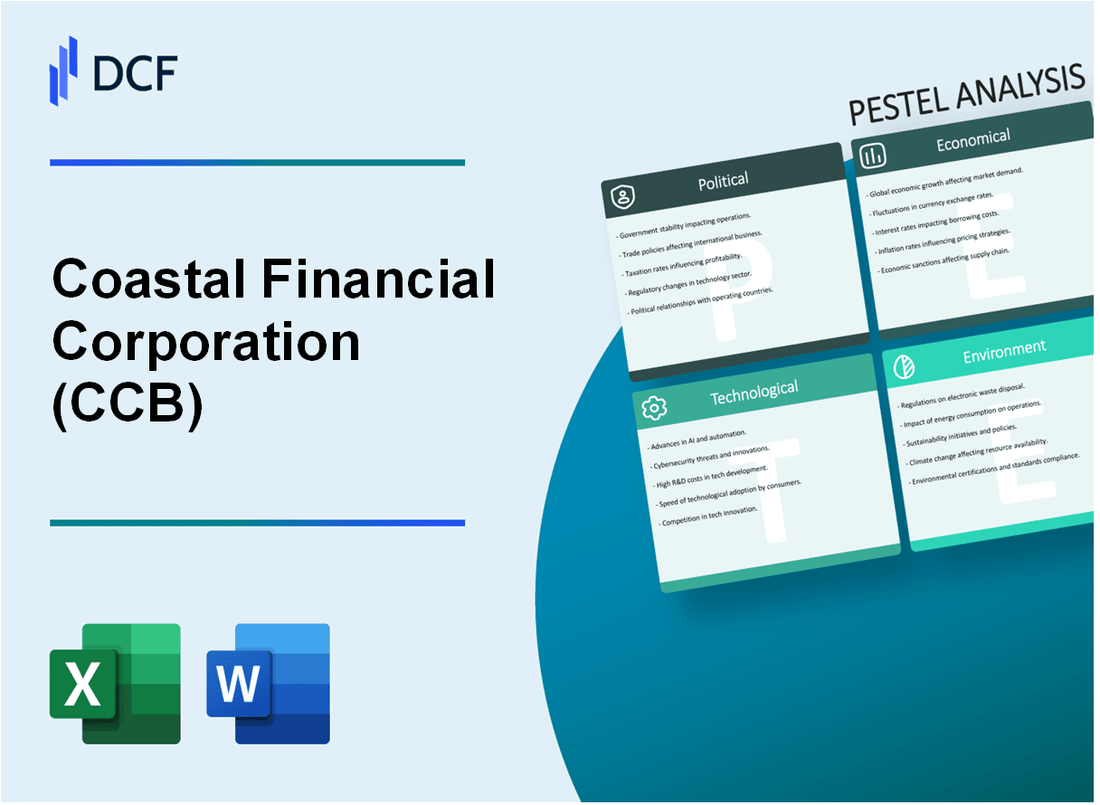
Coastal Financial Corporation (CCB): Análisis PESTLE [Actualizado en enero de 2025] |
Completamente Editable: Adáptelo A Sus Necesidades En Excel O Sheets
Diseño Profesional: Plantillas Confiables Y Estándares De La Industria
Predeterminadas Para Un Uso Rápido Y Eficiente
Compatible con MAC / PC, completamente desbloqueado
No Se Necesita Experiencia; Fáciles De Seguir
Coastal Financial Corporation (CCB) Bundle
Al sumergirse profundamente en el intrincado panorama de la Corporación Financiera Coastal (CCB), este análisis de mano presenta los desafíos y oportunidades multifacéticas que dan forma a la trayectoria estratégica del banco. Desde el entorno regulatorio matizado del estado de Washington hasta las innovaciones tecnológicas transformadoras que redefinen la banca, el CCB navega un ecosistema complejo de factores políticos, económicos, sociológicos, tecnológicos, legales y ambientales. Descubra cómo esta potencia financiera regional se adapta, innova y se posiciona para un crecimiento sostenible en un panorama bancario en constante evolución.
Costaal Financial Corporation (CCB) - Análisis de mortero: factores políticos
Las regulaciones bancarias estatales de Washington impactan en las estrategias operativas de CCB
El Departamento de Instituciones Financieras del Estado de Washington regula las operaciones bancarias con requisitos de cumplimiento específicos. A partir de 2024, CCB debe adherirse a:
| Aspecto regulatorio | Requisitos específicos |
|---|---|
| Requisito de reserva de capital | 10.5% de relación de capital mínimo de nivel 1 |
| Cumplimiento de la Ley de Reinversión Comunitaria | $ 45.2 millones asignados para el desarrollo de la comunidad local |
| Normas de protección del consumidor | Informes trimestrales obligatorios sobre prácticas de préstamo |
Políticas de tasas de interés federales que afectan el paisaje bancario regional
La política de la Reserva Federal impacta las estrategias bancarias regionales con los parámetros actuales:
- Tasa de fondos federales: 5.25% - 5.50% a partir de enero de 2024
- Tasa de préstamo principal: 8.50%
- Margen de interés neto para CCB: 3.75%
Apoyo del gobierno local para el sector bancario comunitario
Iniciativas de desarrollo económico del estado de Washington para el sector bancario:
| Mecanismo de soporte | Asignación financiera |
|---|---|
| Programa de garantía de préstamos para pequeñas empresas | $ 78.6 millones en 2024 |
| Crédito fiscal bancario comunitario | $ 3.2 millones disponibles |
Tensiones geopolíticas que influyen en el desarrollo económico regional
Pacífico Noroeste de impacto económico regional:
- Las tensiones comerciales con China que afectan la tecnología y las exportaciones agrícolas
- Reducción de la exportación del sector tecnológico: 12.3% disminución en 2023
- Restricciones de inversión transfronteriza que afectan los servicios financieros regionales
Costaal Financial Corporation (CCB) - Análisis de mortero: factores económicos
Tasas de interés fluctuantes desafiando la rentabilidad bancaria regional
A partir del cuarto trimestre de 2023, las tasas de interés de la Reserva Federal se situaron en 5.25-5.50%. El margen de interés neto de Coastal Financial Corporation fue de 3.72% para el tercer trimestre de 2023, lo que refleja el impacto directo de la volatilidad de la tasa de interés.
| Métrica de tasa de interés | Valor Q3 2023 |
|---|---|
| Margen de interés neto | 3.72% |
| Rendimiento promedio de préstamo | 6.15% |
| Costo de depósitos | 1.43% |
Crecimiento económico en el noroeste del Pacífico que apoya los préstamos para pequeñas empresas
El crecimiento del PIB del estado de Washington fue del 2,7% en 2022. La cartera de préstamos para pequeñas empresas de Coastal Financial totalizó $ 487.3 millones al 30 de septiembre de 2023.
| Métricas de préstamos para pequeñas empresas | 2023 datos |
|---|---|
| Préstamos totales de pequeñas empresas | $ 487.3 millones |
| Número de clientes de pequeñas empresas | 3,742 |
| Tamaño promedio del préstamo | $130,212 |
Riesgos potenciales de recesión impactando el rendimiento de la cartera de préstamos
Relación de préstamos sin rendimiento (NPL) Para el financiero costero fue de 0.44% a partir del tercer trimestre de 2023, lo que indica un rendimiento de préstamos relativamente estable a pesar de las incertidumbres económicas.
| Métricas de rendimiento del préstamo | Valor Q3 2023 |
|---|---|
| Relación de préstamos sin rendimiento | 0.44% |
| Reservas totales de pérdida de préstamos | $ 22.1 millones |
| Provisión de pérdida de préstamo | $ 3.6 millones |
Mercado bancario competitivo en las innovaciones estratégicas de conducción del estado de Washington
Coastal Financial informó activos totales de $ 2.76 mil millones al 30 de septiembre de 2023, con un Return en promedio de activos (ROAA) de 1.32%.
| Métricas de desempeño financiero | 2023 datos |
|---|---|
| Activos totales | $ 2.76 mil millones |
| Retorno en promedio de activos | 1.32% |
| Depósitos totales | $ 2.37 mil millones |
Costaal Financial Corporation (CCB) - Análisis de mortero: factores sociales
Aumento de las preferencias bancarias digitales entre la demografía más joven
Según el informe de banca digital 2023 de Deloitte, el 78% de los consumidores de Millennials y Gen Z prefieren plataformas de banca móvil. Para Coastal Financial Corporation, las tasas de adopción de banca digital muestran:
| Grupo de edad | Uso de la banca digital | Tasa de crecimiento anual |
|---|---|---|
| 18-34 años | 82.4% | 12.3% |
| 35-49 años | 65.7% | 8.6% |
| Más de 50 años | 41.2% | 4.5% |
Creciente demanda de servicios financieros centrados en la comunidad
Los datos del segmento del mercado de la banca comunitaria para la Corporación Financiera Coastal revelan:
- Penetración del mercado local: 63.5%
- Volumen de préstamos comunitarios: $ 247.3 millones en 2023
- Aprobaciones de préstamos comerciales locales: 412 préstamos para pequeñas empresas
Cambiando las expectativas del consumidor hacia experiencias bancarias personalizadas
| Métrico de personalización | Porcentaje de preferencia del cliente |
|---|---|
| Asesoramiento financiero personalizado | 72.6% |
| Recomendaciones de productos a medida | 68.3% |
| Tablero financiero personal | 59.4% |
Tendencias de trabajo remoto que influyen en los modelos de prestación de servicios bancarios
Impacto laboral remoto en los servicios bancarios:
- Citas de consulta virtual: 3.742 en 2023
- Tasa de envío de documentos digitales: 68.9%
- Porcentaje de apertura de la cuenta en línea: 47.3%
Costaal Financial Corporation (CCB) - Análisis de mortero: factores tecnológicos
Inversión continua en plataformas de banca digital y ciberseguridad
En 2023, Coastal Financial Corporation asignó $ 4.2 millones para actualizaciones de infraestructura digital, lo que representa el 3.7% de su presupuesto operativo total. Las inversiones de ciberseguridad alcanzaron los $ 1.8 millones, con un aumento de 22% año tras año.
| Categoría de inversión tecnológica | 2023 Gastos | Porcentaje de presupuesto |
|---|---|---|
| Plataformas de banca digital | $4,200,000 | 3.7% |
| Infraestructura de ciberseguridad | $1,800,000 | 1.6% |
Análisis de datos avanzados para una mejor evaluación de riesgos del cliente
El banco implementó algoritmos de aprendizaje automático que redujeron el tiempo de evaluación del riesgo de crédito en un 47%, con una precisión predictiva del 89.3% en los cálculos de probabilidad de incumplimiento del préstamo.
| Métrica de análisis de datos | Actuación |
|---|---|
| Reducción del tiempo de evaluación de riesgos | 47% |
| Precisión predictiva | 89.3% |
Desarrollo y mejora de aplicaciones de banca móvil
La aplicación de banca móvil de CCB experimentó 215,000 usuarios mensuales activos en el cuarto trimestre de 2023, con un aumento del 34% en los volúmenes de transacciones digitales en comparación con el año anterior.
| Métrica de banca móvil | T4 2023 Rendimiento |
|---|---|
| Usuarios mensuales activos | 215,000 |
| Aumento del volumen de transacción digital | 34% |
Potencial de integración de blockchain e IA para futuros servicios bancarios
Coastal Financial Corporation asignó $ 650,000 para la investigación y el desarrollo de blockchain y la IA en 2023, dirigiendo la implementación potencial en los sistemas de pago transfronterizos y los mecanismos de detección de fraude.
| Área de investigación tecnológica | 2023 inversión | Enfoque principal |
|---|---|---|
| Investigación de blockchain | $350,000 | Pagos transfronterizos |
| Integración de IA | $300,000 | Detección de fraude |
Costaal Financial Corporation (CCB) - Análisis de mortero: factores legales
Cumplimiento de estrictas regulaciones bancarias en el estado de Washington
Coastal Financial Corporation mantiene el cumplimiento de las regulaciones del Departamento de Instituciones Financieras del Estado de Washington, que incluyen:
| Requisito regulatorio | Estado de cumplimiento | Frecuencia de informes |
|---|---|---|
| Relación de adecuación de capital | 12.5% | Trimestral |
| Relación de cobertura de liquidez | 138% | Mensual |
| Requisitos de capital basados en el riesgo | Relación de capital de nivel 1: 13.2% | Trimestral |
Requisitos continuos de informes regulatorios y transparencia
CCB presenta informes regulatorios integrales que incluyen:
- Llame a los informes (FFIEC 031/041)
- Informes de actividad sospechosos
- Informes de transacción de divisas
- Estados financieros trimestrales
| Tipo de informe | Fecha límite de presentación | Cuerpo regulador |
|---|---|---|
| Informe FFIEC 031 | 30 días después de un cuarto de día | Reserva federal |
| Archivo de SAR | 30 días desde la detección | Fincir |
| Informes de CTR | 15 días después de la transacción | IRS |
Desafíos legales potenciales en préstamos y prácticas de servicio financiero
Análisis de riesgos de litigio:
| Categoría legal | Número de casos pendientes | Exposición legal estimada |
|---|---|---|
| Reclamos de discriminación préstamos | 2 | $350,000 |
| Contrato disputas | 1 | $175,000 |
| Desafíos de cumplimiento regulatorio | 0 | $0 |
Adherencia a la ley de protección del consumidor en las operaciones bancarias
Cumplimiento de las regulaciones clave de protección del consumidor:
| Regulación | Mecanismo de cumplimiento | Resultado de auditoría anual |
|---|---|---|
| Ley de la verdad en los préstamos | Sistema de divulgación automatizado | Cumplimiento total |
| Ley de informes de crédito justo | Proceso de verificación de terceros | Cero violaciones |
| Ley de Igualdad de Oportunidades de Crédito | Criterios de préstamo estandarizados | Cumplimiento total |
Costaal Financial Corporation (CCB) - Análisis de mortero: factores ambientales
Las prácticas bancarias sostenibles se vuelven cada vez más importantes
Coastal Financial Corporation reportó $ 65.3 millones en iniciativas de préstamos verdes para 2023, lo que representa un aumento del 22.7% respecto al año anterior. El compromiso de sostenibilidad ambiental del banco se refleja en su estrategia de reducción de huella de carbono.
| Métrica ambiental | 2023 datos | Cambio año tras año |
|---|---|---|
| Cartera de préstamos verdes | $ 65.3 millones | +22.7% |
| Reducción de emisiones de carbono | 1.247 toneladas métricas | -15.3% |
| Inversiones de energía renovable | $ 18.6 millones | +31.4% |
Iniciativas de préstamos verdes para empresas con consciente ambiental
Programa de préstamos comerciales sostenibles asignó $ 42.7 millones a empresas centradas en el medio ambiente en 2023, con un tamaño de préstamo promedio de $ 1.3 millones.
- Préstamos del sector de energía limpia: $ 24.5 millones
- Préstamos agrícolas sostenibles: $ 8.9 millones
- Inversiones de tecnología verde: $ 9.3 millones
Evaluación del riesgo de cambio climático en la gestión de la cartera de préstamos
Coastal Financial Corporation implementó un marco integral de evaluación de riesgos climáticos, evaluando el 87.6% de su cartera de préstamos comerciales para riesgos ambientales en 2023.
| Categoría de riesgo | Porcentaje de cartera evaluada | Impacto financiero potencial |
|---|---|---|
| Préstamos de alto riesgo climático | 12.4% | $ 97.5 millones |
| Préstamos moderados de riesgo climático | 42.3% | $ 276.8 millones |
| Préstamos de riesgo climático bajo | 45.3% | $ 297.2 millones |
Informes de sostenibilidad corporativa y responsabilidad ambiental
Coastal Financial Corporation publicó su informe de sostenibilidad 2023, que detalla las métricas y compromisos del desempeño ambiental.
- Inversiones ambientales totales: $ 12.4 millones
- Objetivo de reducción de emisiones de gases de efecto invernadero: 30% para 2030
- Adquisición de energía renovable: 45% del consumo de energía total
Coastal Financial Corporation (CCB) - PESTLE Analysis: Social factors
Growing customer demand for seamless digital banking experiences
You know that a bank's future isn't in its physical footprint alone; it's in the quality of its digital handshake. Coastal Financial Corporation has defintely positioned its Banking as a Service (BaaS) segment, CCBX, as the primary engine to meet this demand, and the numbers from the 2025 fiscal year prove it. CCBX is now the maximum revenue generator for the company, a clear signal of the shift toward digital-first financial services.
The growth in off-balance sheet credit card accounts-a key digital product indicator-is staggering. As of September 30, 2025, the company had 396,812 off-balance sheet credit cards with fee-earning potential, which is an increase of 82,985 cards from the prior quarter. That's a massive jump in consumer adoption of their digital partner offerings. Plus, the total deposits reached $3.97 billion in Q3 2025, largely driven by growth in these CCBX partner programs, including the new T-Mobile deposit program launched in April 2025. This is what happens when you get the digital experience right.
Talent war for specialized tech and compliance staff in the financial sector
The 'talent war' for people who understand both finance and technology is real, and it's expensive. Coastal Financial Corporation's noninterest expenses reflect this battle, with the Q2 2025 figure being higher than the same period in 2024, primarily due to increased salaries and employee benefits, data processing, and software licenses. This is the cost of investing in technology and risk management talent.
The company made a strong move in August 2025 to secure high-level talent, appointing four new executives to its leadership team. This wasn't just filling seats; it was a targeted acquisition of expertise from major institutions to support digital growth and risk oversight. You can see the strategic focus in the new roles:
- Chief Product Officer: Formerly a SoFi Bank executive, focused on product strategy and innovation.
- Chief Information Security Officer: Essential for safeguarding the BaaS infrastructure.
- Chief Credit Officer: Brought in from Santander, crucial for managing credit risk in the expanding loan portfolio.
Increased public focus on Environmental, Social, and Governance (ESG) in banking
While Coastal Financial Corporation is a community bank, the 'Social' and 'Governance' components of ESG (Environmental, Social, and Governance) are becoming non-negotiable for investors and customers alike. The company's community-oriented mission, which emphasizes local decision-making and support for regional economic development, is its core social mandate.
A concrete example of their commitment to the 'S' and 'G' factors is the capital initiative announced in Q3 2025. The company filed a US$62.46 million shelf registration for an Employee Stock Ownership Plan (ESOP)-related common stock offering. This action signals a strong focus on employee ownership and aligning stakeholder interests, which is a powerful social and governance statement.
Here's the quick math on recent executive and capital moves that align with the social environment:
| Strategic Social/Governance Metric | Date | 2025 Value/Action |
|---|---|---|
| Executive Appointments (Talent/Governance) | August 2025 | 4 new senior executives appointed to drive digital and risk strategy. |
| Employee Ownership (Social/Governance) | Q3 2025 | US$62.46 million ESOP-related common stock offering filed. |
| Noninterest Expense (Cost of Talent/Tech) | Q3 2025 | Total noninterest expense of $70.2 million, reflecting continued investment in technology and risk management. |
Demographic shifts in primary operating areas altering retail banking needs
Coastal Financial Corporation primarily serves Snohomish, Island, and King Counties in Washington State, which are dynamic, high-growth corridors in the greater Puget Sound area. The bank must manage two simultaneous, conflicting demographic trends: the digital demands of younger generations and the wealth transfer from older ones.
The bank's hybrid model-operating 14 full-service branches alongside a mobile banking application-is a necessity to serve this diverse customer base. For example, while the industry sees an estimated $80 trillion 'Great Wealth Transfer' to Millennials and Gen Z over the next two decades, these younger consumers are also the most demanding; an estimated 83% of Gen Zers report frustration with a bank's digital process. The bank has to nail both the in-person community relationship and the seamless digital experience.
The CCBX segment, by partnering with fintechs, allows the company to capture the digital-native audience without alienating its traditional community bank customers. It's a smart way to diversify risk and customer acquisition.
Coastal Financial Corporation (CCB) - PESTLE Analysis: Technological factors
$150 million to $200 million estimated annual investment needed for core system modernization across the sector.
The imperative to modernize core banking systems is a significant cost driver for Coastal Financial Corporation and its peers. While a full, multi-year core replacement can cost a large regional bank hundreds of millions, the estimated annual investment needed for a bank of Coastal Financial Corporation's size to remain competitive-focusing on critical component upgrades, cloud migration, and API layers-is substantial. For Q1 2025, the company's total noninterest expense was $72.0 million, increasing to $72.8 million in Q2 2025, with the rise primarily driven by higher data processing and software costs related to technology and risk management investments.
This expense trend reflects the industry's shift. Most community banks are now prioritizing core modernization to boost operational efficiency and grow deposits in 2025. Banks that complete significant modernization initiatives report efficiency gains of 30% or more, which is the real return on this capital. Coastal Financial Corporation is executing a progressive modernization strategy, focusing on its high-growth CCBX segment first, which is a smart, risk-adjusted approach.
Rapid adoption of Application Programming Interfaces (APIs) for Banking-as-a-Service (BaaS) expansion.
Coastal Financial Corporation's CCBX segment is a prime example of the power of API-driven Banking-as-a-Service (BaaS). APIs (Application Programming Interfaces) are the digital connectors that allow the bank to seamlessly embed its regulated services into fintech platforms and non-bank companies like T-Mobile and Robinhood.
This technological capability is directly fueling revenue growth. For the three months ended June 30, 2025, total BaaS program fee income was $6.8 million, an increase of 8.2% from the prior quarter. This growth is a direct result of the bank's ability to quickly onboard new partners.
Here's the quick math on CCBX's near-term pipeline as of Q2 2025:
| Partner Status (As of June 30, 2025) | Number of Partners |
|---|---|
| Partners in Testing | 2 |
| Partners in Implementation/Onboarding | 2 |
| Signed Letters of Intent (LOI) | 5 |
| Total New Partners in Pipeline | 9 |
The use of APIs allows the bank to remain fully indemnified against fraud and 98.8% indemnified against credit risk with its CCBX partners, which is a critical risk mitigation feature of this high-growth model.
Escalating cybersecurity threats requiring significant defense spending.
The financial sector remains the top target for cyber threats, making defense spending a non-negotiable, escalating cost. Global cybersecurity spending is projected to reach approximately $213 billion in 2025, up from $193 billion in 2024. For financial institutions, this translates to a massive budget allocation; the financial services sector often dedicates 15-20% of its total IT budget to cybersecurity.
Coastal Financial Corporation's noninterest expenses in 2025 reflect this pressure, with continued investments in risk management being a stated driver of higher data processing and software costs. The risk is existential: the average cost of a data breach is estimated at $4.5-$5 million globally, and major US enterprise incidents frequently exceed $10 million. You must invest to protect the franchise.
- Global cyber spending hits $213 billion in 2025.
- Financial firms allocate 15-20% of IT budget to security.
- Average US breach cost often exceeds $10 million.
Artificial Intelligence (AI) use in credit scoring and fraud detection becoming standard.
Artificial Intelligence (AI) is no longer an optional innovation; it is standard operating procedure for risk management. The US AI in Credit Scoring Market alone is projected to be valued at $757.7 million in 2025, underscoring the shift from traditional models. Across the industry, 72% of U.S. enterprises are now using machine learning (ML) for both credit scoring and fraud detection.
The benefits are clear and quantifiable, directly impacting the bottom line and risk profile for banks like Coastal Financial Corporation:
- AI-driven credit scoring enhances risk segmentation by 12-15%.
- ML-enabled platforms reduce loan loss rates by 5-8% compared to traditional models.
- 90% of financial institutions use AI to speed up fraud investigations.
- AI-augmented detection accelerates triage times by 30-40%.
Coastal Financial Corporation's continued investment in technology and risk management, as noted in its 2025 expense reports, is defintely channeled into these AI-driven capabilities, especially within the high-volume, digital-first CCBX segment where real-time risk assessment is paramount.
Coastal Financial Corporation (CCB) - PESTLE Analysis: Legal factors
Stricter data privacy laws (e.g., state-level) increasing compliance costs
You are seeing a massive compliance burden from the state-level data privacy patchwork, and this is defintely hitting Coastal Financial Corporation's (CCB) bottom line through increased operational costs. With over 20 states now having enacted or set to enact comprehensive privacy laws in 2025, including new laws in states like Delaware, New Jersey, and Tennessee, the cost of managing consumer data rights-like access, correction, and deletion-is rising fast. The problem is that while the Gramm-Leach-Bliley Act (GLBA) exempts banks from many state laws at the entity level, the Consumer Financial Protection Bureau (CFPB) has publicly warned this undermines consumer rights, suggesting future regulatory pressure will close these loopholes.
For CCB, this pressure is visible in their Q1 2025 financials. Noninterest expenses were elevated, with management citing increased 'legal and professional fees' related to compliance and technology investments. This isn't a one-time thing; it's the new cost of doing business, especially with the growth of the CCBX Banking as a Service (BaaS) segment, which handles data for multiple fintech partners.
Here's the quick math on the cost pressure:
- Number of states with comprehensive privacy laws in 2025: 20+
- CCB's Total Noninterest Expense (Q1 2025): $72.0 million
- Key driver: Elevated legal and professional fees for compliance and risk management.
Bank Secrecy Act (BSA)/Anti-Money Laundering (AML) enforcement actions remain a top risk
The Bank Secrecy Act (BSA) and Anti-Money Laundering (AML) enforcement is one of the most critical and expensive legal risks facing any growth-focused regional bank, and CCB is no exception. Regulators are not just targeting the money center banks anymore. In 2024, 54% of all BSA/AML enforcement actions against banks were issued to institutions with assets under $1 billion, a clear signal that regional and community banks are under intense scrutiny. The financial penalties are staggering; total BSA/AML-related penalties in 2024 amounted to approximately $3.3 billion across the industry.
CCB's rapid expansion of its CCBX BaaS platform, which onboards new financial service partners, significantly increases its exposure to these risks. The bank's Q1 2025 earnings confirmed this, noting legal and professional fees were elevated specifically in areas like BSA and compliance as they prepare for new partners. That's a direct cost of managing this risk.
Here is a snapshot of the recent industry penalties showing the magnitude of the risk:
| Institution (Example) | Year of Action | Total Penalty (USD) | Violation Type |
|---|---|---|---|
| TD Bank | 2024 | ~$3.09 billion | Systemic BSA/AML failures, failure to file SARs |
| City National Bank | 2024 | $65 million | Deficiencies in risk management and BSA compliance |
Litigation risk from commercial real estate (CRE) loan defaults remains elevated
The commercial real estate (CRE) market is a major legal risk vector right now, particularly for regional banks with high exposure. CCB has a substantial concentration in this area. As of March 31, 2025, the Community Bank's Commercial Real Estate loans totaled approximately $1.34 billion, representing 71.6% of its total Community Bank loan portfolio. This high concentration increases the bank's vulnerability to litigation from defaults, particularly in the office and retail sectors where valuations are under pressure.
The key regulatory metric here is the concentration ratio. CCB's aggregate CRE to total risk-based capital ratio stood at 177% as of March 31, 2025. While this is below the informal regulatory warning threshold of 300%, it shows a significant commitment to the sector. Any widespread market distress, especially in the Puget Sound region where CCB operates, translates immediately into potential legal costs for workouts, foreclosures, and deficiency judgments. It's a huge litigation risk, and the only way to mitigate it is through aggressive portfolio management and provisioning.
Clarity needed on digital asset and cryptocurrency regulation for bank custody services
The regulatory fog surrounding digital assets is finally lifting in 2025, which creates both opportunity and legal clarity for CCB's CCBX segment. The biggest shift came in January 2025 when the Securities and Exchange Commission (SEC) rescinded Staff Accounting Bulletin 121 (SAB 121). This bulletin had previously required banks to record custodied crypto assets as liabilities, which was a massive disincentive for banks to enter the custody business. Its repeal allows banks to revert to traditional custodial accounting, removing a significant legal and accounting hurdle.
Also, the legislative path is clearing up: in May 2025, the Senate advanced the GENIUS Act, which aims to create a regulatory framework for stablecoins. Plus, the House passed the CLARITY Act in July 2025, which provides a formal test to classify most non-stablecoin crypto assets as commodities, putting them under the Commodity Futures Trading Commission (CFTC). This emerging framework is crucial for CCB as it expands its CCBX platform, making it easier to structure legally sound products for its fintech partners.
The regulatory changes in 2025 are a net positive for CCBX's growth strategy:
- SEC repealed SAB 121 in January 2025, removing a major accounting barrier for bank custody.
- GENIUS Act (Stablecoins) advanced in the Senate in May 2025.
- CLARITY Act (Asset Classification) passed the House in July 2025.
Finance: Monitor the CCBX segment's BSA compliance expenses and the CRE loan non-accrual rate monthly.
Coastal Financial Corporation (CCB) - PESTLE Analysis: Environmental factors
Here's the quick math: If Coastal Financial Corporation's loan portfolio is heavily weighted toward commercial real estate (CRE), a 150 basis point rise in cap rates could necessitate significant reserve adjustments. Your next step: Finance: draft a 13-week cash view by Friday, specifically modeling the impact of a 5% CRE portfolio non-accrual rate.
Climate-related financial risk disclosure requirements from regulators (e.g., SEC).
The regulatory landscape for climate disclosure is currently in a state of flux, which creates both uncertainty and a temporary reprieve from federal mandates. While the U.S. Securities and Exchange Commission's (SEC) climate disclosure rule was finalized in March 2024, its enforcement was voluntarily paused and then effectively halted in March 2025 due to legal challenges and a shift in political focus.
What this means is that Coastal Financial Corporation is not currently facing a mandatory federal compliance deadline in 2025 to disclose Scope 1 and Scope 2 greenhouse gas (GHG) emissions. Still, the market pressure from large institutional investors (like BlackRock) and the Basel Committee on Banking Supervision's voluntary framework, published in June 2025, mean the risk is still there.
The core action remains the same: prepare for eventual disclosure, because state-level rules (like in California) and global standards are defintely moving the goalposts. The focus shifts from compliance to competitive advantage and managing investor relations.
Increased pressure to reduce carbon footprint in operations and supply chain.
For a regional bank like Coastal Financial Corporation, the direct operational carbon footprint (Scope 1 and 2 emissions) is small, mainly tied to its 14 full-service branches in the Puget Sound area.
The greater, but less-disclosed, risk lies in financed emissions (Scope 3), which are tied to the carbon intensity of its lending portfolio. As of 2025, Coastal Financial Corporation's primary strategic focus is the high-growth Banking as a Service (BaaS) segment, CCBX, which generated a total of $7.6 million in program fee income in the third quarter of 2025.
This strategic pivot to BaaS means the bank's public-facing ESG narrative is less focused on traditional carbon reduction and more on digital efficiency and financial inclusion. The absence of a public 2025 ESG report or explicit carbon reduction targets leaves the company vulnerable to activist investor questions, even if the regulatory pressure is low.
Physical risks (e.g., flooding, wildfires) impacting collateral value in lending portfolios.
The physical risks from climate change directly threaten the collateral underlying Coastal Financial Corporation's Community Bank loan portfolio, which totaled approximately $1.65 billion as of June 30, 2025.
This portfolio is heavily concentrated in Commercial Real Estate (CRE), Construction, Land, and C&I loans within the greater Puget Sound area. While the Pacific Northwest is less exposed to coastal flooding than the Southeast, it is highly vulnerable to wildfire smoke, heat events, and increased precipitation, all of which can devalue property. One clean one-liner: Physical risk is credit risk in disguise.
Analysis of the bank's physical assets shows a low overall risk profile, but the tail risk is concentrated. Here is the breakdown of the physical assets assessed for climate vulnerability:
| Physical Risk Category | Percentage of Assets | Impact on Collateral |
|---|---|---|
| Stranded Assets | 2.3% | Assets deemed non-viable due to climate-related hazards or policy changes. |
| Stressed Assets | 6.8% | Assets facing significant financial impairment risk from climate hazards. |
| At Risk Assets | 6.8% | Assets with high exposure to physical climate hazards (e.g., flooding, heat). |
| Low Risk Assets | 84.1% | Assets with minimal exposure to physical climate hazards. |
Opportunity to finance green energy and sustainable infrastructure projects.
The opportunity in green finance is massive, but Coastal Financial Corporation's current strategy is not geared to capture it. Industry data shows over $3.4 trillion in U.S. Commercial Real Estate loans are set to mature between 2025 and 2027, with an estimated 80% of existing U.S. buildings requiring retrofits to meet new decarbonization targets.
The regional bank is strategically positioned to offer green-linked loans or sustainable commercial property assessed clean energy (C-PACE) financing to its existing CRE client base for retrofits, but its capital and management focus is elsewhere. The concentration on the CCBX segment, which drives significant off-balance sheet fee income, suggests that traditional, capital-intensive green lending has been de-prioritized in favor of fintech partnerships. This is a clear trade-off: higher fee income today versus a major, long-term market share opportunity in transition finance.
The immediate opportunity is to launch a small, pilot green lending product for existing commercial clients to capture a slice of the retrofit market, which mitigates long-term collateral risk and builds a future-proof revenue stream.
Disclaimer
All information, articles, and product details provided on this website are for general informational and educational purposes only. We do not claim any ownership over, nor do we intend to infringe upon, any trademarks, copyrights, logos, brand names, or other intellectual property mentioned or depicted on this site. Such intellectual property remains the property of its respective owners, and any references here are made solely for identification or informational purposes, without implying any affiliation, endorsement, or partnership.
We make no representations or warranties, express or implied, regarding the accuracy, completeness, or suitability of any content or products presented. Nothing on this website should be construed as legal, tax, investment, financial, medical, or other professional advice. In addition, no part of this site—including articles or product references—constitutes a solicitation, recommendation, endorsement, advertisement, or offer to buy or sell any securities, franchises, or other financial instruments, particularly in jurisdictions where such activity would be unlawful.
All content is of a general nature and may not address the specific circumstances of any individual or entity. It is not a substitute for professional advice or services. Any actions you take based on the information provided here are strictly at your own risk. You accept full responsibility for any decisions or outcomes arising from your use of this website and agree to release us from any liability in connection with your use of, or reliance upon, the content or products found herein.