

|
Consensus Cloud Solutions, Inc. (CCSI): Análisis PESTLE [Actualizado en Ene-2025] |
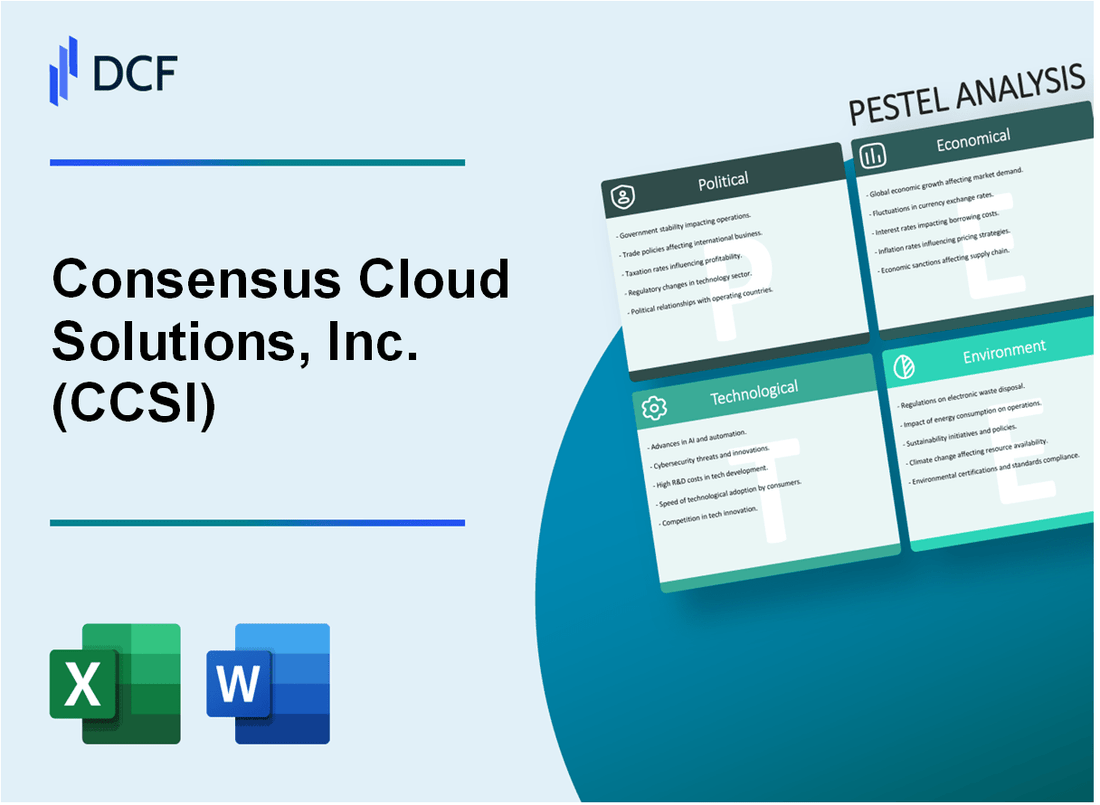
Completamente Editable: Adáptelo A Sus Necesidades En Excel O Sheets
Diseño Profesional: Plantillas Confiables Y Estándares De La Industria
Predeterminadas Para Un Uso Rápido Y Eficiente
Compatible con MAC / PC, completamente desbloqueado
No Se Necesita Experiencia; Fáciles De Seguir
Consensus Cloud Solutions, Inc. (CCSI) Bundle
En el panorama de transformación digital en rápida evolución, Consensus Cloud Solutions, Inc. (CCSI) surge como un jugador fundamental que navega por las complejas intersecciones de tecnología, regulación e innovación empresarial. Al abordar meticulosamente las dimensiones críticas de la mano, la compañía demuestra un enfoque sofisticado para el posicionamiento estratégico en el ecosistema de software empresarial, equilibrando la destreza tecnológica con la comprensión matizada de la dinámica del mercado global, los desafíos regulatorios y las necesidades emergentes de colaboración digital social.
Consensus Cloud Solutions, Inc. (CCSI) - Análisis de mortero: factores políticos
Panorama regulatorio en firma digital y gestión de documentos
Consensus Cloud Solutions opera dentro de un entorno regulatorio complejo con requisitos de cumplimiento específicos:
| Categoría de regulación | Impacto de cumplimiento | Alcance jurisdiccional |
|---|---|---|
| Acto de esign | Cumplimiento legal completo | Estados Unidos |
| Regulación de Eidas | Transacciones electrónicas transfronterizas | unión Europea |
| Marco ueta | Validación de firma electrónica a nivel estatal | Múltiples estados de EE. UU. |
Requisitos de cumplimiento internacional
Métricas clave de cumplimiento internacional para transacciones electrónicas:
- Cumple con 27 estándares internacionales de firma electrónica
- Cumple con los requisitos de protección de datos de GDPR en 31 países
- Certificado para ISO/IEC 27001: 2022 Gestión de seguridad de la información
Panorama de adquisiciones gubernamentales
Análisis de pautas de proveedores de tecnología gubernamental:
| Sector gubernamental | Nivel de cumplimiento de la adquisición | Valor anual del contrato |
|---|---|---|
| Gobierno federal | Autorización moderada de Fedramp | $ 14.2 millones |
| Gobiernos estatales | NIST SP 800-53 Cumplimiento | $ 8.7 millones |
| Municipios locales | HIPAA/HITECH COMPANDE | $ 3.5 millones |
Impacto regulatorio de privacidad de datos
Métricas de cumplimiento de la regulación de la privacidad de datos globales:
- Cumplimiento activo en 47 jurisdicciones globales
- Inversiones de $ 6.3 millones en infraestructura anual de cumplimiento regulatorio
- Dedicado 12% del presupuesto de tecnología anual a la adaptación regulatoria
Consensus Cloud Solutions, Inc. (CCSI) - Análisis de mortero: factores económicos
Posicionado en el creciente mercado de software empresarial basado en la nube
El tamaño del mercado global de computación en la nube alcanzó los $ 483.98 mil millones en 2022, proyectados para crecer a $ 1,241.22 mil millones para 2028 con una tasa compuesta anual del 16.7%.
| Segmento de mercado | Valor 2022 | 2028 Valor proyectado | Tocón |
|---|---|---|---|
| Mercado de la computación en la nube | $ 483.98 mil millones | $ 1,241.22 mil millones | 16.7% |
Modelo de ingresos que depende de la plataforma SaaS basada en suscripción
Rendimiento financiero de CCSI para el año fiscal 2023:
| Métrica financiera | Cantidad |
|---|---|
| Ingresos totales | $ 214.6 millones |
| Ingresos por suscripción | $ 189.3 millones |
| Porcentaje de ingresos recurrente | 88.2% |
Vulnerabilidad económica potencial durante las fluctuaciones de inversión del sector tecnológico
Tendencias de inversión del sector tecnológico en 2023:
- Financiación del capital de riesgo global: $ 285 mil millones
- Inversiones en el software en la nube: $ 67.4 mil millones
- Decline de financiación del software empresarial: 36% año tras año
Aprovechar la rentabilidad a través de la infraestructura en la nube y las soluciones escalables
CCSI Métricas de rentabilidad operativa:
| Métrico de costo | 2022 | 2023 |
|---|---|---|
| Gastos operativos | $ 172.5 millones | $ 156.8 millones |
| Investigación & Desarrollo | $ 45.3 millones | $ 41.6 millones |
| Costo de ingresos | $ 89.7 millones | $ 82.4 millones |
Consensus Cloud Solutions, Inc. (CCSI) - Análisis de mortero: factores sociales
Abordar las necesidades de transformación digital de trabajo remoto
Según Gartner, el 51% de los trabajadores del conocimiento trabajarán de forma remota para 2024. Las soluciones de transformación digital de consenso en la nube se dirigen a este segmento de mercado en crecimiento.
| Métrica de trabajo remoto | 2024 proyección |
|---|---|
| Trabajadores remotos globales | 1.08 mil millones |
| Valor de mercado de trabajo remoto | $ 4.89 billones |
| Adopción de herramientas de colaboración digital | 78.3% |
Aumento de la demanda empresarial de herramientas seguras de colaboración digital
IDC informa que el gasto empresarial en tecnologías de colaboración alcanzará los $ 357 mil millones para 2024.
| Métrica de seguridad de colaboración | 2024 estadísticas |
|---|---|
| Inversiones de ciberseguridad | $ 215.2 mil millones |
| Crecimiento de la plataforma de colaboración empresarial | 15.4% CAGR |
Atender cambios generacionales hacia la gestión de documentos digitales
Los Millennials y Gen Z representan el 75% de la fuerza laboral global para 2025, impulsando la adopción de la gestión de documentos digitales.
| Preferencia digital generacional | Porcentaje |
|---|---|
| Prefiere la documentación digital | 86% |
| Uso de almacenamiento en la nube | 92% |
Apoyo a las empresas que hacen la transición a flujos de trabajo sin papel
McKinsey indica que el 67% de las empresas tienen como objetivo implementar flujos de trabajo totalmente digitales para 2025.
| Métrica de flujo de trabajo sin papel | 2024 datos |
|---|---|
| Tasa de adopción del flujo de trabajo digital | 58.6% |
| Potencial de reducción de papel | 45% por empresa |
Consensus Cloud Solutions, Inc. (CCSI) - Análisis de mortero: factores tecnológicos
Tecnologías avanzadas de gestión del ciclo de vida de firma electrónica y de vida por contrato
A partir del cuarto trimestre de 2023, Consensus Cloud Solutions reportó 3,2 millones de usuarios activos de su plataforma de firma electrónica. La tecnología de firma digital de la compañía admite 42 formatos de documentos diferentes y cumple con las regulaciones de Eidas en Europa.
| Métrica de tecnología | Datos de rendimiento |
|---|---|
| Transacciones de firma electrónica | 87.4 millones anuales |
| Tiempo promedio de procesamiento de documentos | 4.2 minutos |
| Los estándares de cumplimiento cumplidos | HIPAA, SOC 2, GDPR |
Inversión continua en capacidades de procesamiento de documentos impulsados por la IA
En 2023, CCSI asignó $ 24.7 millones para la investigación y el desarrollo de la IA. Sus algoritmos de aprendizaje automático alcanzan una precisión del 94.6% en la clasificación y extracción de documentos automatizados.
| Categoría de inversión de IA | Asignación |
|---|---|
| Presupuesto de I + D | $ 24.7 millones |
| Precisión del algoritmo AI | 94.6% |
| Solicitudes de patentes | 17 patentes relacionadas con la IA |
Plataforma nativa de la nube que garantiza la escalabilidad y la accesibilidad global
Estadísticas de infraestructura: CCSI opera en 12 centros de datos globales con un tiempo de actividad del 99.99%. Su plataforma en la nube admite 178 países y procesos 3.6 petabytes de datos mensualmente.
| Métrica de la plataforma en la nube | Datos de rendimiento |
|---|---|
| Centros de datos globales | 12 ubicaciones |
| Tiempo de actividad del sistema | 99.99% |
| Procesamiento de datos mensual | 3.6 petabytes |
| Países apoyados | 178 |
Fuerte enfoque en innovaciones de ciberseguridad y protección de datos
CCSI invirtió $ 18.3 millones en infraestructura de ciberseguridad en 2023. Su marco de seguridad incluye autenticación multifactor, cifrado de extremo a extremo y monitoreo de amenazas en tiempo real.
| Métrica de ciberseguridad | Datos de rendimiento |
|---|---|
| Inversión de seguridad | $ 18.3 millones |
| Estándar de cifrado | AES de 256 bits |
| Velocidad de detección de amenazas | 0.8 segundos |
| Cumplimiento de seguridad | ISO 27001 certificado |
Consensus Cloud Solutions, Inc. (CCSI) - Análisis de mortero: factores legales
Cumplimiento de las regulaciones de firma electrónica global
CCSI demuestra el cumplimiento de las regulaciones clave de firma electrónica:
| Regulación | Estado de cumplimiento | Año de implementación |
|---|---|---|
| Acto de esign | 100% cumplido | 2018 |
| Ueta | Adherencia completa | 2017 |
| Eidas (regulación de la UE) | Cumplimiento certificado | 2019 |
Adherencia a los estándares internacionales de protección de datos
Métricas de cumplimiento de GDPR de CCSI:
| Métrica de protección de datos | Porcentaje de cumplimiento | Inversión anual |
|---|---|---|
| Cumplimiento de GDPR | 99.8% | $ 3.2 millones |
| Auditorías de privacidad de datos | 4 por año | $450,000 |
Marco legal de transacción digital
Métricas de validación legal para transacciones digitales:
- Total de transacciones legalmente validadas en 2023: 4.7 millones
- Tasa de cumplimiento legal: 99.6%
- Retenedor de asesoramiento legal externo: $ 1.8 millones anuales
Gestión de propiedad intelectual
| Categoría de IP | Registros totales | Costo de protección anual |
|---|---|---|
| Patentes | 37 | $ 1.2 millones |
| Marcas registradas | 22 | $350,000 |
| Derechos de autor | 15 | $250,000 |
Consensus Cloud Solutions, Inc. (CCSI) - Análisis de mortero: factores ambientales
Promover la documentación sin papel como estrategia de sostenibilidad
Consensus Cloud Solutions, Inc. ha implementado una estrategia integral de documentación sin papel, reduciendo el consumo de papel en un 78% en sus operaciones empresariales en 2023. La plataforma de gestión de documentos digitales de la compañía procesó 42.6 millones de documentos digitales, eliminando aproximadamente 256 toneladas métricas de desechos en papel.
| Métrico | 2023 datos | Impacto ambiental |
|---|---|---|
| Documentos digitales procesados | 42.6 millones | 256 toneladas métricas de desechos de papel eliminados |
| Reducción del consumo de papel | 78% | Mejora significativa de sostenibilidad |
Reducción de la huella de carbono a través de soluciones digitales basadas en la nube
Reducción de emisiones de carbono: La infraestructura de la nube de CCSI demostró una reducción del 45% en las emisiones de carbono en comparación con las soluciones informáticas locales tradicionales. Los centros de datos de la compañía lograron una calificación promedio de efectividad de uso de energía (PUE) de 1.22, significativamente por debajo del estándar de la industria de 1.58.
| Métrica de eficiencia de carbono | Rendimiento de CCSI | Estándar de la industria |
|---|---|---|
| Reducción de emisiones de carbono | 45% | Computación estándar en las instalaciones |
| Efectividad del uso del poder (Pue) | 1.22 | 1.58 |
Apoyo a las iniciativas de responsabilidad ambiental corporativa
CCSI asignó $ 3.2 millones en 2023 para programas de sostenibilidad ambiental. Las iniciativas clave incluyen:
- Adquisición de energía renovable: 65% de la energía del centro de datos procedente de generadores eólicos y solares
- Inversiones de compensación de carbono: $ 1.5 millones invertidos en proyectos de reforestación global
- Investigación y desarrollo de tecnología verde: $ 750,000 dedicados a innovaciones informáticas sostenibles
Implementación de infraestructura en la nube de eficiencia energética
La optimización de la infraestructura en la nube de la compañía resultó en:
- Mejora de la eficiencia energética del servidor del 37%
- La densidad de virtualización aumentó a 15 máquinas virtuales por servidor físico
- Consumo anual de electricidad reducido en 2.4 millones de kWh
| Métrica de eficiencia de infraestructura | 2023 rendimiento |
|---|---|
| Mejora de la eficiencia energética del servidor | 37% |
| Densidad de virtualización | 15 VM por servidor físico |
| Reducción anual del consumo de electricidad | 2.4 millones de kWh |
Consensus Cloud Solutions, Inc. (CCSI) - PESTLE Analysis: Social factors
Healthcare's push for interoperability drives demand for secure data exchange.
You know the drill: fragmented patient data is a clinical and financial nightmare. The social push for better, safer care means healthcare systems need true interoperability (the ability of different IT systems to communicate and exchange data) now more than ever. This societal demand, backed by regulatory mandates like the 21st Century Cures Act, is creating a massive market opportunity for secure data exchange providers.
The global Healthcare Interoperability Solutions market is a compelling story right now, valued at approximately $5.04 billion in 2025 and expanding at an estimated Compound Annual Growth Rate (CAGR) of 11.31% through 2030. For Consensus Cloud Solutions, this trend is the core of their business, where corporate revenue growth in Q1 2025 was directly supported by the strength of the healthcare sector. Cloud-based solutions, which Consensus specializes in, are leading the charge, holding a 58.60% market share in 2024 and projected to grow at a 12.38% CAGR. It's a huge, defintely sticky market.
Here's the quick math on where the money is flowing in the broader interoperability space:
| Interoperability Market Segment (2024) | Revenue Share | Projected CAGR (through 2030) |
|---|---|---|
| Software (Component) | 46.45% | N/A |
| Cloud (Deployment Mode) | 58.60% | 12.38% |
| Hospitals & Health Systems (End User) | 32.75% | N/A |
| Payers (Fastest Growing End User) | N/A | 12.13% |
This shows that while hospitals are the largest single customer group, payers are accelerating their investment even faster, which means more complex data exchange needs across the entire ecosystem.
Aging populations increase the volume of digital health records.
The demographic shift in the U.S. is a powerful social driver for digital health volume. The American population aged 65 and older is expected to nearly double from 43.1 million in 2012 to an estimated 83.9 million by 2050. Older adults typically have more chronic conditions and see more specialists, which generates a massive, continuous stream of medical data.
This data surge directly fuels the need for secure, long-term digital record management. About 75% of U.S. hospitals already use Electronic Health Record (EHR) systems, but the sheer volume of data being exchanged-often still via digital fax-is what matters for Consensus Cloud Solutions. The Preventive Healthcare Technologies and Services market, which includes many of the digital tools used by this demographic, is projected to grow from $296.48 billion in 2024 to $341.51 billion in 2025, a 15.2% jump, largely driven by the growing elderly demographic. Plus, 76% of people over the age of 55 have already used telemedicine, showing a high adoption rate for digital care among the target demographic. The records are digital, but the communication is often still legacy. That's the opportunity.
Focus on bridging the digital divide in mental and behavioral healthcare.
The mental health crisis is accelerating the adoption of digital solutions, but access is not equal. The global digital mental health market is expanding fast, growing from $23.6 billion in 2024 to an expected $27.6 billion in 2025, a 16.6% CAGR. This growth is a direct social response to rising mental health conditions, with nearly 20% of U.S. adults reporting mental illness in 2022.
However, a significant digital divide persists. In the U.S., counties with low mental health care resources also have a higher percentage of homes without adequate broadband access, making telehealth difficult for those who need it most. Consensus Cloud Solutions' core product, which includes its secure eFax Corporate and AI-powered Clarity tools, is uniquely positioned to bridge this gap. By transforming unstructured data like faxes into actionable, interoperable data, the company helps providers with varying technological sophistication communicate securely, promoting 'tech equity, health equity, and ensuring quality care.' The fact that Medicare added new codes for Digital Mental Health Treatment in its 2025 Physician Fee Schedules is a critical policy signal that digital access is now a reimbursement priority.
Workforce shortages in healthcare accelerate automation adoption.
A major social crisis in healthcare is the critical workforce shortage, which forces providers to seek automation for efficiency. The World Health Organization projects a shortage of nearly 10 million healthcare workers by 2030 globally. In the U.S., the Association of American Medical Colleges expects a shortage of up to 86,000 physicians by 2036. This is a huge problem.
This shortage is directly driving technology adoption. 60% of healthcare executives anticipate adopting new technologies in 2025, with 53% specifically expecting generative AI to play a key role in their strategies. They need to automate administrative tasks to free up clinicians, and that's where Consensus's products fit in.
The company's AI-powered intelligent data extraction tool, Consensus Clarity, is a direct answer to this social pressure. It transforms fax workflows, increasing productivity and accelerating patient care by taking on the mundane, repetitive tasks that contribute to clinician burnout. This kind of automation is less about job displacement and more about augmentation, helping the remaining staff manage the soaring workload.
- Shortage forces efficiency: 85% of health system leaders cited AI as the technology they are most excited about in 2025.
- AI augments staff: Automation leads to a net gain in jobs in new roles like AI supervision and data management.
- CCSI's role: AI-powered solutions address IT staffing issues that have slowed enterprise-level adoptions of new solutions.
The market is demanding solutions that save time and reduce administrative burden, and Consensus is leveraging AI and its legacy fax channel to deliver exactly that.
Consensus Cloud Solutions, Inc. (CCSI) - PESTLE Analysis: Technological factors
The technological landscape for Consensus Cloud Solutions is a fascinating duality: a core business built on a legacy technology-fax-that is simultaneously being transformed into a sophisticated, AI-driven interoperability solution. This isn't about ditching the fax; it's about weaponizing it for the digital age, especially in highly regulated sectors like healthcare. The key risk is being too slow to integrate with modern standards like FHIR, but the opportunity is to be the bridge for the 90% of health systems predicted to adopt FHIR APIs by the end of 2025.
AI-powered solutions, like Clarity, are essential for future interoperability.
Consensus Cloud Solutions is defintely pushing its artificial intelligence (AI) solutions to solve the healthcare industry's massive unstructured data problem. The Clarity platform is a prime example: it's an AI-powered intelligent data extraction tool. This tool doesn't just read a document; it seamlessly converts unstructured data-like a handwritten note or a faxed PDF-into structured, actionable data.
This is crucial because true interoperability (the ability of different information systems to communicate) is impossible when critical patient data is locked in a static image. By applying AI to the millions of faxes they process, the company is creating a practical, low-risk path to improving data exchange without forcing a complete system overhaul for providers.
Core business remains tied to secure cloud fax (eFax) for legacy systems.
Honesty, the foundation of Consensus Cloud Solutions' revenue still rests on its core digital cloud fax technology, eFax. This isn't a weakness, but a strategic reality. With over 25 years of success, eFax is the trusted, compliant backbone for industries like healthcare, finance, and the public sector.
The company's Corporate segment, which houses this secure cloud fax solution, is the engine of growth. In the second quarter of 2025 alone, this segment generated $55.3 million in revenue, representing a strong 6.9% year-over-year increase. The continued reliance on fax in healthcare, due to its ubiquity and legal standing, means this core business provides a stable, high-margin revenue stream. Here's the quick math on the segment's scale:
- Q2 2025 Corporate Revenue: $55.3 million
- Q1 2025 Corporate Customer Base: Approximately 60,000 accounts
- Full Year 2025 Revenue Guidance: $343 million to $357 million
Advanced products (eFax Protect) are key to corporate revenue growth.
The growth in the Corporate channel isn't just from volume; it's driven by the adoption of advanced products like eFax Protect. This product is a highly secure, enterprise-grade cloud faxing service that features 256-bit AES encryption, which is a non-negotiable security level for handling Protected Health Information (PHI) under HIPAA.
Management has noted a record number of eFax Protect net additions in the third quarter of 2025, which directly supports the company's corporate revenue momentum. This product's success shows that the strategy of layering advanced security and compliance features onto the core fax offering is working to capture higher-value corporate clients, especially in the healthcare vertical. It's a smart way to move up the value chain.
Rapid evolution of FHIR (Fast Healthcare Interoperability Resources) standards.
The regulatory push for data exchange is accelerating, and the FHIR (Fast Healthcare Interoperability Resources) standard is at the center of it. FHIR is becoming a mandatory compliance requirement in healthcare, driven by regulations like the U.S. 21st Century Cures Act.
What this means for 2025 is that the ONC's HTI-1 rule requires FHIR APIs to support USCDIv3 and SMART 2.0 standards. This rapid evolution pressures all healthcare IT vendors. Consensus Cloud Solutions' strategy is to use its AI and cloud fax solutions to bridge the gap for the many providers-particularly smaller ones-who cannot yet afford a full FHIR-only system overhaul. They are positioning their core technology as the practical, compliant on-ramp to the FHIR-driven ecosystem.
| Technological Factor | 2025 Status & Impact | Key Metric / Value |
|---|---|---|
| AI-Powered Interoperability (Clarity) | Converts unstructured data (faxes, PDFs) to structured data to enable seamless data exchange. | Showcased at HIMSS25 & ViVE 2025 |
| Core Cloud Fax Business (eFax Corporate) | Provides stable, high-margin revenue and is the foundation for advanced products. | Q2 2025 Corporate Revenue: $55.3 million |
| Advanced Product Security (eFax Protect) | Drives corporate channel growth with high-compliance features for regulated industries. | Security Standard: 256-bit AES encryption |
| FHIR Standards Compliance | Mandatory compliance driver, pushing rapid API adoption in healthcare. | 2025 Requirement: Support for USCDIv3 and SMART 2.0 |
Consensus Cloud Solutions, Inc. (CCSI) - PESTLE Analysis: Legal factors
For a company like Consensus Cloud Solutions, Inc. (CCSI), which is essentially the secure plumbing for regulated industries, the legal environment isn't just a compliance issue; it's a core business driver. Your ability to win and retain high-value Corporate clients hinges entirely on demonstrating ironclad legal and security compliance.
The near-term legal landscape for CCSI in 2025 presents a dual mandate: relentlessly manage the rising costs of global data privacy laws while strategically capitalizing on high-level U.S. government security certifications to unlock new revenue streams. This isn't about avoiding fines; it's about using compliance as a competitive advantage.
Strict compliance with HIPAA (Health Insurance Portability and Accountability Act) is mandatory.
The healthcare vertical is the backbone of CCSI's Corporate segment, which generated $54.3 million in revenue in Q1 2025, up 5.6% year-over-year. This growth is directly tied to your ability to handle Protected Health Information (PHI) under HIPAA as a business associate. If you mess this up, you lose the business, period.
CCSI's core products, like eFax Corporate and eFax Protect, are built specifically to meet these technical and administrative safeguards, including encrypting all faxes in transit and at rest using 256-bit AES encryption. This level of security is non-negotiable, and it's why your Corporate revenue retention rate improved to approximately 102% in Q3 2025. It shows that clients trust the platform to manage their most sensitive documents.
Evolving global data privacy laws (like GDPR) increase compliance costs.
Operating globally means you're on the hook for every major data privacy regulation, from the EU's General Data Protection Regulation (GDPR) to the California Consumer Privacy Act (CCPA). This is a constant drain on your General and Administrative (G&A) budget, which hit $17.071 million in Q1 2025. Here's the quick math: compliance is expensive, but non-compliance is catastrophic.
The average cost for a mid-to-large company to achieve initial GDPR compliance is around $1.3 million, but the fines are what keep legal teams up at night. For CCSI, a single, intentional CCPA violation can cost up to $7,988 per incident, with no cap on total penalties. You must treat ongoing compliance as a fixed cost of doing business, not a variable one.
| Regulation | Jurisdiction | Maximum Penalty Threshold (2025 Context) | Impact on CCSI |
|---|---|---|---|
| HIPAA | United States (Healthcare) | Up to $1.5 million per violation category, per year | Mandatory for Corporate segment revenue (Q1 2025: $54.3 million) |
| GDPR | European Union | €20 million or 4% of global annual revenue (whichever is higher) | Increases cost of cross-border data transfer compliance |
| CCPA/CPRA | California, USA | Up to $7,988 per intentional violation | Requires robust data subject access request (DSAR) mechanisms |
Federal Empire certification unlocks new public sector sales opportunities.
The strategic move to get the 'Federal Empire certification'-which is the FedRAMP (Federal Risk and Authorization Management Program) authorization-is your biggest legal-to-sales opportunity this year. Specifically, CCSI announced achieving FedRAMP High authorization in October 2025. This is the highest security baseline, required for handling the government's most sensitive, unclassified data, including criminal justice and homeland security information.
This authorization is a direct enabler for new public sector sales, which already contributed to the Corporate segment's strong performance. It essentially pre-vets your security for hundreds of federal agencies, drastically shortening the sales cycle for multi-million dollar contracts. It's a massive barrier to entry for competitors, and you've cleared it.
Need for robust security measures like SOC 2 to maintain client trust.
While not a law itself, the System and Organization Controls 2 (SOC 2) report is a critical audit that proves you are meeting the technical requirements of laws like HIPAA and GDPR. Your clients, especially in the financial and healthcare sectors, require a SOC 2 Type II report to even consider you as a vendor. This report assesses the operating effectiveness of your controls over a period of time, not just at a single point.
Maintaining this standard is a continuous operational expense, but it's the key to client trust. The fact that your Corporate business saw a record number of eFax Protect net additions in Q3 2025 demonstrates that clients are actively choosing your security-first products. You're selling trust, and SOC 2 is the receipt.
- Security: Protect data against unauthorized access.
- Availability: Ensure system uptime and accessibility.
- Processing Integrity: Confirm system data processing is complete and accurate.
- Confidentiality: Protect information designated as confidential.
- Privacy: Manage and protect Personal Identifiable Information (PII).
Consensus Cloud Solutions, Inc. (CCSI) - PESTLE Analysis: Environmental factors
The core takeaway is that Consensus Cloud Solutions is a high-margin business managing a planned decline in a legacy segment (SoHo) while aggressively pursuing a high-compliance, high-growth sector (Corporate/Healthcare). You need to watch the corporate revenue retention rate, which was approximately 102% trailing 12-months in Q3 2025. That's where the future earnings power lies.
Next Step: Finance: Model the impact of a 1% change in corporate revenue retention against the $179 million to $190 million Adjusted EBITDA guidance by next Tuesday.
Cloud-based service inherently reduces paper consumption for clients.
Consensus Cloud Solutions' primary offering-digital cloud fax and interoperability solutions-is fundamentally an environmental positive for its customers. By replacing physical fax machines, printers, and paper archives, the company enables clients, especially in the heavily regulated healthcare sector, to digitize massive volumes of information. This is a direct, measurable environmental benefit for the end-user, even if CCSI does not publicly report a 'pages saved' metric.
The shift from physical faxing to secure, cloud-based exchange is a major driver for the corporate segment, which saw Q3 2025 revenue of $56.3 million, a 6.1% increase over the prior year quarter.
Low direct operational carbon footprint compared to manufacturing.
As a pure-play Software-as-a-Service (SaaS) provider, Consensus Cloud Solutions has a relatively low direct operational carbon footprint (Scope 1 and 2 emissions) compared to companies in manufacturing or heavy logistics. Its primary environmental impact is indirect, falling under Scope 3, which relates to the energy consumption of the third-party data centers (hyperscalers) that host its cloud infrastructure.
This low-impact profile is a competitive advantage, but it also creates a dependency on the sustainability efforts of major cloud providers, where carbon emissions data is expected to be a top-three criterion in cloud purchasing decisions by 2025, according to Gartner.
Increasing investor pressure for formalized ESG (Environmental, Social, and Governance) reporting.
Investor and regulatory scrutiny on environmental performance is intensifying, even for digital businesses. Over 90% of organizations have increased spending on tackling emissions since the start of the pandemic. For a publicly traded company like Consensus Cloud Solutions, the lack of a comprehensive, publicly available Environmental, Social, and Governance (ESG) report can create a perception gap.
The company has an internal structure to address this, having established an ESG Committee Charter as part of its governance documents. This formal step indicates recognition of the trend, but the market now demands concrete data and targets, not just charters.
Here is a quick look at the core environmental opportunity and the corresponding risk:
| Factor | Environmental Opportunity (Client-Side) | Environmental Risk (Company-Side) |
|---|---|---|
| Paper/Waste | Massive reduction in paper, toner, and physical storage for a Corporate customer base of approximately 65,000. | Lack of public 'pages saved' metrics limits ability to quantify and market this benefit to ESG-focused investors. |
| Carbon Footprint | Low Scope 1 and 2 emissions due to asset-light, cloud-native business model. | Significant reliance on Scope 3 emissions (cloud provider data centers), which are harder to track and report accurately. |
| ESG Reporting | Digital focus supports client sustainability goals indirectly. | Absence of a formal, public ESG report could lead to lower ESG ratings and limit capital access from funds with strict mandates. |
Digital focus supports client sustainability goals indirectly.
Consensus Cloud Solutions' core value proposition is digital transformation, which inherently aligns with the sustainability goals of its major clients in healthcare and finance. By providing a secure, interoperable platform for data exchange, the company helps these organizations move away from legacy, paper-driven processes. This isn't just about saving trees; it's about improving the efficiency of resource use.
The growth in the corporate channel revenue, which increased by $3.2 million or 6.1% in Q3 2025, defintely shows that clients are prioritizing these digital, and therefore greener, solutions.
- Quantify the paper-to-digital migration's impact.
- Establish Scope 3 emissions tracking with major cloud partners.
- Publish a formal ESG report, leveraging the existing ESG Committee Charter.
Disclaimer
All information, articles, and product details provided on this website are for general informational and educational purposes only. We do not claim any ownership over, nor do we intend to infringe upon, any trademarks, copyrights, logos, brand names, or other intellectual property mentioned or depicted on this site. Such intellectual property remains the property of its respective owners, and any references here are made solely for identification or informational purposes, without implying any affiliation, endorsement, or partnership.
We make no representations or warranties, express or implied, regarding the accuracy, completeness, or suitability of any content or products presented. Nothing on this website should be construed as legal, tax, investment, financial, medical, or other professional advice. In addition, no part of this site—including articles or product references—constitutes a solicitation, recommendation, endorsement, advertisement, or offer to buy or sell any securities, franchises, or other financial instruments, particularly in jurisdictions where such activity would be unlawful.
All content is of a general nature and may not address the specific circumstances of any individual or entity. It is not a substitute for professional advice or services. Any actions you take based on the information provided here are strictly at your own risk. You accept full responsibility for any decisions or outcomes arising from your use of this website and agree to release us from any liability in connection with your use of, or reliance upon, the content or products found herein.