

|
Chegg, Inc. (CHGG): Análisis de la Matriz ANSOFF [Actualizado en enero de 2025] |
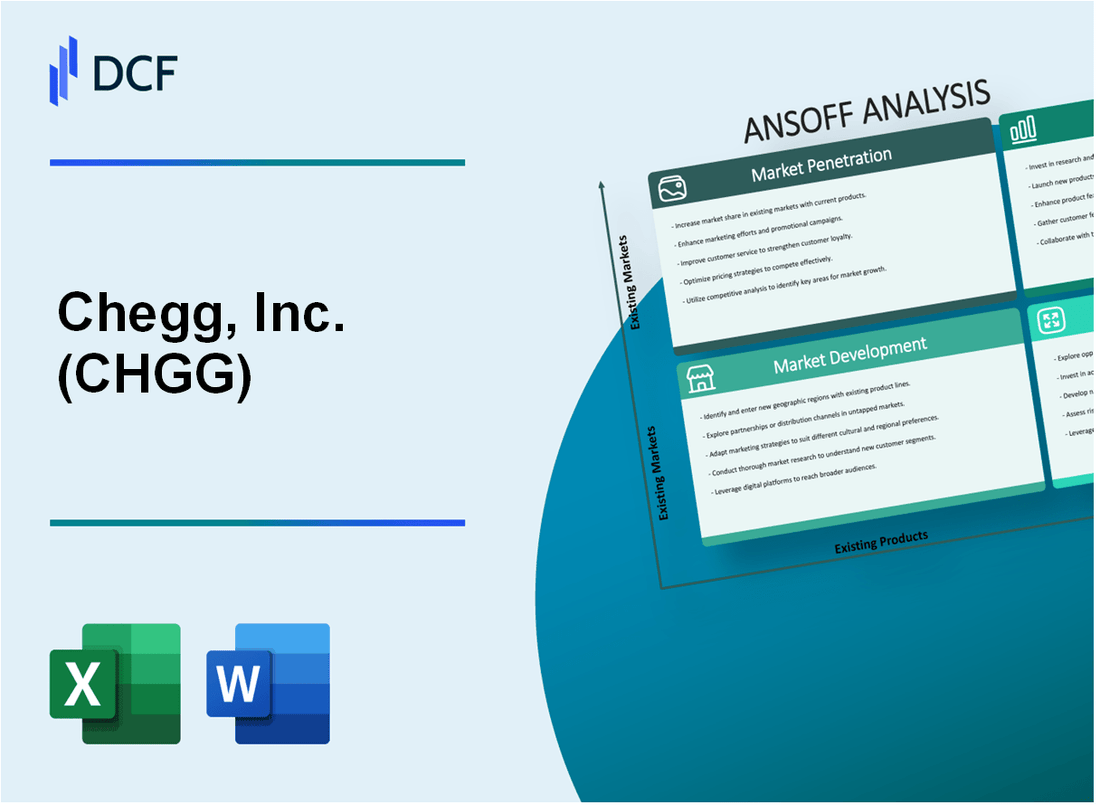
Completamente Editable: Adáptelo A Sus Necesidades En Excel O Sheets
Diseño Profesional: Plantillas Confiables Y Estándares De La Industria
Predeterminadas Para Un Uso Rápido Y Eficiente
Compatible con MAC / PC, completamente desbloqueado
No Se Necesita Experiencia; Fáciles De Seguir
Chegg, Inc. (CHGG) Bundle
En el panorama de educación digital en rápida evolución, Chegg, Inc. se encuentra en la encrucijada de la innovación y el crecimiento estratégico, trazando meticulosamente un curso a través de la compleja matriz Ansoff. Al aprovechar las tecnologías de vanguardia, las estrategias de mercado específicas y un enfoque implacable en las necesidades de los estudiantes, la compañía está preparada para transformar el aprendizaje en línea, ampliando su alcance de las aulas de la escuela secundaria a plataformas de desarrollo profesional global. Esta hoja de ruta estratégica revela una visión audaz del empoderamiento educativo, que promete redefinir cómo los estudiantes y los profesionales adquieren conocimiento en la era digital.
Chegg, Inc. (CHGG) - Ansoff Matrix: Penetración del mercado
Expandir las ofertas de suscripción digital
A partir del cuarto trimestre de 2022, Chegg reportó 4,7 millones de suscriptores, con una disminución año tras año. Los ingresos por suscripción digital fueron de $ 64.4 millones en el cuarto trimestre de 2022.
| Métrico | Valor | Año |
|---|---|---|
| Suscriptores totales | 4.7 millones | 2022 |
| Ingresos de suscripción digital | $ 64.4 millones | P4 2022 |
Implementar campañas de marketing dirigidas
Chegg gastó $ 69.8 millones en ventas y marketing en el cuarto trimestre de 2022, lo que representa el 43.9% de los ingresos totales.
Desarrollar estrategias de precios competitivas
Los ingresos promedio de Chegg por suscriptor fueron de $ 14.87 en el cuarto trimestre de 2022.
Mejorar la experiencia del usuario
La tasa de rotación del cliente fue de aproximadamente el 22% en 2022.
| Métrica de experiencia del usuario | Valor |
|---|---|
| Tasa de rotación de clientes | 22% |
| Gasto de ventas y marketing | $ 69.8 millones |
Aumentar las oportunidades de venta cruzada
Los ingresos totales de Chegg en el cuarto trimestre de 2022 fueron de $ 158.4 millones, con ingresos por servicios en $ 114.8 millones.
- Ingresos de servicios: $ 114.8 millones
- Ingresos totales: $ 158.4 millones
- Ingresos promedio por suscriptor: $ 14.87
Chegg, Inc. (CHGG) - Ansoff Matrix: Desarrollo del mercado
Expandir la presencia internacional
A partir de 2022, Chegg operaba en múltiples países con 3,7 millones de suscriptores. Los ingresos internacionales alcanzaron $ 48.2 millones en el cuarto trimestre de 2022, lo que representa el 15.4% de los ingresos totales.
| País | Población estudiantil | Penetración de educación digital |
|---|---|---|
| Canadá | 2.1 millones | 68% |
| Reino Unido | 2.5 millones | 72% |
| Australia | 1.6 millones | 65% |
Dirigir segmentos educativos adicionales
Tamaño del mercado de certificación profesional estimado en $ 13.2 mil millones en 2022. Los segmentos de expansión potenciales de Chegg incluyen:
- Capacitación de certificación de TI
- Desarrollo de habilidades profesionales
- Plataformas de educación continua
Desarrollar contenido localizado
Inversión de localización: $ 6.3 millones en 2022 para la adaptación de contenido en los mercados internacionales.
| Idioma | Costo de adaptación de contenido | Tamaño del mercado objetivo |
|---|---|---|
| Español | $ 1.2 millones | 12.5 millones de estudiantes |
| Francés | $ 1.5 millones | 8.3 millones de estudiantes |
Asociaciones de la Universidad Global
Asociaciones universitarias mundiales actuales: 127 instituciones en 14 países.
Exploración del mercado emergente
Crecimiento del mercado de la educación digital en los mercados emergentes: 22.5% CAGR de 2022-2027. Los mercados objetivo incluyen países de India, Brasil y el sudeste asiático.
| Mercado emergente | Población estudiantil | Tasa de crecimiento de la educación digital |
|---|---|---|
| India | 37.4 millones | 28% |
| Brasil | 8.3 millones | 19.5% |
Chegg, Inc. (CHGG) - Ansoff Matrix: Desarrollo de productos
Desarrollar herramientas de asistencia de aprendizaje y tutoría con alimentación de IA
Chegg invirtió $ 40.7 millones en gastos de I + D en 2022. La plataforma Chegg Tutors atiende a 1,8 millones de usuarios activos. La plataforma de estudio de Chegg con IA respondió 76.3 millones de preguntas de los estudiantes en 2022.
| Herramienta AI | Compromiso de usuario | Costo anual |
|---|---|---|
| Estudio de Chegg | 1.5 millones de suscriptores | $ 14.99/mes |
| Herramientas de escritura de Chegg | 750,000 usuarios activos | $ 9.95/mes |
Crear recursos de aprendizaje más especializados específicos de sujeto
Chegg ofrece recursos en más de 60 disciplinas académicas. Los sujetos STEM representan el 45% de su cartera de contenido de aprendizaje.
- Los recursos informáticos aumentaron en un 22% en 2022
- Contenido de ingeniería expandido por un 18% año tras año
- Los recursos de matemáticas crecieron en un 15%
Introducir tecnologías de aprendizaje adaptativo para personalizar las experiencias de aprendizaje de los estudiantes.
La plataforma de aprendizaje adaptativo de Chegg procesa 3.2 millones de recomendaciones de aprendizaje personalizadas por mes.
| Tecnología | Tasa de personalización | Satisfacción del usuario |
|---|---|---|
| Algoritmo de aprendizaje automático | 92% de precisión | Calificación de 4.3/5 |
Ampliar las ofertas de libros de texto digitales con contenido interactivo y multimedia
Los alquileres de libros de texto digitales alcanzaron 1.4 millones de unidades en 2022. El contenido interactivo aumentó la participación del usuario en un 37%.
Desarrollar aplicaciones de aprendizaje móvil con características y funcionalidad mejoradas
La aplicación móvil de Chegg se descargó 2.6 millones de veces en 2022. La plataforma móvil genera el 58% del tráfico total de la plataforma.
| Métricas de aplicaciones móviles | Datos 2022 |
|---|---|
| Descargas totales | 2.6 millones |
| Usuarios activos mensuales | 1.2 millones |
| Duración de la sesión promedio | 24 minutos |
Chegg, Inc. (CHGG) - Ansoff Matrix: Diversificación
Capacitación corporativa y plataformas de desarrollo de habilidades profesionales
Chegg reportó $ 198.4 millones en ingresos por servicios para el cuarto trimestre de 2022. La plataforma de desarrollo de habilidades profesionales Chegg Skills generó $ 15.2 millones en ingresos en 2022.
| Plataforma | Ingresos 2022 | Base de usuarios |
|---|---|---|
| Habilidades chegg | $ 15.2 millones | 127,000 suscriptores |
| Pensamiento | $ 8.7 millones | 45,000 alumnos |
Inversiones de inicio de edtech
Chegg invirtió $ 22.3 millones en adquisiciones de tecnología en 2022. Los gastos totales de I + D alcanzaron $ 92.1 millones para el año fiscal.
- Adquirió Mathway por $ 95 millones en 2020
- Invertido en tecnologías de aprendizaje automático
- Plataformas de aprendizaje ampliadas de IA
Servicios de preparación para la fuerza laboral
Chegg Career Services generó $ 24.6 millones en ingresos en 2022. La plataforma admite 3,2 millones de usuarios estudiantiles.
Análisis de datos para instituciones educativas
La plataforma Chegg Insights generó $ 12.5 millones en ingresos de análisis institucional en 2022.
| Servicio de análisis | Clientes institucionales | Ganancia |
|---|---|---|
| Insights Chegg | 487 universidades | $ 12.5 millones |
Preparación de pruebas en línea y asesoramiento profesional
Los servicios de preparación de pruebas en línea generaron $ 41.3 millones en ingresos para 2022. La plataforma de asesoramiento profesional alcanzó 275,000 usuarios activos.
- Ingresos de preparación de la prueba: $ 41.3 millones
- Usuarios de asesoramiento profesional: 275,000
- Precio de suscripción promedio: $ 14.95 por mes
Chegg, Inc. (CHGG) - Ansoff Matrix: Market Penetration
The focus here is on increasing market share within the existing US student base using current products and services, which includes driving deeper usage of new AI features and leveraging existing content assets.
The base for this penetration strategy is the subscriber base reported at the end of the second quarter of 2025. Chegg, Inc. had 2.6 million Subscription Services subscribers in Q2 2025, representing a 40% year-over-year decline. This base is the target for increased adoption of AI-powered features, such as the recently released Solution Scout and the AI-powered Create feature within the Practice service.
Retention efforts, which can be tied to promotional pricing strategies, show some positive signals in engagement metrics, even with subscriber contraction. The US Subscription Services Average Revenue Per User (ARPU) for Q1 2025 was $38.8, marking a 3% year-over-year increase. Furthermore, the monthly retention rate in Q2 showed improvement, increasing by 117 basis points year-over-year.
The Business-to-Institution (B2I) pilot programs represent a penetration strategy into institutional markets using existing core offerings. In Q1 2025, the program expanded from 5 pilot programs to 15 pilot programs quarter-over-quarter. The stated goal for the end of 2025 for these institutional pilots is 40.
Driving higher engagement with the existing content library is a key lever for penetration. Chegg, Inc. retains access to nearly 120 million archived expert answers. This content forms the foundation for the AI models and is a core asset for student value proposition.
Here are the key operational and financial metrics relevant to the Market Penetration strategy as of the first half of 2025:
| Metric | Period/Target | Value/Amount |
| Subscription Services Subscribers | Q2 2025 | 2.6 million |
| Subscription Services Subscribers YoY Change | Q2 2025 | -40% |
| US Subscription Services ARPU | Q1 2025 | $38.8 |
| US Subscription Services ARPU YoY Change | Q1 2025 | 3% |
| B2I Pilot Programs | Q1 2025 Actual | 15 |
| B2I Pilot Programs | 2025 Target | 40 |
| Archived Expert Answers | Current Asset Base | Nearly 120 million |
| Content Licensing Revenue | Q1 2025 | $4 million |
| Content Licensing Revenue Expectation | Q2 2025 | $7 million |
The AI-powered transformation of Chegg Study is designed to make the business more efficient to run, with the goal of generating increased cash flow to support investments in growth areas. The company reported Q2 2025 Adjusted EBITDA of $23.1 million.
The company is implementing significant cost-saving measures, expecting to achieve $45-$55 million in non-GAAP savings in 2025 from the latest restructuring, adding to savings from 2024 actions.
- Increase adoption of AI-powered Chegg Study features by the 2.6 million Q2 subscribers.
- Offer aggressive promotional pricing to retain existing US student base, evidenced by Q1 US Subscription Services ARPU of $38.8.
- Expand B2I pilot programs beyond the Q1 actual of 15 institutions, tracking to a target of 40 for 2025.
- Drive higher engagement with the existing 120 million archived expert answers.
Chegg, Inc. (CHGG) - Ansoff Matrix: Market Development
You're looking at how Chegg, Inc. (CHGG) can take its existing services, like Chegg Study, and push them into new geographic areas. This is Market Development, and the company has already signaled its intent.
Chegg, Inc. (CHGG) dedicated more resources to its international program as part of a June 2024 restructuring plan, initially targeting six countries for Chegg Study localization. This move is about taking a proven product and finding new student bases abroad. The goal is to capture growth where the current penetration is low.
The marketing spend focus should definitely follow the potential. While the core business saw retention and ARPU (Average Revenue Per User) increase YoY in Q2 2025, signaling strong unit economics when students are acquired, the Market Development strategy must look elsewhere for top-line acceleration. You need to find those regions where the initial ARPU might be lower than the US average, but the sheer volume of potential users promises a better long-term return on investment.
Scaling Busuu's language learning platform into new geographic regions outside its current core is a prime example of this strategy in action. Busuu is already a player in the \$3.2 billion global language learning market. Management reiterated an approximate \$48 million FY25 revenue target for Busuu, which is showing strong international traction, with revenue growing 15% YoY in Q2 2025. The B2B segment within Busuu saw revenue jump 39% YoY in that same quarter, indicating a strong appetite for professional language upskilling in corporate settings globally.
Monetizing the content library via new licensing deals is another angle for Market Development, as these deals often involve international content partners or distribution. This builds on a \$7 million revenue stream generated specifically from content licensing in Q2 2025, which was part of the \$15 million total Skills and Other revenue for the period. This shows a viable, albeit smaller, revenue path outside the core subscription base.
Here's a quick look at the financial context from the most recent reported quarter to frame potential investment levels for this expansion:
| Metric | Q2 2025 Actual Amount | Context/Comparison |
| Total Net Revenues | \$105.1 million | Down 36% Year-over-Year |
| Subscription Services Revenue | \$89.7 million | Down 39% Year-over-Year |
| Content Licensing Revenue | \$7 million | Part of Skills and Other Revenue |
| Busuu Revenue Growth (YoY) | 15% | Indicates success in a new market segment |
| Non-GAAP Operating Expenses | \$64 million | Down approximately 33% Year-over-Year |
The execution of this market development hinges on several moving parts, defintely:
- Localize Chegg Study for six new countries.
- Target regions where ARPU is lower but growth potential is higher.
- Scale Busuu, aiming for its \$48 million FY25 revenue target.
- Continue to build the content licensing stream beyond \$7 million quarterly.
If onboarding in these new markets takes longer than expected, churn risk rises. Finance: draft the Q3 2025 cash flow forecast update by Monday.
Chegg, Inc. (CHGG) - Ansoff Matrix: Product Development
You're hiring before product-market fit, so every new feature needs to show immediate, measurable value. Chegg, Inc. is actively pursuing Product Development by embedding generative AI across its platform and expanding its high-growth Skilling segment.
The integration of AI into the core academic offering is a direct response to user needs; the 2025 Global Student Survey showed 80% of undergraduates worldwide used GenAI for studies, but 53% were concerned about receiving inaccurate information. To address this, Chegg, Inc. launched Solution Scout, which lets students see side-by-side answers from multiple Large Language Models (LLMs) alongside Chegg's own solution. This builds on prior AI/ML integration in 2024, which cut content creation costs by over 70% and boosted Question and Answer volume by 66%, adding nearly 26 million new solutions to the archive.
For current student users, the development of new AI-related skills courses within Chegg Skills is central to the new strategy, which is positioning the company toward the skilling market valued at over $40 billion. Chegg Skilling revenues are projected to hit approximately $70 million for Full Year 2025, with a specific guidance of $18 million for the Fourth Quarter 2025, representing a 14% year-over-year increase for that quarter.
The language learning unit, Busuu, is also enhancing its features with AI. The launch of its new AI-powered speaking bites product follows a successful strategic refocus that increased the first 30-day conversion rate to paying customers by 31% and resulted in 9% year-over-year revenue growth for 2024. For the second quarter of 2025, Busuu achieved a 15% year-over-year revenue increase, and the company projected total Busuu revenue to generate $48 million in 2025.
Cross-selling Chegg Skills' workplace readiness courses to the existing academic user base is being executed through enterprise expansion. The business-to-institution program expanded from 5 pilot programs in Q1 2025 to 15 in that same quarter, with a target of 40 by year-end. This focus on enterprise and B2B channels is key to the Skilling growth vector.
Here's a look at the financial segmentation relevant to these product lines based on the latest reported data:
| Metric | Subscription Services (Academic Core) | Skills and Other (Growth Focus) |
| Q3 2025 Revenue | Not explicitly disclosed separately from Total Net Revenues of $77.7 million | Included in Total Net Revenues of $77.7 million |
| Q2 2025 Revenue | $89.7 million | $15 million |
| Q2 2025 Subscriber Count | 2.6 million | N/A |
| FY 2025 Revenue Guidance | Implied to be declining year-over-year | Approximately $70 million |
The company's overall financial performance reflects the transition, with Third Quarter 2025 Total Net Revenues at $77.7 million (a 43% decrease year-over-year) and a Non-GAAP Gross Margin of 62%. The company reported a Net Loss of $17.5 million for Q3 2025, though Adjusted EBITDA was $13.3 million.
Product development efforts are also supported by cost discipline:
- Non-GAAP Operating Expenses were reduced to $49 million in Q3 2025, down 46% year-over-year.
- Capital Expenditures for Full Year 2025 are trimmed to approximately $27 million.
- The company is on track to reduce total non-GAAP expenses to under $250 million by 2026.
The strategic shift is clear; Subscription Services revenue for Q1 2025 was $107.6 million, down 30% year-over-year, while the company secured $4 million in Q1 2025 revenue from content licensing alone, with another $7 million expected in Q2 2025.
Chegg, Inc. (CHGG) - Ansoff Matrix: Diversification
You're looking at the aggressive pivot Chegg, Inc. is making away from its core academic services and into the professional learning space. This is a clear diversification play, targeting a market that management sees as having significant upside.
The focus is squarely on the skilling market, which Chegg, Inc. estimates to be worth over $40 billion and growing. This is where the company is directing its growth investment, positioning its language learning and professional upskilling assets to capture enterprise spend.
Here's a quick look at the financial targets set for the combined Chegg Skilling unit, which bundles Busuu and Chegg Skills, as Chegg, Inc. moves toward year-end 2025:
| Metric | Target/Estimate | Period/Context |
| Total Skilling Market Size | $40 billion+ | Current Estimate |
| Chegg Skilling Full Year Revenue | Roughly $70 million | Expected for 2025 |
| Chegg Skilling Year-over-Year Growth | 14% | Expected for 2025 |
| Chegg Skilling Q4 2025 Revenue Forecast | $18 million | Q4 2025 Guidance |
| Busuu Projected Revenue | Approximately $48 million | Fiscal Year 2025 |
| Busuu Adjusted EBITDA Positive Target | Q1 2026 | Future Milestone |
Targeting corporate clients means expanding the institutional footprint. Chegg, Inc. has already seen its business-to-institution effort grow from 5 pilots in Q4 2024 to 15 pilots in Q1 2025, with a stated goal of reaching 40 by the end of 2025. This seat-based model is a key part of securing contracts for professional upskilling and AI training programs.
Busuu, the language learning segment within the overall skilling push, is showing strong B2B traction. For the first quarter of 2025, Busuu's B2B revenue specifically grew 29% year-over-year. Overall Busuu revenue growth in that same quarter was 7% year-over-year.
The company is positioning the Chegg Skilling unit as a distinct growth engine, separate from the legacy academic services which are now focused on generating cash. This unit, which includes Chegg Skills for workplace readiness and AI training, is expected to deliver that 14% year-over-year growth for 2025, contributing to the $70 million revenue expectation for the full year.
- Content licensing deals with two of the top ten technology companies generated $4 million in Q1 2025 revenue.
- An additional $7 million in content licensing revenue is expected in Q2 2025.
- The company announced a restructuring that will drive $45 million to $55 million in non-GAAP expense savings in 2025.
Disclaimer
All information, articles, and product details provided on this website are for general informational and educational purposes only. We do not claim any ownership over, nor do we intend to infringe upon, any trademarks, copyrights, logos, brand names, or other intellectual property mentioned or depicted on this site. Such intellectual property remains the property of its respective owners, and any references here are made solely for identification or informational purposes, without implying any affiliation, endorsement, or partnership.
We make no representations or warranties, express or implied, regarding the accuracy, completeness, or suitability of any content or products presented. Nothing on this website should be construed as legal, tax, investment, financial, medical, or other professional advice. In addition, no part of this site—including articles or product references—constitutes a solicitation, recommendation, endorsement, advertisement, or offer to buy or sell any securities, franchises, or other financial instruments, particularly in jurisdictions where such activity would be unlawful.
All content is of a general nature and may not address the specific circumstances of any individual or entity. It is not a substitute for professional advice or services. Any actions you take based on the information provided here are strictly at your own risk. You accept full responsibility for any decisions or outcomes arising from your use of this website and agree to release us from any liability in connection with your use of, or reliance upon, the content or products found herein.