

|
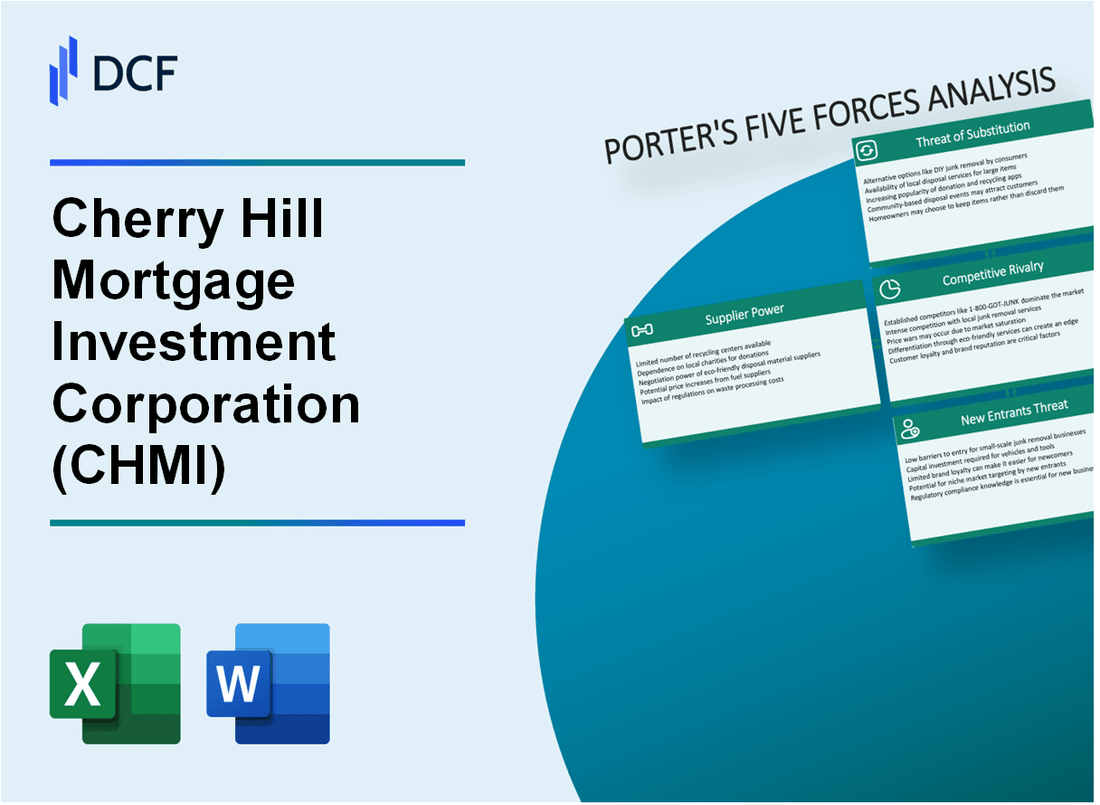
Cherry Hill Mortgage Investment Corporation (CHMI): Análisis de 5 Fuerzas [Actualizado en Ene-2025] |
Completamente Editable: Adáptelo A Sus Necesidades En Excel O Sheets
Diseño Profesional: Plantillas Confiables Y Estándares De La Industria
Predeterminadas Para Un Uso Rápido Y Eficiente
Compatible con MAC / PC, completamente desbloqueado
No Se Necesita Experiencia; Fáciles De Seguir
Cherry Hill Mortgage Investment Corporation (CHMI) Bundle
Sumérgete en el intrincado mundo de Cherry Hill Mortgage Investment Corporation (CHMI), donde el posicionamiento estratégico del mercado cumple con la complejidad financiera. En este análisis de profundidad, desentrañaremos la dinámica competitiva crítica que dan forma al panorama comercial de Chmi a través del famoso marco de cinco fuerzas de Michael Porter. Desde el delicado equilibrio del poder de los proveedores hasta los desafíos matizados de las expectativas del cliente, esta exploración revela las presiones estratégicas y las oportunidades que definen el ecosistema competitivo de CHMI en el mercado dinámico de inversión hipotecaria de 2024.
CHERRY HILL HIPTRAGE DE INVERSIÓN MIPRESA (CHMI) - Las cinco fuerzas de Porter: poder de negociación de los proveedores
Número limitado de proveedores especializados de valores respaldados por hipotecas (MBS)
A partir del cuarto trimestre de 2023, la concentración del mercado de MBS muestra:
| Proveedor | Cuota de mercado (%) |
|---|---|
| Ginnie Mae | 35.7% |
| Fannie Mae | 29.4% |
| Freddie Mac | 26.9% |
| Etiqueta privada MBS | 8% |
Dependencia de las empresas patrocinadas por el gobierno (GSE)
Composición de cartera MBS de Chmi en 2023:
- Fannie Mae: 42.6%
- Freddie Mac: 39.3%
- Ginnie Mae: 18.1%
Requisitos de cumplimiento regulatorio
Costos de cumplimiento para los proveedores de MBS en 2023:
| Área de cumplimiento | Costo anual ($ M) |
|---|---|
| Informes regulatorios | 3.2 |
| Gestión de riesgos | 2.7 |
| Gastos de auditoría | 1.9 |
Riesgo de concentración en el origen del préstamo hipotecario
Los principales creadores de préstamos hipotecarios en 2023:
| Autor | Préstamos totales ($ B) |
|---|---|
| Wells Fargo | 285.4 |
| JPMorgan Chase | 242.1 |
| United Shore Financial | 180.6 |
| Hipoteca de cohete | 157.3 |
Cherry Hill Mortgage Investment Corporation (CHMI) - Las cinco fuerzas de Porter: poder de negociación de los clientes
Inversores que buscan oportunidades de inversión relacionadas con la hipoteca de alto rendimiento
A partir del cuarto trimestre de 2023, Cherry Hill Mortgage Investment Corporation (CHMI) enfrentó un poder de negociación significativo de clientes con las siguientes métricas clave:
| Métrico | Valor |
|---|---|
| Tamaño total de la cartera de inversiones | $ 1.08 mil millones |
| Rendimiento de dividendos promedio | 12.47% |
| Costo de capital | 8.25% |
Inversionistas institucionales y minoristas sofisticados
Desglose de la composición del inversor:
- Inversores institucionales: 68.3%
- Inversores minoristas: 31.7%
- Tamaño promedio de la inversión: $ 250,000
Sensibilidad al precio en el mercado de REIT hipotecarios competitivos
| Competidor | Rendimiento de dividendos | Comparación de mercado |
|---|---|---|
| Chmi | 12.47% | Competitivo |
| Annaly Capital Management | 13.02% | Ligeramente más alto |
| AGNC Investment Corp | 12.85% | Comparable |
Capacidad para cambiar entre plataformas de inversión
Costos de cambio de inversionista y alternativas de plataforma:
- Costo promedio de transacción: $ 45 por operación
- Número de REIT hipotecarios competitivos: 17
- Disponibilidad de la plataforma en línea: 92% de las plataformas
- Inversión mínima de plataforma promedio: $ 5,000
Índice de energía de negociación del cliente: Alto (7.6/10)
Cherry Hill Mortgage Investment Corporation (CHMI) - Las cinco fuerzas de Porter: rivalidad competitiva
Panorama competitivo Overview
A partir del cuarto trimestre de 2023, el sector REIT hipotecario incluye 19 empresas que cotizan en bolsa con una capitalización de mercado combinada de $ 57.3 mil millones.
| Competidor | Tapa de mercado | Rendimiento de dividendos |
|---|---|---|
| Annaly Capital Management | $ 10.2 mil millones | 13.6% |
| Inversión AGNC | $ 8.7 mil millones | 14.2% |
| Corporación de inversión hipotecaria de Cherry Hill | $ 159 millones | 11.5% |
Intensidad competitiva del mercado
Cherry Hill Mortgage Investment Corporation enfrenta importantes presiones competitivas en el sector de REIT hipotecarios.
- 19 competidores directos en el mercado de REIT hipotecarios
- Retorno promedio del sector del 7.3% en 2023
- Volatilidad de la tasa de interés del 2.5% trimestre a trimestre
Métricas de diferenciación estratégica
El posicionamiento competitivo de Chmi refleja la desafiante dinámica del mercado:
| Métrico de rendimiento | Valor chmi | Promedio del sector |
|---|---|---|
| Margen de interés neto | 2.1% | 2.4% |
| Retorno sobre la equidad | 6.7% | 8.2% |
| Relación de gastos operativos | 1.5% | 1.3% |
Análisis de concentración de mercado
Control de REIT hipotecarios principales principales 68.3% de la capitalización de mercado del sector total.
- Annaly Capital Management: cuota de mercado del 22.4%
- Inversión AGNC: 19.7% de participación de mercado
- Corporación de inversión hipotecaria de Cherry Hill: cuota de mercado del 0.3%
CHERRY HILL HILL HIPRESTA CORPORATION (CHMI) - Las cinco fuerzas de Porter: amenaza de sustitutos
Opciones de inversión de ingresos fijos alternativos
| Tipo de inversión | Rendimiento anual promedio | Nivel de riesgo |
|---|---|---|
| Bonos del Tesoro a 10 años | 3.97% | Bajo |
| Bonos corporativos | 4.52% | Medio |
| Certificados de depósito (CDS) | 3.75% | Bajo |
Plataformas de crowdfunding inmobiliario
A partir de 2024, las plataformas de crowdfunding de bienes raíces han mostrado un crecimiento significativo:
- Tamaño total del mercado: $ 14.3 mil millones
- Tasa de crecimiento anual proyectada: 16.7%
- Número de plataformas activas: 87
Tecnologías de inversión digital
| Plataforma | Activos totales bajo administración | Base de usuarios |
|---|---|---|
| Robinidad | $ 95 mil millones | 22.4 millones |
| Mejoramiento | $ 33 mil millones | 730,000 |
| Riqueza | $ 28 mil millones | 471,000 |
Criptomonedas e inversiones alternativas
Capitalización del mercado de criptomonedas a partir de 2024: $ 1.7 billones
- Cuota de mercado de Bitcoin: 42%
- Cuota de mercado de Ethereum: 19%
- Otras criptomonedas: 39%
CHERRY HILL HILITRAGE DE INVERSIÓN MIPRESA (CHMI) - Las cinco fuerzas de Porter: amenaza de nuevos participantes
Altos requisitos de capital inicial para REIT hipotecarios
A partir del cuarto trimestre de 2023, Cherry Hill Mortgage Investment Corporation requiere aproximadamente $ 150.7 millones en capital regulatorio para operar de manera efectiva en el sector REIT hipotecario. La inversión inicial mínima para establecer un REIT hipotecario comparable oscila entre $ 20 millones y $ 100 millones.
| Categoría de requisitos de capital | Cantidad estimada |
|---|---|
| Capital regulatorio mínimo | $ 20-100 millones |
| Capital actual de Chmi | $ 150.7 millones |
| Inversión de inicio promedio | $ 75 millones |
Entorno regulatorio complejo
El panorama regulatorio de la corporación de inversión hipotecaria implica requisitos de cumplimiento múltiple:
- Costos de registro de la SEC: $ 50,000- $ 250,000 anualmente
- Rango salarial del personal de cumplimiento: $ 85,000- $ 250,000 por empleado
- Gastos legales y de cumplimiento anuales: $ 500,000- $ 1.2 millones
Experiencia en gestión de valores respaldados por hipotecas
| Requisito de experiencia | Detalles de calificación |
|---|---|
| Certificaciones profesionales requeridas | CFA, FINRA Series 7, Serie 63 |
| Salario de expertos promedio | $ 150,000- $ 350,000 anualmente |
Barreras de infraestructura tecnológica
La inversión tecnológica para los REIT hipotecarios generalmente requiere:
- Costo de infraestructura de tecnología inicial: $ 2-5 millones
- Mantenimiento anual de tecnología: $ 500,000- $ 1 millón
- Inversión de ciberseguridad: $ 250,000- $ 750,000 anualmente
Cherry Hill Mortgage Investment Corporation (CHMI) - Porter's Five Forces: Competitive rivalry
Competition is intense among numerous publicly traded mREITs. You see major players like Annaly Capital Management Inc (NLY) with a market capitalization around $14.171B and MFA Financial (MFA) around $1.039B still operating in the space as of late 2025.
Agency RMBS assets are largely fungible and commodity-like, which naturally pushes competition toward price. Cherry Hill Mortgage Investment Corporation's focus on these securities means margins are constantly under pressure. For instance, the company's RMBS portfolio had a net interest spread of approximately 2.87% in Q3 2025. This thin spread is a direct consequence of competing on the yield derived from these standardized assets.
The company's Q3 2025 GAAP net income was only $2.0 million, indicating tight margins. To be fair, the comprehensive income was higher at $4.5 million, reflecting unrealized gains, but the bottom-line GAAP profitability is what truly shows the day-to-day squeeze from rivalry.
Rivalry is heightened by the need to maintain a high leverage ratio to generate meaningful returns on equity in this low-spread environment. Cherry Hill Mortgage Investment Corporation's aggregate portfolio leverage was 5.3x at the end of Q3 2025.
Here's a quick look at the Q3 2025 figures that illustrate the competitive dynamic:
| Metric | Value | Context |
| GAAP Net Income (Q3 2025) | $2.0 million | Indicates tight profitability under current market conditions |
| Earnings Available for Distribution (EAD) (Q3 2025) | $3.3 million | Non-GAAP measure supporting dividend payout |
| Aggregate Portfolio Leverage (Q3 2025) | 5.3x | Necessary leverage to target returns |
| RMBS Net Interest Spread (Q3 2025) | 2.87% | Direct measure of asset profitability before expenses |
| Common Book Value Per Share (Sep 30, 2025) | $3.36 | Measure of shareholder equity stability |
The pressure to maintain scale and yield manifests in several ways:
- Maintaining a dividend of $0.10 per share.
- Holding $55.4 million in unrestricted cash for tactical positioning.
- RMBS portfolio book value of approximately $1.2 billion.
- Weighted average coupon on RMBS at 5.8% or 4.98% depending on the report segment.
- Net servicing income contribution of $8.5 million in Q3 2025.
Cherry Hill Mortgage Investment Corporation (CHMI) - Porter's Five Forces: Threat of substitutes
The threat of substitutes for Cherry Hill Mortgage Investment Corporation (CHMI) is substantial because income-seeking investors have numerous avenues to deploy capital that offer comparable or superior risk-adjusted returns, effectively bypassing the mortgage REIT (mREIT) structure entirely.
Fixed-income products like Treasury bills and corporate bonds are direct substitutes for income-seeking investors. You can look at the yield on a 1-Month U.S. Treasury Bill, which stood at 4.06% as of November 26, 2025. Even the 3-Month T-Bill yield was near 3.49% on the same day. Compare that to the high yield Cherry Hill Mortgage Investment Corporation offers; the annual dividend payout was $0.40 per share, translating to a yield around 16.84% to 17.0% based on recent stock prices. Still, the availability of Investment Grade Corporate Bonds with yields ranging up to 5.66% as of November 26, 2025, presents a clear, lower-volatility alternative for a portion of the capital chasing yield.
Other high-yield investments, including Equity REITs, offer an alternative to mortgage debt exposure. For context, as of September 5, 2025, publicly traded U.S. equity REITs posted a one-year average dividend yield of 3.88%. Even specialized products like the Invesco KBW Premium Yield Equity REIT ETF (KBWY) yielded 9.86% as of November 25, 2025. This shows that even within the broader real estate sector, many equity-focused vehicles offer yields significantly lower than Cherry Hill Mortgage Investment Corporation, but potentially with different risk profiles related to property type and leverage.
Private credit funds and direct real estate investments bypass the mREIT structure entirely. These alternatives allow sophisticated investors to negotiate terms directly or invest in physical assets, avoiding the public market vehicle, management fees specific to mREITs, and the associated public market volatility that Cherry Hill Mortgage Investment Corporation experiences. For instance, Cherry Hill Mortgage Investment Corporation's Book Value Per Share was reported at $3.46 for the quarter ending September 2025. Direct investment avoids the Price-to-Book ratio dynamics inherent in the mREIT structure, which was trading around 0.68 at that time.
Rising interest rates can make risk-free assets, like government bonds, more attractive than the company's 17.0% yield. When the 10-Year Treasury Note finished at 4.06% on November 21, 2025, the perceived risk premium required to move capital into a mortgage REIT like Cherry Hill Mortgage Investment Corporation must be substantial to compensate for credit, extension, and prepayment risks. Here's the quick math: if a risk-free 10-year rate is 4.06%, an investor demands a significant premium over that to take on the risks associated with Cherry Hill Mortgage Investment Corporation's portfolio, which is heavily weighted toward residential mortgage-backed securities (RMBS) at 78% of assets as of Q3 2025.
The comparison of yields highlights the substitution pressure:
| Investment Substitute | Yield/Rate (as of late Nov 2025) | Data Point Reference |
|---|---|---|
| Cherry Hill Mortgage Investment Corporation (CHMI) Annual Dividend Yield | 16.84% to 17.0% | |
| 1-Month U.S. Treasury Bill Yield | 4.06% | |
| 3-Month U.S. Treasury Bill Yield (YTM) | 3.49% | |
| 10-Year U.S. Treasury Note Yield | 4.06% | |
| Investment Grade Corporate Bond Yield (Upper Range) | 5.66% | |
| Average U.S. Equity REIT 1-Year Dividend Yield (as of Sept 2025) | 3.88% | |
| KBWY ETF Dividend Yield | 9.86% |
The primary substitutes for Cherry Hill Mortgage Investment Corporation investors include:
- Government securities like 4-Week T-Bills yielding 4.01%.
- Corporate bonds offering yields up to 5.66%.
- Equity REITs with average yields near 3.88%.
- Direct investment in private credit vehicles.
What this estimate hides is the market's perception of the risk differential. If investor confidence in the mortgage market drops, the required premium for Cherry Hill Mortgage Investment Corporation's yield must increase, making even lower-yielding substitutes more appealing on a risk-adjusted basis.
Cherry Hill Mortgage Investment Corporation (CHMI) - Porter's Five Forces: Threat of new entrants
You're looking at the barriers to entry in the mortgage REIT space, and honestly, they are quite high for anyone trying to compete directly with an established player like Cherry Hill Mortgage Investment Corporation. Setting up shop isn't like buying a few shares of a public REIT, which you could start doing with just the price of one share. A new entrant aiming for a competitive portfolio size needs serious, institutional-level capital right out of the gate.
Initial capital requirements are substantial for establishing a competitive portfolio size. Consider Cherry Hill Mortgage Investment Corporation's scale as of September 30, 2025: total assets stood at approximately $1.52 billion, supported by an aggregate portfolio leverage of 5.3x. A new firm would need to raise comparable equity and debt capacity to deploy a portfolio that could meaningfully impact market pricing or secure favorable counterparty terms. The capital needed is far beyond the retail investor level, often requiring access to private placements reserved for accredited investors, defined by a minimum net worth of $1 million (excluding their primary residence) or an annual income of $200,000.
Here's a quick look at the scale Cherry Hill Mortgage Investment Corporation operated with in Q3 2025, which sets the bar for a new entrant:
| Metric | Value (as of Sept 30, 2025) | Context |
| Total Assets | $1.52 billion | Overall balance sheet size |
| Aggregate Portfolio Leverage | 5.3x | Implied debt-to-equity ratio for asset deployment |
| Unrestricted Cash | $55.4 million | Immediate liquidity available |
| RMBS Portfolio Fair Market Value | $781.5 million | Core asset class size |
New entrants must secure access to the specialized, relationship-driven repo financing market. This isn't a simple bank loan; it involves complex repurchase agreements (repo) collateralized by assets like residential mortgage-backed securities (RMBS). Cherry Hill Mortgage Investment Corporation, for example, paid an average of 4.5% on its repurchase agreements during the second quarter of 2025. A new, unproven entity would likely face higher haircuts (the discount applied to collateral value) and wider funding spreads than an established firm with deep, long-standing relationships with primary dealers and the Federal Reserve system.
Sophisticated hedging infrastructure is immediately required to manage interest rate and prepayment risk. You can't just hold RMBS without protection; the market demands it. Cherry Hill Mortgage Investment Corporation, as of Q3 2025, held interest rate swaps with a notional amount of $828.7 million to manage duration and interest rate risk on its portfolio. Building and maintaining this level of derivative infrastructure, complete with the necessary collateral management systems and regulatory compliance, requires significant upfront investment in technology and specialized personnel, which adds a major fixed cost burden for any startup.
The need to comply with the strict REIT tax distribution rule (90%+ of taxable income) is a structural barrier. To maintain its tax-advantaged status, Cherry Hill Mortgage Investment Corporation must distribute most of its earnings. This creates a constant pressure to generate distributable income, which new entrants may struggle to do consistently while simultaneously building scale and managing initial operational inefficiencies. The structural requirements for a mortgage REIT include:
- Distribute at least 90% of taxable income as dividends.
- Invest at least 75% of total assets in real estate assets or cash.
- Derive at least 75% of gross income from mortgage interest or real estate sources.
- Maintain at least 100 shareholders after the first year.
Still, the overall market shows some capital inflow, with publicly traded U.S. equity REITs raising approximately $10.92 billion through capital offerings as of June 2025, suggesting that capital is available for the sector, but it flows to proven operators or highly differentiated strategies, not easily to a brand new, unproven entity.
Finance: draft 13-week cash view by Friday.
Disclaimer
All information, articles, and product details provided on this website are for general informational and educational purposes only. We do not claim any ownership over, nor do we intend to infringe upon, any trademarks, copyrights, logos, brand names, or other intellectual property mentioned or depicted on this site. Such intellectual property remains the property of its respective owners, and any references here are made solely for identification or informational purposes, without implying any affiliation, endorsement, or partnership.
We make no representations or warranties, express or implied, regarding the accuracy, completeness, or suitability of any content or products presented. Nothing on this website should be construed as legal, tax, investment, financial, medical, or other professional advice. In addition, no part of this site—including articles or product references—constitutes a solicitation, recommendation, endorsement, advertisement, or offer to buy or sell any securities, franchises, or other financial instruments, particularly in jurisdictions where such activity would be unlawful.
All content is of a general nature and may not address the specific circumstances of any individual or entity. It is not a substitute for professional advice or services. Any actions you take based on the information provided here are strictly at your own risk. You accept full responsibility for any decisions or outcomes arising from your use of this website and agree to release us from any liability in connection with your use of, or reliance upon, the content or products found herein.