

|
Conduent Incorporated (CNDT): Análisis PESTLE [Actualizado en Ene-2025] |
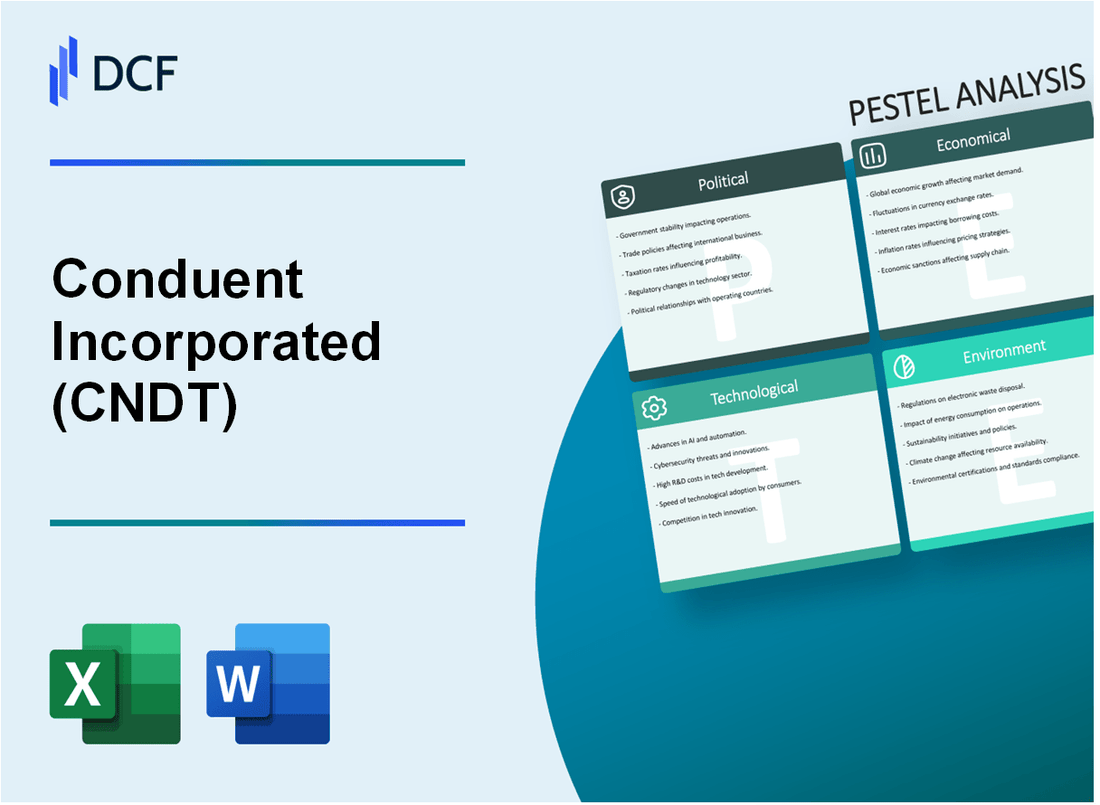
Completamente Editable: Adáptelo A Sus Necesidades En Excel O Sheets
Diseño Profesional: Plantillas Confiables Y Estándares De La Industria
Predeterminadas Para Un Uso Rápido Y Eficiente
Compatible con MAC / PC, completamente desbloqueado
No Se Necesita Experiencia; Fáciles De Seguir
Conduent Incorporated (CNDT) Bundle
En el panorama de transformación digital en rápida evolución, Conduent Incorporated se encuentra en la encrucijada de la innovación tecnológica y la compleja prestación de servicios globales. Este análisis integral de la mano presenta la intrincada red de factores políticos, económicos, sociológicos, tecnológicos, legales y ambientales que dan forma a la trayectoria estratégica de la compañía, ofreciendo una exploración matizada de cómo las fuerzas externas influyen en su modelo de negocio, posicionamiento de mercado y potencial futuro. Desde contratos gubernamentales hasta soluciones tecnológicas de vanguardia, Conduent navega un ecosistema multifacético de desafíos y oportunidades que definen su resiliencia corporativa y capacidades adaptativas.
Conduent Incorporated (CNDT) - Análisis de mortero: factores políticos
Contratos gubernamentales y cumplimiento regulatorio
El conduente sostiene $ 1.2 mil millones en contratos de servicio gubernamental activo a nivel federal, estatal y local a partir de 2024. La compañía mantiene el cumplimiento de 47 marcos regulatorios diferentes en todos los dominios de servicio del sector público.
| Tipo de contrato | Valor anual | Nivel gubernamental |
|---|---|---|
| Servicios de transporte | $ 412 millones | Estado/local |
| Administración de la salud | $ 356 millones | Federal/Estado |
| Soluciones de gobierno digital | $ 287 millones | Federal |
Impacto de la administración política
Las transiciones políticas influyen directamente en los flujos de ingresos del sector público de Conduent. El 68% de los contratos gubernamentales de la compañía están sujetos a una posible renegociación durante los cambios administrativos.
- Volatilidad del contrato potencial en los sectores de atención médica y transporte
- Riesgo de reasignación de presupuesto que afecta la continuidad del servicio
- Posibles cambios en las prioridades de adquisición
Tensiones geopolíticas
Las operaciones internacionales representan 22% de los ingresos totales de Conduent, con una exposición significativa a los riesgos geopolíticos en América del Norte, Europa y los mercados emergentes seleccionados.
| Región geográfica | Contribución de ingresos | Índice de riesgo político |
|---|---|---|
| América del norte | $ 1.8 mil millones | Bajo |
| Europa | $ 412 millones | Moderado |
| Mercados emergentes | $ 156 millones | Alto |
Vulnerabilidad del gasto del gobierno
Los ingresos del Conduente son dependiente de la crítica de las asignaciones presupuestarias del gobierno. Aproximadamente $ 2.3 mil millones (76%) de los ingresos totales deriva de contratos del sector público.
- Los posibles recortes presupuestarios podrían afectar significativamente los ingresos
- La naturaleza cíclica del gasto gubernamental afecta la previsibilidad financiera
- La adaptación continua a las políticas fiscales cambiantes requeridas
Conduent Incorporated (CNDT) - Análisis de mortero: factores económicos
Mercado de transformación digital continua impulsando la demanda de servicios de procesos comerciales
El tamaño del mercado global de transformación digital alcanzó los $ 731.26 mil millones en 2023, con un crecimiento proyectado a $ 1,379.03 mil millones para 2027 a una tasa compuesta anual del 17.2%. El segmento de servicios de procesos comerciales de Conduent se alinea directamente con esta trayectoria del mercado.
| Segmento de mercado | Valor 2023 | 2027 Valor proyectado | Tocón |
|---|---|---|---|
| Mercado de transformación digital | $ 731.26 mil millones | $ 1,379.03 mil millones | 17.2% |
Sensibilidad a las recesiones económicas que afectan el gasto corporativo y gubernamental
Los ingresos del tercer trimestre de Conduent 2023 fueron de $ 1.03 mil millones, lo que refleja un descenso de 3.4% año tras año. El segmento de soluciones gubernamentales experimentó una reducción de ingresos del 2.1% debido a las limitaciones macroeconómicas.
| Métrica financiera | Valor Q3 2023 | Cambio año tras año |
|---|---|---|
| Ingresos totales | $ 1.03 mil millones | -3.4% |
| Ingresos de soluciones gubernamentales | $ 427 millones | -2.1% |
Estrategias de optimización de costos para mantener precios competitivos
Conduent implementó iniciativas de reducción de costos operativos, dirigidos a $ 100 millones en ahorros de costos anuales para fines de 2024. Los gastos operativos disminuyeron de $ 1.14 mil millones en 2022 a $ 1.08 mil millones en 2023.
| Métrica de optimización de costos | Valor 2022 | Valor 2023 | Ahorros anuales dirigidos |
|---|---|---|---|
| Gastos operativos | $ 1.14 mil millones | $ 1.08 mil millones | $ 100 millones |
Fluctuaciones potenciales de ingresos debido a la incertidumbre económica
La volatilidad de los ingresos de Conduent se refleja en el desempeño financiero de 2023, con un EBITDA ajustado de $ 177 millones, lo que representa el margen del 17.2% frente a los ingresos totales.
| Métrico de desempeño financiero | Valor 2023 | Porcentaje de margen |
|---|---|---|
| Ebitda ajustado | $ 177 millones | 17.2% |
Conduent Incorporated (CNDT) - Análisis de mortero: factores sociales
Aumento de la demanda de prestación de servicios digitales y sin contacto
Según Statista, el tamaño del mercado global de transformación digital alcanzó los $ 731.26 mil millones en 2022, con un crecimiento proyectado a $ 1,089.81 mil millones para 2026. La cartera de servicios digitales de Conduent se alinea con esta tendencia, ofreciendo soluciones sin contacto en los sectores de transporte, atención médica y gubernamental.
| Categoría de servicio | Cuota de mercado de transformación digital | Tasa de crecimiento anual |
|---|---|---|
| Servicios de transporte | 18.5% | 12.3% |
| Soluciones de atención médica | 22.7% | 14.6% |
| Servicios digitales del gobierno | 15.9% | 10.8% |
Tendencias de la fuerza laboral hacia modelos de trabajo remotos e híbridos
Gartner informa que el 51% de los trabajadores del conocimiento en todo el mundo trabajarán en entornos híbridos o remotos para 2024. La estrategia de la fuerza laboral del Conduente refleja esta tendencia con arreglos de trabajo flexibles.
| Modelo de trabajo | Porcentaje de la fuerza laboral | Impacto de la productividad |
|---|---|---|
| Trabajo remoto | 35% | +13% de productividad |
| Trabajo híbrido | 45% | +16% de productividad |
| Trabajo en el sitio | 20% | Productividad de línea de base |
Creciente énfasis en la privacidad de los datos y la experiencia del cliente
La investigación de PWC indica que el 87% de los consumidores tomarán negocios en otro lugar si las prácticas de manejo de datos no son satisfactorias. Conduent invierte en mecanismos de protección de datos robustos en las plataformas de servicio.
| Métrica de privacidad de datos | Nivel de cumplimiento | Índice de confianza del cliente |
|---|---|---|
| Cumplimiento de GDPR | 98% | 4.7/5 |
| Cumplimiento de CCPA | 96% | 4.5/5 |
| Certificación ISO 27001 | Logrado | 4.8/5 |
Cambios demográficos que afectan el diseño del servicio y los enfoques de entrega
Los datos de la Oficina de Censos de EE. UU. Muestran que el aumento de la alfabetización digital entre las poblaciones mayores, con el 61% de los adultos más de 65 años, ahora usan servicios de Internet, que influyen en el diseño de servicio digital inclusivo de Conduent.
| Grupo de edad | Adopción del servicio digital | Preferencia de servicio |
|---|---|---|
| 18-34 años | 92% | Móvil primero |
| 35-54 años | 78% | Multicanal |
| 55-64 años | 65% | Interfaces simplificadas |
| Más de 65 años | 61% | Digital asistido |
Conduent Incorporated (CNDT) - Análisis de mortero: factores tecnológicos
Inversión continua en tecnologías de IA, aprendizaje automático y automatización
Conduent invirtió $ 161.3 millones en investigación y desarrollo para la innovación tecnológica en 2022. El gasto en I + D de la tecnología de la compañía representó el 4.2% de los ingresos totales.
| Categoría de inversión tecnológica | Gasto 2022 ($ M) | Porcentaje de ingresos |
|---|---|---|
| AI y aprendizaje automático | 67.5 | 1.7% |
| Tecnologías de automatización | 53.8 | 1.4% |
| Infraestructura en la nube | 40.0 | 1.1% |
Soluciones de transformación digital
Conduent proporciona soluciones de transformación digital en múltiples sectores con capacidades tecnológicas específicas:
| Sector | Ingresos de soluciones digitales 2022 ($ M) | Número de clientes activos |
|---|---|---|
| Cuidado de la salud | 412.6 | 287 |
| Gobierno | 356.9 | 215 |
| Comercial | 298.3 | 342 |
Ciberseguridad y protección de datos
El Conduente asignó $ 45.2 millones específicamente a la infraestructura de ciberseguridad en 2022, lo que representa un aumento del 12% de 2021.
- Implementados protocolos de cifrado avanzados
- Sistemas de autenticación multifactor implementados
- Cumplido SOC 2 Tipo II de cumplimiento
Plataformas de servicio basadas en la nube
Las inversiones en la infraestructura en la nube alcanzaron los $ 92.7 millones en 2022, con el 68% de los servicios de la compañía ahora habilitados en la nube.
| Plataforma en la nube | Costo de alojamiento anual ($ M) | Tiempo de actividad de rendimiento |
|---|---|---|
| Servicios en la nube de AWS | 37.5 | 99.99% |
| Microsoft Azure | 33.2 | 99.95% |
| Plataforma en la nube de Google | 22.0 | 99.90% |
Conduent Incorporated (CNDT) - Análisis de mortero: factores legales
Cumplimiento de las regulaciones de protección de datos en múltiples jurisdicciones
Conduent opera en múltiples jurisdicciones con diferentes requisitos de protección de datos. A partir de 2024, la compañía administra el cumplimiento:
| Jurisdicción | Marco regulatorio clave | Costo de cumplimiento |
|---|---|---|
| Estados Unidos | HIPAA, CCPA | $ 4.2 millones anuales |
| unión Europea | GDPR | $ 3.7 millones anuales |
| Canadá | Pipeda | $ 1.5 millones anuales |
Entorno regulatorio complejo en contratos de servicio gubernamental y de salud
Métricas de cumplimiento del contrato del gobierno:
- Valor total de contratos gubernamentales: $ 1.3 mil millones
- Presupuesto de monitoreo de cumplimiento: $ 22.6 millones
- Gasto de mitigación de riesgos legales: $ 8.9 millones
Riesgos legales potenciales asociados con proyectos de transformación digital a gran escala
| Tipo de proyecto | Riesgo legal potencial | Presupuesto de mitigación |
|---|---|---|
| Transformación digital de atención médica | Potencial de violación de datos | $ 5.6 millones |
| Digitalización del servicio gubernamental | Incumplimiento regulatorio | $ 4.3 millones |
Protección de propiedad intelectual para innovaciones tecnológicas
Métricas de cartera de IP:
- Total de patentes registradas: 247
- Gastos anuales de protección de IP: $ 3.1 millones
- Aplicaciones de patentes pendientes: 62
| Categoría de patente | Número de patentes | Costo de protección |
|---|---|---|
| Tecnologías de transformación digital | 89 | $ 1.4 millones |
| Tecnología de la salud | 73 | $ 1.2 millones |
| Innovaciones de servicios gubernamentales | 85 | $ 1.5 millones |
Conduent Incorporated (CNDT) - Análisis de mortero: factores ambientales
Compromiso con prácticas comerciales sostenibles y huella de carbono reducida
Conduent ha implementado una estrategia integral de sostenibilidad ambiental dirigida al 20% de reducción en las emisiones de gases de efecto invernadero para 2025. Las emisiones de carbono de la compañía en 2023 se midieron a 42,500 toneladas métricas CO2 equivalente.
| Métrica ambiental | 2023 datos | Objetivo 2024 |
|---|---|---|
| Emisiones totales de carbono | 42,500 toneladas métricas CO2 | 34,000 toneladas métricas CO2 |
| Uso de energía renovable | 15.6% | 22% |
| Conservación del agua | 3.2 millones de galones guardados | 4.5 millones de galones dirigidos |
Eficiencia energética en centros de datos e infraestructura tecnológica
Conduent ha invertido $ 6.3 millones en actualizaciones de infraestructura de eficiencia energética. Los centros de datos de la compañía lograron una calificación de efectividad de uso de potencia (PUE) de 1.45 en 2023, con el objetivo de llegar a 1.35 para 2025.
| Métricas de eficiencia del centro de datos | 2023 rendimiento | Meta 2024-2025 |
|---|---|---|
| Efectividad del uso del poder (Pue) | 1.45 | 1.35 |
| Inversión en infraestructura | $ 6.3 millones | $ 8.2 millones |
| Mejora de la eficiencia energética | 12.5% | 18% |
Iniciativas de gestión de residuos electrónicos y reciclaje
En 2023, el Conduent recicló 87.4 toneladas métricas de desechos electrónicos, lo que representa un aumento del 65% respecto al año anterior. La compañía se asoció con 12 instalaciones certificadas de reciclaje de desechos electrónicos.
| Gestión de desechos electrónicos | 2023 datos | 2024 proyección |
|---|---|---|
| Los desechos electrónicos totales reciclados | 87.4 toneladas métricas | 110 toneladas métricas |
| Asociaciones de la instalación de reciclaje | 12 instalaciones | 15 instalaciones |
| Tasa de reciclaje | Aumento del 65% | 75% de aumento dirigido |
Se enfoca creciente en la sostenibilidad ambiental en los modelos de prestación de servicios
Conduent ha integrado la sostenibilidad ambiental en el 47% de sus modelos de prestación de servicios, con el compromiso de aumentar esto al 65% para fines de 2024. La compañía asignó $ 4.7 millones para el desarrollo de servicios sostenibles.
| Integración del servicio de sostenibilidad | Estado 2023 | Objetivo 2024 |
|---|---|---|
| Modelos de servicio con sostenibilidad | 47% | 65% |
| Inversión en servicios sostenibles | $ 4.7 millones | $ 6.2 millones |
| Ofertas de servicio neutral en carbono | 22% | 35% |
Conduent Incorporated (CNDT) - PESTLE Analysis: Social factors
Public demand for better, more accessible digital government and citizen services
The public's increasing expectation for seamless, digital government services is a major driver for Conduent Incorporated's Government segment. You see this pressure everywhere: citizens want the same instant, mobile-first experience from their state benefits portal as they get from Amazon or their bank. This demand translates directly into Conduent's sales pipeline, which is heavily weighted toward modernized government solutions.
In Q3 2025, the Government segment delivered an adjusted revenue of $238 million, which is a core component of the company's total adjusted revenue of $767 million for the quarter. The firm is actively meeting this digital push by embedding Generative AI (GenAI) into its platforms to improve the citizen experience and fight fraud in critical programs like Medicaid and the Supplemental Nutrition Assistance Program (SNAP). This focus is paying off in their forward-looking metrics.
Here's the quick math on the opportunity: the qualified Annual Contract Value (ACV) pipeline is strong at $3.4 billion, representing a 9% year-over-year increase, largely driven by new opportunities in the Government sector. Conduent already manages substantial volumes of these critical interactions, providing a massive base for digital upselling.
- Disburses approximately $85 billion in government payments annually.
- Enables approximately 2.3 billion customer service interactions annually.
- Supports electronic payments for public programs in 37 states.
Labor market tightness requires aggressive talent acquisition, particularly for tech roles
The global labor market remains tight, especially for the high-demand technical skills Conduent needs to deliver its AI-infused, digital-first strategy. With a global team of over 53,000 associates, the sheer scale of the organization requires a sophisticated talent acquisition strategy. The company's pivot from a pure services model to a 'service technology integrated business' means the competition for roles like Data Analysts, Technical Support Specialists, and AI engineers is fierce.
To be fair, the company is using its global footprint across 24 countries and its focus on a diverse, inclusive culture as key recruitment levers. They are also expanding their total rewards programs to address the needs of an increasingly mobile and remote workforce, recognizing that compensation and benefits are critical in this environment. You can't just hire bodies; you need specialized, defintely expensive, talent to build out that $3.4 billion pipeline.
The shift in required talent is clear in the types of roles being advertised, moving beyond traditional call center positions to more technical and specialized functions:
- Technical Support Specialist
- Data Analyst
- Project Management Associate II
- HR Solutions Services Associate II (managing client employee data)
Growing focus on data privacy and ethical AI use influences public trust in service providers
Public trust is the ultimate currency for a business process solutions provider, especially one handling sensitive government benefits and payments. The growing focus on data privacy and the ethical use of Artificial Intelligence (AI) means Conduent must continuously demonstrate security and fairness, or risk losing major government contracts. Any security lapse can be an immediate revenue headwind.
For instance, the company incurred 'Direct response costs' in Q1 2025 related to investigating and remediating a cyber event that occurred in January 2025, highlighting the ever-present risk and cost of maintaining public trust. However, they are actively using AI to counter this risk, which builds confidence with their clients.
Conduent's proactive steps to secure citizen data and ensure ethical AI deployment include:
- Successfully completing a GenAI pilot with Microsoft to significantly increase fraud detection capacity in open-loop payment card programs.
- Implementing a feature for SNAP recipients in a 12th U.S. state to lock/unlock their EBT accounts via a mobile app, giving beneficiaries direct control over fraud prevention.
- Applying AI methodologies to detect and prevent fraud in Medicaid and closed-loop EBT cards.
Shift to remote/hybrid work models changes internal operational footprint and costs
The societal shift toward remote and hybrid work models has fundamentally changed Conduent's internal cost structure and service delivery model. As a major provider of Customer Experience Management (CXM), the company has embraced this trend, which allows them to tap into a wider talent pool and realize real estate efficiencies. This is a critical factor in maintaining their adjusted EBITDA margin, which was 5.2% in Q3 2025.
The company leverages its own work-at-home solutions, noting that up to 70% of its customer experience associates are now working from home, depending on the client's requirements. This is a huge operational change, shifting fixed real estate costs to variable technology and security costs. The challenge is ensuring that this distributed workforce, spread across 24 countries, maintains the high-security standards required for government and healthcare data.
The operational shift is a key part of the broader strategy to drive cost efficiency and improve profitability, which is essential given the company's 2025 adjusted revenue target of between $3.05 billion and $3.1 billion.
| Metric (Q3 2025) | Value | Social Factor Relevance |
|---|---|---|
| Adjusted Revenue | $767 million | Overall business scale to support social demands |
| Government Segment Adjusted Revenue | $238 million | Direct measure of success in meeting digital citizen service demand |
| Qualified ACV Pipeline (up 9% YoY) | $3.4 billion | Future growth driven by digital government modernization |
| Global Associates (Approximate) | 53,000+ | Scale of workforce impacted by hybrid models and talent tightness |
| CX Associates Working from Home (Up to) | 70% | Direct impact of remote/hybrid model on operational footprint |
Conduent Incorporated (CNDT) - PESTLE Analysis: Technological factors
Rapid adoption of Generative AI (GenAI) is automating core transaction processing
You need to understand that Generative AI (GenAI) is no longer a pilot project for Conduent Incorporated; it is a core operational tool that is rapidly automating high-volume transaction processing. The company is embedding GenAI, often in collaboration with partners like Microsoft, directly into its suite of solutions for government and commercial clients. This shift is immediately impacting efficiency and accuracy in critical areas.
For example, in their Government Solutions segment, a GenAI-powered capability is now fully deployed for fraud detection in their largest open-loop payment card programs, which is a significant step up from traditional methods. In the finance and procurement space, Conduent's FastCap Finance Analytics solution, now integrated with GenAI, demonstrated massive speed improvements. The solution was able to process 2,400 contracts-a task typically requiring six to eight months of manual effort-in just three weeks. That's a game-changer for cycle times.
Here's the quick math on one client win: the GenAI-powered contract compliance feature uncovered over $3.5 million in erroneous payments after reviewing 70 million Accounts Payable records for a global logistics client. This isn't just about faster processing; it's about generating immediate, measurable value for clients, which drives Conduent's new business pipeline.
Need for significant investment in cloud infrastructure and cybersecurity capabilities
The push toward GenAI and modernized platforms inherently demands a massive, defintely secure cloud infrastructure, and this is where the risk-reward calculation gets sharp. Conduent is leveraging cloud computing and advanced analytics to deliver mission-critical solutions, but the cost of protecting this expanded digital footprint is rising.
The biggest near-term risk factor is the cost of cybersecurity remediation. Following a cyber event in January 2025, the company incurred $25 million in non-recurring direct response costs. More importantly for the 2025 fiscal year outlook, Conduent anticipates the total cost related to the breach, including breach notifications and other expenses, will rise to approximately $50 million by the first quarter of 2026. That is a substantial, unplanned capital drain that must be covered, even with cyber insurance.
This event underscores the critical need for sustained, significant investment to fortify their cloud-based and network infrastructure. The table below outlines the direct financial impact of this security gap:
| Cybersecurity Cost Component (2025-2026) | Amount (USD) | Timeline |
|---|---|---|
| Direct Response Costs Incurred | $25 million | Q1-Q3 2025 |
| Anticipated Total Breach Cost | Up to $50 million | By Q1 2026 |
| Impact on Adjusted Free Cash Flow | Negative $54 million (Q3 2025) | Q3 2025 |
Legacy technology modernization remains a high-cost, high-risk factor
Conduent's business process outsourcing (BPO) heritage means they still manage a complex web of legacy systems for many long-standing client contracts. While the company is focused on a technology-led transformation, the modernization of this aging infrastructure remains a high-cost, high-risk factor that constrains capital.
The move to consolidate data centers and modernize the IT infrastructure is a strategic priority, but it competes for capital with new GenAI and cloud initiatives. The risk isn't just financial; it's operational. Older systems are harder to secure, which increases the probability of future, costly cyber incidents like the one in January 2025.
What this estimate hides is the potential for client churn if modernization efforts slow down. Clients demand next-generation solutions, and a failure to rapidly migrate them off legacy platforms can jeopardize the new business signings, which were reported at $111 million in ACV (Annual Contract Value) for Q3 2025.
Automation platforms (RPA) drive efficiency, but require deep process re-engineering
Conduent has a long history with automation, using AI-enabled technologies in over 25 BPO solutions since the early 2000s, including intelligent character recognition and chatbots. This foundation in Robotic Process Automation (RPA) is what allows them to quickly integrate GenAI into their processes today, but it requires deep process re-engineering to maximize the benefit.
RPA alone automates repetitive, rule-based tasks; the integration of GenAI (intelligent automation) means they are now automating cognitive tasks like summarization, classification, and exception handling. The global RPA market is valued at $11.3 billion in 2025, showing this is a massive, competitive field. Conduent must continuously re-engineer its client processes to capture the full economic impact of automation, which is projected to be between $5 trillion and $7 trillion for knowledge work by 2025 across the industry.
The action required is not just deploying bots, but fundamentally redesigning the workflow. This is how they are achieving efficiency gains like:
- Reducing call handling times in customer service interactions using GenAI.
- Accelerating contract intake from months to weeks.
- Improving fraud detection accuracy in payment processing.
Conduent Incorporated (CNDT) - PESTLE Analysis: Legal factors
Strict compliance requirements for handling sensitive data (HIPAA, GDPR, CCPA)
The biggest legal risk for Conduent Incorporated right now is the sheer volume of sensitive data it manages for government and healthcare clients. This isn't theoretical; we saw a major failure in 2025. A January 2025 cyberattack exposed the Protected Health Information (PHI) of over 10.5 million individuals, making it the largest healthcare data breach of the year.
This single event immediately triggered a massive financial and legal fallout. The immediate, non-recurring direct response costs, which included forensic investigation and remediation, hit $25 million in the first quarter of 2025. Plus, the company incurred an additional $9 million for breach notifications through September 2025, with a further $16 million anticipated by the first quarter of 2026. That's a minimum of over $50 million in direct costs before any fines or settlements.
The ongoing legal exposure is severe:
- At least 9 federal class-action lawsuits have been filed in New Jersey federal court alleging negligence in data security.
- The U.S. Department of Health and Human Services (HHS) Office for Civil Rights (OCR) has an active HIPAA investigation.
- The incident involves data covered by the California Consumer Privacy Act (CCPA) and potentially the European Union's General Data Protection Regulation (GDPR) for global clients, multiplying the regulatory fine risk.
You simply cannot afford a compliance misstep when you are a business associate for so many major entities. The cost of prevention is always cheaper than the cost of a breach.
Contractual disputes and litigation risk tied to large-scale, long-term government contracts
Conduent's reliance on large, long-term government contracts in areas like Medicaid Management Information Systems (MMIS) and state benefit programs means litigation is an operational reality. These contracts are notorious for their strict performance metrics and high-stakes penalties, so a minor service failure can escalate into a multi-million-dollar dispute.
The financial statements reflect this constant legal churn. For the first quarter of 2025, Conduent reported a net litigation (settlements) recovery of $2 million, compared to a net recovery of $4 million in the same period a year prior. This line item is a permanent fixture on the balance sheet.
A recent example is the March 2025 appeal case, Munoz, et al. v. Conduent State & Local Solutions, et al. in the 10th Circuit, regarding the administration of a prepaid benefit card (EPPICard) program for the State of New Mexico. While the amounts are often undisclosed, the precedent is clear: the company has paid out huge sums in the past, such as the $236 million settlement with the State of Texas in 2019/2020 over the Medicaid Fraud Prevention Act, demonstrating the magnitude of the risk. You must treat every government contract as a potential lawsuit.
Evolving labor laws regarding contractor classification and remote employee rights
With a global workforce of approximately 56,000 employees, Conduent is highly sensitive to shifts in labor law, particularly around worker classification and remote work.
The new U.S. Department of Labor's 2024 independent contractor rule, which took effect in early 2025, is a major factor. It requires a six-factor economic reality test to determine if a worker is an employee or an independent contractor, making it harder to classify workers as contractors. For a BPS company that relies on flexible staffing, this creates a significant compliance burden and potential for wage-and-hour class actions.
Furthermore, Conduent is actively defending itself in employment litigation. In October 2025, a California federal court granted summary judgment in favor of Conduent HR Services, LLC in a disability discrimination and wrongful termination case, Parker v. Conduent HR Services, LLC. The company successfully argued the termination was based on a legitimate, non-discriminatory reason: the need to cut costs in the face of declining revenues. This shows the legal team is actively using cost-reduction as a defense in employment disputes.
Antitrust and competition regulations in the consolidating BPS market
The Business Process Services (BPS) market is consolidating, and Conduent has been an active participant, divesting non-core assets like the BenefitWallet portfolio and its Curbside Management business in 2024. This activity is occurring in an environment of heightened antitrust scrutiny in 2025, especially in the US.
While no specific Conduent antitrust investigation has been announced, the general legal climate is shifting, and you need to pay attention to two key areas:
- Vertical Scrutiny: Antitrust regulators are increasingly focused on vertical mergers-deals between companies at different points in the supply chain-and non-horizontal theories of harm, which can complicate any future acquisitions or divestitures.
- Labor Practices: The Department of Justice (DOJ) and Federal Trade Commission (FTC) are aggressively targeting anticompetitive labor practices, including 'no-poach' and wage-fixing agreements. Any collaboration with competitors on salary or benefits data, even through industry groups, is a major antitrust risk in 2025.
The focus has also broadened to institutional investors. The FTC and DOJ's May 2025 statement of interest in Texas v. BlackRock Inc., concerning allegedly coordinated conduct among institutional investors, signals that the owners of BPS firms are now also under the antitrust microscope. This means the competitive landscape is not just about market share, but also about the conduct of your capital partners.
Conduent Incorporated (CNDT) - PESTLE Analysis: Environmental factors
The core takeaway is this: Conduent's future hinges on converting political and economic cost-cutting pressures into technological opportunities. Finance: draft a 13-week cash view by Friday, explicitly modeling the capital expenditure needed for GenAI adoption versus the projected labor savings.
Investor and client pressure for transparent Environmental, Social, and Governance (ESG) reporting.
You are defintely seeing the shift from ESG being a nice-to-have to a non-negotiable requirement, and Conduent Incorporated is squarely in the crosshairs. Institutional investors now demand clear, auditable metrics, not just glossy brochures. Conduent addresses this directly by aligning its disclosures with globally recognized frameworks, including the Sustainability Accounting Standards Board (SASB) and the Task Force on Climate-Related Financial Disclosures (TCFD), both now under the International Sustainability Standards Board (ISSB). This is critical because it speaks the language of the street-it translates environmental action into financial risk and opportunity.
The company actively participates in the CDP (formerly Carbon Disclosure Project) and the EcoVadis rating survey, plus they committed to the Science Based Targets initiative (SBTi) in 2023 to develop near-term greenhouse gas (GHG) reduction targets for Scopes 1, 2, and 3. Honesty, if you aren't reporting through these channels in 2025, you are losing capital access. In fact, Conduent already reached its initial goal of a 40-50% reduction in Scope 2 GHG emissions over a 2019 baseline well ahead of the 2030 deadline.
Need to reduce energy consumption in large data centers and office spaces.
As a technology-driven business process solutions provider, Conduent's largest environmental footprint comes from its data centers and global real estate. The big win here is efficiency driving both cost savings and sustainability. They have been aggressively consolidating their data center footprint, moving from 27 data centers down to a handful of highly efficient centers.
Here's the quick math: consolidation reduces real estate costs, plus it cuts cooling and power consumption dramatically. In 2024, the company achieved a 17% reduction in total greenhouse gas (GHG) emissions (Scopes 1, 2, and 3) compared to the previous year. Furthermore, they transitioned to 24% renewable electricity in their purchased energy mix, a number that must climb to keep pace with industry leaders. This is a clear, actionable metric for the operations team.
- Achieved 17% reduction in total GHG emissions (Scopes 1, 2, and 3) in 2024.
- Purchased energy mix included 24% renewable electricity in 2024.
- Increased electric/hybrid vehicle fleet to 15% in 2024.
- Migrating legacy IT to facilities using water-free cooling and high-efficiency air systems.
Supply chain resilience and ethical sourcing for hardware and technology partners.
The supply chain is where Scope 3 emissions-and reputation risk-live. For a BPO firm, this means scrutinizing hardware partners, office suppliers, and subcontractors. Conduent has a clear Supplier Code of Conduct, and in 2024, they ensured 100% of associates in purchasing roles completed sustainable procurement training. That's a good internal control.
For 2025, the focus is on deeper integration. They plan to weave Supplier Business Reviews into relevant business lines and are exploring the use of EcoVadis ratings to formally assess the sustainability practices of their partners. This is the right move, especially since 20% of their sourceable spend in the U.S. was already with certified diverse suppliers in 2024, demonstrating that ethical sourcing is a measurable priority.
Climate-related risks impacting global service delivery centers (e.g., extreme weather).
Conduent operates globally, with service delivery centers across 24 countries, and that geographic diversity creates inherent exposure to climate-related physical risks like floods, hurricanes, and extreme heat. Their February 2025 risk disclosure explicitly calls out the 'risk and impact of geopolitical events... macroeconomic conditions, natural disasters and other factors in a particular country or region on our workforce, customers and vendors.'
To mitigate this, the company maintains site-specific emergency response and business continuity plans. Their core service-processing critical government benefits and payments-must remain operational even during a regional disaster. For instance, their solutions are used to disburse approximately $85 billion in government payments annually, a function that becomes mission-critical during natural disasters, making delivery center resilience a core financial and social mandate.
| Environmental Metric (Based on 2024 Performance/2025 Context) | Value/Amount | Strategic Implication |
|---|---|---|
| Total GHG Emissions Reduction (Y/Y 2023 to 2024) | 17% reduction | Exceeding initial pace; validates efficiency of data center consolidation. |
| Renewable Electricity in Purchased Mix (2024) | 24% | Strong base, but needs aggressive increase to meet 1.5°C SBTi alignment. |
| Procurement Team Training on Sustainable Practices (2024) | 100% participation | Lowers Scope 3 risk; ensures ethical sourcing policies are enforced. |
| U.S. Sourceable Spend with Certified Diverse Suppliers (2024) | 20% | Demonstrates measurable commitment to supply chain social/governance goals. |
| Data Center Consolidation Progress (Since 2021) | From 27 down to two highly efficient centers | Major driver of cost savings and Scope 2 emissions reduction. |
Disclaimer
All information, articles, and product details provided on this website are for general informational and educational purposes only. We do not claim any ownership over, nor do we intend to infringe upon, any trademarks, copyrights, logos, brand names, or other intellectual property mentioned or depicted on this site. Such intellectual property remains the property of its respective owners, and any references here are made solely for identification or informational purposes, without implying any affiliation, endorsement, or partnership.
We make no representations or warranties, express or implied, regarding the accuracy, completeness, or suitability of any content or products presented. Nothing on this website should be construed as legal, tax, investment, financial, medical, or other professional advice. In addition, no part of this site—including articles or product references—constitutes a solicitation, recommendation, endorsement, advertisement, or offer to buy or sell any securities, franchises, or other financial instruments, particularly in jurisdictions where such activity would be unlawful.
All content is of a general nature and may not address the specific circumstances of any individual or entity. It is not a substitute for professional advice or services. Any actions you take based on the information provided here are strictly at your own risk. You accept full responsibility for any decisions or outcomes arising from your use of this website and agree to release us from any liability in connection with your use of, or reliance upon, the content or products found herein.