
|
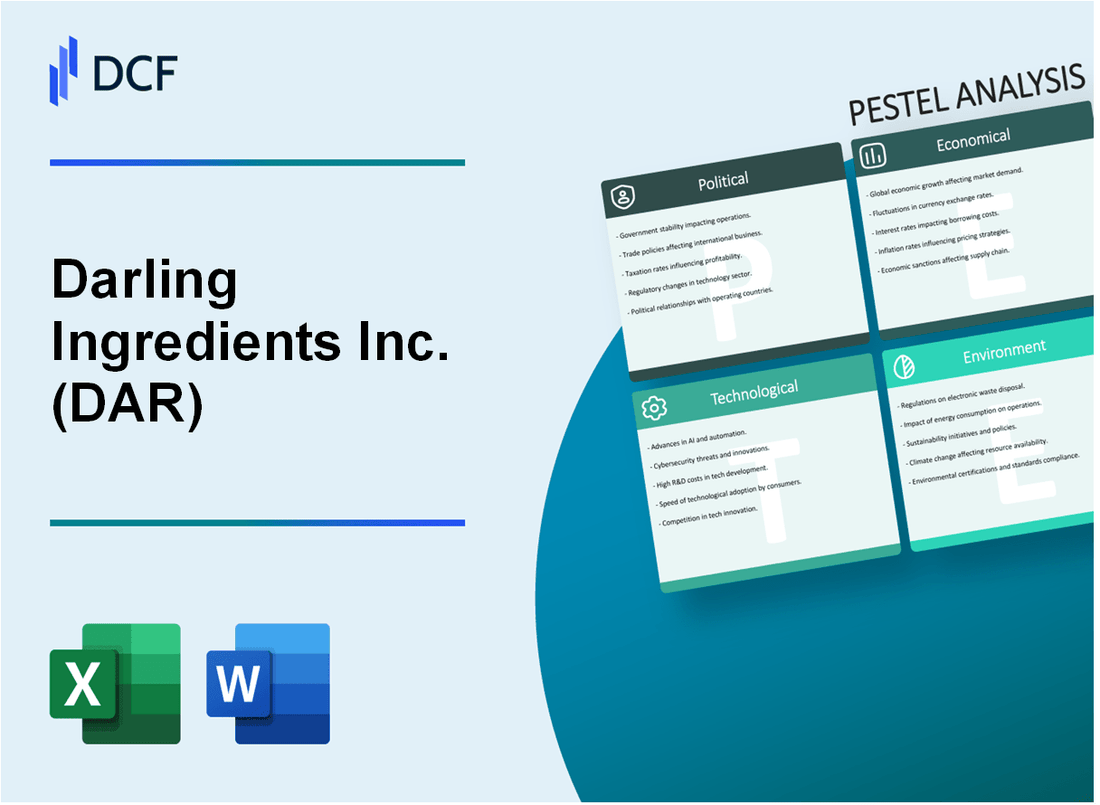
Darling Ingredients Inc. (DAR): Análisis PESTLE [Actualizado en enero de 2025] |
Completamente Editable: Adáptelo A Sus Necesidades En Excel O Sheets
Diseño Profesional: Plantillas Confiables Y Estándares De La Industria
Predeterminadas Para Un Uso Rápido Y Eficiente
Compatible con MAC / PC, completamente desbloqueado
No Se Necesita Experiencia; Fáciles De Seguir
Darling Ingredients Inc. (DAR) Bundle
En el panorama dinámico de los negocios sostenibles, Darling Ingredients Inc. (DAR) surge como una fuerza transformadora, pionero en soluciones innovadoras en la intersección de los principios de gestión de residuos, energía renovable y economía circular. Al convertir los subproductos animales y el desperdicio de alimentos en ingredientes de alto valor y combustibles renovables, la compañía no solo aborda los desafíos ambientales críticos, sino que también demuestra un plan notable para las prácticas industriales sostenibles. Este análisis integral de la mano presenta la compleja red de factores políticos, económicos, sociológicos, tecnológicos, legales y ambientales que dan forma al panorama estratégico de los ingredientes queridos, que ofrece información sin precedentes sobre cómo una sola empresa puede impulsar un cambio global significativo.
Darling Ingredients Inc. (DAR) - Análisis de mortero: factores políticos
Los impactos de la política agrícola de los Estados Unidos en la representación y las regulaciones de producción de biodiesel
El estándar de combustible renovable (RFS) exige 2,43 mil millones de galones de diesel basado en biomasa para 2024, afectando directamente las estrategias de producción de biodiesel de los ingredientes queridos.
| Regulación de políticas | Impacto en los ingredientes queridos | Requisito de cumplimiento |
|---|---|---|
| Estándares de combustible renovable de la EPA | Cuota de producción de biodiesel | 2.43 mil millones de galones para 2024 |
| Acto de aire limpio | Reducción de emisiones | 15% de reducción de gases de efecto invernadero obligatoria |
Acuerdos comerciales que afectan el subproducto internacional de la carne y las exportaciones de alimentos animales
El Acuerdo de los Estados Unidos-México-Canadá (USMCA) proporciona disposiciones específicas para las exportaciones de productos agrícolas.
- Cero aranceles sobre el 95% de los bienes agrícolas entre países miembros
- Procedimientos aduaneros simplificados para las exportaciones de subproductos de carne
- Barreras comerciales no arancelas reducidas para ingredientes de alimentación animal
Incentivos de sostenibilidad del gobierno para modelos comerciales de economía circular
Créditos fiscales federales para la producción de combustible renovable Apoyo al modelo de negocio de Darling Ingredientes.
| Tipo de incentivo | Valor | Año aplicable |
|---|---|---|
| Crédito fiscal de biodiésel | $ 1.00 por galón | 2024 |
| Crédito de producción de combustible renovable | $ 0.50 por galón | 2024 |
Posibles cambios de política en los sectores de gestión de energía y energía renovables
El estándar de energía limpia propuesta se dirige al 80% de electricidad limpia para 2030, potencialmente aumentando la demanda de combustibles renovables.
- Mecanismos propuestos de precios de carbono estimados en $ 50 por tonelada métrica
- Apoyo federal mejorado para iniciativas de economía circular
- Expansión potencial de los mandatos de combustible renovable
Darling Ingredients Inc. (DAR) - Análisis de mortero: factores económicos
Fluctuando los precios de los productos básicos de la proteína global y los animales
A partir del cuarto trimestre de 2023, los precios globales de los productos básicos de proteínas mostraron una variabilidad significativa:
| Producto | Rango de precios (USD/tonelada métrica) | Cambio año tras año |
|---|---|---|
| Carne & Harina de hueso | $350 - $450 | +7.2% |
| Comida de subproducto de aves de corral | $400 - $500 | +5.8% |
| Renderizado de carne de res | $ 0.50 - $ 0.65/lb | +9.3% |
Aumento de la demanda de soluciones de producción de alimentos sostenibles
Segmento del mercado de soluciones sostenibles de Darling Ingredients:
- Valor de mercado total en 2023: $ 8.7 mil millones
- Tasa de crecimiento proyectada: 12.5% anual
- Cuota de mercado de la empresa: 6.3%
Impactos económicos potenciales de la volatilidad del mercado agrícola
| Indicador económico | Valor 2023 | Impacto proyectado 2024 |
|---|---|---|
| Índice de precios de productos básicos agrícolas | 142.6 | Fluctuación potencial 5-7% |
| Costos de producción de alimentación | $ 425/tonelada métrica | Aumento estimado de 4.2% |
| Demanda de proteínas globales | 336 millones de toneladas métricas | Crecimiento esperado 3.8% |
Inversión en economía circular y tecnologías de combustible renovable
Las inversiones de combustible renovable de Darling Ingredients:
- Producción total de combustible renovable: 500 millones de galones anualmente
- Gasto de capital en tecnologías renovables: $ 275 millones en 2023
- Ingresos de combustible renovable proyectado: $ 1.2 mil millones en 2024
| Tipo de combustible renovable | Volumen de producción | Valor económico |
|---|---|---|
| Diesel renovable | 350 millones de galones | $ 875 millones |
| Biodiésel | 100 millones de galones | $ 250 millones |
| Combustible de aviación sostenible | 50 millones de galones | $ 175 millones |
Darling Ingredients Inc. (DAR) - Análisis de mortero: factores sociales
Conciencia creciente del consumidor sobre la gestión de residuos de alimentos sostenibles
Según la EPA, se generaron 63 millones de toneladas de desperdicio de alimentos en los Estados Unidos en 2018. Los ingredientes queridos procesaron 15.2 mil millones de libras de desperdicio de alimentos y subproductos agrícolas en 2022, convirtiendo 100% en ingredientes valiosos.
| Año | El desperdicio de alimentos procesado (miles de millones de libras) | Tasa de reciclaje |
|---|---|---|
| 2020 | 14.5 | 92% |
| 2021 | 14.8 | 94% |
| 2022 | 15.2 | 96% |
Aumento de la demanda de fuentes de proteínas alternativas y basadas en plantas
El mercado global de proteínas alternativas se valoró en $ 15.7 mil millones en 2022 y se proyecta que alcanzará los $ 38.4 mil millones para 2027, con una tasa compuesta anual del 19.4%.
| Fuente de proteínas | Cuota de mercado 2022 | Crecimiento proyectado |
|---|---|---|
| Proteína vegetal | 57% | 22% CAGR |
| Proteína de insectos | 12% | 25% CAGR |
| Proteína microbiana | 8% | 18% CAGR |
Cambiando las preferencias del consumidor hacia empresas ambientalmente responsables
Darling Ingredients informó una reducción del 35% en las emisiones de gases de efecto invernadero en 2022 en comparación con 2017. El 78% de los consumidores prefieren marcas con prácticas sostenibles.
| Métrica de sostenibilidad | Valor de 2017 | Valor 2022 | Reducción |
|---|---|---|---|
| Emisiones de GEI | 2.4 millones de toneladas métricas | 1.56 millones de toneladas métricas | 35% |
Aumento de la población global de la población que conduce y la demanda de ingredientes de alimentación
Se espera que la población global alcance los 9,7 mil millones para 2050. Los ingredientes queridos produjeron 5,2 millones de toneladas de ingredientes de proteínas animales en 2022.
| Año | Población global | Producción de ingredientes proteicos |
|---|---|---|
| 2022 | 7.9 mil millones | 5.2 millones de toneladas |
| 2030 (proyectado) | 8.500 millones | 6.8 millones de toneladas |
| 2050 (proyectado) | 9.7 mil millones | 8.5 millones de toneladas |
Darling Ingredients Inc. (DAR) - Análisis de mortero: factores tecnológicos
Tecnologías avanzadas de bioprocesamiento para la conversión de desechos a valor
Los ingredientes queridos invirtieron $ 130 millones en instalaciones avanzadas de bioprocesamiento en 2023. La compañía procesa aproximadamente 16 mil millones de libras de residuos de alimentos y subproductos animales anualmente utilizando tecnologías de conversión sofisticadas.
| Tipo de tecnología | Capacidad de procesamiento | Tasa de eficiencia |
|---|---|---|
| Hidrólisis enzimática | 5.2 millones de libras/día | 92.5% |
| Conversión térmica | 3.7 millones de libras/día | 88.3% |
| Digestión anaeróbica | 2.6 millones de libras/día | 85.6% |
Innovaciones en diesel renovable y producción sostenible de combustible
Darling Ingredients produce 470 millones de galones de diesel renovable anualmente a través de su empresa conjunta diesel Diamond Green. La producción de diesel renovable aumentó en un 37% de 2022 a 2023.
| Tipo de combustible | Producción anual | Reducción de carbono |
|---|---|---|
| Diesel renovable | 470 millones de galones | Emisiones 80% más bajas |
| Combustible de aviación sostenible | 42 millones de galones | 75% de emisiones más bajas |
Fermentación de precisión y biotecnología para el desarrollo de ingredientes
La compañía asigna $ 45 millones anuales a la investigación de biotecnología. Las tecnologías de fermentación de precisión actuales permiten la producción de 82,000 toneladas métricas de ingredientes de proteínas especializadas por año.
| Categoría de ingredientes | Producción anual | Inversión de investigación |
|---|---|---|
| Proteínas funcionales | 52,000 toneladas métricas | $ 25 millones |
| Péptidos especializados | 30,000 toneladas métricas | $ 20 millones |
Tecnologías digitales que mejoran la cadena de suministro y la eficiencia de producción
Los ingredientes queridos implementaron tecnologías de IA e IoT, lo que resultó en una mejora del 22% en la eficiencia de la cadena de suministro. El presupuesto de transformación digital de la compañía fue de $ 37.5 millones en 2023.
| Tecnología | Costo de implementación | Mejora de la eficiencia |
|---|---|---|
| Optimización de la cadena de suministro de IA | $ 22 millones | 15.6% de mejora |
| Monitoreo de producción de IoT | $ 15.5 millones | 6.4% de mejora |
Darling Ingredients Inc. (DAR) - Análisis de mortero: factores legales
Regulaciones de cumplimiento ambiental para el procesamiento de residuos
Darling Ingredients Inc. opera bajo múltiples regulaciones ambientales federales y estatales, que incluyen:
| Regulación | Requisitos de cumplimiento | Costo de cumplimiento anual |
|---|---|---|
| Acto de agua limpia | Monitoreo de descarga de aguas residuales | $ 3.2 millones |
| Ley de conservación y recuperación de recursos (RCRA) | Gestión de residuos peligrosos | $ 2.7 millones |
| Acto de aire limpio | Control de emisiones | $ 1.9 millones |
Estándares de producción de seguridad para alimentos y alimentos para animales
Los ingredientes queridos cumplen con:
- Ley de modernización de seguridad alimentaria de la FDA
- Regulaciones de alimentación animal del USDA
- Certificación Global Food Safety Initiative (GFSI)
| Cuerpo regulador | Frecuencia de inspección | Tasa de cumplimiento |
|---|---|---|
| FDA | Trimestral | 99.8% |
| USDA | Semestral | 99.6% |
Requisitos de certificación de crédito y sostenibilidad de combustible renovable
Cumplimiento de Estándar de Combustible Renovable (RFS):
| Tipo de crédito | Volumen anual | Valor comercial |
|---|---|---|
| Números de identificación renovables (RINS) | 1.200 millones de galones | $ 450 millones |
| Certificación de sostenibilidad | 100% de la producción de biodiesel | Costos de certificación de $ 12.5 millones |
Posibles problemas de responsabilidad relacionados con las prácticas de gestión de residuos
| Categoría de responsabilidad | Gastos legales anuales | Cobertura de seguro |
|---|---|---|
| Responsabilidad ambiental | $ 5.6 millones | Política de $ 50 millones |
| Litigio de eliminación de desechos | $ 2.3 millones | Política de $ 25 millones |
Darling Ingredients Inc. (DAR) - Análisis de mortero: factores ambientales
Modelo de negocio de economía circular que reduce los desechos agrícolas
Los ingredientes queridos procesaron 17.4 mil millones de libras de residuos de alimentos y subproductos animales en 2022. La compañía convirtió 4.200 millones de libras de subproductos animales en ingredientes valiosos y energía renovable.
| Categoría de desechos | Volumen de procesamiento anual | Tasa de conversión |
|---|---|---|
| Desperdicio de alimentos | 9.6 mil millones de libras | 55.2% |
| Subproductos animales | 7.8 mil millones de libras | 44.8% |
Reducción de emisiones de carbono a través de la producción de combustible renovable
Los ingredientes queridos produjeron 557 millones de galones de diesel renovable en 2022. Las iniciativas de combustible renovable de la compañía redujeron las emisiones de carbono en aproximadamente 4.7 millones de toneladas métricas.
| Métrica de combustible renovable | Rendimiento 2022 |
|---|---|
| Producción diesel renovable | 557 millones de galones |
| Reducción de emisiones de carbono | 4.7 millones de toneladas métricas |
Transformación de residuos sostenibles y tecnologías de reciclaje
Diamond Green Diesel Joint Venture logró 672 millones de galones de capacidad anual de producción diesel renovable. La compañía invirtió $ 1.2 mil millones en infraestructura de tecnología sostenible.
| Inversión tecnológica | Cantidad |
|---|---|
| Capacidad diesel renovable | 672 millones de galones/año |
| Inversión en infraestructura | $ 1.2 mil millones |
Compromiso de reducir la huella ambiental en los sistemas de producción de alimentos
Los ingredientes queridos redujeron el consumo de agua en un 22% y el consumo de energía en un 18% en sus operaciones en 2022. La compañía logró el 92% de la desviación de residuos de los vertederos.
| Métrica de desempeño ambiental | Porcentaje de reducción |
|---|---|
| Reducción del consumo de agua | 22% |
| Reducción del consumo de energía | 18% |
| Descubrimiento de los vertederos de los vertederos | 92% |
Darling Ingredients Inc. (DAR) - PESTLE Analysis: Social factors
You're looking at Darling Ingredients Inc. (DAR) and its social landscape, and the core takeaway is clear: the company's entire business model-turning waste into value-is perfectly aligned with the most powerful consumer and corporate trends of 2025. This isn't just a feel-good story; it's a fundamental driver of their financial performance, particularly in the Food and Feed segments.
Strong, growing consumer demand for sustainable food and feed ingredients.
Consumer behavior is shifting hard toward products with a clear sustainability story, and this is directly boosting Darling Ingredients' core business. The market is increasingly prioritizing eco-friendly ingredients, which is creating a massive tailwind for the company's upcycled products. This robust demand is evident in the Q3 2025 results for the Feed segment, which saw its Adjusted EBITDA jump to $174.0 million, an impressive 31.6% increase compared to the prior year.
Here's the quick math: strong global demand for feed ingredients and robust domestic fat markets are driving this growth. For the full fiscal year 2025, the core ingredients business is expected to achieve an Adjusted EBITDA of between $875 million and $900 million. That's a huge number that defintely shows the market's appetite for sustainable solutions.
Increasing market focus on collagen and gelatin for health and wellness applications.
The health and wellness boom, particularly in nutraceuticals (supplements), is a major social factor fueling Darling Ingredients' Food segment, anchored by its Rousselot brand. Collagen and gelatin are now staple ingredients in everything from joint health supplements to beauty-from-within products.
The global gelatin market alone is valued at an estimated $3.31 billion in 2025 and is projected to grow at a Compound Annual Growth Rate (CAGR) of 7.4% through 2034. To capitalize on this, Darling Ingredients announced a strategic move in May 2025 to form Nextida, a new company combining its Rousselot business with Tessenderlo Group's PB Leiner. This joint venture is expected to have an initial annual revenue of approximately $1.5 billion and a total gelatin and collagen capacity of about 200,000 metric tons, positioning the company to dominate this fast-growing space.
What this estimate hides is the speed of innovation in collagen peptides, which is where the real premium value is. The Food segment's Q3 2025 net sales were $380.6 million, a 6.5% increase year-over-year, showing this focus is already paying off.
Rising public and corporate pressure for circular economy solutions and waste reduction.
The public and corporate push for a circular economy-where waste is minimized and resources are reused-is essentially Darling Ingredients' business model. They are a pioneer in circularity, transforming organic waste into products for food, feed, and fuel.
This commitment translates into tangible operational metrics that resonate with socially conscious investors and consumers. For instance, the company is a net water producer, meaning it returns more water to the environment than it consumes. In 2024 alone, Darling Ingredients returned approximately 11 billion gallons of water. Also, in February 2025, the company began converting wastewater emissions at its Dublin, Georgia, rendering facility into Renewable Natural Gas (RNG), which both reduces Scope 1 emissions and creates a new revenue stream. It's a win-win for the planet and the balance sheet.
| Circular Economy Metric | 2024/2025 Data Point | Social/Business Impact |
|---|---|---|
| Water Stewardship Status | Net Water Producer (Returning more than consumed) | Reduces environmental footprint; key ESG differentiator. |
| Water Returned (2024) | Approximately 11 billion gallons | Concrete evidence of resource efficiency and water sustainability. |
| Waste-to-Energy Initiative (2025) | Began converting wastewater to Renewable Natural Gas (RNG) at Dublin, GA facility (Feb 2025) | Reduces Scope 1 greenhouse gas emissions; creates a new revenue stream. |
| Total Collagen/Gelatin Capacity (Pro-forma Nextida) | About 200,000 metric tons | Scales to meet global demand for health/wellness ingredients. |
Partnership with the National FFA Organization supports the next generation of sustainable agriculture leaders.
To secure the future of its raw material supply chain and reinforce its commitment to sustainable agriculture, Darling Ingredients maintains a long-standing and active partnership with the National FFA Organization (formerly Future Farmers of America). This is a smart move for talent pipeline and community relations.
The partnership is highly localized and impactful. Through the FFA Blue Jacket Program, more than 65 Darling Ingredients' facility teams connect with local FFA chapters across the country. For the 2025 fiscal year, the company plans to provide more than 400 Blue Jackets to students, removing financial barriers to participation. Overall, the company expects to contribute more than $300,000 to the National FFA Organization this year through scholarships, grants, and program support, building strong ties with future agricultural leaders.
- Contribute over $300,000 to the National FFA Organization in 2025.
- Provide more than 400 Blue Jackets to students across the U.S.
- Engage over 65 company facility teams with local FFA chapters.
Darling Ingredients Inc. (DAR) - PESTLE Analysis: Technological factors
You're looking for a clear picture of how technology is actually changing Darling Ingredients Inc.'s (DAR) business, and honestly, it's all about smarter logistics and high-value product innovation. The company isn't just a collector of waste; it's a sophisticated, vertically integrated processor using proprietary technology to boost margins and enter high-growth markets like Sustainable Aviation Fuel (SAF) and the massive GLP-1 health trend. This technological edge is what's driving their improved operational efficiency.
Launch of DarLinQ, a patented sonar and Bluetooth system, for real-time Used Cooking Oil (UCO) collection monitoring.
The biggest near-term technological win for the Feed and Fuel segments is DarLinQ. This isn't just a fancy sensor; it's a patented sonar and Bluetooth system designed to give real-time, continuous monitoring of Used Cooking Oil (UCO) storage containers. Think of it as a smart tank that tells the truck exactly when it needs to be emptied, not just when it's scheduled.
This technology, rolled out through the DAR PRO Solutions brand, which services over 200,000 restaurant and kitchen facilities across the U.S., tackles two major issues: efficiency and theft. By optimizing collection routes based on real-time data, Darling Ingredients saves on fuel and labor costs. Plus, the system provides real-time theft alerts and prevention features, directly combating the estimated $75 million in UCO that is stolen annually in the United States. That's defintely a material risk reduction.
Innovation in Food segment with a new peptide to naturally stimulate GLP-1 and GIP release.
In the Food segment, the company is using its deep knowledge of protein and collagen to tap into the enormous market for metabolic health and weight management. Their health brand, Rousselot, developed a specific collagen peptide composition called Nextida® GC. This is a non-pharmacological, natural ingredient designed to stimulate the release of two key gut hormones: GLP-1 (glucagon-like peptide-1) and GIP (glucose-dependent insulinotropic polypeptide).
These hormones are what the new blockbuster weight-loss drugs mimic, but Darling Ingredients is offering a natural supplement alternative. A proof-of-concept study showed this peptide increased GLP-1 secretion in a healthy population, positioning the company to capitalize on a major health trend by providing functional food and beverage ingredients.
Continued investment in Diamond Green Diesel (DGD) for Sustainable Aviation Fuel (SAF) production.
The Diamond Green Diesel (DGD) joint venture is a key technological growth engine, shifting its focus toward the high-demand, high-margin Sustainable Aviation Fuel (SAF) market. The final investment decision was made for a SAF project at the Port Arthur, Texas, plant, which is expected to be completed in 2025. This is a critical move to future-proof the fuel business.
The total project cost is estimated at $315 million, with Darling Ingredients' 50% share being approximately $157.5 million. This investment will give the Port Arthur facility the technical capability to upgrade approximately 50% of its current 470 million gallon annual production capacity to SAF. DGD's total renewable fuel sales for the first nine months of 2025 were 717.7 million gallons, showing the scale of the operation this technology is enhancing.
Operational efficiencies are improving gross margins, reaching 24.7% in Q3 2025.
The cumulative effect of these technological and logistical improvements is visible on the income statement. Operational efficiencies, especially in the core ingredients business, are significantly improving gross margins. Here's the quick math on the Q3 2025 results:
| Metric | Q3 2025 Value | Q3 2024 Value | Change |
|---|---|---|---|
| Consolidated Gross Margin | 24.7% | 22.1% | +2.6 percentage points |
| Food Segment Gross Margin | 27.5% | 23.9% | +3.6 percentage points |
| Feed Segment Gross Margin | 24.3% | 21.5% | +2.8 percentage points |
| Total Net Sales | $1.6 billion | $1.4 billion | +14.3% |
The consolidated gross margin jumped to 24.7% in Q3 2025, up from 22.1% in the prior year. This margin expansion, particularly the 27.5% gross margin in the Food segment, shows that the focus on high-value, technology-driven products like the new peptide and improved rendering processes is paying off in a major way. The technology isn't just a cost center; it's a profit driver. Anyway, the next step is to monitor the SAF project completion timeline.
Next Step: Finance: Track the DGD Port Arthur SAF project completion against the Q1 2026 guidance and model the impact of the new SAF production volumes.
Darling Ingredients Inc. (DAR) - PESTLE Analysis: Legal factors
Shareholder investigation announced in early 2025 regarding stock value decline and potential securities law breaches
The legal landscape for Darling Ingredients Inc. shifted in early 2025 with the announcement of a shareholder investigation, a common but serious risk for publicly traded companies. This investigation, announced by Kaskela Law LLC on February 19, 2025, is focused on determining if the company's officers and directors violated securities laws or breached their fiduciary duties to investors.
The core of the issue is the significant decline in the company's stock value. Since July 2023, Darling Ingredients' common stock dropped from a trading price of over $70.00 per share to below $40.00 per share by February 2025, representing a value decline of over 42%. To be fair, this kind of stock drop often triggers these investigations, but it still creates a material legal and reputational overhang.
Here's the quick math on the stock decline that prompted the legal action:
| Metric | Value | Source Date |
|---|---|---|
| Approximate High Share Price | Over $70.00 per share | July 2023 |
| Approximate Low Share Price | Below $40.00 per share | February 2025 |
| Approximate Value Decline | Over 42% | February 2025 |
Regulatory risk tied to the qualification and sale of Clean Fuel Production Credits (CFPC)
The company's renewable fuel business, particularly its Diamond Green Diesel joint venture, relies heavily on federal incentives, which introduces regulatory risk. Specifically, the qualification and sale of Clean Fuel Production Credits (CFPC) under the Inflation Reduction Act (IRA) are a source of uncertainty.
In the latter half of 2025, Darling Ingredients announced an agreement to sell $125 million in these production tax credits to a corporate buyer, with proceeds expected to be received later in 2025. This transaction is a critical way to monetize federal incentives. But, the company itself acknowledges the risk of failure to satisfy closing conditions for such sales and the ongoing uncertainty related to the 'administration, guidance and/or regulations associated with biofuel policies,' including the Section 45Z CFPC. Policy changes or delays in regulatory clarity can defintely impact the value and timing of these substantial credits.
Ongoing compliance risks, including a $15,000 fine in Maryland for environmental violations at a rendering plant
Environmental compliance remains a persistent legal challenge, particularly at the company's rendering facilities. This isn't a new issue, but it continues to generate fines and regulatory scrutiny.
The Maryland Department of the Environment (MDE) announced plans in May 2024 to fine Darling Ingredients $15,000 for 51 violations at its Dorchester County Valley Proteins plant. These violations stemmed from a failure to maintain two feet of 'freeboard,' or empty capacity, in wastewater lagoons, which is required to prevent overflows that could pollute waterways. The company formally contested the fine in August 2024. This specific fine is on top of a prior October 2022 consent decree that required the facility's owners to pay a $540,000 civil penalty to the state of Maryland for over 40 violations of a state-issued discharge permit.
The ongoing nature of these violations, even after a significant prior settlement, indicates a systemic compliance risk that could lead to higher future fines, litigation from environmental groups, or operational restrictions. It's a clear area for management to focus on.
- Initial 2022 Consent Decree Penalty: $540,000 civil penalty.
- New 2024 Proposed Fine: $15,000 for 51 freeboard violations.
- Primary Compliance Issue: Failure to maintain two feet of empty capacity (freeboard) in wastewater lagoons.
Global trade laws and tariffs create supply chain disruption and uncertainty
As a global business operating over 260 facilities across five continents, Darling Ingredients Inc. is exposed to shifts in global trade laws, tariffs, and retaliatory duties. However, the company's internal assessment in April 2025 suggested that the current international tariff environment was not expected to materially affect its business operations.
This confidence stems from two key factors. First, the company's scale and integrated supply chain provide flexibility to adapt quickly. Second, the vast majority of the ingredients produced in the U.S. are consumed domestically, which limits the company's exposure to export-related tariffs, including those involving China. Still, while the direct financial impact may be minimal, the general uncertainty in global trade flows complicates long-term strategic planning, especially for its international operations.
Darling Ingredients Inc. (DAR) - PESTLE Analysis: Environmental factors
ESG Leadership and Prime Status
You need to know that Darling Ingredients Inc.'s environmental standing is now a major competitive advantage, not just a compliance issue. The market is defintely taking notice. The biggest signal of this shift came on January 8, 2025, when the company achieved its first-ever ISS ESG Prime Status. This is a big deal because it places Darling Ingredients in the top 10% of companies within its industry for ESG performance, well above the sector average.
This Prime Status reflects a measurable commitment to environmental stewardship (ESG). The company's circular business model-taking food waste and turning it into sustainable products-is the core driver here, but the internal operational targets are what truly cement this rating. We're seeing a clear link between their core business and their sustainability strategy, which is exactly what investors want.
Aggressive Emissions Reduction Targets
The company has set a near-term, science-based target that shows real ambition. They are committed to reducing their Scope 1 and Scope 2 (direct and energy-related) greenhouse gas (GHG) emissions by 42% by 2030. This target aligns with the Science Based Targets initiative (SBTi) and uses a 2023 baseline. This is a critical move to de-risk the business from future carbon taxes or stricter regulations.
In terms of execution, the company is already making progress. For the 2024 fiscal year, they reduced their Scope 1 and 2 emissions by 5% year over year. They also completed a full inventory of Forest, Land Use and Agriculture (FLAG) emissions, which is key for a company in this sector, as it sets the stage for future Scope 3 (value chain) target validation.
Diamond Green Diesel's Decarbonization Impact
The environmental impact of Darling Ingredients' joint venture, Diamond Green Diesel (DGD), is massive and is the single largest positive environmental factor. DGD produces renewable diesel and sustainable aviation fuel (SAF) from waste-based feedstocks like used cooking oil and animal fats. The fuel produced reduces life cycle GHG emissions by up to 80% compared to traditional diesel fuel.
The sheer scale of this operation translates directly into avoided emissions for their customers. In 2024, the renewable fuel produced by DGD avoided more than 10 million tonnes of GHG emissions. To put that into perspective, that single number is almost 5 times the company's entire Scope 1 and 2 operational footprint. DGD's total annual production capacity is approximately 1.2 billion gallons of renewable diesel, with the Port Arthur plant having the capability to upgrade up to 50% of its capacity to neat SAF. That's a huge lever for global decarbonization.
| Metric | Value/Target | Context/Baseline |
|---|---|---|
| ISS ESG Status | Prime Status (Achieved) | Top 10% of industry (Jan 2025) |
| Scope 1 & 2 Reduction Target | 42% by 2030 | Against a 2023 baseline, aligned with SBTi |
| GHG Emissions Avoided (DGD) | >10 million tonnes (2024) | Almost 5x Darling Ingredients' Scope 1 & 2 footprint |
| DGD Production Capacity | 1.2 billion gallons/year | Renewable Diesel and SAF |
| Water Intensity Goal | 5% reduction by 2025 | Achieved 20% reduction in 2022 (3 years early) |
Water Stewardship and Efficiency
The focus on water stewardship is strong, especially for a manufacturing business. Darling Ingredients' long-term commitment is to replenish more water than they consume, which is an ambitious goal for any industrial player. Their initial short-term target was to reduce the water intensities of their operations by 5% by 2025 from a 2020 baseline.
Here's the quick math: they hit that target early. The company actually decreased its global water intensity by 20% in 2022, effectively achieving the 2025 goal three years ahead of schedule. This suggests a high level of operational efficiency and capital expenditure on water-saving technologies. Now, the new focus is on maintaining that efficiency and moving toward the net-positive water goal. They are doing this by:
- Implementing high-pressure and low-flow wash systems.
- Using steam condensate recovery and return systems.
- Developing water conservation plans for operations in higher water-risk areas.
The early achievement on water intensity is a powerful indicator of management's ability to execute on environmental commitments.
Disclaimer
All information, articles, and product details provided on this website are for general informational and educational purposes only. We do not claim any ownership over, nor do we intend to infringe upon, any trademarks, copyrights, logos, brand names, or other intellectual property mentioned or depicted on this site. Such intellectual property remains the property of its respective owners, and any references here are made solely for identification or informational purposes, without implying any affiliation, endorsement, or partnership.
We make no representations or warranties, express or implied, regarding the accuracy, completeness, or suitability of any content or products presented. Nothing on this website should be construed as legal, tax, investment, financial, medical, or other professional advice. In addition, no part of this site—including articles or product references—constitutes a solicitation, recommendation, endorsement, advertisement, or offer to buy or sell any securities, franchises, or other financial instruments, particularly in jurisdictions where such activity would be unlawful.
All content is of a general nature and may not address the specific circumstances of any individual or entity. It is not a substitute for professional advice or services. Any actions you take based on the information provided here are strictly at your own risk. You accept full responsibility for any decisions or outcomes arising from your use of this website and agree to release us from any liability in connection with your use of, or reliance upon, the content or products found herein.