

|
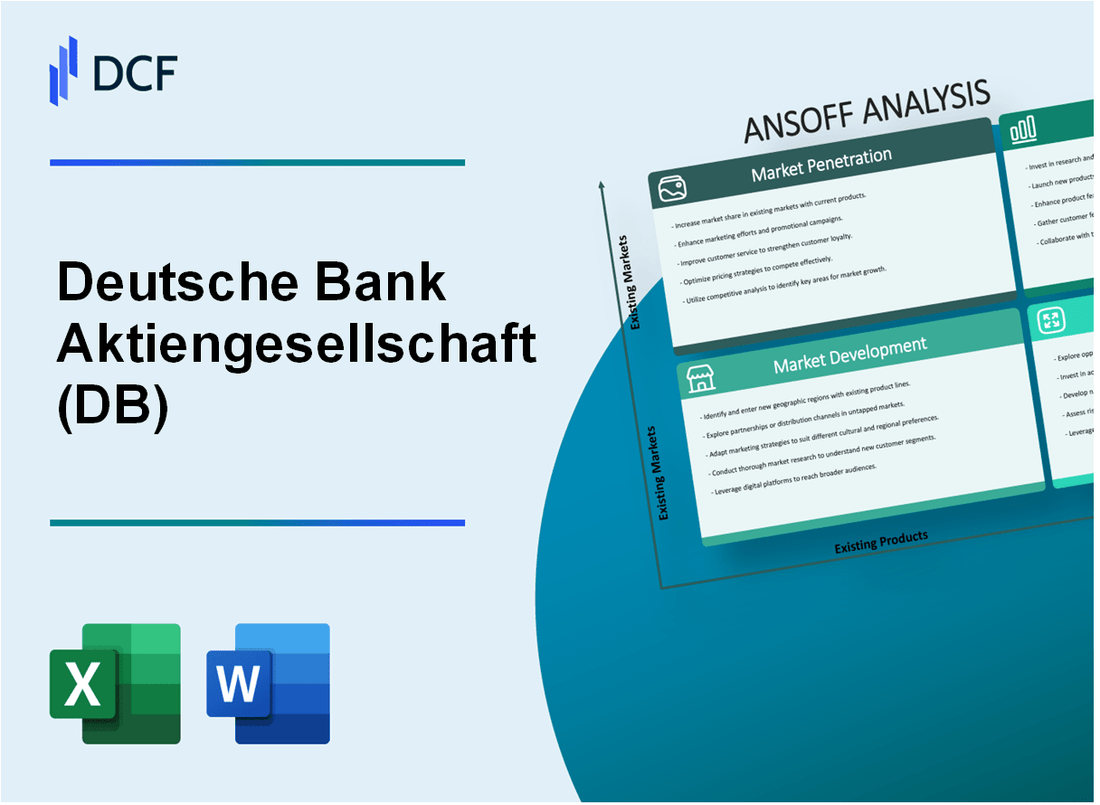
Análisis de la Matriz ANSOFF de Deutsche Bank Aktiengesellschaft (DB) [Actualizado en enero de 2025] |
Completamente Editable: Adáptelo A Sus Necesidades En Excel O Sheets
Diseño Profesional: Plantillas Confiables Y Estándares De La Industria
Predeterminadas Para Un Uso Rápido Y Eficiente
Compatible con MAC / PC, completamente desbloqueado
No Se Necesita Experiencia; Fáciles De Seguir
Deutsche Bank Aktiengesellschaft (DB) Bundle
En el panorama en rápida evolución de la banca global, Deutsche Bank Aktiengesellschaft está orquestando un viaje estratégico transformador que combina la innovación digital, la expansión del mercado y las tecnologías financieras de vanguardia. Al navegar meticulosamente la matriz de Ansoff, el banco se está posicionando como una potencia financiera con visión de futuro, dirigiendo estratégicamente el crecimiento entre servicios digitales, mercados emergentes, desarrollo innovador de productos y diversificación. Prepárese para sumergirse en una hoja de ruta convincente que revele cómo Deutsche Bank está reinventando su estrategia competitiva en un ecosistema financiero cada vez más complejo y dinámico.
Deutsche Bank Aktiengesellschaft (DB) - Ansoff Matrix: Penetración del mercado
Expandir los servicios de banca digital
Deutsche Bank reportó 15.3 millones de usuarios de banca digital en 2022. Las transacciones bancarias móviles aumentaron en un 42% en comparación con el año anterior. El banco invirtió 672 millones de euros en infraestructura digital y actualizaciones de tecnología.
| Métrica de banca digital | Rendimiento 2022 |
|---|---|
| Usuarios digitales totales | 15.3 millones |
| Crecimiento de transacciones móviles | 42% |
| Inversión en infraestructura digital | 672 millones de euros |
Implementar estrategias de venta cruzada específicas
Deutsche Bank logró € 3.4 mil millones en ingresos de venta cruzada de clientes corporativos existentes. La venta cruzada de la banca minorista generó un adicional de € 1.2 mil millones en 2022.
- Ingresos de venta cruzada de clientes corporativos: 3.400 millones de euros
- Banca minorista Ingresos de venta cruzada: € 1.2 mil millones
- Productos promedio por cliente corporativo: 3.7
- Productos promedio por cliente minorista: 2.5
Mejorar la experiencia del cliente
La aplicación de banca móvil de Deutsche Bank recibió una calificación de usuario de 4.6/5. La plataforma de banca en línea procesó 287 millones de transacciones en 2022, con un 99.8% de tiempo de actividad del sistema.
| Métrica de experiencia del cliente | Rendimiento 2022 |
|---|---|
| Calificación del usuario de la aplicación móvil | 4.6/5 |
| Transacciones bancarias en línea | 287 millones |
| Tiempo de actividad del sistema | 99.8% |
Ofrecer tasas de interés competitivas
Deutsche Bank ofreció tasas de interés de la cuenta de ahorro que van desde 1.2% al 3.5% en 2022. Las tasas de préstamos corporativos promediaron 2.7% para pequeñas y medianas empresas.
Desarrollar servicios de asesoramiento financiero personalizado
Deutsche Bank lanzó 127 programas de asesoramiento financiero personalizado en 2022. La satisfacción del cliente en los servicios de asesoramiento alcanzó el 88%. El banco asignó € 456 millones para mejorar las capacidades de consultoría financiera personalizada.
- Programas de asesoramiento personalizados lanzados: 127
- Tasa de satisfacción del cliente: 88%
- Inversión en servicios de asesoramiento: € 456 millones
Deutsche Bank Aktiengesellschaft (DB) - Ansoff Matrix: Desarrollo del mercado
Expandir la presencia bancaria digital en los mercados emergentes
Deutsche Bank informó que las transacciones de banca digital en Asia aumentaron en un 37% en 2022, con un crecimiento específico en mercados como India e Indonesia. El volumen de transacciones digitales alcanzó 4.200 millones de euros en los mercados asiáticos emergentes.
| Mercado | Crecimiento de la transacción digital | Nuevos usuarios digitales |
|---|---|---|
| India | 42% | 1.3 millones |
| Indonesia | 29% | 780,000 |
| Brasil | 33% | 650,000 |
Fortalecer las operaciones bancarias corporativas
Los ingresos de la banca corporativa en las regiones europeas alcanzaron € 12.7 mil millones en 2022, con Alemania y los Países Bajos que representan el 68% del total de ingresos bancarios corporativos.
Desarrollar asociaciones estratégicas
- Se asoció con 17 instituciones financieras locales en Asia y América Latina
- Inversión en infraestructura de asociación: € 320 millones
- Ingresos de asociación proyectados: € 1.8 mil millones para 2024
Ofertas de finanzas sostenibles
La cartera de finanzas verdes se expandió a € 22.5 mil millones en mercados emergentes, lo que representa un aumento del 44% de 2021.
Tecnología digital para mercados desatendidos
Invirtió 475 millones de euros en infraestructura bancaria digital para mercados desatendidos, apuntando a 3.2 millones de nuevos clientes en economías emergentes.
Deutsche Bank Aktiengesellschaft (DB) - Ansoff Matrix: Desarrollo de productos
Herramientas de gestión financiera y de gestión de inversiones con alimentación de IA
Deutsche Bank invirtió 1.500 millones de euros en IA y transformación digital en 2022. El Banco desplegó más de 350 algoritmos basados en IA para estrategias de gestión de riesgos e inversión.
| Inversión tecnológica de IA | Cantidad |
|---|---|
| Inversión total de IA 2022 | 1.500 millones de euros |
| Número de algoritmos de IA | 350+ |
Desarrollo de productos de inversión de ESG
Deutsche Bank gestionó € 78 mil millones en activos de ESG a partir del cuarto trimestre de 2022. Los productos de inversión sostenible aumentaron un 42% año tras año.
| Métricas de inversión de ESG | Valor |
|---|---|
| Activos totales de ESG | 78 mil millones de euros |
| Crecimiento del producto ESG | 42% |
Plataformas de gestión de patrimonio digital
Deutsche Bank lanzó una plataforma digital dirigida a Millennials con una inversión mínima de € 500. La plataforma atrajo a 175,000 nuevos clientes en 2022.
| Estadísticas de plataforma digital | Valor |
|---|---|
| Inversión mínima | €500 |
| Nuevos clientes 2022 | 175,000 |
FinTech Solutions for PYME
Deutsche Bank desarrolló 12 soluciones de banca digital especializadas para pequeñas y medianas empresas. La cartera total de banca digital de las PYME alcanzó 22 mil millones de euros en 2022.
| Banca digital de las PYME | Valor |
|---|---|
| Soluciones digitales desarrolladas | 12 |
| Puerta digital de las PYME | 22 mil millones de euros |
Servicios de blockchain y criptomonedas
Deutsche Bank asignó € 350 millones para el desarrollo de productos blockchain y criptomonedas. Lanzó 7 productos de inversión relacionados con la criptomonedas en 2022.
| Inversión en blockchain | Valor |
|---|---|
| Presupuesto de desarrollo de blockchain | 350 millones de euros |
| Productos criptográficos lanzados | 7 |
Deutsche Bank Aktiengesellschaft (DB) - Ansoff Matrix: Diversificación
Invierta en nuevas empresas de fintech para explorar soluciones innovadoras de tecnología financiera
Deutsche Bank invirtió 350 millones de euros en FinTech Ventures en 2022. El banco identificó 17 nuevas empresas específicas de fintech para inversiones estratégicas durante ese año fiscal.
| Categoría de inversión | Monto invertido | Número de startups |
|---|---|---|
| Tecnologías blockchain | 87 millones de euros | 5 startups |
| Soluciones de pago digital | € 129 millones | 8 startups |
| Plataformas financieras de IA | € 134 millones | 4 startups |
Desarrollar flujos de ingresos alternativos a través de la monetización de la plataforma digital
Deutsche Bank generó € 2,1 mil millones a partir de ingresos de plataforma digital en 2022, lo que representa el 14.3% de los ingresos totales sin intereses.
- Tarifas de transacción de plataforma digital: € 612 millones
- Ingresos de monetización de datos: € 453 millones
- Servicios de integración de API: 387 millones de euros
Expandirse a financiamiento de infraestructura sostenible e inversión de energía verde
Deutsche Bank cometió € 25.5 mil millones a proyectos de infraestructura sostenible en 2022.
| Sector de la inversión | Inversión total | Retorno anual proyectado |
|---|---|---|
| Energía renovable | 12.7 mil millones de euros | 4.6% |
| Infraestructura verde | 8.300 millones de euros | 3.9% |
| Transporte sostenible | 4.500 millones de euros | 3.2% |
Crear ecosistemas digitales integrados que combinen servicios bancarios, seguros y tecnología
Deutsche Bank lanzó 6 plataformas integradas de ecosistemas digitales en 2022, generando € 1.8 mil millones en ingresos intersectoriales.
- Plataforma de integración de seguro bancario: 612 millones de euros
- Plataforma de servicios financieros tecnológicos: 534 millones de euros
- Ecosistema de gestión de patrimonio digital: 654 millones de euros
Explore las adquisiciones estratégicas en la tecnología financiera emergente y los sectores de pago digital
Deutsche Bank completó 3 adquisiciones de tecnología estratégica en 2022, totalizando € 1.2 mil millones en valor de transacción.
| Objetivo de adquisición | Valor de transacción | Enfoque de tecnología primaria |
|---|---|---|
| Inicio de pago digital | 450 millones de euros | Soluciones de pago móvil |
| Empresa de tecnología blockchain | 380 millones de euros | Infraestructura de criptomonedas |
| AI Financial Analytics Company | 370 millones de euros | Modelado financiero predictivo |
Deutsche Bank Aktiengesellschaft (DB) - Ansoff Matrix: Market Penetration
You're looking at how Deutsche Bank Aktiengesellschaft can deepen its hold in its current markets, which is the essence of market penetration. This means getting more business from the clients we already serve, rather than finding new ones or new products.
Increase wallet share in the German Private Bank segment
Focusing on the home turf is key. For the first nine months of 2025, the Private Bank division brought in net revenues of €7.2 billion, a 3% year-on-year rise. Within that, the Wealth Management & Private Banking segment specifically saw revenues grow by 5% to €3.3 billion for the same nine-month period. Assets under management (AUM) across the Private Bank and Asset Management divisions rose by €109 billion in the twelve months leading up to the first half of 2025. To capture more wallet share, Deutsche Bank Aktiengesellschaft established a dedicated Ultra High-Net-Worth (UHNW) coverage unit in Germany, staffed by over 50 specialized employees, targeting complex family governance and asset allocation for large entrepreneurs. The third quarter of 2025 saw Private Bank net revenues hit €2.4 billion.
Offer competitive pricing on Corporate Bank lending to key EU clients
The Corporate Bank is leveraging its leading position in Germany to support clients capitalizing on European investment programs, including cooperation with KfW and EIB for tailored solutions. For the first nine months of 2025, the Corporate Bank delivered a profit before tax of €2.0 billion, achieving a Return on Tangible Equity (RoTE) of 16.0%. In the second quarter of 2025, Corporate Bank net revenues were €1.9 billion, which was 1% lower year on year. The strategy here is to use the existing platform to capture more of the financing demand related to the German and European infrastructure and defense agenda.
Boost digital adoption for existing retail customers via the mobile app
Digital engagement is non-negotiable now. While specific Deutsche Bank Aktiengesellschaft mobile adoption figures for existing retail customers aren't public, the broader German market context shows that 60% of German consumers prefer using their banking app to manage finances, according to 2024 data. Globally, the number of mobile banking users reached 2.17 billion by the end of 2025. For existing customers, boosting adoption means driving usage of features like PFM (Personal Financial Management) and investment tracking within the app. The bank is working toward its 2025 financial targets, which include a Group cost/income ratio target of below 65%, achieved at 63.0% for the first nine months of 2025.
Cross-sell wealth management services to high-net-worth Investment Bank clients
This involves deepening relationships with the Investment Bank's top-tier clients. The Investment Bank division posted a profit before tax of €3.3 billion in the first nine months of 2025, with a RoTE of 12.5%. The overall Investment Bank division generated €10.6 billion in revenue last year, up 15%, and is on course for €11.5 billion this year. A clear action point is the stated aim for the Investment Banking and Capital Markets (IBCM) unit to grow its coverage from 35% to around 40% of the fee payers by fee volume by the end of 2028. This growth in coverage directly relates to cross-selling more services, including wealth management, to the existing corporate and institutional client base.
Run targeted campaigns to capture more fixed-income trading volume
Fixed Income, Currency (FIC) Sales & Trading is a core revenue driver, accounting for more than 80% of the Investment Bank's revenues as of September 30, 2024. In the first quarter of 2025, FIC revenues were up 17% year-on-year, contributing significantly to the Investment Bank's total revenue of €3.4 billion, a 10% increase year-on-year. Deutsche Bank Aktiengesellschaft has an explicit goal to boost fixed income revenue by 20% from 2023 to 2027. The bank has already added over 600 staff in the Americas over the last three years to bolster this business.
Here's a quick look at some key 2025 financial performance indicators through the first nine months:
| Business Segment | Profit Before Tax (9M 2025) | Return on Tangible Equity (RoTE 9M 2025) | Cost/Income Ratio (9M 2025) |
| Corporate Bank | €2.0 billion | 16.0% | 62% |
| Investment Bank | €3.3 billion | 12.5% | 55% |
| Group (Overall) | €7.7 billion | 10.9% | 63.0% |
The Group's overall post-tax Return on Average Tangible Shareholders' Equity (RoTE) was 10.9% in the first nine months of 2025, hitting the bank's 2025 target of above 10%.
Finance: draft the Q4 2025 client acquisition targets for the UHNW unit by end of January.
Deutsche Bank Aktiengesellschaft (DB) - Ansoff Matrix: Market Development
You're looking at where Deutsche Bank Aktiengesellschaft (DB) is taking its existing services into new geographies or client sets for growth.
US Corporate Bank Expansion
The strategy involves pushing Corporate Bank coverage outside the established major financial centers in the US. This targets capturing market share in underpenetrated US markets, leveraging the high-yield platform. While specific client count increases outside hubs for 2025 aren't public, the overall revenue context is set by the forecast.
| Metric | 2025 Forecast/Target |
| Forecasted Full-Year Revenue | € 32 billion |
| Target Cost/Income Ratio | below 65% |
This market development push supports the broader ambition to scale the Global Hausbank.
Asia-Pacific Mid-Sized Company Targeting (Vietnam Focus)
Targeting mid-sized companies in high-growth Asia-Pacific markets like Vietnam is a key development area. Vietnam has seen significant trade shifts, making it pivotal for regional strategy.
- Exports to the United States from Vietnam increased by US$ 60 billion between 2017 and 2023.
- Deutsche Bank Aktiengesellschaft (DB) has raised over US$ 1 billion annually for Vietnamese corporates in debt, loan, and equity capital since 2017.
- Deutsche Bank Aktiengesellschaft (DB) doubled its capital allocation in Vietnam to over US$ 200 million (as of 2023).
Latin American Private Bank Launch (Mexico Start)
Launching Private Bank services in select Latin American countries, starting with Mexico, taps into local wealth and nearshoring investment flows. The Private Bank segment's performance metrics provide a baseline for the division's focus.
| Private Bank Performance Metric | 2024 Actual | 2025 Forecast |
| Cost/Income Ratio | 75.0% | 69.6% |
| Post-tax Return on Average Tangible Shareholders' Equity | 9.2% | 10.5% |
The bank is focused on scaling franchise with asset gathering, which is central to Private Bank growth.
Trade Finance Solutions in Eastern Europe
Offering trade finance solutions to new client segments in Eastern Europe aligns with Deutsche Bank Aktiengesellschaft (DB)'s CEO role for Central and Eastern Europe and its global trade finance recognition.
- Deutsche Bank Aktiengesellschaft (DB) secured 25 No 1 rankings in the Euromoney Trade Finance Survey for 2025.
- Global trade volume reached US$ 33 trillion in 2024.
- The bank is leveraging its export credit agency (ECA) coverage to support corporate trade in the region.
Digital Platforms for Eurozone Small Businesses
Using digital platforms to reach underserved small businesses across the Eurozone is executed via the Fyrst digital banking offering. This is a direct play for market share against fintechs.
| Fyrst (DB Digital SME Offering) Metric | Current Count (Approx.) | End of 2025 Target |
| Accounts | 75,000 | 90,000 to 95,000 |
| Total Customers (Fyrst, Postbank, DB Brand) | Around 800,000 | N/A |
Speed of account opening, taking as little as ten minutes for individuals, is a key competitive factor in this digital segment.
Finance: draft 13-week cash view by Friday.
Deutsche Bank Aktiengesellschaft (DB) - Ansoff Matrix: Product Development
You're looking at how Deutsche Bank Aktiengesellschaft is pushing new products into existing markets, which is the heart of Product Development on the Ansoff Matrix. This isn't just about tweaking old services; it's about building entirely new offerings to meet evolving client demands, especially around digital assets and sustainability.
Introduce new ESG-linked derivatives for institutional investors
The push for Environmental, Social, and Governance (ESG) products is translating into concrete transaction volumes for Deutsche Bank Aktiengesellschaft. You saw the cumulative sustainable financing and ESG investment volumes hit €417 billion as of the end of the second quarter of 2025, up from €373 billion at the end of 2024. This is closing in on the initial goal of achieving €500 billion by the end of 2025. The Investment Bank segment has been the biggest driver here, recording €253 billion cumulatively since 2020, with €17 billion added in Q2 2025 alone. The bank has already set a more ambitious long-term goal: facilitating €900 billion in sustainable and transition finance by the end of 2030.
These sustainability-linked solutions are a key part of the offering. For instance, in Q2 2025, the private bank grew its ESG assets and client lending by €5 billion. The focus on these products shows client demand is strong, even if the specific volume for new ESG-linked derivatives isn't broken out separately.
Develop a proprietary digital asset custody platform for institutional clients
Deutsche Bank Aktiengesellschaft is moving deliberately into digital asset custody, planning a launch for 2026. This isn't a small side project; it involves building regulated custody solutions for institutional investors and corporate clients who need secure storage for their crypto holdings. The bank is leveraging partnerships, including with Taurus, which already provides enterprise-grade digital asset infrastructure for over 25 institutional clients. This move aligns with the bank's broader strategy to increase fee income, mirroring efforts in its DWS Group investment arm.
The Head of Digital Assets noted that the digital asset space is expected to encompass trillions of dollars of assets, making it a priority for investors. You've got to appreciate the measured timeline; developing the necessary infrastructure and ensuring regulatory compliance takes time, especially when dealing with assets that saw a market cap leap from $20 billion in 2020 to $246 billion.
Launch a fully automated, low-cost robo-advisory service for retail clients
The retail space sees Deutsche Bank Aktiengesellschaft involved in the robo-advisory segment, with its offering, Robin, categorized as a sales-oriented solution. While the bank's own client numbers for its specific service aren't immediately available, its research projected that German robo-advisors, in general, would manage about €25-35 billion by 2025. However, a July 2025 study indicated that the overall German robo-advisor market is stagnating despite a strong stock market year in 2024. The cost structure is a key factor; service fees for these digital wealth managers typically range between 0.35 and 1.18 percent per year.
Create specialized sector-focused lending products for the tech industry
Deutsche Bank Aktiengesellschaft is definitely focused on the tech sector, particularly as it relates to the AI boom. The bank has financed large parts of the data center network supporting major platforms like Microsoft, Google, and Amazon. While a specific portfolio size for all tech lending isn't cited, the focus on infrastructure supporting AI-like data centers-is clear. The bank is reviewing its exposure here, signaling a need to balance confidence in growth with a safety net against overexposure. The 2025 net revenue outlook for the entire bank is around €32 billion.
Integrate advanced AI tools for personalized credit risk management
Integrating advanced Artificial Intelligence (AI) and Machine Learning (ML) is a cornerstone of Deutsche Bank Aktiengesellschaft's 2025 strategic vision for sustainable growth. In credit risk specifically, modernization efforts have yielded concrete efficiency gains. Process automation removed numerous manual checks, leading to a 25% improvement in Risk Manager productivity. In one measured instance, report-generation time fell by 21 days. This entire credit risk technology overhaul delivered over €10 million in savings and improved overall productivity by 10%. The bank aims to scale generative AI securely across all divisions, positioning itself for future applications.
Here are some key financial and operational metrics related to the bank's 2025 targets and recent performance, which underpin these product development investments:
| Metric | 2025 Target/Forecast | 2024 Actual/End of Year |
| Net Revenues (Forecast) | Around €32 billion | N/A |
| Return on Tangible Equity (RoTE) Target | Above 10% | N/A |
| Cost/Income Ratio Target | Below 65% | N/A |
| CET1 Capital Ratio (Forecast) | Approximately 14% | 13.8% |
| Capital Distributions Authorized (So Far) | €2.1 billion | €675 million (2024 share repurchases) |
The bank's focus on technology investment is significant; leading institutions are collectively investing over $35 billion in AI across North America, Europe, and Asia in 2025, often equating to over 35% of total IT budgets.
You should review the Q3 2025 results when they drop to see the immediate impact of these new product initiatives on fee income growth.
Deutsche Bank Aktiengesellschaft (DB) - Ansoff Matrix: Diversification
You're looking at how Deutsche Bank Aktiengesellschaft (DB) can push beyond its core markets, which is what diversification in the Ansoff Matrix is all about. The bank's current health is strong; for the first nine months of 2025, profit before tax hit € 7.7 billion, and the Return on Tangible Equity (RoTE) has been consistently above 10% across all three quarters of 2025 to date. Still, growth requires new frontiers, so let's map out these potential moves.
Acquire a specialized payments processing firm in the US market.
Moving into specialized payments processing in the US means targeting a market that is structurally pivoting toward real-time rails. The United States payments market itself stands at USD 13.24 billion in 2025. This is a fraction of the global payment processing solutions vendor revenue, which is estimated at USD 173.38 billion for 2025. An acquisition here would immediately place Deutsche Bank Aktiengesellschaft (DB) in the middle of the action, capturing revenue from the 16.71% Compound Annual Growth Rate (CAGR) projected for the US market through 2030. This isn't just about volume; it's about owning the infrastructure that supports the shift to instant payments, a space where Deutsche Bank Aktiengesellschaft (DB) is already active, having helped a partner establish real-time payout infrastructure covering more than 90% of its merchant transactions.
Establish a venture capital arm to invest in FinTech and RegTech startups.
Formalizing a venture capital (VC) arm allows Deutsche Bank Aktiengesellschaft (DB) to gain early access to disruptive technologies, which is crucial given that private business investment, excluding AI, has shown little to no growth since 2019, according to the bank's own analysis. You see the bank is already active here; for instance, its corporate venture capital (CVC) group invested in the AI company Aleph Alpha in November 2024. Furthermore, the bank actively partners with fintechs, such as its August 2025 collaboration with Upvest to provide banking infrastructure, including virtual IBANs and automated payment processing. This strategy directly addresses the need to stay close to innovation, as Deutsche Bank Aktiengesellschaft (DB) maintains Innovation Network offices in key hubs like Berlin, New York, and Palo Alto for scouting.
Offer a white-labeled Banking-as-a-Service (BaaS) platform to non-financial firms.
The BaaS space is expanding rapidly, making it a prime target for a bank with existing infrastructure to monetize. The global Banking as a Service market is valued at USD 24.58 billion in 2025, with projections to reach USD 60.35 billion by 2030. North America currently holds about 31% of this market share in 2025. By offering a white-labeled platform, Deutsche Bank Aktiengesellschaft (DB) can embed its regulated services into non-financial firms' user journeys, tapping into the 21.4% CAGR expected for the BaaS market through 2029. This leverages the bank's existing strengths, as its Corporate Bank division already focuses on innovative financial solutions at the intersection of IoT and 'Pay per use' models.
Develop a dedicated carbon-credit trading and advisory business unit.
The environmental, social, and governance (ESG) trend is creating massive new markets. The global carbon credit market size is estimated at USD 933.23 billion in 2025, though the compliance segment drives the vast majority, contributing more than 98% of revenue in 2025. For context, the compliance-driven EU Emissions Trading System alone reached a value of ~€881 billion (US$949 billion) in 2023. A dedicated unit would focus on advisory services for corporate clients navigating these mandatory frameworks, while also capturing a piece of the voluntary market, which, despite a 2024 dip to roughly $535 million, is forecast to reach $10-25 billion by 2030. This aligns with the bank's long-term optimism for copper stemming from energy transition trends.
Enter the insurance brokerage market through a strategic partnership.
Partnering to enter insurance brokerage provides access to a stable, fee-based revenue stream driven by risk management needs. The global insurance brokerage market size is specifically valued at $125.49 billion in 2025. The top 10 global brokerage firms alone generated over $100 billion in combined revenues in 2025. The Property and Casualty insurance segment is the largest, holding approximately 70% market share in 2025. A partnership would allow Deutsche Bank Aktiengesellschaft (DB) to immediately offer specialized risk management, which is a key driver, especially for specialty lines like cyber and ESG insurance that are growing above 30% annually.
Here's a quick look at the market sizes you'd be targeting with these diversification moves:
| Market Segment | 2025 Estimated Size / Value | Key Growth Metric |
|---|---|---|
| Global Payment Processing (Vendor Revenue) | USD 173.38 billion | 10-20% CAGR (2025-2030) |
| US Payments Market | USD 13.24 billion | 16.71% CAGR (to 2030) |
| Global Banking-as-a-Service (BaaS) | USD 24.58 billion | 24.34% CAGR for embedded finance software (to 2030) |
| Global Carbon Credit Market | USD 933.23 billion | 37.68% CAGR (2025-2034) |
| Global Insurance Brokerage | $125.49 billion | 4.80% CAGR (to 2029) |
Finance: draft the capital allocation plan for the VC arm by next Wednesday.
Disclaimer
All information, articles, and product details provided on this website are for general informational and educational purposes only. We do not claim any ownership over, nor do we intend to infringe upon, any trademarks, copyrights, logos, brand names, or other intellectual property mentioned or depicted on this site. Such intellectual property remains the property of its respective owners, and any references here are made solely for identification or informational purposes, without implying any affiliation, endorsement, or partnership.
We make no representations or warranties, express or implied, regarding the accuracy, completeness, or suitability of any content or products presented. Nothing on this website should be construed as legal, tax, investment, financial, medical, or other professional advice. In addition, no part of this site—including articles or product references—constitutes a solicitation, recommendation, endorsement, advertisement, or offer to buy or sell any securities, franchises, or other financial instruments, particularly in jurisdictions where such activity would be unlawful.
All content is of a general nature and may not address the specific circumstances of any individual or entity. It is not a substitute for professional advice or services. Any actions you take based on the information provided here are strictly at your own risk. You accept full responsibility for any decisions or outcomes arising from your use of this website and agree to release us from any liability in connection with your use of, or reliance upon, the content or products found herein.