

|
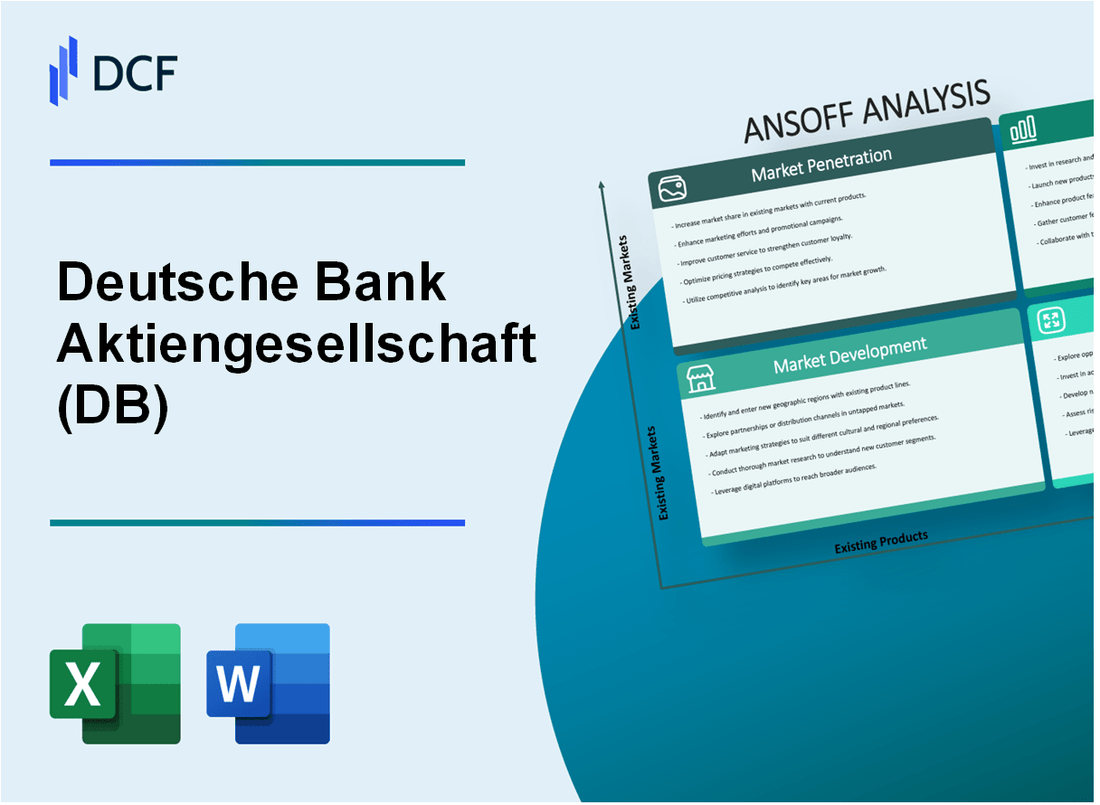
دويتشه بنك Aktiengesellschaft (DB): تحليل مصفوفة ANSOFF |
Fully Editable: Tailor To Your Needs In Excel Or Sheets
Professional Design: Trusted, Industry-Standard Templates
Investor-Approved Valuation Models
MAC/PC Compatible, Fully Unlocked
No Expertise Is Needed; Easy To Follow
Deutsche Bank Aktiengesellschaft (DB) Bundle
في المشهد المصرفي العالمي سريع التطور، يقوم Deutsche Bank Aktiengesellschaft بتنظيم رحلة استراتيجية تحويلية تمزج بين الابتكار الرقمي وتوسيع السوق والتقنيات المالية المتطورة. ومن خلال التنقل الدقيق في مصفوفة أنسوف، يضع البنك نفسه كقوة مالية ذات تفكير تقدمي، ويستهدف النمو بشكل استراتيجي عبر الخدمات الرقمية، والأسواق الناشئة، وتطوير المنتجات المبتكرة، والتنويع. استعد للتعمق في خريطة طريق مقنعة تكشف كيف يعيد دويتشه بنك تصور استراتيجيته التنافسية في نظام بيئي مالي متزايد التعقيد والديناميكي.
Deutsche Bank Aktiengesellschaft (DB) - مصفوفة أنسوف: اختراق السوق
توسيع الخدمات المصرفية الرقمية
أعلن دويتشه بنك عن وجود 15.3 مليون مستخدم للخدمات المصرفية الرقمية في عام 2022. وزادت المعاملات المصرفية عبر الهاتف المحمول بنسبة 42% مقارنة بالعام السابق. استثمر البنك 672 مليون يورو في البنية التحتية الرقمية وتحديث التكنولوجيا.
| مقياس الخدمات المصرفية الرقمية | أداء 2022 |
|---|---|
| إجمالي المستخدمين الرقميين | 15.3 مليون |
| نمو المعاملات المتنقلة | 42% |
| الاستثمار في البنية التحتية الرقمية | 672 مليون يورو |
تنفيذ استراتيجيات البيع المتبادل المستهدفة
حقق دويتشه بنك 3.4 مليار يورو من إيرادات البيع المتبادل من العملاء الحاليين من الشركات. وحقق البيع المتبادل للخدمات المصرفية للأفراد 1.2 مليار يورو إضافية في عام 2022.
- إيرادات البيع المتبادل للعملاء من الشركات: 3.4 مليار يورو
- إيرادات البيع المتبادل للخدمات المصرفية للأفراد: 1.2 مليار يورو
- متوسط المنتجات لكل عميل من الشركات: 3.7
- متوسط المنتجات لكل عميل تجزئة: 2.5
تعزيز تجربة العملاء
حصل تطبيق الخدمات المصرفية عبر الهاتف المحمول التابع لدويتشه بنك على تقييم 4.6/5 من المستخدمين. عالجت منصة الخدمات المصرفية عبر الإنترنت 287 مليون معاملة في عام 2022، مع وقت تشغيل للنظام بنسبة 99.8%.
| مقياس تجربة العملاء | أداء 2022 |
|---|---|
| تقييم مستخدم تطبيق الهاتف المحمول | 4.6/5 |
| المعاملات المصرفية عبر الإنترنت | 287 مليون |
| وقت تشغيل النظام | 99.8% |
نقدّم أسعار فائدة تنافسية
وعرض دويتشه بنك أسعار فائدة على حسابات التوفير تتراوح من 1.2% إلى 3.5% في عام 2022. وبلغ متوسط أسعار قروض الشركات 2.7% للمؤسسات الصغيرة والمتوسطة.
تطوير الخدمات الاستشارية المالية الشخصية
أطلق دويتشه بنك 127 برنامجًا استشاريًا ماليًا شخصيًا في عام 2022. نسبة رضا العملاء عن الخدمات الاستشارية وصلت إلى 88%. خصص البنك مبلغ 456 مليون يورو لتعزيز قدرات الاستشارات المالية الشخصية.
- إطلاق برامج استشارية شخصية: 127
- معدل رضا العملاء: 88%
- الاستثمار في الخدمات الاستشارية: 456 مليون يورو
Deutsche Bank Aktiengesellschaft (DB) - مصفوفة أنسوف: تطوير السوق
توسيع حضور الخدمات المصرفية الرقمية في الأسواق الناشئة
أعلن دويتشه بنك عن زيادة المعاملات المصرفية الرقمية في آسيا بنسبة 37% في عام 2022، مع نمو محدد في أسواق مثل الهند وإندونيسيا. بلغ حجم المعاملات الرقمية 4.2 مليار يورو في الأسواق الآسيوية الناشئة.
| السوق | نمو المعاملات الرقمية | المستخدمون الرقميون الجدد |
|---|---|---|
| الهند | 42% | 1.3 مليون |
| اندونيسيا | 29% | 780,000 |
| البرازيل | 33% | 650,000 |
تعزيز العمليات المصرفية للشركات
وصلت إيرادات الخدمات المصرفية للشركات في المناطق الأوروبية إلى 12.7 مليار يورو في عام 2022، وتمثل ألمانيا وهولندا 68% من إجمالي دخل الخدمات المصرفية للشركات.
تطوير الشراكات الاستراتيجية
- عقدت شراكة مع 17 مؤسسة مالية محلية في جميع أنحاء آسيا وأمريكا اللاتينية
- الاستثمار في البنية التحتية للشراكة: 320 مليون يورو
- إيرادات الشراكة المتوقعة: 1.8 مليار يورو بحلول عام 2024
عروض التمويل المستدام
وتوسعت محفظة التمويل الأخضر إلى 22.5 مليار يورو في الأسواق الناشئة، وهو ما يمثل زيادة بنسبة 44% عن عام 2021.
التكنولوجيا الرقمية للأسواق المحرومة
استثمرنا 475 مليون يورو في البنية التحتية للخدمات المصرفية الرقمية للأسواق المحرومة، مستهدفين 3.2 مليون عميل جديد في الاقتصادات الناشئة.
Deutsche Bank Aktiengesellschaft (DB) - مصفوفة أنسوف: تطوير المنتجات
أدوات الاستشارات المالية وإدارة الاستثمار المدعومة بالذكاء الاصطناعي
استثمر دويتشه بنك 1.5 مليار يورو في الذكاء الاصطناعي والتحول الرقمي في عام 2022. ونشر البنك أكثر من 350 خوارزمية قائمة على الذكاء الاصطناعي لإدارة المخاطر واستراتيجيات الاستثمار.
| الاستثمار في تكنولوجيا الذكاء الاصطناعي | المبلغ |
|---|---|
| إجمالي الاستثمار في الذكاء الاصطناعي 2022 | 1.5 مليار يورو |
| عدد خوارزميات الذكاء الاصطناعي | 350+ |
تطوير المنتجات الاستثمارية البيئية والاجتماعية والحوكمة
أدار دويتشه بنك 78 مليار يورو من الأصول البيئية والاجتماعية والحوكمة اعتبارًا من الربع الرابع من عام 2022. وزادت منتجات الاستثمار المستدامة بنسبة 42٪ على أساس سنوي.
| مقاييس الاستثمار البيئي والاجتماعي والحوكمة | القيمة |
|---|---|
| إجمالي الأصول البيئية والاجتماعية والحوكمة | 78 مليار يورو |
| نمو المنتجات البيئية والاجتماعية والحوكمة | 42% |
منصات إدارة الثروات الرقمية
أطلق دويتشه بنك منصة رقمية تستهدف جيل الألفية بحد أدنى للاستثمار قدره 500 يورو. اجتذبت المنصة 175000 عميل جديد في عام 2022.
| إحصائيات المنصة الرقمية | القيمة |
|---|---|
| الحد الأدنى للاستثمار | €500 |
| العملاء الجدد 2022 | 175,000 |
حلول التكنولوجيا المالية للشركات الصغيرة والمتوسطة
قام دويتشه بنك بتطوير 12 حلاً مصرفيًا رقميًا متخصصًا للمؤسسات الصغيرة والمتوسطة. بلغ إجمالي محفظة الخدمات المصرفية الرقمية للشركات الصغيرة والمتوسطة 22 مليار يورو في عام 2022.
| الخدمات المصرفية الرقمية للشركات الصغيرة والمتوسطة | القيمة |
|---|---|
| تم تطوير الحلول الرقمية | 12 |
| المحفظة الرقمية للشركات الصغيرة والمتوسطة | 22 مليار يورو |
خدمات Blockchain والعملات المشفرة
خصص دويتشه بنك مبلغ ٣٥٠ مليون يورو لتطوير منتجات بلوكتشين والعملات المشفرة. إطلاق 7 منتجات استثمارية مرتبطة بالعملات المشفرة في عام 2022.
| استثمار البلوكشين | القيمة |
|---|---|
| ميزانية تطوير Blockchain | 350 مليون يورو |
| تم إطلاق منتجات التشفير | 7 |
دويتشه بنك Aktiengesellschaft (DB) - مصفوفة أنسوف: التنويع
استثمر في الشركات الناشئة في مجال التكنولوجيا المالية لاستكشاف حلول التكنولوجيا المالية المبتكرة
استثمر دويتشه بنك 350 مليون يورو في مشاريع التكنولوجيا المالية في عام 2022. وحدد البنك 17 شركة ناشئة محددة في مجال التكنولوجيا المالية للاستثمارات الإستراتيجية خلال تلك السنة المالية.
| فئة الاستثمار | المبلغ المستثمر | عدد الشركات الناشئة |
|---|---|---|
| تقنيات البلوكشين | 87 مليون يورو | 5 الشركات الناشئة |
| حلول الدفع الرقمي | 129 مليون يورو | 8 الشركات الناشئة |
| منصات الذكاء الاصطناعي المالية | 134 مليون يورو | 4 الشركات الناشئة |
تطوير مصادر إيرادات بديلة من خلال تحقيق الدخل من المنصات الرقمية
حقق دويتشه بنك 2.1 مليار يورو من إيرادات المنصات الرقمية في عام 2022، وهو ما يمثل 14.3% من إجمالي الدخل من غير الفوائد.
- رسوم المعاملات على المنصة الرقمية: 612 مليون يورو
- إيرادات تسييل البيانات: 453 مليون يورو
- خدمات تكامل واجهة برمجة التطبيقات: 387 مليون يورو
التوسع في تمويل البنية التحتية المستدامة والاستثمار في الطاقة الخضراء
وخصص دويتشه بنك 25.5 مليار يورو لمشاريع البنية التحتية المستدامة في عام 2022.
| قطاع الاستثمار | إجمالي الاستثمار | العائد السنوي المتوقع |
|---|---|---|
| الطاقة المتجددة | 12.7 مليار يورو | 4.6% |
| البنية التحتية الخضراء | 8.3 مليار يورو | 3.9% |
| النقل المستدام | 4.5 مليار يورو | 3.2% |
إنشاء أنظمة بيئية رقمية متكاملة تجمع بين الخدمات المصرفية والتأمين والتكنولوجيا
أطلق دويتشه بنك 6 منصات متكاملة للنظام البيئي الرقمي في عام 2022، مما حقق 1.8 مليار يورو من الإيرادات عبر القطاعات.
- منصة التكامل بين الخدمات المصرفية والتأمين: 612 مليون يورو
- منصة الخدمات التكنولوجية المالية: 534 مليون يورو
- النظام البيئي لإدارة الثروات الرقمية: 654 مليون يورو
استكشف عمليات الاستحواذ الاستراتيجية في قطاعات التكنولوجيا المالية والدفع الرقمي الناشئة
أكمل دويتشه بنك 3 عمليات استحواذ تكنولوجية استراتيجية في عام 2022، بقيمة إجمالية بلغت 1.2 مليار يورو.
| هدف الاستحواذ | قيمة الصفقة | التركيز على التكنولوجيا الأولية |
|---|---|---|
| بدء الدفع الرقمي | 450 مليون يورو | حلول الدفع عبر الهاتف المحمول |
| شركة تكنولوجيا Blockchain | 380 مليون يورو | البنية التحتية للعملات المشفرة |
| شركة AI للتحليلات المالية | 370 مليون يورو | النمذجة المالية التنبؤية |
Deutsche Bank Aktiengesellschaft (DB) - Ansoff Matrix: Market Penetration
You're looking at how Deutsche Bank Aktiengesellschaft can deepen its hold in its current markets, which is the essence of market penetration. This means getting more business from the clients we already serve, rather than finding new ones or new products.
Increase wallet share in the German Private Bank segment
Focusing on the home turf is key. For the first nine months of 2025, the Private Bank division brought in net revenues of €7.2 billion, a 3% year-on-year rise. Within that, the Wealth Management & Private Banking segment specifically saw revenues grow by 5% to €3.3 billion for the same nine-month period. Assets under management (AUM) across the Private Bank and Asset Management divisions rose by €109 billion in the twelve months leading up to the first half of 2025. To capture more wallet share, Deutsche Bank Aktiengesellschaft established a dedicated Ultra High-Net-Worth (UHNW) coverage unit in Germany, staffed by over 50 specialized employees, targeting complex family governance and asset allocation for large entrepreneurs. The third quarter of 2025 saw Private Bank net revenues hit €2.4 billion.
Offer competitive pricing on Corporate Bank lending to key EU clients
The Corporate Bank is leveraging its leading position in Germany to support clients capitalizing on European investment programs, including cooperation with KfW and EIB for tailored solutions. For the first nine months of 2025, the Corporate Bank delivered a profit before tax of €2.0 billion, achieving a Return on Tangible Equity (RoTE) of 16.0%. In the second quarter of 2025, Corporate Bank net revenues were €1.9 billion, which was 1% lower year on year. The strategy here is to use the existing platform to capture more of the financing demand related to the German and European infrastructure and defense agenda.
Boost digital adoption for existing retail customers via the mobile app
Digital engagement is non-negotiable now. While specific Deutsche Bank Aktiengesellschaft mobile adoption figures for existing retail customers aren't public, the broader German market context shows that 60% of German consumers prefer using their banking app to manage finances, according to 2024 data. Globally, the number of mobile banking users reached 2.17 billion by the end of 2025. For existing customers, boosting adoption means driving usage of features like PFM (Personal Financial Management) and investment tracking within the app. The bank is working toward its 2025 financial targets, which include a Group cost/income ratio target of below 65%, achieved at 63.0% for the first nine months of 2025.
Cross-sell wealth management services to high-net-worth Investment Bank clients
This involves deepening relationships with the Investment Bank's top-tier clients. The Investment Bank division posted a profit before tax of €3.3 billion in the first nine months of 2025, with a RoTE of 12.5%. The overall Investment Bank division generated €10.6 billion in revenue last year, up 15%, and is on course for €11.5 billion this year. A clear action point is the stated aim for the Investment Banking and Capital Markets (IBCM) unit to grow its coverage from 35% to around 40% of the fee payers by fee volume by the end of 2028. This growth in coverage directly relates to cross-selling more services, including wealth management, to the existing corporate and institutional client base.
Run targeted campaigns to capture more fixed-income trading volume
Fixed Income, Currency (FIC) Sales & Trading is a core revenue driver, accounting for more than 80% of the Investment Bank's revenues as of September 30, 2024. In the first quarter of 2025, FIC revenues were up 17% year-on-year, contributing significantly to the Investment Bank's total revenue of €3.4 billion, a 10% increase year-on-year. Deutsche Bank Aktiengesellschaft has an explicit goal to boost fixed income revenue by 20% from 2023 to 2027. The bank has already added over 600 staff in the Americas over the last three years to bolster this business.
Here's a quick look at some key 2025 financial performance indicators through the first nine months:
| Business Segment | Profit Before Tax (9M 2025) | Return on Tangible Equity (RoTE 9M 2025) | Cost/Income Ratio (9M 2025) |
| Corporate Bank | €2.0 billion | 16.0% | 62% |
| Investment Bank | €3.3 billion | 12.5% | 55% |
| Group (Overall) | €7.7 billion | 10.9% | 63.0% |
The Group's overall post-tax Return on Average Tangible Shareholders' Equity (RoTE) was 10.9% in the first nine months of 2025, hitting the bank's 2025 target of above 10%.
Finance: draft the Q4 2025 client acquisition targets for the UHNW unit by end of January.
Deutsche Bank Aktiengesellschaft (DB) - Ansoff Matrix: Market Development
You're looking at where Deutsche Bank Aktiengesellschaft (DB) is taking its existing services into new geographies or client sets for growth.
US Corporate Bank Expansion
The strategy involves pushing Corporate Bank coverage outside the established major financial centers in the US. This targets capturing market share in underpenetrated US markets, leveraging the high-yield platform. While specific client count increases outside hubs for 2025 aren't public, the overall revenue context is set by the forecast.
| Metric | 2025 Forecast/Target |
| Forecasted Full-Year Revenue | € 32 billion |
| Target Cost/Income Ratio | below 65% |
This market development push supports the broader ambition to scale the Global Hausbank.
Asia-Pacific Mid-Sized Company Targeting (Vietnam Focus)
Targeting mid-sized companies in high-growth Asia-Pacific markets like Vietnam is a key development area. Vietnam has seen significant trade shifts, making it pivotal for regional strategy.
- Exports to the United States from Vietnam increased by US$ 60 billion between 2017 and 2023.
- Deutsche Bank Aktiengesellschaft (DB) has raised over US$ 1 billion annually for Vietnamese corporates in debt, loan, and equity capital since 2017.
- Deutsche Bank Aktiengesellschaft (DB) doubled its capital allocation in Vietnam to over US$ 200 million (as of 2023).
Latin American Private Bank Launch (Mexico Start)
Launching Private Bank services in select Latin American countries, starting with Mexico, taps into local wealth and nearshoring investment flows. The Private Bank segment's performance metrics provide a baseline for the division's focus.
| Private Bank Performance Metric | 2024 Actual | 2025 Forecast |
| Cost/Income Ratio | 75.0% | 69.6% |
| Post-tax Return on Average Tangible Shareholders' Equity | 9.2% | 10.5% |
The bank is focused on scaling franchise with asset gathering, which is central to Private Bank growth.
Trade Finance Solutions in Eastern Europe
Offering trade finance solutions to new client segments in Eastern Europe aligns with Deutsche Bank Aktiengesellschaft (DB)'s CEO role for Central and Eastern Europe and its global trade finance recognition.
- Deutsche Bank Aktiengesellschaft (DB) secured 25 No 1 rankings in the Euromoney Trade Finance Survey for 2025.
- Global trade volume reached US$ 33 trillion in 2024.
- The bank is leveraging its export credit agency (ECA) coverage to support corporate trade in the region.
Digital Platforms for Eurozone Small Businesses
Using digital platforms to reach underserved small businesses across the Eurozone is executed via the Fyrst digital banking offering. This is a direct play for market share against fintechs.
| Fyrst (DB Digital SME Offering) Metric | Current Count (Approx.) | End of 2025 Target |
| Accounts | 75,000 | 90,000 to 95,000 |
| Total Customers (Fyrst, Postbank, DB Brand) | Around 800,000 | N/A |
Speed of account opening, taking as little as ten minutes for individuals, is a key competitive factor in this digital segment.
Finance: draft 13-week cash view by Friday.
Deutsche Bank Aktiengesellschaft (DB) - Ansoff Matrix: Product Development
You're looking at how Deutsche Bank Aktiengesellschaft is pushing new products into existing markets, which is the heart of Product Development on the Ansoff Matrix. This isn't just about tweaking old services; it's about building entirely new offerings to meet evolving client demands, especially around digital assets and sustainability.
Introduce new ESG-linked derivatives for institutional investors
The push for Environmental, Social, and Governance (ESG) products is translating into concrete transaction volumes for Deutsche Bank Aktiengesellschaft. You saw the cumulative sustainable financing and ESG investment volumes hit €417 billion as of the end of the second quarter of 2025, up from €373 billion at the end of 2024. This is closing in on the initial goal of achieving €500 billion by the end of 2025. The Investment Bank segment has been the biggest driver here, recording €253 billion cumulatively since 2020, with €17 billion added in Q2 2025 alone. The bank has already set a more ambitious long-term goal: facilitating €900 billion in sustainable and transition finance by the end of 2030.
These sustainability-linked solutions are a key part of the offering. For instance, in Q2 2025, the private bank grew its ESG assets and client lending by €5 billion. The focus on these products shows client demand is strong, even if the specific volume for new ESG-linked derivatives isn't broken out separately.
Develop a proprietary digital asset custody platform for institutional clients
Deutsche Bank Aktiengesellschaft is moving deliberately into digital asset custody, planning a launch for 2026. This isn't a small side project; it involves building regulated custody solutions for institutional investors and corporate clients who need secure storage for their crypto holdings. The bank is leveraging partnerships, including with Taurus, which already provides enterprise-grade digital asset infrastructure for over 25 institutional clients. This move aligns with the bank's broader strategy to increase fee income, mirroring efforts in its DWS Group investment arm.
The Head of Digital Assets noted that the digital asset space is expected to encompass trillions of dollars of assets, making it a priority for investors. You've got to appreciate the measured timeline; developing the necessary infrastructure and ensuring regulatory compliance takes time, especially when dealing with assets that saw a market cap leap from $20 billion in 2020 to $246 billion.
Launch a fully automated, low-cost robo-advisory service for retail clients
The retail space sees Deutsche Bank Aktiengesellschaft involved in the robo-advisory segment, with its offering, Robin, categorized as a sales-oriented solution. While the bank's own client numbers for its specific service aren't immediately available, its research projected that German robo-advisors, in general, would manage about €25-35 billion by 2025. However, a July 2025 study indicated that the overall German robo-advisor market is stagnating despite a strong stock market year in 2024. The cost structure is a key factor; service fees for these digital wealth managers typically range between 0.35 and 1.18 percent per year.
Create specialized sector-focused lending products for the tech industry
Deutsche Bank Aktiengesellschaft is definitely focused on the tech sector, particularly as it relates to the AI boom. The bank has financed large parts of the data center network supporting major platforms like Microsoft, Google, and Amazon. While a specific portfolio size for all tech lending isn't cited, the focus on infrastructure supporting AI-like data centers-is clear. The bank is reviewing its exposure here, signaling a need to balance confidence in growth with a safety net against overexposure. The 2025 net revenue outlook for the entire bank is around €32 billion.
Integrate advanced AI tools for personalized credit risk management
Integrating advanced Artificial Intelligence (AI) and Machine Learning (ML) is a cornerstone of Deutsche Bank Aktiengesellschaft's 2025 strategic vision for sustainable growth. In credit risk specifically, modernization efforts have yielded concrete efficiency gains. Process automation removed numerous manual checks, leading to a 25% improvement in Risk Manager productivity. In one measured instance, report-generation time fell by 21 days. This entire credit risk technology overhaul delivered over €10 million in savings and improved overall productivity by 10%. The bank aims to scale generative AI securely across all divisions, positioning itself for future applications.
Here are some key financial and operational metrics related to the bank's 2025 targets and recent performance, which underpin these product development investments:
| Metric | 2025 Target/Forecast | 2024 Actual/End of Year |
| Net Revenues (Forecast) | Around €32 billion | N/A |
| Return on Tangible Equity (RoTE) Target | Above 10% | N/A |
| Cost/Income Ratio Target | Below 65% | N/A |
| CET1 Capital Ratio (Forecast) | Approximately 14% | 13.8% |
| Capital Distributions Authorized (So Far) | €2.1 billion | €675 million (2024 share repurchases) |
The bank's focus on technology investment is significant; leading institutions are collectively investing over $35 billion in AI across North America, Europe, and Asia in 2025, often equating to over 35% of total IT budgets.
You should review the Q3 2025 results when they drop to see the immediate impact of these new product initiatives on fee income growth.
Deutsche Bank Aktiengesellschaft (DB) - Ansoff Matrix: Diversification
You're looking at how Deutsche Bank Aktiengesellschaft (DB) can push beyond its core markets, which is what diversification in the Ansoff Matrix is all about. The bank's current health is strong; for the first nine months of 2025, profit before tax hit € 7.7 billion, and the Return on Tangible Equity (RoTE) has been consistently above 10% across all three quarters of 2025 to date. Still, growth requires new frontiers, so let's map out these potential moves.
Acquire a specialized payments processing firm in the US market.
Moving into specialized payments processing in the US means targeting a market that is structurally pivoting toward real-time rails. The United States payments market itself stands at USD 13.24 billion in 2025. This is a fraction of the global payment processing solutions vendor revenue, which is estimated at USD 173.38 billion for 2025. An acquisition here would immediately place Deutsche Bank Aktiengesellschaft (DB) in the middle of the action, capturing revenue from the 16.71% Compound Annual Growth Rate (CAGR) projected for the US market through 2030. This isn't just about volume; it's about owning the infrastructure that supports the shift to instant payments, a space where Deutsche Bank Aktiengesellschaft (DB) is already active, having helped a partner establish real-time payout infrastructure covering more than 90% of its merchant transactions.
Establish a venture capital arm to invest in FinTech and RegTech startups.
Formalizing a venture capital (VC) arm allows Deutsche Bank Aktiengesellschaft (DB) to gain early access to disruptive technologies, which is crucial given that private business investment, excluding AI, has shown little to no growth since 2019, according to the bank's own analysis. You see the bank is already active here; for instance, its corporate venture capital (CVC) group invested in the AI company Aleph Alpha in November 2024. Furthermore, the bank actively partners with fintechs, such as its August 2025 collaboration with Upvest to provide banking infrastructure, including virtual IBANs and automated payment processing. This strategy directly addresses the need to stay close to innovation, as Deutsche Bank Aktiengesellschaft (DB) maintains Innovation Network offices in key hubs like Berlin, New York, and Palo Alto for scouting.
Offer a white-labeled Banking-as-a-Service (BaaS) platform to non-financial firms.
The BaaS space is expanding rapidly, making it a prime target for a bank with existing infrastructure to monetize. The global Banking as a Service market is valued at USD 24.58 billion in 2025, with projections to reach USD 60.35 billion by 2030. North America currently holds about 31% of this market share in 2025. By offering a white-labeled platform, Deutsche Bank Aktiengesellschaft (DB) can embed its regulated services into non-financial firms' user journeys, tapping into the 21.4% CAGR expected for the BaaS market through 2029. This leverages the bank's existing strengths, as its Corporate Bank division already focuses on innovative financial solutions at the intersection of IoT and 'Pay per use' models.
Develop a dedicated carbon-credit trading and advisory business unit.
The environmental, social, and governance (ESG) trend is creating massive new markets. The global carbon credit market size is estimated at USD 933.23 billion in 2025, though the compliance segment drives the vast majority, contributing more than 98% of revenue in 2025. For context, the compliance-driven EU Emissions Trading System alone reached a value of ~€881 billion (US$949 billion) in 2023. A dedicated unit would focus on advisory services for corporate clients navigating these mandatory frameworks, while also capturing a piece of the voluntary market, which, despite a 2024 dip to roughly $535 million, is forecast to reach $10-25 billion by 2030. This aligns with the bank's long-term optimism for copper stemming from energy transition trends.
Enter the insurance brokerage market through a strategic partnership.
Partnering to enter insurance brokerage provides access to a stable, fee-based revenue stream driven by risk management needs. The global insurance brokerage market size is specifically valued at $125.49 billion in 2025. The top 10 global brokerage firms alone generated over $100 billion in combined revenues in 2025. The Property and Casualty insurance segment is the largest, holding approximately 70% market share in 2025. A partnership would allow Deutsche Bank Aktiengesellschaft (DB) to immediately offer specialized risk management, which is a key driver, especially for specialty lines like cyber and ESG insurance that are growing above 30% annually.
Here's a quick look at the market sizes you'd be targeting with these diversification moves:
| Market Segment | 2025 Estimated Size / Value | Key Growth Metric |
|---|---|---|
| Global Payment Processing (Vendor Revenue) | USD 173.38 billion | 10-20% CAGR (2025-2030) |
| US Payments Market | USD 13.24 billion | 16.71% CAGR (to 2030) |
| Global Banking-as-a-Service (BaaS) | USD 24.58 billion | 24.34% CAGR for embedded finance software (to 2030) |
| Global Carbon Credit Market | USD 933.23 billion | 37.68% CAGR (2025-2034) |
| Global Insurance Brokerage | $125.49 billion | 4.80% CAGR (to 2029) |
Finance: draft the capital allocation plan for the VC arm by next Wednesday.
Disclaimer
All information, articles, and product details provided on this website are for general informational and educational purposes only. We do not claim any ownership over, nor do we intend to infringe upon, any trademarks, copyrights, logos, brand names, or other intellectual property mentioned or depicted on this site. Such intellectual property remains the property of its respective owners, and any references here are made solely for identification or informational purposes, without implying any affiliation, endorsement, or partnership.
We make no representations or warranties, express or implied, regarding the accuracy, completeness, or suitability of any content or products presented. Nothing on this website should be construed as legal, tax, investment, financial, medical, or other professional advice. In addition, no part of this site—including articles or product references—constitutes a solicitation, recommendation, endorsement, advertisement, or offer to buy or sell any securities, franchises, or other financial instruments, particularly in jurisdictions where such activity would be unlawful.
All content is of a general nature and may not address the specific circumstances of any individual or entity. It is not a substitute for professional advice or services. Any actions you take based on the information provided here are strictly at your own risk. You accept full responsibility for any decisions or outcomes arising from your use of this website and agree to release us from any liability in connection with your use of, or reliance upon, the content or products found herein.