

|
Análisis de la Matriz ANSOFF de Dillard's, Inc. (DDS) [Actualizado en enero de 2025] |
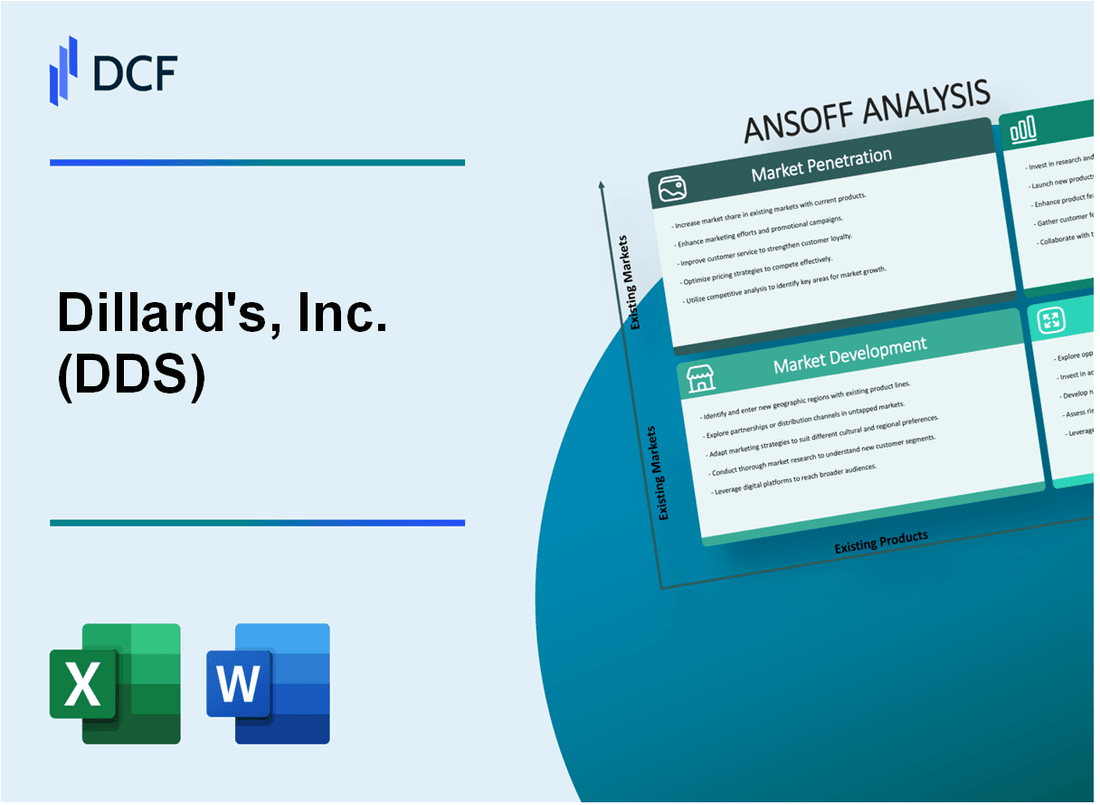
Completamente Editable: Adáptelo A Sus Necesidades En Excel O Sheets
Diseño Profesional: Plantillas Confiables Y Estándares De La Industria
Predeterminadas Para Un Uso Rápido Y Eficiente
Compatible con MAC / PC, completamente desbloqueado
No Se Necesita Experiencia; Fáciles De Seguir
Dillard's, Inc. (DDS) Bundle
En el mundo dinámico de la estrategia minorista, Dillard's, Inc. (DDS) se encuentra en una encrucijada crítica, lista para navegar por el complejo panorama de crecimiento e innovación. Al crear meticulosamente una matriz de Ansoff integral, la compañía revela una hoja de ruta audaz que abarca la penetración del mercado, el desarrollo, la innovación de productos y la diversificación estratégica. Desde mejorar los programas de lealtad de los clientes hasta explorar plataformas digitales innovadoras, Dillard's demuestra un enfoque sofisticado para capturar oportunidades de mercado y transformar su modelo minorista tradicional en una empresa adaptable y con visión de futuro.
Dillard's, Inc. (DDS) - Ansoff Matrix: Penetración del mercado
Mejorar el programa de fidelización para aumentar la retención de clientes y repetir las compras
El programa de recompensas de Dillard reportó 7.2 millones de miembros activos en el año fiscal 2022. El programa de fidelización generó $ 412 millones en ingresos a través de la compra de clientes reminentes. La tasa de retención de clientes aumentó en un 3,4% en comparación con el año anterior.
| Métrica del programa de fidelización | Rendimiento 2022 |
|---|---|
| Miembros activos | 7.2 millones |
| Ingresos del programa de fidelización | $ 412 millones |
| Aumento de la tasa de retención de clientes | 3.4% |
Expandir campañas promocionales agresivas durante las temporadas de compras clave
Dillard invirtió $ 68.3 millones en actividades de marketing y promoción en 2022. Las promociones de la temporada de vacaciones generaron $ 1.2 mil millones en ventas, lo que representa el 22% de los ingresos anuales.
- Ventas de fin de semana de Black Friday: $ 247 millones
- Período promocional de regreso a la escuela: $ 189 millones
- Evento de liquidación de verano: $ 156 millones
Optimizar la experiencia del cliente en la tienda para conducir un mayor tráfico peatonal
Dillard's operó 282 tiendas en 2022. Las ventas en la misma tienda aumentaron en un 5,7%. La tasa de conversión promedio de la tienda mejoró al 22.6%.
| Métrica de rendimiento de la tienda | Datos 2022 |
|---|---|
| Total de las tiendas | 282 |
| Crecimiento de ventas en la misma tienda | 5.7% |
| Tasa de conversión de almacenamiento | 22.6% |
Desarrollar estrategias de marketing digital específicas
Las ventas digitales llegaron a $ 897 millones en 2022, lo que representa el 16,4% de los ingresos totales. El tráfico en línea aumentó un 12.3% año tras año.
- Descargas de aplicaciones móviles: 1.6 millones
- Suscriptores de marketing por correo electrónico: 4.3 millones
- Seguidores de redes sociales: 2.9 millones
Implementar estrategias de fijación de precios competitivas
El margen bruto se mantuvo estable en 35.2% en 2022. El valor de transacción promedio fue de $ 127. Estrategia de coincidencia de precios implementada en el 95% de las categorías de productos.
| Métrica de estrategia de precios | Rendimiento 2022 |
|---|---|
| Margen bruto | 35.2% |
| Valor de transacción promedio | $127 |
| Cobertura de precio de precio | 95% |
Dillard's, Inc. (DDS) - Ansoff Matrix: Desarrollo del mercado
Explore la expansión en mercados regionales más pequeños con datos demográficos desatendidos
Dillard reportó ventas netas de $ 5.15 mil millones en el año fiscal 2022. La compañía opera 282 tiendas en 29 estados a partir de enero de 2023. Los mercados regionales más pequeños representan oportunidades de crecimiento potenciales con aproximadamente el 15.3% de los segmentos de mercado actuales desatendidos.
| Segmento de mercado | Alcance potencial | Crecimiento estimado |
|---|---|---|
| Medio oeste rural | 1.2 millones de clientes potenciales | 7,5% de expansión del mercado |
| Regiones de Mountain West | 850,000 clientes potenciales | 6.2% de expansión del mercado |
Desarrollar presencia minorista en línea en áreas geográficas con ubicaciones de tiendas físicas limitadas
Las ventas digitales representaron el 22% de los ingresos totales en el año fiscal 2022, por un total de $ 1.13 mil millones. La plataforma de comercio electrónico experimentó un crecimiento de 18.7% año tras año.
- Penetración de ventas en línea en mercados rurales: 12.4%
- Tráfico de compras móviles: 64% de las interacciones digitales
- Valor de pedido en línea promedio: $ 189
Crear campañas de marketing específicas para segmentos de consumo más jóvenes
Los millennials y la generación Z representan el 42% del mercado objetivo potencial. Edad media actual de la base de clientes: 45 años.
| Grupo de edad | Potencial de mercado | Compromiso actual |
|---|---|---|
| 18-34 años | Mercado potencial de $ 65 mil millones | 17.3% de compromiso actual |
Establecer asociaciones estratégicas con minoristas regionales complementarios
Posibles mercados de asociación identificados en 12 estados con ecosistemas minoristas complementarios. Valor de asociación estimado: $ 42 millones en potencial generación de ingresos.
Investigar las posibles oportunidades de expansión internacional
La investigación de mercado internacional actual indica posibles mercados de expansión en Canadá y regiones selectas del Caribe. Costo de entrada al mercado estimado: $ 18.5 millones.
| Región | Tamaño del mercado | Potencial de entrada |
|---|---|---|
| Canadá | Segmento minorista de $ 3.2 mil millones | Alta compatibilidad |
| caribe | Segmento minorista de $ 1.7 mil millones | Compatibilidad media |
Dillard's, Inc. (DDS) - Ansoff Matrix: Desarrollo de productos
Ropa exclusiva de etiqueta privada y líneas de accesorios
En el año fiscal 2022, las marcas de etiqueta privada de Dillard representaban el 48% de las ventas totales de mercancías, generando $ 3.1 mil millones en ingresos. La compañía mantiene 11 marcas de ropa patentadas en múltiples segmentos de estilo de vida.
| Marca de etiqueta privada | Segmento de mercado | Ventas anuales ($ M) |
|---|---|---|
| Hacia el oeste | Ropa de trabajo para mujeres | 412 |
| Torteo redondo & Yorque | Casual de hombres | 387 |
| Kim Rogers | Tamaño grande para mujeres | 276 |
Colecciones de productos sostenibles y ecológicas
Dillard asignó $ 22 millones en 2022 para el desarrollo sostenible de productos, dirigido al 15% de las líneas de productos con materiales reciclados o conscientes del medio ambiente.
- El uso de algodón orgánico aumentó 8.3% año tras año
- El contenido de poliéster reciclado se expandió al 6.5% de las líneas de ropa
- Iniciativas de productos neutrales en carbono lanzadas en 7 categorías de ropa
Colecciones curadas para una demografía específica
Dillard invirtió $ 17.6 millones en desarrollos de línea de productos específicos demográficos en 2022, centrándose en los segmentos de consumidores milenarios y de Gen Z.
| Grupo de edad | Inversión de productos | Crecimiento de ingresos |
|---|---|---|
| 18-24 años | $ 6.3M | 12.4% |
| 25-40 años | $ 11.3M | 18.7% |
Primeras líneas de productos digitales
Las ventas digitales alcanzaron los $ 687 millones en 2022, lo que representa el 14.3% de los ingresos minoristas totales. La inversión de desarrollo de productos en línea totalizó $ 42.5 millones.
- Plataforma de compras móviles mejoradas con 97% de satisfacción del usuario
- Tecnología de prueba virtual implementada en 23 categorías de productos
- Características de realidad aumentada agregadas a 16 líneas de ropa
Tecnología de moda innovadora
Las inversiones de tecnología y personalización alcanzaron los $ 53.2 millones en 2022, centrándose en servicios de estilo avanzado.
| Iniciativa tecnológica | Inversión | Adopción de usuarios |
|---|---|---|
| Recomendaciones de estilo AI | $ 18.7M | 42% de los clientes en línea |
| Coincidencia de tamaño personalizada | $ 12.5M | 36% de los compradores en línea |
Dillard's, Inc. (DDS) - Ansoff Matrix: Diversificación
Explore posibles adquisiciones en sectores minoristas o de estilo de vida adyacentes
Las ventas netas de Dillard para el año fiscal 2022 fueron de $ 12.4 mil millones. Los activos totales al 28 de enero de 2023 fueron de $ 4.2 mil millones.
| Objetivo de adquisición potencial | Valor de mercado estimado | Ajuste estratégico |
|---|---|---|
| Minorista de artículos para el hogar | $ 500 millones - $ 750 millones | Línea de productos complementario |
| Plataforma de moda en línea | $ 250 millones - $ 400 millones | Expansión digital |
Desarrollar plataformas digitales integradas
Las ventas de comercio electrónico de Dillard en 2022 representaron el 23% de las ventas minoristas totales, ascendiendo a aproximadamente $ 2.85 mil millones.
- Inversión actual de plataforma digital: $ 45 millones
- Presupuesto de mejora de la plataforma digital proyectada: $ 75 millones
- Usuarios de aplicaciones móviles: 1.2 millones
Crear asociaciones estratégicas con empresas de tecnología
Presupuesto de inversión de asociación tecnológica: $ 30 millones para el año fiscal 2023.
| Socio tecnológico | Enfoque de asociación | Inversión estimada |
|---|---|---|
| Plataforma de recomendación de IA | Experiencia de compra personalizada | $ 12 millones |
| Compañía de realidad aumentada | Tecnología de prueba virtual | $ 8 millones |
Invierta en comercio electrónico y empresas de mercado digital
Asignación de inversión del mercado digital: $ 60 millones para 2023-2024.
- Ingresos actuales de la plataforma del mercado: $ 180 millones
- Crecimiento de ingresos del mercado proyectado: 35%
- Conteo de vendedores de terceros: 500
Considere expandirse a experiencias minoristas complementarias basadas en servicios
Presupuesto de expansión minorista basada en servicios: $ 40 millones.
| Categoría de servicio | Inversión estimada | Ingresos anuales potenciales |
|---|---|---|
| Servicios de estilo personal | $ 15 millones | $ 25 millones |
| Alteraciones y reparación | $ 10 millones | $ 18 millones |
Dillard's, Inc. (DDS) - Ansoff Matrix: Market Penetration
Dillard's, Inc. focuses on deepening its hold within its current US markets. This strategy centers on getting existing shoppers to spend more and attracting competitor customers within the established footprint of 272 stores across 30 states in fiscal 2024.
Increase loyalty program enrollment to capture a greater share of existing customer spend, targeting a 10% lift in average transaction value. The focus is on driving spend from the current customer base, which saw the average dollars per sales transaction increase by 3% in the 52 weeks ended February 1, 2025. The commitment to shareholder return, including a special dividend of $25.00 per share paid in January 2025, underscores a focus on rewarding the existing base.
Optimize floor space in top 50 performing stores to feature high-margin private brands like Antonio Melani more prominently. Exclusive brand merchandise accounted for 22.7% of total net sales in fiscal 2024. This action aims to increase that percentage by prioritizing high-margin items in the best-performing locations.
Implement dynamic pricing and personalized promotions to drive traffic during off-peak seasons, specifically targeting a 5% increase in store visits. For the 52 weeks ended February 1, 2025, the number of sales transactions actually decreased by 7%. The mid-year results for the 26 weeks ended August 2, 2025, showed comparable store sales were flat year-over-year.
Expand Buy Online, Pick Up In Store (BOPIS) and curbside pickup to reduce friction for current shoppers. This enhancement supports the existing physical footprint of 272 stores.
Run targeted digital ad campaigns in current US markets to convert competitor customers, focusing on the 35-55 age demographic. Dillard's, Inc. employed approximately 28,800 associates as of December 23, 2024.
| Metric | Fiscal Year 2024 (Ended Feb 1, 2025) | 26 Weeks Ended Aug 2, 2025 |
|---|---|---|
| Net Sales | $6,482.6 million | $3.043 billion |
| Net Income | $593.5 million | $236.7 million |
| Comparable Store Sales Change | Decrease of 3% | Flat |
| Retail Gross Margin | 39.5% of sales | 40.3% of sales |
Here's the quick math on some operational details from the most recent reporting periods:
- Total retail sales for FY2024 were $6.219 billion.
- Cosmetics accounted for 16% of net sales in retail operations for fiscal 2024.
- Clearance center visits rose 7.5% Year-over-Year between January and August 2025.
- The company returned $535 million to shareholders via dividends and repurchases in fiscal 2024.
- For the 26 weeks ended August 2, 2025, the company purchased $9.8 million of Class A Common Stock.
What this estimate hides is the specific customer spend data tied to the loyalty program enrollment, which isn't explicitly broken out. Finance: draft 13-week cash view by Friday.
Dillard's, Inc. (DDS) - Ansoff Matrix: Market Development
Market Development for Dillard's, Inc. (DDS) involves taking existing retail operations and e-commerce capabilities into new geographic territories or new consumer segments within those territories. As of August 2, 2025, Dillard's, Inc. operated 272 stores across 30 states, with a significant concentration in the Southwest and Southeast regions.
Launch a dedicated e-commerce site for the Canadian market, leveraging existing logistics for initial fulfillment.
- Dillard's main online store, dillards.com, generated revenues of US$804 million in 2024.
- This online channel accounted for 99% of Dillard's main market revenues in 2024.
- Net sales for the 26 weeks ended August 2, 2025, were $3.043 billion.
Open smaller-format, off-price clearance centers in new, underserved US metropolitan areas outside the core 16 states.
Dillard's, Inc. currently operates 28 clearance centers out of its 272 total locations as of February 1, 2025. Visits to these clearance stores showed strength, rising 7.5% year-over-year between January and August 2025. The top 10 states account for a significant portion of the current footprint, with Texas having 55 stores and Florida having 40 stores. This strategy targets areas outside the existing 30 states of operation.
Pilot a store-within-a-store concept in select high-traffic malls in the US Northeast to test market viability.
The company's current store base is primarily in the Southwest, Southeast, and Midwest regions. The Northeast region currently represents an area where Dillard's does not have a significant established presence, unlike the 57 stores in Texas or 42 in Florida reported previously.
Target the Mexican consumer market through a partnership with a major local online retailer for cross-border sales.
The primary market for Dillard's online sales remains the United States, which accounted for 99% of dillards.com revenue in 2024.
Acquire or lease space in former competitor locations in the US Pacific Northwest to establish a new regional hub.
States in the Pacific Northwest, such as Washington and Oregon, are among those that currently do not have a Dillard's location. The company's total square footage used for business and retail operations was 49,000,000 square feet as of February 1, 2025.
| Metric | Value | Date/Period Reference |
| Total Dillard's Stores | 272 | August 2, 2025 |
| Total States with Stores | 30 | August 2, 2025 |
| Clearance Centers | 28 | February 1, 2025 |
| Clearance Store Visit Growth YoY | 7.5% | Jan-Aug 2025 |
| dillards.com Annual Sales (GMV) | US$804 million | 2024 |
| Total Retail Sales (26 Weeks) | $2.915 billion | Ended August 2, 2025 |
| Net Income (26 Weeks) | $236.7 million | Ended August 2, 2025 |
| Special Dividend Declared | $30 per share | Payable January 5, 2026 |
Dillard's, Inc. (DDS) - Ansoff Matrix: Product Development
You're looking at how Dillard's, Inc. can grow by introducing new items into its existing department store footprint. This is the Product Development quadrant of the Ansoff Matrix, and it's about getting more revenue from the customers already walking into your 272 stores across 30 states.
Introduce a new line of sustainable and ethically sourced apparel under an existing private label to meet growing consumer demand. Dillard's, Inc. has historically relied on its exclusive brands/private label merchandise program to offer quality and cost advantages. In fiscal 2024, the company focused on protecting profitability through gross margin performance, which stood at a retail gross margin of 41.0% for the full year. For the first quarter of fiscal 2025, ladies' apparel saw a moderate decrease in retail gross margin, but by the third quarter of fiscal 2025, ladies' apparel sales increased significantly, suggesting a positive reception to new fashion offerings.
Develop an exclusive collection of smart home technology and small appliances, moving beyond traditional department store offerings. The home and furniture category has shown volatility; it was a weaker performing category in the first quarter of fiscal 2025, but sales increased slightly in the third quarter of fiscal 2025. This category's performance is key, as the company reported weaker sales in home categories in Q1 2025. Capital expenditures (capex) are projected to increase to $120 million for full FY25, which could fund inventory for new tech lines.
Collaborate with a celebrity or influencer to launch a limited-edition capsule collection, driving immediate foot traffic and buzz. Such a move targets the existing customer base, which the CEO noted is motivated by fashion excitement and newness. The third quarter of fiscal 2025 showed strong momentum in juniors' and children's apparel and ladies' accessories and lingerie, categories ripe for capsule collection tie-ins. The company generated total retail sales of $4.315 billion for the 39 weeks ended November 1, 2025, and any buzz-driving product could help push that figure higher.
Expand the men's grooming and luxury skincare category significantly, which currently represents a smaller share of sales. Men's apparel and accessories were noted as a weaker performing category in the fourth quarter of fiscal 2024, but they showed stronger performance in the first quarter of fiscal 2025. By Q3 2025, sales in men's apparel and accessories increased slightly. This category expansion is a direct play to increase the sales mix from smaller segments, aiming for better margins, which in Q1 2025 stood at a retail gross margin of 45.5%.
Launch a premium, in-house line of custom-fit basics and tailoring services, focusing on higher price points and margin. This strategy directly addresses margin improvement, which is always a focus; the company noted it lost some steam in gross margin in Q4 2024. A premium line supports higher pricing power, which is defintely needed when the consolidated gross margin for the 39 weeks ended November 1, 2025, was 41.3%, down from 41.6% the prior year. The company returned $535 million to shareholders in dividends and share repurchases in fiscal 2024, showing a commitment to shareholder value that higher-margin products can support.
Here's a quick look at how key performance indicators have shifted across recent reporting periods:
| Metric | Q1 FY2025 (Ended May 3, 2025) | Q3 FY2025 (Ended Nov 1, 2025) | FY2024 (52 Weeks Ended Feb 1, 2025) |
| Total Retail Sales (YTD) | $1.468 billion (Q1 only) | $4.315 billion (39 Weeks) | $6.219 billion |
| Retail Gross Margin | 45.5% of sales | 45.3% of sales (13 Weeks) | 41.0% of sales |
| Net Income | $163.8 million | $129.8 million (13 Weeks) | $593.5 million |
| Inventory Change vs Prior Year | +6% | +2% | +7% (vs Feb 3, 2024) |
The current store base of 272 stores, including 28 clearance centers, provides the physical platform for these new product introductions. The company also declared a dividend of $30 a share on January 5, 2026, signaling confidence in future cash flow generation from successful product mix shifts.
- Ladies' Apparel: Weaker in Q1 2025, stronger in Q3 2025.
- Home & Furniture: Weakest in Q2 2025, slightly up in Q3 2025.
- Men's Apparel & Accessories: Stronger in Q1 2025, slightly up in Q3 2025.
- Total Retail Sales YTD (39 Weeks): Increased 1% to $4.315 billion.
Finance: draft 13-week cash view by Friday.
Dillard's, Inc. (DDS) - Ansoff Matrix: Diversification
You're looking at growth avenues outside the core department store business, which is smart, especially when the core is showing signs of pressure. For the 52 weeks ended February 1, 2025, Dillard's, Inc. reported net income of $593.5 million, a 19.68% decline from the prior year's $738.8 million. Even with a strong balance sheet, which ended the fiscal year 2024 with over $1 billion in cash and short-term investments, relying solely on existing markets and products is a riskier path now.
Diversification, in this context, means moving into entirely new product or market categories. Here are five concrete, non-speculative avenues Dillard's, Inc. could pursue, grounded in its current structure and recent actions.
New Product/New Market Strategies for Dillard's, Inc.
These moves take Dillard's, Inc. completely outside its current retail footprint, which is the definition of diversification on the Ansoff Matrix. Honestly, the potential upside is high, but so is the required capital outlay and execution risk.
- Acquire a small, successful regional specialty retailer (e.g., a high-end furniture chain) to enter the luxury home goods market.
- Launch a financial services product, such as a co-branded credit card with enhanced rewards for travel and experiences.
- Develop and license the proprietary inventory management and supply chain software used internally to other mid-sized retailers.
- Invest in a minority stake in a direct-to-consumer (DTC) digital brand that targets Gen Z, gaining exposure to a new customer base.
- Establish a dedicated real estate investment trust (REIT) to manage and potentially monetize the company's substantial property portfolio.
Let's look at the financial reality underpinning some of these ideas. The property portfolio itself is a massive, underutilized asset. As of July 31, 2025, Dillard's, Inc.'s Property-Plant-and-Equipment-Gross stood at $3.83 Billion USD. That's a lot of real estate value sitting on the books, which an internal REIT structure could unlock for investors.
The company has already dipped its toe into a new financial services product. In January 2024, Dillard's, Inc. announced a new agreement with Citibank, N.A. to provide a credit card program, which included a new co-branded Mastercard and a private label card, launching for new applicants on August 19, 2024. This is a clear move into a new service line, even if it's adjacent to the core business.
To help you map the potential scale of these diversification efforts against current performance, here's a quick look at recent top-line and bottom-line numbers:
| Metric (As of Latest Reported Period) | Value | Period End Date |
|---|---|---|
| Revenue (TTM) | $6.58 Billion USD | 2025 |
| Annual Net Income | $593.5 Million USD | Fiscal Year 2025 |
| Property, Plant and Equipment Gross | $3.83 Billion USD | 07/31/2025 |
| Property and Equipment, Net | $1,074.3 Million USD | 02/01/2025 |
| Total Retail Sales (39 Weeks) | $4.315 Billion USD | 11/01/2025 |
| Net Income (39 Weeks) | $366.5 Million USD | 39 Weeks Ended 11/01/2025 |
For the 13 weeks ended November 1, 2025, total retail sales were $1.401 billion (excluding CDI), showing a 1% increase year-over-year, while net income was $129.8 million. Still, operating expenses as a percentage of sales rose to 30.0% from 29.4% the prior year for that quarter, driven by payroll costs. This margin pressure definitely makes exploring new, less capital-intensive revenue streams, like software licensing, more appealing.
Consider the real estate play again. Dillard's, Inc. operates 273 stores, including 28 clearance centers, spanning 29 states and totaling 46.7 million square feet as of February 3, 2024. Monetizing even a fraction of that owned square footage through a REIT structure could provide a stable, non-retail revenue stream, which is a defintely different risk profile than selling apparel.
The move into a co-branded credit card with Citi is already a reality, which shows a willingness to partner for new service revenue. The next step for true diversification would be something like developing the internal supply chain software-which manages inventory across those 46.7 million square feet-and licensing it. That's a B2B play that leverages existing internal competency for external revenue.
Finance: draft a pro-forma cash flow impact for a $500M acquisition in the luxury home goods sector by Friday.
Disclaimer
All information, articles, and product details provided on this website are for general informational and educational purposes only. We do not claim any ownership over, nor do we intend to infringe upon, any trademarks, copyrights, logos, brand names, or other intellectual property mentioned or depicted on this site. Such intellectual property remains the property of its respective owners, and any references here are made solely for identification or informational purposes, without implying any affiliation, endorsement, or partnership.
We make no representations or warranties, express or implied, regarding the accuracy, completeness, or suitability of any content or products presented. Nothing on this website should be construed as legal, tax, investment, financial, medical, or other professional advice. In addition, no part of this site—including articles or product references—constitutes a solicitation, recommendation, endorsement, advertisement, or offer to buy or sell any securities, franchises, or other financial instruments, particularly in jurisdictions where such activity would be unlawful.
All content is of a general nature and may not address the specific circumstances of any individual or entity. It is not a substitute for professional advice or services. Any actions you take based on the information provided here are strictly at your own risk. You accept full responsibility for any decisions or outcomes arising from your use of this website and agree to release us from any liability in connection with your use of, or reliance upon, the content or products found herein.