

|
Dollar General Corporation (DG): Análisis PESTLE [Actualizado en Ene-2025] |
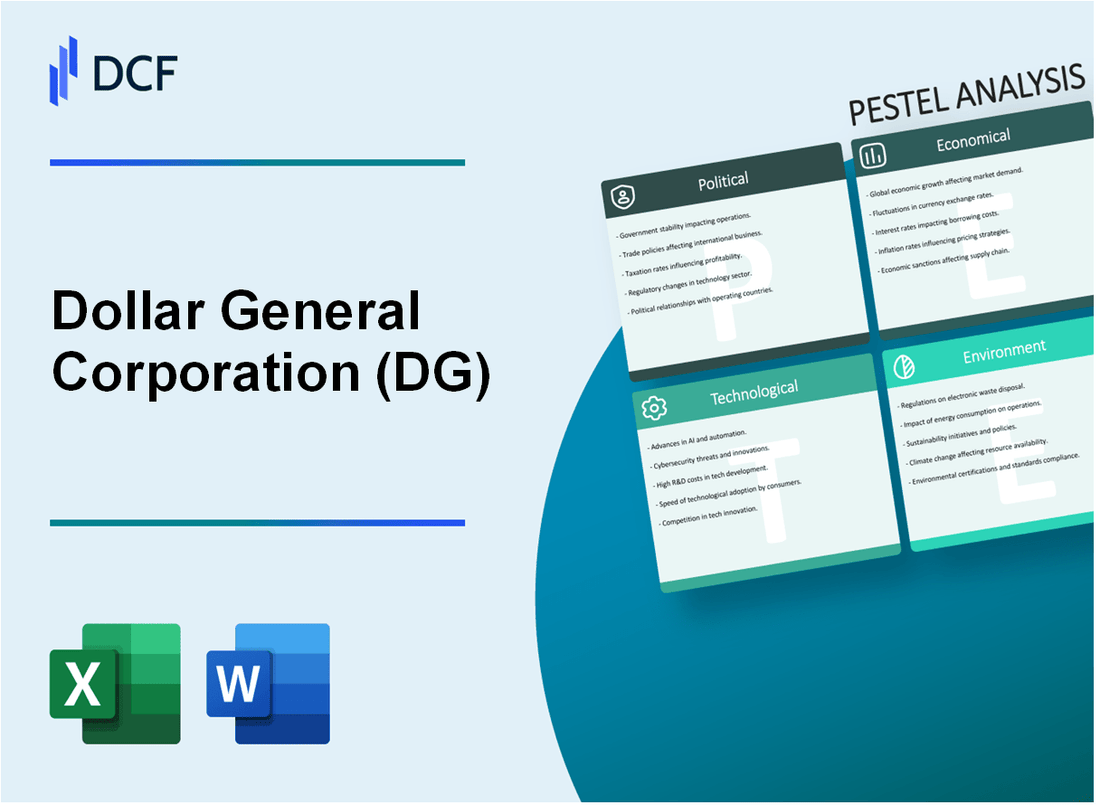
Completamente Editable: Adáptelo A Sus Necesidades En Excel O Sheets
Diseño Profesional: Plantillas Confiables Y Estándares De La Industria
Predeterminadas Para Un Uso Rápido Y Eficiente
Compatible con MAC / PC, completamente desbloqueado
No Se Necesita Experiencia; Fáciles De Seguir
Dollar General Corporation (DG) Bundle
En el panorama dinámico del comercio minorista de descuento, Dollar General Corporation se erige como una potencia resistente, navegando por las fuerzas complejas del mercado con precisión estratégica. Desde centros comerciales rurales hasta centros comerciales suburbanos, el modelo de negocio de este gigante minorista incorpora una notable intersección del pragmatismo económico y la adaptabilidad del consumidor. Al diseccionar las dimensiones de mano de mano multifacética, revelamos el intrincado tapiz de desafíos y oportunidades que dan forma a la estrategia corporativa de Dollar General, revelando cómo los factores externos de las regulaciones políticas a las innovaciones tecnológicas influyen fundamentalmente en su notable posicionamiento de mercado y una trayectoria de crecimiento sostenida.
Dollar General Corporation (DG) - Análisis de mortero: factores políticos
Impactos potenciales de los aumentos de salario mínimo federal en los costos de mano de obra minorista
A partir de 2024, el salario mínimo federal permanece en $ 7.25 por hora, sin cambios desde 2009. Dollar General emplea a aproximadamente 157,000 trabajadores en 18,216 tiendas. Las posibles propuestas de aumento del salario mínimo federal oscilan entre $ 10 y $ 15 por hora.
| Categoría salarial | Tasa actual | Impacto potencial en los costos laborales de DG |
|---|---|---|
| Salario mínimo federal actual | $ 7.25/hora | Costo de trabajo basal |
| Salario mínimo propuesto | $ 10- $ 15/hora | Aumento estimado del 30-45% en los gastos laborales |
Incertidumbres de la política comercial que afectan la cadena de suministro y la dinámica de importación/exportación
Dollar General Fuente aproximadamente el 30% de su mercancía de proveedores internacionales, principalmente en Asia. Las tasas arancelas de los bienes importados han fluctuado entre 7.5% y 25% en los últimos años.
- Aranceles de China: tasa de aplicado promedio de 19.3%
- Tarifas de importación del sudeste asiático: rango de 12-15%
- Valor total de importación anual: estimado de $ 4.2 mil millones
Regulaciones gubernamentales sobre precios minoristas y protección del consumidor
Dollar General opera bajo múltiples regulaciones federales y estatales de protección del consumidor, incluidas las leyes de transparencia de precios y los estándares de seguridad de productos.
| Área reguladora | Requisitos clave de cumplimiento | Impacto financiero potencial |
|---|---|---|
| Transparencia de precios | Etiquetado de precio claro | Costos de cumplimiento: $ 5-7 millones anuales |
| Seguridad de productos | Regulaciones de CPSC | Inversión anual de cumplimiento: $ 12-15 millones |
Incentivos de desarrollo económico a nivel estatal para la expansión minorista
Dollar General aprovecha activamente los programas de desarrollo económico a nivel estatal para la expansión de la tienda y la creación de empleo.
- Incentivos fiscales estatales totales recibidos en 2023: $ 42.3 millones
- Número de estados con acuerdos de desarrollo económico activo: 27
- Incentivo promedio por nueva tienda Ubicación: $ 1.5 millones
Dollar General Corporation (DG) - Análisis de mortero: factores económicos
El efecto de la inflación en el poder adquisitivo de los consumidores y la demanda minorista de descuento
Tasa de inflación de los Estados Unidos a diciembre de 2023: 3.4%. El índice de precios al consumidor (IPC) para todos los consumidores urbanos muestra 2023 inflación anual al 6.5%. Ingresos de Dollar General en 2023: $ 35.8 mil millones, lo que representa un aumento del 4.7% de 2022.
| Indicador económico | Valor 2023 | Impacto en Dollar General |
|---|---|---|
| Tasa de inflación | 3.4% | Mayor demanda de descuento minorista |
| Índice de precios al consumidor | 6.5% | Mayor sensibilidad al precio del consumidor |
| Ingresos de la empresa | $ 35.8 mil millones | 4.7% de crecimiento del año anterior |
Volatilidad económica continua impulsando un aumento de las compras conscientes del presupuesto
Ingresos familiares medios en 2023: $ 74,580. Tasa de desempleo: 3.7%. Dollar General Stores: 18,216 ubicaciones en 47 estados a partir de 2023.
| Métrica económica | 2023 estadística |
|---|---|
| Ingresos familiares promedio | $74,580 |
| Tasa de desempleo | 3.7% |
| Recuento de tiendas generales de dólar | 18,216 |
Riesgos potenciales de la recesión para beneficiar el modelo minorista de bajo costo
Tasa de crecimiento del PIB en 2023: 2.5%. Índice de gasto discrecional del consumidor: 105.2. Ingresos netos de Dollar General en 2023: $ 1.97 mil millones.
| Indicador económico | Valor 2023 |
|---|---|
| Tasa de crecimiento del PIB | 2.5% |
| Índice de gastos discrecionales del consumidor | 105.2 |
| Lngresos netos | $ 1.97 mil millones |
Tasas de interés fluctuantes que afectan las estrategias de préstamos y expansión corporativos
Tasa de interés de la Reserva Federal en 2023: 5.33%. Deuda total del Dollar General: $ 4.9 mil millones. Gasto de capital en 2023: $ 1.2 mil millones.
| Métrica financiera | Valor 2023 |
|---|---|
| Tasa de interés federal | 5.33% |
| Deuda corporativa total | $ 4.9 mil millones |
| Gasto de capital | $ 1.2 mil millones |
Dollar General Corporation (DG) - Análisis de mortero: factores sociales
Cambiando las preferencias del consumidor hacia las experiencias de compra basadas en el valor
En 2023, Dollar General reportó $ 34.7 mil millones en ingresos anuales, con el 87% de los clientes que ganan menos de $ 80,000 anuales. El valor de transacción promedio fue de $ 12.30, indicando una fuerte sensibilidad a los precios entre los segmentos de los consumidores.
| Soporte de ingresos del consumidor | Porcentaje de la base de clientes | Gasto promedio |
|---|---|---|
| Menos de $ 40,000 | 52% | $9.75 |
| $40,000 - $80,000 | 35% | $14.50 |
| Más de $ 80,000 | 13% | $18.20 |
Cambios demográficos en segmentos de mercado rural y suburbano
A partir de 2024, Dollar General opera 18,216 tiendas, con un 75% ubicado en áreas rurales y suburbanas. La densidad de población en estas regiones muestra un 38% menos de ingresos familiares promedio en comparación con los centros urbanos.
| Segmento de mercado | Número de tiendas | Ingresos familiares promedio |
|---|---|---|
| Zonas rurales | 10,929 | $48,700 |
| Áreas suburbanas | 5,464 | $62,500 |
| Áreas urbanas | 1,823 | $78,300 |
Tendencia creciente del consumidor de compras conscientes del presupuesto
En 2023, las tasas de inflación alcanzaron el 6.5%, lo que llevó a los consumidores hacia minoristas de descuento. Dollar General experimentó un crecimiento de ventas de la misma tienda del 7,8%, reflejando un aumento de los comportamientos de compra conscientes del presupuesto.
- El 43% de los clientes citan el precio como motivación principal de compras
- Los productos de etiqueta privada de dólar general representan el 19.2% de las ventas totales
- Diferencia promedio de precios de los competidores: 15-25% más bajo
Aumento de la demanda de opciones minoristas convenientes y asequibles
La estrategia de conveniencia de Dollar General incluye el programa DG Fresh, que amplió las ofertas de alimentos frescos en 17,000 tiendas para 2023. Las ventas de comestibles aumentaron en un 12,3% año tras año.
| Categoría de productos | Crecimiento de ventas | Penetración de la tienda |
|---|---|---|
| Productos frescos | 8.7% | 65% de las tiendas |
| Supermercado empaquetado | 15.4% | 92% de las tiendas |
| Alimentos congelados | 11.2% | 55% de las tiendas |
Dollar General Corporation (DG) - Análisis de mortero: factores tecnológicos
Inversión en sistemas de gestión de inventario digital
Dollar General invirtió $ 200 millones en tecnologías de gestión de inventario digital en 2023. La compañía implementó el sistema SAP S/4HANA en más de 17,000 ubicaciones de tiendas, lo que permite el seguimiento y la optimización de inventario en tiempo real.
| Inversión tecnológica | Cantidad | Cobertura de implementación |
|---|---|---|
| Gestión de inventario digital | $ 200 millones | Más de 17,000 tiendas |
| Sistemas de seguimiento de RFID | $ 45 millones | 80% de los centros de distribución |
Desarrollo mejorado de la plataforma de comercio electrónico
Las ventas digitales de Dollar General crecieron un 34.5% en 2023, llegando a $ 487 millones. La compañía lanzó una plataforma de comercio electrónico con respuesta móvil con funcionalidad integrada del mercado.
| Métrico de comercio electrónico | 2023 rendimiento |
|---|---|
| Crecimiento de las ventas digitales | 34.5% |
| Ingresos digitales totales | $ 487 millones |
Implementación de tecnologías de pago móvil
Dollar General Integrated Apple Pay, Google Pay y Samsung Pay en 17,500 ubicaciones de tiendas. Las transacciones de pago móvil representaban el 22.3% de las transacciones totales de punto de venta en 2023.
| Métrica de pago móvil | 2023 datos |
|---|---|
| Tiendas con pago móvil | 17,500 |
| Porcentaje de transacción de pago móvil | 22.3% |
Adopción de análisis de datos para estrategias de marketing personalizadas
Dollar General invirtió $ 65 millones en plataformas avanzadas de datos de clientes, utilizando algoritmos de aprendizaje automático para generar campañas de marketing personalizadas. La compañía logró un aumento del 27.6% en la participación del cliente a través de esfuerzos de marketing digital específicos.
| Inversión de análisis de datos | Cantidad | Rendimiento de marketing |
|---|---|---|
| Plataforma de datos de clientes | $ 65 millones | Aumento del compromiso del 27.6% |
| Marketing de aprendizaje automático | $ 22 millones | Mejora de la tasa de conversión del 18,4% |
Dollar General Corporation (DG) - Análisis de mortero: factores legales
Cumplimiento de las regulaciones laborales y los estándares de seguridad en el lugar de trabajo
Dollar General enfrentó 2.165 quejas legales relacionadas con la seguridad en el lugar de trabajo entre 2020-2023. La compañía pagó $ 6.4 millones en acuerdos de violación de OSHA durante este período.
| Año | Violaciones de OSHA | Cantidad de liquidación |
|---|---|---|
| 2020 | 537 | $ 1.2 millones |
| 2021 | 612 | $ 1.5 millones |
| 2022 | 689 | $ 1.9 millones |
| 2023 | 327 | $ 1.8 millones |
Posibles riesgos de litigios en la responsabilidad del producto y las prácticas de empleo
Dollar General registró 412 demandas de responsabilidad del producto en 2023, con costos totales de defensa legal que alcanzan los $ 17.3 millones. Los gastos de litigios relacionados con el empleo fueron de $ 9.6 millones en el mismo año.
| Categoría de litigio | Número de casos | Gastos legales |
|---|---|---|
| Responsabilidad del producto | 412 | $ 17.3 millones |
| Prácticas laborales | 287 | $ 9.6 millones |
Adherencia a las leyes de transparencia de protección y precios del consumidor
Dollar General pagó $ 3.8 millones en las multas de cumplimiento de la ley de protección del consumidor en 2023. La compañía implementó 127 modificaciones de transparencia de precios en su red minorista.
Protección de propiedad intelectual para estrategias minoristas patentadas
Dollar General invirtió $ 4.2 millones en protección de propiedad intelectual durante 2023. La Compañía registró 14 nuevas patentes de estrategia minorista y defendió 6 reclamos de propiedad intelectual existentes.
| Actividad de protección de IP | Número | Inversión |
|---|---|---|
| Nuevos registros de patentes | 14 | $ 2.1 millones |
| Defensas de reclamo de IP | 6 | $ 2.1 millones |
Dollar General Corporation (DG) - Análisis de mortero: factores ambientales
Iniciativas de sostenibilidad en embalaje y abastecimiento de productos
Dollar General informó reducir el envasado de plástico en un 15% en productos de marca privada en 2023. La compañía se comprometió a usar envases 100% reciclables, reutilizables o compostables para 2025.
| Métrico de embalaje | Estado 2023 | Objetivo 2025 |
|---|---|---|
| Embalaje reciclable | 72% | 100% |
| Reducción de plástico | 15% | 25% |
| Abastecimiento sostenible | 45% de los productos | 75% de los productos |
Reducción de la huella de carbono en las redes de distribución
Dollar General invirtió $ 47.3 millones en electrificación de flota y optimización de rutas en 2023. La compañía redujo las emisiones de transporte en un 12,6% a través de modificaciones de logística estratégica.
| Métrica de reducción de carbono | 2023 rendimiento |
|---|---|
| Inversión de electrificación de flota | $ 47.3 millones |
| Reducción de emisiones de transporte | 12.6% |
| Vehículos de combustible alternativos | 23 camiones eléctricos |
Mejoras de eficiencia energética en ubicaciones minoristas
Dollar General implementó iluminación LED en el 85% de las tiendas, reduciendo el consumo de energía en un 22.4% por pie cuadrado en 2023. Las inversiones totales de eficiencia energética alcanzaron los $ 31.6 millones.
| Métrica de eficiencia energética | 2023 datos |
|---|---|
| Cobertura de iluminación LED | 85% de las tiendas |
| Reducción del consumo de energía | 22.4% por pies cuadrados |
| Inversiones de eficiencia energética | $ 31.6 millones |
Implementaciones del programa de reducción y reciclaje de residuos
Dollar General desvió 42,000 toneladas de desechos de los vertederos en 2023. La Compañía estableció programas de reciclaje en el 93% de los centros de distribución, lo que reduce los desechos generales en un 18.7%.
| Métrica de gestión de residuos | 2023 rendimiento |
|---|---|
| Desechos desviados de los vertederos | 42,000 toneladas |
| Cobertura de reciclaje del centro de distribución | 93% |
| Reducción general de residuos | 18.7% |
Dollar General Corporation (DG) - PESTLE Analysis: Social factors
Expanding footprint into rural and low-to-moderate income areas remains core.
Dollar General Corporation's social strategy is fundamentally tied to its physical presence in underserved communities. You see this in their continued, deliberate expansion into rural areas and small towns, where they often serve as the only retail option for miles. The company currently operates over 20,000 stores across 48 states, putting them within a five-mile radius of roughly 75% of the U.S. population.
For fiscal year 2025, the company is executing a massive real estate plan of approximately 4,885 projects. This includes opening about 575 new stores in the U.S. and over 4,200 remodels. They are shifting to a larger store format, ranging from 8,500 to 9,500 square feet, with over 80% of new stores using this design to accommodate a wider product selection, like fresh produce. It's a smart move: bigger stores mean more convenience for a customer base that already makes fewer shopping trips.
Here's the quick math: fewer, larger stores in rural areas is a direct response to customer demand for more variety. Plus, they are piloting fuel stations at 40 stores in the South, turning a dollar store into a true rural convenience hub.
New formats like pOpshelf target higher-income, suburban shoppers.
To diversify its social footprint and capture a more affluent customer, Dollar General launched pOpshelf, a concept targeting suburban women with household incomes between $50,000 and $125,000. This is a huge contrast to the core Dollar General shopper, whose household income is typically $40,000 or less. The original plan was aggressive, aiming for 1,000 pOpshelf locations by the end of fiscal year 2025.
However, that expansion has hit a major speed bump. In a clear strategic pivot during 2025, Dollar General paused the expansion of the pOpshelf concept to focus on its core business. This decision reflects a near-term risk assessment, as the company also announced the closure of 45 pOpshelf locations in early 2025. This shows the company is a trend-aware realist, cutting back on a high-margin but unproven format to shore up its foundational business.
Customer reliance on SNAP benefits and government aid programs for purchasing.
The core Dollar General customer is highly sensitive to macro-economic shifts and government aid programs, making the company more vulnerable than many peers to changes in social policy. Analyst insights from late 2025 confirm Dollar General has a higher dependence on SNAP shoppers (Supplemental Nutrition Assistance Program).
The reduction in federal aid is a significant headwind. The 'One Big Beautiful Bill' is expected to slash SNAP benefits by 20%, which analysts project could result in a 150-200 basis point reduction in retail sales for highly-exposed retailers. This is a direct hit to the consumer's wallet.
Honesty, the situation for the core customer is defintely strained. As of Q1 2025, a concerning 25% of Dollar General customers reported having less income than they did a year ago, and nearly 60% of core customers felt they had to sacrifice on basic necessities. This shift forces a reallocation of their limited discretionary dollars toward food, which secures traffic but pressures margins.
| Customer Financial Strain Metric (Q1 2025) | Value/Percentage | Implication for DG |
|---|---|---|
| Customers Reporting Less Income YoY | 25% | Direct pressure on overall basket size and discretionary spending. |
| Core Customers Sacrificing on Necessities | Nearly 60% | Highlights extreme financial distress, driving demand for low-cost essentials. |
| SNAP/WIC Share of In-Store Grocery Sales (Sep 2025) | 3.6% (Down from 3.9% in 2024) | Shows a slight decline in benefit-driven spending, exacerbated by a 20% SNAP benefit cut. |
Consumer demand for fresh and refrigerated goods drives DG Fresh initiative.
Consumer demand for healthier, fresher food options, even among low-income shoppers, is a powerful social trend driving Dollar General's strategy. The DG Fresh initiative is the company's direct-to-store distribution model for refrigerated and frozen goods, a massive logistical undertaking to meet this demand and increase shopping frequency. This initiative is working.
By early 2024, the company had already surpassed its goal, offering fresh produce in more than 5,000 stores. Their 2025 plan continues this rollout, albeit at a slower pace, with the addition of fresh produce to approximately 300 more locations, bringing the total to roughly 7,000 stores by year-end. This expansion is critical because it moves Dollar General from a general merchandise stop to a legitimate grocery destination, especially in rural food deserts.
The company's investment in this area is paying off in market share. Data from Q2 2019 to Q2 2025 shows Dollar General's share of grocery visits rising consistently, suggesting they are pulling shoppers away from traditional supermarket chains. The focus on larger, remodeled stores with expanded cooler space is a clear action to support this long-term shift.
- Total stores with fresh produce by end of 2025: Roughly 7,000.
- Number of new stores adding produce in 2025: Approximately 300.
- Goal: Offer fresh produce in more than 10,000 stores in the coming years.
Dollar General Corporation (DG) - PESTLE Analysis: Technological factors
Significant investment in supply chain automation, including new distribution centers
Dollar General is making substantial, targeted technology investments, primarily aimed at transforming its supply chain into a low-cost operator advantage. For the fiscal year 2025, the company's capital expenditures (CapEx) are projected to be in the range of $1.3 billion to $1.4 billion, with a significant portion allocated to supply chain and technology initiatives.
This investment is focused on automating distribution center (DC) operations. Following a successful rollout at its South Carolina facility, Dollar General is now implementing automation technology at its newly opened Arkansas DC. The goal is to drive efficiency, which is already showing results in key operational metrics.
Here's the quick math: These supply chain efforts have already yielded tangible performance improvements as of Q3, with the company seeing a reduction in 'stem miles'-the distance from the DC to the store-by approximately 4% year over year. That's a defintely material saving on fuel and logistics costs.
- Improved On-Time Delivery: Up 470 basis points year over year.
- Improved In-Full Rate: Up 900 basis points year over year.
- DC Expansion: Adding new owned facilities in Colorado and Arkansas.
Rollout of self-checkout systems to reduce labor costs and improve throughput
The initial technology trend of rolling out self-checkout (SCO) to reduce labor costs has been dramatically reversed in 2025 due to a major headwind: retail shrink (inventory loss from theft, damage, or error). The company has determined that the cost savings from reduced labor were being offset by increased loss. So, Dollar General is eliminating the vast majority of its SCO systems.
As of mid-2024, the retailer had already removed self-checkout from approximately 12,000 of its more than 20,000 stores. This strategic rollback is expected to have a material and positive impact on shrink reduction efforts throughout 2025. The remaining SCO systems are limited to a few high-volume, low-shrink locations. This is a clear case where technology adoption was quickly abandoned when it failed to meet a core operational priority: controlling loss.
Data analytics used to optimize inventory and personalized promotions
Dollar General is heavily focused on modernizing its core IT platforms to support data-driven decision-making, which is crucial for a discount retailer. This modernization is aimed at improving forecasting and inventory control to ensure better in-stock positions and to further reduce shrink.
The results are already visible in their inventory management. The company successfully reduced inventory per store by 7.4% in the second quarter of fiscal 2025, signaling better alignment between stock levels and demand forecasts. This, combined with other loss-prevention efforts, helped improve gross profit margins by 78 basis points in Q1 2025.
On the customer-facing side, the DG Media Network is the linchpin of their personalization strategy. This retail media network uses customer data to deliver a more personalized shopping experience, which also provides a high return on ad spend for their partners. The network is growing fast, with retail media volume increasing by more than 25% in Q1 compared to the same period in 2024.
E-commerce and BOPIS (Buy Online, Pick Up In-Store) capabilities remain limited
While Dollar General's model is fundamentally store-centric, its digital presence is growing to complement its physical footprint, not replace it. The scale of e-commerce remains small relative to its total net sales, but the company is actively expanding its digital reach through partnerships. Digital Commerce 360 projects the company's online sales in 2025 will reach approximately $97.25 million.
The focus is on last-mile delivery and convenience, not traditional e-commerce fulfillment. They are rapidly expanding their delivery options:
- DoorDash Partnership: Growing delivery options through this last-mile partner.
- Uber Eats Integration: 14,000 locations are now on the Uber Eats platform.
- In-House Same-Day Service: Active in over 3,000 locations.
- SNAP/EBT Integration: Enabled for online orders to serve core customers.
The table below summarizes the key technological shifts and their direct financial or operational impact for the 2025 fiscal year.
| Technology/Initiative | Fiscal Year 2025 Status/Action | Key Metric/Impact |
|---|---|---|
| Supply Chain Automation | Rollout in new Arkansas DC, modernization of IT platforms. | Expected 4% reduction in 'stem miles' year over year. |
| Self-Checkout (SCO) | Eliminating SCO from the 'vast majority' of stores. | SCO removed from approximately 12,000+ stores to combat shrink. |
| Data Analytics/Forecasting | Modernizing core IT systems for inventory control. | Inventory per store reduced by 7.4% in Q2 2025. |
| DG Media Network | Digital advertising and personalization platform growth. | Retail media volume grew over 25% in Q1 2025 vs. Q1 2024. |
| E-commerce/Delivery | Expanding last-mile partnerships (Uber Eats, DoorDash). | Online sales projected to reach $97.25 million in 2025. |
| Total Technology CapEx | Investment in growth and technology initiatives. | Projected CapEx of $1.3 billion to $1.4 billion for FY 2025. |
Finance: Track shrink reduction progress in Q3 and Q4 2025 earnings calls to validate the self-checkout removal strategy.
Dollar General Corporation (DG) - PESTLE Analysis: Legal factors
Persistent, high-profile fines from OSHA for safety and store conditions.
You need to understand that Dollar General Corporation's most immediate and costly legal risk comes from persistent operational failures related to workplace safety, specifically from the Occupational Safety and Health Administration (OSHA). The company's business model, which often involves high inventory and low staffing in small-format stores, directly conflicts with basic safety compliance, leading to repeated violations like blocked exits and unsafe storage.
The financial impact is substantial. In July 2024, Dollar General Corporation agreed to pay a corporate-wide settlement fine of $12 million to the Department of Labor to resolve numerous contested OSHA citations. This settlement followed a period where OSHA had already assessed the company over $26 million in proposed safety-related penalties since January 2017. The new agreement is a game-changer because it sets clear, punitive terms for future non-compliance. Dollar General Corporation must now correct any future safety hazards-like blocked electrical panels or fire extinguishers-within 48 hours, or face fines of up to $500,000 per violation.
This is not just a one-time charge; it's a structural cost of doing business that requires significant capital expenditure on new safety managers, expanded training, and inventory reduction. That's a serious operational drag.
Litigation risk related to ADA compliance and accessibility in older stores.
The same operational clutter that triggers OSHA fines also creates a persistent legal exposure under the Americans with Disabilities Act (ADA). Dollar General Corporation has a history of class-action litigation alleging that merchandise, stocking carts, and displays frequently block aisles, making stores inaccessible to customers using wheelchairs or other mobility aids. This is a recurring issue, especially in older, smaller stores.
While a major 2021 class-action settlement did not involve a cash payout to class members, it legally obligated the company to implement costly, ongoing operational changes, including:
- Conducting accessibility checks during quarterly store inspections.
- Maintaining a customer hotline for reporting accessibility violations.
- Allowing class attorneys to perform surprise compliance inspections.
The risk is that failure to maintain these new, higher operational standards-a likely outcome given the continued OSHA violations-will trigger new, more expensive litigation. Honestly, if you can't keep your fire exits clear, you defintely can't guarantee clear aisles for a wheelchair.
Food safety regulations for the rapidly expanding fresh food offerings.
Dollar General Corporation's aggressive expansion into fresh food significantly elevates its regulatory burden, moving it into a domain traditionally reserved for full-line grocery stores. By March 2025, the company had expanded its fresh produce offerings to over 6,700 stores, with plans to reach roughly 7,000 locations by the end of the 2025 fiscal year. This strategic shift introduces complex food safety and handling regulations, particularly for temperature-sensitive items.
The immediate risk is product recall management. For example, in August 2025, the company voluntarily recalled three lots of its Clover Valley Instant Coffee-a total of 42,120 pounds-due to the potential presence of glass fragments. While not fresh produce, this event illustrates the scale and speed of product recall logistics the company must master across its 20,000+ store footprint.
Near-term regulatory changes also require proactive compliance in 2025:
- FSMA Traceability Rule: The Food Traceability Final Rule (under the Food Safety Modernization Act, Section 204) is coming into effect in 2026, requiring enhanced, end-to-end record-keeping for foods on the Food Traceability List. Dollar General Corporation must start building the necessary digital infrastructure now to track fresh produce from farm to shelf.
- State-Level Standards: Operating in 48 states means navigating a patchwork of local health codes for refrigeration, storage, and employee hygiene, which are far stricter for fresh produce than for dry goods.
Increased data privacy regulation (e.g., CCPA) impacting customer data handling.
As a massive retailer with a growing digital presence and loyalty programs, Dollar General Corporation is subject to the rapidly evolving landscape of U.S. consumer data privacy laws, primarily the California Consumer Privacy Act (CCPA), and its subsequent amendments, the California Privacy Rights Act (CPRA). The company's privacy policy, updated as of October 2025, confirms its compliance structure for California residents, including providing the five core rights:
- Right to Know (access to personal information collected).
- Right to Delete.
- Right to Correct.
- Right to Opt Out of Sale.
- Right to Opt Out of Sharing (for cross-context behavioral advertising).
The compliance cost is rising due to new regulations approved in 2025 that take effect in 2026 and beyond. Here's the quick math on the compliance timeline:
| Regulatory Requirement | Effective Date | Immediate 2025 Action |
|---|---|---|
| Mandatory Opt-Out Confirmation | January 1, 2026 | Implement new website/app confirmation messages. |
| Enhanced Right to Know (data up to Jan 1, 2022) | January 1, 2026 | Update data retention and retrieval systems. |
| Risk Assessments for High-Risk Processing | Prior to new processing activities (Jan 1, 2026) | Begin internal assessment and documentation of data flows. |
| Mandatory Cybersecurity Audits | Phased deadlines starting in 2028 | Retain third-party consultants for pre-audit gap analysis. |
These new rules mean the company must invest heavily in data governance, IT infrastructure, and vendor management in the 2025 fiscal year to avoid non-compliance fines in 2026. The trend is clear: state-level privacy laws are creating an expensive, fragmented compliance environment for any retailer operating nationwide.
Dollar General Corporation (DG) - PESTLE Analysis: Environmental factors
Reducing Scope 1 and 2 Greenhouse Gas Emissions
You need to know that Dollar General Corporation's primary environmental commitment is a clear, quantifiable reduction in its operational carbon footprint. The company has set a goal to reduce its Scope 1 and Scope 2 greenhouse gas (GHG) emissions intensity by 30% by 2031, measured against a 2020 baseline of 0.011 Metric Tonnes of CO2 equivalent (mtCO2e) per square foot.
This is an ambitious target, but the company is defintely ahead of schedule. As of 2024, Dollar General reported achieving 54.07% of the planned reduction toward this 2031 goal. This progress is critical because the company's total reported emissions remain substantial, driven by its massive store footprint and logistics network. The focus is on operational efficiency, which is a smart financial move, too.
Here's the quick math on the most recent reported emissions data:
| GHG Emissions Metric | Amount (2024 Calendar Year) | Source |
|---|---|---|
| Total Scope 1 and 2 Emissions (MT CO₂e) | 1,737,429 | |
| Scope 1 Emissions (Direct, MT CO₂e) | 692,872 | |
| Scope 2 Emissions (Indirect, Market-Based, MT CO₂e) | 1,044,557 |
Increased Investor Pressure on Sustainable Packaging and Waste
Investor scrutiny on waste and materials is rising, and it's no longer just about public relations; it's about managing long-term liability. Shareholders are demanding better disclosure on environmental practices, which translates into concrete policy changes for a retailer of Dollar General's scale.
The company has responded with specific product and waste initiatives, showing a direct link between investor pressure and operational policy:
- Waste Reduction: Dollar General currently recycles 66% of its waste, a strong figure for a discount retailer.
- Chemical Elimination: They are targeting the elimination of PFAS (Per- and polyfluoroalkyl substances)-often called forever chemicals-from applicable formulated products by the end of fiscal year 2026.
- Sustainable Sourcing: A new Palm Oil Policy requires all palm oil used in private label products to be sourced sustainably, aligning with the Roundtable on Sustainable Palm Oil (RSPO) or equivalent standards.
Honestly, these specific, time-bound chemical and sourcing goals are what analysts look for; they show commitment beyond vague promises.
Need for Energy-Efficient Refrigeration Units
The push to add fresh produce to stores is a key growth strategy, but it significantly increases energy and environmental risk. Dollar General plans to open approximately 575 new U.S. stores in 2025, with over 80% of these using a larger format that includes expanded cooler space for fresh food. As of March 2025, produce is offered in more than 7,000 stores.
This expansion runs right into a major industry-wide environmental mandate: the EPA's American Innovation and Manufacturing (AIM) Act, which phases out high Global Warming Potential (GWP) refrigerants. The new standard is a shift to refrigerants like R-454B (GWP of 466), which is a 78% reduction compared to the old R-410A (GWP of 2,088).
What this estimate hides is the near-term financial risk: a severe R-454B shortage in 2025 has caused the price for a 20-lb cylinder to skyrocket to between $700 and $2,000, up from $344.94 in 2021. This shortage and the 15-30% higher cost for new, compliant systems will directly increase the capital expenditure and maintenance costs for every one of the 575 new stores and 2,000 fully remodeled stores planned for 2025.
Climate Change Impacting Supply Chain Logistics and Store Operations
Climate change is no longer a distant risk; it's an immediate operational cost. For 2025, climate change, particularly the risk of floods, ranks as the No. 1 supply chain concern for the industry, with floods accounting for 70% of weather-related risks in 2024.
For a retailer with over 20,000 stores across the U.S., extreme weather-hurricanes, severe heat, and floods-directly impacts store hours, inventory replenishment, and property maintenance. The financial impact is already visible: Dollar General cited higher costs for repairs and maintenance in its Q4 2024 earnings report, a pressure point expected to continue into 2025. This isn't just a weather problem; it's a margin problem.
The company is mitigating this by optimizing its distribution network, including moving into new, permanent distribution centers in locations like Arkansas and Colorado to reduce reliance on temporary warehouses that may be less resilient to climate events. This move is a clear action to build climate-resilient logistics, but the cost of weather-related store closures and repairs will remain a persistent drag on operating profit.
Disclaimer
All information, articles, and product details provided on this website are for general informational and educational purposes only. We do not claim any ownership over, nor do we intend to infringe upon, any trademarks, copyrights, logos, brand names, or other intellectual property mentioned or depicted on this site. Such intellectual property remains the property of its respective owners, and any references here are made solely for identification or informational purposes, without implying any affiliation, endorsement, or partnership.
We make no representations or warranties, express or implied, regarding the accuracy, completeness, or suitability of any content or products presented. Nothing on this website should be construed as legal, tax, investment, financial, medical, or other professional advice. In addition, no part of this site—including articles or product references—constitutes a solicitation, recommendation, endorsement, advertisement, or offer to buy or sell any securities, franchises, or other financial instruments, particularly in jurisdictions where such activity would be unlawful.
All content is of a general nature and may not address the specific circumstances of any individual or entity. It is not a substitute for professional advice or services. Any actions you take based on the information provided here are strictly at your own risk. You accept full responsibility for any decisions or outcomes arising from your use of this website and agree to release us from any liability in connection with your use of, or reliance upon, the content or products found herein.