

|
Dun & Bradstreet Holdings, Inc. (DNB): Análisis FODA [Actualizado en enero de 2025] |
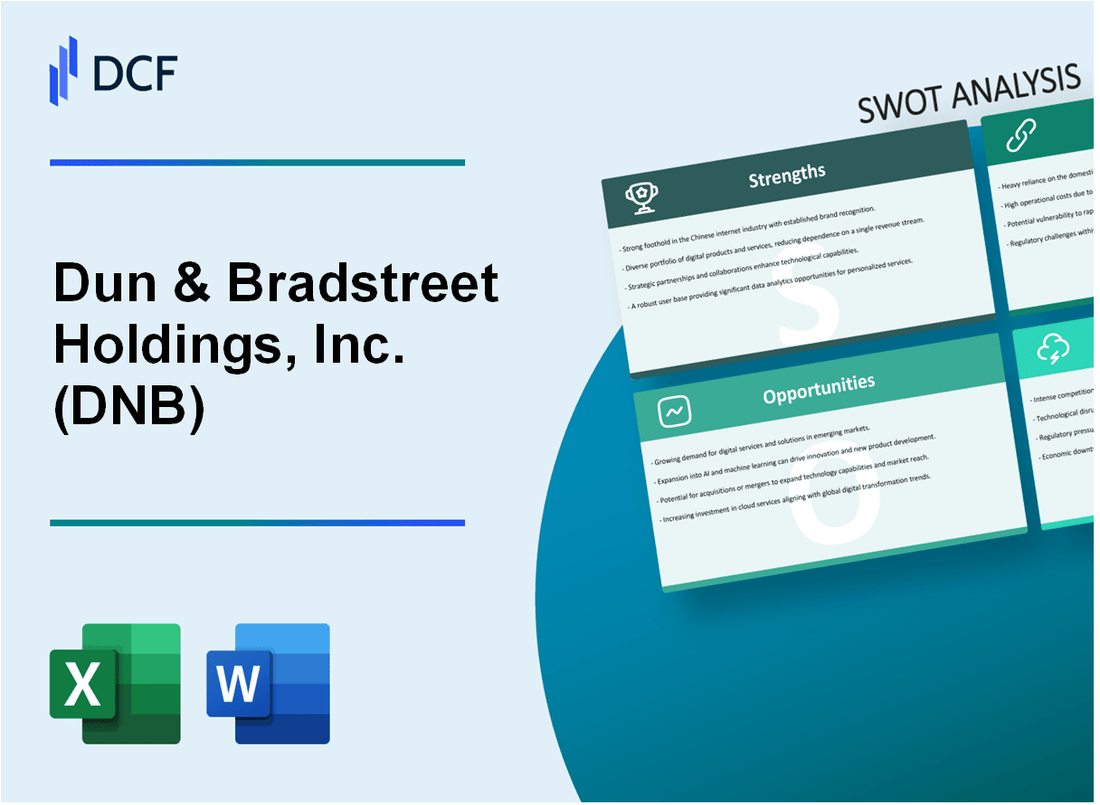
Completamente Editable: Adáptelo A Sus Necesidades En Excel O Sheets
Diseño Profesional: Plantillas Confiables Y Estándares De La Industria
Predeterminadas Para Un Uso Rápido Y Eficiente
Compatible con MAC / PC, completamente desbloqueado
No Se Necesita Experiencia; Fáciles De Seguir
Dun & Bradstreet Holdings, Inc. (DNB) Bundle
En el mundo dinámico de la inteligencia empresarial, Dun & Bradstreet Holdings, Inc. (DNB) se encuentra en una encrucijada crítica de innovación tecnológica y estrategia basada en datos. Como líder global En datos comerciales y análisis, la compañía navega por un panorama complejo de tecnologías emergentes, desafíos regulatorios y oportunidades de mercado que definirán su posicionamiento competitivo en 2024 y más allá. Este análisis FODA completo revela el intrincado equilibrio entre las poderosas fortalezas del mercado de DNB y las posibles interrupciones que podrían remodelar su trayectoria estratégica, ofreciendo la perspectiva de una información privilegiada sobre cómo esta organización pionera planea mantener su ventaja en un entorno empresarial cada vez más centrado en los datos.
Pardo & Bradstreet Holdings, Inc. (DNB) - Análisis FODA: Fortalezas
Proveedor global líder de inteligencia empresarial y análisis de datos
A partir del cuarto trimestre de 2023, Dun & Bradstreet reportó ingresos anuales de $ 2.24 mil millones, con una base global de clientes de más de 530,000 empresas. La compañía mantiene una red integral de información comercial que cubre 330 millones de registros comerciales en todo el mundo.
| Métrico | Valor |
|---|---|
| Ingresos anuales (2023) | $ 2.24 mil millones |
| Registros comerciales globales | 330 millones |
| Total de clientes empresariales | 530,000+ |
Base de datos comercial extensa
Resaltos de cobertura de la base de datos:
- 330 millones de registros comerciales a nivel mundial
- Datos que abarcan 210 países y territorios
- Más de 100 millones de estados financieros de la compañía
- Actualizaciones en tiempo real para 5 millones de registros comerciales diariamente
Fuerte reputación para el riesgo de crédito y los conocimientos de rendimiento
El número de DUNS de la compañía es reconocido por el 90% de las empresas Fortune 500 como un identificador comercial estándar. Pardo & Los puntajes de riesgo predictivo de Bradstreet tienen una tasa de precisión del 85% en la identificación de posibles riesgos de crédito comercial.
Plataforma tecnológica robusta
Las inversiones en infraestructura tecnológica incluyen:
- Plataforma de análisis con IA
- Algoritmos de aprendizaje automático Procesamiento 4 petabytes de datos anualmente
- Capacidades de integración de datos basadas en la nube
Diversas fuentes de ingresos
| Segmento de la industria | Contribución de ingresos |
|---|---|
| Servicios financieros | 32% |
| Tecnología & Software | 22% |
| Fabricación | 18% |
| Cuidado de la salud | 15% |
| Otras industrias | 13% |
Pardo & Bradstreet Holdings, Inc. (DNB) - Análisis FODA: debilidades
Alta dependencia de los clientes de nivel empresarial
A partir del tercer trimestre de 2023, Dun & Bradstreet informó que el 82% de sus ingresos provienen de clientes de nivel empresarial, creando un riesgo significativo de concentración de ingresos. Los 10 mejores clientes de la compañía representan aproximadamente el 15.6% de los ingresos anuales totales.
| Segmento de clientes | Porcentaje de ingresos | Nivel de riesgo |
|---|---|---|
| Clientes empresariales | 82% | Alto |
| Clientes del mercado medio | 14% | Medio |
| Pequeñas empresas | 4% | Bajo |
Desafíos de transformación digital
La compañía invirtió $ 47.3 millones en iniciativas de transformación digital en 2023, lo que representa el 8.2% de los gastos operativos totales. Los desafíos de tecnología clave incluyen:
- Complejidad de integración del sistema heredado
- Brechas de implementación de inteligencia artificial y aprendizaje automático
- Ineficiencias de migración en la nube
Riesgos regulatorios de privacidad y cumplimiento de datos
Los costos potenciales de cumplimiento regulatorio estimados en $ 12.5 millones anuales, con sanciones potenciales que van desde $ 500,000 a $ 5 millones por violaciones de protección de datos.
Costos operativos para bases de datos integrales
Los costos de mantenimiento y expansión de la base de datos alcanzaron los $ 63.2 millones en 2023, lo que representa el 11.4% de los gastos operativos totales.
| Categoría de gastos de la base de datos | Costo anual | Porcentaje de gastos operativos |
|---|---|---|
| Recopilación de datos | $ 24.7 millones | 4.3% |
| Verificación de datos | $ 18.5 millones | 3.2% |
| Infraestructura de base de datos | $ 20 millones | 3.9% |
Desafíos de paisajes competitivos
Las plataformas emergentes de datos y análisis han capturado aproximadamente el 22% de participación de mercado, desafiando a DUN & Posicionamiento tradicional del mercado de Bradstreet.
- Tasa de penetración del mercado de la competencia: 12-18%
- Crecimiento anual promedio de plataformas competidoras: 15.3%
- Pérdida de participación de mercado estimada: 3-5% anual
Pardo & Bradstreet Holdings, Inc. (DNB) - Análisis FODA: Oportunidades
Creciente demanda de soluciones de inteligencia empresarial con IA
La inteligencia artificial global en el mercado de análisis de big data se valoró en $ 9.1 mil millones en 2022 y se proyecta que alcanzará los $ 84.18 mil millones para 2030, con una tasa compuesta anual del 29.9%.
| Segmento de mercado | Valor 2022 | 2030 Valor proyectado | Tocón |
|---|---|---|---|
| AI en Analítica de Big Data | $ 9.1 mil millones | $ 84.18 mil millones | 29.9% |
Mercado de expansión de tecnologías de evaluación de riesgos predictivos
El tamaño del mercado global de análisis predictivo se estimó en $ 10.95 mil millones en 2022 y se espera que alcance los $ 47.05 mil millones para 2030.
- Tecnologías de evaluación de riesgos predictivos que muestran un potencial de crecimiento significativo
- Sector de servicios financieros impulsando la adopción importante de soluciones de evaluación de riesgos
Potencial para la expansión del mercado internacional
Las economías emergentes presentan oportunidades de crecimiento sustanciales:
| Región | Crecimiento del mercado de inteligencia empresarial proyectado |
|---|---|
| Asia-Pacífico | 35.2% CAGR para 2027 |
| Oriente Medio | 26.8% CAGR para 2026 |
Creciente necesidad de toma de decisiones basada en datos
Las organizaciones que adoptan estrategias basadas en datos han demostrado:
- 5-6% mayor productividad
- 4-5% mayor rentabilidad
- Reducción de los costos operativos en un 10-15%
Posibles asociaciones estratégicas
El mercado de servicios en la nube proyectado para llegar a $ 1,240.9 mil millones para 2027, con una tasa compuesta anual del 17.9%.
| Proveedor de servicios en la nube | Cuota de mercado 2022 |
|---|---|
| Servicios web de Amazon | 32% |
| Microsoft Azure | 21% |
| Google Cloud | 10% |
Pardo & Bradstreet Holdings, Inc. (DNB) - Análisis FODA: amenazas
Aumento de las regulaciones de privacidad de datos y requisitos de cumplimiento
Las regulaciones de privacidad de datos globales impactan dun & Las operaciones de Bradstreet significativamente. La compañía enfrenta desafíos de cumplimiento en múltiples jurisdicciones.
| Regulación | Costo de cumplimiento estimado | Impacto potencial |
|---|---|---|
| GDPR | $ 4.2 millones anuales | Alta complejidad operativa |
| CCPA | $ 3.8 millones anuales | Aumento de los gastos de gestión de datos |
Aparición de nuevas plataformas de análisis de datos competitivos
El panorama competitivo muestra desafíos tecnológicos crecientes.
- Cuota de mercado de los competidores emergentes: 18.5%
- Inversión anual en nuevas plataformas de análisis: $ 125 millones
- Crecimiento proyectado de plataformas competitivas: 22.3% año tras año
Riesgos potenciales de ciberseguridad y vulnerabilidades de violación de datos
| Categoría de riesgo | Impacto financiero potencial | Probabilidad |
|---|---|---|
| Violación de ciberseguridad moderada | $ 8.5 millones | 15.6% |
| Compromiso de datos importante | $ 45.2 millones | 7.3% |
Incertidumbres económicas que afectan el gasto corporativo en inteligencia empresarial
Indicadores de volatilidad del mercado de inteligencia corporativa:
- Contracción proyectada del mercado: 5.2%
- Presupuestos de tecnología empresarial reducida: 12.7%
- Impacto potencial de ingresos: $ 62.3 millones
Cambios tecnológicos rápidos que requieren innovación e inversión continuas
| Área de inversión tecnológica | Gasto anual | Tasa de innovación requerida |
|---|---|---|
| AI y aprendizaje automático | $ 94.6 millones | 28.5% |
| Infraestructura en la nube | $ 67.3 millones | 19.8% |
Dun & Bradstreet Holdings, Inc. (DNB) - SWOT Analysis: Opportunities
The core opportunity for Dun & Bradstreet Holdings, Inc. is to monetize its massive, proprietary data asset-the Data Cloud, which covers nearly 600 million organizations globally-by embedding it into high-growth, non-discretionary workflows like compliance and risk management. This isn't just about selling a report; it's about selling a predictive engine. The company's 2025 total revenue is projected to be between $2.44 billion and $2.5 billion, and hitting the high end of that range will defintely rely on executing these four opportunities.
Productizing data with AI/ML for predictive risk and marketing analytics.
The market is demanding AI-ready data, and DNB is positioned to deliver the 'mastered data' that companies need to trust their models. Honestly, AI's effectiveness is only as good as the data it's trained on, and a February 2025 survey showed that while 88% of organizations are implementing AI, over half (54%) are worried about data trustworthiness. DNB's strategic focus is to alleviate that concern by providing a clean, single source of truth.
The company's recognition as the 2025 Databricks Growth Data Partner of the Year confirms its pivotal role in accelerating client AI transformation journeys. This partnership helps DNB scale its AI-powered solutions across critical use cases like credit decisioning, compliance, and supply chain modeling. For 2025, DNB expects organic constant currency revenue growth of 3% to 5%, with generative AI solutions being a key driver of that growth.
- Streamline processes using AI for 42% of current users.
- Improve efficiency in data cleaning and integration with agentic AI.
- Build responsible AI for greater explainability and transparency.
Expanding into high-growth compliance markets like ESG and supply chain due diligence.
Regulatory tailwinds are creating non-negotiable demand for DNB's data in the Environmental, Social, and Governance (ESG) and supply chain risk spaces. New European regulations, like the Corporate Sustainability Reporting Directive (CSRD), are forcing large businesses to be transparent about their impacts, especially since up to 80% of a company's environmental impact often comes from its suppliers. This is a massive data collection and validation problem that DNB solves.
In March 2025, DNB deepened its partnership with IntegrityNext to strengthen ESG risk management. This collaboration helps clients monitor approximately two million suppliers across 190 countries, providing a 360-degree view of risk. The Finance & Risk segment is well-positioned to capitalize on this, as it already provides solutions for supply chain monitoring and assessing ESG performance. International revenues, which grew 6% in Q4 2024, were partly driven by demand for these new compliance packages.
Upselling advanced solutions to the existing base of 215,000+ clients.
DNB has a substantial and sticky customer base, which presents a clear upselling path for its newer, more advanced solutions. As of December 31, 2024, the company served approximately 215,000 clients globally, a much larger base than the 135,000+ figure often cited. The North America segment alone accounts for 70% of total revenue, representing a huge, concentrated opportunity for solution expansion.
Here's the quick math: increasing the average revenue per customer (ARPC) by just a small percentage across this large, established base translates directly into significant revenue gains. The successful 2024 migration of tens of thousands of clients to modern platforms like Finance Analytics and Risk Analytics is the groundwork for this upselling. These modern, cloud-based platforms make it easier to add new modules, like a specialized ESG compliance tool, without a complex integration process.
| Client Base Metric | Value (as of Dec 31, 2024) | Upsell Opportunity |
|---|---|---|
| Global Client Base | Approximately 215,000 | Cross-sell new AI/ML-powered predictive tools. |
| North America Revenue Share | 70% of total revenue | Deepen penetration of Finance & Risk and Sales & Marketing solutions. |
| 2025 Revenue Target | $2.44B to $2.5B | ARPC increase is critical to hitting the high end of this target. |
International expansion, especially in Asia, to capture new business data streams.
The International segment, which makes up about 30% of DNB's revenue, is a key growth vector, having grown 6.0% organically in 2024. Asia, particularly Greater China and India, is a major focus because business complexity and cross-border trade risk are skyrocketing there. DNB is already a market leader in these regions.
The strategic office relocation in Hong Kong SAR in January 2025 is a concrete step to accelerate growth and better serve the Greater Bay Area (GBA), a major economic hub. Furthermore, DNB's own research, released in September 2025, shows that Chinese firms' overseas expansion is facing rising policy and operational risks, which directly increases the demand for DNB's risk-management frameworks. Hong Kong is the leading destination for overseas subsidiaries established by Chinese mainland firms, accounting for 47.8% of the roughly 36,000 firms established since 2021. DNB is perfectly positioned to capture the data and analytics spend from this massive, ongoing capital outflow. That's a huge, captive market.
Dun & Bradstreet Holdings, Inc. (DNB) - SWOT Analysis: Threats
Aggressive competition from Experian and Moody's Analytics in credit and risk
The biggest threat to Dun & Bradstreet is the sheer scale and growth of its primary competitors in the data and analytics space. While DNB reported total revenue of $2,381.7 million for the 2024 fiscal year, this figure is dwarfed by the revenue of its main rivals. Experian, with its focus on both consumer and business data, reported ongoing activities revenue of US$7,056 million for its fiscal year ended March 31, 2024. Moody's Corporation, whose Moody's Analytics (MA) division directly competes with DNB's Finance & Risk segment, achieved a record annual revenue of $7.1 billion in 2024.
This massive revenue disparity allows competitors to invest significantly more in technology, acquisitions, and global expansion, creating a clear risk of market share erosion for DNB. Moody's Analytics, for example, is consistently recognized as a top risk technology provider, and its MA segment achieved a 9% growth in Annual Recurring Revenue (ARR) in 2024. DNB must accelerate its digital transformation to keep pace, or it will defintely lose ground in the high-margin risk and compliance market.
| Competitor (2024 Fiscal Year Data) | Total Revenue (USD) | Competitive Advantage over DNB |
|---|---|---|
| Dun & Bradstreet (DNB) | $2,381.7 million | Deep legacy in B2B data, D-U-N-S Number standard |
| Experian | $7,056 million | Nearly 3x DNB's revenue, strong consumer/credit bureau integration |
| Moody's Corporation | $7.1 billion | Over 3x DNB's revenue, top-ranked risk technology platform |
Escalating global data privacy regulations (e.g., CCPA) increasing compliance costs
As a company whose core product is commercial data, DNB faces an ever-growing and fragmented regulatory landscape that increases compliance costs and operational risk. Regulations like the European Union's General Data Protection Regulation (GDPR) and the California Consumer Privacy Act (CCPA) are not just legal hurdles; they are fundamental threats to the business model of data aggregation and monetization. The cost of non-compliance is staggering: the average GDPR fine in 2024 was €2.8 million, a 30% increase from the prior year, and CCPA violations can cost up to $7,500 per incident with no total cap.
The operational burden is also significant, especially in managing Data Subject Access Requests (DSARs), which cost businesses an average of $1,500 per request. Furthermore, compliance forces companies to process less data. Studies show that due to GDPR, European companies retain 26% less information and process 15% less data, which directly shrinks the pool of information DNB can sell. This means DNB has to spend more to acquire and clean data, only to have a smaller, more restricted final product.
- GDPR fines averaged €2.8 million in 2024.
- CCPA penalties can reach $7,500 per incident.
- Data Subject Access Requests cost an average of $1,500 each.
Macroeconomic slowdown reducing B2B marketing and credit spending
The health of Dun & Bradstreet's business is directly tied to the financial confidence and spending of other businesses. When the economy slows down, B2B companies pull back on two key areas DNB serves: credit/risk monitoring and sales/marketing. The company's own Q1 2025 Global Business Optimism Index showed a 12.9% quarter-over-quarter decline, reflecting growing concerns over weak economic growth and elevated credit risk.
Specifically, the Global Business Financial Confidence Index declined 8.9% in Q1 2025, which translates directly into tighter credit terms and lower demand for DNB's Finance & Risk solutions. On the Sales & Marketing side, while many B2B professionals expect budgets to increase in 2025, a significant 32% expect a decrease, indicating a cautious, polarized spending environment. This caution is already visible: DNB's Sales & Marketing revenue saw a slight decrease of 0.5% in the fourth quarter of 2024. A sustained slowdown, particularly one that impacts Small and Medium-sized Enterprises (SMEs) through high lending rates, will constrict DNB's client base and revenue growth in 2025.
Open-source data initiatives challenging the value of proprietary data
The rise of high-quality, community-driven open-source data initiatives and platforms is fundamentally challenging the premium price DNB charges for its proprietary data. Why pay high licensing fees when alternatives offer lower costs and greater transparency? For example, an open-source data warehouse can cost approximately $1,000,000 per year less than a proprietary alternative for a 30TB dataset. For data-intensive tasks like mapping, organizations can save 60-80% on annual data costs by switching to open alternatives.
The core threat is that open-source platforms like OpenMetadata, which has over 11,000 members and hundreds of code contributors, are quickly closing the gap on data quality and accessibility. While proprietary data still offers a polished interface and enterprise-grade governance-DNB's key selling point-the cost difference is a powerful incentive for smaller and mid-sized businesses to look elsewhere. Open-source is not just free; it is becoming a credible, collaborative alternative that pressures DNB's pricing power.
What this estimate hides is the execution risk on their digital transformation. Finance: keep a close watch on their interest coverage ratio against that $3.8 billion debt load by the end of Q4 2025.
Disclaimer
All information, articles, and product details provided on this website are for general informational and educational purposes only. We do not claim any ownership over, nor do we intend to infringe upon, any trademarks, copyrights, logos, brand names, or other intellectual property mentioned or depicted on this site. Such intellectual property remains the property of its respective owners, and any references here are made solely for identification or informational purposes, without implying any affiliation, endorsement, or partnership.
We make no representations or warranties, express or implied, regarding the accuracy, completeness, or suitability of any content or products presented. Nothing on this website should be construed as legal, tax, investment, financial, medical, or other professional advice. In addition, no part of this site—including articles or product references—constitutes a solicitation, recommendation, endorsement, advertisement, or offer to buy or sell any securities, franchises, or other financial instruments, particularly in jurisdictions where such activity would be unlawful.
All content is of a general nature and may not address the specific circumstances of any individual or entity. It is not a substitute for professional advice or services. Any actions you take based on the information provided here are strictly at your own risk. You accept full responsibility for any decisions or outcomes arising from your use of this website and agree to release us from any liability in connection with your use of, or reliance upon, the content or products found herein.