

|
DiamondRock Hospitality Company (DRH): Análisis PESTLE [Actualizado en Ene-2025] |
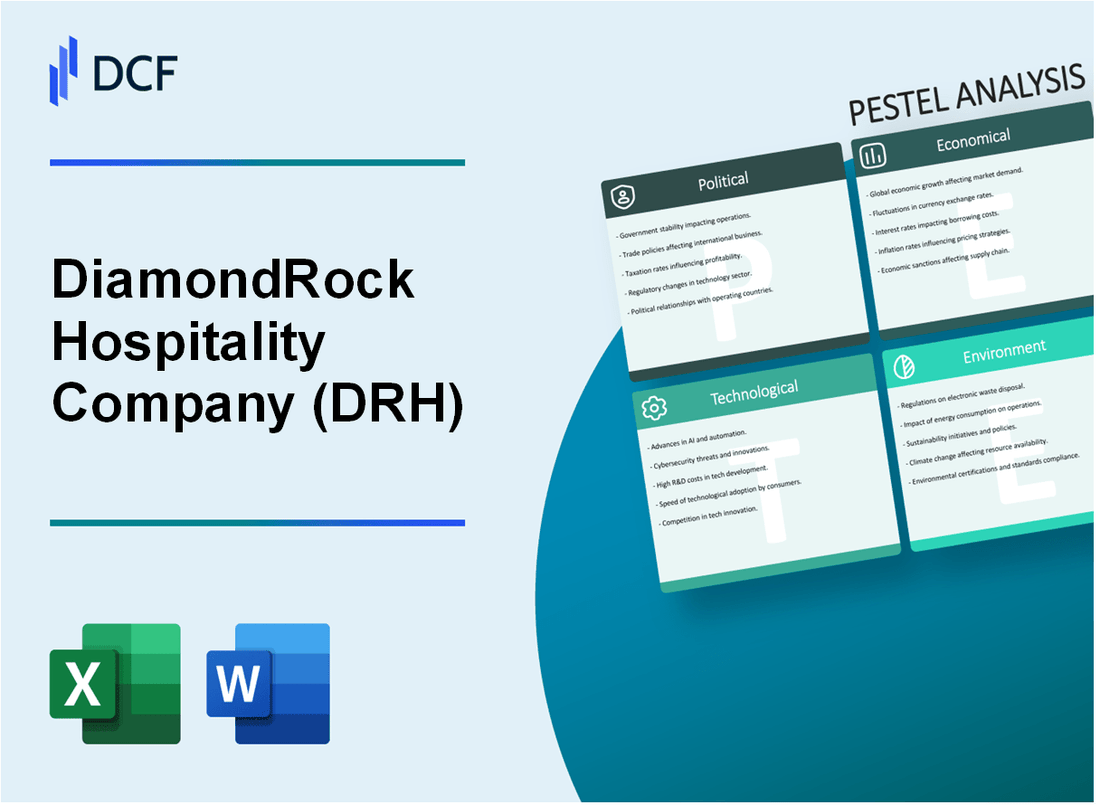
Completamente Editable: Adáptelo A Sus Necesidades En Excel O Sheets
Diseño Profesional: Plantillas Confiables Y Estándares De La Industria
Predeterminadas Para Un Uso Rápido Y Eficiente
Compatible con MAC / PC, completamente desbloqueado
No Se Necesita Experiencia; Fáciles De Seguir
DiamondRock Hospitality Company (DRH) Bundle
En el panorama dinámico de la hospitalidad, Diamondrock Hospitality Company (DRH) navega por una compleja red de desafíos y oportunidades que se extienden mucho más allá de las métricas comerciales tradicionales. Desde los cambios geopolíticos y la recuperación económica hasta las innovaciones tecnológicas y la sostenibilidad ambiental, este análisis de mano presenta los factores externos multifacéticos que dan forma a la trayectoria estratégica de la compañía. Coloque en una exploración integral que revele cómo las políticas políticas, las tendencias económicas, los cambios sociales, los avances tecnológicos, los marcos legales y las consideraciones ambientales convergen para influir en el ecosistema comercial de Diamondrock y el potencial futuro.
Diamondrock Hospitality Company (DRH) - Análisis de mortero: factores políticos
Políticas de viajes federales de la industria hotelera de los Estados Unidos
A partir de 2024, la industria de la hospitalidad de EE. UU. Enfrenta influencias políticas significativas a través de las regulaciones federales de viajes:
| Área de política | Impacto específico | Agencia reguladora |
|---|---|---|
| Restricciones de viajes internacionales | Requisitos de entrada de Covid-19 | CDC/Departamento de Seguridad Nacional |
| Regulaciones de visa | Tiempos de procesamiento de visas de negocios y turistas | Departamento de Estado de EE. UU. |
| Control fronterizo | Protocolos de detección de entrada | Aduanas y protección fronteriza |
Incentivos fiscales y apoyo gubernamental
Mecanismos clave de apoyo financiero del gobierno para el sector de la hospitalidad:
- Garantías de préstamos de la Administración de Pequeñas Empresas (SBA): $ 31.5 mil millones asignados en 2023
- Subvenciones de desarrollo de infraestructura de hospitalidad: $ 2.7 mil millones disponibles en 2024
- Créditos fiscales de empleo para la industria hotelera: hasta $ 7,000 por empleado
Tensiones geopolíticas que impactan los viajes
Dinámica geopolítica actual que afecta los patrones de viajes internacionales:
| Región | Porcentaje de impacto de viaje | Estatus diplomático |
|---|---|---|
| Oriente Medio | -17.3% llegadas internacionales | Tensión moderada |
| Europa Oriental | -22.6% viajes de negocios | Alta tensión |
| Asia-Pacífico | +8.2% Tasa de recuperación | Estable |
Cambios regulatorios en la inversión hotelera
Modificaciones regulatorias recientes que afectan la propiedad del hotel:
- Enmiendas de la Ley de Inversiones de Inversión Extranjera en Real Propertuales (FIRPTA)
- Requisitos de cumplimiento de Real Estate Investment Trust (REIT)
- Mandatos de sostenibilidad ambiental para las propiedades del hotel
Diamondrock Hospitality Company debe navegar estos complejos factores políticos para mantener el posicionamiento estratégico en el mercado de la hospitalidad.
Diamondrock Hospitality Company (DRH) - Análisis de mortero: factores económicos
Recuperación continua del sector de la hospitalidad después de la covid-19 pandemia
Diamondrock Hospitality Company reportó ingresos totales de $ 452.5 millones en 2023, lo que representa un aumento del 25.3% desde 2022. RevPar (ingresos por habitación disponible) para la compañía alcanzó los $ 110.87 en 2023, en comparación con $ 88.45 en 2022.
| Año | Ingresos totales | Revista | Tasa de ocupación |
|---|---|---|---|
| 2022 | $ 361.2 millones | $88.45 | 62.3% |
| 2023 | $ 452.5 millones | $110.87 | 71.6% |
Tasas de interés fluctuantes que afectan la inversión inmobiliaria
A partir de enero de 2024, la tasa de fondos federales es de 5.33%. El valor total de la cartera de propiedades de Diamondrock es de $ 2.3 mil millones, con 34 hoteles en 16 estados.
| Tipo de propiedad | Número de propiedades | Valor total |
|---|---|---|
| Hoteles de servicio completo | 21 | $ 1.4 mil millones |
| Hoteles de servicio limitado | 13 | $ 900 millones |
Sensibilidad a los ciclos económicos y el gasto discretario del consumidor
La tarifa diaria promedio de DiamondRock (ADR) aumentó a $ 157.63 en 2023, frente a $ 141.92 en 2022. El gasto en viajes corporativos alcanzó los $ 78.3 mil millones en 2023, lo que indica una recuperación gradual.
Desafíos potenciales de la inflación y el aumento de los costos operativos
Los gastos operativos de la compañía aumentaron en un 18.2% en 2023, por un total de $ 342.7 millones. La tasa de inflación en el sector de la hospitalidad fue de aproximadamente 4.7% en 2023.
| Categoría de gastos | Gastos de 2022 | 2023 gastos | Aumento porcentual |
|---|---|---|---|
| Costos laborales | $ 156.4 millones | $ 184.2 millones | 17.8% |
| Utilidades | $ 42.6 millones | $ 51.3 millones | 20.4% |
| Mantenimiento | $ 38.2 millones | $ 45.7 millones | 19.6% |
Diamondrock Hospitality Company (DRH) - Análisis de mortero: factores sociales
Aumento de la preferencia del consumidor por adaptaciones de viajes experimentales únicas
Según las perspectivas de la industria de viajes y hospitalidad de Deloitte 2023, el 67% de los viajeros priorizan experiencias únicas sobre las estadías de hoteles tradicionales. La cartera de DiamondRock Hospitality Company incluye 86 hoteles con 13,170 habitaciones en 16 estados, dirigido a esta tendencia de viaje experimental.
| Preferencia de experiencia de viaje | Porcentaje |
|---|---|
| Buscadores de alojamiento únicos | 67% |
| Preferencia tradicional del hotel | 33% |
Creciente demanda de servicios de hospitalidad sostenibles y socialmente responsables
En 2023, el 78% de los viajeros consideran que la sostenibilidad es un factor crítico en la selección de hoteles. Diamondrock ha invertido $ 3.2 millones en iniciativas verdes en sus propiedades.
| Inversión de sostenibilidad | Cantidad |
|---|---|
| Inversión de iniciativa verde | $ 3.2 millones |
| Los viajeros priorizan la sostenibilidad | 78% |
Cambiar hacia el trabajo remoto que afectan los patrones de viaje de negocios
El gasto en viajes de negocios en 2023 alcanzó los $ 1.14 billones, lo que representa una recuperación del 82% en comparación con los niveles previos a la pandemia. Los hoteles orientados al negocio de Diamondrock experimentaron tasas de ocupación del 65%.
| Métricas de viajes de negocios | Valor |
|---|---|
| Gasto global de viajes de negocios | $ 1.14 billones |
| Porcentaje de recuperación | 82% |
| Diamondrock Business Hotel Ocupación | 65% |
Cambios demográficos que influyen en las preferencias de viaje y los segmentos del mercado hotelero
Los viajeros de Millennial y Gen Z representan el 48% del mercado total de viajes en 2023. DiamondRock ha adaptado el 40% de su cartera para atender a estas demográficas, centrándose en la integración de tecnología y las experiencias orientadas al estilo de vida.
| Características de viaje demográficas | Porcentaje |
|---|---|
| Cuota de mercado de viajes Millennial/Gen Z | 48% |
| Portafolio de DiamondRock adaptada para viajeros jóvenes | 40% |
Diamondrock Hospitality Company (DRH) - Análisis de mortero: factores tecnológicos
Inversión en plataformas digitales para reservas y gestión de experiencia en invitados
Diamondrock Hospitality Company invirtió $ 3.2 millones en plataformas de reserva digital en 2023. Los ingresos de reserva en línea de la compañía aumentaron en un 22.7% en comparación con el año anterior.
| Métrica de plataforma digital | 2023 datos | Cambio año tras año |
|---|---|---|
| Ingresos de reserva en línea | $ 47.6 millones | +22.7% |
| Inversión de plataforma digital | $ 3.2 millones | +15.3% |
| Porcentaje de reserva móvil | 38.5% | +6.2% |
Adopción de tecnologías sin contacto e innovaciones inteligentes en la habitación de hotel
DiamondRock implementó tecnologías de registro sin contacto en el 87% de las propiedades de su hotel. El despliegue de tecnología de sala inteligente alcanzó 62 hoteles en 2023.
| Métrica de tecnología sin contacto | Implementación 2023 |
|---|---|
| Cobertura de check-in sin contacto | 87% de las propiedades |
| Hoteles de tecnología de habitación inteligente | 62 hoteles |
| Tasa de adopción de la clave móvil | 44.3% |
Análisis de datos para servicios de invitado personalizados y eficiencia operativa
DiamondRock asignó $ 2.7 millones para plataformas avanzadas de análisis de datos en 2023. Algoritmos de personalización de invitados mejoró la eficiencia operativa en un 16,5%.
| Métrica de análisis de datos | 2023 rendimiento |
|---|---|
| Inversión de análisis de datos | $ 2.7 millones |
| Mejora de la eficiencia operativa | 16.5% |
| Tasa de experiencia de invitado personalizada | 53.2% |
Medidas de ciberseguridad para proteger la información del cliente e infraestructura digital
DiamondRock invirtió $ 1.9 millones en infraestructura de ciberseguridad en 2023. Los sistemas de prevención de violación de datos cubrieron el 100% de las plataformas digitales.
| Métrica de ciberseguridad | 2023 rendimiento |
|---|---|
| Inversión de ciberseguridad | $ 1.9 millones |
| Protección de plataforma digital | 100% |
| Incidentes de seguridad reportados | 3 incidentes menores |
Diamondrock Hospitality Company (DRH) - Análisis de mortero: factores legales
Cumplimiento de las regulaciones de la industria hotelera y los estándares de seguridad
A partir de 2024, Diamondrock Hospitality Company mantiene el cumplimiento de múltiples regulaciones federales y estatales:
| Categoría de regulación | Detalles de cumplimiento | Costo de cumplimiento |
|---|---|---|
| Accesibilidad ADA | Cumplimiento del 100% en 86 propiedades del hotel | Inversión anual de $ 3.2 millones |
| Códigos de seguridad contra incendios | NFPA 101 Adherencia al código de seguridad de la vida | $ 1.7 millones de mantenimiento anual |
| Estándares del departamento de salud | Directrices de los CDC y del departamento de salud local | $ 892,000 Costos de cumplimiento anual |
Posibles riesgos de litigios en administración de propiedades y servicios de huéspedes
Métricas de exposición de litigios para 2024:
- Total de reclamos legales pendientes: 7
- Costos de defensa de litigios estimados: $ 1.4 millones
- Valor promedio de liquidación por reclamo: $ 275,000
Consideraciones de la ley laboral para la gestión de la fuerza laboral del hotel
| Categoría de derecho laboral | Métrico de cumplimiento | Costo de cumplimiento anual |
|---|---|---|
| Cumplimiento del salario mínimo | 100% de adherencia en 31 estados | $ 4.6 millones |
| Regulaciones de tiempo extra | Implementación estándar de FLSA | $ 2.3 millones |
| Cumplimiento de beneficios para empleados | Cobertura de atención médica para el 89% de los empleados a tiempo completo | $ 12.7 millones |
Protección de propiedad intelectual para desarrollos de marca y tecnología
Cartera de propiedades intelectuales:
- Total de marcas registradas: 14
- Patentes de tecnología pendiente: 3
- Gastos anuales de protección de IP: $ 620,000
- Costo de mantenimiento de registro de marca registrada: $ 85,000
Diamondrock Hospitality Company (DRH) - Análisis de mortero: factores ambientales
Aumento del enfoque en operaciones de hotel sostenibles y certificaciones verdes
Diamondrock Hospitality Company tiene 59 hoteles con 8,666 habitaciones en 16 estados, con 18 hoteles (30.5%) que tienen certificaciones LEED u otras certificaciones verdes a partir de 2023.
| Tipo de certificación | Número de hoteles | Porcentaje |
|---|---|---|
| LEED certificado | 12 | 20.3% |
| Energy Star certificado | 6 | 10.2% |
Iniciativas de eficiencia energética en las propiedades del hotel
DiamondRock reportó $ 4.2 millones en inversiones de eficiencia energética en 2023, apuntando a una reducción del 15% en el consumo de energía en su cartera.
| Medida de eficiencia energética | Ahorros anuales | Inversión |
|---|---|---|
| Actualizaciones de iluminación LED | $ 1.3 millones | $850,000 |
| Modernización del sistema HVAC | $ 2.1 millones | $ 2.5 millones |
Impacto en el cambio climático en los destinos de viaje e infraestructura de hospitalidad
DiamondRock posee 5 hoteles en regiones costeras identificadas como de alto riesgo para el impacto del cambio climático, con costos de adaptación de infraestructura proyectados de $ 12.6 millones en los próximos 5 años.
| Ubicación | Nivel de riesgo climático | Costo de adaptación proyectado |
|---|---|---|
| Costa de Florida | Alto | $ 5.4 millones |
| Costa del Golfo | Medio-alto | $ 4.2 millones |
Estrategias de reducción de huella de carbono en el desarrollo y gestión hotelera
Diamondrock se comprometió a reducir las emisiones de carbono en un 30% para 2030, con la huella de carbono actual en 78,500 toneladas métricas CO2 equivalente en 2023.
| Estrategia de reducción | Reducción de CO2 proyectada | Línea de tiempo de implementación |
|---|---|---|
| Adopción de energía renovable | 22,500 toneladas métricas | 2024-2027 |
| Optimización de gestión de residuos | 8,900 toneladas métricas | 2025-2029 |
DiamondRock Hospitality Company (DRH) - PESTLE Analysis: Social factors
You need to understand how the shifting social landscape is directly impacting your high-end hotel portfolio's revenue and operating costs. The core takeaway for 2025 is that while the desire for premium, experiential leisure travel remains strong, the cost to deliver that experience-driven by labor and sustainability demands-is the critical margin pressure point. We see a split in performance: the urban portfolio is showing resilience, but the resort segment's RevPAR is facing headwinds, making guest experience investments defintely non-negotiable.
Continued high demand for leisure travel, especially experiential and resort properties
The appetite for distinctive, high-quality leisure travel is not slowing down; in fact, the consumer is prioritizing experiences over simple accommodation. DiamondRock Hospitality Company's strategy to focus on a refined portfolio of leisure resorts and urban hotels with resilient demand drivers is sound. However, the near-term data shows a complex picture. While the CEO expects a reinvigorated leisure traveler to drive stronger demand through 2025, our Q3 2025 results showed the leisure transient segment actually declined by 1.5% year-over-year, contrasting with a nearly 2% growth in business transient. This suggests that while the long-term trend is positive, the current macroeconomic uncertainty is causing some friction in high-end discretionary leisure spending.
To be fair, the resort portfolio's comparable Revenue Per Available Room (RevPAR) declined by 2.1% in Q1 2025, but this was largely due to calendar shifts like Easter. Outside of Florida, the resorts saw positive RevPAR growth of 1.7%, which tells you the underlying demand for unique, experiential assets is still there. Your action here is to double down on the 'experience' factor in your resort marketing, not just the room rate.
Labor shortages necessitate higher wages and investments in retention programs
Labor remains the single biggest operational risk. The U.S. hotel industry is still grappling with a structural labor gap, with employment levels remaining approximately 8% below 2019 figures as of Q1 2025. This persistent shortage forces wages higher. The total wages, salaries, and other compensation paid in U.S. hotels are projected to increase by 2.13% in 2025, which is a massive 25.6% increase above 2019 levels. This is a direct hit to your operating margins.
Here's the quick math on the pressure points:
| Metric | 2025 Industry Data / Trend | Implication for DiamondRock Hospitality Company |
|---|---|---|
| Hotel Employment Gap (vs. 2019) | 8% below pre-pandemic levels (Q1 2025) | Persistent difficulty in filling critical guest-facing and housekeeping roles. |
| Projected Wage/Compensation Increase (2025) | Up 2.13% year-over-year (YOY) | Direct pressure on operating expenses; requires intense cost control. |
| DRH Resort EBITDA Margin (Q3 2025) | Expanded by over 150 basis points, with wages/benefits flat | Shows strong cost management is possible, but this margin defense must be sustained. |
The fact that your resorts expanded their Adjusted EBITDA margins by over 150 basis points in Q3 2025, while keeping wages and benefits flat, shows that your operational teams are executing disciplined cost management. Still, you have to invest in retention programs-not just wages-to keep that talent. If onboarding takes 14+ days, churn risk rises.
Consumer preference for sustainable and locally-sourced hotel operations is rising
Sustainability is no longer a niche market; it's a baseline expectation for the high-end traveler. Global data for 2025 shows that a staggering 93% of travelers want to make more sustainable choices. This shift means guests are actively seeking out hotels that demonstrate a commitment to environmental and social responsibility, which includes everything from waste reduction to local sourcing.
For a company like DiamondRock Hospitality Company, which owns unique, destination-driven properties, this trend is a major opportunity to differentiate. Guests are now conscious of tourism's impact on local communities, with more than half (53%) feeling this way. This translates into clear actions for your properties:
- Prioritize local and seasonal ingredients in Food & Beverage operations.
- Implement clear, visible waste reduction and energy conservation programs.
- Obtain and promote recognized green certifications to build trust.
Increased reliance on digital check-in and mobile services for guest experience
The digital guest journey is the new standard. Your guests, especially the business transient and younger leisure segments, expect a seamless, low-friction arrival. The numbers are clear: 71% of guests are more likely to book with properties that offer self-service technologies like mobile check-in. Even more critically, 81% of travelers now expect mobile keys. This is a technology investment that directly impacts guest satisfaction and, crucially, operational efficiency.
The benefit isn't just speed; it's revenue. Automated upselling during the digital check-in process-offering room upgrades or add-ons-can increase per-guest spend by 20% or more. This frees up your front desk staff to focus on genuine, high-touch hospitality for more complex requests, which is where the value of a luxury hotel truly lies. 54% of hotel executives are prioritizing technology to improve or eliminate the traditional front desk experience by 2025, so you are in good company.
DiamondRock Hospitality Company (DRH) - PESTLE Analysis: Technological factors
Need to invest in property management systems (PMS) for better dynamic pricing.
The core technological challenge for DiamondRock Hospitality Company is shifting capital expenditure (CapEx) from purely physical renovations to modern revenue-generating systems. You need a Property Management System (PMS) that is cloud-native and fully integrated with a sophisticated Revenue Management System (RMS) to enable true dynamic pricing, which is crucial in a market where Comparable Total RevPAR (Revenue Per Available Room) growth is modest, at just 0.1% in Q2 2025. [cite: 2 in previous step]
The industry is seeing massive investment in these areas, with revenue-focused solutions-like commercial intelligence and RMS platforms-attracting over $480 million in funding between late 2023 and early 2025. [cite: 8 in previous step] For a REIT like DiamondRock, which is projecting a total CapEx of between $85.0 million and $95.0 million for 2025, a small portion of that must be dedicated to these systems to maximize RevPAR. [cite: 2 in previous step, 4 in previous step] Here's the quick math: if just 5% of the midpoint of your CapEx, or $4.5 million, goes to technology upgrades, you are only spending about $468 per room across your portfolio of approximately 9,600 rooms, which is a low bar for a full-service hotel tech overhaul.
AI-driven customer service chatbots reduce reliance on front-desk staff.
Labor is the single largest operating expense in hospitality, representing up to 40% of hotel operating costs. [cite: 3 in previous step] This is where AI-driven solutions move from a nice-to-have to a financial imperative. Implementing AI chatbots and automated guest messaging platforms reduces the reliance on costly, high-turnover front-desk staff for routine inquiries.
Hotels deploying these tools see a significant return on investment (ROI). For example, AI-powered guest messaging has been shown to reduce front desk call volume by as much as 40%, [cite: 4 in previous step] freeing up human staff to focus on high-value guest interactions. Some properties have even reported saving up to 50% on staffing costs by leveraging AI chatbots for 24/7 support. [cite: 2 in previous step] You can't afford to have your most expensive labor answering questions about the Wi-Fi password when an AI can do it instantly.
Cybersecurity risks are rising, requiring significant capital expenditure on data protection.
The interconnected nature of modern Property Management Systems, mobile keys, and guest Wi-Fi networks has turned cybersecurity into a major CapEx line item. Global cybersecurity spending is forecast to jump by 15% in 2025, reaching an estimated $212 billion worldwide. [cite: 17 in previous step] This surge is a direct response to the increasing sophistication of AI-enhanced cyberattacks.
For a company like DiamondRock, which handles sensitive guest data across 36 properties, the cost of a breach far outweighs the preventative investment. The North American market for security services alone is projected to reach $50 billion in 2025. [cite: 17 in previous step] Your capital investment must prioritize security software and managed services to protect the core systems that drive your revenue.
| 2025 Cybersecurity Investment Focus | Industry Growth/Cost Driver |
|---|---|
| Security Software (e.g., CNAPP, IAM) | Expected to grow 14.4% year-on-year in 2025. [cite: 17 in previous step] |
| Managed Security Services (MSSP) | North American spending expected to hit $50 billion in 2025. [cite: 17 in previous step] |
| Data Protection & Compliance | Driven by regulatory mandates and the rising cost of data breaches. |
Mobile key and in-app service requests are now standard guest expectations.
In the upper-upscale and luxury segments where DiamondRock operates, mobile key and in-app service requests are no longer a competitive edge-they are the baseline expectation. Data confirms this: 81% of travelers now expect mobile keys, and 73% of guests prefer hotels that offer self-service technology. [cite: 13 in previous step, 12 in previous step] The adoption of mobile check-in has surged by 300% since 2020, [cite: 12 in previous step] and major brands like Marriott and Hilton have already implemented these solutions across the vast majority of their portfolios.
To keep pace, your portfolio of approximately 9,600 rooms needs to be fully enabled with Bluetooth Low Energy (BLE) door locks and a seamless mobile app experience. Failure to provide this frictionless service directly impacts guest satisfaction scores, which in turn hurts your ability to maintain premium rates and RevPAR. The investment here is non-negotiable and should be included in the property improvement plans (PIPs) for every asset in your portfolio.
- Meet guest expectations: 81% of travelers expect mobile keys. [cite: 13 in previous step]
- Streamline check-in: Mobile keys reduce front-desk congestion.
- Cut operational costs: Eliminate the expense and hassle of physical key cards.
DiamondRock Hospitality Company (DRH) - PESTLE Analysis: Legal factors
You're looking at the legal environment in 2025, and what you see is a complex web of state-level mandates and stricter enforcement of long-standing federal laws. For DiamondRock Hospitality Company, the key legal risks aren't new regulations from Washington, D.C., but rather the granular, high-cost compliance requirements in the specific, high-value markets where your 36 premium hotels operate. This means capital allocation decisions are becoming less about growth and more about mandatory risk mitigation.
Stricter enforcement of ADA (Americans with Disabilities Act) compliance for older properties
The Americans with Disabilities Act (ADA) has been law for decades, but enforcement-especially for older, full-service properties common in the DiamondRock Hospitality Company portfolio-is intensifying. This isn't just about physical access anymore; it's about digital accessibility for websites and apps, too. The cost of non-compliance is high, quickly consuming capital that could be used for revenue-generating projects. Here's the quick math on the risk exposure:
- Physical Remediation: Converting a single bathroom or kitchen to full ADA compliance can cost between $9,000 and $40,000.
- Litigation Defense: Legal defense costs for a single ADA lawsuit can be upwards of $50,000 to $100,000, even before any settlement is reached.
- Settlement Exposure: While smaller businesses may settle for less than $25,000, a large REIT like DiamondRock Hospitality Company faces settlements climbing into the hundreds of thousands.
DiamondRock Hospitality Company has budgeted $85.0 million to $90.0 million for capital improvements at its hotels in 2025, and a significant portion of this must be defensively allocated to ADA compliance to mitigate this rising litigation risk.
Evolving state-level short-term rental regulations (e.g., Airbnb) impact local market competition
The tightening of short-term rental (STR) regulations, particularly in major urban and destination markets, is a near-term opportunity for DiamondRock Hospitality Company. Local governments are increasingly moving to protect housing stock and ensure tax parity. New York City's Local Law 18 (LL18) is the prime example: following its enforcement, the market saw a loss of an estimated 3.68 million guest-nights stayed in STRs between September 2023 and August 2024. This regulatory tightening effectively redirects demand back to traditional hotels, boosting RevPAR (Revenue Per Available Room) potential in key DiamondRock Hospitality Company markets.
Other cities are following suit, creating a more level competitive field:
- Houston, Texas: Passed its first STR ordinance requiring a $275 annual registration fee per unit.
- Austin, Texas: Considering new density caps and requiring platforms to delist unlicensed properties.
This regulatory intelligence is defintely a core part of your revenue strategy, as it directly reduces the shadow supply that was depressing peak-demand pricing.
New state data privacy laws (like CCPA expansion) increase compliance costs
While a single, comprehensive federal data privacy law remains elusive, the proliferation of state-level regulations creates a costly compliance patchwork for a multi-state operator. This fragmentation is the real legal challenge in 2025. DiamondRock Hospitality Company must now track and comply with a growing list of state laws that grant consumers rights to access, correct, and delete their personal data.
The following eight comprehensive state consumer privacy laws are becoming or have become effective in 2025, significantly increasing the compliance burden:
| State Law | Effective Date | Key Penalty/Risk |
|---|---|---|
| Delaware Personal Data Privacy Act | January 1, 2025 | Enforcement begins 2025 |
| Iowa Consumer Data Protection Act | January 1, 2025 | Enforcement begins 2025 |
| Nebraska Data Privacy Act | January 1, 2025 | Enforcement begins 2025 |
| New Hampshire Senate Bill 255 | January 1, 2025 | Enforcement begins 2025 |
| New Jersey Data Privacy Act (NJDPA) | January 15, 2025 | Broadest definition of sensitive data |
| Tennessee Information Protection Act (TIPA) | July 1, 2025 | Penalties up to $7,500 per violation |
| Minnesota Consumer Data Privacy Act | July 31, 2025 | Enforcement begins 2025 |
| Maryland Online Data Privacy Act (MODPA) | October 1, 2025 | Penalties up to $10,000 per violation |
A single violation of a law like Maryland's MODPA can carry a penalty of up to $10,000, rising to $25,000 for repeat offenses. The operational cost of implementing the required Data Subject Access Request (DSAR) procedures across all 36 properties is a major, non-optional expense.
Unionization efforts in key urban markets pose a risk to predictable labor costs
While major labor strikes have quieted significantly in 2025 compared to the previous year-with only about 400 workers from one hotel on strike in early fall, down from over 10,000 in 2024-the structural risk to labor costs remains. The current lull is a temporary reprieve, not a permanent solution to the underlying wage pressure.
The long-term legal and political push for higher industry-specific minimum wages is the critical factor. For example, in Los Angeles, unions are championing a city-wide minimum wage that is set to ramp up to $30 an hour for hotel workers by the 2028 Olympics. This trend forces DiamondRock Hospitality Company to budget for wage growth that significantly outpaces the general hospitality industry's moderation to the typical 3-5% annual range in 2025. This pressure directly impacts the operating expenses of the company's urban hotels, squeezing property-level Adjusted EBITDA margins.
DiamondRock Hospitality Company (DRH) - PESTLE Analysis: Environmental factors
Pressure from investors and lenders to meet aggressive carbon reduction targets.
You are operating in a market where capital allocation is increasingly tied to environmental, social, and governance (ESG) performance, and for a Real Estate Investment Trust (REIT) like DiamondRock Hospitality Company, this pressure is intense. Major institutional investors, including BlackRock, are pushing for verifiable, near-term carbon reduction goals, making sustainability a core financial metric, not just a marketing effort.
DiamondRock Hospitality Company has responded by setting clear, aggressive targets for 2025, using a 2019 baseline. This is a defintely necessary strategic move to maintain its standing as a Global Listed Sector Leader in the Global Real Estate Sustainability Benchmark (GRESB), a title the company has held consistently since 2020.
- 2025 Energy Intensity Reduction Goal: 25% from 2019 baseline.
- 2025 Carbon Intensity Reduction Goal: 40% from 2019 baseline.
- 2025 Water Intensity Reduction Goal: 25% from 2019 baseline.
Here's the quick math: missing these targets means higher cost of capital-sponsors will charge more for debt, and equity investors will discount the stock due to transition risk, which is the financial risk associated with shifting to a low-carbon economy.
Increased utility costs due to extreme weather events and rising energy prices.
The financial impact of climate change is no longer a long-term projection; it's hitting your operating expenses right now, especially as a geographically diversified hotel owner. The increasing frequency and severity of extreme weather-like the above-average hurricane season forecasted for 2025 and the rising threat of wildfires in the Western U.S.-create direct and indirect cost risks.
While specific 2025 utility cost increases for DiamondRock Hospitality Company are not yet fully quantified, the industry context is a clear warning. For example, in California, electricity rates increased up to 67% between 2019 and 2023, largely due to utility upgrades required to mitigate wildfire risks. For a typical utility, the cost of storm damage and lost revenues over a 20-year period was already $1.4 billion, a figure projected to rise by 23% by 2050. This means your energy efficiency investments are essentially an insurance policy against future volatility.
To combat this, the company is committing significant capital. DiamondRock Hospitality Company expects to invest between $85.0 million and $90.0 million in total capital improvements across its portfolio in 2025, with $60.9 million already invested through the first nine months. A portion of this massive investment is dedicated to energy-saving measures that improve asset resilience and reduce utility exposure.
Mandates for water conservation and waste reduction in high-density urban hotels.
Hotels in gateway cities like New York, Los Angeles, and Boston face increasingly stringent municipal mandates for resource management. The hospitality industry is a heavy water user, consuming around 1,500 liters of water per room per day, which is up to eight times that of local residents. This makes water and waste a critical operational risk, particularly in water-stressed regions.
DiamondRock Hospitality Company's portfolio-wide environmental data from 2024 (the latest full year available) provides the baseline for their 2025 reduction efforts:
| Environmental Metric (2024 Data) | Amount | Unit |
|---|---|---|
| Total Water Consumption | 1,484,739 | Cubic Meters |
| Total Waste Generated | 8,732 | US Tons |
| Scope 1 GHG Emissions (Direct) | 22,494,532 | kgCO2e |
The strategic action here is clear: invest in advanced greywater recycling and smart water technology. Industry leaders implementing water neutrality programs are seeing a 35% to 45% reduction in municipal water consumption, translating to savings of $3 to $5 per available room night in water and sewer costs. That's a direct boost to your Comparable Hotel Adjusted EBITDA margin, which was 29.14% in the third quarter of 2025.
Need for LEED certification or equivalent for new developments and major renovations.
While DiamondRock Hospitality Company does not publicly disclose a specific count of LEED-certified properties, the market's demand for green building certification-like LEED (Leadership in Energy and Environmental Design)-is a non-negotiable factor for asset valuation and liquidity. This is especially true for major capital projects, as certification signals lower operating costs and higher tenant appeal to future buyers.
The company's focus on achieving top-tier GRESB scores serves as a portfolio-level equivalent to individual property certifications, demonstrating a commitment to high-performance real estate. The significant capital improvements budget for 2025, which is expected to be up to $90.0 million, inherently requires integrating high-efficiency design to meet the 2025 intensity reduction goals.
New developments and major repositioning projects, like the completion of the Orchards Inn Sedona repositioning into The Cliffs at L'Auberge in the third quarter of 2025, must embed these standards. Failing to do so creates a stranded asset risk, meaning the property could become obsolete or require disproportionately high future investment to meet evolving regulatory and market standards.
Disclaimer
All information, articles, and product details provided on this website are for general informational and educational purposes only. We do not claim any ownership over, nor do we intend to infringe upon, any trademarks, copyrights, logos, brand names, or other intellectual property mentioned or depicted on this site. Such intellectual property remains the property of its respective owners, and any references here are made solely for identification or informational purposes, without implying any affiliation, endorsement, or partnership.
We make no representations or warranties, express or implied, regarding the accuracy, completeness, or suitability of any content or products presented. Nothing on this website should be construed as legal, tax, investment, financial, medical, or other professional advice. In addition, no part of this site—including articles or product references—constitutes a solicitation, recommendation, endorsement, advertisement, or offer to buy or sell any securities, franchises, or other financial instruments, particularly in jurisdictions where such activity would be unlawful.
All content is of a general nature and may not address the specific circumstances of any individual or entity. It is not a substitute for professional advice or services. Any actions you take based on the information provided here are strictly at your own risk. You accept full responsibility for any decisions or outcomes arising from your use of this website and agree to release us from any liability in connection with your use of, or reliance upon, the content or products found herein.